
Note: This article contains affiliate links. If you click on these links and make a purchase, we may earn a small commission at no extra cost to you. This helps support our research and content. Read our full affiliate disclosure here.
Dry indoor air from central heating can cause sore throats, cracked woodwork, and uncomfortable static shocks. Picking the right humidifier for a central heating system matters because whole-house humidity affects comfort, health, and the longevity of home finishes. You want a unit that delivers sufficient output for your square footage, integrates cleanly with ducts or furnace plenum, and is easy to maintain. This guide collects seven shortlisted humidifiers that suit central heating systems and explains the key factors we used to evaluate them. Read on to understand capacity, installation tradeoffs, maintenance needs, and controls so you can choose the right whole-home solution.
Top Picks at a Glance
| Best Overall The best all-around choice for most situations | AIRCARE Valiant HD1409 Humidifier |  |
| Best Quality Built to a higher standard if you want something more solid | Aprilaire 800 Steam Humidifier |  |
| Best Value The sweet spot between price and what you get | AIRCARE MA Console Humidifier |  |
| Best Budget The cheapest option that still gets the job done reliably | BREEZOME 6L Humidifier MG07JS |  |
| Top Rated A top-rated pick with lots of positive feedback | Aprilaire 600M Whole-House Humidifier |  |
| Most Popular A crowd favorite that many people choose with confidence | Levoit LV600HH 6L Humidifier |  |
| Best Seller A high-volume bestseller chosen again and again | Vornado Evap40 Humidifier |  |
AIRCARE Valiant HD1409 Humidifier

| Capacity | 5 gallons |
|---|---|
| Floor Area | 4000 square_feet |
| Operation Mode | Evaporative |
| Wattage | 150 watts |
| Runtime | 55 hours |
The AIRCARE Valiant HD1409 is a console evaporative humidifier built to humidify large spaces up to 4,000 square feet. It uses a wick filter and an evaporative fan with nine speed settings to disperse moisture from its 5-gallon reservoir, and a digital humidistat lets you set a target humidity while the unit automatically cycles to maintain it. Practical features include a digital readout that shows actual and desired humidity or fan speed, an empty-bottle shutoff and a refill indicator so you do not overrun the tank. With a maximum run time of about 55 hours and touch controls, it is intended for continuous use in homes with central heating where indoor air becomes very dry. Expect regular wick replacements and some maintenance to prevent mineral buildup since it is an evaporative design, and its size and weight make it a stationary piece rather than portable. Noise varies with fan speed, so lowest settings are quietest but slower to raise humidity.
Best for: Homeowners who need a dependable, console-style humidifier to manage dry air across most of a house and prefer set-and-forget humidity control.
Less Ideal for: People who need a compact, lightweight or travel-friendly humidifier for single rooms or who want a filter-free ultrasonic design.
- Designed for whole-house coverage up to 4,000 sq ft
- Large 5-gallon reservoir provides long run times (up to 55 hours)
- Digital humidistat with automatic maintenance of target humidity
- Multiple fan speeds and digital readout for fine control
- Empty-bottle shutoff and refill indicator for safer unattended use
- Evaporative wick filters require periodic replacement and maintenance
- Large footprint and weight limit placement options and make it non-portable
Verdict: Choose the Valiant HD1409 when you want a robust whole-house evaporative humidifier with automatic digital humidity control for steady comfort during central heating season.
Aprilaire 800 Steam Humidifier

| Capacity | 11.5 gallons_per_day |
|---|---|
| Floor Area | 10300 square_feet |
| Operation Mode | Steam |
| Control Method | App |
| Power Source | ac |
The Aprilaire 800 is a whole-house steam humidifier designed to deliver automatic, high-capacity humidification for central heating systems. It uses electrode canister technology to generate steam and offers six output levels that can add from about 11.5 up to 34.6 gallons of moisture per day depending on installation and voltage, making it suitable for very large or tightly built homes. The unit includes an automatic digital control with indoor sensor and outdoor temperature sensor so the system adjusts humidity continuously without manual intervention, and the replaceable steam canister eliminates scrubbing or seasonal cleaning. Installation requires plumbing into the HVAC system and a drain connection, and the package includes the steam hose, drain tubing, dispersion tube, valves, and control components for a complete setup. Limitations include the need for a professional-style installation if you are not comfortable with HVAC plumbing and electrical connections, and the electrode design expects regular canister replacement as a seasonal maintenance item. For buyers prioritizing high, reliable output and hands-off control for a central heating setup, this unit is a strong contender.
Best for: Buyers who need reliable, high-capacity humidification for a large home and value automatic, set-and-forget control integrated with a central heating system.
Less Ideal for: If you want a simple plug-and-play room humidifier or have a small home under light occupancy, this whole-house steam unit is more capability and complexity than necessary.
- Very high maximum output suitable for homes up to 10,300 sq ft
- Automatic digital control with indoor humidistat and outdoor temperature sensor for continuous adjustment
- Electrode canister design requires no scrubbing and is replaced seasonally for low maintenance
- Includes necessary installation components such as steam hose, drain tubing, dispersion tube, and control
- Requires plumbing and electrical hookup to the HVAC system which may need professional installation
- Seasonal replacement of the steam canister is required, creating ongoing consumable cost
Verdict: Choose the Aprilaire 800 if you need powerful, automated whole-house humidification integrated with your central heating system.
AIRCARE MA Console Humidifier

| Capacity | 3.6 gallons |
|---|---|
| Floor Area | 3600 square_feet |
| Operation Mode | Evaporative |
| Runtime | 36 hours |
| Wattage | 1650 watts |
The AIRCARE MA1201 is a console evaporative humidifier built to maintain humidity across large open homes and rooms served by central heating. It moves air through a saturated wick filter and offers a digital humidistat with customizable humidity set points, four fan speeds plus an auto mode, and a runtime of up to 36 hours from its 3.6 gallon tank. Practical touches include an auto shutoff when the tank is empty or set humidity is reached, refill and filter indicators, touch controls, and casters for moving the unit between rooms. Because it is evaporative, it helps avoid visible mist and reduces mineral spatter but does require periodic wick replacements and occasional cleaning to prevent buildup. The unit draws mains power and uses a wick filter system rather than ultrasonic misting, so it is quieter and better suited to whole-house applications tied into central heating circulation than for point-source bedside humidification. Its size and wattage mean it is a utility appliance intended for sustained, area-wide humidification rather than discreet room-only use.
Best for: Buyers who want a reliable, low-maintenance humidifier to stabilize humidity across large homes or multiple rooms served by central heating and who prioritize consistent whole-house humidity control over compact convenience.
Less Ideal for: If you need a small, portable bedside humidifier or a unit for a single small room, this console-style evaporative humidifier is larger and more powerful than necessary.
- Designed for large coverage up to 3,600 sq ft suitable for whole-house humidification
- Digital humidistat with customizable humidity settings and auto mode for hands-off control
- Long runtime (up to 36 hours) from a 3.6 gallon tank reduces refill frequency
- Auto shutoff and indicator lights for empty tank and filter simplify maintenance
- Caster wheels and touch controls make operation and placement easy
- Requires replacement wick filters and periodic cleaning to maintain performance
- Bulkier and higher wattage than small room humidifiers, so not ideal for tight spaces
Verdict: Choose this console evaporative humidifier when you need dependable, hands-off humidity control for an entire home or large area connected to central heating.
BREEZOME 6L Humidifier MG07JS

| Capacity | 6 liters |
|---|---|
| Floor Area | 500 square_feet |
| Operation Mode | Ultrasonic |
| Control Method | Touch |
| Runtime | 60 hours |
The BREEZOME MG07JS is a large 6L ultrasonic cool-mist humidifier designed to add consistent moisture to rooms up to about 500 sq ft. It uses a top-fill detachable tank for easier refilling and cleaning and includes a built-in humidistat so you can set and hold a target humidity rather than running the unit continuously. The unit also doubles as an aroma diffuser via a small essential-oil tray and runs quietly in sleep mode, which makes it suitable for bedrooms and nurseries. With a reported runtime up to 60 hours at lower output, it reduces the need for daily refills and the auto shut-off protects the unit when water is depleted. Practical limits include it being a cool-mist ultrasonic model only, so it does not provide warm mist for quick room warming, and it relies on a demineralization cartridge to avoid white dust if you use hard tap water. For buyers looking to add steady humidity for central heating–dried rooms, this model delivers long runtimes, straightforward controls, and low noise.
Best for: Buyers who want a budget-friendly, large-tank humidifier to keep rooms softened during long central-heating runs and prefer set-and-forget humidity control.
Less Ideal for: People who need a warm-mist humidifier for faster heating effects or users who cannot commit to replacing cartridges when using hard tap water.
- Large 6 liter tank supports long runtime up to 60 hours between fills
- Built-in humidistat lets the unit maintain a chosen humidity level automatically
- Top-fill detachable tank simplifies refilling and cleaning
- Very quiet sleep mode suitable for bedrooms and nurseries
- Aromatherapy tray allows using essential oils without contaminating the main tank
- Cool-mist only design does not offer warm mist options
- Requires demineralization cartridge to limit mineral buildup or white dust
Verdict: A cost-conscious choice for adding long-lasting, quiet cool-mist humidity and automatic humidity control to rooms dried by central heating.
Aprilaire 600M Whole-House Humidifier
| Capacity | 17 gallons_per_day |
|---|---|
| Floor Area | 4000 square_feet |
| Operation Mode | Evaporative |
| Voltage | 24 volts_of_alternating_current |
| Control Method | Touch |
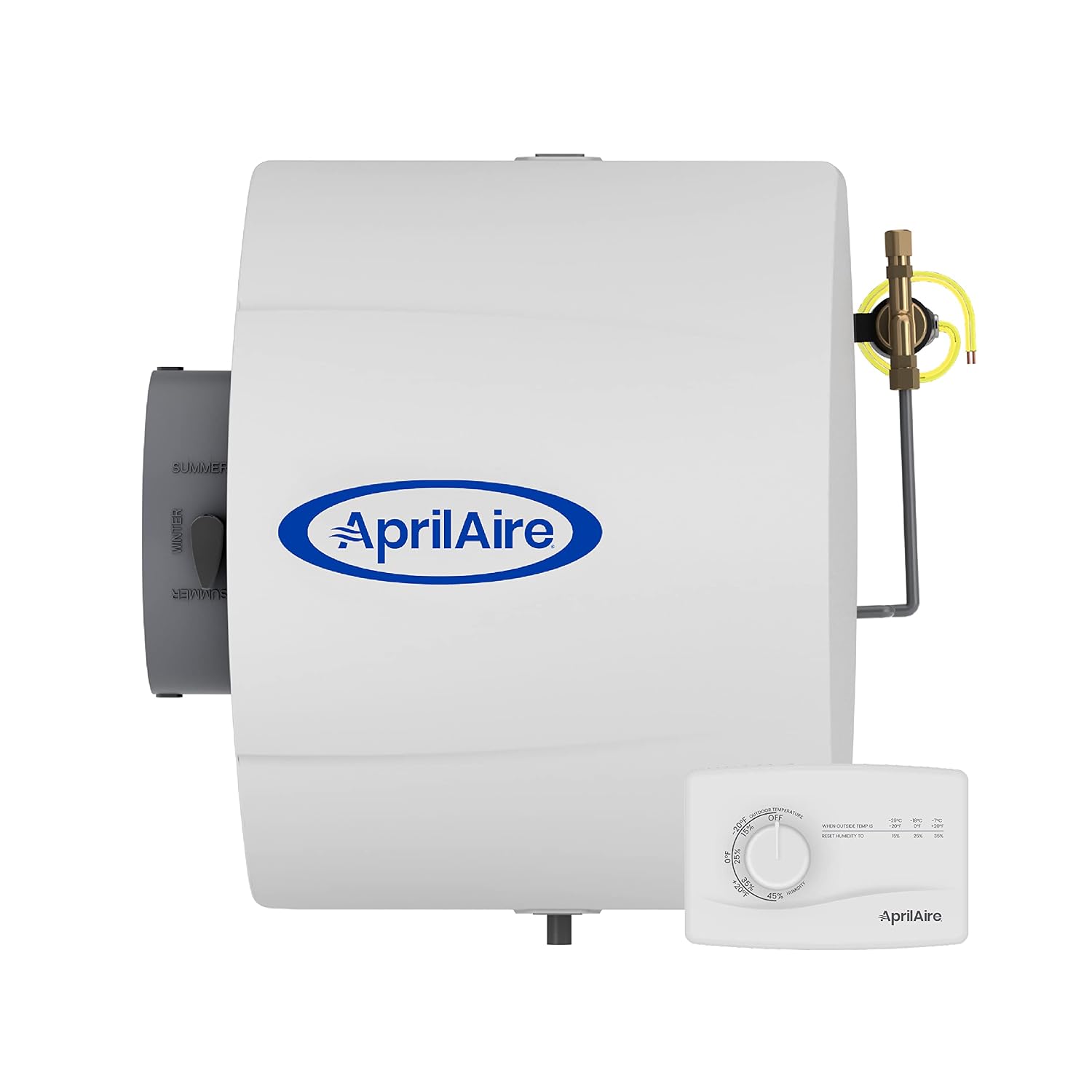
The Aprilaire 600M is a manual, bypass whole-house humidifier that mounts to a forced-air furnace to raise indoor humidity across an entire home. It uses a water panel evaporator and the furnace blower to pass dry air through a moisture-laden panel so humidified air is circulated by the HVAC system. The unit includes a built-in bypass damper, a manual humidistat control with sensor, transformer, solenoid valve, and the Model 35 water panel so it is ready for standard installation and seasonal adjustment. Practical benefits are broad coverage up to roughly 4,000–5,000 sq ft, quiet evaporative operation, and straightforward mechanical controls that make it easy to set and leave alone. The design emphasizes durability and serviceability but it is a manual system, so it requires occasional water panel replacement and basic annual maintenance and wiring to a 24 VAC furnace control. It lacks automated smart controls or advanced scheduling, so buyers who want app control or automatic modulation will need a different model.
Best for: Buyers who prioritize a durable, factory-quality whole-house humidifier that integrates with a central forced-air furnace and favors simple, proven mechanical controls over smart features.
Less Ideal for: People who need Wi-Fi, app control, or fully automatic modulation of humidity levels should consider models with electronic or smart controls instead.
- Whole-home coverage suitable for large houses up to about 4,000–5,000 sq ft
- Includes humidistat, transformer, valve, and water panel for complete installation
- Evaporative design runs quietly and uses furnace airflow for even distribution
- Built-in bypass damper labeled for summer and winter simplifies seasonal setup
- Manual control only with no smart or automated remote management
- Requires periodic water panel replacement and basic annual maintenance
Verdict: Choose the Aprilaire 600M when you want a rugged, factory-quality bypass humidifier that reliably humidifies an entire home using straightforward manual controls.
Levoit LV600HH 6L Humidifier
| Capacity | 6 liters |
|---|---|
| Floor Area | 753 square_feet |
| Operation Mode | Ultrasonic |
| Runtime | 50 hours |
| Control Method | Remote |
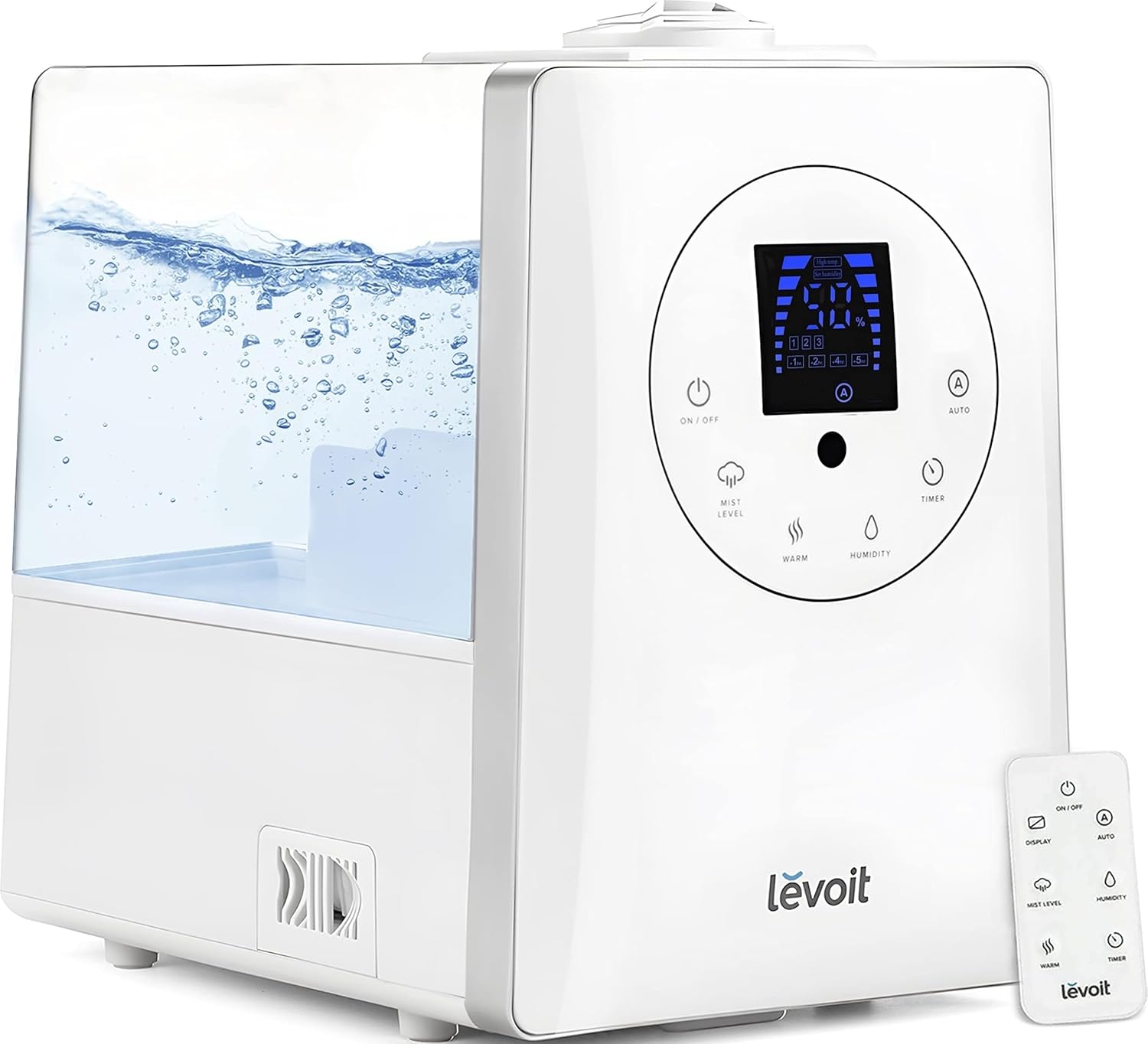
The Levoit LV600HH is a hybrid ultrasonic humidifier designed to add moisture to large rooms using either warm or cool mist. It combines a 6 liter tank with a high output (up to 500 mL/hr warm, 300 mL/hr cool) to run up to about 50 hours between refills and can cover spaces listed around 753 ft2. Daily use centers on filling the large reservoir, selecting warm or cool mist depending on symptoms, and letting Auto Mode and the built-in humidity sensor maintain a target level. The unit includes a remote, aroma pads, and absorption pads for optional scenting and mineral control, and it operates quietly for bedroom use. Practical benefits are long runtime, fast humidity increase with the warm-mist option, and simple hands-off control via auto mode and remote. Important limitations are the need to use distilled or filtered water to avoid white dust, weekly cleaning to prevent buildup, and caution with the warm-mist setting because the mist is hot; it also requires regular maintenance of included pads for best performance.
Best for: Buyers who want a high-capacity humidifier for large heated homes and prefer a unit that can run long periods with automatic humidity control and remote convenience.
Less Ideal for: People seeking a maintenance-free or filterless ultrasonic humidifier or those who cannot commit to routine cleaning and distilled-water use should look elsewhere.
- Large 6 L tank supports long run times up to about 50 hours between refills
- Hybrid warm and cool mist gives symptom relief options and faster humidity increase
- Auto Mode with built-in humidity sensor maintains a set target with minimal adjustments
- Includes remote control and aroma/absorption pads for convenience and light scenting
- Relatively quiet operation suitable for bedroom use
- Requires distilled or filtered water to prevent white dust and mineral buildup
- Warm mist produces hot vapor that needs cautious placement and handling
- Needs weekly cleaning and periodic pad replacement to avoid mold and performance loss
Verdict: Choose the LV600HH if you need a large‑tank humidifier that reliably raises and holds humidity in big, centrally heated rooms with minimal daily attention.
Vornado Evap40 Humidifier
| Capacity | 4 gallons |
|---|---|
| Coverage | 1,000 sq. ft. |
| Humidification Method | Evaporative |
| Fan Settings | 3 |
| Power | 43 watts |
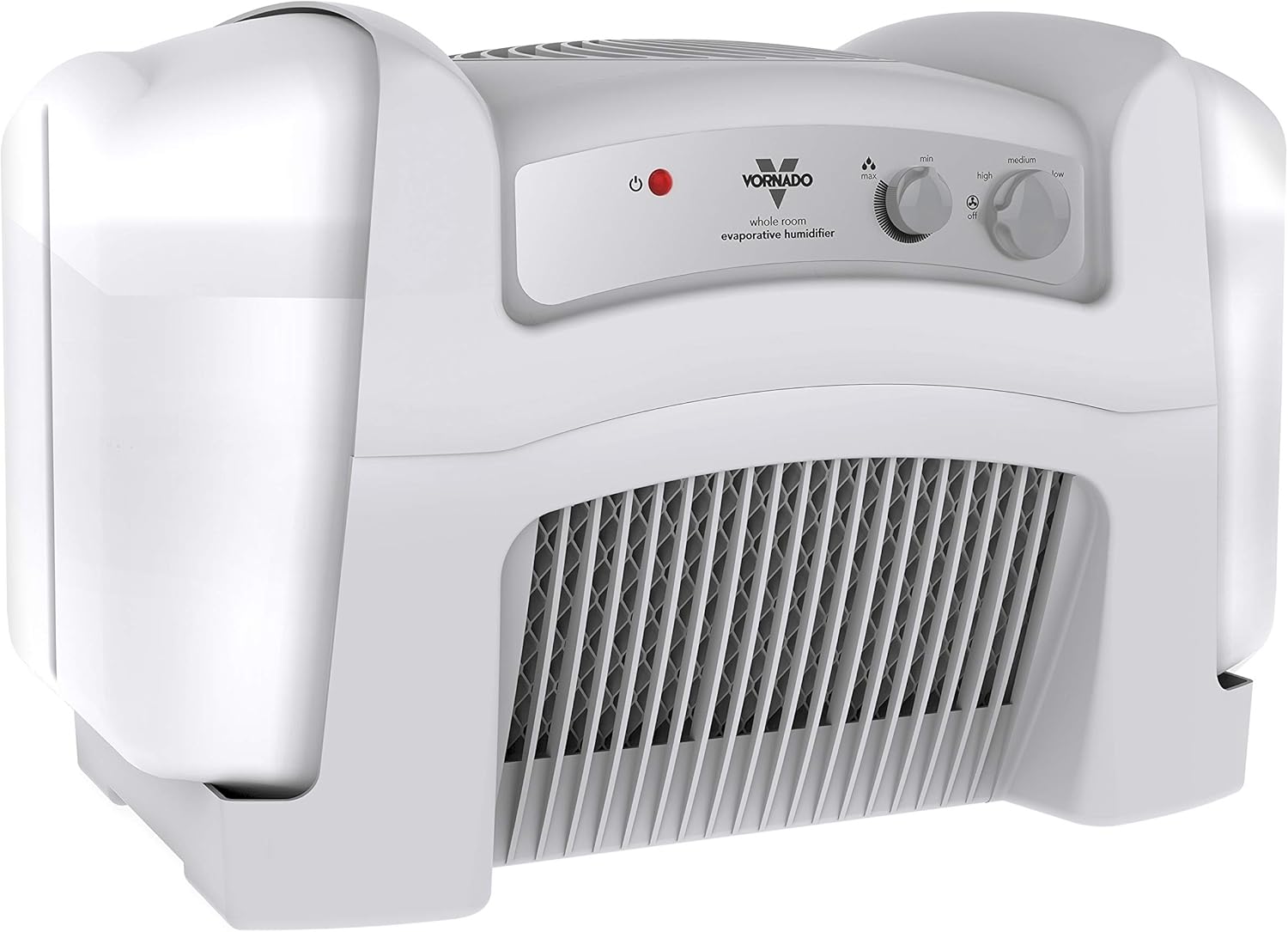
The Vornado Evap40 is a large-capacity evaporative humidifier built to maintain consistent humidity across big rooms and open living areas. It uses dual 2-gallon tanks and wick filters to produce up to 4 gallons of moisture per day while Vornado's Vortex Action circulates humidified air so the effect is even rather than concentrated near the unit. Controls include a built-in humidistat and three fan speeds, letting the unit run automatically to hold a target humidity or manually on low, medium, or high. The top-access tanks are removable and leak-resistant, which makes refilling and basic cleaning straightforward for regular home use. As an evaporative system it does not emit a visible mist and avoids mineral white dust, but it does require periodic wick-filter replacement and routine cleaning to prevent buildup. Power draw is modest at 43 watts, though the unit is sizable and intended for central heating-era dryness or whole-room applications rather than small bedrooms or travel.
Best for: Buyers who prioritize steady, low-maintenance whole-room humidity control for homes with central heating and want an appliance that can run long between refills while maintaining set humidity automatically.
Less Ideal for: People needing a compact travel or personal humidifier for small rooms, or those who want ultrasonic cool-mist units that require no wick filters.
- Large 4-gallon dual-tank capacity enables long runtime with fewer refills
- Vortex circulation distributes humidified air evenly through rooms up to 1,000 sq ft
- Built-in adjustable humidistat provides automatic humidity control
- Evaporative wick system produces mist-free humidification without white dust
- Requires periodic replacement of wick filters and regular cleaning
- Physically large footprint may be cumbersome in tight spaces
Verdict: Choose the Evap40 when you need reliable, whole-room evaporative humidification with long runtime and automatic humidistat control for homes with central heating.
Choosing the Right Humidifier for Central Heating System: Key Factors to Consider
Moisture Output Relative to Home Size
Matching a humidifier's moisture output to your home's square footage is essential. A unit with insufficient output will never reach the target humidity and will run continuously, wasting energy and stressing components.
Conversely, a system that can produce far more moisture than your home needs raises the risk of condensation, mold, and damage to woodwork. Look for manufacturers' stated daily output and compare it to your home's volume. When in doubt, choose a unit with a slightly higher capacity and rely on accurate controls to prevent over-humidification.
Installation Type and Compatibility
Central humidifiers come in different mounting styles, typically plenum-mounted, bypass, or fan-powered installations. Each style has tradeoffs in terms of airflow dependency, installation complexity, and noise.
Consider whether your furnace and duct layout support a bypass loop or whether a fan-powered unit is better for consistent output. Installation difficulty affects total cost and long-term reliability, so evaluate access to the furnace plenum, existing ductwork layout, and whether professional installation will be necessary.
Control Options and Sensor Accuracy
Good control hardware prevents both under- and over-humidification. Basic systems use a simple humidistat installed in a living area, while advanced setups include digital controls, remote sensors, or integration with whole-home thermostats.
Sensor placement matters because hallway sensors can misread conditions in living spaces. Choose a system that offers reliable sensing and options to calibrate or relocate sensors. Accurate controls reduce runtime, save energy, and maintain a stable indoor environment.
Maintenance Frequency and Consumables
All central humidifiers require periodic service such as pad, drum, or filter replacement, and occasional cleaning. The time between maintenance events varies widely between designs and affects lifetime cost and convenience.
Consider how easy it is to access the unit and change consumables, the availability of replacement pads or filters, and whether the system needs seasonal shutdown procedures. Low-maintenance designs reduce hassle, but they may require specific water treatment or harder-to-find parts.
Water Quality, Scale Buildup, and Microbial Control
Tap water mineral content influences how quickly scale forms in a humidifier. Scale reduces efficiency and can foster microbial growth if not managed. Some systems include scale-reduction features, removable scale collectors, or use evaporative pads that are inexpensive to replace.
If your water is hard, factor in the need for more frequent pad changes or a water treatment accessory. Also evaluate whether the unit's design minimizes standing water and supports easy cleaning to limit bacteria and mold.
Energy Use and Fan Interaction
Central humidifiers interact with furnace blowers and can affect overall HVAC runtime. Fan-powered units consume additional electricity but can deliver humidity independently of furnace cycles. Bypass units rely on furnace airflow and are more efficient when the furnace runs frequently.
Consider how your heating schedule and furnace efficiency will interact with the humidifier. Systems with smart controls can reduce energy use by limiting operation to necessary periods and by using the furnace fan strategically.
Installation Basics and What to Expect
Most central humidifiers mount to the furnace plenum or inline with supply ducts. Installation usually requires cutting into sheet metal, securing a water supply and drain, and installing a control harness to the furnace or a separate humidistat. Expect at least a few hours of labor for a straightforward installation and longer if ductwork modifications are needed.
Plan for a professional install if you are not comfortable working with gas or electric furnace connections. Proper sealing at the duct penetration is important to avoid air leaks that reduce HVAC efficiency. After installation, a short commissioning period helps confirm sensor placement and control behavior.
- Confirm clear access to the plenum before starting work
- Route water line with a shutoff valve for maintenance
- Ensure a proper condensate drain or trap is installed if required
Choosing Between Bypass, Fan-Powered, and Steam
Bypass models use furnace airflow and are energy efficient when the furnace runs regularly. They are quieter but depend on consistent fan cycles to move humidified air through the ductwork. Fan-powered units include an internal fan for steady distribution at the cost of additional power use and potential noise.
Steam humidifiers provide fast, controllable output and are less sensitive to water hardness when paired with proper water treatment. They are typically more expensive to install and may require a dedicated electrical circuit. Select the delivery method based on your heating patterns and humidity targets.
- Bypass: lower power, quiet, dependent on furnace fan
- Fan-powered: consistent output, uses electricity, can operate independently
- Steam: high output and precise control, higher installation complexity
Maintenance Routine and Seasonal Care
Create a simple seasonal checklist that includes inspecting and replacing pads or filters, cleaning scale-prone components, and verifying the humidistat calibration. Most units need attention at the start and end of the heating season, with additional mid-season checks for homes with hard water.
Keep spare consumables on hand and record replacement intervals to avoid lapses. Proper maintenance prevents performance loss, reduces microbial risk, and extends the life of mechanical parts.
- Replace evaporative pads annually or as recommended
- Inspect water lines and drains for clogs
- Flush or clean scale collectors if present
Controls, Smart Integration, and Placement
Decide whether you need a standalone humidistat, a wall-mounted digital sensor, or integration with a central thermostat. Smart controls can schedule humidification, learn patterns, and provide remote monitoring, which reduces manual adjustments.
Sensor placement is critical. Mount sensors away from exterior doors, windows, or direct heat sources. If the included sensor is in the furnace room, consider an auxiliary sensor in a commonly used living space to ensure representative readings.
- Prefer controls that allow setpoint adjustment and calibration
- Consider wireless sensor kits for large or multi-level homes
- Verify compatibility with your thermostat wiring if integrating
Managing Water Quality and Hardness
Hard water accelerates scale formation and shortens the life of evaporative elements. If your water is hard, expect more frequent pad changes and consider options that simplify scale removal. Some systems offer removable scale traps or use materials less prone to mineral adherence.
In areas with very hard water, standalone water treatment or a distilled-water feed may be worth considering for steam systems. Evaluate ease of cleaning and the availability of replacement parts when water quality is a concern.
- Check local water hardness and plan maintenance accordingly
- Look for units with removable scale collectors when possible
- Consider water treatment accessories for steam units
How We Chose the Best Humidifier for Central Heating System
Our selection focused on devices designed specifically for integration with central heating systems and whole-house distribution. We prioritized output capacity that matches common home sizes, installation flexibility for both duct- and plenum-mounted setups, and proven methods for minimizing mineral buildup and microbial growth. Control options and sensor accuracy were important because whole-home systems need reliable humidity regulation to avoid over-humidification. We also evaluated ease of routine maintenance including filter or pad replacement, and access to consumables. Excluded were portable room humidifiers, evaporative-only tabletop units, and devices intended solely for individual rooms. We examined product specifications and manufacturer performance claims rather than independent lab testing. Key dimensions that determined picks were maximum moisture output (pints or gallons per day), compatibility with typical furnace configurations, control and sensor features, maintenance complexity, and materials that resist scale buildup. Units that required impractical installation work or lacked basic humidity control were filtered out.
Our full evaluation process is outlined in our review methodology.
FAQ
How often should I run a central humidifier during the heating season?
It often depends on indoor humidity targets and outdoor conditions. Many systems run intermittently to maintain a setpoint, while in very dry weather they may operate more frequently. Use a reliable humidistat to avoid continuous runtime.
Will a central humidifier increase my heating bills?
Effect on heating energy is usually small. Proper humidity can make the home feel warmer at a given thermostat setting, which may allow slightly lower setpoints. Fan-powered or steam units use more electricity than bypass types, so consider that in your decision.
Can I install a central humidifier myself?
DIY installation is possible for experienced homeowners who are comfortable with basic HVAC and plumbing tasks. However, many people opt for professional installation to ensure proper duct connections, electrical work, and water-line routing.
What humidity level should I aim for with central heating?
A comfortable and safe indoor range is usually between 30 and 50 percent relative humidity. Higher levels increase the risk of condensation on cold surfaces, so aim for the lower half of that range in very cold climates.
How does water hardness affect humidifier maintenance?
Hard water leads to faster scale buildup on pads and internal components, requiring more frequent replacement and cleaning. Systems with removable scale collectors or easier-access pads reduce the maintenance burden in hard-water areas.
Final Verdict
When choosing a humidifier for a central heating system, prioritize a unit with the right moisture output for your home's volume, reliable humidity controls, and an installation style that matches your furnace and duct layout. Balance output capacity against the risk of condensation, and factor in water quality and maintenance needs. Select a system with accessible consumables and accurate sensors to minimize seasonal upkeep and avoid over-humidification. With those tradeoffs in mind, you can choose a whole-home humidifier that delivers comfort without undue complexity.