
Note: This article contains affiliate links. If you click on these links and make a purchase, we may earn a small commission at no extra cost to you. This helps support our research and content. Read our full affiliate disclosure here.
A properly matched humidifier for your furnace can make winter living rooms more comfortable, reduce dry-skin and throat irritation, and help preserve wood floors and trim. Choosing the right unit matters because capacity, control options, and installation method determine how well the humidifier keeps indoor humidity stable without overworking your HVAC system. This guide covers our top shortlisted humidifiers for furnace systems and explains the technical and practical tradeoffs buyers need to weigh. Read on for the evaluation criteria used and the features that matter most when pairing a humidifier with a forced-air furnace.
Top Picks at a Glance
| Best Overall The best all-around choice for most situations | Vornado Evap40 Humidifier |  |
| Best Quality Built to a higher standard if you want something more solid | Honeywell HM750A1000 Electrode Humidifier |  |
| Best Value The sweet spot between price and what you get | AIRCARE MA1201 Console Humidifier |  |
| Best Budget The cheapest option that still gets the job done reliably | GeneralAire 3200M Evaporative Humidifier |  |
| Top Rated A top-rated pick with lots of positive feedback | Aprilaire 600M Whole-House Humidifier |  |
| Most Popular A crowd favorite that many people choose with confidence | AprilAire 500 Whole-House Humidifier |  |
| Best Seller A high-volume bestseller chosen again and again | AIRCARE Space Saver Evaporative Humidifier |  |
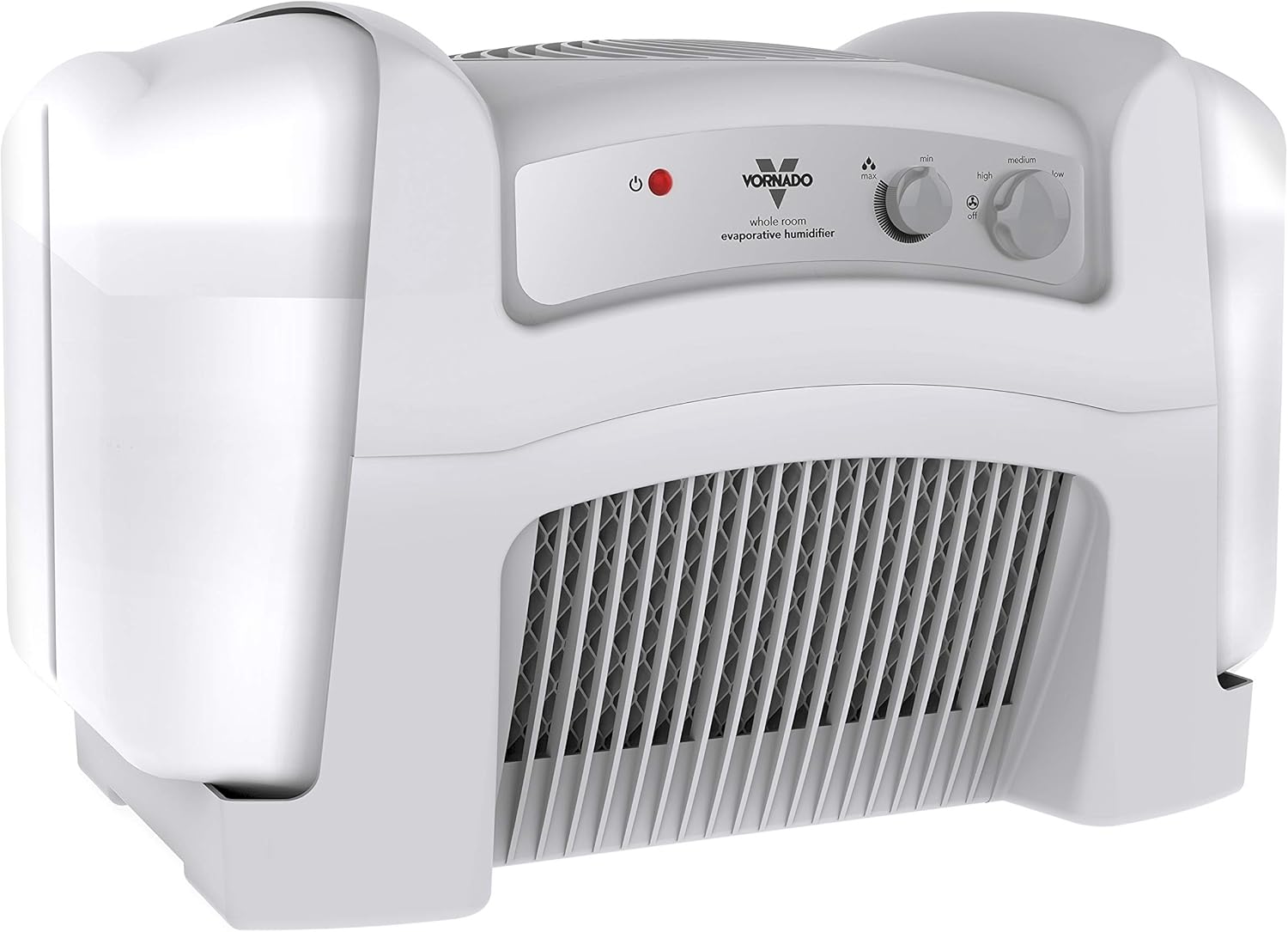
Vornado Evap40 Humidifier
| Capacity | 4 gallons |
|---|---|
| Coverage | 1,000 sq. ft. |
| Operation Mode | Evaporative |
| Power | 43 watts |
| Filter Type | Wick |
The Vornado Evap40 is an evaporative whole-room humidifier built for large spaces; it uses deep-pitch blades and dual wick filters to pull dry air through the unit and circulate humidified air across up to 1,000 square feet. Setup centers on two removable 2-gallon tanks that combine for a 4-gallon capacity, so runtime between refills is long and maintenance is mostly replacing or cleaning the wicks and tanks. Controls are simple: a touch panel with an adjustable humidistat and three fan speeds lets the unit automatically maintain a target humidity. Because it is evaporative and wick-based, it does not produce visible mist, reducing wet spots on surfaces and making it safer around electronics and fabrics. Expect modest power use at about 43 watts, and quieter operation compared with many ultrasonic models when set low. The main limits are evaporative-specific: it relies on airflow and wicks so output varies with room temperature and ventilation, and you will need to replace filters periodically for best performance.
Best for: Homeowners wanting a low-mist, whole-room humidifier that runs for long periods between refills and maintains humidity automatically in large living areas heated by a furnace.
Less Ideal for: Users who need instant visible mist or precise, room-to-room humidity control in very small spaces should consider ultrasonic or smaller point humidifiers instead.
- Large 4-gallon dual-tank capacity supports extended runtime and fewer refills
- Vortex circulation spreads humidified air evenly across up to 1,000 sq ft
- Built-in adjustable humidistat with automatic control and three fan speeds
- Evaporative, wick-based design produces no visible mist, reducing surface wetness
- Output depends on air movement and room conditions, so peak humidity can vary
- Requires periodic wick filter maintenance and replacement
Verdict: Choose the Evap40 if you want a low-mist, long-run evaporative humidifier that circulates humidity evenly throughout large furnace-heated rooms.
Honeywell HM750A1000 Electrode Humidifier

| Power Source | Corded Electric |
|---|---|
| Control Method | Touch |
| Filter Type | Demineralization Cartridge |
| Runtime | 8 hours |
The Honeywell HM750A1000 is a small-footprint electrode steam humidifier made to integrate with furnace ductwork or mount on a wall for central-home humidification. It produces steam on demand using replaceable pre-mineralized cylinders and a dematerialization cartridge to reduce mineral buildup, and the touch control and automatic operation simplify setup and daily use. Its compact size aims to make single-person installation and service easier than larger steam units, and the included funnel assists initial filling and maintenance. Practical benefits include fast humidity response for the whole house and the flexibility of duct- or wall-mount placement where space is limited. Limitations include an 8-hour stated runtime that depends on cylinder life and water quality, and the electrode design requires periodic cylinder replacement and routine maintenance to maintain peak output. This unit suits buyers who want reliable, furnace-integrated steam humidification in a smaller package and who are prepared to follow the maintenance schedule inherent to electrode systems.
Best for: Buyers who prioritize fast, whole-house humidity control tied into a furnace and need a compact steam solution that installs in limited spaces.
Less Ideal for: Users who want a zero-maintenance or filter-free evaporative humidifier for single rooms or who cannot perform periodic cylinder maintenance.
- Duct- or wall-mountable for flexible installation in tight mechanical spaces
- Small footprint simplifies one-person installation and servicing
- Pre-mineralized cylinder and dematerialization cartridge reduce startup time and mineral buildup
- Touch control with automatic operation for straightforward daily use
- Designed for whole-house steam humidification when integrated with a furnace
- Electrode cylinder design requires periodic replacement and maintenance
- Runtime and performance depend on water quality and cylinder life
Verdict: Choose this compact electrode steam humidifier when you need fast, furnace-integrated whole-home humidification in a small, install-friendly package.
AIRCARE MA1201 Console Humidifier

| Capacity | 3.6 gallons |
|---|---|
| Floor Area | 3600 square_feet |
| Runtime | 36 hours |
| Operation Mode | Evaporative |
| Power Source | Corded Electric |
The AIRCARE MA1201 is an evaporative, console-style humidifier built to add invisible moisture to large areas, making it suited to whole-house or furnace-room use. It draws dry air through a saturated wick filter and pushes humidified air with four fan speeds, an auto mode, and a digital humidistat that maintains a chosen humidity level. The 3.6 gallon tank delivers up to about 36 hours of runtime between refills, and indicators remind you to refill or change the wick while the unit automatically shuts off when empty or when the set humidity is reached. Built-in casters make moving and positioning the unit straightforward, and touch controls simplify adjustments. Because it uses an evaporative wick, it traps mineral deposits and avoids white dust, but the system depends on regular filter changes and water refills and requires a power outlet at the placement spot. At its stated coverage, it is a practical, low-tech solution for maintaining stable indoor humidity over large floorplans where humidifier-to-furnace integration is not needed.
Best for: Buyers who want a practical, low-maintenance humidification solution for large open areas or whole-house coverage and prioritize steady humidity control over smart integrations.
Less Ideal for: Do not choose this if you need a humidifier that integrates directly with a furnace or central HVAC system or if you prefer a completely hands-off, plumbed-in appliance.
- Large 3.6 gallon tank supports extended runtime up to 36 hours between refills
- Digital humidistat with customizable humidity settings and auto mode for consistent control
- Evaporative wick design reduces white dust and traps minerals for easier maintenance
- Auto shutoff and refill/filter indicators improve safety and convenience
- Wheels (casters) allow easy repositioning around the home or near a furnace return
- Requires regular wick replacement and periodic cleaning to maintain performance
- Needs a nearby electrical outlet and manual refilling — not plumbed to a furnace humidifier system
- Relatively high wattage compared with small room units
Verdict: A straightforward, high-capacity evaporative console humidifier that delivers reliable whole-house humidity control for buyers who want practical performance without HVAC integration.
GeneralAire 3200M Evaporative Humidifier

| Capacity | 12 gallons per day |
|---|---|
| Floor Area | 3200 square_feet |
| Operation Mode | Evaporative |
| Filter Type | Wick |
| Runtime | 12 hours |
The GeneralAire 3200M is a furnace-mounted bypass evaporative humidifier intended to raise indoor humidity for homes up to about 3,200 square feet. It installs on ductwork and uses a wick filter and flow-through design to evaporate water into the furnace air stream, controlled by the included MHX3C manual humidistat. With a 12 gallons-per-day capacity and low electrical draw, it provides steady humidification for living areas and bedrooms while matching modern high-efficiency furnaces. The unit is compact and relatively lightweight for easier installation and maintenance, and the wick filter makes replacement simple. Limitations include manual control rather than automatic digital sensing and the need to change the wick periodically, so it requires some routine upkeep. It is a practical, no-frills factory-quality replacement for homeowners who want reliable humidification tied to their furnace without advanced electronics or smart controls.
Best for: Homeowners on a budget who need a reliable furnace-mounted humidifier to cover whole-house humidification without paying for digital or smart controls.
Less Ideal for: If you want automatic humidity management, remote control, or app connectivity, look at models with digital sensors and automatic control instead.
- Bypass evaporative design works with furnace air for whole-house humidification
- 12 gallons per day capacity suitable for mid-to-large homes
- Includes manual humidistat for straightforward control
- Low wattage and corded electric power with simple wick filter maintenance
- Compact, lightweight housing simplifies installation and handling
- Manual humidistat lacks automatic humidity sensing or digital controls
- Requires periodic replacement of the wick filter and routine maintenance
Verdict: A straightforward, budget-friendly furnace humidifier that delivers dependable whole-house moisture with simple manual control.
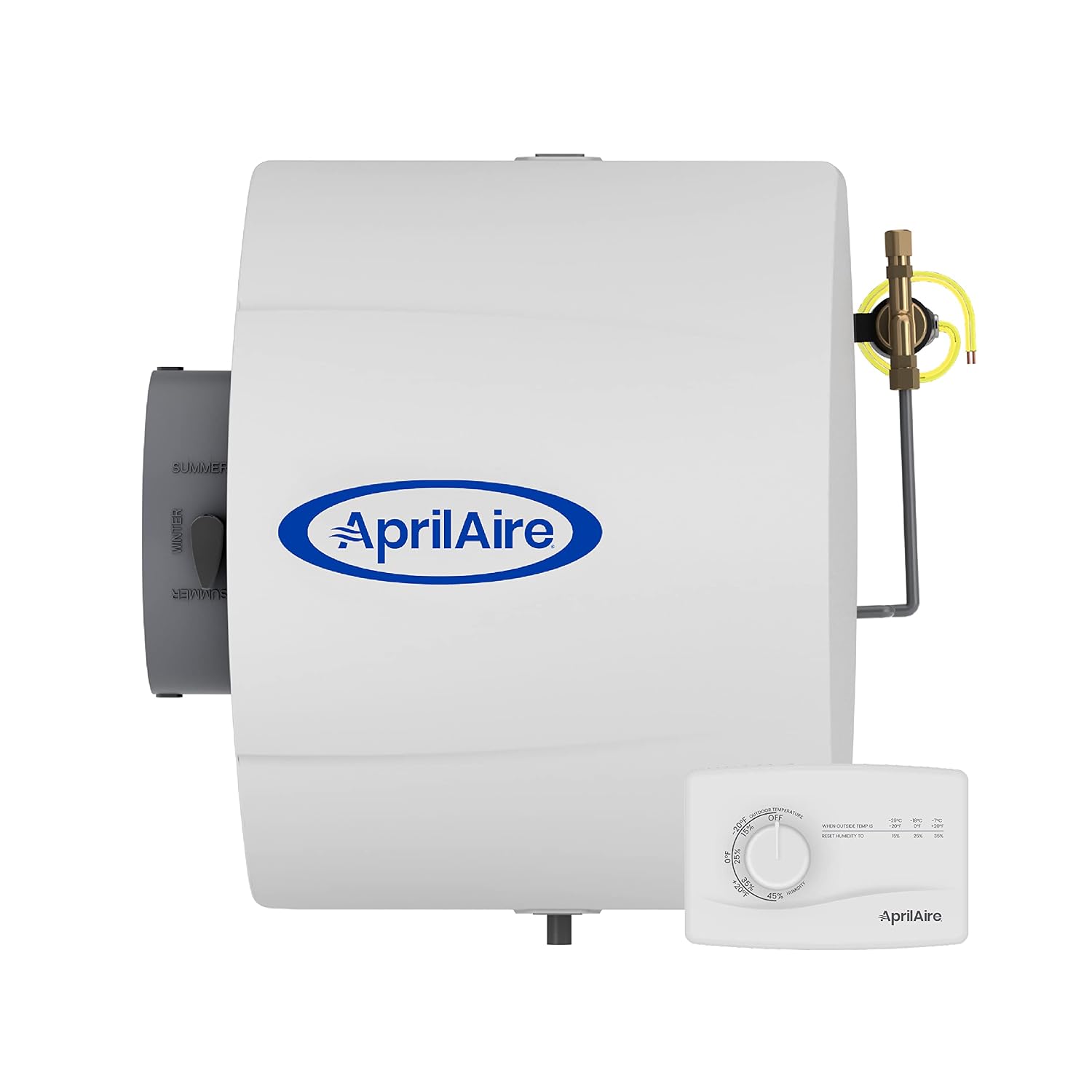
Aprilaire 600M Whole-House Humidifier
| Capacity | 17 gallons_per_day |
|---|---|
| Floor Area | 4000 square_feet |
| Operation Mode | Evaporative |
| Power Source | ac |
| Control Method | Touch |
The Aprilaire 600M is a manual bypass whole-house evaporative humidifier built to work with forced-air furnace systems and cover large homes. It feeds water over a replaceable Water Panel where warm, dry HVAC air passes through and picks up moisture before circulating through ducts. The unit includes a built-in bypass damper, manual humidistat sensor control, transformer, solenoid valve, and installation hardware so it can be installed directly on a furnace return with relatively few external parts. Its 17 gallons-per-day capacity and 4000–5000 sq ft coverage make it suitable for full-home humidification in colder, drier climates. Because it is an evaporative, low-tech design, run costs are modest and the humidification process is quiet, but it requires periodic Water Panel replacements and routine servicing to prevent buildup. The manual control and fixed bypass design mean less automation than electronic whole-home models, so users should be comfortable setting humidity levels and checking the system seasonally. For buyers prioritizing durability and proven performance, the 600M is a straightforward, serviceable choice.
Best for: Homeowners seeking a proven, serviceable furnace-mounted humidifier that reliably treats an entire house and who prefer simple, durable systems over flashy automation.
Less Ideal for: Buyers who want fully automatic, app-connected, or sensor-driven humidification with minimal seasonal maintenance should consider more modern electronic models.
- High humidification capacity suitable for large homes up to 4,000–5,000 sq ft
- Built-in bypass damper and included controls simplify installation and reduce extra parts
- Quiet evaporative operation with modest running costs
- Includes transformer, humidistat, solenoid valve, and Water Panel in the box
- Manual control requires user adjustment rather than automatic digital regulation
- Evaporative Water Panel needs periodic replacement and maintenance
Verdict: Choose the Aprilaire 600M if you want a durable, high-capacity furnace-mounted humidifier that reliably humidifies large homes with a simple, serviceable design.
AprilAire 500 Whole-House Humidifier

| Capacity | 12 gallons_per_day |
|---|---|
| Floor Area | 3000 square_feet |
| Operation Mode | Evaporative |
| Voltage | 24 volts_of_alternating_current |
| Wattage | 15 watts |
The AprilAire 500 is a furnace-mounted evaporative humidifier intended to add controlled moisture to an entire home. It installs inline with a forced-air system and uses a replaceable Water Panel evaporator; water flows over the panel while warm furnace air passes through and carries humidity into ductwork. The unit includes an automatic digital control with indoor and outdoor sensors, a built-in bypass damper, 24 VAC transformer, solenoid valve, and a saddle valve for plumbing hookup, so it can run automatically to maintain a set humidity level. Practical benefits include a high daily output rated at 12 gallons, coverage for large homes, quiet evaporative operation, and clear status indicators for filter change and service. Limitations are that it requires professional or experienced DIY installation to integrate with a furnace and plumbing, periodic Water Panel replacements, and it only operates with a compatible forced-air system rather than as a standalone room unit.
Best for: Buyers who want a reliable, hands-off whole-house solution tied to their existing furnace and who prioritize consistent, automatic humidity control backed by a long industry track record.
Less Ideal for: People who need a portable or window-mounted humidifier, those without a forced-air HVAC system, or buyers unwilling to schedule installation and periodic maintenance.
- Automatic digital control with indoor and outdoor sensors for consistent humidity regulation
- High capacity evaporative output (12 gallons per day) suitable for large homes
- Includes necessary installation components such as transformer, control, valves, and outdoor sensor
- Quiet evaporative operation with service and filter change indicators
- Requires furnace integration and plumbing, which usually needs professional installation
- Regular replacement of the Water Panel evaporator is necessary
- Not suitable as a portable or single-room humidifier
Verdict: Choose the AprilAire 500 when you want a high-capacity, automatic furnace-mounted humidifier that maintains whole-house humidity reliably with built-in sensors and controls.
AIRCARE Space Saver Evaporative Humidifier

| Capacity | 6 gallons |
|---|---|
| Floor Area | 2700 square_feet |
| Operation Mode | Evaporative |
| Wattage | 1000 watts |
| Control Method | Touch |
The AIRCARE Space Saver is a floor-standing evaporative humidifier built for whole-house use or large open areas. It uses a 6-gallon tank and a replaceable 1043 wick to deliver moisture over long runs while the touch digital control and built-in humidistat let you set and maintain a target humidity automatically. Practical features include Auto Shut Off when the tank is empty, Trapmax filter protection, and caster wheels for moving the unit between rooms. Because it is an evaporative design it will naturally self-regulate and tends to avoid over-humidifying, but it requires periodic wick replacement and occasional cleaning to prevent mineral buildup. The unit runs on 120V at roughly 1000 watts so expect noticeable power draw during operation and plan for drain/maintenance in hard-water areas. For buyers who prioritize reliable, hands-off humidity control in large homes or basements, this model offers a proven, serviceable approach without complex installation.
Best for: A cautious buyer who wants a low-complexity, proven evaporative humidifier to maintain steady indoor humidity across large spaces without complicated setup.
Less Ideal for: Those seeking a furnace-mounted or in-duct humidifier solution or buyers who want a near-maintenance-free ultrasonic unit for small rooms.
- 6-gallon capacity suitable for extended run times in large spaces
- Digital controls with auto humidistat maintain set humidity levels
- Auto shutoff prevents dry-run when tank is empty
- Includes 1043 Super Wick and uses wick filtration for mineral control
- Caster wheels make it easy to move between rooms
- Evaporative wicks require regular replacement and cleaning
- Higher power draw at 1000 watts compared with smaller room humidifiers
- Not a direct in-duct furnace humidifier so may require placement planning for whole-house coverage
Verdict: Choose this model if you want a reliable, large-capacity evaporative humidifier that maintains set humidity automatically for big spaces without complex installation.
Choosing the Right Humidifier for Furnace: Key Factors to Consider
Moisture Output Capacity
Moisture output, typically measured in gallons per day, determines how large an area the humidifier can effectively serve. A unit with too low an output will never reach set humidity in colder, drier climates, while an oversized unit can cause excess humidity and condensation risks.
When selecting capacity, estimate the heated square footage and typical winter outdoor dryness. Factor in building tightness and occupants' comfort targets. Proper sizing ensures the humidifier runs within its efficient range instead of cycling inefficiently.
Installation Type and Fit
Humidifiers for furnace systems mount to ductwork or the furnace itself, with variations in location and required clearances. Some units are designed for bypass installations that use ducted airflow, while others are furnace-mounted and rely on the blower to distribute moisture.
Consider available space around the furnace cabinet, the routing needed for drain and supply lines, and whether you have access to basic plumbing and electrical connections. Easier-fit designs reduce installation time and lower the risk of leaks or poor airflow that compromise performance.
Control Options and Integration
Controls range from simple mechanical humidistats to digital controllers that integrate with furnace thermostats or home automation systems. Precise control helps prevent over-humidification, which can cause condensation and mold, and reduces unnecessary cycling.
Look for units that offer clear setpoint adjustment, automatic shutoff features, and compatibility with standard furnace controls if you want centralized humidity management. Good controls also make seasonal adjustment straightforward.
Maintenance Requirements
Routine maintenance affects long-term cost and reliability. Evaporative humidifiers usually require periodic pad or filter replacement and occasional cleaning to prevent mineral buildup and bacterial growth. Some designs minimize service needs with washable components or longer-life media.
Assess the frequency and complexity of tasks such as pad changes, drain clearing, and winter shutdown procedures. Easy access to consumables and clear replacement schedules reduces the chance that the unit will be neglected.
Plumbing and Drain Needs
Most furnace humidifiers need a cold water feed and a drain for condensate or used water. The ease of routing those lines and the availability of a nearby drain influence installation difficulty and ongoing reliability.
Verify water quality considerations, such as hard water that can increase scale and maintenance. Consider whether you need a condensate pump for remote drain locations and whether a professional plumbed connection is warranted for long-term reliability.
Durability and Corrosion Resistance
Components exposed to moisture must resist corrosion and mineral attack. Material choices for water trays, housings, and fasteners influence the unit's service life and maintenance frequency. Durable construction reduces the risk of leaks and failure.
Check for replaceable metal parts or coated surfaces, straightforward access for inspection, and a design that minimizes trapped water. Robust units typically require less frequent intervention and provide steadier humidity control over time.
Bypass Vs. Fan-Powered Vs. Steam: Which Type Suits Your Home
Understanding the basic operating types clarifies compatibility with your furnace and your performance expectations. Bypass humidifiers use furnace airflow to pass air over a moist pad and are generally quiet and energy efficient. Fan-powered units include an internal blower for stronger moisture delivery independent of furnace blower speed. Steam units generate moisture directly but usually require higher electrical capacity and more complex installation.
For most typical single-family homes, bypass and fan-powered models strike the best balance of output and installation complexity. Steam systems are an option when you need very high output or rapid humidity recovery, but they often add cost and service needs.
- Bypass: quiet, lower output, depends on furnace airflow
- Fan-powered: higher output, works even when furnace blower is off
- Steam: highest output, more complex and higher electrical demand
Sizing a Humidifier for Winter Conditions
Size the humidifier to meet worst-case winter conditions rather than mild days. Manufacturers list output in gallons per day; compare that to your home's heated square footage and target indoor relative humidity at low outdoor temperatures. Conservative oversizing is better than undersizing, but avoid extreme oversizing that risks condensation on cold surfaces.
If you live in very cold, dry climates, choose a model with extra capacity and reliable control to avoid constant running. For milder regions, a modest-capacity unit with precise control often provides steadier comfort.
- Estimate required GPD based on square footage and local winter dryness
- Factor in building tightness and ventilation rates
- Prioritize control accuracy if hesitant about exact sizing
Common Installation Challenges and Solutions
Tight furnace rooms, restricted duct runs, and locating a suitable drain are frequent hurdles. Small clearance around the furnace can complicate mounting and access for future maintenance. Plan the routing for water supply and drain lines before buying to ensure the unit will fit and serviceable parts are reachable.
If you lack easy drain access, consider units designed to handle condensate or that include optional pumps. When electrical capacity is limited, avoid steam models that require dedicated high-voltage circuits. Professional installation can resolve complex ductwork or electrical constraints, but many homeowners can handle straightforward furnace-mounted installs.
- Check clearances and service access before purchase
- Plan water and drain routing in advance
- Avoid steam systems if electrical upgrades are required
Maintaining Peak Performance Seasonally
Seasonal maintenance keeps the humidifier operating efficiently and reduces health risks. At the start and end of humidifying season, clean or replace pads, flush the water lines, and inspect the housing for mineral deposits. Regularly inspect drain paths and any solenoids or valves for proper operation.
Keeping a simple maintenance log helps ensure timely part replacement and can reveal recurring issues early. Using manufacturer-recommended replacement parts and following shutdown procedures for summer reduces corrosion and extends service life.
- Replace pads per manufacturer schedule or sooner with hard water
- Flush and inspect water lines annually
- Log maintenance dates to track replacement cycles
Noise, Airflow, and Indoor Comfort
Some humidifiers introduce audible noise or alter furnace airflow patterns. Fan-powered models can be louder, while bypass units are quieter but rely on furnace blower speed. Consider where you spend time versus where the furnace is located to balance noise with effective distribution.
Proper placement and duct connections minimize unwanted drafts or room-to-room humidity imbalance. If noise sensitivity is a concern, prioritize quieter designs and confirm user reports of low operating sound for the chosen configuration.
- Expect higher noise from fan-powered units
- Verify duct connections to prevent drafts
- Place controls where household occupants can easily monitor them
How We Chose the Best Humidifier for Furnace
We evaluated candidate humidifiers for furnace systems using practical, home-focused filters that reflect real installation and seasonal use. Primary criteria included humidification output and control accuracy, because a unit must provide enough moisture and maintain setpoints without wide swings. Installation and fitment was assessed for common furnace-side mounting and ductwork options, including required tools and typical labor scope. Durability and maintenance covered expected service intervals, corrosion resistance of wetted parts, and availability of replaceable pads or cartridges. Control compatibility looked at both standalone humidistats and integration with common furnace controls, plus the clarity of user interfaces. Noise and airflow impact were considered since furnace-mounted units can produce audible changes in living spaces. We excluded whole-home steam systems and bespoke commercial humidifiers that require specialized electrical or plumbed installations. We prioritized models that balance sufficient output for typical single-family homes with straightforward installation and routine upkeep. The shortlist favors units whose specifications and features align with common homeowner installation capabilities and typical furnace airflow and cabinet configurations.
Our full evaluation process is outlined in our review methodology.
FAQ
How do I know what humidifier capacity my home needs?
Capacity is usually expressed in gallons per day and should be chosen based on heated square footage, typical winter outdoor dryness, and desired indoor relative humidity. Use manufacturer sizing guidance and err toward slightly higher capacity in very cold climates.
Can I install a furnace humidifier myself?
Many furnace-mounted and bypass units are designed for competent DIYers with basic plumbing and electrical skills. However, limited space, routing a drain, or integrating controls may warrant professional help. Safety and leak prevention are the prime reasons to hire an installer when uncertain.
How often do humidifier pads or filters need replacement?
Replacement frequency depends on water quality and usage but is commonly every 6 to 12 months. Hard water typically shortens pad life, so inspect the media more often and follow the manufacturer's recommended schedule.
Will a furnace humidifier increase my energy bill?
Evaporative bypass and fan-powered humidifiers use minimal electricity, so the impact on energy bills is usually small. Steam systems consume more electrical power and can increase energy use noticeably, so consider operational costs when choosing a steam unit.
How can I prevent over-humidification and condensation?
Use a precise humidity control and set conservative relative humidity targets at very low outdoor temperatures. Proper sizing, accurate controls, and good installation that avoids damp spots or cold surfaces help prevent condensation and associated problems.
Final Verdict
Choosing the right humidifier for your furnace depends on matching capacity, installation practicality, and control accuracy to your home's winter conditions. Prioritize a unit sized for worst-case cold weather, with controls that prevent over-humidification and maintenance needs you are willing to perform. Balance the tradeoffs between quieter bypass models and higher-output fan-powered or steam options based on your output needs and installation constraints. With correct sizing, straightforward installation, and regular upkeep, a furnace humidifier reliably improves comfort and protects woodwork without undue hassle.