
Note: This article contains affiliate links. If you click on these links and make a purchase, we may earn a small commission at no extra cost to you. This helps support our research and content. Read our full affiliate disclosure here.
If you grow plants in a tent, maintaining steady humidity can make the difference between slow stress and vigorous growth. A dedicated humidifier for grow tents helps you hit target relative humidity for seedlings, clones, and tropical crops without constant manual adjustment. This guide covers seven shortlisted options that suit small to medium tents, highlighting features that matter for indoor horticulture. We evaluated output control, runtime, ease of maintenance, and footprint to pick humidifiers that integrate into tent environments. Read on to find models designed to keep humidity stable while minimizing refill frequency and cleaning time.
Top Picks at a Glance
| Best Overall The best all-around choice for most situations | AC Infinity CLOUDFORGE T3 |  |
| Best Quality Built to a higher standard if you want something more solid | VIVOSUN AeroStream H09 Humidifier |  |
| Best Value The sweet spot between price and what you get | Coolfiqu 6L Humidifier LP-2113 |  |
| Best Budget The cheapest option that still gets the job done reliably | ROSEKM 2.0L Cool Mist Humidifier |  |
| Top Rated A top-rated pick with lots of positive feedback | Everlasting Comfort 2.5L Humidifier |  |
| Most Popular A crowd favorite that many people choose with confidence | Pure Enrichment MistAire Humidifier |  |
| Best Seller A high-volume bestseller chosen again and again | VIVOSUN AeroStream H05 5L Humidifier |  |
AC Infinity CLOUDFORGE T3

| Capacity | 4.5 liters |
|---|---|
| Output Rate | 240 ml/h |
| Wattage | 24 Watts |
| Control Method | App |
| Runtime | 45 hours |
The AC Infinity CLOUDFORGE T3 is a grow-tent humidifier built around a 4.5 liter ultrasonic vaporizer and app-driven controls to keep humidity and VPD stable. It supplies up to 240 ml/hour of output and offers 10 adjustable vapor levels, extendable tubing, and a targeted pipe for directing moisture to specific plant areas. Smart features include VPD and humidity triggers, scheduling, alerts, and graphing in the companion app, plus a hidable backlit display and auto-start memory for power interruptions. Practical benefits for tent growers are precise set-and-forget control, reduced manual monitoring, and the ability to automate humidity cycles tied to environmental triggers. The unit runs on 24 watts and includes a sensor probe and pre-filter, and the water-resistant seal reduces leakage risk. Limitations include a modest runtime relative to very large tents and a fixed maximum output rate that may require multiple units for larger setups, and the 240V rating may need consideration depending on local power. Setup and app integration are generally straightforward but assume familiarity with grow-room automation systems.
Best for: Growers who want automated, precision humidity control in a medium-sized tent and value programmability and targeted vapor delivery to specific plant zones.
Less Ideal for: Those managing very large grow spaces who need higher continuous output or users who cannot accommodate the unit's 240V power requirement.
- Smart app control with VPD and humidity triggers for automated climate routines
- Ten vapor output levels for fine-tuning humidity delivery
- Extendable tubing and targeting pipe for focused moisture distribution
- Water-resistant seal and pre-filter reduce leakage and maintenance
- Maximum output (240 ml/h) may be insufficient for larger grow tents without additional units
- Requires 240V power specification which may limit plug compatibility
Verdict: Buy this if you need a programmable, targeted humidifier that automates VPD and humidity control for a medium grow tent.
VIVOSUN AeroStream H09 Humidifier

| Capacity | 9 liters |
|---|---|
| Floor Area | 250 square_feet |
| Operation Mode | Automatic |
| Filter Type | Carbon |
| Power Source | Corded Electric |
The VIVOSUN AeroStream H09 is a grow-focused ultrasonic humidifier built to keep humidity stable in tents and small grow rooms. It uses a 9 liter tank and an external temperature and humidity probe to deliver precise, 1% resolution humidity control, and it supports Auto, Manual, and Cycle modes so you can lock in target conditions or run custom recipes. The unit is Wi‑Fi enabled and integrates with the VIVOSUN app and the Vivosun Smart Grow System for remote monitoring, alerts, and automated adjustments, and a flexible hose lets you route vapor into a tent or place the machine outside the grow space. Practical touches include phantom mode to disable display light for light-sensitive plants, a top-fill opening for easier refills, and a low-water alert and auto shutoff for safety. Limitations to note are a 3 hour runtime figure listed (likely at higher output) and the humidifier relies on app connectivity for advanced features, so growers wanting purely local controls or longer unattended runtime may need to plan accordingly.
Best for: Growers who prioritize precise, automated humidity control and remote monitoring to maintain steady VPD and follow grow recipes in tents or small rooms.
Less Ideal for: Casual users who want a simple, fully local humidifier with long unattended runtime and no reliance on app connectivity should consider simpler models.
- High 9 L capacity suited for multi-hour runs in tents
- External temperature and humidity probe for accurate environmental feedback
- Wi‑Fi app control with SGS integration for remote monitoring and recipe automation
- Phantom mode and opaque tank to avoid light interference with plants
- Flexible vapor outlet and hose for versatile placement relative to the grow space
- Runtime listed as 3 hours, which may be shorter at high mist settings
- Advanced automation depends on Wi‑Fi and the app for full functionality
Verdict: Choose the AeroStream H09 if you need a grow-tailored, app‑driven humidifier that delivers precise, probe-based humidity control and integrates with a smart grow system.
Coolfiqu 6L Humidifier LP-2113

| Capacity | 6 liters |
|---|---|
| Floor Area | 500 square_feet |
| Operation Mode | Ultrasonic |
| Control Method | Touch |
| Runtime | 60 hours |
The Coolfiqu 6L is a large-capacity ultrasonic humidifier designed to run long stretches between refills while giving you the option of warm or cool mist. It's a top-fill unit with touch controls, a digital display that can be turned off in sleep mode, and a 360° rotating nozzle for directing output. Built-in features include a humidistat for automatic regulation, low-water indicator with auto shutoff for safety, and an aroma pad for using essential oils. In practice the 6-liter tank and claimed 60-hour runtime mean fewer interruptions in a grow tent environment, and the touch interface makes adjustments easy. The humidistat helps maintain steady humidity without constant manual tweaks, but you should verify actual output rate to match the tent volume because manufacturers often quote ideal room coverage. The unit requires periodic cleaning to avoid mineral buildup if tap water is used, and warm-mist mode may slightly raise tent temperature compared with cool mist. Overall it is a practical choice when you need extended runtime and basic automatic humidity control inside a contained grow space.
Best for: Growers who prioritize long unattended runtime and simple automatic humidity control for small to medium grow tents and value easy refilling and directional mist output.
Less Ideal for: People running very small, highly controlled microclimates that need precise ppm-free vapor delivery or large commercial tents where industrial humidification and proven output rates are required.
- Large 6 L tank for long runtime between refills
- Top-fill design simplifies refilling in confined spaces
- Built-in humidistat and auto shutoff for hands-off humidity control
- 360° nozzle and switchable warm/cool mist for flexible output
- Manufacturer runtime and coverage claims should be confirmed against your tent size and conditions
- Mineral buildup possible with hard tap water, requiring regular cleaning
Verdict: Choose this humidifier when you want long, low-maintenance runtime and simple automatic humidity control for a hobby grow tent.
ROSEKM 2.0L Cool Mist Humidifier

| Capacity | 2 liters |
|---|---|
| Operation Mode | Ultrasonic |
| Floor Area | 320 square_feet |
| Runtime | 24 hours |
| Wattage | 18 watts |
This small ROSEKM humidifier uses ultrasonic mist to raise humidity quietly and continuously for up to 24 hours on the lowest setting from its 2.0L tank. It is controlled by a single touch button with four mist levels and a rotatable 360 degree nozzle so you can aim vapor where needed, and the unit includes a cleaning brush and removable tank for straightforward maintenance. Practical safety features include auto shut-off when water is low and a near-silent operation under 26 dB that keeps noise out of the way while running. Because it is filter-free and rated for about 320 square feet, it is easy to run and inexpensive to maintain, but it lacks a built-in hygrometer or automatic humidity sensing so you must monitor humidity manually or pair it with an external sensor for precise control in a grow tent. The compact footprint fits on a shelf or tent floor and the touch interface is simple, though the single-button control can feel limited for fine adjustments. For straightforward, budget-friendly humidity boost in a small grow space this unit is a solid, low-maintenance option.
Best for: Growers on a tight budget who need an easy-to-use, low-maintenance humidifier to raise humidity in a small tent or grow shelf and are comfortable monitoring levels with a separate hygrometer.
Less Ideal for: Those who require automated humidity control or precise digital setpoints inside larger or climate-critical grow tents should consider a unit with an integrated humidistat or larger capacity.
- Compact 2.0L tank offers up to 24 hours runtime on low for less frequent refills
- Ultrasonic operation runs quietly (under 26 dB), suitable for noise-sensitive spaces
- Filter-free design lowers ongoing maintenance cost
- 360° adjustable nozzle and four mist levels let you direct output where needed
- Auto shut-off protects the unit when water runs low
- No built-in humidity sensor or automatic humidity control for closed-loop regulation
- Single-touch controls limit precision compared with dial or digital setpoints
- Not designed for essential oils and may be damaged by additives
Verdict: A compact, budget-friendly ultrasonic humidifier that delivers quiet, low-maintenance humidity boosts for small grow tents when paired with an external hygrometer.
Everlasting Comfort 2.5L Humidifier
| Capacity | 2.5 liters |
|---|---|
| Floor Area | 425 square_feet |
| Operation Mode | Vaporizer, Ultrasonic |
| Runtime | 24 hours |
| Control Method | Touch |
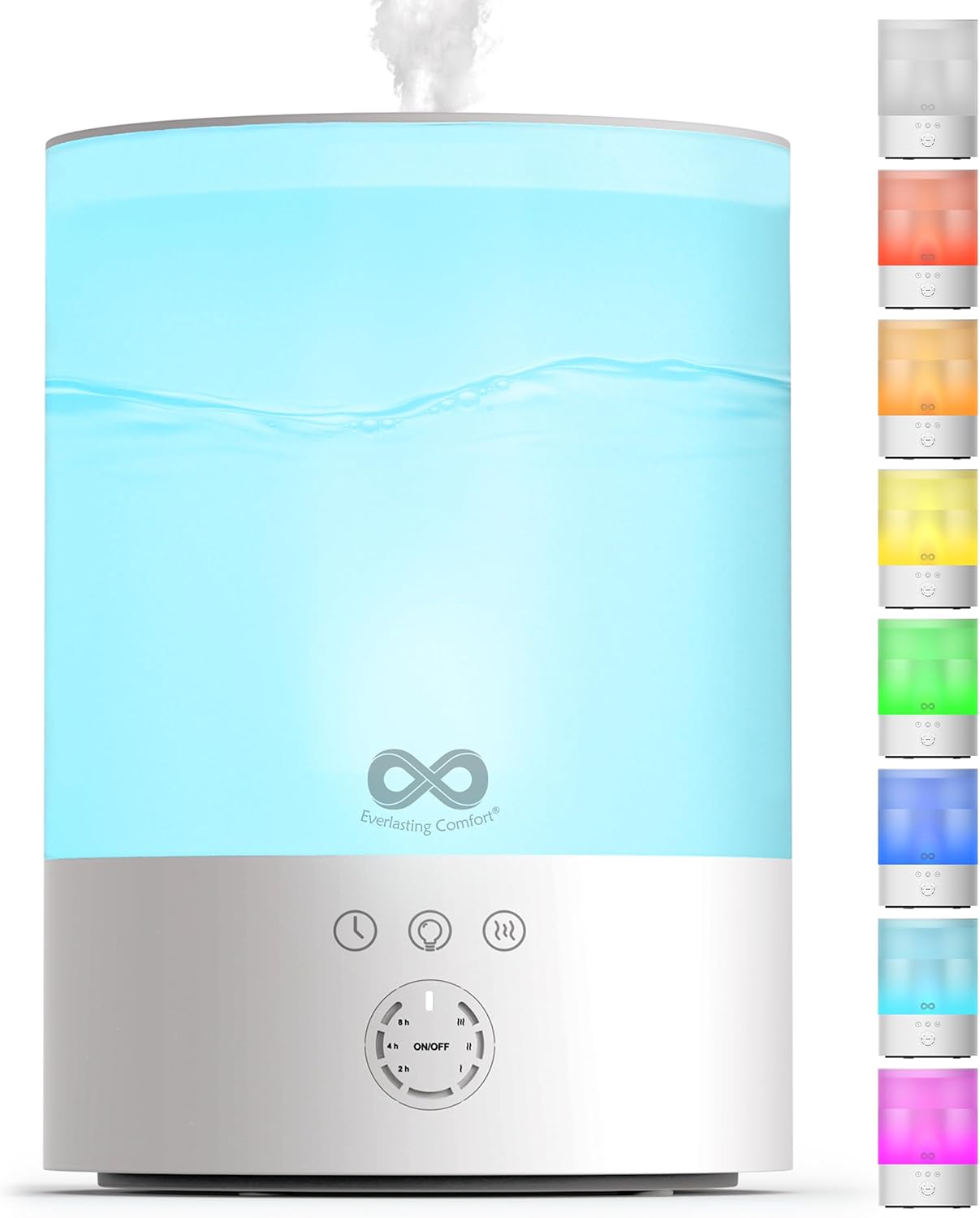
This Everlasting Comfort 2.5L top‑fill humidifier delivers steady cool mist for up to 24 hours and is built with a user-friendly, leak‑resistant design that makes daily use simple. It uses ultrasonic vibration to produce mist quietly at about 28 dB, so it can run in the background without disturbing sleep or work. Controls are touch‑based with adjustable mist output (high/medium/low) and 2/4/8 hour timer settings, while auto shut‑off and dry‑run protection stop the unit when water runs low. The wide top opening and filterless tank reduce maintenance time and make refills and cleaning straightforward. Additional features include an 8‑color LED night light and compatibility with a few drops of essential oil for aromatherapy. Important limits for grow tent use are the modest 2.5L capacity and room coverage rating aimed at living spaces rather than tightly controlled grow environments, so you will need more frequent refills and careful humidity monitoring if used in an enclosed tent. For growers who prioritize quiet, simple maintenance, this unit offers reliable baseline humidification but is not a precision greenhouse controller.
Best for: Growers who want a low‑maintenance, quiet humidifier that provides reliable baseline moisture in small tents and who favor easy cleaning and simple controls over precise automated humidity control.
Less Ideal for: Do not choose this unit if you need continuous, large‑volume humidification or integrated humidity sensing and PID‑level control for tightly regulated grow tents.
- Top‑fill 2.5L tank is easy to refill and clean
- Whisper‑quiet ultrasonic operation suitable for overnight use
- Touch controls with adjustable mist levels and timer options
- Auto shut‑off and dry‑run protection improve safe continuous operation
- Filterless design reduces replacement costs and maintenance steps
- 2.5L capacity requires frequent refills for medium or large grow tents
- No built‑in hygrometer or precise humidity control for tight environmental management
Verdict: A quiet, easy‑to‑clean 2.5L humidifier that reliably adds baseline moisture for small grow tents when simple, low‑maintenance operation is the priority.
Pure Enrichment MistAire Humidifier
| Capacity | 1.5 liters |
|---|---|
| Floor Area | 250 square_feet |
| Operation Mode | Ultrasonic |
| Runtime | 25 hours |
| Power Source | ETL Certified AC Power Adapter |
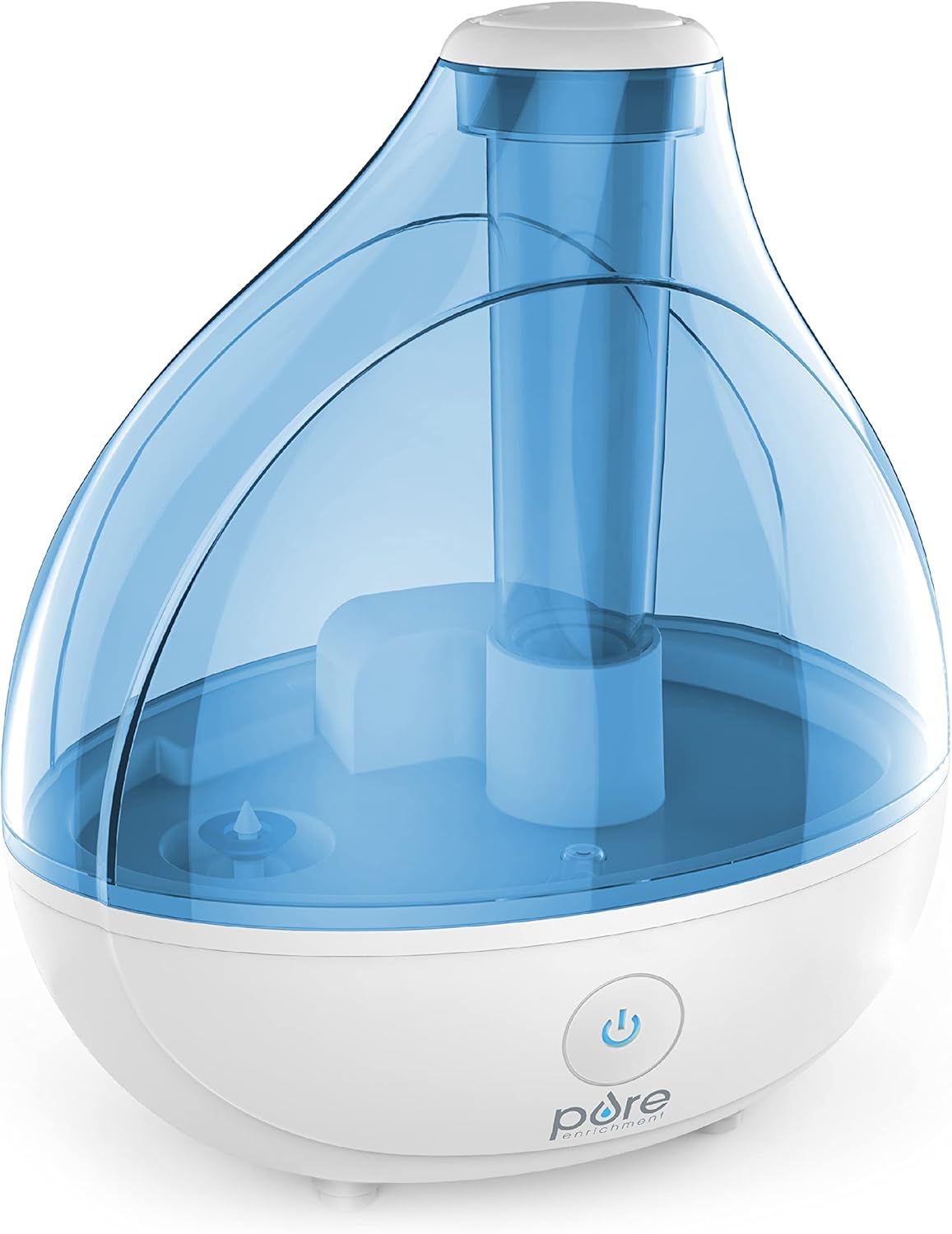
The MistAire uses ultrasonic cool-mist technology to humidify spaces up to about 250 square feet with two mist settings and a 360° nozzle for directional output. It is typically filled at the sink and placed on a table or shelf; the transparent 1.5–1.7 liter tank and auto shut-off make refill and unattended overnight use straightforward. The unit runs quietly and includes a soft night light, which helps if you need near-silent operation during lights-off periods. Its touch controls and ETL-certified AC adapter simplify setup, and the package includes a small cleaning brush to help prevent mineral buildup. On the downside, the tank is modest in size for continuous high-humidity demands and the MistAire lacks precise humidity sensing or timers, so maintaining tight RH bands for sensitive grow tents will require external monitoring and more frequent refills when running at high output.
Best for: Growers who value a simple, quiet humidifier to support a single small tent or cloning/seedling area and prefer proven product reviews and brand reliability.
Less Ideal for: Users needing automated humidity control for multiple or large grow tents or those who require precise RH regulation without separate sensors and controls.
- Quiet ultrasonic operation suitable for overnight use
- 360° mist nozzle and two output settings for directional control
- Transparent tank with easy top fill and automatic shut-off for safety
- Includes AC adapter and cleaning brush to simplify setup and maintenance
- No built-in hygrometer or automatic humidity control
- Smaller tank capacity requires regular refilling under sustained high output
Verdict: A reliable, quiet cool-mist unit for a single small grow tent or seedling station when paired with external humidity monitoring.
VIVOSUN AeroStream H05 5L Humidifier

| Capacity | 5 liters |
|---|---|
| Operation Mode | Ultrasonic |
| Floor Area | 150 square_feet |
| Filter Type | Carbon |
| Other Special Features of the Product | Quiet |
The VIVOSUN AeroStream H05 is a grow-focused ultrasonic humidifier built around precise environmental control and app connectivity. It uses an external temperature and humidity probe for accurate readings and offers 1% humidity resolution plus VPD monitoring through the Vivosun app, so you can set targets and let the unit auto-adjust mist output. The 5 L tank and included vapor outlet with flexible hose let you place the main unit outside a tent while delivering humidity inside, which keeps electronics and plants separate. Phantom mode mutes the display to avoid light disturbance, and the opaque tank reduces internal light exposure and visible buildup. Smart features include Wi‑Fi control, saved grow recipes, timers, and integration with the Vivosun Smart Grow System. Practical limitations are the relatively short listed runtime under one spec line and the need to rely on the app for advanced automation; users who want fully offline or ultra-long runtime solutions may need alternatives. Daily use centers on maintaining steady humidity in small grow tents or rooms, with periodic refills and routine cleaning guided by the included instructions and video.
Best for: Growers who prioritize stable, measurable humidity in small tents and prefer remote control and recipe-driven automation to maintain plant environments with minimal hands-on adjustments.
Less Ideal for: Large commercial grows or setups that need very long unattended runtimes or prefer entirely offline, non‑app-based control.
- Precise external humidity and temperature probe for accurate control
- Wi‑Fi app control with VPD monitoring and customizable grow recipes
- 5 liter capacity and flexible hose allow unit placement outside a grow tent
- Phantom mode and opaque tank reduce light exposure for sensitive plants
- Ultrasonic operation is quiet for indoor grow environments
- Listed runtime entry is limited to 3 hours which may require frequent refills depending on settings
- Advanced automation depends on the app and Smart Grow System integration rather than fully built-in schedules
Verdict: For small grow tents, this smart 5 L humidifier delivers precise, app-driven humidity and VPD control while letting you keep the unit outside the tent for cleaner, quieter operation.
Choosing the Right Humidifier for Grow Tents: Key Factors to Consider
Humidity Output Range and Control
Grow tents often require precise humidity setpoints for different phases like cloning, vegetative growth, and flowering. A humidifier that offers adjustable output in small increments allows you to maintain those setpoints without large swings. Variable controls or a built-in humidistat can automate corrections and reduce manual intervention.
If output is too coarse or too powerful for a small tent, you can oversaturate the canopy or cause condensation on walls, which increases the risk of mold and disease. Conversely, insufficient maximum output means the unit will struggle to keep relative humidity up when lights or heat sources dry the air.
Tank Capacity and Runtime
Tank capacity determines how often you need to refill and how predictable your schedule will be. For grow tents you often want a unit that can run through a dark cycle or multiple workdays without attention. Longer runtime reduces the chance of humidity crashes that stress plants.
Remember that runtime varies with output setting and ambient conditions. A larger tank increases unattended runtime but also takes more space inside the tent or on a shelf. Consider how often you can realistically check and refill the unit when choosing capacity.
Ease of Maintenance and Cleaning
Humidifiers that are easy to disassemble and clean reduce the buildup of mineral deposits and biofilm. For grow tents this is critical because dirty tanks or wicks can harbor bacteria and mold that then circulate into the grow space. Look for accessible reservoirs, removable wicking elements, and parts that can be rinsed or scrubbed without tools.
Frequent maintenance tasks should be straightforward. If the unit requires complex disassembly or special cleaners, you may skip maintenance and risk plant health. Models that minimize standing water areas and use antimicrobial materials can also lower upkeep frequency.
Size, Placement, and Mounting Options
Grow tents have limited floor and shelf space, so the humidifier's physical footprint matters. Compact units fit on shelves or in corners, while larger tanks might need to sit outside the tent with tubing routed in. Some humidifiers offer hanging or wall-mount features that help position the mist away from the canopy and avoid direct wetting of leaves.
Consider where the unit will sit relative to fans and vents. Proper placement helps the tent circulation distribute humidity evenly and prevents puddling near plants.
Control Integration and Automation
Automation reduces guesswork. Units that accept external humidistats, have built-in sensors, or offer timer modes let you maintain specific humidity windows tied to light cycles. Integration with a controller can make tight control feasible, especially in tents with variable ventilation schedules.
If the humidifier lacks automation, you will need to monitor and adjust it frequently. For small operations, simple built-in controls may suffice. For multi-tent setups, external control and remote monitoring are worth considering.
Water Type, Filtration, and Mineral Management
Tap water can leave mineral deposits that affect mist output and leave white dust on foliage and equipment. Some humidifiers tolerate hard water better or include simple filters to reduce deposits. Where heavy mineralization is a concern, units with replaceable filters or compatibility with distilled water are advantageous.
Consider how easy it is to service or replace filtration components. If you plan to use RO or distilled water, confirm the tank and seals are compatible and that maintenance intervals align with your routine.
Sizing a Humidifier to Tent Volume
Calculate your tent's internal volume in cubic feet to estimate the humidity load you need to supply. Larger volume and higher ventilation rates both increase how much moisture is required to reach and hold a target relative humidity. Start by converting tent dimensions into cubic feet and compare that to recommended coverage or output rates.
Also account for heat-generating equipment and light cycles. Lights and inline fans dry the air faster, increasing the moisture demand during lights-on periods. Choose a unit with enough output headroom to cope with peak drying conditions without frequently running at maximum setting.
- Measure length × width × height to get cubic feet.
- Factor in ventilation rate: higher exchange needs more humidification.
- Allow some output headroom for lights-on conditions.
Placement Tips to Avoid Foliage Wetting and Mold
Position the humidifier so mist is introduced into the airflow rather than sprayed directly at plants. Direct wetting can promote disease, especially on dense canopies. Use a small mixing fan or place the unit near an intake to distribute humidity evenly.
If the unit sits on a shelf, tilt or direct the mist outlet upward and towards the center of the tent. When using external-tank solutions, route tubing into a higher point in the tent to allow mist to dissipate before reaching the canopy.
- Avoid aiming mist directly at leaves.
- Introduce humidity into circulating airflow for even distribution.
- Keep the unit off the floor to limit accidental spills near electrical gear.
Managing Minerals and Preventing White Dust
White dust originates from dissolved minerals in the water that are aerosolized by ultrasonic and some impeller-type humidifiers. If white dust is observed on leaves or reflective tent walls, switch to distilled water or use models with demineralization cartridges.
Regularly clean the reservoir and any removable parts to remove deposits before they impair output. If you cannot use distilled water, plan for more frequent maintenance and consider a unit that isolates mineral-laden components for easier replacement.
- Use distilled or RO water to minimize white dust.
- Choose humidifiers with removable filters or cartridges when hard water is unavoidable.
- Scrub and rinse tanks on a regular schedule to prevent buildup.
Noise, Heat, and Impact on Tent Climate
Humidifiers add a small amount of heat and noise to an enclosed tent. While most units are quiet at low settings, running near maximum output can increase fan or pump noise. Consider noise if you work in a shared space or if the tent is in a living area.
Heat from the unit is usually minor compared with grow lights, but in small tents every degree counts. Monitor temperature after installing the humidifier, and adjust ventilation or light schedules if you see unwanted warming.
- Check manufacturer noise ratings and user reports for practical expectations.
- Place the humidifier where its heat contribution will not create hot spots.
- Balance ventilation to remove excess heat without over-drying the tent.
Safety and Electrical Considerations
Choose units with automatic shutoff when the tank is empty to avoid dry running and potential damage. Ensure electrical connections are kept dry and use GFCI-protected outlets where available. Avoid placing the unit directly above power strips or controllers.
Inspect cords and seals regularly for wear. If you route tubing or cables through tent entries, keep shear points protected so movement does not cause shorts or leaks.
- Automatic shutoff prevents dry running and overheating.
- Keep electrical components elevated and away from potential spills.
- Use GFCI protection for added safety in damp environments.
How We Chose the Best Humidifier for Grow Tents
We focused on the attributes that directly affect plant health and day-to-day tent operation. Selection began with products designed for confined indoor grow spaces and those offering adjustable output so you can dial in a target relative humidity. We prioritized units with predictable run time and refill intervals so growers can plan maintenance around light cycles and work schedules. Ease of cleaning and parts that resist mineral buildup were required to limit downtime and reduce mold risk. Other criteria included compact footprint and compatibility with common tent setups, reliable controls such as variable mist levels or built-in humidistats, and options for continuous refill or large-capacity tanks to suit different tent sizes. Noise level and energy draw were considered because ventilation and equipment heat interact in small tents. We excluded items intended for whole-room humidification without controllable low-end output or those lacking basic safety features like automatic shutoff when empty. The resulting shortlist reflects products that balance control, runtime, ease of upkeep, and tent-friendly sizing.
Our full evaluation process is outlined in our review methodology.
FAQ
How often should I run a humidifier in a grow tent?
How often depends on tent volume, ventilation, and stage of growth. Seedlings and clones typically need higher sustained humidity, so the unit may run continuously at low output or cycle via a humidistat. Vegetative and flowering stages generally require lower humidity, so intermittent operation or timed cycles is common.
Can I use tap water in a tent humidifier?
You can, but tap water often causes mineral buildup and white dust that can settle on plants and equipment. If you must use tap water, plan for more frequent cleaning or use a unit with a demineralization cartridge. Distilled or RO water reduces maintenance and dust issues.
Where should I place the humidifier inside the tent?
Place it so mist enters the tent airflow rather than spraying leaves directly. Elevated placement or routing mist near an intake helps even distribution. Keep the unit off the floor and away from power strips and controllers to minimize spill risk.
Do humidifiers affect tent temperature?
Most humidifiers add minimal heat, but in small tents even a few degrees can matter. Monitor temperature after installation and adjust ventilation or light schedules if you notice unwanted warming at higher humidifier settings.
Is an external humidistat necessary?
An external humidistat is not always necessary but it provides more accurate and repeatable control, especially when tent ventilation varies with fans or environmental conditions. Built-in controls can work for single tents with stable conditions, while external sensors are helpful in precision setups.
Final Verdict
Choose a humidifier that matches your tent volume and the humidity needs of the plants you grow. Prioritize precise output control and sufficient tank capacity to minimize crashes, and factor in ease of cleaning to reduce disease risk. Balance placement, automation, and water management against your maintenance rhythm. When in doubt, opt for a unit that offers adjustable output plus reliable runtime and accessible maintenance. That combination delivers consistent humidity with less hands-on work, letting you focus on other aspects of plant care.