
Note: This article contains affiliate links. If you click on these links and make a purchase, we may earn a small commission at no extra cost to you. This helps support our research and content. Read our full affiliate disclosure here.
If you store or play guitars in a dedicated room, controlling humidity is one of the simplest steps you can take to protect tone, playability, and finish. A room humidifier designed for instruments smooths seasonal swings that cause neck warping, finish checking, and buzzing frets. This guide shortlists the six best humidifiers for guitar rooms, focusing on models that deliver stable relative humidity, gentle air distribution, and reliable runtime. Below you will find concise product picks followed by the decision factors we used, so you can match a humidifier to your room size, instrument mix, and maintenance habits.
Top Picks at a Glance
| Best Overall The best all-around choice for most situations | DREO 6L Smart Humidifier |  |
| Best Quality Built to a higher standard if you want something more solid | Vornado EVDC500 Humidifier |  |
| Best Value The sweet spot between price and what you get | Everlasting Comfort 6L Humidifier |  |
| Best Budget The cheapest option that still gets the job done reliably | Clarston 2L Cool Mist Humidifier |  |
| Top Rated A top-rated pick with lots of positive feedback | Levoit Classic 160 Humidifier |  |
| Most Popular A crowd favorite that many people choose with confidence | Levoit Classic 160 Humidifier |  |
DREO 6L Smart Humidifier

| Capacity | 6 Liters |
|---|---|
| Max Runtime | 60 Hours |
| Mist Type | Warm & Cool Mist |
| Effective Area | 100-550 ft² |
| Control Method | Voice, App, Touch |
The DREO 6L Smart Humidifier is a large-room humidifier that delivers warm and cool mist from a dual mist system and is designed to run for extended periods without refilling. You set a target humidity in Auto mode and the unit uses a built-in sensor and app connectivity to maintain it within a narrow 5% tolerance, or switch to Manual for three mist levels and Sleep for quiet overnight use. MistWave tech pushes a 40-inch tall plume and the 6L tank supports up to about 60 hours of runtime at lower outputs, which is useful for continuous humidity control. It also offers a dimmable indicator light, dual-aroma pads, and compatibility with Alexa and Google for voice control and remote scheduling. Practical limitations include its relatively large footprint and the need for occasional cartridge or filter accessories to reduce mineral buildup if you have hard water. For a guitar room this unit provides stable, automated humidity control and low-noise night operation but you should place it so the mist does not blow directly on instruments.
Best for: Buyers who want a dependable, low-maintenance humidifier that holds humidity steady in a mid-to-large room and integrates with smart home controls for hands-off monitoring and scheduling.
Less Ideal for: Those needing a compact tabletop humidifier for very small spaces or anyone who prefers a strictly ultrasonic cool-mist unit without warm-mist capability.
- Large 6L tank supports long runtimes for unattended use
- Auto mode with built-in humidity sensor maintains target humidity within about 5%
- App and voice control enable remote scheduling and monitoring
- Produces both warm and cool mist with a tall, wide plume for even distribution
- Dimmable sleep mode and low noise for night-time operation
- Relatively large unit that requires floor or shelf space
- May need demineralization cartridge or scale-inhibitor in hard-water areas
Verdict: Provides reliable, long‑runtime automatic humidity control with smart app and voice features ideal for keeping a guitar room at consistent humidity.
Vornado EVDC500 Humidifier

| Capacity | 2 gallons |
|---|---|
| Floor Area | 1000 square_feet |
| Operation Mode | Evaporative |
| Wattage | 9 watts |
| Control Method | Touch |
The Vornado EVDC500 is an evaporative whole-room humidifier designed to keep large spaces comfortably humid without the white dust or mist of ultrasonic units. It uses a DC Energy Smart motor that the manufacturer says consumes substantially less power than standard AC designs, and the dual SimpleTank system provides two 1-gallon top-fill tanks for easier refills and cleaning. The built-in electronic humidistat and low-water indicator let you set a target humidity and have the unit maintain it automatically, while four fan speeds let you adjust output for bedrooms, living rooms, or dedicated spaces like a guitar room. Evaporative operation means moisture is dispersed naturally across the room and you do not have to worry about mineral deposits from tap water, but output is tied to air circulation and may take longer to change humidity than misting models. The unit is designed for up to 1,000 square feet and includes wick filters and an automatic shutoff when tanks are empty, making it a low-maintenance option for long-term humidity control.
Best for: Buyers who prioritize steady, energy-efficient humidity control and low-maintenance operation for a dedicated room where preserving wood instruments and stable humidity is important.
Less Ideal for: Users who need very fast humidity changes or visible mist for spot treatment should consider active misting models instead.
- Energy Smart DC motor for much lower power use than typical AC humidifiers
- Dual 1-gallon SimpleTanks that are top-fill and easy to remove for cleaning
- Electronic humidistat with auto humidity control and low-water indicator for set-and-forget operation
- Evaporative design that avoids white dust and uses wick filtration for low maintenance
- Evaporative output depends on air circulation so humidity changes can be slower than warm or ultrasonic mist models
- Requires replacement wick filters over time to maintain performance
Verdict: A low-energy, whole-room evaporative humidifier that reliably maintains set humidity levels with easy-to-use dual tanks, ideal for protecting guitars in a dedicated room.
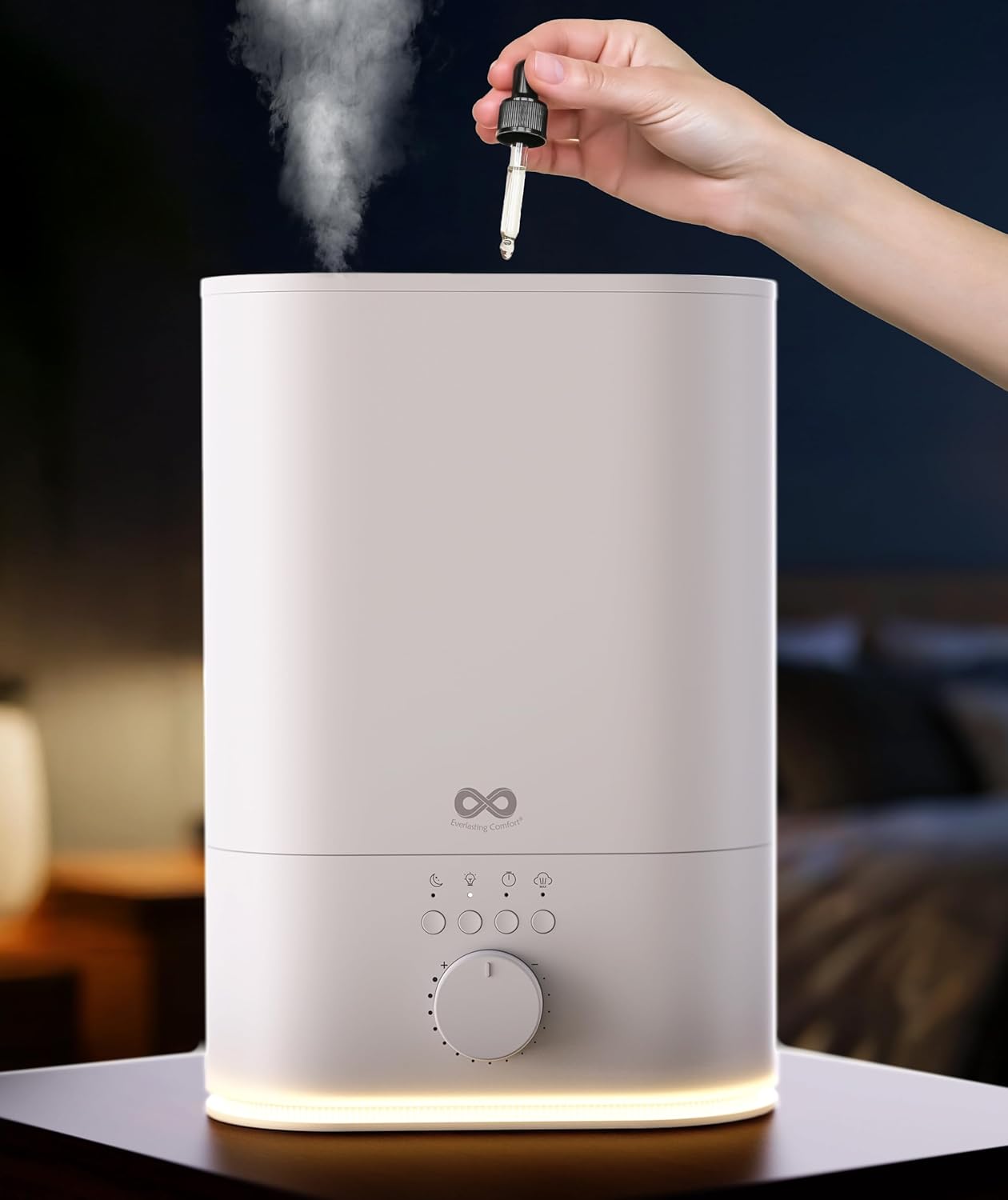
Everlasting Comfort 6L Humidifier
| Capacity | 6 liters |
|---|---|
| Floor Area | 500 square_feet |
| Operation Mode | Ultrasonic |
| Wattage | 38 watts |
| Control Method | Touch |
This Everlasting Comfort humidifier is built around a large 6L top‑fill tank and ultrasonic cool‑mist output that can run up to roughly 50 hours between refills, making it practical for steady humidity control in a guitar room. The filterless design and wide opening make cleaning and maintenance straightforward, while touch controls, adjustable mist levels, timer and sleep mode let you tune runtime and noise for overnight use. A 360° rotating nozzle helps distribute moisture across the space and the unit runs quietly enough to sit near instruments without adding distracting fan noise. It also includes a small tray for essential oils if you want a light scent, though that is separate from humidity control. Limitations include the lack of a built‑in hygrometer or auto‑humidistat, so you will need an external humidity monitor to maintain precise percentages preferred for wooden instruments, and the unit is corded so placement depends on outlet access.
Best for: Players who want a low‑maintenance, long‑run humidifier to keep a guitar room consistently moist without frequent refills and who are comfortable monitoring humidity with a separate meter.
Less Ideal for: People who need automatic, set‑and‑forget humidity control or integrated digital humidity readouts should consider models with built‑in humidistats instead.
- 6 liter tank provides long runtime (up to ~50 hours) for fewer refills
- Top‑fill, wide opening simplifies cleaning and maintenance
- Whisper‑quiet ultrasonic operation suitable for quiet rooms
- Adjustable mist levels and 360° nozzle for even coverage
- Filterless design eliminates recurring filter replacement
- No built‑in hygrometer or automatic humidity control
- Requires proximity to a power outlet because it is corded
Verdict: A practical, low‑maintenance 6L ultrasonic humidifier that delivers long runtime and quiet operation for maintaining humidity in guitar rooms when used with a separate hygrometer.
Clarston 2L Cool Mist Humidifier

| Capacity | 2 liters |
|---|---|
| Operation Mode | Ultrasonic |
| Runtime | 25 hours |
| Wattage | 25 watts |
| Floor Area | 260 square_feet |
This Clarston 2L cool mist humidifier uses ultrasonic technology to produce a fine 5μm mist that spreads evenly and helps raise indoor humidity without wetting surfaces. It has two output levels including a high setting (about 200 ml/h) for faster relief and a low setting that can run up to 25 hours from a full tank. The unit is very quiet at approximately 24 dB and includes a 360° adjustable nozzle, a seven‑color nightlight, and touch controls for simple operation. Practical touches include a wide 6‑inch top opening for easier cleaning, auto shut‑off when water runs low, and BPA‑free construction. Limitations: the 2L capacity is best suited to small to medium rooms so larger guitar rooms may need more frequent refills or a larger-capacity unit, and only water‑soluble essential oils are supported. For guitar rooms the fine mist and quiet operation help protect wood instruments from rapid humidity swings without creating noticeable noise or visible dampness.
Best for: Owners of small to medium guitar rooms who want a low‑noise, easy‑to‑maintain humidifier that delivers steady humidity overnight to protect wooden instruments.
Less Ideal for: Large rehearsal spaces or players who prefer a hands‑off solution for long multi‑day humidification without refilling should consider higher‑capacity models.
- Very quiet operation (~24 dB) suitable for night use or silent practice sessions
- Up to 25 hours runtime on low from the 2L tank for overnight humidity
- 5μm ultrafine mist disperses evenly without soaking surfaces
- Wide 6‑inch top opening and simple top‑fill design make cleaning and refills easy
- Auto shut‑off and BPA‑free materials for safer use around instruments and in studios
- 2L tank may require daily refills in larger guitar rooms or dry climates
- Only supports water‑soluble essential oils which limits aroma options
Verdict: A quiet, budget‑friendly 2L ultrasonic humidifier that provides steady overnight humidity and easy maintenance for small to medium guitar rooms.
Levoit Classic 160 Humidifier

| Capacity | 2.5 liters |
|---|---|
| Runtime | 25 hours |
| Operation Mode | Ultrasonic |
| Power | 17 watts |
| Control Method | Touch |
The Levoit Classic 160 is a compact top-fill ultrasonic humidifier that keeps a small room evenly humidified without fuss. Its 2.5 liter tank and low-speed runtime of up to 25 hours make it suitable for overnight use, and the easy top-fill design plus wide opening simplifies refilling and routine cleaning. Controls are simple with a touch interface and a single knob to adjust mist output while the 360 degree rotating nozzle helps direct moisture where you need it. The unit runs very quietly at around the advertised 26 to 28 dB, which is helpful in a guitar room where you want to avoid noise and maintain instrument stability. Safety features include a float-controlled auto shut-off and BPA-free materials. Limitations to note are the lack of precise humidity control or a built-in hygrometer, so you will need a separate hygrometer to monitor and fine-tune humidity for sensitive instruments, and replacement wick filters are recommended if you want particle filtration and improved efficiency.
Best for: Buyers who prioritize a reliable, low-maintenance humidifier that runs quietly overnight and is easy to fill and clean, especially for small dedicated rooms.
Less Ideal for: Users who need precise, automated humidity control or integrated humidity monitoring for highly sensitive musical instruments should consider units with built-in hygrometers and auto-humidistats.
- Top-fill tank and wide opening make refilling and cleaning fast and spill-free
- Long runtime up to 25 hours at low setting for overnight operation
- Ultra-quiet operation (around 26–28 dB) suitable for quiet rooms
- 360° rotating nozzle lets you direct mist toward specific areas
- No built-in hygrometer or automatic humidity control
- Uses a wick filter for filtration which requires periodic replacement
Verdict: A dependable, easy-to-use quiet humidifier that keeps small rooms stable overnight when you want low noise and minimal upkeep.
Levoit Classic 160 Humidifier

| Capacity | 2.5 liters |
|---|---|
| Runtime | 25 hours |
| Operation Mode | Ultrasonic |
| Noise Level | 26–28 dB |
| Power | 17 watts |
The Levoit Classic 160 is a small ultrasonic cool-mist humidifier built for straightforward daily use in bedrooms, nurseries, or dedicated hobby spaces like a guitar room. Its 2.5 liter top-fill tank makes refills simple and cleaning easier because you can reach inside without flipping the reservoir. A single control knob adjusts mist output and a 360° nozzle lets you direct humidity where instruments or furniture need it. It runs quietly at about 26–28 dB on low and can operate up to 25 hours between fills, so it can run overnight without disturbing practice or sleep. Safety is addressed by an auto shut-off when water runs low and a red indicator to signal refills. Practical limitations include the lack of a built-in humidistat or auto humidity control, so you must monitor humidity levels yourself, and using tap water can produce mineral "white dust," which Levoit warns against and recommends distilled water to avoid. Replacement filter sponge maintenance is required periodically depending on water hardness.
Best for: Buyers who want a compact, low-noise humidifier to maintain consistent moisture in a small guitar room or practice space and who prefer simple manual controls and easy maintenance.
Less Ideal for: People who need automatic humidity regulation or whole-room coverage for larger studios should consider models with a built-in humidistat and higher output.
- Top-fill 2.5 L tank for easy refills and cleaning
- Very quiet operation (26–28 dB) suitable for overnight use
- Runs up to 25 hours on low, reducing refill frequency
- 360° adjustable nozzle for directing mist toward instruments or room areas
- Auto shut-off with low-water indicator improves safety
- No built-in humidistat or automatic humidity control
- May produce mineral white dust if tap water is used
Verdict: A quiet, easy-to-fill humidifier that delivers long overnight runtime and precise mist direction, making it a practical choice for keeping guitars safe in small practice rooms.
Choosing the Right Humidifier for Guitar Rooms: Key Factors to Consider
Target Relative Humidity Range
Choosing an appropriate humidity setpoint is the foundation of instrument care. Guitars and other wooden instruments are happiest in a fairly narrow band of relative humidity. If you aim too low, wood shrinks and joints can loosen. If you set humidity too high, glue lines and finishes can soften and fretboard swelling can lead to buzzing. Select a humidifier that can reliably maintain the target range for your instrument types, and check whether the unit offers a precise setpoint or only graduated low-medium-high controls.
Also consider how quickly the unit responds to changes. A system that overshoots then cuts out can create repeat cycles that stress wood. For rooms with frequent door openings or heaters, a model with fine-grained control and a responsive sensor is preferable.
Room Size and Coverage
Match the humidifier's specified coverage to the actual volume of your guitar room. Manufacturers sometimes list square footage based on ceiling heights that vary from your space, so estimate the cubic footage to be safe. Underpowering a unit leads to constant running and short runtimes between refills. Overpowered units can create localized high-humidity zones near the outlet that risk finish damage.
Consider whether a single central unit can serve the whole room or if you need multiple smaller units placed strategically. Also factor in doorways, ducting, or open storage cases that can alter effective coverage.
Noise Level During Use
Noise is a practical concern in practice rooms and home studios. Fans, pumps, or ultrasonic transducers can introduce hums, whines, or rattles that interfere with playing, rehearsing, or recording. Look for units with documented decibel ratings or reviewer measurements. Designs with larger, slower fans or passive airflow often run quieter than small high-RPM blowers.
Think about typical usage times. If you record at night or practice in the evening, aim for a unit with exceptionally low vibration and a quiet motor. Also verify whether the unit's sound signature is tonal (annoying) or broadband (less distracting).
Mist Type and Finish Safety
Different humidifiers produce moisture in different ways. Warm steam units heat water, which can produce localized hot vapor and mineral deposits. Ultrasonic and evaporative models create fine mist or promote natural evaporation, which tends to be gentler on instrument finishes. For vintage or nitrocellulose-finished instruments, avoid concentrated hot outputs and aim for even, diffused distribution.
Also consider mineral buildup if you have hard water. Some designs include demineralization cartridges or recommend distilled water to prevent white dust and residue that can settle near instruments.
Maintenance and Upkeep
A humidifier only protects instruments if it is maintained. Look for units with easy-fill tanks, wide openings for cleaning, and clear indicators for water level and filter replacement. Complex top-load or sealed modules that require special tools discourage routine cleaning and increase mold risk. Removable tanks that fit easily in sinks speed refilling and cut down on spills.
Maintenance also includes filter availability and cost. If the unit uses disposable cartridges, verify expected replacement frequency and whether alternatives exist. Units with simple washable filters or no filters at all tend to be easier to keep functioning properly over time.
Control Options and Monitoring
A humidifier that offers precise controls and monitoring saves hassle. Built-in hygrostats or compatibility with external hygrometers lets you maintain stable RH without constant checks. Digital displays, app connectivity, or programmable timers can be useful but are secondary to reliable sensor feedback. Avoid units that advertise smart features but lack accurate local sensing; remote sensors that sit near instruments are preferable to basing control on a damp corner of the room.
Redundancy matters too. Consider pairing the humidifier with an independent stand-alone hygrometer so you can verify the unit's reporting and catch calibration drift.
Optimal Humidity Targets for Different Instruments
Different stringed instruments and finishes respond differently to humidity. Acoustic guitars and classical instruments with solid wood bodies typically do best in the mid 40s to mid 50s relative humidity. Electric guitars with laminated bodies tolerate a slightly wider band but the neck and fingerboard materials still benefit from steady RH. Extended ranges are sometimes acceptable for short-term storage, but long-term exposure to levels outside the recommended band increases the risk of warping, cracking, and saddle or nut movement.
If you keep multiple instrument types in the same room, choose a conservative midpoint and monitor carefully. Small changes in humidity will show on neck relief and action long before structural damage occurs, so regular checks let you dial in the humidifier without risking finishes.
- Acoustic guitars: aim for 45%–55% RH
- Electric guitars: safe around 40%–55% RH
- Classical instruments: lean toward the higher end within the recommended band
Placement Tips to Avoid Localized Over-Humidification
Where you place a humidifier in the room affects how evenly moisture spreads. Avoid positioning the outlet directly aimed at instrument cases, stands, or amp cabinets. Instead, select a central location or a higher shelf where airflow can distribute moisture more evenly across the room.
Keep units at least a few feet from wooden necks and bodies to prevent concentrated wetting. If your humidifier has directional vents, use them to encourage mixing rather than a steady jet on a single instrument. When in doubt, monitor relative humidity at instrument height rather than floor level.
- Place unit centrally or elevated for better mixing
- Avoid directing output at instruments or finishes
- Check RH at instrument height and near storage cases
Water Quality and Residue Management
Water quality affects maintenance and cleanliness. Hard water increases mineral residue that can settle as white dust, which may attract grime on cases and hardware. Where possible, use distilled water or models with demineralization filters to reduce deposits. Some ultrasonic units are particularly prone to visible residue if filled with untreated water.
Schedule periodic cleaning to prevent biofilm growth inside tanks and channels. Follow the manufacturer's recommended cleaning intervals, and use a mild vinegar solution or the recommended descaler when mineral buildup appears. Proper upkeep keeps the humidifier working efficiently and prevents odors or mold.
- Use distilled water to minimize mineral deposits
- Clean tanks regularly to avoid biofilm and odors
- Replace or clean any demineralization media per guidance
Integrating a Hygrometer for Peace of Mind
An independent hygrometer is the simplest way to verify humidity control. Built-in sensors can drift over time or be influenced by placement, so a separate calibrated meter placed at instrument height gives a true reading of the environment. Choose meters with clear displays and data logging if you want to track seasonal trends.
Use the hygrometer readings to tune the humidifier's setpoint rather than trusting default settings. Over time, you will learn how your room responds to external weather and heating, and you can adjust routines accordingly to maintain stability.
- Place hygrometer at instrument height, away from vents
- Compare readings with the humidifier's sensor regularly
- Consider models with logging to track seasonal changes
Quiet Operation for Recording and Practice
If your guitar room doubles as a recording space, prioritize units that run below typical ambient noise levels for microphones. Look for humidifiers described as 'whisper-quiet' or those with large low-speed fans. Mechanical pumps or ultrasonic transducers can offer quiet operation, but installation and maintenance differences affect long-term noise performance.
Also consider vibrational coupling. A quiet fan mounted on a hard shelf can still transmit structure-borne noise to stands or instrument racks. Use vibration-absorbing pads or place the unit on a soft surface to cut transmitted noise if necessary.
- Aim for the quietest unit you can reasonably maintain
- Isolate the unit from racks to prevent vibration transfer
- Test at typical practice volumes to confirm acceptable noise
How We Chose the Best Humidifier for Guitar Rooms
We prioritized features that directly affect instrument health and day-to-day usability in a guitar room. First, humidity control accuracy matters most because instruments respond poorly to repeated RH swings; we favored devices with reliable sensors or compatibility with external hygrostats. Second, coverage and runtime were evaluated to ensure a single unit can maintain target humidity overnight or during long sessions without frequent refills. Third, quiet operation and airflow patterns were considered so the unit does not interfere with recording or practice. Fourth, output type and mist quality matter for finish safety and mold prevention; we preferred systems that produce fine, even moisture rather than concentrated hot streams. Fifth, ease of maintenance and ease of filling reduce the chance a unit will be neglected, which negates any humidity benefits. We excluded units designed only for personal, one-person desktop use and commercial industrial humidifiers because they do not match the typical guitar-room environment. Our selection filter removed products that lack basic user-adjustable humidity control, have poor maintenance access, or that rely on vague runtime claims without humidity-stability data. The result is a list of units that balance accurate RH control, suitable coverage, low noise, and practical upkeep.
Our full evaluation process is outlined in our review methodology.
FAQ
What relative humidity should I keep in a guitar room year-round?
A stable range around 45% to 55% relative humidity is a good target for most guitars. Stability matters more than exact numbers, so avoid wide daily swings and use a humidifier with reliable control to maintain the band.
Can I use steam or warm-mist humidifiers near guitars?
Warm-mist units can create localized hot vapor that is not ideal near delicate finishes. If you use a warm-mist device, place it far from instruments and ensure the output disperses well. Ultrasonic or evaporative models are generally gentler for instrument rooms.
How often should I refill and clean a guitar-room humidifier?
Refill frequency depends on tank capacity and runtime, but plan regular checks at least every few days. Clean the tank and components following the manufacturer schedule, usually every one to four weeks, to prevent mold and mineral buildup.
Do I need distilled water for my humidifier?
Distilled water is recommended to reduce mineral deposits and white dust, especially for ultrasonic models. If you must use tap water, consider a unit with demineralization media and clean more often to manage residue.
Will a humidifier fix buzzing and fret issues immediately?
Humidity changes affect neck relief and action gradually. Correcting low humidity can improve buzzing over days to weeks as wood re-equilibrates. Monitor and adjust slowly to avoid overcorrection.
Final Verdict
Protecting guitars starts with stable humidity and a humidifier selected to match room size, noise tolerance, and maintenance willingness. Prioritize accurate control, even coverage, and a mist type that is safe for instrument finishes. Balance runtime and tank size against how often you can refill and clean the unit. With those tradeoffs clear, choose the humidifier that best aligns to your daily routines and recording or practice needs. Consistent monitoring and simple upkeep deliver the long-term benefits for tone, playability, and instrument longevity.