
Note: This article contains affiliate links. If you click on these links and make a purchase, we may earn a small commission at no extra cost to you. This helps support our research and content. Read our full affiliate disclosure here.
When your heat pump runs all winter, it can leave indoor air dry and uncomfortable. A properly selected humidifier for a heat pump restores balanced humidity, reduces static, protects wood floors and furnishings, and can make lower thermostat settings feel more comfortable. This guide covers our top shortlisted humidifiers for heat pump systems, focusing on models suited to central HVAC integration and whole-home performance. Below we evaluate each option on the control features, output capacity, installation needs, and ongoing maintenance requirements so you can pick the best fit for your home and ducted heat pump setup.
Top Picks at a Glance
| Best Overall The best all-around choice for most situations | Levoit LV600S Humidifier |  |
| Best Quality Built to a higher standard if you want something more solid | Venta LW25 Humidifier |  |
| Best Value The sweet spot between price and what you get | Coolfiqu 6L Humidifier |  |
| Best Budget The cheapest option that still gets the job done reliably | Crane Ultrasonic Cool Mist Humidifier |  |
| Top Rated A top-rated pick with lots of positive feedback | Aprilaire 600M Whole-House Humidifier |  |
| Most Popular A crowd favorite that many people choose with confidence | Levoit OasisMist 1000S 10L Humidifier |  |
| Best Seller A high-volume bestseller chosen again and again | DREO HM524 6L Humidifier |  |
Levoit LV600S Humidifier

| Capacity | 6 liters |
|---|---|
| Floor Area | 753 square_feet |
| Operation Mode | Ultrasonic |
| Power Source | ac |
| Runtime | 50 hours |
The Levoit LV600S is a hybrid ultrasonic humidifier that delivers both warm and cool mist from a 6 L tank to cover large spaces up to about 753 sq ft. It is used as a whole‑room humidifier: top-fill design for easier refills, touchscreen controls plus VeSync app and voice control for schedules and monitoring, and a sleep mode that dims displays and runs quietly. The unit offers a higher warm mist output (advertised up to 550 ml/h) and a cool mist mode (up to 300 ml/h), which helps it adapt to seasonal needs or to boost humidity quickly during dry spells. Extras include an aroma pad, pre-filters and replaceable absorption sponges, and a safety auto-off when water runs out. Practical limitations are routine maintenance needs — the manufacturer recommends weekly cleaning — and the recommendation to use distilled or filtered water to avoid white dust and residue. The humidifier is relatively feature-rich for its class but requires regular upkeep to maintain performance and hygiene.
Best for: Buyers who want a smart, whole‑room humidifier that adapts to seasonal needs and prioritizes easy scheduling, quiet night operation, and strong output for heat‑pump heated homes.
Less Ideal for: People seeking a no‑maintenance or ultra‑compact bedroom-only unit or those who prefer units that tolerate tap water without regular cleaning.
- Large 6 L tank for extended runtime between refills
- Warm and cool mist modes for seasonal flexibility and faster humidification
- Smart app and voice control with auto and sleep modes for hands-off operation
- Top-fill design and included cleaning/accessory parts simplify maintenance
- Requires weekly cleaning and filtered/distilled water to avoid mineral buildup and white dust
- Relatively high wattage compared with small room units, so not ideal for continuous low-power use
Verdict: Choose the LV600S if you want a smart, high‑output warm-and-cool mist humidifier that reliably humidifies large rooms and integrates with app and voice controls.
Venta LW25 Humidifier
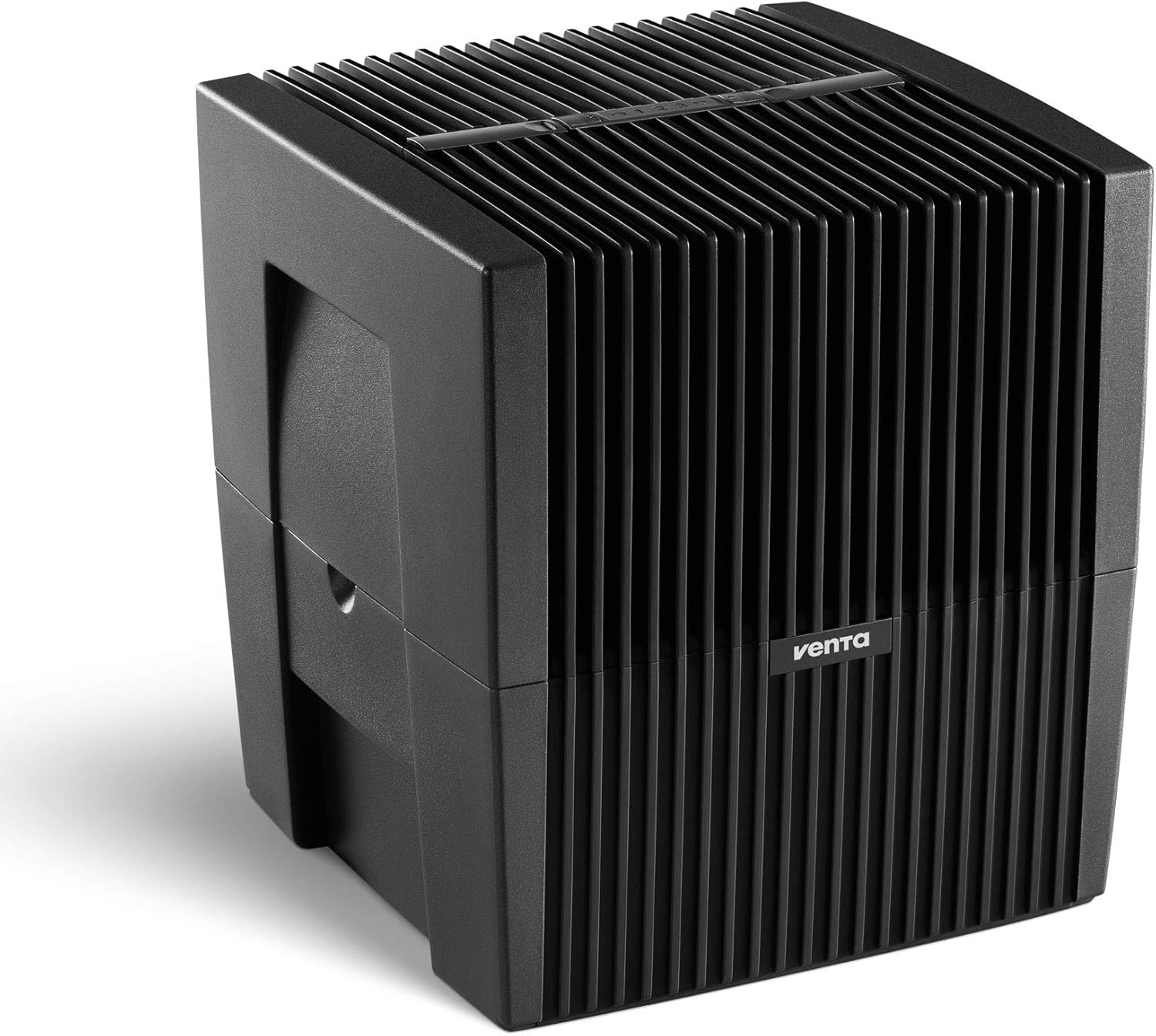
| Capacity | 2 gallons |
|---|---|
| Floor Area | 430 square_feet |
| Operation Mode | Evaporative |
| Wattage | 8 watts |
| Control Method | Touch |
The Venta LW25 uses a rotating disk stack in a 2-gallon reservoir to deliver mist-free evaporative humidification for spaces up to about 430 square feet. It runs continuously and is meant to raise and maintain indoor relative humidity in the 40–60% range without over-humidifying, which helps reduce static and protect wood furniture and instruments. The unit is filter-free, safe for tap water, and consumes very little power at about 8 watts, making it inexpensive to run long-term. Controls are touch-based and the design is straightforward to clean compared with filter-based models. On the downside the LW25 is a compact, single-room airwasher rather than a whole-house solution, so larger open-plan spaces or homes with uneven airflow may still need multiple units or supplemental humidification. It also lacks humidistats or advanced automatic scheduling found on some competitors, so achieving precise humidity control requires manual monitoring or a separate hygrometer. For users who prioritize reliable, low-maintenance evaporative performance for a heat-pump-heated room, the LW25 is a practical choice.
Best for: A buyer who wants reliable, low-maintenance humidification for a single room heated by a heat pump and values steady evaporative performance over smart features.
Less Ideal for: People seeking whole-house humidification, integrated automatic humidity control, or smart/scheduled operation should consider other solutions.
- Filter-free evaporative design reduces ongoing filter costs and maintenance.
- 2-gallon reservoir supports long continuous run times between fills.
- Mist-free cold evaporation minimizes white dust and over-humidifying risks.
- Very low power consumption (around 8 watts) for continuous operation.
- Simple touch controls and an easy-to-clean water reservoir.
- No built-in humidistat or automatic humidity control for precise set-and-forget operation.
- Designed for single-room coverage so larger or multi-zone homes may need additional units.
Verdict: Choose the Venta LW25 when you need efficient, low-maintenance evaporative humidification for a single heat-pump-heated room.
Coolfiqu 6L Humidifier

| Capacity | 6 liters |
|---|---|
| Floor Area | 500 square_feet |
| Operation Mode | Ultrasonic |
| Control Method | Touch |
| Runtime | 60 hours |
The Coolfiqu 6L is a large-capacity ultrasonic humidifier designed to run up to 60 hours per fill and cover sizable rooms. It supports both cool and warm mist selectable via touch controls, and a 360° rotating nozzle helps direct output where you need it. The top-fill tank makes refilling straightforward and less messy than bottom-fill units, and the included aroma pad lets you add essential oils for light scenting. It also has a digital display with a sleep mode that turns LEDs off for night use, plus an automatic humidistat and three mist levels so the unit can maintain a steady target humidity without constant adjustment. Safety features include an anti-dry burn auto shutoff and a low-water indicator. On the downside, ultrasonic units can leave mineral residue if you use hard tap water, so the maker recommends distilled water and periodic descaling, and warm-mist operation may consume slightly more energy. For homes with heat pumps the steady humidification and long runtime reduce the need for frequent refills and help counteract dry indoor air during heating seasons.
Best for: Buyers who prioritize long runtime, easy top-fill maintenance, and steady humidity control for larger rooms or bedrooms where preventing dry air from heat pump heating is the main goal.
Less Ideal for: People who want a no-maintenance evaporative or whole-home solution or who cannot use distilled water regularly should consider other humidifier types or home humidification systems.
- Large 6 L tank provides up to 60 hours of runtime between refills
- Top-fill design simplifies refilling and everyday maintenance
- Switchable cool and warm mist plus 360° nozzle for flexible comfort
- Built-in humidistat and three mist levels let the unit maintain consistent humidity
- Sleep mode and auto shutoff with low-water indicator improve night use and safety
- Ultrasonic operation can create mineral buildup if tap water is used frequently
- Warm-mist mode may use more power than cool-mist operation
Verdict: Choose this 6L Coolfiqu if you need long-running, easy-to-refill humidification with both warm and cool mist to combat dry air from heat pump heating.
Crane Ultrasonic Cool Mist Humidifier

| Tank capacity | 1 gallon |
|---|---|
| Run time | Up to 24 hours |
| Coverage | Up to 500 square feet |
| Safety | Automatic shut-off |
The Crane Ultrasonic Cool Mist Humidifier is a simple, user-friendly humidifier built around a one-gallon tank and ultrasonic misting to raise indoor humidity quietly. It is typically used in bedrooms, nurseries, or small living areas where continuous, low-noise operation is important; the large tank delivers up to 24 hours of run time at lower settings for minimal refilling. Controls let you adjust output to match room needs and there is an optional filter slot for users who prefer added water filtering. Practical benefits include whisper-quiet operation for sleeping spaces, an automatic shut-off that turns the unit off when the tank is empty, and a compact, attractive design that fits on nightstands. Limitations to consider are that it is a cool-mist ultrasonic unit, so mineral deposits can build up if hard water is used and occasional cleaning is required, and it does not include heated mist or advanced humidistat control built in. For basic, quiet humidity support in homes with heat pumps, it offers straightforward performance without complex features.
Best for: Buyers who want an affordable, quiet humidifier to maintain comfortable humidity in bedrooms or nurseries with minimal fuss and infrequent refills.
Less Ideal for: People who need precise humidity control for large open spaces or want a warm-mist unit for faster humidity increases should look elsewhere.
- One-gallon tank provides up to 24 hours of run time on low for infrequent refilling
- Ultrasonic operation is very quiet, suitable for bedrooms and nurseries
- Automatic shut-off when tank is empty adds safety and convenience
- Adjustable output and optional filter slot let you tailor performance
- Cool-mist ultrasonic design can leave mineral residue when using hard water
- No built-in humidistat or heated-mist option for faster humidity increase
Verdict: A quiet, budget-friendly one-gallon cool-mist humidifier that delivers long run time and simple, reliable operation for bedrooms and nurseries.
Aprilaire 600M Whole-House Humidifier
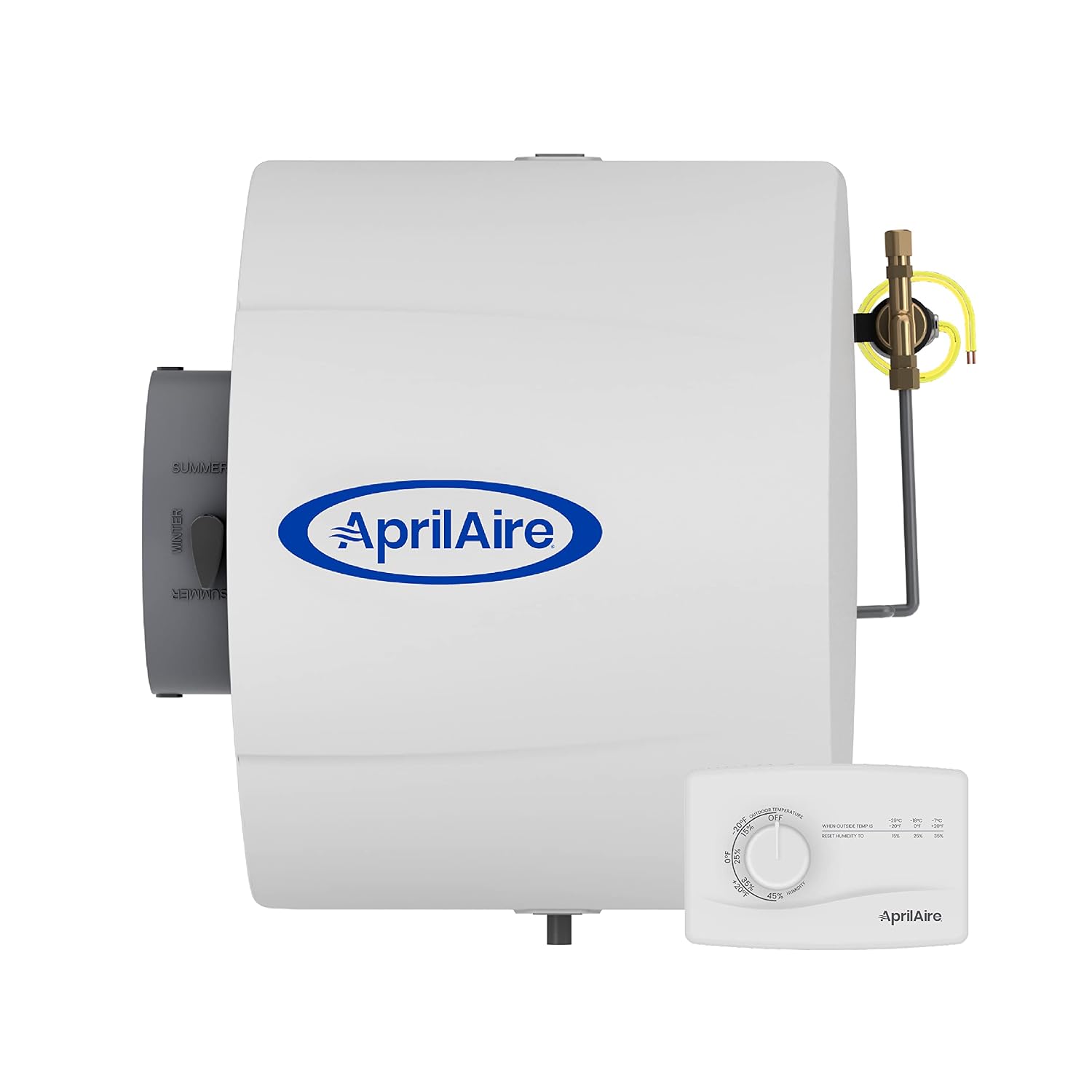
| Capacity | 17 gallons_per_day |
|---|---|
| Floor Area | 4000 square_feet |
| Operation Mode | Evaporative |
| Voltage | 24 volts_of_alternating_current |
| Control Method | Touch |
The Aprilaire 600M is a manual, bypass whole-house evaporative humidifier that ties into a forced-air HVAC system to raise indoor humidity across a home. It uses a water distribution tray and a replaceable Water Panel evaporator so furnace air passes over a moisture-laden panel and circulates humidified air through ductwork. The unit includes a built-in bypass damper, 24 VAC transformer, humidistat sensor, solenoid valve and manual control for season settings, which simplifies install and seasonal adjustment. With a rated capacity of 17 gallons per day and coverage up to about 4,000 to 5,000 square feet, it suits larger homes and runs quietly compared with portable units. Because it is an evaporative, plumbed model, it requires a water supply line, periodic Water Panel replacement, and basic HVAC-compatible installation; it does not offer automatic digital scheduling or Wi-Fi remote control. For buyers prioritizing dependable, long-running whole-home humidification integrated with a heat pump or furnace, the 600M delivers steady humidity with proven evaporative technology and straightforward serviceability.
Best for: Buyers who want a durable, factory-quality whole-house humidifier that integrates with a heat-pump or furnace system and prioritizes consistent, low-maintenance performance over smart features.
Less Ideal for: People seeking a plug-and-play portable humidifier, users who need app controls or automated scheduling, or those without access to an HVAC ducted system should look elsewhere.
- High moisture output rated at 17 gallons per day for whole-house coverage
- Includes built-in bypass damper and standard control components for simpler installation
- Supplied humidistat, transformer, valve and sensor make it ready for integration with HVAC systems
- Evaporative Water Panel design is quiet in operation compared with many fan-based units
- Designed for large homes up to about 4,000–5,000 sq ft so one unit can cover most houses
- Requires professional or DIY HVAC plumbing and electrical hookup and routine Water Panel replacement
- Manual control lacks advanced automation or remote monitoring features
- Not a standalone or portable unit—must be installed into a forced-air system
Verdict: Choose the Aprilaire 600M when you need a reliable, high-output whole-house humidifier that integrates directly with your heat-pump or furnace for consistent humidity control.
Levoit OasisMist 1000S 10L Humidifier

| Capacity | 10 liters |
|---|---|
| Floor Area | 600 square_feet |
| Operation Mode | Ultrasonic |
| Runtime | 100 hours |
| Wattage | 27.5 watts |
The Levoit OasisMist 1000S is a tower-style ultrasonic humidifier built for long runtime and smart control. It uses a 10-liter tank to deliver cool mist for up to 100 hours and claims coverage up to about 600 square feet, making it suitable for living rooms, large bedrooms, or open plan spaces. Controls include voice and app integration for scheduling and Auto Mode, plus a remote for direct adjustments; a top-fill design and included cleaning tools make refills and maintenance easier. Additional modes such as Plant Mode and Aroma Mode add flexibility for plant care and scent diffusion. On the downside it is cool-mist only and requires demineralization filtering or distilled water to reduce white dust, and its tower size means it is not as compact as small-room units. For heat pump homes the long runtime and smart scheduling let you maintain humidity without frequent refills while the cool-mist operation is compatible with forced-air circulation.
Best for: Buyers who want a low-maintenance humidifier for large rooms and value smart scheduling and long runtime so they can set humidity and forget it during multi-day heat pump cycles.
Less Ideal for: If you need a compact bedside unit or require warm-mist output for faster room warming, choose a smaller or warm-mist model instead.
- Very large 10 L tank supports up to 100 hours between refills
- Smart controls with app and voice support plus remote for convenient scheduling
- Top-fill wide opening simplifies refills and cleaning compared with bottom-fill designs
- Designed coverage up to 600 sq ft and high mist output for large rooms
- Includes plant and aroma modes for additional use cases
- Cool-mist only so no warm-mist option for cold-season comfort
- Requires distilled or demineralized water to limit mineral deposits and white dust
Verdict: If you need a smart, long‑runtime humidifier for large rooms served by a heat pump, this 10 L OasisMist delivers multi-day operation and easy scheduling to keep humidity steady.
DREO HM524 6L Humidifier

| Capacity | 6 liters |
|---|---|
| Runtime | 60 hours |
| Floor Area | 500 square_feet |
| Operation Mode | Ultrasonic |
| Noise Level | 28 dB |
The DREO HM524 is a large-capacity ultrasonic cool-mist humidifier intended to raise indoor humidity in rooms up to about 500 sq ft. It uses a 6 L top-fill tank and dual inlets with a wide adjustable nozzle to produce a fine 5 μm mist and a claimed output around 300 ml/hour, which on low/sleep settings can run up to 60 hours between refills. Controls are via a touch panel and a digital LED that shows humidity; there is also an auto mode driven by a humidity sensor, a nightlight, and an aroma pad for optional fragrance. Noise is rated at about 28 dB, so it is quiet enough for bedrooms and nurseries. Practical benefits include the long continuous runtime for overnight use, easy top filling and cleaning, and a precise humidity readout for tuning performance with a heat pump system. Important limitations are that it is a cool-mist ultrasonic unit, so mineral white dust can occur with hard water unless you use filtered or distilled water or a demineralization cartridge, and it does not provide warm mist which some users prefer for rapid room warming or sanitizing effects.
Best for: Buyers who want a low-noise, long-running humidifier that provides predictable humidity control for bedrooms or living areas and value easy refills and clear humidity feedback.
Less Ideal for: People seeking a warm-mist or steam humidifier, or those who want a unit that tolerates hard tap water without using distilled water or cartridges.
- Large 6 L tank for long continuous runtime up to 60 hours in low/sleep mode
- Quiet operation around 28 dB suitable for bedrooms and nurseries
- Top-fill design and included cleaning brush simplify refills and maintenance
- Digital touch controls with humidity sensor and auto mode allow set-and-forget operation
- Adjustable nozzle and 300 ml/hour mist output cover larger rooms up to about 500 sq ft
- Cool-mist ultrasonic design can produce mineral white dust if using hard tap water
- No warm-mist option for users who prefer heated output
Verdict: If you need quiet, long-running humidity control for large rooms with easy top-fill convenience and a reliable humidity sensor, the DREO HM524 is a practical choice.
Choosing the Right Humidifier for Heat Pump: Key Factors to Consider
Output Capacity & Room Coverage
Humidifier output capacity determines how quickly the unit can raise indoor relative humidity and how large an area it can effectively serve. For heat pump systems that handle whole-house airflow, choose a humidifier rated to cover the square footage of conditioned space at typical winter conditions. Under-sizing leads to persistent dryness and frequent run times, while over-sizing can cause condensation issues if not matched to control capability.
Pay attention to both maximum output (often listed in gallons per day or liters per day) and the practical coverage guidance. Real-world performance depends on insulation, air changes, and occupant humidity preferences, so allow some margin when matching capacity to your home.
Control Compatibility With Heat Pump Operation
A humidifier for a heat pump must integrate cleanly with the HVAC control strategy so moisture is delivered when air is circulating. Controls that tie humidifier operation to the furnace or fan relay and include humidistats provide consistent humidity control. Advanced units offer adjustable humidity setpoints, demand-controlled ventilation compatibility, and remote or smart-home interfaces.
Poor control integration can waste water, run the humidifier when the system is idle, or create uneven humidity. Verify that the humidifier supports the control signals your heat pump uses and that it can be wired to run only when the air handler or fan is active.
Installation Location and Access
Humidifiers for whole-home use are commonly installed on ductwork, in the plenum, or adjacent to the air handler. Each location affects how the moisture mixes with conditioned air and how accessible the unit is for maintenance. Consider whether your utility closet or attic provides room for installation and whether existing duct runs and clearances allow for straightforward mounting.
You should also evaluate access for service tasks like replacing pads, cleaning, and checking water lines. Units that require extensive disassembly or tight, hard-to-reach mounting points increase service time and cost. Professional installation may be necessary for complex ductwork or electrical modifications.
Maintenance Frequency and Consumable Costs
Different humidifier technologies have varying maintenance needs. Evaporative pad systems need periodic pad replacement and occasional cleaning to prevent mineral buildup. Steam models may require descaling and more robust water treatment but can have lower airflow dependency. Consider how often filters, pads, or cartridges must be replaced and the ongoing cost and availability of those parts.
Water quality in your area also affects maintenance. Hard water increases mineral deposits and may require a water softening step or more frequent pad changes. Factor in the time and cost of regular maintenance when selecting a unit.
Water Efficiency and Drain Requirements
Water efficiency matters for ongoing operating cost and plumbing complexity. Some humidifiers waste more water through drain lines or require continuous flushing, while others deliver a higher fraction of inlet water as humidity. Check whether the unit needs a dedicated drain or condensate pump and whether installation will require routing plumbing through conditioned spaces.
Homes on metered water or with limited utility access will benefit from higher-efficiency designs. Also consider winter operation: inefficient units can increase water use when the system runs longer in cold, dry months.
Noise and Fan Interaction
Humidifiers that rely on the HVAC air handler for distribution are mostly silent at the humidifier itself, but steam generation or internal fans can create noise. Consider how the unit interacts with your heat pump's blower cycles; noisy operation during night-time sleep cycles can be an issue if the air handler runs frequently.
Noise also factors into placement decisions. Installing the humidifier away from bedrooms or finished living spaces, or choosing models with quieter components, helps maintain household comfort.
Types of Whole‑Home Humidifiers
Whole-home humidifiers compatible with heat pumps come in three primary technologies: bypass or evaporative, fan-powered evaporative, and steam. Bypass units use the system blower to move air across a wet medium. Fan-powered models add a blower to move air through the wick faster, increasing output. Steam humidifiers boil water to inject moisture directly into the duct or plenum, providing fast, precise control independent of fan runtime.
Each type has tradeoffs between installation complexity, maintenance, and water use. Understanding these differences helps you pick a technology that matches your heat pump's running characteristics and your maintenance preferences.
- Bypass evaporative: lower cost, relies on HVAC fan, moderate maintenance
- Fan-powered evaporative: higher output, works when heat pump fan is off in some setups
- Steam humidifiers: precise control and high output, require electrical and plumbing considerations
Wiring and Control Options
Humidifiers can be controlled by simple mechanical humidistats, electronic humidistats, or integrated into the home's HVAC control system. For heat pump integration, look for models that support fan relay activation or have dedicated terminals for humidifier control. Electronic controls often provide automatic compensation for outdoor temperature, which prevents over-humidification when outside conditions change.
If you have a smart thermostat or home automation system, prioritize units with compatible control signals or relay interfaces so humidity can be coordinated with heating schedules and ventilation events.
- Mechanical humidistats: simple but less precise
- Electronic humidistats: programmable, often include outdoor temp compensation
- HVAC integration: best for automatic, coordinated operation
Plumbing and Drainage Considerations
Most whole-home humidifiers need a continuous water feed and may require a drain for excess water or periodic flushing. Confirm whether your chosen installation location has convenient access to cold water lines and an appropriate drain or condensate route. When a drain is not nearby, a condensate pump can move wastewater to a higher-level drain.
Water treatment options such as inline filters or softeners can reduce scale and lower maintenance frequency. Consider local water hardness and whether adding a simple filter or routine descaling schedule will be required.
- Require cold water supply and access to a drain or condensate pump
- Hard water increases need for descaling or water treatment
- Plan plumbing runs to minimize visibility and avoid freezing in unconditioned spaces
Sizing a Humidifier for Your Heat Pump System
To size a whole-home humidifier, estimate the conditioned volume and typical winter indoor-outdoor temperature difference. Manufacturers usually list capacity in gallons per day; match rated output to your home size and account for factors like high ceilings, ventilation rates, and known air leaks. If unsure, choose a unit with slightly higher capacity and use control features to limit output rather than relying on an undersized system.
Also consider how often your heat pump's air handler runs. Units that depend on continuous fan operation should align with your system's runtime to ensure adequate distribution. Steam units provide flexibility when air handler runtime is limited.
- Match gallons-per-day rating to home square footage and air exchange rate
- Account for high ceilings and frequent ventilation
- Prefer slightly larger capacity with adjustable control over undersized units
Maintaining Healthy Indoor Air
Proper humidification improves comfort but can encourage mold or dust mite growth if humidity is kept too high. Aim for a balanced indoor relative humidity, typically between 30 and 45 percent in winter, to minimize these risks. Use accurate humidistats and consider zoning or room-level sensors if humidity needs vary across the house.
Regular maintenance such as pad replacement, cleaning, and ensuring proper drainage prevents bacterial or mineral buildup. Also monitor for signs of condensation on windows or cold surfaces, which indicate humidity setpoints may be too high.
- Keep winter humidity generally between 30 and 45 percent
- Inspect for condensation or mold as a sign to lower setpoint
- Follow manufacturer maintenance schedules to prevent microbial growth
How We Chose the Best Humidifier for Heat Pump
We focused on humidifiers designed to work with ducted heat pump systems and whole-home humidification. Selection prioritized products that offer reliable moisture output control compatible with HVAC fan schedules, durable moisture delivery methods, and clear installation paths for integration with existing ductwork or plenum locations. We also weighed maintenance burden, including filter or pad replacement frequency and accessibility, and assessed energy and water use characteristics relevant to year-round operation. Concrete evaluation criteria included moisture output range and control precision, compatibility with HVAC wiring and fan operation, ease of installation and service access, and maintenance demands and consumable costs. We excluded countertop or single-room portable units, evaporative-only devices that cannot integrate with central systems, and any humidifiers lacking documented HVAC-compatible controls. The shortlist favors products that balance robust whole-home performance with manageable upkeep and straightforward installation for typical heat pump configurations.
Our full evaluation process is outlined in our review methodology.
FAQ
Can a whole‑home humidifier run with a heat pump's intermittent fan cycles?
It depends on the humidifier type. Evaporative bypass units rely on the air handler to distribute moisture and work best when the fan runs regularly. Steam models and fan-powered evaporative units can deliver moisture independent of long fan runtimes, making them better for systems with intermittent blower operation.
How often will I need to replace pads or filters?
Replacement frequency depends on local water quality and unit design. Typical evaporative pads need replacing once or twice per heating season in average conditions, while areas with hard water may require more frequent changes or additional water treatment to extend component life.
Will adding a humidifier increase my energy use significantly?
Operating an evaporative humidifier primarily uses water and little extra electricity beyond any small internal fans or the HVAC blower. Steam humidifiers consume more electricity to generate steam, so their energy impact is higher, but they can offer faster, more precise humidity control.
Is professional installation necessary for a heat pump humidifier?
Professional installation is recommended for plenum or duct-mounted units because of the plumbing, electrical, and ductwork modifications involved. A qualified installer ensures correct wiring to the heat pump control, proper water hookup, and safe drain routing.
How do I prevent over‑humidification and condensation?
Use a reliable humidistat and consider outdoor-temperature compensation controls that lower indoor setpoints when it is very cold outside. Monitor windows and cold surfaces for condensation and lower the humidity setpoint if moisture appears on these surfaces.
Final Verdict
Choose a humidifier for your heat pump by prioritizing control compatibility and the right output capacity for your home's volume. Balance installation complexity and maintenance demands against desired precision and responsiveness. If your heat pump's fan runtime is limited, favor steam or fan-powered designs that do not rely solely on continuous blower operation. With correct sizing, proper controls, and routine maintenance, a whole-home humidifier will improve comfort and protect wood and finishes while minimizing water and energy waste.