
Note: This article contains affiliate links. If you click on these links and make a purchase, we may earn a small commission at no extra cost to you. This helps support our research and content. Read our full affiliate disclosure here.
If you store or play musical instruments in a dedicated room, controlling humidity is one of the simplest things you can do to protect tone, action, and structural integrity. A humidifier for an instrument room helps prevent cracking, warping, sticky keys, and tuning drift by keeping relative humidity within a safe band for wood and glue. This guide shortlists the top six humidifiers suited to instrument rooms, focusing on steady output, quiet operation, and controls that make seasonal adjustments easy. Below we explain the criteria we used to choose these units and what to prioritize when matching a humidifier to your space.
Top Picks at a Glance
| Best Overall The best all-around choice for most situations | Levoit NeoClassic 650S |  |
| Best Quality Built to a higher standard if you want something more solid | Vornado Evap40 Humidifier |  |
| Best Value The sweet spot between price and what you get | BREEZOME 6L Humidifier MG07JS |  |
| Best Budget The cheapest option that still gets the job done reliably | MegaWise Cool Mist Humidifier Humi01 |  |
| Top Rated A top-rated pick with lots of positive feedback | Levoit Classic 160 Humidifier |  |
| Most Popular A crowd favorite that many people choose with confidence | Everlasting Comfort 6L Humidifier |  |
Levoit NeoClassic 650S

| Capacity | 6.2 liters |
|---|---|
| Floor Area | 536 square_feet |
| Operation Mode | Ultrasonic |
| Runtime | 62 hours |
| Wattage | 30 watts |
The Levoit NeoClassic 650S is a large-room ultrasonic cool-mist humidifier built for extended unattended use. It uses a 6.2 L top-fill tank and a 320 ml/h mist output to humidify spaces up to about 536 sq ft and can run for around 62 hours on low, which reduces how often you need to refill during long practice or recording sessions. The unit includes smart features — an app with scene presets, voice control and an Auto Mode driven by an internal sensor with ±5% accuracy — so it can maintain a target humidity without constant manual adjustments. Practical design touches include a wide top opening, dishwasher-safe water tank cover and detachable sink for easier cleaning, a 360 rotating nozzle for directing mist, and a blue light-safe night light plus a very quiet low/sleep setting rated near 26 dB. For instrument rooms the antimicrobial silver-ion treatment and recommendation to use distilled water help limit mineral residue and microbial growth, though you should still follow maintenance guidance and keep the unit positioned so mist does not hit instruments directly.
Best for: Musicians or gear caretakers who want a mostly hands-off humidification solution for a medium to large instrument room and prioritize quiet operation and easy maintenance.
Less Ideal for: Small desktops, single-instrument cases, or users needing precise instrument-case humidifiers where direct, low-volume case humidification is required.
- Large 6.2 L tank supports multi-day runtime up to about 62 hours
- Top-fill design and wide opening make refills and cleaning easier
- Smart app and voice control plus Auto Mode for hands-off humidity management
- Very quiet operation around 26 dB suitable for quiet practice or recording
- Antimicrobial-treated waterpath to reduce microbial growth and a rotating nozzle to direct mist
- High mist output requires careful placement to avoid moistening instruments or finishes
- Dishwasher safety is limited to specific detachable parts and detergent should not be used
Verdict: Choose the NeoClassic 650S when you need quiet, long-running smart humidification for a medium to large instrument room with easy top-fill maintenance.
Vornado Evap40 Humidifier
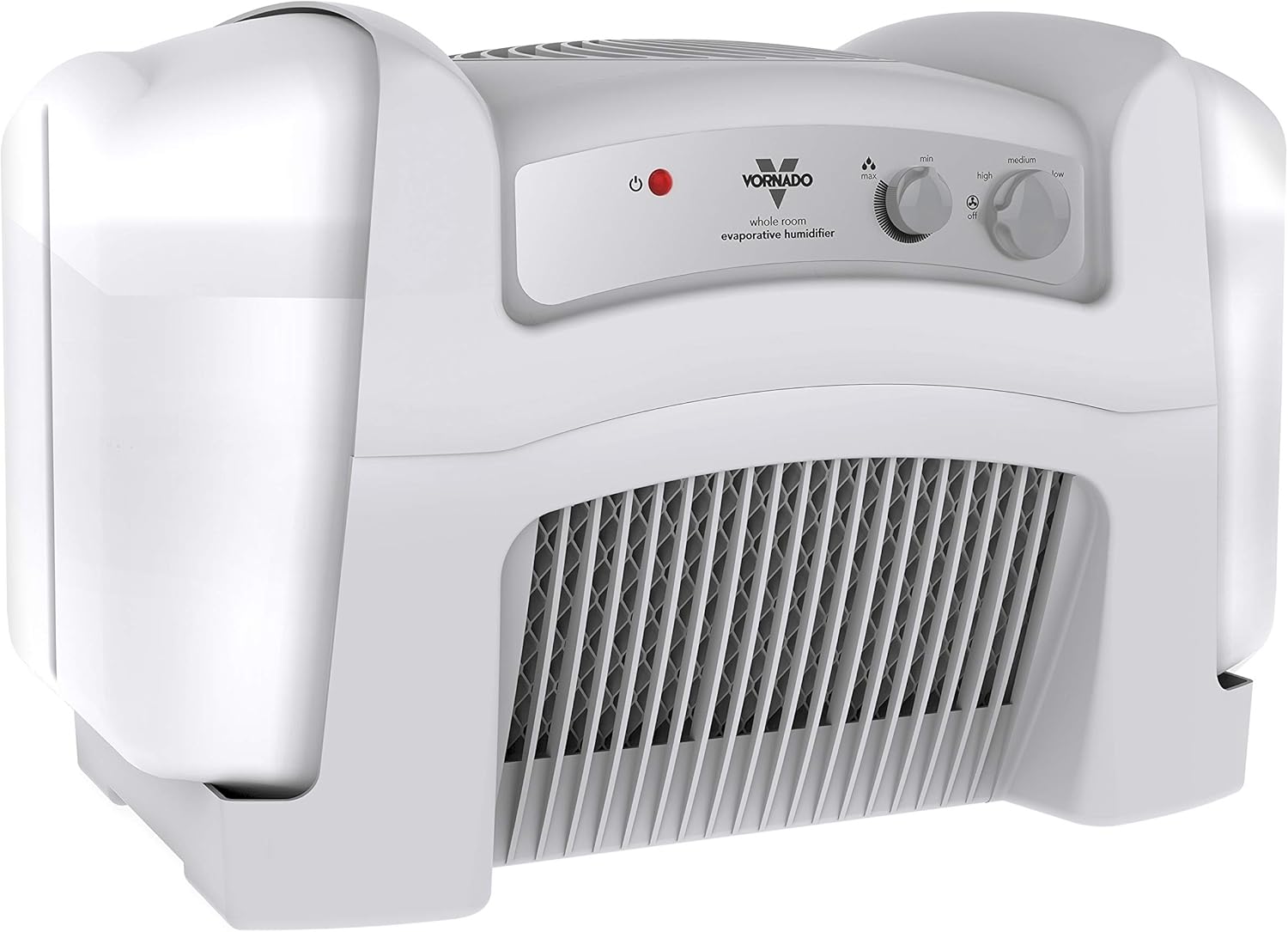
| Capacity | 4 gallons |
|---|---|
| Coverage | 1,000 sq. ft. |
| Operation Mode | Evaporative |
| Power | 43 watts |
| Filter Type | Wick (2 filters) |
The Vornado Evap40 is a large-capacity evaporative humidifier designed to keep big rooms and dedicated spaces consistently humidified without visible mist. It pulls dry air through dual wick filters and uses Vornado's Vortex Action to circulate humidified air throughout rooms up to 1,000 square feet, making it suitable for spaces where even moisture distribution matters. Controls are simple: an adjustable humidistat and three fan speeds let you set a target humidity and let the unit maintain it automatically, while the dual 2-gallon tanks give long run times and fewer refills. Because it is evaporative and wick-based, it does not produce a fine mist, which reduces the risk of surface wetting near instruments and furniture. Maintenance requires periodic filter replacement and cleaning of tanks, and the unit is larger and heavier than portable ultrasonic models, so placement and occasional handling matter. Power draw is modest at 43 watts, but the evaporative system will be less effective in very dry, low-airflow environments than warm-mist or ultrasonic units paired with circulation.
Best for: Players and techs who prioritize steady, whole-room humidity control to protect instruments and want a low-misting system that distributes moisture evenly across a dedicated practice or storage room.
Less Ideal for: People who need a compact, ultra-quiet bedside humidifier or those who prefer mist-producing ultrasonic models for very small enclosed spaces.
- Large 4-gallon dual-tank capacity for long continuous operation and fewer refills
- Vortex airflow design circulates humidified air evenly across up to 1,000 sq ft
- Built-in adjustable humidistat with three speed settings for automatic humidity control
- Evaporative, wick-based operation produces no visible mist that could wet surfaces
- Requires regular wick filter maintenance and periodic tank cleaning
- Physically larger and heavier than compact ultrasonic humidifiers
Verdict: Choose the Evap40 when you need reliable, low-mist whole-room humidity control for instrument rooms and large practice spaces.
BREEZOME 6L Humidifier MG07JS

| Capacity | 6 liters |
|---|---|
| Floor Area | 500 square_feet |
| Operation Mode | Ultrasonic |
| Runtime | 60 hours |
| Control Method | Touch |
The BREEZOME MG07JS is a top-fill ultrasonic cool-mist humidifier designed to run for long periods in larger spaces. It holds 6 liters and the manufacturer rates coverage up to about 500 sq ft with as much as 60 hours runtime, so it can maintain steady humidity overnight or through multiple practice sessions. A built-in humidistat and touch controls let you set a target humidity and the unit will adjust output to hold that level, which helps keep room conditions stable for sensitive instruments. The top-fill tank and detachable design make refilling and cleaning straightforward, and an aroma tray lets you add essential oils if desired. At about 22 watts and a quiet sleep mode rated near 25 dB, it is unobtrusive during recording or practice. Important limits: it is a cool-mist ultrasonic unit so mineral buildup and white dust are possible unless you use filtered water or the demineralization cartridge, and it does not offer warm mist or advanced app-based controls. For instrument rooms that need steady, low-noise humidification, this unit provides practical, long-running performance.
Best for: Buyers who want steady, low-noise humidification for a dedicated instrument or practice room and prefer a set-and-forget unit that runs for days between refills.
Less Ideal for: Those who need app control, warm-mist humidification, or want to avoid any maintenance for mineral buildup should consider different options.
- Large 6L tank supports extended runtime up to 60 hours for less frequent refills
- Built-in humidistat and touch controls maintain a user-set humidity level
- Top-fill, detachable tank simplifies refilling and cleaning
- Quiet sleep mode suitable for practice and recording environments
- Aroma tray doubles as an essential oil diffuser for scenting rooms
- Ultrasonic cool mist can produce mineral white dust without demineralized or distilled water
- No warm-mist option or smartphone connectivity for remote control
Verdict: A long‑runtime, quiet ultrasonic humidifier with a built-in humidistat that keeps instrument rooms consistently humid with minimal user intervention.
MegaWise Cool Mist Humidifier Humi01

| Capacity | 0.5 gallons |
|---|---|
| Operation Mode | Ultrasonic |
| Runtime | 10 minutes |
| Power Source | Corded Electric |
| Wattage | 15 watts |
The MegaWise Cool Mist Humidifier Humi01 is a small ultrasonic unit designed to add moisture quietly in bedrooms, nurseries, or small rooms where low noise matters. It uses a top-fill 0.5 gallon tank and touch controls to deliver adjustable mist output for up to about 10 hours on the lowest setting, and its automatic shut-off prevents dry-run damage when the water runs out. At roughly 25 dB reported operation, the unit stays nearly silent which helps instruments in a practice or instrument room by maintaining humidity without constant mechanical noise. Practical benefits include easy top refills, a pre-filter to keep larger debris out of the reservoir, and low power draw. Limitations are the modest tank size and the stated runtime that means it will need refilling more often than larger capacity humidifiers, and it is intended for small rooms rather than large spaces. For instrument rooms needing gentle, quiet humidity control in a compact, budget-friendly package, this unit is a straightforward option.
Best for: Buyers who want a quiet, affordable humidifier for a small instrument or practice room and prioritize low noise and simple operation over long unattended runtime.
Less Ideal for: People needing whole-room or multi-room humidity control, long unattended runtime, or precise digital humidity regulation should consider larger or more feature-rich models.
- Very quiet operation suitable for noise-sensitive spaces
- Top-fill design makes refilling simple
- Auto shut-off protects the unit when water runs out
- Low power consumption with touch controls for easy adjustment
- Small 0.5 gallon tank requires frequent refills in continuous use
- Rated coverage and runtime are intended for small rooms, not large instrument spaces
Verdict: A compact, whisper-quiet humidifier that provides affordable, low-noise humidity control for small instrument or practice rooms.
Levoit Classic 160 Humidifier

| Capacity | 2.5 liters |
|---|---|
| Operation Mode | Ultrasonic |
| Runtime | 25 hours |
| Runtime Noise | 26–28 dB |
| Power | 17 watts |
The Levoit Classic 160 is a simple, reliable cool-mist ultrasonic humidifier intended for small to medium rooms. It uses a 2.5 liter top-fill tank that runs up to 25 hours on the lowest setting and a 360 degree nozzle to direct mist where you need it. Controls are touch-based with a single dial for mist output, making operation straightforward without a display or auto-humidistat. Key practical benefits include easy top filling and a wide opening that simplifies weekly cleaning, a pre-filter sponge to capture impurities, and an auto shut-off float with a red low-water indicator for safety. Noise is very low at 26–28 dB, so it will not disturb sensitive instruments or sleepers. Limitations for instrument-room use are the lack of a built-in humidistat for automatic RH control and potential white dust if hard tap water is used, so distilled water and a separate humidity monitor are recommended for precise humidity management. Replacement filter sponges are needed periodically depending on water quality.
Best for: Buyers who prioritize a dependable, low-noise humidifier that is easy to fill and maintain for overnight or continuous use in rooms with sensitive items.
Less Ideal for: If you need automatic relative-humidity control or plan to use tap water in a room with delicate finishes or instruments without filtration, consider a humidifier with a built-in humidistat or a model designed to minimize mineral emissions.
- Top-fill 2.5 L tank for easy refills and accessible cleaning
- Very quiet operation (26–28 dB) suitable for night use
- Runs up to 25 hours on low for extended unattended operation
- Auto shut-off with low-water indicator adds a safety layer
- 360 degree nozzle and simple touch control for easy aim and adjustments
- No built-in humidistat or automatic humidity control
- Can produce white dust if tap water with minerals is used
Verdict: A compact, easy-to-maintain, and whisper-quiet humidifier that delivers reliable continuous moisture for small instrument rooms when paired with distilled water and a separate hygrometer.
Everlasting Comfort 6L Humidifier

| Capacity | 1.6 gallons |
|---|---|
| Floor Area | 500 square_feet |
| Operation Mode | Vaporizer, Ultrasonic |
| Wattage | 22 watts |
| Runtime | 50 hours |
This Everlasting Comfort 6L humidifier is a large-capacity ultrasonic cool-mist unit meant to add moisture to big rooms and run for extended stretches without refilling. It is typically used in bedrooms, nurseries, living rooms, or dedicated spaces like an instrument room where steady humidity is important. Key features include a 6-liter tank that can run up to 50 hours, adjustable mist output with a 360° rotating nozzle for even coverage, a built-in essential oil tray for aromatherapy, and a filterless design that simplifies cleaning. The unit operates quietly thanks to ultrasonic technology, so it will not disturb sleeping or sensitive listening sessions. Practical benefits include long unattended runtime, no ongoing filter replacement costs, and easy top access for refills and cleaning. Important limitations are that it is a cool-mist vaporizer only, so it will not heat the output, and the large tank and plastic construction make it less portable than smaller tabletop humidifiers. Also it requires a corded connection and lacks smart connectivity for remote monitoring.
Best for: Buyers who want a dependable, long-running humidifier with quiet operation and easy maintenance for larger rooms or specialty spaces where steady humidity matters.
Less Ideal for: People who need a compact travel unit, smart-home remote control, or a warm-mist humidifier should consider other options.
- Large 6L tank provides up to 50 hours of continuous mist for long unattended operation
- Ultrasonic, whisper-quiet operation suitable for bedrooms and quiet rooms
- Filterless design with wide tank opening makes cleaning and maintenance simple
- Adjustable mist output and 360° rotating nozzle help distribute humidity evenly
- Includes essential oil tray for optional aromatherapy
- No heated mist option limits use in very cold environments
- Corded power required and no smart connectivity for remote control or monitoring
- Relatively large and less portable compared with compact tabletop units
Verdict: A quiet, long-runtime filterless humidifier that reliably maintains humidity in larger rooms and other sensitive spaces.
Choosing the Right Humidifier for Instrument Room: Key Factors to Consider
Humidity Target Range
Different instruments tolerate different relative humidity bands, but most wooden instruments fare best in a stable midrange. Look for a humidifier that can hold and maintain your chosen setpoint rather than simply running continuously. A unit with an adjustable humidistat or accurate digital sensor means fewer manual adjustments and reduces the risk of swings that stress wood and glue. If you need split controls for seasonal shifts, choose a model with programmable settings or simple, repeatable output levels so you can return to the same target quickly after a weather change.
Noise and Vibration
Sound-sensitive environments require quiet operation. Ultrasonic and evaporative units vary widely in how much fan and mechanical noise they produce. Check spec-sheet decibel ratings and look for models designed for bedroom or office use, since those prioritize low vibration and muffled fans. Vibration transmitted through floors or stands can cause buzzes or sympathetic resonance with instruments. A low-vibration unit or one that can be placed on a rubber pad will help avoid audible interference during practice or recording.
Distribution and Placement
A humidifier's placement affects whether humidity is distributed evenly or concentrates in one spot. For instrument rooms, you want steady, room-wide distribution so instruments stored in cases or on stands all receive similar exposure. Consider models with adjustable nozzles, quiet fans, or built-in diffusers that spread output more uniformly. Also think about practical placement: units that fit discreetly on a shelf or that can operate safely near stands and cases without creating condensation are preferable.
Tank Size and Runtime
Larger tanks reduce how often you need to refill, which matters if the room is used frequently or left unattended. But very large tanks can be heavier and harder to clean. Balance capacity against the convenience of daily top-ups and the physical layout of your room. Runtime affects both convenience and humidity stability. A unit that can run overnight or for several days without refilling will maintain steadier conditions and minimize handling that could introduce dust or contaminants.
Maintenance and Water Quality
Mineral deposits and biological growth are risks with humidifiers. Units that are easy to open, have simple filter access, or accept distilled water reduce maintenance time and protect instruments from airborne mineral dust. Consider models with washable tanks and straightforward descaling procedures. If hard water is present, choose a humidifier designed to limit white dust or that uses wicking filters to trap minerals. Regular cleaning schedules are essential to avoid mold spores that could harm instruments and human occupants.
Safety Features and Controls
Automatic shutoff on low water, tip-over protection, and reliable electrical safety features are important, especially in rooms with high-value instruments and cables. Precise controls, such as a digital humidistat and a clear display, reduce the chance of accidental over-humidification. Some units include child or tamper locks and scheduling functions that help limit operation during specific hours, which can be useful when the room is used intermittently or during recording sessions.
Choosing the Right Humidification Type
Humidifiers typically use one of three methods: ultrasonic, evaporative (wick-based), or warm mist. Ultrasonic models create fine mist with little audible noise and are compact, but they can produce visible white dust if your water is mineral-rich. Evaporative units use a fan to blow air through a wetted wick and tend to self-regulate moisture output but may be slightly louder.
Warm-mist units boil water and release steam, which reduces mineral dust but uses more energy and sometimes produces more sound. For instrument rooms, many owners prefer ultrasonic or evaporative designs with good control and low vibration.
- Ultrasonic: very quiet, efficient, may need distilled water in hard-water areas
- Evaporative: self-limiting humidity output, typically reliable distribution
- Warm-mist: reduces minerals, higher energy use and potential noise
Best Placement Practices in an Instrument Room
Place the humidifier off the floor on a stable surface at least a few feet from instruments to avoid localized dampness. Aim for central placement if possible so the output has room to disperse. Avoid directing mist straight at wooden surfaces or instrument cases.
If you store instruments in cases, run the humidifier with room circulation to let humidity equalize inside cases. Use a hygrometer at instrument height to verify conditions rather than relying on a ceiling-mounted or distant sensor.
- Avoid corners and direct proximity to instruments
- Use a small fan or existing room circulation to even out humidity
- Monitor multiple points in the room to catch variations
Monitoring and Maintaining Desired Humidity
Use a reliable hygrometer to measure relative humidity where instruments are kept. Set a target band and check readings in different parts of the room and inside instrument cases if possible. Make small adjustments to humidifier settings rather than large swings to avoid stressing wood.
Regular maintenance, including tank cleaning and descaling, keeps output consistent and prevents odor or biological growth. Replace or clean any wicking filters on schedule and follow manufacturer guidance for sanitizing components.
- Measure at instrument height, not ceiling level
- Keep humidity changes gradual to protect wood and glue
- Log readings during seasonal transitions to establish repeatable settings
Recording and Practice Considerations
Noise and vibration are especially important if the room is used for recording. Choose a humidifier with low fan noise and minimal mechanical resonance. Consider running the unit during breaks rather than live takes if you cannot tolerate any background noise.
Some users schedule humidifier operation around practice times or use models with timers to avoid interference. If you share the room with sensitive electronics, ensure humidifier placement minimizes water exposure to cables and gear.
- Opt for models marketed for bedroom or office use for quieter operation
- Use rubber pads or isolation stands to reduce transmitted vibration
- Time humidification to avoid running during critical recording moments
When to Use Case-Based Humidification
For single high-value instruments or tight storage cases, an in-case or case-mounted humidification system can provide very localized control that complements a room humidifier. These systems are useful when instruments are stored long-term or when room control is imperfect.
A combined approach—room humidification for overall stability plus in-case devices for individual instruments—gives the most robust protection against rapid environmental swings. Monitor both the room and inside the case to keep both environments within safe ranges.
- Case systems stabilize the microclimate around a single instrument
- Combine with room humidification for overall stability
- Check case humidity regularly to ensure devices are functioning
How We Chose the Best Humidifier for Instrument Room
We shortlisted humidifiers based on features and performance that directly affect instrument health and day-to-day usability in a dedicated music or instrument room. Key evaluation criteria included precise humidity control mechanisms, low noise output, consistent dispersion to avoid hot or wet spots, and ease of maintenance. We favored units with reliable sensors or adjustable humidistats so you can hold relative humidity within a target band. Noise level mattered because practice and recording sessions require quiet background operation. We also considered run time and tank capacity to minimize interruptions and humidifier placement needs in small to medium rooms. Durability and serviceability were part of the filter: units that allow easy cleaning and have replaceable consumables were scored higher because mineral buildup and mold risk directly threaten instruments. Energy efficiency and safety features such as automatic shutoff were included to reduce risk in unattended rooms. Excluded were general-purpose room humidifiers that lack precise control or produce visible mist that could create localized wetting. We did not include units intended only for whole-house systems or units without documented noise or humidity control specs.
Our full evaluation process is outlined in our review methodology.
FAQ
What humidity level is best for wooden instruments?
Most wooden instruments are happiest in the midrange of relative humidity, typically between about 40 and 50 percent. Exact tolerance varies, but avoiding rapid swings and prolonged extremes is more important than hitting a single precise number.
Can a humidifier damage instruments if placed too close?
Yes. Placing a humidifier too close can create damp spots and localized condensation that may harm finishes or hardware. Keep units at a distance and monitor humidity distribution to ensure even coverage.
Do I need distilled water in my humidifier for an instrument room?
Distilled water reduces mineral deposits and white dust from ultrasonic units and lowers the need for frequent descaling. In areas with hard water, using distilled water or a unit designed to handle minerals is advisable.
How often should I clean the humidifier tank?
Clean the tank at least weekly or per the manufacturer's schedule, especially when running continuously. Regular cleaning prevents biofilm and mineral buildup that can affect output and air quality.
Is a room humidifier enough, or do I need case humidifiers too?
A room humidifier often provides broad protection, but cases can lag or develop different microclimates. For high-value or long-stored instruments, supplementing room control with case humidifiers gives better insurance against localized drying.
Final Verdict
Prioritize steady, controllable humidity and low noise when choosing a humidifier for an instrument room. Balance tank size and runtime with how often you can maintain the unit, and pick a model that is easy to clean to avoid mineral and biological buildup. Use reliable monitoring at instrument height and consider supplemental case humidification for valuable instruments. Focus on maintaining a stable humidity band rather than chasing perfect numbers, and choose features that match your room size and usage patterns for confident, long-term instrument protection.