
Note: This article contains affiliate links. If you click on these links and make a purchase, we may earn a small commission at no extra cost to you. This helps support our research and content. Read our full affiliate disclosure here.
Keeping a small greenhouse at the right humidity can make the difference between thriving seedlings and frustrated crop failures. The right humidifier reduces stress on plants, helps rooting and propagation, and smooths daily humidity swings that invite pests and disease. This guide shortlists the top humidifiers for small greenhouse use, focusing on coverage, control precision, and durability for steady, predictable performance. Below you will find the top picks chosen for their ability to hold target humidity in compact greenhouse spaces, plus clear guidance on which features matter most for your setup.
Top Picks at a Glance
| Best Overall The best all-around choice for most situations | AC Infinity CLOUDFORGE T7 |  |
| Best Quality Built to a higher standard if you want something more solid | AC Infinity CLOUDFORGE T3 |  |
| Best Value The sweet spot between price and what you get | MegaWise Cool Mist Humidifier Humi01 |  |
| Best Budget The cheapest option that still gets the job done reliably | BAMCOO WSQ08 650ml Humidifier |  |
| Top Rated A top-rated pick with lots of positive feedback | Levoit Classic 160 Humidifier |  |
| Most Popular A crowd favorite that many people choose with confidence | Levoit Classic 160 Humidifier |  |
| Best Seller A high-volume bestseller chosen again and again | Everlasting Comfort 2.5L Humidifier |  |
AC Infinity CLOUDFORGE T7

| Capacity | 15 liters |
|---|---|
| Output Rate | 1300 ml/h |
| Wattage | 100 watts |
| Control Method | App |
| Operation Mode | Ultrasonic |
The AC Infinity CLOUDFORGE T7 is a grow-focused ultrasonic humidifier built to deliver precise humidity control in small greenhouse or grow-tent environments. It uses a 15 L tank and an ultrasonic vaporizer that can output up to 1300 ml per hour and offers 10 discrete output levels, plus VPD and humidity triggers for automated activation. The unit includes flexible tubing, interchangeable nozzles, and a sensor probe so moisture can be routed directly to a target area, and the app integration and UIS controller compatibility let you schedule, graph, and receive alerts for temperature, humidity, and VPD. Practical benefits include long runtime between refills, directable vapor for localized distribution, and advanced automation for hands-off climate management. Limitations are that it runs on 240 V and draws 100 W, so electrical requirements and placement need consideration, and like all ultrasonic units it requires regular cleaning and pre-filter maintenance to avoid mineral buildup or white dust when using hard water.
Best for: A plant grower who wants precise, automated humidity control in a small greenhouse or grow tent and values directable vapor and data-driven scheduling.
Less Ideal for: People who need a simple, plug-and-play household humidifier for living spaces or who cannot accommodate 240 V equipment or routine maintenance.
- Large 15 L capacity for extended runtime
- 10-level output with VPD and humidity triggers for precise automation
- Includes flexible hose, nozzles, and sensor probe for targeted vapor distribution
- App and UIS controller integration for scheduling, alerts, and environmental graphs
- Requires 240 V power which may limit placement options
- Ultrasonic operation needs regular cleaning and pre-filter upkeep to prevent mineral buildup
Verdict: Buy this if you need a grow-grade humidifier that delivers long runtime and precise VPD-driven automation for small greenhouses and grow tents.
AC Infinity CLOUDFORGE T3

| Capacity | 4.5 liters |
|---|---|
| Output Rate | 240 ml/h |
| Wattage | 24 Watts |
| Control Method | App |
| Runtime | 45 hours |
The AC Infinity CLOUDFORGE T3 is a grow-focused ultrasonic humidifier designed to deliver precise humidity control inside small greenhouses or grow tents. It uses a next-generation vaporizer with 10 output levels and a 240 ml/h rate to provide fine-grained moisture adjustments, and the 4.5 L tank supports extended run times. The unit integrates VPD and humidity triggers plus scheduling through the AC Infinity app, letting you automate activation and maintain a target microclimate without constant manual intervention. Included extendable tubing and a sensor probe let you send vapor directly to specific areas, which helps avoid over-humidifying the whole space. Practical strengths are the leak-resistant seal, hidable backlit display, and backup memory for auto-restart after power interruptions. Limitations to consider are the 240 V rating and 24 W power profile that reflect its intended regional electrical spec and modest output, so it is best for small enclosed grow environments rather than larger greenhouses, and users who need higher raw output should size accordingly.
Best for: Growers who prioritize tight environmental control and automation for small greenhouses or tents and want to tune humidity with VPD-aware scheduling and targeted vapor delivery.
Less Ideal for: People needing a high-capacity humidifier for large or open greenhouse rooms or those who cannot use a 240 V device without adapting their power supply.
- Precision control with 10 vapor output levels for fine humidity tuning
- App integration with VPD and humidity triggers for automated climate management
- Extendable tubing and sensor probe for targeted vapor distribution
- Large 4.5 L tank that supports long runtimes
- Leak-resistant seal and backup memory for reliable unattended operation
- Designed for small grow spaces so output may be insufficient for larger greenhouses
- Unit is specified for 240 volts which may limit direct use in some regions without appropriate power
- No humidistat listed as a standalone spec separate from app controls
Verdict: Choose the CLOUDFORGE T3 when you need automated, VPD-aware humidity control and targeted vapor delivery for a small greenhouse or grow tent.
MegaWise Cool Mist Humidifier Humi01

| Capacity | 0.5 gallons |
|---|---|
| Operation Mode | Ultrasonic |
| Runtime | 10 minutes |
| Power Source | Corded Electric |
| Wattage | 15 watts |
The MegaWise Humi01 is a small ultrasonic cool-mist humidifier built for simple, quiet operation in bedrooms, nurseries, offices, or small greenhouse spaces. It holds 0.5 gallons (1.5L) of water in a top-fill reservoir and offers adjustable mist output via touch controls; at low setting it can run for up to 10 hours. The unit is whisper-quiet (around 25 dB) so it can run overnight without disrupting plants or sleep. Safety features include auto shut-off when the tank is empty and a BPA-free plastic body. Practical buyers will appreciate the low 15W power draw and the included pre-filter for basic particulate control. Limitations are its small capacity and relatively short maximum runtime compared with larger humidifiers, so it requires more frequent refills in continuous-use situations or larger greenhouse setups. The touch controls and basic feature set keep operation straightforward, but there are no advanced humidity sensing or scheduling features, so users must monitor humidity manually or pair it with an external hygrometer.
Best for: Buyers who want a simple, low-maintenance humidifier to raise humidity in a small greenhouse corner or propagation area and value quiet, continuous operation over automation.
Less Ideal for: Not a good choice for growers needing automated humidity control or coverage for larger greenhouse areas where longer runtime and higher output are required.
- Compact top-fill design makes refilling quick and easy
- Very quiet operation suitable for overnight use
- Auto shut-off protects the unit when water runs out
- Low power draw (15W) keeps energy use minimal
- Small 0.5 gallon tank requires frequent refills for continuous greenhouse use
- No built-in humidistat or scheduling features for automated humidity control
Verdict: A compact, whisper-quiet ultrasonic humidifier that efficiently raises humidity in small greenhouse spaces where simple, low-energy operation is the priority.
BAMCOO WSQ08 650ml Humidifier

| Capacity | 650 ml |
|---|---|
| Runtime | 8 hours |
| Operation Mode | Manual |
| Power Source | Corded Electric |
| Other Special Features of the Product | 2 Spray Modes, 3 Lighting Modes, Auto Shut Off, Night Light |
The BAMCOO WSQ08 is a compact 650ml cool-mist humidifier meant for personal spaces like desks, bedrooms, and small plant areas. It offers two spray modes (continuous and intermittent) that run up to about 5 hours continuous or 8 hours intermittent and features three lighting modes that double as a night light or ambient plant light. Setup requires soaking and correctly seating the included filter cartridge and spring, and the unit runs on USB/corded power with a low-noise motor rated around 28 dB. Practical benefits for a small greenhouse or plant shelf include a sizeable water reservoir for its footprint, whisper-quiet operation that will not disturb seedlings, and selectable mist timing to avoid overwatering. Limitations are that it uses a filter cartridge that needs occasional replacement and should not be used with essential oils, and the timed auto shutoff (5–8 hours depending on mode) means it is not intended for continuous multi-day operation without supervision or frequent refills. The simple controls and lightweight cylindrical design make it easy to move between locations but it lacks advanced humidity control or built-in hygrometer feedback for precise greenhouse humidity management.
Best for: Buyers wanting an inexpensive, portable humidifier to give seedlings or small greenhouse shelves extra humidity for short periods and who prioritize quiet, easy-to-move units.
Less Ideal for: Not the best choice for growers who need precise, long-duration humidity control, automated scheduling, or continuous unattended operation for larger greenhouse spaces.
- Generous 650 ml tank for longer run times relative to its compact size
- Two spray modes for continuous or intermittent misting
- Very quiet operation at about 28 dB suitable for plant rooms or nurseries
- Three lighting modes that can serve as a gentle grow/night light or be turned off
- Requires a replaceable filter cartridge and occasional maintenance to prevent clogging
- Auto shutoff limits continuous multi-day unattended operation
Verdict: A compact, budget-friendly humidifier that delivers quiet, selectable mist and ambient lighting for small plant shelves or seedling areas.
Levoit Classic 160 Humidifier

| Capacity | 2.5 liters |
|---|---|
| Operation Mode | Ultrasonic |
| Runtime | 25 hours |
| Floor Area | 219 square_feet |
| Wattage | 17 watts |
The Levoit Classic 160 is a compact ultrasonic cool-mist humidifier built around ease of use and low noise. It features a 2.5 liter top-fill tank that removes the need to invert the reservoir, a large opening and simple base for cleaning, and a 360 degree rotating nozzle to direct mist where you need it. Touch controls and a single output knob make daily adjustments straightforward, and the unit runs up to about 25 hours on its lowest setting while operating at whisper-quiet levels around 26 to 28 dB. A float-controlled auto shut-off and BPA-free construction add practical safety for continuous unattended use. For a small greenhouse the Classic 160 will maintain humidity without fuss, though it is an ultrasonic wick-filter design so you should use filtered or softened water and change the included sponge/filter regularly to avoid mineral buildup. It does not include humidity sensing or automatic humidistat control, so you will need a separate hygrometer to tune output for delicate seedlings or tropical plants.
Best for: Buyers who prioritize a dependable, low-maintenance humidifier that runs quietly and is easy to fill and clean for continuous humidity support in a small space.
Less Ideal for: Those who want automatic humidity regulation or a unit that handles very large greenhouse volumes should look for models with built-in humidistats and higher output capacity.
- Large 2.5L top-fill tank that reduces refills and spills
- Very quiet operation suitable for overnight or close-proximity use
- Simple construction and wide opening for easier cleaning
- 360° rotating nozzle for easy mist direction
- Float-controlled auto shut-off and BPA-free materials for safer unattended operation
- No built-in humidistat or automatic humidity control
- Requires regular filter/sponge replacement and care to prevent mineral deposits
Verdict: A quietly reliable, easy-to-fill 2.5L ultrasonic humidifier that delivers steady manual humidity control for small greenhouses needing low-maintenance operation.
Levoit Classic 160 Humidifier

| Capacity | 2.5 liters |
|---|---|
| Operation Mode | Ultrasonic |
| Runtime | 25 hours |
| Runtime Noise | 26–28 dB |
| Power | 17 watts |
The Levoit Classic 160 is a compact top-fill ultrasonic humidifier designed to add steady cool mist to small spaces. It is typically used on a table or raised surface to humidify a single room for up to 25 hours on the lowest setting, and the 360 degree nozzle plus adjustable knob make it easy to aim and control output. Notable features include a wide top opening that simplifies filling and cleaning, a pre-filter sponge for basic particle capture, and an automatic shut-off triggered by a float when water runs low. In real-world use the Classic 160 is very quiet at 26–28 dB, consumes only 17 watts, and runs long on a single fill, which suits overnight or continuous greenhouse humidity support in small enclosures. Important limitations are the lack of a built-in humidistat or automatic humidity control, so you must monitor humidity with a separate hygrometer, and it is not designed for essential oils. Also using hard tap water can produce white mineral residue, so distilled water and periodic filter changes are recommended for plant health and to reduce maintenance.
Best for: Growers who want a low-noise, easy-to-maintain humidifier to keep humidity stable in a small greenhouse or propagation area and who will monitor humidity with a separate meter.
Less Ideal for: Large greenhouses or growers who need automatic humidity regulation or integrated humidistatic control without manual monitoring should consider higher-capacity or controller-ready humidifiers.
- Top-fill wide opening for fast, spill-free refills and easier cleaning
- 2.5 L tank provides up to 25 hours of runtime on low for extended unattended use
- Very quiet operation (26–28 dB) suitable for overnight or low-noise environments
- Adjustable mist knob and 360° nozzle let you direct humidity where plants need it most
- Low power draw (17 watts) keeps energy use minimal during continuous operation
- No built-in humidistat or automatic humidity control so target RH must be monitored separately
- Can produce white mineral dust if used with hard tap water, requiring distilled water or frequent cleaning
- Pre-filter sponge requires periodic replacement depending on water hardness
Verdict: A quiet, easy-to-fill 2.5 L ultrasonic humidifier that delivers long runtime and precise mist direction for small greenhouse spaces when paired with a separate humidity monitor.
Everlasting Comfort 2.5L Humidifier
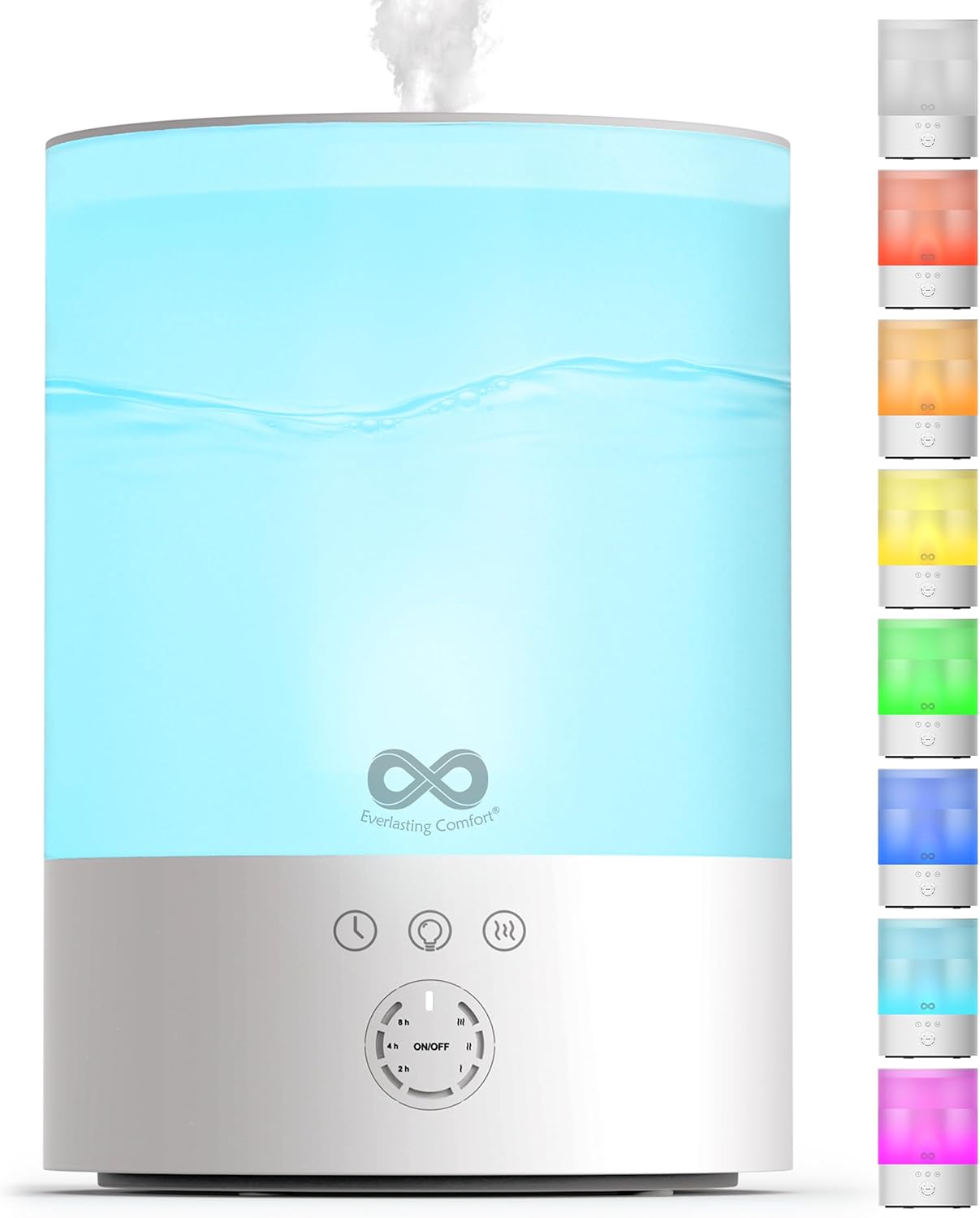
| Capacity | 2.5 liters |
|---|---|
| Runtime | 24 hours |
| Operation Mode | Vaporizer, Ultrasonic |
| Control Method | Touch |
| Filter Type | Filterless |
This Everlasting Comfort 2.5L humidifier uses ultrasonic cool‑mist technology to add moisture to indoor air with low noise and straightforward controls. It fills from the top, which makes refilling and cleaning faster than bottom‑fill designs, and the 2.5L tank supports extended runtimes—up to 24 hours at lower output settings. Touch controls let you choose high, medium, or low mist plus 2/4/8 hour timer modes, and an automatic shut‑off prevents operation when the tank is empty. The unit is filterless and made from BPA‑free plastic, so upkeep is mainly occasional cleaning of the tank and nozzle rather than replacing filters. It also includes eight LED night light colors and can disperse a small amount of aroma if you add oils to the water. Practical limits: the 2.5L capacity and specified floor area coverage are intended for single rooms rather than large greenhouse spaces, and mist output control is basic rather than precision humidity regulation. For a small greenhouse or propagation area this model provides reliable, quiet humidity with easy maintenance, but you should monitor humidity with a separate hygrometer for precise control.
Best for: Buyers who prioritize reliability, quiet operation, and low maintenance for small indoor growing areas or single‑room propagation setups and prefer simple, easy‑to‑clean equipment.
Less Ideal for: Growers who need tightly controlled, factory‑quality humidity setpoints for larger or commercial greenhouses should choose a dedicated greenhouse humidification system with built‑in humidistat and higher output.
- Top‑fill 2.5L tank for easy refills and simpler cleaning
- Ultrasonic operation rated at 28 dB for quiet overnight use
- Adjustable mist levels plus 2/4/8 hour timer and auto shut‑off for basic timed control
- Filterless design reduces ongoing maintenance and replacement costs
- Eight LED night light options and aroma diffuser capability add multiuse functionality
- Not a precision humidistat—no built‑in humidity sensor for exact setpoint control
- 2.5L capacity limits continuous high‑output runtimes in larger spaces
- Plastic construction may feel less durable than heavier duty greenhouse equipment
Verdict: A quiet, easy‑to‑maintain 2.5L cool‑mist humidifier that reliably raises humidity in small greenhouse or propagation spaces where simple, low‑fuss operation is the priority.
Choosing the Right Humidifier for Small Greenhouse: Key Factors to Consider
Sustained Humidity Output
A humidifier's continuous output determines whether it can raise and hold relative humidity in a small greenhouse. Short spikes of mist that stop after a few minutes rarely change the room's microclimate, while a steady output rated in hundreds of milliliters per hour can maintain a stable setpoint.
When evaluating output, consider the greenhouse volume and how much ventilation you run. Higher output is important if you have frequent venting or circulating fans because those losses must be replaced. For propagation benches or seed trays, look for models that can run for many hours at a mid output without frequent refilling.
Control Precision and Automation
Precise humidity control reduces wide swings that stress plants. Digital hygrostats and programmable controllers let you set target ranges and cycle the unit to hold a steady environment rather than simple on/off behavior based on a single threshold.
Automation also frees you from manually topping up or adjusting settings daily. Timers, built-in humidistats, or external controller compatibility can maintain consistent relative humidity during day and night cycles important for flowering or seedling stages.
Coverage and Air Distribution
Coverage is about more than output numbers. In a greenhouse, how mist is distributed and how air moves matters. Ultrasonic units produce fine mist that disperses quickly, which helps even distribution in small spaces, while evaporative approaches rely on airflow to spread humidity.
Consider internal shelving and plant density. If plants are densely packed or you have multiple tiers, place the humidifier to avoid localized wetting and to achieve even humidity. Some units pair better with a small circulation fan to remove pockets of dry air.
Water Quality and Maintenance Requirements
Greenhouse water quality affects mineral buildup, nozzle clogging, and frequency of cleaning. Units that tolerate hard water or have accessible parts and simple descaling procedures reduce downtime. Removable tanks, large openings for cleaning, and washable filters simplify maintenance.
Plan for ongoing upkeep when selecting a unit. Frequent, difficult cleaning can lead to neglected maintenance and inconsistent humidity performance over time.
Safety and Durability for Continuous Use
Greenhouse humidifiers often run for extended periods and may face damp, warm environments that accelerate wear. Corrosion-resistant materials and sealed electronics improve longevity. Safety features like automatic shutoff on low water and tip-over protection reduce the risk of damage to plants and equipment.
Reliable seals and stable bases also help prevent accidental spills that can create overly wet conditions and fungal issues in a greenhouse.
Choosing Between Ultrasonic and Evaporative Systems
Ultrasonic and evaporative humidifiers take different approaches to adding moisture. Ultrasonic models atomize water into a fine mist using vibrations, producing rapid humidity raises and good distribution in compact spaces. Evaporative systems pass air over a wet medium and are self-limiting because evaporation slows as humidity rises.
For a small greenhouse, ultrasonic units usually deliver faster results and can be quieter, but they can leave mineral deposits on nearby surfaces if water is hard. Evaporative systems are less likely to create visible wetting but may require more airflow to achieve even coverage.
- Ultrasonic: fast output, fine mist, may need distilled water for low deposits
- Evaporative: gentler humidity rise, less visible residue, depends on airflow
Placement and Integration With Greenhouse Venting
Where you place a humidifier affects performance. Position the unit so mist can spread across the plant canopy without blasting leaves directly. Mid-height placement or slightly elevated positions often yield the most even humidity.
Account for vents and exhaust fans. If your greenhouse vents frequently, place the humidifier away from major air exits or increase output to compensate. Integrating the humidifier with existing circulation fans helps distribute humidity evenly and avoids cold, damp pockets near the floor.
- Avoid pointing mist directly at delicate leaves
- Keep refill access clear when choosing placement
- Use gentle circulation to even out humidity without excessive drying
Power Needs and Run Time Planning
Plan for continuous or scheduled operation by checking run time between refills and power requirements. Units with larger tanks or external-water-supply options reduce refill frequency and are useful if you run long humidification cycles overnight.
Also consider power draw if you operate multiple environmental controls. Lower wattage models are more efficient but may produce less output. Balance runtime and output to match your daily humidity schedule.
- Larger tanks reduce manual refills
- External water hookup options can enable continuous operation
- Check that circuit capacity can handle simultaneous greenhouse devices
Controlling Mineral Buildup and Algae
Mineral deposits and algae growth affect spray nozzles and sensors. If your water is hard, consider units designed for easy descaling or that include washable components. Rinsing and drying tanks regularly prevents biofilm formation.
Using filtered or softened water lowers maintenance but is not always necessary if the unit has accessible parts. Regular inspection of nozzles and wicks extends performance life and ensures accurate humidity delivery.
- Rinse tanks weekly in frequent-use setups
- Descale atomizers per manufacturer recommendations
- Consider a small pre-filter on water supply to reduce particulates
Using Controllers and External Hygrostats
External controllers allow tighter routines than built-in dials. A dedicated humidity controller that switches the humidifier based on a probe reading inside the greenhouse gives more reliable control, especially when temperature and ventilation cycles change throughout the day.
Programmable controllers can also implement different setpoints for day and night, which benefits plants that require lower nighttime humidity to limit disease risk.
- Probe placement matters for accurate readings
- Choose controllers with simple hysteresis or PID-like behavior to avoid rapid cycling
- Look for models that accept remote probes for flexible sensor placement
How We Chose the Best Humidifier for Small Greenhouse
We prioritized features that matter for greenhouse plant health rather than consumer conveniences alone. Our selection filters emphasized sustained humidity output, control precision, and coverage consistency suitable for compact greenhouse footprints. We also considered build quality and maintenance demands because filters, mineral buildup, and water handling directly affect uptime in humid environments. Noise and energy use were evaluated to ensure systems can run long duty cycles without stressing nearby seedlings or adding excessive operating cost. Safety features such as automatic shutoff and corrosion-resistant materials were included as gating criteria. Excluded from consideration were units designed only for single-room household use with minimal runtime or tiny output capacities that cannot maintain conditions in a greenhouse. We also excluded products lacking basic humidity control or that relied solely on manual adjustments. The dimensions we actually measured and compared were sustained output (ml/hr), effective coverage area in greenhouse conditions, controller accuracy and programmability, maintenance frequency and ease, and durability for continuous or cyclical operation.
Our full evaluation process is outlined in our review methodology.
FAQ
How much humidity does a small greenhouse typically need?
It depends on the plants, but many seedlings and tropical houseplants thrive around 50 to 70 percent relative humidity. Propagation and cuttings often benefit from higher, more stable humidity in that range, while mature fruiting plants may prefer lower humidity to reduce disease risk.
Can I use tap water in a greenhouse humidifier?
You can, but tap water with high mineral content can cause deposits and clogging over time. For ultrasonic units, using filtered or distilled water reduces visible residue and lowers maintenance frequency. Regular cleaning also mitigates buildup.
How often should I clean a greenhouse humidifier?
Cleaning frequency depends on use and water quality. In continuous or heavy-duty greenhouse use, inspect and clean tanks, wicks, or atomizers at least weekly and descale components monthly. Lighter use may allow longer intervals, but routine checks prevent performance degradation.
Will a humidifier make my greenhouse too wet and encourage mold?
Over-humidifying can increase disease risk. Use a controller or hygrometer to maintain target ranges and ensure adequate circulation and occasional venting. Balancing humidity with air movement and temperature control reduces condensation and mold risk.
Is it better to humidify near plants or at a distance?
Place the humidifier so the mist disperses broadly rather than directly onto foliage, which can cause localized wetting. Slight elevation and gentle circulation usually produce the most even humidity across shelves and benches.
Final Verdict
For a small greenhouse, prioritize stable sustained output and precise control over raw peak mist. Choose a unit that matches your greenhouse volume, offers accessible maintenance, and can integrate with a controller or external hygrometer for predictable daily cycles. Expect tradeoffs between speed of humidity increase and maintenance needs; ultrasonic models act quickly but may demand more descaling, while evaporative approaches are lower maintenance but rely on airflow. Focus on coverage, runtime, and how easy the unit is to clean. With those priorities, you can select a humidifier that keeps seedlings healthy and reduces daily micromanagement in a compact greenhouse.