
Note: This article contains affiliate links. If you click on these links and make a purchase, we may earn a small commission at no extra cost to you. This helps support our research and content. Read our full affiliate disclosure here.
If you keep tropical houseplants, maintaining consistent humidity can be the difference between lush growth and persistent leaf browning. A purpose-appropriate humidifier helps recreate the warm, humid conditions many tropical species need without overwatering the soil or encouraging pests. This guide shortlists the top options for growing tropical plants indoors and explains the performance and usability features that matter most. We evaluated models for humidity stability, runtime, and plant-safe mist delivery to help you pick the right unit for your room and watering routine.
Top Picks at a Glance
| Best Overall The best all-around choice for most situations | DREO HM717S 8L Humidifier |  |
| Best Quality Built to a higher standard if you want something more solid | DREO Smart Humidifier DR-HHM017S |  |
| Best Value The sweet spot between price and what you get | Everlasting Comfort 6L Humidifier |  |
| Best Budget The cheapest option that still gets the job done reliably | ROSEKM 2.0L Cool Mist Humidifier |  |
| Top Rated A top-rated pick with lots of positive feedback | LRAZU HQ-JS2604 15L Humidifier |  |
| Most Popular A crowd favorite that many people choose with confidence | Levoit Classic 160 Humidifier |  |
| Best Seller A high-volume bestseller chosen again and again | Levoit Classic 160 Humidifier |  |
DREO HM717S 8L Humidifier

| Capacity | 8 liters |
|---|---|
| Floor Area | 600 square_feet |
| Operation Mode | Ultrasonic |
| Control Method | App, Touch, Voice |
| Filter Type | Activated Carbon, Demineralization |
The DREO HM717S is a smart ultrasonic humidifier built to raise humidity across large rooms up to about 600 ft² using either warm or cool mist. It normally sits on a tabletop and is top-filled for easier refills; the large 8 L tank and up to 80 hours of runtime mean it can run for days between fills at moderate settings. You get smart controls — app, touch, and voice support for Alexa/Google Home — plus an accurate humidistat and auto mode that adjusts output to hold a set humidity. Practical extras include an aroma pad, activated-carbon/demineralization filtration options, a 1500+ RGB ambient light, and a quiet 28 dB low-noise mode for night use. For plant care the high 550 ml/h output and wide mist spread help distribute moisture over a room, but the powerful output means you should place it thoughtfully to avoid overwatering localized plants and check placement to prevent surfaces getting damp. Filters and optional cartridges can reduce white dust from hard water but add maintenance and replacement cost.
Best for: Buyers who want a single smart humidifier that can maintain steady humidity across a large room for plant collections and prefer hands-off control via app or voice.
Less Ideal for: People needing a tiny, desktop humidifier for a single small planter or those who want a completely maintenance-free, filterless device.
- Large 8 L tank supports long runtime up to 80 hours for fewer refills.
- High mist output (≈550 ml/h) and wide mist spread suitable for larger plant areas.
- Smart control via app and voice with precise humidistat and auto mode.
- Top-fill design and removable tank simplify refills and cleaning.
- Includes aroma pad and filtration options to reduce minerals and odors.
- Strong mist output can create localized dampness if placed too close to plants or surfaces.
- Optional cartridges and filters require additional purchases and periodic replacement.
Verdict: Choose the DREO HM717S when you need a smart, high‑output humidifier that can sustain stable humidity across large plant spaces with minimal refills.
DREO Smart Humidifier DR-HHM017S
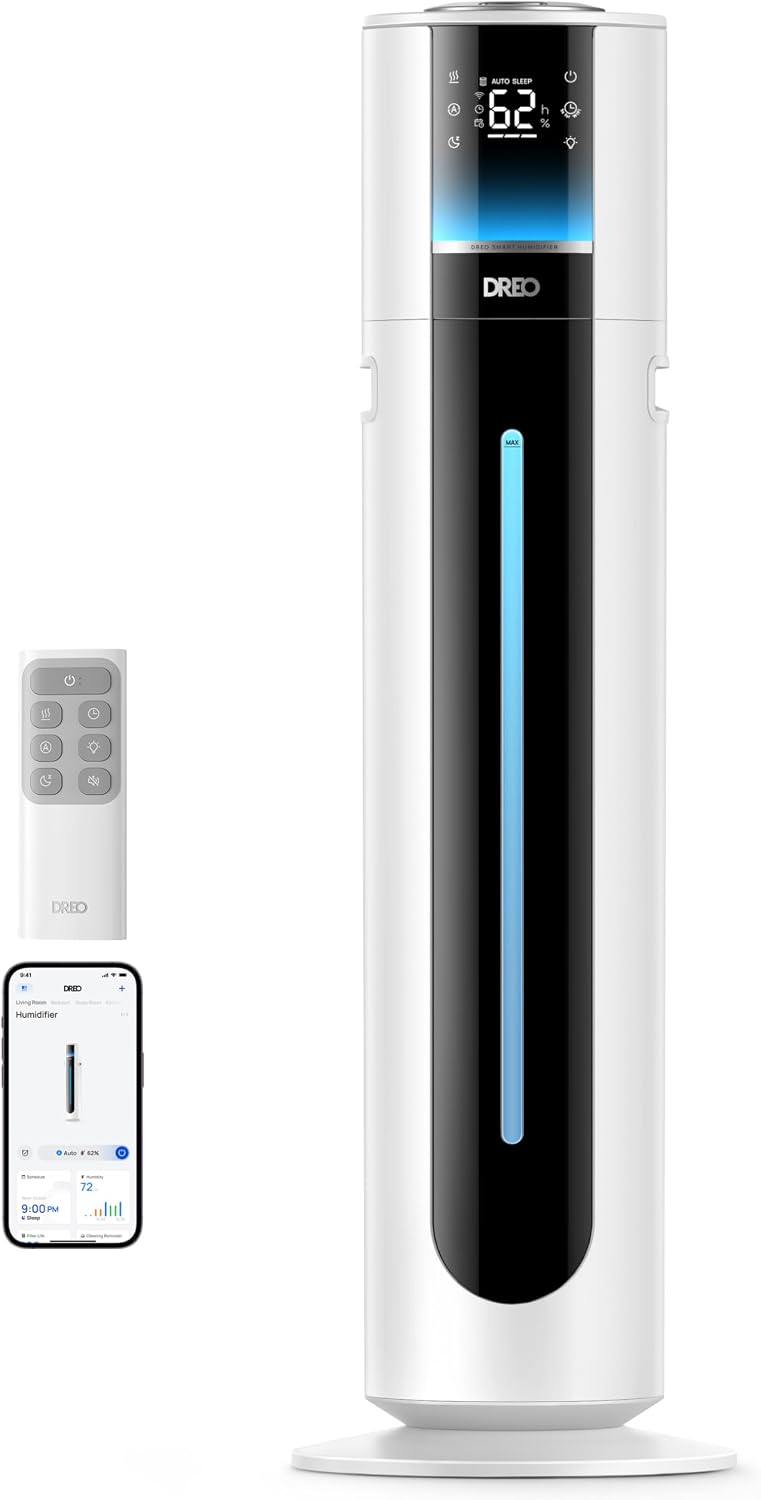
| Capacity | 11 liters |
|---|---|
| Floor Area | 700 square_feet |
| Operation Mode | Ultrasonic |
| Control Method | App, Remote, Touch, Voice |
| Runtime | 100 hours |
The DREO Smart Humidifier is an ultrasonic, top-fill unit built to maintain steady humidity in larger rooms and plant spaces. It holds an 11 L tank that the company rates for up to 100 hours of continuous operation, so you can run it for extended periods between refills when keeping tropical plants happy. Controls include app, voice, remote and touch inputs plus a built-in humidistat and auto mode that adjusts mist based on readings, which helps maintain target humidity without constant manual adjustments. Practical extras for plant care include a 180 degree rotating nozzle for directed mist, an anti-scale/replaceable cartridge to reduce mineral buildup, and an aroma tray if you choose to add beneficial plant-safe additives. It runs quietly in sleep mode, and RGB lighting is available if you want status or grow-area illumination. Downsides to note are the unit size and plastic construction, which take up floor space, and the recommendation to replace the scale-inhibitor cartridge regularly to preserve performance.
Best for: Buyers who prioritize steady, low-maintenance humidity for tropical plants and want smart controls to automate levels across longer intervals.
Less Ideal for: People needing a compact tabletop unit for a single small plant or those who prefer truly maintenance-free, filterless designs.
- Large 11 L tank for long runtime and fewer refills
- Built-in humidistat and auto mode for more consistent humidity control
- Multiple control options: app, voice, remote and touch for remote management
- 180° rotating nozzle and top-fill design make directed misting and refills easy
- Anti-scale cartridge and recommended maintenance reduce mineral buildup on plants
- Relatively tall footprint may be awkward in small spaces
- Requires periodic replacement of the scale-inhibitor cartridge to maintain effectiveness
Verdict: Choose this DREO humidifier when you need long, automated, and directed humidification for larger tropical plant collections.
Everlasting Comfort 6L Humidifier

| Capacity | 1.6 gallons |
|---|---|
| Floor Area | 500 square_feet |
| Operation Mode | Vaporizer, Ultrasonic |
| Runtime | 50 hours |
| Wattage | 22 watts |
This Everlasting Comfort 6L humidifier is a filterless ultrasonic cool-mist unit built for extended runtime and easy upkeep. With a large 6-liter tank and adjustable mist output plus a 360 degree rotating nozzle, it can humidify rooms up to 500 sq ft and run as long as 50 hours between refills depending on the mist setting. The top-fill, wide-opening tank and smooth interior surfaces make cleaning straightforward, and the included essential oil tray adds aromatherapy capability. At 22 watts and touch controls, it operates quietly enough for bedrooms and nurseries while delivering steady moisture for plants, skin, and congestion relief. Because it is filterless there are no replacement costs, but users should clean the tank regularly to avoid mineral buildup. The unit is corded and designed for indoor household use where continuous, low-noise humidity is wanted rather than targeted humidistat control or smart home integration.
Best for: Buyers who want low-maintenance, long-run humidification to keep tropical plants healthy across larger rooms and prioritize easy filling and quiet operation.
Less Ideal for: People who need precise automated humidity control, remote or smart-home management, or who cannot place the unit near an electrical outlet should consider other options.
- Large 6L tank offers up to 50 hours of continuous mist for fewer refills
- 360° rotating nozzle and adjustable mist help distribute humidity evenly
- Filterless design with wide tank opening simplifies cleaning and eliminates replacement costs
- Whisper-quiet ultrasonic operation suitable for bedrooms and nurseries
- Built-in essential oil tray provides aromatherapy while humidifying
- No built-in humidistat or automatic humidity-level sensing
- Corded power only, limiting placement without an outlet
- Requires regular cleaning to prevent mineral buildup since it is filterless
Verdict: A practical, long‑running cool‑mist humidifier that delivers steady, quiet humidity and easy maintenance—well suited for keeping tropical plants happy in larger indoor spaces.
ROSEKM 2.0L Cool Mist Humidifier

| Capacity | 2 liters |
|---|---|
| Floor Area | 320 square_feet |
| Operation Mode | Ultrasonic |
| Runtime | 24 hours |
| Wattage | 18 watts |
This small ultrasonic humidifier supplies steady cool mist from a 2.0L removable tank and is aimed at bedroom or small-room use. It runs quietly, with the brand claiming under 26 dB, and offers four mist levels plus a 360 degree adjustable nozzle so you can direct humidity toward plant groups or a single tropical specimen. One-touch touch control and an auto shut-off when water is low make it simple to operate and safe to leave running overnight. The filter-free design keeps maintenance basic and a cleaning brush is included for the tank and base. Expect continuous output up to 24 hours on the lowest setting but shorter runtime at higher output levels, so larger or very thirsty tropical plants will need more frequent refills. The compact footprint fits on a stand or shelf but will not humidify large rooms effectively. Overall it is an affordable, quiet option for keeping humidity up around a few tropical plants in small rooms or terrarium-style setups.
Best for: Buyers who want an inexpensive, low-maintenance humidifier to raise humidity around a few tropical plants or a small planting area without adding noise or complex filters.
Less Ideal for: People needing to humidify large rooms, whole greenhouses, or extensive plant collections should choose a larger-capacity or higher-output unit.
- Quiet operation suitable for bedrooms and plant rooms
- Adjustable 4-level mist output and 360° nozzle for targeted humidity
- Filter-free design reduces ongoing costs
- Auto shut-off for safe unattended use
- 2.0L tank limits runtime at higher mist settings for multiple or large plants
- Not intended for large rooms or whole-greenhouse humidification
Verdict: A compact, budget-friendly humidifier that quietly boosts humidity for a few tropical plants or a small indoor planting area.
LRAZU HQ-JS2604 15L Humidifier

| Capacity | 15 liters |
|---|---|
| Max Mist Output | 350 mL/h |
| Coverage Area | 800 square_feet |
| Operation Mode | Ultrasonic |
| Control Method | App, Remote, Touch |
The LRAZU HQ-JS2604 is a large-capacity ultrasonic humidifier built to keep big spaces consistently humidified for plants and living areas. It holds 15 liters and can run up to 100 hours at lower settings, with a maximum mist output of 350 mL/h and five adjustable mist levels to tune humidity between roughly 40% and 90%. The unit includes automatic mode that monitors room humidity and adjusts output, plus app, remote, and touch control for scheduling and remote adjustments. Practical features for plant care include a top-fill removable tank, 360° rotating nozzle to direct mist, a built-in aroma tray, and a quiet 35 dB operation that lets you run it near sensitive plant collections or living spaces overnight. For reliability it adds auto shut-off and a low-water indicator to prevent dry-run damage. The trade-offs are the moderate max output relative to dense tropical collections and the unit's primary reliance on 2.4 GHz Wi-Fi for app features, which may limit smart control in some networks. For most hobbyist tropical plants this unit offers steady, low-noise humidity support over long runtimes.
Best for: Plant owners who prioritize a dependable, low-maintenance humidifier that can run for days between refills and maintain steady humidity without frequent intervention.
Less Ideal for: Large conservatories or commercial grow rooms that need very high output or rapid humidity recovery should consider higher-capacity commercial units.
- Large 15 L tank supports long unattended runtime up to 100 hours
- Auto mode with humidity monitoring maintains target humidity automatically
- Multiple control options: app, remote, and touch for flexible scheduling
- Top-fill removable tank and 360° nozzle make refills and mist direction simple
- Quiet operation around 35 dB suitable for bedrooms or plant rooms
- Maximum mist output of 350 mL/h may be insufficient for very large or densely planted tropical greenhouses
- App control requires a 2.4 GHz Wi-Fi network which may not work on some routers
Verdict: Choose this humidifier when you want long, quiet, automated humidity support for a home tropical plant collection with minimal hands-on maintenance.
Levoit Classic 160 Humidifier

| Capacity | 2.5 liters |
|---|---|
| Runtime | 25 hours |
| Operation Mode | Ultrasonic |
| Noise Level | 26–28 dB |
| Power | 17 watts |
The Levoit Classic 160 is a compact top-fill ultrasonic humidifier that delivers cool mist for bedrooms, nurseries, and plant corners. It is used by filling the 2.5 liter tank from the top, setting mist output with a simple knob, and pointing the 360 degree nozzle toward the target plants or area. Notable features include an easy-clean wide opening, a pre-filter sponge, auto shut-off when water is low, and whisper-quiet operation at about 26–28 dB. For plant care it provides steady humidity without lights or loud fans that could disturb a room. Practical benefits are long low-speed runtime—up to 25 hours—low power draw at 17 watts, and straightforward maintenance with the included cleaning brush and replaceable filter sponge. Limitations are the lack of a built-in humidistat or automatic humidity control, so you must monitor humidity or use a separate hygrometer, and using hard tap water can cause white dust and require distilled water or frequent cleaning. The unit is not compatible with essential oils and has no display, which keeps it simple but reduces precise control options.
Best for: Plant owners who want a quiet, easy-to-maintain humidifier to raise ambient moisture for tropical plants in small to medium rooms and prefer simple manual controls and clear user feedback from others.
Less Ideal for: Buyers who need automatic humidity regulation or precise digital control should consider models with a built-in humidistat and display instead.
- Top-fill design and wide opening make refilling and cleaning quick and spill-free
- 2.5 L tank runs up to 25 hours on low for overnight humidity support
- Very quiet operation (26–28 dB) suitable for bedrooms and plant rooms
- 360 degree nozzle and simple knob let you direct and adjust mist easily
- Includes pre-filter sponge and cleaning brush to reduce maintenance effort
- No built-in humidistat or auto humidity control so target RH must be monitored separately
- May produce white dust if used with hard tap water, recommending distilled water and regular cleaning
Verdict: A quiet, easy-to-clean 2.5 L ultrasonic humidifier that reliably raises room humidity for tropical plants when you want simple manual control and long low-speed runtime.
Levoit Classic 160 Humidifier

| Capacity | 2.5 liters |
|---|---|
| Operation Mode | Ultrasonic |
| Runtime | 25 hours |
| Floor Area | 219 square_feet |
| Wattage | 17 watts |
The Levoit Classic 160 is a compact top-fill ultrasonic humidifier that delivers cool mist for up to a full day on low, making it convenient for overnight use around plants and in living spaces. Its 2.5 liter tank and 360° rotating nozzle let you direct output toward plant groupings, and the single-knob plus touch control layout keeps operation straightforward. The wide top opening and included cleaning brush make regular maintenance easier than many small tabletop models, and the unit uses a wick filter sponge option to help capture larger impurities. Noise is minimal at around 26 to 28 dB so it will not disturb a room or the quiet environment tropical plants prefer. The float-controlled auto shut-off protects against running dry, but the auto-stop can have a short delay. While it humidifies effectively for small to medium rooms and plant collections, it is not designed for large greenhouse spaces or continuous heavy-duty use and needs routine filter changes in hard-water areas.
Best for: Buyers who prioritize a low-maintenance, quiet humidifier that is easy to fill and safe to run overnight for small collections of tropical plants.
Less Ideal for: Users looking to humidify large conservatories, multiple large plant rooms, or continuous commercial greenhouse environments should choose a higher-capacity or industrial unit.
- Top-fill design with large opening for easy filling and cleaning
- 2.5L tank supports long runtime up to 25 hours on low
- Very quiet operation (around 26–28 dB) suitable for bedrooms and nurseries
- 360° rotating nozzle lets you aim mist toward plant clusters
- Float-controlled auto shut-off prevents dry-run damage
- Not intended for large greenhouse or whole-room humidification
- Requires periodic filter sponge replacement depending on water hardness
Verdict: Choose the Classic 160 when you want an easy-to-fill, whisper-quiet humidifier that reliably raises humidity around small to medium tropical plant collections.
Choosing the Right Humidifier for Tropical Plants: Key Factors to Consider
Humidity Control Accuracy
Precise humidity control matters because tropical plants typically prefer a narrow relative humidity range. Units that provide a reliable built-in hygrometer or connect to an external hygrometer let you target and maintain the desired level without constant manual adjustment.
Inconsistent or overshooting systems can stress plants by cycling between too-dry and too-wet air, which increases transpiration shock and susceptibility to fungal issues. Aim for a model that reports or accepts a setpoint and can hold it within a few percentage points.
Mist Type and Droplet Size
Ultrasonic and evaporative humidifiers deliver moisture differently. Ultrasonic models create a fine visible mist that quickly raises local humidity, while evaporative designs rely on airflow and wick pads to disperse moisture more gradually.
For tropical plants, finer droplets and adjustable output help boost ambient humidity without drenching leaves and soil. Adjustable nozzles or multiple output settings let you tailor the mist to small terrariums or larger rooms, reducing the risk of leaf spotting or mold growth.
Runtime and Tank Capacity
Long runtime reduces refill frequency and keeps humidity steady, which is particularly important for growers who prefer uninterrupted conditions overnight or while away. Tank capacity interacts with output setting: a small tank on high output can require multiple daily fills, which is inconvenient and risks missed cycles.
Consider how often you can reasonably refill and match tank size to your chosen output setting and room volume. For planted displays with many specimens, larger tanks or models that accept external reservoirs save time.
Ease of Cleaning and Maintenance
Humidifiers used around plants can accumulate minerals, algae, and biofilm. Units with wide openings, simple removable parts, and dishwasher-safe components make routine cleaning faster and more thorough, limiting health risks to plants and people.
Avoid designs with hard-to-reach crevices or non-serviceable cartridges unless you are prepared for frequent replacement. Regular cleaning reduces odor, maintains mist quality, and preserves components like ultrasonic discs or wicks.
Noise Level and Energy Use
Noise matters if the humidifier runs in living areas, bedrooms, or near quiet plant workspaces. Ultrasonic models are typically quieter, while evaporative fans produce a steady hum. Consider both measured decibel levels and subjective noise character.
Energy-efficient units lower operating cost and are preferable for continuous use. Fans and pumps add to power draw, so balance runtime and output to avoid excessive energy use.
Safety Features and Auto Controls
Automatic shutoff on low water, tip-over protection, and overheat safeguards reduce the risk of accidents and plant damage. Controls that prevent over-humidifying, such as built-in hygrostats or timers, protect plants from prolonged wet conditions that can encourage rot.
If you plan to use the humidifier inside a terrarium or near electronics, choose models with stable bases and reliable shutoff behaviors to minimize the chance of leaks or spills.
Matching Humidifier Output to Room Size
Estimate the cubic footage of the space you want to humidify and compare that to a unit's recommended coverage. Manufacturers often state square-foot coverage at a given ceiling height; for plants, consider the microclimate around the foliage rather than whole-room averages.
For concentrated plant displays such as a grouping of tropicals or a terrarium, a lower-rated unit placed close to the plants can be more effective than a high-capacity unit positioned far away. Conversely, for entire rooms with multiple plant clusters, choose a model with higher output and larger tank capacity.
- Place the humidifier to avoid direct spray on delicate leaves.
- Account for open windows or vents that reduce effective coverage.
- Use multiple smaller units for distributed displays instead of one central unit.
Placement and Humidifier Setup for Plant Health
Correct placement helps the device raise ambient humidity without wetting foliage excessively. Position units at least a few feet from plants and direct mist upward or toward open space so moisture disperses before reaching leaves.
Elevating a small humidifier on a stable stand encourages better distribution and prevents puddling. In terrariums, follow enclosure airflow principles: avoid dead zones and ensure some ventilation to prevent stagnant, overly wet air that promotes mold.
- Avoid placing units directly on wooden furniture to prevent moisture damage.
- Keep the unit accessible for regular tank cleaning and refills.
- Monitor humidity at plant level with a separate hygrometer for accuracy.
Water Quality and Its Impact on Plants
Tap water mineral content affects mist quality and can leave white dust on leaves if droplets land and evaporate. Using filtered, distilled, or demineralized water reduces mineral deposits and extends the life of ultrasonic transducers and wicks.
For growers concerned about foliar mineral buildup or sensitive epiphytic plants, water quality becomes a higher priority. Rinsing leaves occasionally and wiping mineral film helps photosynthesis and keeps stomata functioning properly.
- Consider a simple pre-filter or using low-mineral water for sensitive collections.
- Regularly descale components per the manufacturer's maintenance guidance.
- If using tap water, run periodic cleaning cycles to prevent buildup.
Using Timers and Smart Controls to Stabilize Humidity
Timers and smart hygrostat-based controls let you maintain predictable humidity cycles without manual intervention. Scheduling higher output during dry daytime hours and lower output overnight helps mimic diurnal humidity changes for some tropical species.
Smart sensors can also integrate with other environmental tools such as fans or lights. When used thoughtfully, automation reduces manual work and helps you respond quickly to seasonal humidity shifts.
- Avoid aggressive on/off cycling that causes rapid humidity swings.
- Combine timed runs with periodic manual checks to verify actual plant conditions.
- Use separate plant-level sensors if room-level sensors do not reflect microclimates.
Maintenance Routines to Prevent Mold and Algae
Establishing a simple cleaning routine protects both your plants and the humidifier. Weekly rinses and monthly deeper cleans minimize microbial growth in reservoirs and nozzles.
Drying the unit between uses and storing it empty when not in active rotation reduces the chance of mold taking hold. Replace disposable filters on the manufacturer-recommended schedule if used.
- Empty and dry tanks if you pause usage for several days.
- Use vinegar or manufacturer-recommended cleaners for descaling.
- Inspect and clean nozzle openings and mist outlets to maintain even distribution.
How We Chose the Best Humidifier for Tropical Plants
We focused on features that directly affect plant health and everyday use. Core evaluation criteria included humidity control accuracy because stable relative humidity limits leaf stress and reduces pest pressure; runtime and tank capacity since long intervals between refills are important for continuity; mist output type and adjustability because droplet size and flow affect leaf wetting and soil saturation; and quiet operation and energy use because many plant growers keep humidifiers in living spaces or terrariums. We also considered maintenance: how easy tanks and nozzles are to clean and whether filters or parts are readily serviceable, since mineral buildup and mold are practical concerns. Safety features such as automatic shutoff on low water and tip-over protection were required. Units that relied on proprietary consumables without clear longevity or that lacked basic humidity control were excluded. The final shortlist balances plant-focused performance with day-to-day reliability and low maintenance.
Our full evaluation process is outlined in our review methodology.
FAQ
How high should humidity be for most tropical plants?
Most tropical houseplants thrive between about 50 and 70 percent relative humidity. Exact needs vary by species, but keeping levels consistently within that band reduces leaf stress and supports active growth.
Is ultrasonic or evaporative better for tropical plants?
Both can work well. Ultrasonic units produce a fine visible mist quickly raising local humidity, while evaporative models add moisture more slowly and rely on airflow. Choose based on how close the unit will sit to plants and your tolerance for visible mist and noise.
Do I need to use distilled water in a humidifier for plants?
Using distilled or low-mineral water reduces white dust and mineral buildup in the unit. It is not always required, but it helps prevent grime on leaves and extends component life, especially for ultrasonic models.
How often should I clean a humidifier used with plants?
Basic rinsing and refilling should be done weekly, with a deeper clean and descaling once a month or as mineral buildup appears. More frequent cleaning is wise if you notice odors, clouded mist, or uneven output.
Can humidifiers cause fungal problems for tropical plants?
If humidity remains excessively high for long periods or if leaves stay wet, fungal issues can develop. Avoid directing mist onto foliage, ensure some air circulation, and monitor humidity to prevent prolonged saturation.
Where should I place a humidifier relative to my plants?
Place the unit a few feet away and slightly elevated so mist disperses before contacting leaves. For terrariums, position the outlet to circulate moisture without creating wet pockets on the substrate or plant surfaces.
Final Verdict
Choose a humidifier that matches your room size and the needs of your plants, prioritizing stable humidity control, easy maintenance, and appropriate mist type. Balance tank capacity and runtime against how often you can perform refills and cleaning. Focus on units with reliable hygrostat control, simple serviceability, and safe shutoff features to reduce risk to plants and home spaces. With the right tradeoffs, you can recreate humid tropical conditions that support healthier foliage and more vigorous growth.