
Note: This article contains affiliate links. If you click on these links and make a purchase, we may earn a small commission at no extra cost to you. This helps support our research and content. Read our full affiliate disclosure here.
When you want steady indoor humidity without adding airborne dust or mineral grit, a humidifier with filters can make a big difference. You need a unit that handles your room size, fits into your maintenance routine, and reduces particulates rather than spreading them. This guide covers six shortlisted humidifiers with filters chosen for home use and balanced performance across common needs. Below we summarize the real-world strengths that matter to buyers, including coverage, filter life and cost, and ease of upkeep. Read on for concise decision cues before the product list.
Top Picks at a Glance
| Best Overall The best all-around choice for most situations | AIRTHEREAL AEH300 2-in-1 |  |
| Best Quality Built to a higher standard if you want something more solid | DREO HM311S 4L Humidifier |  |
| Best Value The sweet spot between price and what you get | Afloia Miro Pro Air Purifier & Humidifier |  |
| Best Budget The cheapest option that still gets the job done reliably | Provirtec MistFree Evaporative Humidifier HC-13 |  |
| Top Rated A top-rated pick with lots of positive feedback | Levoit Superior 6000S |  |
| Most Popular A crowd favorite that many people choose with confidence | Honeywell QuietCare HCM350B |  |
AIRTHEREAL AEH300 2-in-1

| Coverage | 1200 ft² |
|---|---|
| Water tank | 1.5 L |
| Noise level | 24–46 dB |
| Timer | 1–24 Hours |
The AEH300 combines a three-stage HEPA-grade filtration system with a detachable evaporative humidifier to tackle dryness and airborne particles in one unit. It pulls air through a 360° intake, traps particles down to 0.03 microns, and shows real-time PM2.5 with a color-coded indicator while automatically adjusting fan speed. The humidifier uses a visible 1.5 L water tank and filters water before evaporation to avoid white dust and protect furniture and electronics, and it produces no visible mist. Practical controls include four fan speeds, a child lock, a 1–24 hour timer, filter change indicator, and a whisper-quiet 24 dB sleep mode for overnight use. The humidifier module is removable if you prefer standalone purification. Trade-offs are that you cannot set a target humidity level and the humidification capacity is limited by the modest tank size, so very large rooms may need refills or supplemental humidification for long runs.
Best for: Buyers who want a single, space-saving device that both cleans air and adds moisture with sensible safety features and automatic air-quality control.
Less Ideal for: Those who need precise humidity control or continuous high-output humidification for very large or extremely dry spaces should consider a dedicated large-capacity humidifier.
- Two-in-one design lets you use both humidifier and HEPA-style purifier together or detach the humidifier for standalone purification
- 3-stage filtration captures very small particles and includes real-time PM2.5 monitoring with auto fan adjustment
- Evaporative humidification uses filtered water to avoid white dust and produces no visible mist, safer for furniture and electronics
- Quiet 24 dB sleep mode and a long 1–24 hour timer make it suitable for overnight use
- Cannot set a specific target humidity level, only monitors and reports humidity
- 1.5 L water tank requires regular refilling for extended humidification in large spaces
Verdict: Choose the AEH300 if you want a compact, award-winning combo unit that cleans air and adds filtered evaporative moisture without producing visible mist.
DREO HM311S 4L Humidifier
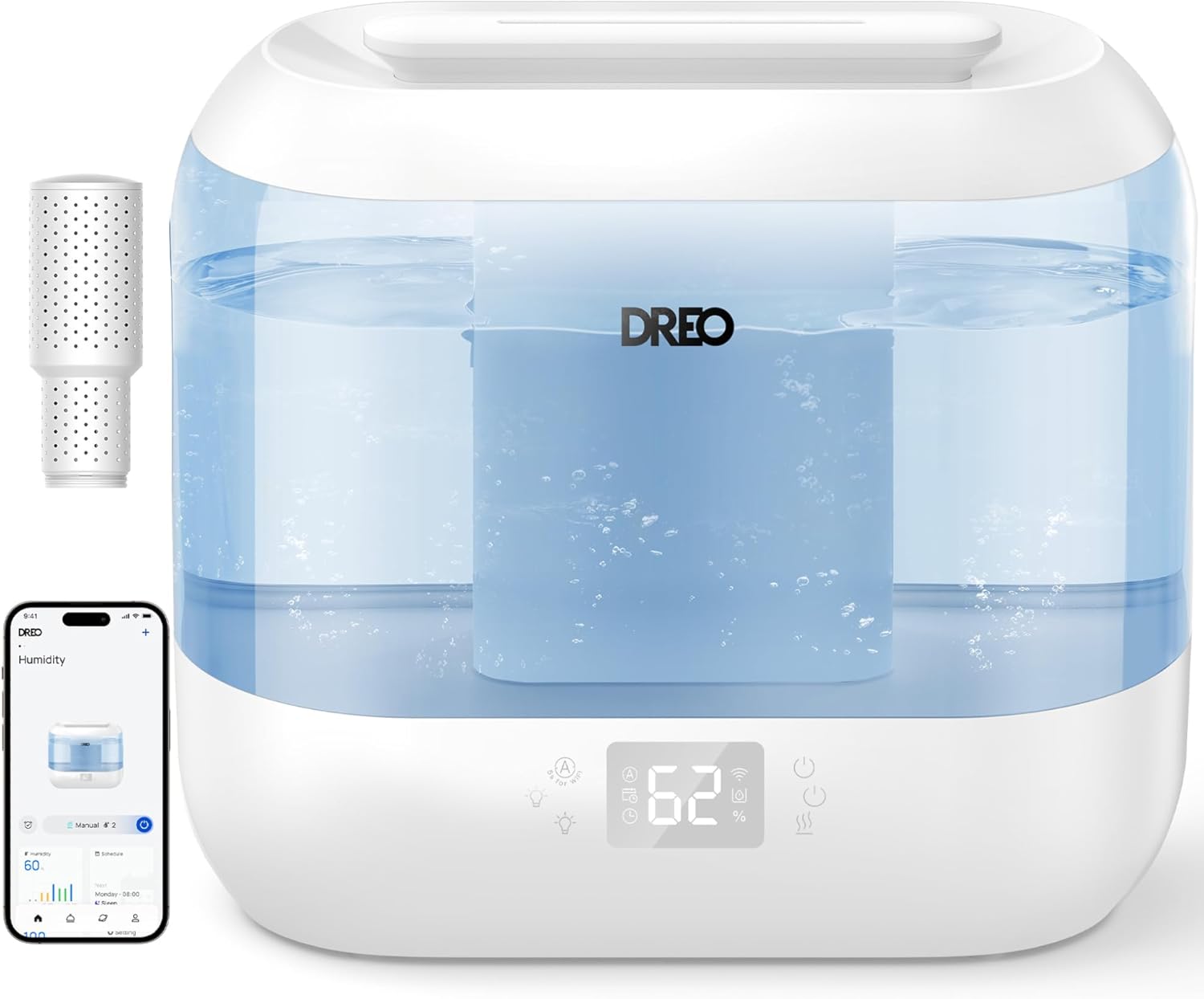
| Capacity | 4 liters |
|---|---|
| Runtime | 36 hours |
| Control Method | App, Touch, Voice |
| Operation Mode | Ultrasonic |
| Wattage | 26 watt-hours |
The DREO HM311S is a smart top-fill ultrasonic humidifier designed to run quietly through the night while delivering steady cool mist to medium rooms. It is typically used in bedrooms, nurseries, or offices where overnight runtime and low noise matter; the 4 L tank and claimed 36-hour runtime mean you rarely need to refill during sleep cycles. Controls include touch buttons on the unit plus app and voice control via Alexa or Google Assistant, which makes remote adjustments easy. Practical features include a supplied pre-filter and a demineralization cartridge to reduce mineral dust, a 30° tiltable nozzle to direct mist, and an ambient humidity-aware Auto Mode for more consistent humidity. The unit is energy efficient at 26 Wh and emphasizes quiet operation around 28 dB. Limitations to weigh: it produces cool mist only and is sized for roughly 100–300 ft², so it is not intended for large open living spaces, and some users will need periodic filter and cartridge replacements to maintain performance.
Best for: Buyers who prioritize quiet, long-running performance and smart remote control for bedrooms or nurseries and want a humidifier with a factory-compatible filter included.
Less Ideal for: People who need whole-house or large open-space humidification or who prefer warm-mist humidifiers should consider other options.
- Large 4 L top-fill tank provides long runtime (about 36 hours) between refills
- Smart controls with app and Alexa/Google voice support let you adjust settings remotely
- Included pre-filter and demineralization cartridge reduce mineral buildup and improve air quality
- Very quiet operation around 28 dB suitable for bedrooms and nurseries
- Cool-mist only design limits use where warm-mist is preferred
- Effective coverage is aimed at medium rooms and may be insufficient for larger open areas
Verdict: A quiet, long-runtime smart humidifier with a factory-compatible filter that is ideal for performance-focused bedroom and nursery use.
Afloia Miro Pro Air Purifier & Humidifier
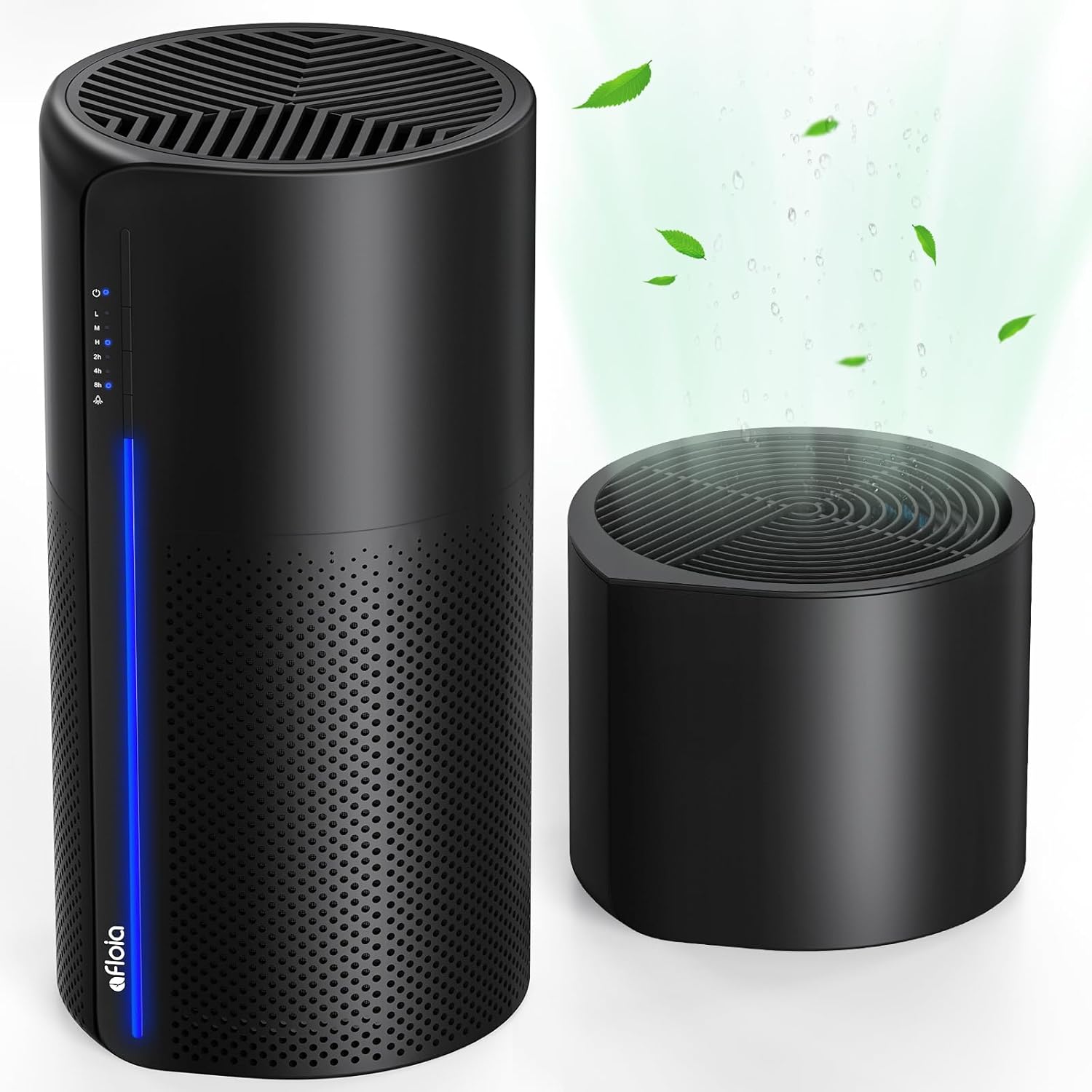
| Coverage | 219 ft²/20 ㎡ |
|---|---|
| Air refresh rate | Purifies air every 12 minutes (≈5×/hr in 438 ft²) |
| Filtration | Pre-filter + activated carbon + high-efficiency filter |
| Noise level | 24-55 dB |
The Afloia Miro Pro pairs a 3-stage air filter (pre-filter, activated carbon, HEPA-style filter) with an evaporative, mist-free humidifier module so you can both remove particles and add humidity from one compact tower. In daily use the purifier runs quietly and circulates room air every 12 minutes in the stated coverage, while the detachable humidifier uses a wicking-style wet curtain to produce nano-scale moisture without visible mist or leakage. The unit includes a seven-color ambient light and a red LED filter-change indicator to simplify upkeep, and Afloia lists compatible replacement air and humidifier filters for straightforward maintenance. Expect practical benefits like reduced dust, pet dander, and odors plus humidity for dry-winter comfort, but note the humidifier module is designed to work only when attached to the purifier and cannot operate fully independently. The evaporative approach minimizes white dust and leaks but will not deliver aggressive steam-style humidification for very dry or large open areas.
Best for: Buyers who want a compact two-in-one device to improve indoor air quality and maintain comfortable humidity in bedrooms or small living spaces, prioritizing convenience and low-maintenance operation.
Less Ideal for: People needing high-output humidification for very large rooms or whole-home humidification should consider a dedicated high-capacity humidifier instead.
- Combined purifier and humidifier saves counter space and combines two functions in one unit.
- Three-stage filtration with activated carbon helps capture particles and reduce odors.
- Evaporative, mist-free humidification avoids visible mist and reduces risk of water leakage or white dust.
- Detachable humidifier module and LED filter indicator make maintenance straightforward.
- Humidifier module cannot operate completely independently from the purifier unit.
- Coverage is limited to moderate-size rooms rather than large open areas.
Verdict: A practical two-in-one purifier and evaporative humidifier that simplifies maintenance while improving air quality and comfort in small to medium rooms.
Provirtec MistFree Evaporative Humidifier HC-13
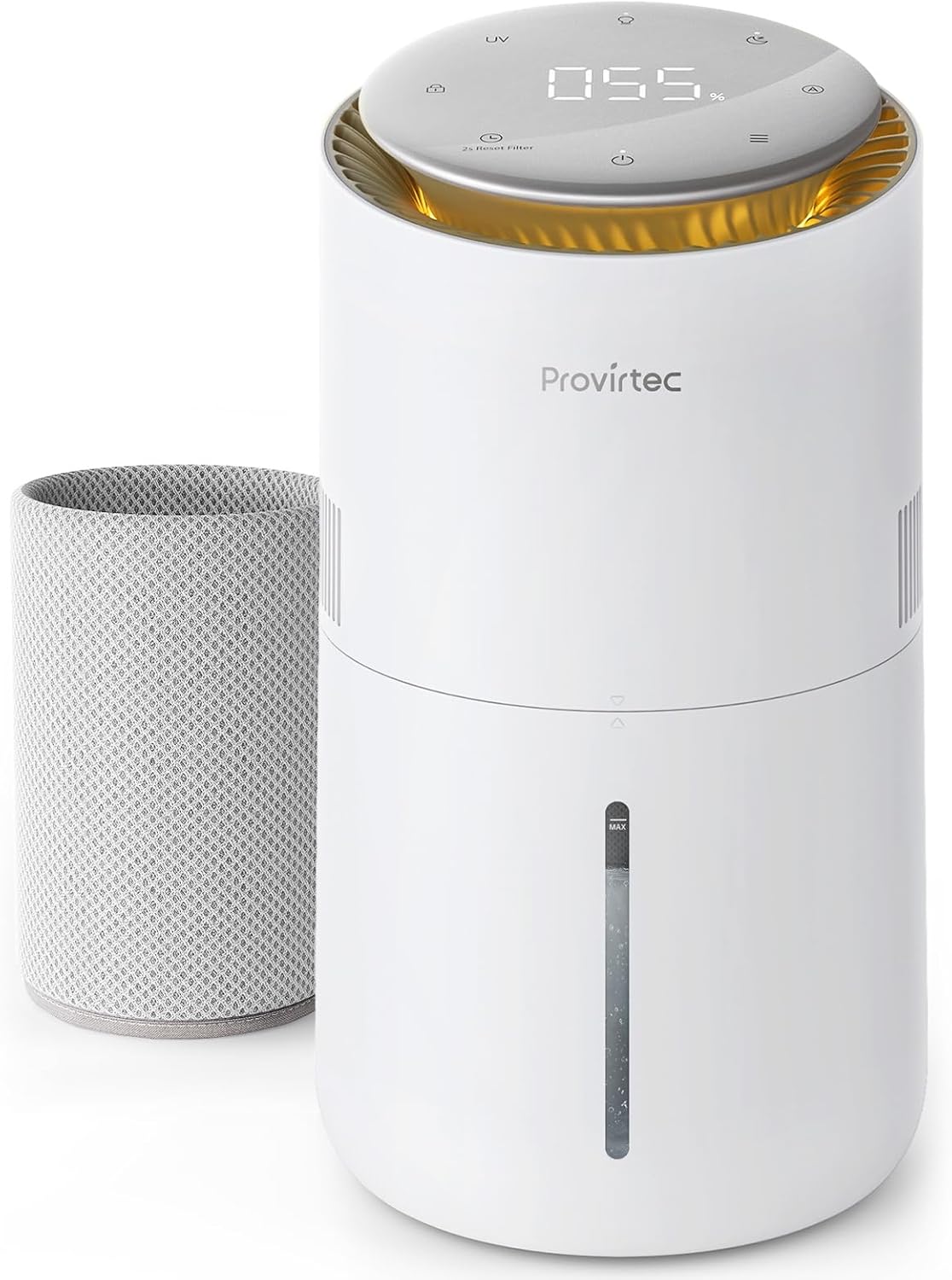
| Capacity | 3 liters |
|---|---|
| Floor Area | 200 square_feet |
| Operation Mode | Cool Evaporative |
| Wattage | 12 watts |
| Control Method | Touch |
The Provirtec MistFree HC-13 is an evaporative cool-mist humidifier designed for bedrooms and small rooms up to about 100–200 sq ft. It uses a 3 L integrated tank and an evaporative cartridge to produce moisture without visible mist or white dust, which keeps surfaces dry and avoids mineral residue. A built-in humidity sensor and automatic mode let the unit maintain a target humidity range, and sleep mode plus noise reduction makes it suitable for overnight use. The washable non-woven filter and top-fill seamless tank simplify cleaning and reduce running costs versus disposable filters, and safety features include child lock, tip-over shutoff, and water shortage protection. Practical limits are room size and output rate common to evaporative models, and effectiveness depends on placement and ambient ventilation; it will not deliver the dense visible mist of ultrasonic models or heat for warm mist needs. For buyers focused on clean air and low maintenance, it offers sensible features in a compact package.
Best for: Buyers who want a low-maintenance, filter-equipped humidifier for bedrooms or nurseries and prioritize clean, dust-free moisture over loud visible mist.
Less Ideal for: Users needing rapid humidification of large rooms or those who prefer visible warm or ultrasonic mist effects should consider other types.
- Evaporative design prevents white dust and keeps floors/furniture dry.
- Automatic humidity sensor with auto mode maintains set humidity range.
- Washable, reusable filter lowers ongoing filter costs and is easy to clean.
- Top-fill seamless 3 L tank simplifies refills and reduces leaks.
- Quiet sleep mode and adjustable night light for bedroom use.
- Best suited for small rooms; output and coverage are limited to about 100–200 sq ft.
- Evaporative models depend on air circulation and may humidify slower than ultrasonic units.
Verdict: A practical, easy-to-clean evaporative humidifier with a washable filter and automatic humidity control that fits small bedrooms and nurseries on a budget.
Levoit Superior 6000S

| Capacity | 6 gallons |
|---|---|
| Floor Area | 3000 square_feet |
| Operation Mode | Evaporative |
| Runtime | 72 hours |
| Wattage | 30 watts |
The Levoit Superior 6000S is an evaporative whole-home humidifier built around a large 23 L (6 gallon) tank and a wick filter to deliver mist-free, residue-free humidity for extended periods. It uses a high-speed fan and wick filtration to evaporate water rather than pump visible mist, which reduces white dust and wet surfaces and makes it safe to use with tap water. Practical features include up to 72 hours runtime on low, a detachable pump for easier deep cleaning, touch controls with auto/humidistat modes, and VeSync smart and voice control for remote monitoring. The unit is relatively quiet for its capacity and claims an improved humidity sensor with ±5% accuracy to avoid over-humidifying. Limitations to consider are routine filter replacements every 3–6 months depending on water quality, and the size and weight mean it is stationary compared with smaller room humidifiers; placement in an open area is important to achieve the rated coverage. For buyers who prioritize steady, low-maintenance humidification across large areas, this model delivers predictable, factory-style evaporative performance.
Best for: Buyers who want reliable, continuous humidification across large rooms or whole-home spaces and prioritize steady performance and easy maintenance over portability.
Less Ideal for: People who need a compact, highly portable bedroom humidifier or those unwilling to replace filters periodically should look elsewhere.
- Very large 23 L (6 gallon) tank supports up to 72 hours between refills on low.
- Evaporative wick filter design produces no visible mist or white dust and works with tap water.
- Smart controls and VeSync voice integration allow remote monitoring and auto humidity management.
- Detachable pump and accessible components simplify deep cleaning and maintenance.
- Requires periodic wick filter replacement (3–6 months) depending on water quality.
- Bulky and heavier than tabletop units, so it is not convenient to move frequently.
Verdict: Choose the Superior 6000S for dependable, long-running evaporative humidification across large spaces with smart control and low visible residue.
Honeywell QuietCare HCM350B

| Capacity | 1.1 gallons |
|---|---|
| Operation Mode | Evaporative |
| Filter Type | Wick |
| Runtime | 24 hours |
| Control Method | Touch |
The Honeywell QuietCare HCM350B is an evaporative cool-mist humidifier designed to raise indoor humidity in medium bedrooms and kids rooms. It uses a wick filter and UV-treated water to reduce minerals in the mist, and its large 1.1-gallon tank delivers up to 24 hours of continuous run time for overnight use. Touch controls make basic adjustments simple, and the unit runs with a soft, fan-like noise that is suitable for sleeping areas. Practical benefits include dishwasher-safe parts for easier cleaning and a filter-based design that holds and maintains a target humidity level rather than outputting raw mist. Important limitations are the need to replace the Honeywell wicking filter for best performance and the evaporative operation that depends on room airflow and the filter condition, so it may not humidify very large or poorly circulated spaces as quickly as ultrasonic models. The HCM350B is straightforward to operate and keeps maintenance predictable if you follow the filter replacement guidance.
Best for: Buyers who prioritize proven, filter-based humidification with visible service history and predictable maintenance will appreciate this unit for bedroom or nursery use.
Less Ideal for: People who need rapid humidification for large, poorly ventilated rooms or want a silent, no-filter ultrasonic unit should consider other technologies.
- 1.1-gallon tank provides up to 24 hours continuous runtime for overnight use.
- Wick filter plus UV treatment reduces minerals and helps deliver cleaner mist.
- Dishwasher-safe water-touching parts simplify cleaning and maintenance.
- Touch controls and a quiet, fan-like sound suitable for bedrooms.
- Requires genuine Honeywell wicking filter replacements to maintain specified performance.
- Evaporative design depends on airflow and filter condition, so humidification rate can be slower than ultrasonic units.
Verdict: Choose this Honeywell if you want a reliable, filter-based humidifier for medium bedrooms that balances overnight runtime, cleaner mist, and easy maintenance.
Choosing the Right Humidifier with Filters: Key Factors to Consider
Room Coverage and Placement
Match capacity to the room you plan to humidify. A unit rated for a small bedroom will not meaningfully change humidity in an open-plan living area. Consider where the humidifier will sit: central placement provides the most uniform humidity, while corner placement reduces effective coverage. If you need to move the unit between rooms, prioritize models with manageable weight and a secure carrying handle.
Placement also affects maintenance: units near walls or furniture will deposit more moisture on nearby surfaces and may require a slightly lower output setting. Always check the manufacturer-stated coverage area and compare it to your room's square footage to get a realistic expectation of performance.
Filter Type and Replacement Cycle
Filters differ widely: some are simple wick pads absorbing mineral content, others are activated carbon or multi-stage pads that trap dust and reduce odors. Know what contaminants you want captured and choose a filter type that targets them. Replacement intervals vary by water hardness and usage; heavy daily use in a high-mineral area shortens filter life.
Consider the availability and cost of replacement filters before committing. Some filters are washable and reusable for several cycles, reducing ongoing cost but increasing the effort for periodic cleaning. Check whether the filter is easy to access and replace without tools, which saves time and reduces the chance of missed maintenance.
Water Tank Size and Refill Frequency
Tank capacity directly impacts how often you must refill the humidifier. Larger tanks extend runtime between fill-ups but make the appliance heavier and sometimes more cumbersome to clean. If you prefer low-maintenance operation, prioritize tanks that provide a full night or multi-day runtime at typical settings for your room size.
Balance tank volume with how often you are willing to tend the unit. Frequent refilling increases wear on seals and the tank opening, so consider models with well-designed caps and wide openings for easier cleaning and filling.
Ease of Cleaning and Internal Access
Regular cleaning prevents scale buildup, bacterial growth, and odor. Units with wide tank openings, removable bases, and few hidden crevices are much easier to keep sanitary. Look for models that specify dishwasher-safe parts or provide straightforward disassembly for routine maintenance.
Also factor in how simple it is to inspect and replace the filter. A design that requires partial disassembly or tools will discourage regular upkeep. Clear manufacturer guidance on cleaning frequency and methods is a sign of a user-friendly product.
Control Features and Humidity Management
Precise control options change how the humidifier fits into your daily routine. Built-in humidistats that let you set a target relative humidity level are helpful to avoid over-humidifying, which can promote mold. Timers, multiple output settings, and auto-shutoff at low water add convenience and safety.
If you plan to run a humidifier in a bedroom, prioritize quieter operation and simple nighttime controls. Digital displays and programmable schedules can be useful but check that they are intuitive and reliable, as complex menus can be frustrating for everyday use.
Noise Level and Day-to-Day Use
Operational noise matters, especially if the unit will run in sleeping areas or workspaces. Evaporative and ultrasonic designs have different noise profiles. Look for published decibel ratings when available and read descriptions of fan speed or motor noise. Low-noise models may slightly compromise maximum output, so balance sound tolerance with humidity needs.
Also consider whether the unit requires frequent adjustments or if it can run well on a single setting. Simpler controls reduce fuss and make the humidifier more compatible with daily life.
Evaporative Vs Ultrasonic Approaches
Humidifiers with filters are commonly evaporative models where air is passed through a wetted filter, picking up moisture and trapping particulates. This passive method naturally limits over-humidification because evaporation rate drops as room humidity rises. Ultrasonic units can pair with filters but often rely on different mechanics; when a filter is present it primarily addresses dust and minerals rather than generating mist.
Understanding the basic operating method helps you decide which tradeoffs you accept: evaporative filtered units tend to reduce mineral dust without producing visible white residue, while filtered ultrasonic models can deliver very quiet operation with lower energy use.
- Evaporative filtered units: effective at trapping particulates, self-limiting evaporation.
- Ultrasonic filtered units: quieter, can pair with carbon or particle filters, may require more frequent filter attention.
Reducing Mineral Dust and White Dust
If you use tap water, minerals can end up as fine dust on nearby surfaces. A proper filter helps capture those minerals before they become airborne. In areas with hard water, consider using distilled or demineralized water as a complementary step to extend filter life and reduce deposits.
Wick and particulate filters collect minerals but will need inspection and replacement more often in high-mineral settings. Regularly rinsing the tank and following the cleaning schedule helps avoid mineral buildup that can reduce airflow and overall effectiveness.
- Use distilled water to minimize mineral load.
- Check filters more often in hard-water regions.
Maintenance Schedule That Fits Your Routine
A humidifier only helps if it is maintained. Establish a cleaning cadence that matches the machine's usage: light daily checks for visible residue and weekly deep cleans for tanks and filters are common for daily-use models. Replace or thoroughly wash filters according to the manufacturer guidance and earlier usage notes about water quality.
Set calendar reminders for filter changes and tank cleaning. Simple habits like emptying and drying the tank when not in use and wiping the exterior and base weekly will extend the unit's life and keep indoor air healthier.
- Daily: quick visual check for leaks or visible residue.
- Weekly: empty, rinse, and air-dry the tank; wipe the base.
- Monthly: deep clean and inspect or replace the filter as needed.
Controls, Sensors, and Auto Modes
Units that include reliable humidity sensors and automatic modes reduce the need for manual adjustments. Auto mode can throttle output to achieve a set relative humidity, which is useful to avoid over-humidifying and the risk of condensation on windows. For bedrooms, look for models with a quiet low mode and an easy-to-read humidity indicator.
Manual controls provide straightforward operation but need more frequent monitoring. If you want a near-set-and-forget experience, pick a unit with a well-regarded humidistat and simple scheduling features.
- Auto humidity control helps maintain stable indoor moisture levels.
- Look for clear indicators and simple control layouts for daily use.
Safety and Convenience Features
Auto shutoff on low water is essential to prevent dry-running. Other useful conveniences include child locks, night modes with dimmed displays, and easy-to-remove tanks that minimize spills during refills. Consider whether the unit has a stable base and secure tank latches to reduce the chance of accidental tipping or leaks.
Portability features like built-in handles and lightweight construction are helpful if you plan to move the humidifier between rooms seasonally. Also check whether replacement filters are widely available or proprietary, as that affects long-term convenience.
- Auto-shutoff prevents motor or heater damage in low-water conditions.
- Night modes and child locks improve safety and comfort.
How We Chose the Best Humidifier with Filters
We evaluated models that combine consistent humidification with effective particulate filtering and manageable upkeep. Our editorial filters prioritized devices that include replaceable or washable filters specifically designed to capture minerals, dust, and common allergens rather than relying solely on plain wick pads. We favored units with clear stated coverage areas and measurable run-time on a single tank fill so performance claims can be matched to typical room sizes. Key evaluation criteria included humidification output relative to tank capacity, filter effectiveness and replacement interval, ease of cleaning and access to internal parts, noise levels for bedroom use, and control options such as humidity targeting and reliable sensors. We excluded any units that lack replaceable filtration or that only advertise nebulizing or ultrasonic mist without a particulate-capturing element. Products with opaque maintenance requirements or no clear spec for filter life were also set aside. The final list focuses on units that balance filtration, usable run time, and straightforward maintenance for everyday home use.
Our full evaluation process is outlined in our review methodology.
FAQ
How often should I replace the filter in a humidifier with filters?
Replacement depends on water quality and usage. Typical intervals are one to three months with daily use, but in high-mineral or high-dust environments you may need to change filters more often. Check the manufacturer guidance and inspect the filter for discoloration or reduced airflow.
Can I use tap water in a humidifier with filters?
You can, but hard tap water increases mineral deposits and shortens filter life. Using distilled or demineralized water reduces mineral buildup and extends the interval between filter changes and deep cleans.
Will a filter prevent mold growth in the humidifier?
A particle filter helps reduce airborne particulates but does not eliminate the need for regular cleaning to prevent microbial growth. Follow recommended cleaning schedules for the tank and base and dry the unit when not in use to minimize mold risk.
Is a humidifier with filters noisy?
Noise varies by design and fan speed. Evaporative filtered units can produce audible airflow at high settings, while some filtered ultrasonic units run more quietly. Look for published decibel ratings and consider nighttime or low-noise modes if sound is a concern.
How do I know what size humidifier I need?
Match the unit's stated coverage area to the square footage of your room. Also consider ceiling height and how airtight the space is. If in doubt, choose a model rated a bit higher than your target room to achieve the desired humidity level more quickly.
Final Verdict
A humidifier with filters is a practical choice when you want to add moisture while limiting mineral dust and airborne particulates. Prioritize coverage that matches your room size, a filter type suited to your water quality, and a maintenance regime you will actually follow. Expect tradeoffs between runtime, noise, and the frequency of filter changes. Focus on units with clear filter access, reliable humidistats or auto modes, and straightforward cleaning procedures. With those priorities in mind, you can choose a filtered humidifier that improves comfort without adding extra maintenance burdens.