
Note: This article contains affiliate links. If you click on these links and make a purchase, we may earn a small commission at no extra cost to you. This helps support our research and content. Read our full affiliate disclosure here.
If you are launching or expanding an ice cream operation, the right equipment determines whether you can meet demand while maintaining consistent texture and food safety. Small business ice cream makers must deliver repeatable batch yields, fast freeze times, and durable construction that stands up to daily use. This guide highlights seven shortlisted ice cream makers chosen for commercial-style performance but sized and priced for smaller operations. Below we summarize the strengths and typical use cases for each pick and explain the ranking criteria so you can match a machine to your production schedule and menu. Read on to find options that suit your expected batch volume, staffing, and space constraints.
Top Picks at a Glance
| Best Overall The best all-around choice for most situations | FOHERE Commercial Ice Cream Machine 4L |  |
| Best Quality Built to a higher standard if you want something more solid | FSKEKU YFK-8230 Soft Serve Machine |  |
| Best Value The sweet spot between price and what you get | Instant Pot InstantChill Ice Cream Maker |  |
| Best Budget The cheapest option that still gets the job done reliably | Hamilton Beach Electric Ice Cream Maker 4-Quart |  |
| Top Rated A top-rated pick with lots of positive feedback | Whynter Ice Cream Maker ICM-200LS |  |
| Most Popular A crowd favorite that many people choose with confidence | Ninja CREAMi NC301 |  |
| Best Seller A high-volume bestseller chosen again and again | Cuisinart Ice Cream Maker ICE-21P1ES |  |
FOHERE Commercial Ice Cream Machine 4L

| Capacity | 4.5 liters |
|---|---|
| Hopper capacity | 4L |
| Freezer tank | 1.6L |
| Operation mode | Automatic |
This FOHERE commercial soft-serve machine is built for small commercial environments that need steady output and easy controls. It combines a 4L hopper with a 1.6L freezing cylinder and a high-performance compressor to make 10–20 liters per hour, reaching an initial freeze in about 12 minutes and subsequent batches in roughly 6 minutes. The touch LCD lets you adjust serving size, hardness, temperature, and run a pre-cool or one-touch auto-clean cycle, which simplifies operation and daily maintenance. Construction mixes stainless steel with food-grade plastics and includes practical touches like an anti-slip base, removable drip tray, and ergonomic handle. At 134 pounds it is a substantial countertop unit intended for fixed placement rather than portability. Buyers should expect a professional-feeling machine that handles steady volume, but its size and weight mean you need adequate counter space and a stable installation spot.
Best for: Operators running a small ice cream shop, cafe, food truck, or bar who need reliable soft-serve throughput and simple digital controls for consistent product quality.
Less Ideal for: Home users or very small operations with minimal counter space or who need a lightweight, portable machine.
- Commercial-grade refrigeration with fast freeze times for quick batch turnaround
- Touch LCD with pre-cool, hardness and timer controls for precise portioning and consistency
- Auto-clean program and removable drip tray simplify daily sanitation
- Stainless steel food-contact surfaces and ergonomic details for durability and ease of use
- Heavy and large for a countertop unit, requiring dedicated space and stable support
- Materials list includes plastics alongside stainless steel which may need careful cleaning to avoid wear
Verdict: A robust countertop soft-serve machine that delivers steady commercial output with intuitive touch controls and built-in auto-clean for small-business service.
FSKEKU YFK-8230 Soft Serve Machine
| Capacity | 5.5 liters |
|---|---|
| Power | 2450W |
| Voltage | 115V |
| Output | 22-30 L/H |
| Operation Mode | Automatic |
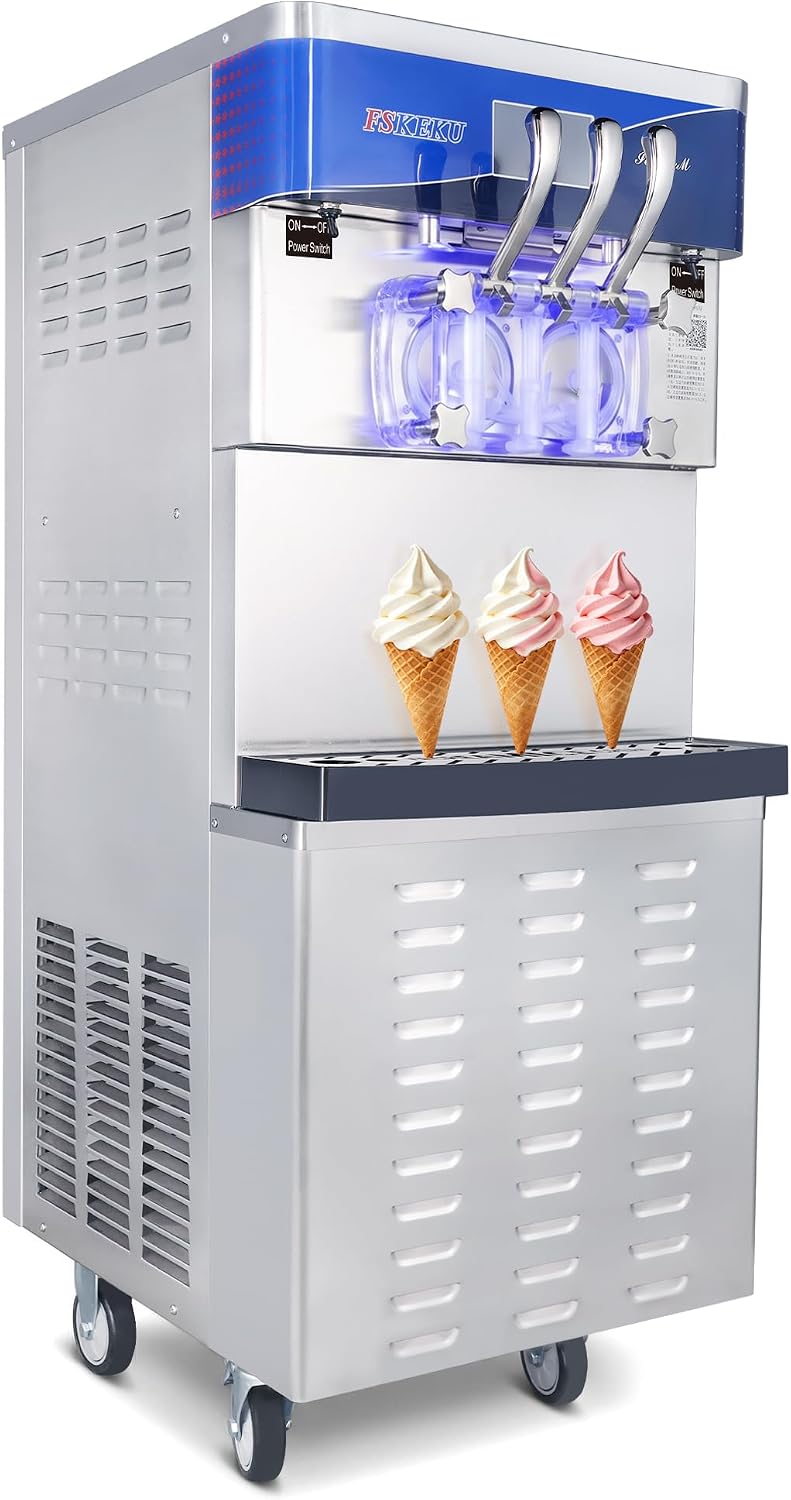
This FSKEKU YFK-8230 is a high-output commercial soft serve machine built for busy small businesses. It delivers a reported 22–30 liters per hour using a 2450W motor on standard 115V power, making it suitable for coffee shops, food trucks, and dessert counters that need steady production during peak periods. Dual compressor cooling with a keep-fresh function chills both cylinders and hoppers so mix can sit overnight without degrading, and the 5-inch touch screen plus one-click defrost simplify operation and recovery from over-freeze events. The unit includes practical commercial features such as a stainless steel hopper, visible discharge base with blue LED lighting for monitoring, hardness adjustment, low-mix alarm, and an auto-clean function to reduce hands-on maintenance. The machine is large and heavy, so it requires a dedicated counter and staff trained for routine cleaning and refill procedures, and its power and output are geared to commercial use rather than home kitchens. For a small business needing consistent, high-throughput soft serve with straightforward controls, this model covers the essentials well.
Best for: Operators who prioritize reliable, high-throughput soft serve production for cafes, food trucks, or dessert counters and want straightforward controls and commercial-grade cooling.
Less Ideal for: Individuals or businesses with very limited counter space or low daily demand should consider smaller countertop units or batch freezers instead.
- High production rate (22–30 L/h) suitable for peak service periods
- Dual compressors and keep-fresh cooling preserve mix quality and reduce downtime
- 5-inch touch screen with one-click defrost for simple control and fast recovery
- Commercial stainless steel construction and visual discharge for durability and monitoring
- Large, heavy footprint requires substantial counter space and installation planning
- Designed for commercial environments so it may be oversized for casual or home use
Verdict: A performance-focused, commercial soft serve station that delivers consistent high-volume output and simple controls for small businesses needing dependable service during busy shifts.
Instant Pot InstantChill Ice Cream Maker

| Capacity | 2 pints |
|---|---|
| Included Components | 2 Rolled Ice Cream Paddles |
| Operation Mode | Automatic |
| Other Special Features of the Product | Built in Cold Plate, Mix-in Function, Built-In Compressor |
The InstantChill combines a compressor freezer and cold plate to churn ice cream, gelato, sorbet, non-dairy desserts, and rolled ice cream on demand without pre-freezing the bowl. You pick a one-touch program, pour your mixed base, and the machine cools and churns automatically while a smart mix-in alert signals when to add fruit or chips. The cold plate option lets you pour and roll directly for faster, firmer results, and quiet operation makes it suitable for small shops or demos. It cleans quickly with removable paddles and fast-rinse parts, and the 2-pint capacity handles small batches or sampler portions. The main compromises are batch size and throughput: at 2 pints per run and with a recommended rest after shipping, it is best for limited production, testing flavors, or complementary dessert stations rather than high-volume continuous service.
Best for: Small-business owners and food entrepreneurs who need a flexible countertop machine for recipe development, menu testing, or making small specialty batches and samples.
Less Ideal for: Operators seeking high-capacity or continuous-production equipment for heavy retail or full-service dessert counters should choose commercial-scale machines instead.
- Built-in compressor and cold plate let you make frozen desserts without pre-freezing a bowl
- Six one-touch programs cover ice cream, gelato, sorbet, non-dairy, rolled ice cream, and mix-ins
- Smart mix-in alert times additions for even distribution and better texture
- Quiet, automatic operation and removable parts make it easy to run demos or test recipes
- Maximum 2-pint batch size limits throughput for commercial peak periods
- Not intended for continuous high-volume production; requires short setup/rest guidance after shipping
Verdict: A compact, compressor-driven countertop unit ideal for small businesses that need fast, on-demand 2-pint batches and flexible recipe testing.
Hamilton Beach Electric Ice Cream Maker 4-Quart

| Capacity | 4 quarts |
|---|---|
| Operation Mode | Automatic |
| Other Special Features of the Product | Detachable Freezer |
| Material | Metal |
This Hamilton Beach 4-quart machine is an entry-level automatic churner designed for home kitchens and light commercial use where speed and simplicity matter. You freeze the removable metal freezer bowl ahead of time, pour in your base and mix-ins, then assemble, plug in, add ice and rock salt to the outer bucket and let the motor churn for roughly 20 to 40 minutes until set. The large 4-quart capacity makes enough for families or small gatherings, and the automatic operation removes the need for hand cranking. Its metal construction and detachable bowl give it a more durable feel than plastic-only models, but it requires pre-freezing the bowl and the ice-and-salt step, which adds prep and mess compared with compressor-based machines. Cleanup is mostly hand wash only. For a budget-conscious buyer who needs straightforward results and decent batch size, this machine delivers reliable, homemade frozen treats without complicated controls; it is less suited to continuous commercial production or kitchens that need rapid back-to-back batches without downtime for freezing the bowl.
Best for: Buyers on a tight budget who want a simple, large-batch machine for occasional small-business events, sampling, or making consistent homemade frozen desserts without complex controls.
Less Ideal for: Operators who need continuous, high-volume production or rapid back-to-back batches should choose a compressor-based commercial unit instead.
- Generous 4-quart capacity suitable for family-sized batches or small gatherings
- Automatic motorized churning eliminates hand cranking
- Detachable metal freezer bowl offers better durability and cold retention than plastic bowls
- Simple operation with minimal controls makes it easy for beginners to use
- Requires pre-freezing the removable bowl and using ice and rock salt, which adds prep time and cleanup
- Not designed for continuous commercial use due to downtime between batches
Verdict: A roomy, budget-friendly automatic churner that makes family-sized batches of homemade ice cream with minimal learning curve.
Whynter Ice Cream Maker ICM-200LS

| Capacity | 2.1 quarts |
|---|---|
| Operation Mode | Automatic |
| Material | Stainless Steel |
| Included Components | Removable aluminum bowl and churn blade |
The Whynter ICM-200LS is a self-contained compressor ice cream maker designed for repeat small-batch production without the need to pre-freeze a bowl. You load your mix, choose the soft-touch settings on the LCD panel and the machine chills and churns to produce up to 2.1 quarts of ice cream, gelato, or sorbet per cycle. Its built-in compressor supports continuous use between batches and an extended cooling function helps keep the mixture from thawing during finish stages. Practical details include a removable BPA-free aluminum bowl and churn blade for easier cleanup, a motor protection feature to halt churning if the mixture becomes overly firm, and an audible timer. The stainless steel housing is sturdy for countertop use, but the unit is fairly heavy and sized for a dedicated workspace. For a small business making multiple daily batches, the reliable compressor and motor safeguards reduce downtime and protect the machine during heavy use, though a commercial kitchen would need to consider capacity and electrical demands before committing this as primary production equipment.
Best for: Small business owners who need a dependable countertop machine for consistent small-batch production and value continuous, no-pre-freeze operation and protective motor features.
Less Ideal for: High-volume commercial operations that require larger capacity, faster cycle times, or machines built to commercial-spec duty cycles should consider true commercial ice cream equipment instead.
- Built-in compressor allows continuous back-to-back batches without pre-freezing
- 2.1 quart capacity suitable for multiple small batches
- Removable BPA-free aluminum bowl and churn blade simplify cleaning
- Motor protection and extended cooling functions help prevent overheating and melting
- Sleek stainless steel exterior and LCD controls are durable and easy to use
- Designed for residential use so throughput is limited compared with commercial machines
- Relatively heavy and requires dedicated counter space
Verdict: Pick this Whynter model if you want a reliable self-freezing countertop ice cream maker that handles repeated small-batch runs without pre-freezing.
Ninja CREAMi NC301

| Capacity | 1 pints |
|---|---|
| Included Components | (2) 16 oz. CREAMi Pints with storage lids, Creamerizer Paddle, Motor Base, Outer bowl and lid |
| Operation Mode | Automatic |
| Power | 800W | 120V / 60Hz |
| Material | Stainless Steel |
The Ninja CREAMi NC301 is a small, user-friendly countertop machine that transforms frozen 16-oz pints into scoopable desserts in minutes using proprietary Creamify Technology. You prepare a base, freeze it in the included pint for 24 hours, then slot the pint into the outer bowl and select one of seven one-touch programs such as Ice Cream, Gelato, Sorbet, Milkshake, Lite Ice Cream, Smoothie Bowl, or Mix-In. The unit includes two pints, a Creamerizer Paddle for processing, and a re-spin option to refine texture. It is practical for kitchens that want quick, made-to-order single pints with tight ingredient control, and cleanup is simple because the paddle and pints are top-rack dishwasher safe. Important limitations for a small-business setting are the 16-oz pint capacity and requirement to freeze bases for 24 hours, which prevents continuous throughput; the machine is optimized for batch-at-a-time home use rather than commercial production. Still, for sampling, limited menu add-ons, or trial-and-tasting environments where portion control and custom flavors matter, the NC301 is an efficient, easy-to-operate choice.
Best for: Buyers who need a compact, easy-to-use machine for producing single-serving, made-to-order frozen treats—ideal for sampling, tasting stations, or small-scale dessert offerings where customization matters.
Less Ideal for: Operators who require continuous high-volume output, large batch production, or vendor-grade throughput should choose a commercial pasteurizing or batch freezer instead.
- Seven one-touch programs handle ice cream, gelato, sorbet, milkshakes and mix-ins for versatile recipes
- Creamify Technology produces smooth, scoopable texture from frozen pints quickly
- Includes two 16-oz pints and a processing paddle so you can make back-to-back flavors with brief downtime
- Removable parts including pints and paddle are top-rack dishwasher safe for easy cleanup
- Each pint must be frozen for about 24 hours before processing, limiting rapid turnaround
- Small 16-oz capacity is not suited for high-volume commercial production
Verdict: If you need a compact machine for customizable, single‑serve frozen desserts and easy cleanup, the Ninja CREAMi NC301 delivers smooth, scoopable results with minimal fuss.
Cuisinart Ice Cream Maker ICE-21P1ES

| Capacity | 1.5 quarts |
|---|---|
| Operation Mode | Automatic |
| Material | Plastic |
| Included Components | Freezer bowl, plastic lid, mixing paddle |
The Cuisinart ICE-21P1ES is a straightforward countertop ice cream maker that uses a double-insulated freezer bowl and a mixing paddle to churn ice cream, sorbet, or frozen yogurt in roughly 20 minutes. You freeze the removable bowl ahead of time, add your base through the clear, easy-lock lid with a large spout, and the automatic motor does the mixing until the mixture firms. Its 1.5 quart capacity makes it suited to small batches for family use or recipe testing, and the plastic construction keeps the unit lightweight and simple to clean with a wipe. Key conveniences are the no-ice-required insulated bowl and the transparent lid for watching and adding mix-ins without stopping the cycle. Limitations include the need to pre-freeze the bowl in a separate freezer (no built-in compressor) and a relatively small batch size that is not designed for continuous commercial output, so you will run multiple cycles for larger quantities. The machine is reliable for home kitchens and low-volume demo or tasting work but is not a production unit for sustained business service.
Best for: Buyers who prioritize a reliable, easy-to-use machine for small-batch production, recipe testing, or offering samples with minimal fuss and predictable results.
Less Ideal for: Businesses that need continuous, high-volume production or a commercial compressor-style machine should look for larger-capacity, commercial-grade equipment instead.
- Double-insulated freezer bowl removes the need for ice and simplifies setup
- Quick churn time of about 20 minutes for small batches
- Transparent easy-lock lid with large spout lets you add ingredients mid-cycle without mess
- Simple automatic operation and removable parts make it easy to use and clean
- Requires pre-freezing the bowl in a freezer since it has no built-in compressor
- 1.5 quart capacity is small for high-volume or continuous commercial use
Verdict: A dependable, easy-to-use small-batch ice cream maker ideal for low-volume testing or sampling thanks to its insulated bowl and quick 20-minute churn time.
Choosing the Right Ice Cream Maker for Small Business: Key Factors to Consider
Hourly Throughput and Batch Size
Hourly throughput determines whether a machine can handle your busiest service windows. Estimate peak demand in single-scoop equivalents and translate that into liters or quarts per hour so you can choose a machine with sufficient output.
Batch size affects staffing and plating rhythm. Larger batches reduce the number of cycles but require more freezer space and potentially longer recovery times between batches. Smaller batches give more flavor flexibility but increase labor and cycle frequency.
Freeze Time and Cycle Consistency
Freeze time affects how quickly you can turn product and recover between batches. Faster cycles increase hourly output but must not sacrifice texture. Consistent cycle times also matter for scheduling prep, staffing, and inventory.
Machines that maintain consistent evaporator temperatures and tight control over refrigeration cycles produce more uniform texture from batch to batch, which is important when training staff and maintaining customer expectations.
Sanitation and Ease of Cleaning
Food-safety compliance is nonnegotiable. Machines with removable, dishwasher-safe components or tool-free access for cleaning reduce labor time and the risk of contamination.
Consider how parts contact the mix, the number of crevices where residue can accumulate, and whether the machine design supports routine sanitizing procedures without specialized tools or long disassembly.
Build Quality and Maintainability
Durable materials and straightforward serviceability minimize downtime and repair costs. Look for robust motors, corrosion-resistant bowls, and accessible service panels.
Also evaluate the availability of replacement parts and how simple routine maintenance tasks are, such as belt changes, gasket replacements, or condenser cleaning. Easier maintenance reduces total cost of ownership and keeps machines running reliably.
Control and Texture Adjustability
Different recipes and menu styles demand different textures. Machines with adjustable timers, variable speed paddles, or programmable cycles give you control over overrun, creaminess, and firmness.
Controls that are intuitive reduce operator error and training time. Precise control matters most when offering a variety of products like soft-serve, gelato, or frozen yogurt from the same machine.
Energy Use and Operating Costs
Refrigeration and motor power drive ongoing energy costs. Higher-efficiency compressors and insulated bowls reduce electricity consumption and cooling load on shop HVAC.
Calculate expected energy draw during peak service and idle periods. Lower operating costs improve margins, but be mindful of tradeoffs where efficiency might come at the expense of initial capacity or control features.
Sizing Your Kitchen and Planning Workflow
Before selecting equipment, map out where the machine will sit relative to service counters, reach-in freezers, and cleaning sinks. Space constraints determine which form factors are practical and influence cleaning and maintenance workflows.
- Leave clearance for ventilation and access to service panels
- Plan a logical flow from mix prep to freezing to service to minimize cross-traffic
- Reserve nearby refrigerated staging so finished batches can be held without overloading the machine
Understanding Different Machine Styles
Ice cream makers suitable for small businesses range from batch freezer-style machines to machines designed for continuous soft-serve production. Each style favors different menus and service models. Batch freezers are flexible for different textures and mix types, while continuous machines excel at high-volume soft-serve output.
- Batch freezers: versatile texture control and flavor rotation
- Continuous/soft-serve machines: steady on-demand dispensing for high throughput
- Countertop/commercial hybrids: compact footprint with moderate output
Maintenance Schedule and Common Service Tasks
Establish a routine maintenance schedule that includes daily cleaning, weekly sanitizing of contact parts, and monthly condenser and compressor inspections. Preventive maintenance reduces the risk of sudden failures during peak service.
- Daily: remove and clean bowls, paddles, and seals after service
- Weekly: inspect gaskets and fasteners for wear and replace as needed
- Monthly: clean condenser fins and check electrical connections for tightness
Menu Planning and Recipe Scaling
Think about the balance between offering many rotating flavors and maintaining consistent quality. Machine batch size and recovery time affect how quickly you can switch flavors and scale recipes up from test batches to service portions.
- Scale recipes using weight measures for consistency across batches
- Consider dedicating machines or bowls to high-risk allergens to avoid cross-contact
- Test new flavors during low-traffic hours to measure cycle performance and texture
Staff Training and Operational Best Practices
Operator familiarity with controls, loading procedures, and cleaning protocols has a big impact on product quality and uptime. Create simple checklists and train multiple staff to reduce single-point failures.
- Provide step-by-step SOPs for start-up, cleaning, and shutdown
- Include troubleshooting steps for common issues such as air locks or unusual textures
- Log cycles and maintenance to spot trends before they become failures
How We Chose the Best Ice Cream Maker for Small Business
We evaluated machines on metrics that matter to small-scale commercial production, prioritizing reliable output, sanitation, and operational cost. Key evaluation angles included production capacity and cycle speed to reflect realistic hourly throughput for a busy counter or catering schedule. Build quality and serviceability were considered so equipment can handle repetitive daily cycles with minimal downtime. Ease of cleaning and compliance with food-safety practices were essential; accessible bowls, removable parts, and materials that tolerate sanitizers ranked highly. Temperature control and consistency were reviewed to ensure the machines can produce a stable texture across flavors and varying mix compositions. Energy efficiency and operating cost were weighed because cumulative utility and refrigerant demands affect margins for small businesses. We excluded hobby or countertop units designed strictly for home use or machines with unclear service support. Units were selected only if they offered clear capacity ratings and user-accessible maintenance procedures. The final list balances throughput, sanitation, and year-round reliability for small commercial environments.
Our full evaluation process is outlined in our review methodology.
FAQ
How much space do I need for a small-business ice cream maker?
Space needs vary by machine style. Allow clearance for ventilation and service access, plus separate staging for mix prep and finished product. Account for additional space for cleaning and sanitizer stations.
Can I use regular home recipes in commercial machines?
Home recipes can be adapted but often need scaling and rebalancing for larger batches. Pay attention to overrun, fat, and sugar levels because those affect freezing behavior and texture at commercial scale.
What should I look for to keep machines food-safe?
Prioritize machines with removable contact parts, smooth surfaces, and minimal crevices. Follow daily cleaning and sanitizing procedures and inspect seals and gaskets regularly to prevent contamination.
How do I know if a machine can handle my peak demand?
Estimate peak scoop volume per hour and convert that to liters or quarts per hour. Compare that number to the machine's rated production capacity and consider recovery time between batches for continuous operation.
How often do commercial ice cream machines need professional servicing?
Professional servicing frequency depends on usage, but a typical cadence is annual preventative maintenance plus additional service as needed for heavy-use environments. Regular in-house cleaning and simple checks reduce the need for emergency repairs.
Final Verdict
Choose an ice cream maker for small business by matching capacity and cycle speed to your busiest service periods while prioritizing sanitation and maintainability. Tradeoffs are inevitable: higher throughput machines may need more space and skilled maintenance, while compact units offer flexibility but require tighter recipe and scheduling control. Focus first on hourly production needs and cleaning workflow, then evaluate durability and control features to find the machine that fits your menu and operational rhythm.