
Note: This article contains affiliate links. If you click on these links and make a purchase, we may earn a small commission at no extra cost to you. This helps support our research and content. Read our full affiliate disclosure here.
If you need reliable warmth for a large living area, garage, or open-plan space, the right infrared heater can make a big difference in comfort and running cost. Choosing an infrared heater sized for roughly 1000 square feet matters because undersized units struggle to maintain temperature while oversized units waste energy and cycle inefficiently. This guide brings together six shortlisted infrared heaters that suit around 1000 square feet and walks through the practical factors that affect real-world performance. We evaluated coverage capability, energy efficiency, safety features, and installation flexibility to identify heaters that balance steady radiant heat with sensible operating costs. Read on for the top picks and the decision criteria to match a heater to your space and usage patterns.
Top Picks at a Glance
| Best Overall The best all-around choice for most situations | DR. INFRARED HEATER DR-978 |  |
| Best Quality Built to a higher standard if you want something more solid | Heat Storm Phoenix HS-1500-PHX-WIFI |  |
| Best Value The sweet spot between price and what you get | RealSmart Infrared Space Heater 1500W |  |
| Best Budget The cheapest option that still gets the job done reliably | Amazon Basics Portable Space Heater DF1501 |  |
| Top Rated A top-rated pick with lots of positive feedback | EdenPURE CopperPLUS 903G |  |
| Most Popular A crowd favorite that many people choose with confidence | Dr. Infrared Heater DR-968 |  |
DR. INFRARED HEATER DR-978

| Heating Coverage | 400 sq ft |
|---|---|
| Heat Output | 1500 watts |
| Number of Speeds | 2 |
| Voltage | 120 volts |
| Min Temperature Setting | 50 °F |
The DR. INFRARED HEATER DR-978 uses a hybrid dual-heating system (PTC plus quartz infrared) and a high-velocity low-noise blower to warm rooms quickly and distribute heat more evenly than a bare infrared element alone. It is designed for freestanding indoor use in living rooms, bedrooms, or home offices and offers Eco, High (1500W) and Low (1000W) power modes plus a programmable 12-hour timer and adjustable thermostat (50 to 85 F). Safety features include tip-over and overheat shutoff and a covered heating element that stays safe to touch around kids and pets. The unit ships with a remote and a reusable filter for basic maintenance. Trade-offs are heat coverage and capacity: the listing cites roughly 400 sq ft coverage, so this model is best as a room heater or supplemental source rather than a whole-house solution; it also draws standard 12.5 A and must run on a dedicated circuit for continuous high-power use. Expect solid, quiet performance for targeted room heating with the convenience of remote control and timer programming.
Best for: Buyers who want a reliable, room-focused heater that warms quickly, offers programmable controls and safety features, and is meant as a primary heater for single rooms or a strong supplemental unit for larger spaces.
Less Ideal for: People seeking a single heater to warm an entire 1000 sq ft open plan area should consider higher-capacity or whole-home systems instead.
- Hybrid PTC plus infrared elements for faster, more even heat transfer
- High-velocity blower provides good air circulation with low noise
- Remote control and 12-hour timer for convenient, programmable operation
- Built-in safety features including tip-over and overheat shutoff and covered heating element
- Reusable filter for simple maintenance
- Rated coverage is about 400 sq ft so not intended as a single heater for very large open areas
Verdict: A compact, safety-conscious hybrid infrared heater that delivers fast, quiet warming for individual rooms and reliable programmable control.
Heat Storm Phoenix HS-1500-PHX-WIFI
| Power | 1500 watts |
|---|---|
| Voltage | 110 volts |
| Heating Method | Infrared (radiant) |
| Heating Coverage | 150 ft² primary, 750 ft² secondary |
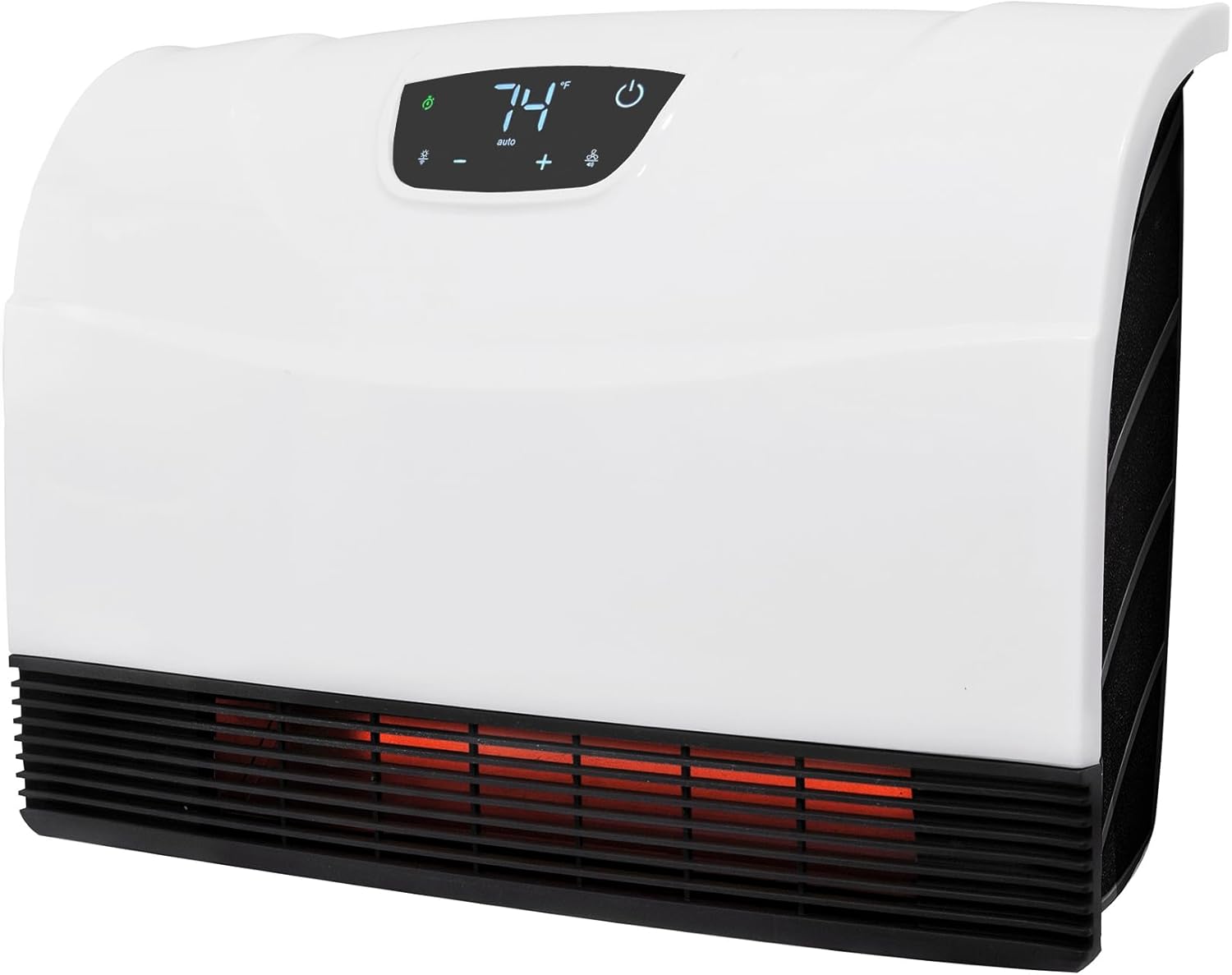
The Heat Storm Phoenix HS-1500-PHX-WIFI is a corded infrared wall heater intended to free up floor space while providing zone heating for rooms such as bedrooms, bathrooms, offices, and small garages. It produces up to 1500 watts (about 5200 BTU) and uses radiant heating to warm objects and people directly rather than relying on forced air, which can feel quicker and more comfortable in targeted spots. The unit includes Wi‑Fi control with one-touch Bluetooth setup and scheduling from your phone, a touch-screen thermostat, and a remote for on-device control. Wall mounting keeps the heater out of the way and allows the cord to be routed behind the unit when installed over an outlet. Practical benefits include fast, focused warmth, programmable schedules for energy management, and a washable filter for basic upkeep. Limitations for performance-focused buyers include the stated primary coverage of roughly 150 sq ft, so it will serve as a zone heater rather than an effective single-unit solution for a full 1000 sq ft home, and it runs on a standard 110V circuit so overall output is limited compared with hardwired or higher-voltage systems.
Best for: Buyers who want a high-output, wall-mounted zone heater that delivers fast, targeted infrared warmth and remote scheduling for individual rooms.
Less Ideal for: People seeking a single heater to warm an entire 1000 sq ft home or those who need a hardwired high-voltage unit for whole-house heating.
- Wall-mount design saves floor space and allows cord concealment when mounted over an outlet
- Wi‑Fi and Bluetooth one-touch setup enable remote control and programmable schedules
- Infrared radiant heating provides quick, localized warmth perceived faster than convection heating
- 1500W power delivers strong output for a single zone without tripping typical household circuits
- Includes touch-screen thermostat and remote for convenient local control
- Rated primary coverage is about 150 sq ft so it is not suitable as a single heater for very large areas
- Not a hardwired higher-voltage unit so maximum heat output is limited compared with commercial or whole-house systems
Verdict: Choose the Heat Storm Phoenix HS-1500-PHX-WIFI when you need a powerful, wall-mounted infrared zone heater with Wi‑Fi scheduling for fast, focused warmth in individual rooms.
RealSmart Infrared Space Heater 1500W

| Heat Output | 1500 watts |
|---|---|
| Heating Method | Radiant |
| Number of Speeds | 3 |
| Min Temperature Setting | 50 °F |
| Max Temperature Setting | 90 °F |
The RealSmart 1500W infrared space heater uses quartz infrared elements to deliver direct, sun-like warmth aimed at people and objects rather than just heating air, which helps it feel faster in a single room. It offers three power settings (750W, 1500W, ECO) and a built-in thermostat with adjustable temperature from 50 to 90°F; ECO mode can maintain a target (68°F) to limit wasted energy. Controls include an LED display, remote, and a 12-hour timer for scheduled shutoff. The unit is relatively quiet and designed for floor placement, with tip-over and overheat protection for safer everyday use. Practical strengths are straightforward controls, energy-saving ECO behavior, and the rapid, focused heat typical of infrared designs. Limitations are that 1500W is best for single large rooms or targeted zones rather than evenly heating an entire 1000 sq ft open plan without supplemental sources, and there is no mention of smart-home connectivity or multiple-room circulation features.
Best for: Buyers who want a practical, energy-aware heater to warm a large room or targeted living area quickly and prefer simple controls and safety features over smart integrations.
Less Ideal for: People who need a single appliance to evenly heat a full 1000 sq ft open floor plan without supplementary heating or those who require app-based smart home control.
- Fast, direct radiant heat that warms people and objects quickly
- Three power modes including ECO to reduce energy use
- Built-in thermostat and 12-hour timer for temperature control and scheduling
- Remote control and clear LED display for convenient operation
- Safety features: tip-over and overheat protection
- 1500W output may not evenly heat an entire 1000 sq ft area by itself
- No built-in smart-home connectivity for remote scheduling beyond the included remote
Verdict: A practical 1500W infrared heater that delivers fast, focused warmth with ECO thermostat control for energy-conscious heating of large rooms.
Amazon Basics Portable Space Heater DF1501

| Heat Output | 1500 watts |
|---|---|
| Heating Method | Infrared Heating |
| Heating Coverage | 160 square feet |
| Power Source | Electric |
This Amazon Basics portable infrared heater is a budget-friendly cabinet-style unit designed for spot heating in small rooms. It offers two power settings (750W and 1500W), four infrared elements, an adjustable electronic thermostat with an LED readout, and an ECO-Smart energy-saving mode that helps limit consumption during milder conditions. Use it on the floor in a home office or living room to warm a focused area; the remote control makes temperature and mode changes convenient from across the room. Safety features include an overheat sensor, and the cabinet wood finish helps it blend into living spaces. The practical limitations are obvious: rated coverage is about 160 square feet, so it is not intended to heat large open-plan areas or a full 1000 sq ft home, and single-speed airflow means it lacks the quick blast of forced-air ceramic heaters. For buyers prioritizing an inexpensive, quiet radiant heater for modest rooms, it delivers usable warmth and simple controls without frills.
Best for: Buyers on a tight budget who need an inexpensive, quiet radiant heater for single rooms like a home office or small living area and who value simple controls and an included remote.
Less Ideal for: People who need to heat large, open areas or an entire 1000 sq ft home should choose a higher-capacity or whole-home heating solution instead.
- Infrared radiant heating provides quiet, direct warmth
- Two power settings (750W and 1500W) plus ECO-Smart mode for energy saving
- Adjustable electronic thermostat with LED display and included remote
- Overheat sensor for added safety and cabinet-style design that fits living spaces
- Rated to heat about 160 square feet, far below 1000 sq ft coverage
- No fan-forced airflow limits speed of room-wide temperature rise
Verdict: A low-cost, quiet infrared heater that works well for heating single small rooms but is not suited to warming 1000 square feet.
EdenPURE CopperPLUS 903G

| Heating Coverage | 1000 square feet |
|---|---|
| Heat Output | 5000 british thermal units |
| Power Source | Corded Electric |
| Number of Speeds | 24 |
| Min/Max Temperature | 40 °F to 90 °F |
The EdenPURE CopperPLUS 903G is a portable infrared zone heater built to deliver steady, energy-efficient warmth for large rooms. It uses an expanded copper PTC surface to improve heat transfer and offers two power modes (1000W and 1500W) across 24 preset temperature settings from 40°F to 90°F, which makes dialing in comfort easy. Practical features include a washable lifetime filter, quiet operation, a wireless remote, and castor wheels for moving the unit between rooms without installation. Safety is well addressed with cETL approval, dual overheat sensors, tip-over shutoff, and a cool-touch front grill. The heater is intended for long-running zone heating to reduce central system use, but its effectiveness depends on room layout and insulation; like all 1500W portable heaters, it may struggle to maintain target temps in poorly insulated or very large open areas despite the 1000 sq ft coverage claim. Expect modest electricity use on high and reliable, quiet performance for bedrooms, living rooms, and home offices.
Best for: Buyers who prioritize dependable, low-maintenance zone heating for daily use and want a heater with strong safety features and simple controls for large rooms.
Less Ideal for: People needing rapid whole-house heating or those with large poorly insulated open layouts who require higher-capacity HVAC solutions.
- Copper PTC element for improved heat transfer and steady infrared warmth
- Wide temperature control with 24 preset settings and two power modes for precise comfort
- Built-in safety features including dual overheat sensors and tip-over automatic shutoff
- Lifetime washable filter reduces ongoing maintenance costs
- Portable design with remote control and rolling casters for easy room-to-room use
- 1500W power may be insufficient to quickly heat very poorly insulated or open-plan spaces despite the 1000 sq ft claim
- Unit weight and cabinet form factor limit placement options compared with slim tower heaters
Verdict: A dependable, safety-focused infrared zone heater that delivers steady, low-maintenance warmth for large rooms where reliable everyday performance matters most.
Dr. Infrared Heater DR-968

| Power | 1500 Watts |
|---|---|
| Heating Coverage | 576 square feet |
| Number of Speeds | 3 |
| Voltage | 120 |
The Dr. Infrared Heater DR-968 combines a quartz infrared tube and PTC element with a high-velocity low-noise blower to warm rooms quickly and evenly. It is typically used as a freestanding portable heater for bedrooms, living rooms, home offices, or other large indoor spaces and offers an Auto energy-saving mode that cycles between high and low power to maintain a set temperature. The unit includes caster wheels and a remote for easy repositioning and control, an electronic thermostat with a 50 to 85 F range, a 12-hour timer, and built-in tip-over and overheat protections for safer everyday use. Practical benefits include fast radiant heat that warms objects rather than just air, quieter airflow from the 7-inch blower, and a factory-supported safety profile with UL certification. Limitations to expect are the typical power ceiling of a 1500-watt plug-in heater—it can heat large rooms effectively but will not replace whole-house systems—and the unit weighs about 19 pounds, making it less compact than very small space heaters.
Best for: Buyers who want a well-reviewed, safety-focused portable infrared heater to warm larger single rooms efficiently and who value quiet operation and convenient controls.
Less Ideal for: People seeking a built-in or whole-home heating solution or an ultra-lightweight travel/desk heater should look at other options.
- Dual heating system (PTC plus quartz infrared) for faster and more efficient heat transfer
- Auto energy-saving mode that cycles between high and low to maintain set temperature
- UL-certified safety features with tip-over and overheat protection
- Remote control, electronic thermostat, timer, and caster wheels for convenient use
- High-pressure low-noise blower provides quieter operation while moving more air
- 1500-watt maximum limits effectiveness as a permanent whole-house solution
- Heavier and bulkier than compact personal space heaters
Verdict: Choose the DR-968 when you need a safety-certified, quiet, and efficient portable infrared heater that warms large rooms quickly.
Choosing the Right Infrared Heater for 1000 Square Feet: Key Factors to Consider
Rated Heat Output and Coverage
Look for the heater's rated output in watts and any stated square-foot coverage. These numbers give a baseline expectation for how well the unit will maintain temperature across an area near 1000 square feet. Keep in mind that stated coverage assumes typical 8-foot ceilings and average insulation; rooms with higher ceilings, open floor plans, or poor insulation will reduce effective coverage.
Understanding output helps you pick a unit that will run steadily rather than cycling on and off. A heater with too low a rated output will struggle to keep surfaces and occupants warm, while an overpowered unit may be wasteful during milder weather. Consider combining output figures with thermostat accuracy to estimate consistent comfort.
Room Layout and Placement
Infrared heaters warm objects and people directly, not just the air, so placement matters. For a 1000 square foot space think about where occupants spend most time and position emitters to cover those zones. Wall or ceiling-mounted heaters can provide broad, unobstructed radiant coverage for open areas, while portable floor units may be better for focused spots or temporary needs.
Obstructions, furniture, and tall partitions will create shaded zones that receive less radiant heat. Plan placement to minimize blocked sight lines between the heater and primary living areas. For distributed coverage, consider multiple smaller units rather than a single central heater if the space is irregularly shaped.
Energy Use and Operating Cost
Check the heater's wattage and control options to estimate running costs. A higher-wattage unit will warm a large area faster but consumes more electricity; accurate thermostats and multi-stage output help reduce runtime and energy use by avoiding constant full-power operation.
Timers, programmable thermostats, and adjustable output settings let you match heat delivery to occupancy patterns, lowering cost. Also consider integration with building insulation and existing heating systems—an infrared heater is often most efficient as a supplemental heat source targeted at occupied zones rather than attempting to replace a whole-house system for every hour of cold weather.
Safety Features and Certifications
Because infrared heaters run hot and sometimes remain powered for long periods, safety features are critical. Look for overheat protection, thermal cutoffs, and sturdy mounting hardware for fixed installations. Portable units should include stable bases and tip-over shutoff to reduce fire risk.
Certifications from recognized testing organizations indicate that a unit has met standard electrical and safety benchmarks. Clear operating instructions and accessible controls also help prevent misuse. If installation requires electrical hardwiring, ensure the circuit and wiring are rated appropriately and follow local codes.
Control Precision and Ease of Use
Precise temperature control reduces energy waste and increases comfort. Units with digital thermostats, remote controls, or programmable schedules offer more fine-grained control than simple on/off switches. Look for thermostats that measure room or surface temperature accurately rather than relying solely on crude internal sensors.
Ease of use matters in daily life. Intuitive controls, clear indicator lights, and simple mounting or mobility features reduce friction. If multiple units are used for distributed coverage, synchronized controls or wireless thermostats make managing the system easier.
Durability and Maintenance Requirements
Long-term reliability depends on build quality and access to serviceable parts. Metal housings, quality emitter elements, and protected electronics typically last longer than plastic-bodied, low-cost designs. Consider warranty length and what it covers for peace of mind.
Maintenance needs are usually low for infrared technology, but dust buildup on emitters and obstructed vents can reduce performance. Choose units with accessible panels for occasional cleaning and clear guidance on replacement parts if emitters degrade over years of use.
Sizing Tips for 1000 Square Feet
Estimating the right heater size for 1000 square feet starts with the rated wattage and any manufacturer coverage guidance. Convert watts to expected heat output relative to your ceiling height and insulation level, and factor in how drafty or open the space is.
If the area has high ceilings or poor insulation, plan for additional capacity or multiple units to keep heat distributed at occupant level. For typical rooms with standard ceilings, a single high-output unit with wide radiant spread can work, but irregular layouts benefit from two or more strategically placed emitters.
- Measure ceiling height and note insulation quality before choosing capacity.
- Plan placement around where people sit or work, not just the room center.
- Consider multiple lower-wattage units for uneven or partitioned spaces.
Wall-Mounted Vs Floor Models
Wall or ceiling mounting gives unobstructed radiant lines over open areas and keeps the heater out of reach. These installations are well suited to open-plan living rooms, workshops, and garage spaces where coverage across a wide footprint matters.
Floor models are more flexible and portable but can be blocked by furniture and are better for focusing warmth on particular seating or task areas. Choose a model type that matches how permanent you want the solution to be and how much direct radiant line-of-sight the space allows.
- Mounting height affects spread: higher mounting increases coverage but reduces intensity at floor level.
- Portable units allow seasonal repositioning and are easier to install.
- Wall-mounted options often offer cleaner permanent integration and can free up floor space.
Thermostats, Timers, and Smart Controls
Better control systems reduce runtime and improve comfort. A precise thermostat limits cycling and prevents excessive energy use, while timers and programmable schedules let you heat only when needed. Smart controls can add convenience by allowing remote adjustments and integrating with occupancy patterns.
When selecting controls, verify whether the thermostat senses room air temperature or surface temperature, as infrared heating can make surfaces comfortable even when air temperature reads lower. Choose the sensing mode that aligns with how you measure comfort in the space.
- Prefer digital thermostats with clear setpoints for large spaces.
- Timers and schedules help match heating to typical use patterns.
- Remote or wireless control is useful if units are installed in hard-to-reach locations.
Installation and Electrical Considerations
Large-area infrared heaters often require higher-wattage circuits or dedicated wiring. Check the electrical requirements before deciding on a permanent installation. Hardwired wall or ceiling units may need a licensed electrician to meet local code and ensure safe operation.
For portable units, verify plug type and circuit capacity in the intended location. Overloading an existing circuit with a high-wattage heater can trip breakers and create safety hazards, so plan the electrical layout to match continuous operating loads.
- Confirm circuit amperage and wiring compatibility for hardwired units.
- Use dedicated circuits for continuous, high-wattage heaters when recommended.
- Follow local electrical codes and consider professional installation for permanent mounts.
Maintenance and Seasonal Care
Infrared heaters are generally low maintenance but benefit from periodic checks. Inspect emitter elements and housing for dust buildup before the start of heavy use seasons and clean surfaces according to the manufacturer's guidance. Replace any worn mounting hardware or degraded emitter components promptly.
Store portable units in a dry, covered area when not in use for long periods. For fixed installations, schedule an annual visual inspection to ensure brackets, wiring, and protective screens remain secure and free from corrosion or damage.
- Clean emitters and vents before heavy-use seasons.
- Check mounting hardware and electrical connections annually.
- Follow manufacturer cleaning instructions to avoid damaging emitter surfaces.
How We Chose the Best Infrared Heater for 1000 Square Feet
We selected candidates that are designed to heat large, open areas and that list sufficient radiant output for spaces near 1000 square feet. Primary evaluation focused on documented heat output and coverage estimates so we could compare how well each unit would maintain comfortable air and surface temperatures in typical room layouts. Energy efficiency was another core filter; we favored designs and rated outputs that keep electrical draw reasonable for prolonged use. Safety and control features were weighted heavily because large-space heaters often run for extended periods. We prioritized units with reliable overheat protection, tip-over systems if portable, and clear thermostatic control so users can avoid wasteful cycling. Installation flexibility came next: units that work as mounted wall/ceiling options or stable floor units scored better for varied home layouts. Durability and warranty terms were included to reflect long-term value, while user-serviceable elements such as replaceable emitters or accessible controls were considered. We excluded compact personal heaters and any products explicitly rated for much smaller rooms under 300 square feet. Units without clear coverage or power specifications were also excluded to keep the list practical and comparable.
Our full evaluation process is outlined in our review methodology.
FAQ
Can one infrared heater really warm 1000 square feet?
It depends on the heater's rated output, ceiling height, insulation, and room layout. In open-plan spaces with standard ceilings, a high-output unit can provide adequate radiant coverage, but irregular layouts or poor insulation may require additional units or higher capacity.
How do I estimate the wattage I need for 1000 square feet?
Use the manufacturer's coverage guidance and convert to watts per square foot as a starting point, adjusting for ceiling height and insulation. For large open areas, prioritize radiant output and thermostat accuracy over simple square-foot rules of thumb.
Are infrared heaters energy efficient for large rooms?
Infrared heating is efficient at delivering heat to people and surfaces without heating all the air, which can reduce perceived energy use in occupied zones. Efficiency depends on controls, insulation, and how well the heater is sized and placed for the space.
Do I need a licensed electrician for wall-mounted installations?
Often yes. Higher-wattage wall or ceiling units may require hardwiring and a dedicated circuit, so professional installation ensures the wiring meets code and the unit operates safely.
What safety features should I prioritize for a large-area heater?
Look for overheat protection, thermal cutoffs, sturdy mounting hardware for fixed units, and tip-over shutoff for portable models. Certifications from testing organizations also indicate compliance with standard safety benchmarks.
Final Verdict
Prioritize a heater with the right rated output and effective placement to warm occupied zones within a 1000 square foot space. Balance wattage with control precision so the unit can maintain comfort without excessive runtime. Consider installation needs and safety features before committing to a permanent solution. Choosing based on coverage, energy use, and installation flexibility will help you select an infrared heater that meets both comfort and operating-cost goals for a large room.