
Note: This article contains affiliate links. If you click on these links and make a purchase, we may earn a small commission at no extra cost to you. This helps support our research and content. Read our full affiliate disclosure here.
A compact infrared heater can transform chilly bathroom mornings into comfortable starts to the day without taking up much space. Bathrooms demand a different approach to supplemental heat because of higher humidity, tight footprints, and the need for safety features near water. This guide shortlists the top infrared heaters for bathrooms, each selected for reliability in damp environments, sensible output for small spaces, and built-in protections that reduce risks. Below you will find the top picks and concise buyer guidance. We evaluated each heater for heat delivery, safety, and suitability for routine bathroom use to help you pick the right option quickly.
Top Picks at a Glance
| Best Overall The best all-around choice for most situations | Heat Storm Phoenix HS-1500-PHX-WIFI |  |
| Best Quality Built to a higher standard if you want something more solid | WarmlyYours Ember Mirror 600W |  |
| Best Budget The cheapest option that still gets the job done reliably | Comfort Zone Flat Panel Heater CZHTV9 |  |
| Most Popular A crowd favorite that many people choose with confidence | Dr. Infrared Heater DR-968 |  |
| Best Seller A high-volume bestseller chosen again and again | Broan-NuTone 164 Ceiling Heater & Fan |  |
Heat Storm Phoenix HS-1500-PHX-WIFI
| Power | 1500 W |
|---|---|
| Heating Coverage | 150 ft² primary, 750 ft² secondary |
| Voltage | 110 volts |
| Max Temperature Setting | 99 °F |
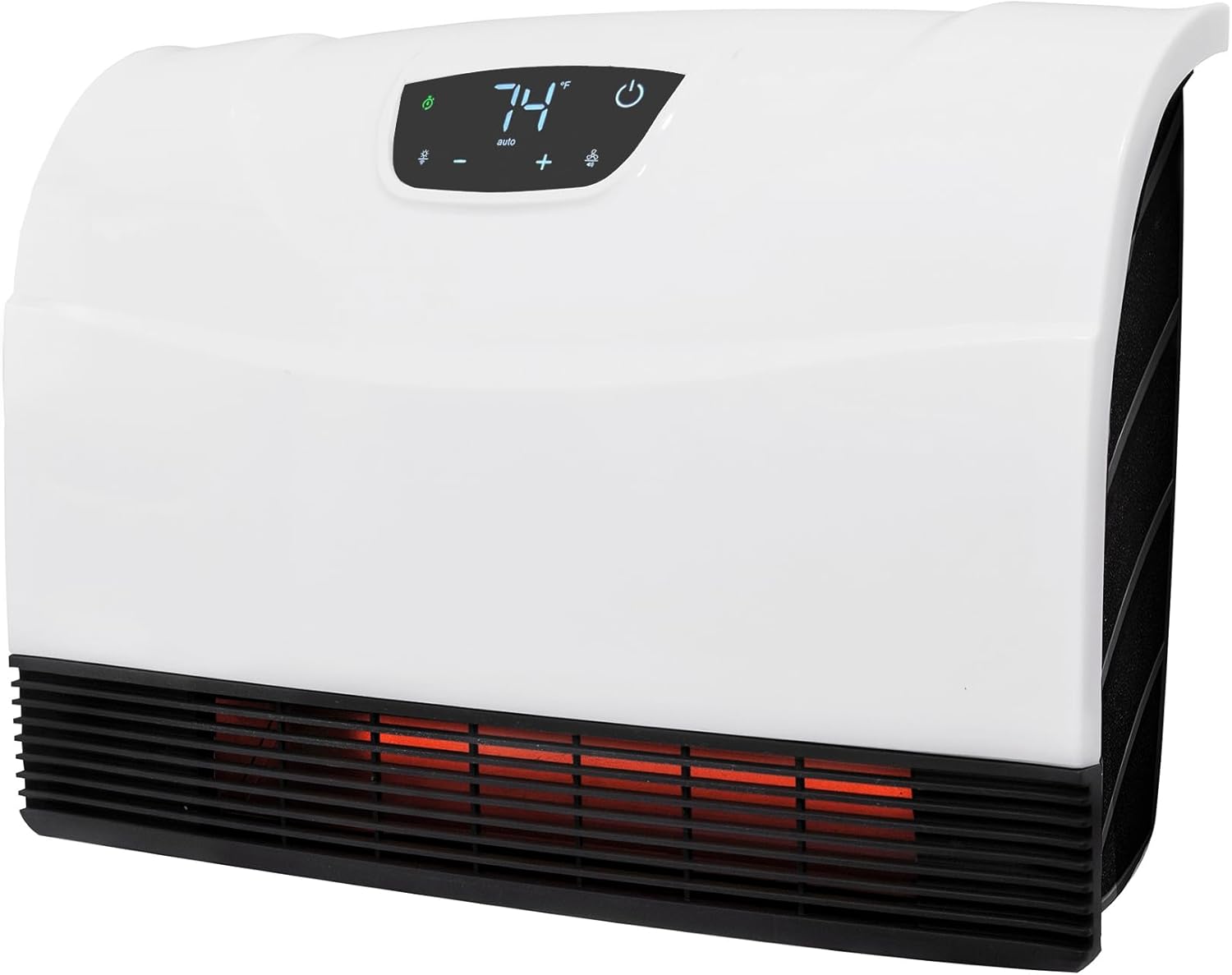
The Heat Storm Phoenix HS-1500-PHX-WIFI is a compact wall-mounted infrared heater aimed at heating a single room or bathroom without taking floor space. It runs at 1500 watts and uses radiant infrared heating to warm objects and people directly, which feels faster and more comfortable in small, enclosed spaces. The built-in Wi‑Fi and one-touch Bluetooth setup let you control temperature and schedules from a phone, and a touchscreen plus included remote provide local control. Its wall-mount design keeps the unit off the floor and allows the cord to be routed behind the unit when mounted over an outlet for a cleaner installation. Safety-minded features such as tip-over protection (relevant for other configurations), a cool-to-touch grill, and washable filters make it suitable for bathrooms and family spaces. Practical limits are its single-room coverage — best as a primary heater for up to about 150 sq ft or supplemental heat for larger areas — and the need to mount it for the cleanest installation and cord management.
Best for: Buyers who want a compact, fast‑warming bathroom heater that stays off the floor and offers smart remote control and scheduling.
Less Ideal for: Homes needing central or whole‑room heating for large open floor plans or buyers who cannot install a wall‑mounted unit.
- Wall‑mount design saves floor space and hides the cord when installed over an outlet
- Wi‑Fi and Bluetooth one-touch setup enable remote scheduling and control from a phone
- 1500W infrared element delivers quick, direct warmth ideal for small bathrooms
- Touchscreen plus remote give convenient on‑unit and hands‑off control
- Cool‑to‑touch grill and washable filter improve safety and maintenance
- Designed for single‑room heating so it is not suitable as the sole heater for large open areas
- Requires wall mounting for optimal installation and cord concealment
Verdict: If you need a space‑saving, smart-controlled infrared heater for a bathroom or small room, this wall‑mount 1500W Phoenix model delivers quick, direct warmth and easy remote scheduling.
WarmlyYours Ember Mirror 600W
| Wattage | 600W |
|---|---|
| Heating Coverage | 86 sq.ft. |
| Voltage | 120 volts |
| Heat Output | 2047 BTU/hr |
| Max Temperature Setting | 248 °F |
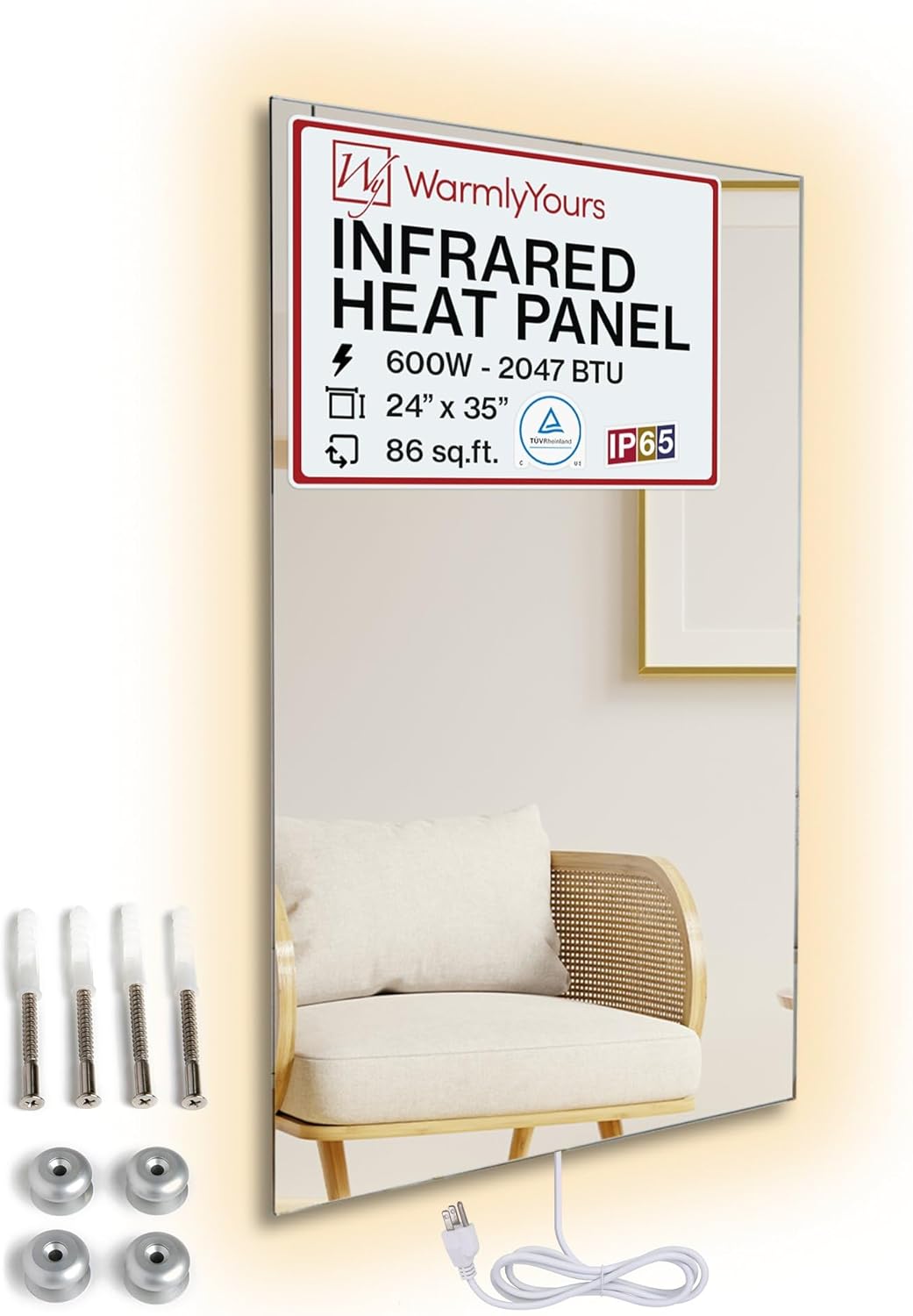
The WarmlyYours Ember Mirror is a 600W infrared radiant panel built to look like an ordinary wall mirror while delivering steady, sun-like heat to small rooms and bathrooms. It plugs in or can be hardwired and mounts vertically or horizontally to warm areas up to about 86 sq ft without fans, so it operates silently and does not stir dust or allergens. The mirror surface doubles as a defogger and can accept an optional towel bar to act as a towel warmer, and the panel reaches an average surface temperature near 194°F with a safety cutoff at 248°F. Its radiant heating method provides even, direct warming of people and surfaces rather than relying on convective airflow, which is useful in bath and vanity zones. Trade-offs include limited coverage — this is meant for small rooms — and a relatively heavy glass unit that requires solid wall mounting or professional installation for a clean hardwired setup. The unit is cTUVus certified and backed by a five-year warranty for added peace of mind.
Best for: Buyers who prioritize quiet, efficient radiant heating and want a space-saving bathroom solution that combines a functional mirror and a supplemental room heater.
Less Ideal for: Those who need a primary heat source for large open rooms or want a lightweight, portable heater for frequent relocation.
- Silent radiant heating with no fan or moving parts
- Built-in mirror surface that prevents fogging and doubles as decor
- Energy-efficient infrared heat that targets people and surfaces
- Can be plug-in or hardwired and mounts vertically or horizontally
- cTUVus safety certification and 5-year warranty
- Designed for small areas only, not suitable as a primary heater for large rooms
- Requires sturdy wall mounting and may need professional hardwiring for a flush install
Verdict: Choose this mirror-style infrared panel when you want silent, energy-efficient radiant heat in a bathroom that also serves as a defogging mirror and towel-warming accent.
Comfort Zone Flat Panel Heater CZHTV9

| Heating Coverage | 150 sq. ft. |
|---|---|
| Heating Element | Halogen |
| Heat Output | 800 watts |
| Number of Speeds | 2 |
| Voltage | 120 |
The Comfort Zone CZHTV9 is a slim flat-panel halogen infrared heater that delivers focused radiant warmth for small rooms such as bathrooms, bedrooms, or offices. It operates on corded electric power with two heat settings (400W and 800W) and a top-mounted knob that also controls a 70-degree oscillation to spread heat across a wider area. The twin-tube halogen element provides near-instant heat to people and objects in front of the unit, making it useful for quickly warming a bathroom for short periods. Safety features include an overheat sensor and a tip-over switch, plus a stay-cool molded handle for moving the unit. The heater is lightweight and compact so it fits on a counter or floor when space is limited. Limitations are its radiant focus—it warms surfaces and people directly rather than raising whole-room air temperature quickly—and the 150 sq. ft. coverage rating means it is best for small bathrooms rather than large or poorly insulated spaces.
Best for: Buyers wanting an inexpensive, compact heater to provide quick, targeted warmth in a small bathroom or vanity area and who prioritize instant radiant heat over whole-room heating.
Less Ideal for: People needing to heat large or very drafty bathrooms, or those who want a heater that raises overall ambient air temperature across multiple rooms.
- Slim, space-saving flat panel fits on counters or floors in small bathrooms
- Two heat settings plus 70-degree oscillation for adjustable, wider coverage
- Halogen radiant element provides near-instant warmth to people and surfaces
- Built-in safety features including overheat sensor and tip-over switch
- Radiant design focuses heat directionally and does not warm whole-room air rapidly
- Limited to small-room coverage (about 150 sq. ft.), not suited for large bathrooms
Verdict: A budget-friendly, compact halogen radiant heater that delivers quick, targeted warmth for small bathrooms.
Dr. Infrared Heater DR-968

| Wattage | 1500 Watts |
|---|---|
| Heating Method | Radiant |
| Heating Coverage | 576 square feet |
| Number of Speeds | 3 |
| Voltage | 120 |
The Dr. Infrared Heater DR-968 combines a quartz infrared tube and a PTC element with a high‑velocity low‑noise blower to warm rooms quickly while using 1500 watts of power. It is typically used freestanding on caster wheels to heat bedrooms, living rooms, home offices, or similar indoor spaces and includes an electronic thermostat with a 50 to 85 F range plus an Auto energy‑saving mode that switches between high and low outputs. Notable features include a 12‑hour timer, remote control, tip‑over and overheat protection, and a lifetime filter that help with day‑to‑day convenience and safety. In practice the unit delivers targeted radiant warmth that makes occupants feel warm faster than convection‑only heaters and runs quietly at about 39 dB. Tradeoffs are its 19 lb weight, which makes it less compact than plug‑in ceramic heaters, and the unit is designed for indoor use only so it is not suited to moist environments without proper ventilation and clearance. The DR‑968 is a solid option when you need fast, quiet infrared heat with built‑in safety and thermostat control.
Best for: Buyers who prioritize proven performance and safety and want a quiet, fast‑warming infrared heater for medium to large indoor rooms backed by strong customer feedback.
Less Ideal for: People who need a heater specifically designed for bathrooms or other high‑humidity spaces or those who need an ultra‑lightweight, truly portable plug‑in heater.
- Dual heating system (quartz infrared + PTC) for faster, more efficient heat transfer
- Electronic thermostat with Auto mode and 12‑hour timer for temperature control and energy savings
- Tip‑over and overheat protection plus UL certification for added safety
- Quiet high‑pressure blower (around 39 dB) keeps operation low-noise
- Included remote control and caster wheels for convenient placement and operation
- Not rated for use in damp or wet locations, so it is not a dedicated bathroom heater
- Heavier and less compact than smaller plug‑in space heaters, making relocation more effortful
Verdict: Choose the DR‑968 if you want a quiet, safety‑focused infrared heater that delivers fast, efficient warmth for medium to large indoor rooms.
Broan-NuTone 164 Ceiling Heater & Fan

| Heating Coverage | 65 sq ft |
|---|---|
| Heat Output | 100 °C |
| Power Source | AC |
| Voltage | 120 volts |
| Amperage | 4.5 A |
The Broan-NuTone 164 combines two infrared bulbs with a 70 CFM ventilation fan to deliver quick, localized warmth and steady air removal in a compact ceiling unit. It is typically installed in a bathroom ceiling where you can run the heater, the fan, or both independently to warm the room and clear steam or odors. Notable features include Type IC rated housing for contact with insulation, adjustable mounting brackets for retrofit or new-construction installs, polymeric blower wheels and dampers for quieter operation, and a 4" round duct connector to simplify ducting. The unit relies on two R40 or BR40 infrared bulbs (not included), which provide instant radiant heat without heating the whole house, making it energy-efficient for short warm-up periods. Trade-offs are that you must buy and replace the bulbs separately, and the unit is optimized for single-room use rather than whole-house heating; the fan noise is low but not silent. For buyers who want a straightforward, factory-quality ceiling heater and exhaust combo, this model delivers reliable performance with simple installation and controls.
Best for: Buyers who want a reliable, ceiling-mounted bathroom heater that provides fast, localized warmth and built-in ventilation with straightforward installation and factory-quality construction.
Less Ideal for: Those seeking whole-house heating or a unit that includes built-in bulbs and lights should consider other solutions.
- Instant radiant warmth from two infrared bulbs for quick bathroom comfort
- Integrated 70 CFM fan provides ventilation and helps clear steam and odors
- Type IC housing and adjustable mounting brackets simplify ceiling installation
- Polymeric dampers and blower wheels reduce mechanical noise during operation
- Bulbs are not included so additional purchase is required before use
- Designed for single-room heating and not suitable as a primary home heater
Verdict: Choose this unit if you want a dependable, recessed infrared bathroom heater with built-in ventilation that installs like a factory replacement and heats a single room quickly.
Choosing the Right Infrared Heater for Bathrooms: Key Factors to Consider
Safety and Moisture Resistance
Bathrooms have higher humidity and occasional splashes, so safety features are essential. Look for heaters with IP-rated components or stated moisture-resistant housings that reduce the risk of internal corrosion and electrical faults. Built-in overheat shutoffs and tip-over switches provide secondary protection if a unit is blocked or displaced. A grounded power cord and a design that keeps live elements shielded from direct spray further improve safety.
Ventilation around the heater matters too. Even moisture-resistant heaters need adequate clearance from walls and wet surfaces to operate safely. Consider placement options that keep the unit away from direct water sources while still delivering effective warmth to the areas you use most.
Appropriate Heat Output
Infrared heaters warm objects and people directly rather than heating all the air, so you do not need the same wattage as for a living room heater. For small bathrooms, look for output that provides quick, localized warmth without producing excessive surface temperatures. Units with adjustable power levels or thermostats let you fine-tune output for quick preheat cycles or gentle maintenance heat.
Also consider the shape and directionality of the infrared element. Flat panels and directional emitters concentrate warmth where you stand, which is preferable for shaving or stepping out of the shower. Avoid oversized units that will overheat a small space or cycle inefficiently.
Mounting and Placement Options
Bathroom footprints are often tight, so a heater that offers multiple installation choices increases usability. Wall-mountable panels free floor space and can be positioned to heat a vanity area or towel rack. Freestanding units work if you need mobility, but they must have stable bases and be rated for bathroom use. Ceiling or high-mounted options can keep the unit away from splashes while still delivering effective radiant heat to the room below.
Check the clearance requirements and whether the manufacturer recommends specific mounting heights. Ease of installation and the availability of hardware should factor into your decision, especially if you prefer a simple DIY setup.
Controls and Convenience
Simple, reliable controls make a heater easier to use daily. Look for adjustable thermostats, multiple heat settings, and timers so you can preheat the bathroom for a short period before use without running the unit continuously. A remote control or programmable timer is especially handy for early mornings. Visual indicators and easy-to-read settings help avoid confusion in low-light conditions.
Maintenance needs also affect convenience. Units with accessible filters or sealed panels that only require an occasional wipe-down will demand less upkeep in a humid bathroom environment.
Durability and Materials
Exposure to humid air can accelerate corrosion, so build materials matter. Stainless steel trims, powder-coated housings, and sealed electronics resist moisture better than untreated metals. Assess whether the heater uses components rated for damp locations and whether the control interfaces are sealed against moisture intrusion.
Long-term reliability also depends on simple, serviceable designs. Units with replaceable elements or modular components are easier to maintain and repair, which can extend service life in the harsher bathroom environment.
Where to Install an Infrared Bathroom Heater
Placement determines both effectiveness and safety. Ideal locations include above a vanity, on an opposite wall that faces the main activity area, or high on a wall where the unit is out of reach of direct splashes. Avoid positioning the heater directly over tubs or inside shower enclosures unless the unit is specifically rated for that use.
For wall-mounted panels, mount at a height that directs warmth toward the typical standing area. If you prefer a freestanding unit, choose a stable position away from foot traffic and water sources. Keep clearance around the heater as recommended in the manual to ensure proper airflow and to prevent overheating.
- Mount above or beside the main activity zone for direct radiant heat
- Keep at least the manufacturer-recommended clearance from walls and fixtures
- Avoid mounting directly over shower or tub unless explicitly rated for that location
Using Timers and Thermostats Efficiently
A brief preheat cycle using a timer delivers the best balance of comfort and energy use. Set the timer to start the heater 10 to 20 minutes before anticipated use so the room and surfaces reach a comfortable level without running the heater all day. Programmable timers and thermostats prevent overshooting and reduce energy waste.
If your heater offers multiple power levels, use a higher setting for quick warm-ups and a lower maintenance setting to keep the room comfortable afterward. Remote controls or smart plugs can add convenience, but confirm compatibility with bathroom-rated equipment.
- Use short preheat times rather than long continuous runs
- Switch to lower maintenance settings once the room is warm
- Prefer units with clear, simple timer operation
Maintenance and Cleaning in Damp Spaces
Regular light cleaning prevents dust buildup on the emitter surface, which can reduce performance and create hotspots. Unplug the unit before wiping down and use a dry or slightly damp cloth rather than spraying water. Check vents and any grille openings periodically and remove lint with a soft brush.
Inspect seals, mounting hardware, and power cords for signs of corrosion or wear. Replace or service any component that shows degradation to maintain safety. Models with washable or replaceable protective screens make upkeep simpler.
- Unplug before cleaning and avoid direct water spray
- Wipe emitters and grilles regularly to maintain output
- Check seals and cords for moisture-related wear
How Radiant Heat Feels Compared to Room Heating
Infrared heat warms skin and surfaces directly, which often feels faster and more comfortable at lower air temperatures. In a bathroom setting this means you can feel warm quickly while the room air remains cooler overall. This characteristic makes infrared a sensible choice for brief use periods like morning routines.
Because the air is not the primary medium being heated, thermostats may read a lower ambient temperature while occupants feel warmer. Account for this difference when setting controls to avoid unnecessary energy use.
- Radiant heat provides rapid perceived warmth without heating all the air
- Thermostat readings can lag behind how warm you feel
- Best for short-duration use like preheating or spot warming
Energy Use and Running Costs
Infrared heaters are generally efficient for spot heating because they deliver warmth directly to people and objects. For occasional bathroom use, short timed runs will usually consume less energy than heating the entire home. Match the heater output to the bathroom size to avoid cycling losses from oversizing.
Use thermostats and timers to limit runtime. In colder climates or poorly insulated bathrooms, combine the heater with better insulation, door sweeps, or heated towels to reduce dependency on continuous heater operation.
- Short, targeted runs are more efficient than continuous heating
- Select output appropriate for the room size to avoid cycling
- Pair with insulation or small auxiliary measures for best results
How We Chose the Best Infrared Heater for Bathrooms
We focused on attributes that matter specifically when using infrared heaters in bathrooms. Safety was the primary filter: models had to include moisture-resistant design elements, tip-over protection, and reliable overheat shutoffs to qualify. Heating effectiveness was judged by rated output relative to small-room needs and how evenly infrared panels distribute warmth at typical bathroom distances. Installation and placement flexibility were considered next, including wall-mount options, compact footprints for limited floor space, and clearances required by typical bathroom layouts. Ease of use and controls mattered for repeated daily use, so we favored units with simple thermostats, timers, or remote controls that make brief preheating convenient. Durability and material choices were checked for corrosion resistance and suitability near damp air. We excluded general room heaters that lack moisture-resistant features or that specify use only in dry, well-ventilated areas. We also excluded units whose documented output far exceeds what a small bathroom requires, since oversized heaters can cycle awkwardly and raise safety concerns in tight, wet spaces. The resulting shortlist balances safe operation, practical output, installation options, and straightforward controls.
Our full evaluation process is outlined in our review methodology.
FAQ
Are infrared heaters safe to use in bathrooms?
Infrared heaters can be safe when designed for damp locations and installed per manufacturer clearance guidelines. Look for moisture-resistant housings, overheat protection, and tip-over switches. Avoid placing units within direct spray unless explicitly rated for such exposure.
Can I mount an infrared heater inside my shower?
Most infrared heaters are not rated for direct exposure to water, so mounting inside a shower is usually not recommended. Only install in wet locations if the product documentation explicitly states it is rated for that use.
How long should I run a bathroom infrared heater before using the room?
A typical preheat cycle of 10 to 20 minutes is sufficient for most small bathrooms. The exact time depends on the unit's output and the room size. Use a timer to automate preheating and avoid running the heater longer than necessary.
Do infrared heaters affect humidity or ventilation needs?
Infrared heaters do not remove moisture from the air, so they do not substitute for ventilation. Maintain proper bathroom ventilation to control humidity and reduce condensation, which helps preserve the heater and other fixtures.
What placement is best for even warmth?
Wall-mounted panels positioned to face the main activity area provide the most even, direct warmth. High wall placement keeps the unit away from splashes while allowing radiant energy to reach occupants.
Final Verdict
Prioritize safety features and appropriate output when choosing an infrared heater for a bathroom. Moisture-resistant construction, overheat protection, and secure mounting options should carry the most weight since they directly affect safe operation in damp conditions. Balance directional radiant output and thermostat options with installation flexibility to match your bathroom layout. For most small bathrooms, select a unit sized for quick preheat cycles and equipped with simple timers or thermostats. That approach delivers comfortable warmth when you need it while minimizing energy use and safety risk.