
Note: This article contains affiliate links. If you click on these links and make a purchase, we may earn a small commission at no extra cost to you. This helps support our research and content. Read our full affiliate disclosure here.
When you sew, the iron is as important as your needle and thread. The right iron for sewing delivers consistent heat, even steam, and a soleplate that glides without snagging so seams lie flat and appliques press neatly. This guide shortlists the top irons for sewing, focusing on stability, control, and fabric-safe performance. Below you will find concise evaluations of seven top picks and clear notes on the features that matter for garment construction, quilting, and craft projects. Use the scoring breakdown and buying factors to match an iron to the kinds of fabrics and workflows you use most often.
Top Picks at a Glance
| Best Overall The best all-around choice for most situations | Rowenta Pro Master Steam Iron |  |
| Best Quality Built to a higher standard if you want something more solid | oliso TG ProPlus SmartIron |  |
| Best Value The sweet spot between price and what you get | BEAUTURAL Steam Iron |  |
| Best Budget The cheapest option that still gets the job done reliably | Mini Craft Iron |  |
| Top Rated A top-rated pick with lots of positive feedback | BEAUTURAL Mini Travel Iron |  |
| Most Popular A crowd favorite that many people choose with confidence | BLACK+DECKER Easy Steam Iron IR40V |  |
| Best Seller A high-volume bestseller chosen again and again | Honoson Mini Craft Iron |  |
Rowenta Pro Master Steam Iron

| Wattage | 1775 watts |
|---|---|
| Steam output | 210 g/min |
| Soleplate material | Stainless Steel |
| Special Features | Auto Shutoff |
The Rowenta Pro Master is built for heavy-duty home ironing and sewing tasks, combining 1775 watts of power with a Microsteam stainless steel soleplate that contains over 430 active steam holes for even steam distribution. It produces a strong steam shot (210 g/min) for tackling deep creases and offers a precision tip and high-precision spray to work around collars, seams, and applique on sewing projects. The large water tank and transparent window mean fewer refills during long press sessions, and the vertical steam setting lets you refresh garments and finished pieces without an ironing board. Practical extras include an anti-calc system to help maintain steady steam performance, an eco setting to reduce energy use, and auto shutoff for safety. Trade-offs are its relatively high power draw and the iron's heft, which may be tiring for extended handheld steaming, but for users who need reliable, fast de-wrinkling and precise control for sewing, it performs well.
Best for: Sewists and home users who need a powerful, consistent iron for pressing seams, collars, and complex fabric pieces and who value speed and precise control during long ironing sessions.
Less Ideal for: People who need a very lightweight travel iron or who require a low-voltage appliance for frequent handheld steaming away from a 220V/50Hz supply should consider other options.
- Very high steam output and steam-shot capability for removing stubborn wrinkles quickly
- Microsteam stainless steel soleplate with many active holes for even steam distribution
- Precision tip and spray for detailed work around seams, collars, and buttons
- Large transparent water tank reduces refill frequency during long sewing or pressing sessions
- Anti-calc system and auto shutoff improve durability and safety
- Higher wattage and weight make it heavier to handle during long handheld steaming sessions
- Voltage and frequency spec indicate a 220V/50Hz configuration which may require compatibility checks for some regions
Verdict: Choose the Rowenta Pro Master when you want powerful, professional-grade steam and a precision soleplate that speeds up pressing and finishing work for sewing projects.
oliso TG ProPlus SmartIron

| Wattage | 1800 watts |
|---|---|
| Voltage | 120 volts |
| Special Features | Auto Lift; 12-foot 360 degree pivot cord; 12.7 oz side fill tank; 30-minute auto shut-off |
| Base Material | Ceramic |
The oliso TG1600 ProPlus SmartIron is built for heavy sewing and quilting use where precision and long sessions matter. Its iTouch Auto-Lift system lowers the iron when you hold the handle and lifts it off the fabric when released, which prevents scorching during repetitive pressing and reduces wrist strain. The 1800W heater and TriplePlay steam delivery provide strong continuous and burst steam for horizontal, vertical, and variable steam needs, while the 12.7 fl oz side-fill tank extends uninterrupted steaming. The diamond ceramic-flow soleplate heats evenly and glides smoothly, and a 2-inch detailer tip helps with seams, pleats, and tight spots. Controls include a fabric selector, variable steam, spray, and burst buttons, and a long 12-foot swivel cord gives good reach around a workspace. Trade-offs: it is heavier than travel irons and the higher heat/steam output may be more than casual users need, but those are acceptable for sewists who press frequently.
Best for: Serious sewists, quilters, and hobbyists who press frequently and value a scorch-safe, high-steam iron that speeds professional-looking results during long sessions.
Less Ideal for: Casual users or those who only need an occasional lightweight iron for quick touch-ups; not intended as a compact travel solution.
- Auto-lift iTouch system prevents scorch and makes repeated pressing easier
- Powerful 1800W heater with strong continuous and burst steam for tough wrinkles and creases
- Large 12.7 fl oz side-fill tank reduces refill interruptions during long sewing sessions
- Diamond ceramic-flow soleplate for even heat distribution and smooth gliding
- 2-inch precision detailer tip and long 12-foot swivel cord suited to quilting and detailed pressing
- Heavier and bulkier than travel or basic domestic irons
- High steam output may be excessive for casual or infrequent ironing
Verdict: If you sew or quilt regularly and need a scorch-safe, powerful steam iron that handles long pressing sessions and fine detail work, this is a top practical choice.
BEAUTURAL Steam Iron
| Wattage | 1800 watts |
|---|---|
| Voltage | 120 volts |
| Frequency | 60 hertz |
| Special Features | Auto Shutoff, Corded, Non-Stick, Self-Cleaning |
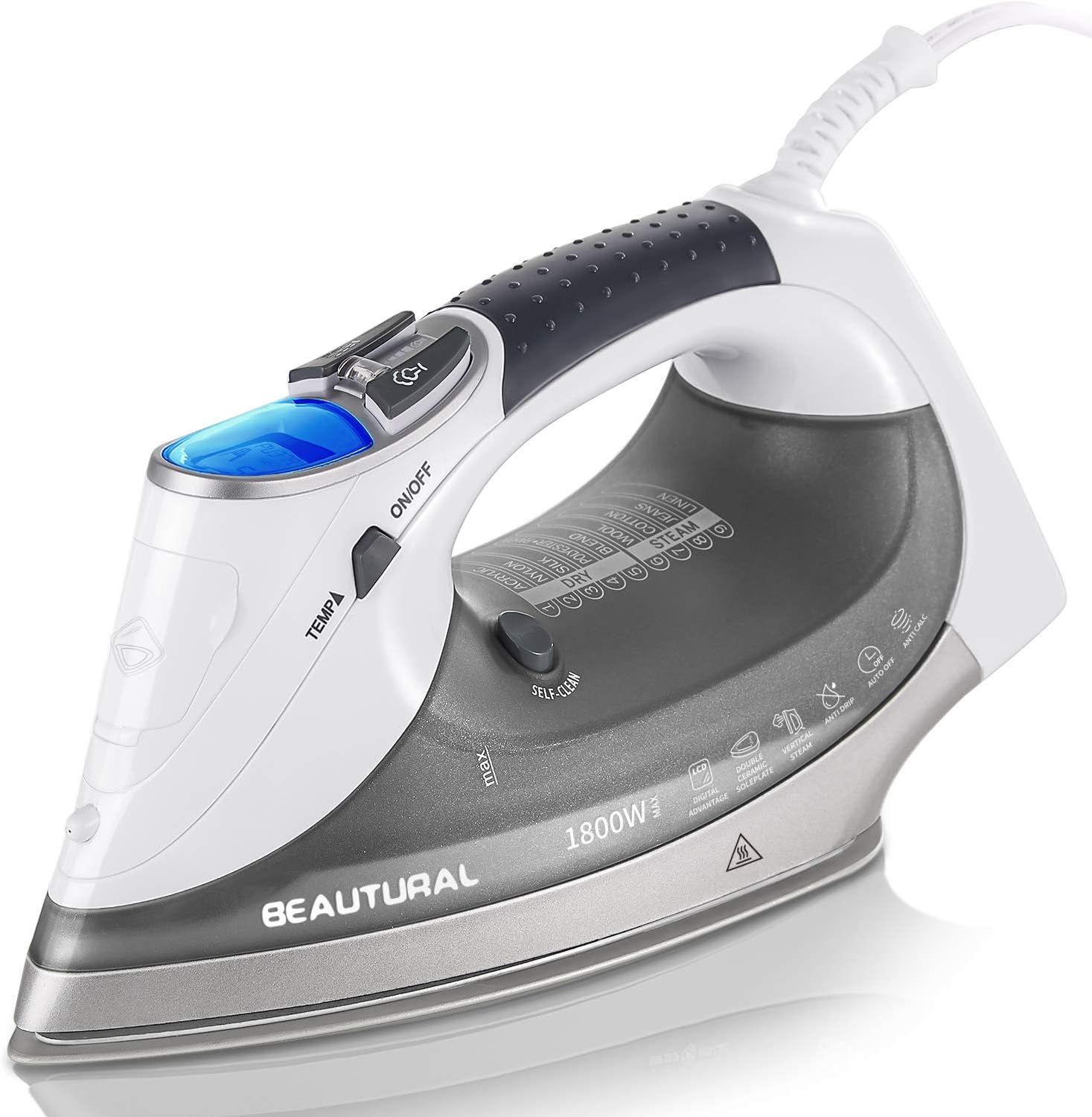
The BEAUTURAL Steam Iron is a midpriced, feature-rich iron aimed at accurate, everyday pressing. It heats quickly with an 1800W element and offers nine preset fabric modes you select via a clear LCD, so you can match temperature to delicate silks or heavy denim without guessing. The double-layer ceramic-coated soleplate is designed for smooth gliding, scratch resistance, and even heat distribution, while steam bursts, spray, and a self-cleaning/anti-calcium system help remove stubborn wrinkles and limit mineral buildup. Safety is handled by a motion-sensitive 3-way auto shutoff that powers the unit down when left idle vertically or horizontally. In practice this iron is convenient for regular sewing room tasks and garment finishing, delivering reliable steam performance and easy temperature control, though it is a conventional corded iron so it lacks cordless mobility or advanced steam-generator pressure found in professional steam stations. The included water measuring cup and visible controls make it straightforward to use during sewing projects.
Best for: Sewists and home sewers who want reliable, accurate temperature control and good steam performance for regular pressing and seam-pressing without investing in a professional steam station.
Less Ideal for: Users who need cordless convenience or a commercial steam generator for heavy continuous steaming should look at dedicated professional equipment instead.
- Nine LCD fabric presets make selecting accurate temperatures fast and repeatable
- 1800W heater and steam burst deliver strong steam output for stubborn wrinkles
- Double-layer ceramic-coated soleplate glides smoothly and resists scratches
- Self-cleaning and anti-calcium systems help reduce mineral buildup and maintenance
- Motion-sensitive 3-way auto shutoff improves safety during sewing sessions
- Corded design limits portability compared with cordless irons or steam generators
- Not a professional steam station, so continuous high-volume steaming may be less efficient
Verdict: A practical, safety-minded steam iron with precise presets and strong steam output that suits most sewing-room pressing tasks.
Mini Craft Iron

| Wattage | 110 watts |
|---|---|
| Voltage | 110 volts |
| Special Features | travel-ready |
| Base Material | Ceramic |
This mini craft iron is a palm-size, 110-watt heat tool intended for quick pressing tasks in sewing, quilting, and hobby projects. It heats on a ceramic soleplate and reaches working temperature in roughly 1.5 minutes, making it useful for small hems, applique, and ironing fabric beads or embellishments. The compact resin body and upright rest let you manipulate small pieces on an ironing board or craft surface while keeping storage and portability simple. Controls are basic with selectable heat gears, so it is straightforward to operate but lacks the precise temperature dials and steam options of full-size irons. Its low wattage and small soleplate mean it excels at spot work and trim pressing rather than smoothing large panels. For light sewing tasks, classroom projects, and travel repairs it offers practical convenience, but sewists who need long continuous pressing, strong steam, or large coverage will want a larger model.
Best for: Sewists and crafters who need an inexpensive, portable tool for spot pressing, applique, and small repairs rather than full-size ironing sessions.
Less Ideal for: People who regularly press large garments, need steam or precise temperature control, or require heavy-duty continuous use should choose a full-size steam iron instead.
- Very compact and portable for travel or craft tables
- Ceramic heating plate that preheats in about 1.5 minutes
- Simple controls make it easy for quick spot pressing
- Resin body is lightweight and easy to handle
- Small soleplate and 110W power limit coverage and continuous pressing
- No steam function or fine temperature control for delicate fabrics
Verdict: A budget-friendly, truly portable mini iron that handles small sewing and craft pressing tasks quickly and conveniently.
BEAUTURAL Mini Travel Iron

| Wattage | 420 watts |
|---|---|
| Voltage | 110240 volts |
| Frequency | 50 hertz |
| Special Features | Dual Voltage, Non-Stick |
| Base Material | Ceramic |
This mini steam iron is built for travel and small sewing projects, offering dual-voltage compatibility so you can use it worldwide and a 420 W heater that reaches operating temperature in about 40 seconds. It has three temperature settings and a steam on/off switch, which makes it practical for pressing cotton, linen, silk and delicate sewing pieces, while the nonstick ceramic soleplate and five steam outlets help the iron glide and deliver continuous steam. Cord-storage and a six-foot cord improve usability in cramped workspaces or hotel rooms, and the compact footprint fits easily into sewing kits or luggage. The downside is limited raw power compared with full-size irons, so larger pressing jobs will take longer and you may need to make multiple passes; the small water capacity typical of mini irons also means more frequent refilling during extended sewing sessions. For anyone who needs reliable, portable pressing for quilting, appliqué, or travel mending, this iron balances performance and portability.
Best for: Sewers and quilters who need a dependable, portable iron for travel, small projects, and on-the-go pressing that still handles a range of fabrics.
Less Ideal for: Those who frequently press large garments, full-size quilts, or long sewing sessions that require a higher-capacity, more powerful iron.
- Dual-voltage (110–240V) for worldwide use
- Nonstick ceramic soleplate that glides over fabric
- Three temperature settings plus steam on/off for fabric versatility
- Compact size and cord storage make it easy to pack and store
- Lower wattage and small water capacity mean slower work on large pressing tasks
Verdict: A reliable, travel-ready steam iron that gives sewers and crafters factory-quality pressing in a compact, globally compatible package.
BLACK+DECKER Easy Steam Iron IR40V

| Special Features | Anti-Drip, Auto Shutoff, Lightweight, Non-Stick Soleplate, Spray & Steam Burst Setting |
|---|---|
| Wattage | 1200 watts |
| Voltage | 120 volts |
| Base Material | Stainless Steel |
The BLACK+DECKER Easy Steam Iron IR40V is a straightforward steam iron designed for routine sewing and wardrobe pressing tasks. It uses SmartSteam to automatically adjust steam output based on fabric settings, which simplifies temperature and steam decisions when moving between cotton, polyester, blends, and synthetics. The TrueGlide nonstick stainless steel soleplate moves smoothly over seams and appliques, and the spray mister plus steam burst help remove deep wrinkles on heavier fabrics. A translucent easy-fill tank and ergonomic comfort-grip handle make longer pressing sessions less fiddly, while the 3-way auto shutoff gives extra peace of mind if you step away mid-project. At 1200 watts it heats up adequately for home use, though it lacks higher-wattage performance and some advanced steam/precision controls found on professional sewing irons. For hobbyists and home sewers it delivers reliable, user-friendly pressing; for heavy, continuous tailoring work you may want a higher-performance model.
Best for: Home sewers and hobbyists who want a simple, safe iron that handles multiple fabric types without complex settings and provides reliable results for everyday sewing projects.
Less Ideal for: Tailors or sewists doing long continuous pressing, heavy-duty couture, or professional shop work should consider a higher-wattage iron with more precise steam and temperature controls.
- SmartSteam technology auto-regulates steam for different fabric settings
- TrueGlide stainless steel soleplate glides smoothly over fabric and seams
- 3-way auto shutoff adds safety when left idle
- Easy-fill translucent water tank and ergonomic handle for comfortable use
- 1200W power is adequate for home use but not as powerful as professional irons
- Lacks advanced steam/precision controls that some sewing specialists prefer
Verdict: A user-friendly, safety-minded steam iron that simplifies fabric pressing for home sewing and everyday garment care.
Honoson Mini Craft Iron

| Upper Temperature Rating | 170 °C |
|---|---|
| Voltage | 220 volts |
| Wattage | 1000 watts |
| Power Source | AC adapter |
The Honoson Mini Craft Iron is a tiny, handheld heat press aimed at sewing and craft projects where a full-size iron is overkill. It plugs into AC power, sits on a small charging base when not in use, and reaches its upper temperature rating of about 170°C within a couple of minutes, making it suitable for applying heat transfer vinyl, patch ironing, and small repairs. Its small footprint and short cord make it easy to maneuver into tight seams, on appliques, or around embellishments, and it works on a range of fabrics such as polyester, cotton blends, silk, and velvet. Practical benefits include fast heat-up, portability, and a low thermal mass that helps prevent accidental scorching on delicate spots when used carefully. Limitations are obvious: the tiny soleplate covers a very small area so pressing larger seams or garments will be slow, and this model uses 220V input which may limit direct use without the correct supply or adapter in some regions. The unit also lacks variable temperature control, so delicate tasks require attention and testing on scraps.
Best for: Buyers who need a reliable, easy-to-use tool for small sewing and craft heat-press work and value quick heat-up and portability for careful, detail-focused projects.
Less Ideal for: Those who frequently press large garments, need precise temperature control for delicate fabrics, or require a standard 110V appliance for everyday household ironing.
- Very compact and easy to maneuver into tight areas for appliques and small seams
- Heats up quickly to working temperature in about 1.5–3 minutes
- Includes a small charging/stand base for safe short-term resting
- Suitable for a range of fabric types and small heat-transfer tasks
- Very small soleplate makes pressing large areas slow
- No variable temperature control for fine tuning to fabric sensitivity
- Designed for 220V input which may require an adapter or transformer in some regions
Verdict: Choose this mini iron if you want a fast-heating, highly maneuverable tool for small sewing and heat-transfer tasks where a full-size iron would be too bulky.
Choosing the Right Iron for Sewing: Key Factors to Consider
Temperature Control Accuracy
Precise temperature control matters because different fabrics require very different heat settings. Natural fibers like cotton and linen need higher, steady heat to achieve crisp seams, while synthetics and delicate trims can melt or distort under excessive temperatures.
Look for irons with clearly labeled fabric settings and quick recovery time so the soleplate returns to the target temperature after repeated presses. A reliable thermostat reduces the chance of scorching and helps you maintain consistent seam allowances and pressed shapes across multiple pieces.
Steam Performance and Adjustability
Steam helps relax fibers and remove wrinkles but too much moisture can distort stabilized fabrics or cause puckering. Adjustable steam output and a responsive burst-of-steam function let you tailor humidity for quilting layers, fusible adhesives, and delicate trims.
Also consider how evenly steam is distributed across the soleplate and whether the iron offers vertical-steam for steaming finished garments or curtains. Features that prevent dripping at low temperatures are valuable for precision sewing tasks.
Soleplate Material and Glide
The soleplate interacts directly with your fabric and any fusibles or appliques. A smooth, nonstick surface prevents snagging on delicate lace, trims, or loosely woven fabrics. Some soleplate finishes offer excellent glide but can be more prone to scratches, while harder materials resist wear but may not slide as effortlessly.
Consider how the soleplate behaves on layered seams and bulky hems. A rounded toe helps navigate seams and corners, and a tip designed for pivoting makes accurate pressing faster and reduces fabric distortion.
Weight, Balance, and Ergonomics
Iron weight affects how much pressure you need to apply. Heavier irons can press layered seams more effectively with less effort, but they may be fatiguing during long quilting or garment sessions. The distribution of weight and handle comfort determine whether the iron feels easy to control for repetitive motions.
Look for a handle shape that fits your hand and controls that you can reach without interrupting workflow. A balanced iron reduces wrist strain and helps you maintain steady, precise movements when manipulating small pieces.
Durability and Ease of Maintenance
Sewing irons see frequent use and exposure to starches, fusible adhesive residues, and mineral deposits from steam. Durable construction and a soleplate that resists scratching extend useful life. Easy-access descaling, self-clean features, or removable filters simplify upkeep and keep steam performance consistent over time.
An iron that is easy to clean and maintain minimizes downtime and prevents damage to fabrics from residue. Consider warranty and build quality as indicators of longevity for a tool you will rely on daily.
Control Features for Sewing Tasks
Fine control features like variable steam, shot-of-steam, and precise temperature dials or digital readouts let you make small adjustments for different sewing tasks. A steam lock or continuous steam option can be useful when working on long seams or large quilt blocks.
Additional conveniences such as an accurate indicator light, auto-shutoff for safety, and a secure heel rest for messy work surfaces help maintain workflow and reduce accidents when you step away from the ironing board.
Why Sewing Needs a Different Iron Than General-Purpose Pressing
Sewing creates a variety of challenges that a general household iron does not always handle well. You are often pressing small seams, navigating bulky intersections where multiple seam allowances meet, and protecting delicate trims and appliques. These tasks demand a combination of steady heat, controlled steam, and a soleplate shape that lets you pivot without stretching fabric.
An iron tailored for sewing emphasizes precision and control over brute force. That means quick temperature recovery, a fine-tuned steam burst, and a soleplate that glides across both lightweight sheers and heavy quilt sandwiches without catching.
- Small contact area and rounded tip aid accuracy.
- Responsive steam helps flatten seams without soaking fabric.
- Stable temperature reduces the risk of heat damage on delicate trims.
Soleplate Shapes and Tips for Seam Work
The shape of the soleplate affects how easily you can press close to seams and corners. A narrow pointed tip reaches between closely spaced seams and into small garment details. A rounded or beveled edge helps press long seam allowances and turn corners cleanly.
When working with quilt blocks or multiple seam layers, a flatter, smoothly contoured soleplate makes it easier to press stacked seams open. Avoid plates that have rough or textured surfaces which can catch on thread or frayed edges.
- Pointed tip: good for detailed work and tight spots.
- Rounded edges: better for pivoting and long seams.
- Smooth finish: prevents snags on delicate fabrics.
Steam Use Techniques for Sewing and Quilting
Understanding how to use steam effectively improves finished results. For seams that must remain stable, use short steam bursts and follow with a dry press to set the fabric. Overly wet pressing can cause distortion, especially on bias-cut pieces or fabrics with stabilizers.
For layered quilts, a balance of heat and moderate steam relaxes fibers and helps blocks lie flat. Use a pressing cloth when working with delicate or shiny materials to prevent shine and avoid direct contact with adhesives or embellishments.
- Short bursts for seams and trims.
- Moderate continuous steam for quilts and heavy fabrics.
- Pressing cloths protect delicate surfaces and adhesives.
Maintenance Tips to Keep an Iron Sewing-Ready
Regular maintenance keeps steam performance reliable and prevents residue transfer to fabric. Empty water reservoirs after use to reduce mineral buildup and follow any recommended descaling procedure if you use hard water. Remove starch or adhesive residues from the soleplate with manufacturer-safe cleaners and a soft cloth.
Store the iron upright on a stable heel rest and allow it to cool fully before putting it away. Routine checks of the power cord, steam vents, and heel rest integrity reduce the chance of interruptions during long projects.
- Empty water after sessions to prevent deposits.
- Use manufacturer-safe soleplate cleaners for adhesive removal.
- Keep a press cloth handy to prevent direct contact with fusibles.
Safe Practices When Pressing Small or Intricate Pieces
Small pattern pieces and trims require extra care to avoid stretching or scorching. Use a low to medium heat and a pressing cloth on delicate fabrics. Avoid sliding the iron continuously over small pieces; instead, lift and press to avoid distorting the fabric grain.
When pressing seams in place on garments, support the fabric on the ironing board with your free hand or a tailor's ham to maintain curvature and avoid crushing darts or shaping details.
- Lift-press technique prevents distortion on small pieces.
- Tailor's ham supports curved seams and prevents flattening.
- Lower heat and cloth protection reduce shine and scorching risks.
How We Chose the Best Iron for Sewing
We selected irons based on attributes that directly affect sewing outcomes: temperature stability across common fabric settings, steam control and shot-of-steam responsiveness, soleplate material and glide, and ergonomics for frequent use. We favored models that provide accurate fabric temperature markings and recover quickly after repeated presses, since inconsistent heat risks shrinking or scorching delicate fabrics. Our review process also considered steam distribution and vertical-steam capability for pressing seams and trims, plus drip prevention and easy descaling where applicable. Weight and handle comfort were evaluated because sewing often requires long sessions of repetitive pressing. We excluded irons lacking clear temperature control, unreliable steam systems, or those with abrasive soleplate finishes that can catch on delicate trims. In short, we filtered for irons that combine precise temperature control, predictable steam performance, a smooth soleplate, and user-friendly ergonomics. These are the dimensions that most directly impact hemming, pressing open seams, and finishing piecing and quilting work.
Our full evaluation process is outlined in our review methodology.
FAQ
Can I use a standard steam iron for delicate sewing fabrics?
Often you can, but check that the iron offers a low, accurate temperature setting and a gentle steam option. Use a pressing cloth and test on a scrap first to avoid shine or heat damage.
How much steam is too much when pressing seams?
Too much steam can over-saturate fabric and distort seams. Use short bursts for seams and trims, and moderate continuous steam for bulky or layered pieces.
Is a heavier iron better for pressing layered seams?
A heavier iron can press layered seams with less physical effort, but it may cause fatigue over long sessions. Balance weight with ergonomics for your typical project duration.
How do I prevent fusible web from sticking to the soleplate?
Use a protective pressing cloth over fusible areas and keep the soleplate clean. If residue builds up, remove it with a cleaner recommended for your soleplate type.
Should I empty the water tank after each sewing session?
Usually it is a good practice to empty the reservoir to reduce mineral deposits and prevent stagnant water from affecting steam quality.
Final Verdict
Choose an iron that prioritizes steady temperature control, a smooth soleplate, and adjustable steam so you can press seams accurately without risking fabric damage. Consider the balance of weight and ergonomics relative to your typical projects: heavier for frequent layered pressing, lighter for long sessions and detailed work. Focus on maintenance features and easy cleaning to keep steam consistent and prevent residue transfer. With those priorities in mind, you can select an iron that supports precise sewing, quilting, and craft finishing with confidence.