
Note: This article contains affiliate links. If you click on these links and make a purchase, we may earn a small commission at no extra cost to you. This helps support our research and content. Read our full affiliate disclosure here.
If you brew your own beer, picking the right kegerator matters more than you might think. A well-matched kegerator preserves carbonation, holds consistent temperatures and lets you serve draft beer at home without frequent keg swaps or fuss. For homebrewers, fit and cooling stability affect flavor, head retention and how long batches stay drinkable. This guide shortlists seven top kegerators for homebrew and walks through the practical criteria that matter to small-batch brewers, including cooling consistency, keg compatibility, and maintenance. Below you will find clear evaluation points and user-focused advice to help you pick the right draft setup for your cellar, garage or kitchen.
Top Picks at a Glance
| Best Overall The best all-around choice for most situations | VEVOR Beer Kegerator BF152-2 |  |
| Best Quality Built to a higher standard if you want something more solid | HCK K150 24" Kegerator |  |
| Best Value The sweet spot between price and what you get | EdgeStar BR2001 Refrigerator |  |
| Best Budget The cheapest option that still gets the job done reliably | EdgeStar BR3002 Kegerator Refrigerator |  |
| Top Rated A top-rated pick with lots of positive feedback | Kegco K309B-2 Kegerator |  |
| Most Popular A crowd favorite that many people choose with confidence | Kegco HBK309S-2 Kegerator |  |
| Best Seller A high-volume bestseller chosen again and again | VEVOR Beer Kegerator BF92 | 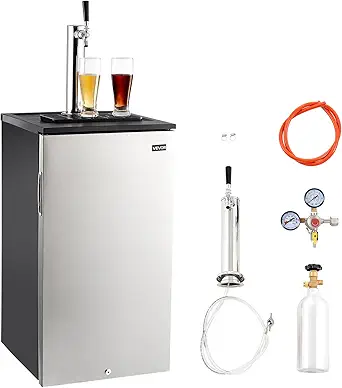 |
VEVOR Beer Kegerator BF152-2

| Capacity | 40 gallons |
|---|---|
| Temperature range | 32°F-50°F |
| Included components | 5 lbs CO₂ tank (empty), regulator, wrench, 2 shelves |
| Voltage | 115 volts |
This VEVOR BF152-2 kegerator is a practical home draft setup that combines a compressor refrigerator with a dual-tap tower and included CO2 regulator hardware. It holds a full-size keg or smaller quarter and sixth kegs and has removable shelving so you can use it as a fridge when not dispensing beer. The compressor cooling, adjustable knob (32 to 50°F), and auto-defrost design make it straightforward to keep beer at serving temperature, while a 9.8 ft beer line and drip tray help manage pours and foam. The unit ships with a 5 lb empty CO2 tank, regulator, hose clamps, gaskets, and casters for easy positioning, and an external bracket frees internal space for larger kegs. Expect typical setup steps—mounting the tower, hooking the regulator and lines, and leveling the unit—and occasional maintenance like cleaning lines and changing CO2. At its size and weight this is best for dedicated home bars or frequent entertaining where a full-size keg capacity and dual pours matter, but buyers should plan for installation space and routine keg-line upkeep.
Best for: Homebrewers or hosts who want a full-size, durable draft setup for regular entertaining and value the ability to store and dispense multiple keg sizes with a dual tap.
Less Ideal for: People who need a compact countertop solution or only occasional single-keg pours should consider smaller or single-tap units instead.
- Holds full-size, quarter, or two sixth kegs for flexible keg options
- Dual-tap tower lets you serve two beers or two lines concurrently
- Includes 5 lb CO2 tank (empty), regulator, hoses, clamps, and mounting bracket
- Adjustable temperature range (32 to 50°F) with compressor cooling and auto-defrost
- Removable shelf and caster wheels increase versatility and mobility
- CO2 tank is shipped empty so you must refill or exchange before dispensing
- Heavy and relatively large, requiring adequate space and handling during installation
Verdict: A solid full-size dual-tap kegerator for homebrewers who want fridge-quality cooling, flexible keg compatibility, and everything needed to set up a draft system.
HCK K150 24" Kegerator

| Capacity | 6.04 cubic feet |
|---|---|
| Installation Type | Undercounter |
| Defrost System Type | Automatic |
| Voltage | 110 volts_of_alternating_current |
| Refrigerant | R-600A |
The HCK K150 is a versatile 2-in-1 kegerator and beverage refrigerator aimed at backyard bars and homebrewers who need multi-tap serving plus fridge capacity. It uses a compressor cooling system with temperature control from 32°F to 50°F, auto-defrost, and a centrifugal compressor to keep draft beer chilled and consistent; the unit also restores the last temperature after power loss. In kegerator mode the stainless steel top and three-tap tower support a variety of keg sizes, and the included D-system tap kit, CO2 tank bracket, drip tray, guard rail, casters, and shelves mean you can install and start pouring without many extra purchases. When used as a fridge it holds up to about 161 cans across three wire shelves. Practical touches include a reversible lockable stainless door for outdoor or built-in installs and casters for mobility. The trade-offs are that the unit is heavy and relatively power hungry, and it carries a basic energy rating, so expect higher operating costs than compact, more efficient models.
Best for: Homebrewers and performance-focused hosts who need reliable draft temperature control and multi-tap serving for backyard bars or entertaining.
Less Ideal for: Those who need an ultra-low-energy or lightweight cooler for occasional use or strictly indoor counter-top placement.
- Three-tap tower and included D-system kit let you serve multiple beers at once
- Adjustable 32°F–50°F compressor cooling with auto-defrost keeps beer at stable serving temps
- Comes with accessory kit (CO2 bracket, guard rail, drip tray, casters, shelves) for out-of-the-box setup
- Reversible, lockable stainless steel door and built-in design suit indoor or outdoor bar installs
- Relatively high annual energy consumption compared with smaller beverage coolers
- Heavy unit that may require help to install or move
Verdict: Choose the HCK K150 if you want a rugged, multi-tap kegerator that doubles as a high-capacity beverage fridge ready for serious homebrew service.
EdgeStar BR2001 Refrigerator

| Capacity | 4.9 cubic feet |
|---|---|
| Defrost System Type | Automatic |
| Voltage | 115 volts |
| Number Of Shelves | 2 |
| Cooling Method | Compressor |
This EdgeStar BR2001 is a compact freestanding refrigerator built to accept a kegerator conversion while still functioning as a general beverage fridge. It stores one standard half-barrel or multiple smaller kegs and includes a tower hole cap so you can run it as a fridge without the tap hardware. The unit uses a reciprocating compressor with automatic defrost and wire shelving, and its reversible stainless steel door plus casters make placement and access flexible in a home setup. Temperature control covers the low 30s to mid 40s Fahrenheit, which is cold enough for draft beer storage but not for deep-freeze tasks. Practical touches include a keyed lock and a protective floor plate to handle keg weight and movement. Expect a straightforward, no-frills installation and operation; the compressor style and compact 4.9 cu ft capacity mean it is efficient for small spaces but not suitable for heavy commercial throughput or larger keg formats that exceed standard Sankey dimensions.
Best for: Buyers who want a compact, conversion-ready refrigerator to run a single-tap homebrew setup or store a few kegs and beverages in tight spaces while prioritizing practicality and easy placement.
Less Ideal for: Do not choose this unit if you need to host high-volume pours, fit nonstandard oversized kegs, or require the lowest-noise, highest-efficiency compressor technology.
- Designed to accept a standard half-barrel or multiple smaller kegs
- Reversible stainless steel door and casters for flexible placement
- Temperature range suitable for draft beer storage (low 30s to mid 40s F)
- Includes keyed lock and protective floor plate for durability
- Limited internal capacity compared with full-size kegerators so it fits only specified keg types
- Reciprocating compressor can be louder and less efficient than inverter models
Verdict: A compact, conversion-ready refrigerator that gives homebrewers a practical, space-saving way to run a single-keg draft setup.
EdgeStar BR3002 Kegerator Refrigerator

| Capacity | 5.6 cubic feet |
|---|---|
| Size | 24 Inch |
| Temperature Range | 32–50°F |
| Defrost System Type | Automatic |
| Refrigerant | R-600A |
The EdgeStar BR3002 is a compact freestanding refrigerator built to serve as a kegerator conversion unit for home draft setups. It holds up to three sixth-barrel or three Cornelius corny kegs and includes an intuitive digital control that sets temperatures between 32 and 50°F, plus a Deep Chill Mode that quickly cools a new keg before reverting to a set point. The unit ships with practical accessories for draft use such as a guard rail, surface-mount drip tray, two wire shelves for traditional refrigeration, and casters for mobility, and it has a rear knockout for optional CO2 tank storage. A compressor-based cooling system and automatic defrost keep temps steady, but the unit is fairly heavy and sized for a dedicated under- or freestanding location. Energy use is listed at 310 kWh annually so expect noticeable power draw compared with smaller refrigerators. For homebrewers who want a straightforward conversion-ready cabinet with digital control and room for multiple keg sizes, this model covers the essentials without specialty tap hardware included.
Best for: Homebrewers on a budget who want a ready-to-convert freestanding cabinet with digital temperature control and room for multiple keg sizes, and who are comfortable sourcing draft hardware separately.
Less Ideal for: Buyers looking for a turnkey kegerator with tower and faucets already installed or those needing an integrated built-in unit for undercounter installation.
- Holds up to three sixth-barrel or three Cornelius kegs for flexible keg sizing
- Digital temperature control with 32–50°F range plus Deep Chill Mode for fast cooling
- Includes practical kegerator accessories: guard rail, drip tray, wire shelves, and casters
- Compressor cooling with automatic defrost maintains consistent serving temperatures
- Rear knockout allows optional CO2 tank placement for a cleaner install
- No tap tower, couplers, or draft hardware included so additional parts are required to serve beer
- Listed annual energy consumption (310 kWh) is higher than smaller beverage fridges
Verdict: A budget-friendly freestanding cabinet that gives homebrewers digital temperature control and multi-keg capacity while leaving draft hardware choices up to you.
Kegco K309B-2 Kegerator

| Capacity | 5.6 cubic feet |
|---|---|
| Configuration | Freestanding |
| Cooling Method | Compressor |
| Number of Tubes | 2 |
| Refrigerant | R-134A |
The Kegco K309B-2 is a sturdy two-faucet home kegerator built to handle full-size domestic kegs or multiple 5-gallon kegs for homebrew dispensing. It uses a compressor with fan-forced cooling and digital push-button temperature controls that let you set and monitor the internal temp down to 32 degrees Fahrenheit, plus a Deep Chill mode for rapidly cooling a warm keg. The unit ships with a full tapping kit including a draft tower, keg couplers, CO2 tank and regulator so you can start pouring right away, and the interior layout and removable drip tray make cleaning and loading kegs straightforward. Casters with locks make it easy to move and secure the cabinet. Expect a reliable, purpose-built dispenser for regular homebrew use, though its 5.6 cu ft capacity and single-door design limit space for bulky additional storage and the CO2 tank ships empty and must be filled locally.
Best for: Homebrewers and hobbyists who need a dependable, purpose-built dispenser that reliably cools and serves multiple kegs and who prioritize consistent temperature control and durable components.
Less Ideal for: Buyers looking for compact countertop units or those who want large refrigerator-style storage in addition to keg dispensing should consider other formats.
- Digital temperature control with 1-degree adjustment and LED display for accurate setpoint monitoring
- Fan-forced compressor cooling and Deep Chill mode achieve very low temperatures when needed
- Comes with a complete two-tap dispensing kit including draft tower, couplers, CO2 tank and regulator
- Spacious interior fits full-size kegs or multiple 5-gallon kegs and has removable drip tray for easy cleaning
- Locking casters allow easy repositioning and stable placement
- CO2 tank ships empty and requires a local fill before use
- 5.6 cubic feet capacity limits additional refrigeration storage when not dispensing
- Single-door, freestanding footprint may be large for very small home spaces
Verdict: A reliable, full-featured two-tap kegerator built for homebrewers who want accurate digital temperature control and commercial-style dispensing out of the box.
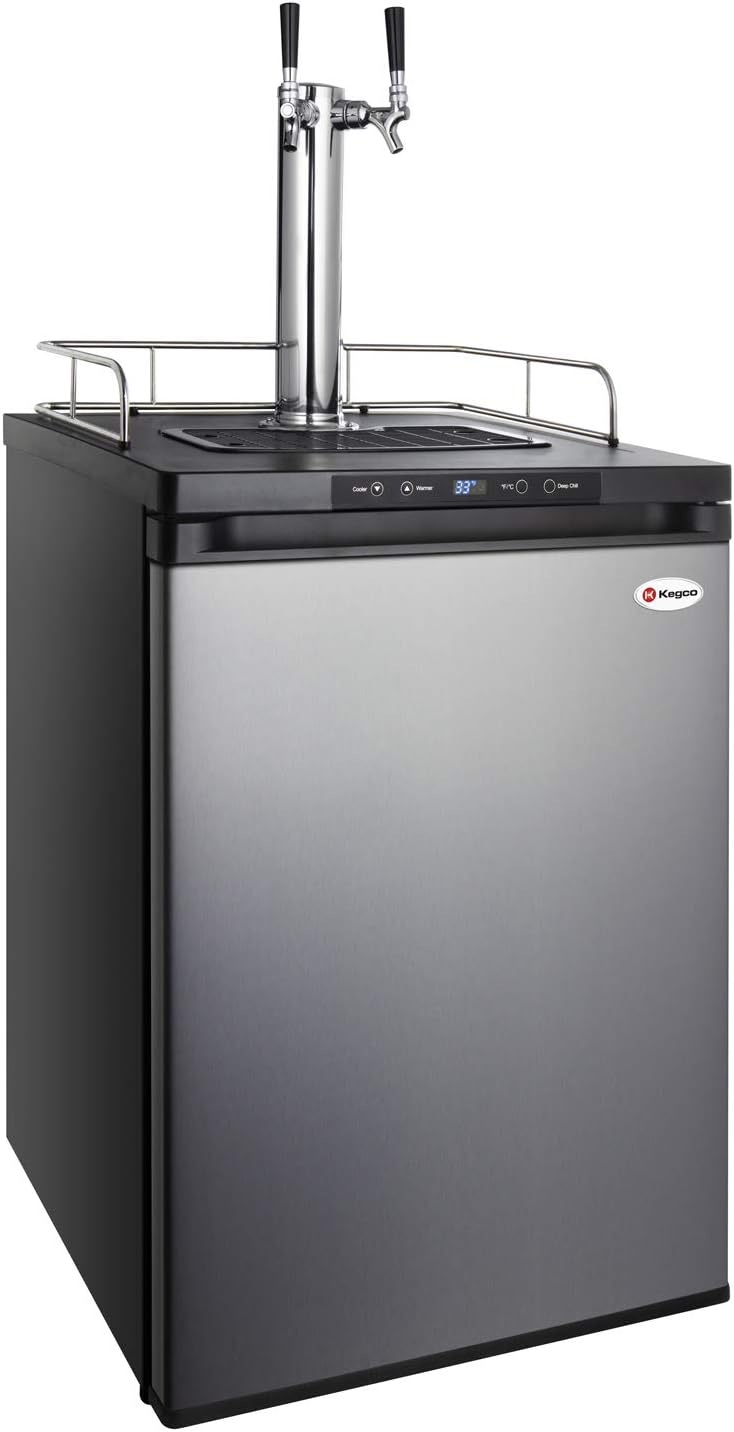
Kegco HBK309S-2 Kegerator
| Temperature range | 32 to 75 degrees F |
|---|---|
| Temperature control | Digital LED with 1-degree adjustment |
| Cooling | Fan-forced cooling with Deep Chill mode |
| Tap configuration | 2-tap stainless steel dual faucet tower |
| Included regulator | Commercial-grade dual-gauge regulator |
The Kegco HBK309S-2 is a full-size homebrew kegerator designed to dispense up to two kegs at once and to serve as a fermentation chamber when needed. It uses fan-forced cooling and a digital LED temperature controller so you can set temperatures precisely between 32 and 75 degrees Fahrenheit, and a Deep Chill mode forces continuous compressor operation for rapid cooldowns. Inside is roomy enough for multiple ball-lock Cornelius kegs or a full-size commercial keg with the included 14-inch stainless steel dual-tower, two ball-lock tap sets, commercial-grade dual-gauge regulator, and a 5 lb aluminum CO2 tank. That kit makes initial setup straightforward for homebrewers and reduces the need to source parts separately. The stainless steel door and black cabinet make it look at home in a garage, basement, or home bar. Expect the unit to be heavy and large, so plan for installation space and at least two people to move it. Also note the included couplers are for ball-lock homebrew kegs only and D-system commercial couplers must be purchased separately if you need them.
Best for: Homebrewers who want a ready-to-use, full-size kegerator that simplifies setup with a complete dispense kit and precise temperature control for both serving and fermenting.
Less Ideal for: People who need out-of-the-box compatibility with commercial D-system kegs or those needing a compact, lightweight dispenser for tight spaces.
- Digital temperature control with 1-degree adjustment and Fahrenheit/Celsius display
- Fan-forced cooling and Deep Chill mode for fast, even cooling
- Comes with a complete two-tap homebrew dispensing kit including tower, faucets, ball-lock tap sets, regulator, and 5 lb CO2 tank
- Large interior fits multiple Cornelius ball-lock kegs or a full-size keg
- Included couplers are ball-lock only, so commercial D-system kegs require separate couplers
- Heavy and bulky, which complicates moving and placement
Verdict: Buy this if you want a full-size, ready-to-serve homebrew kegerator with precise digital temperature control and a complete two-tap dispense kit.
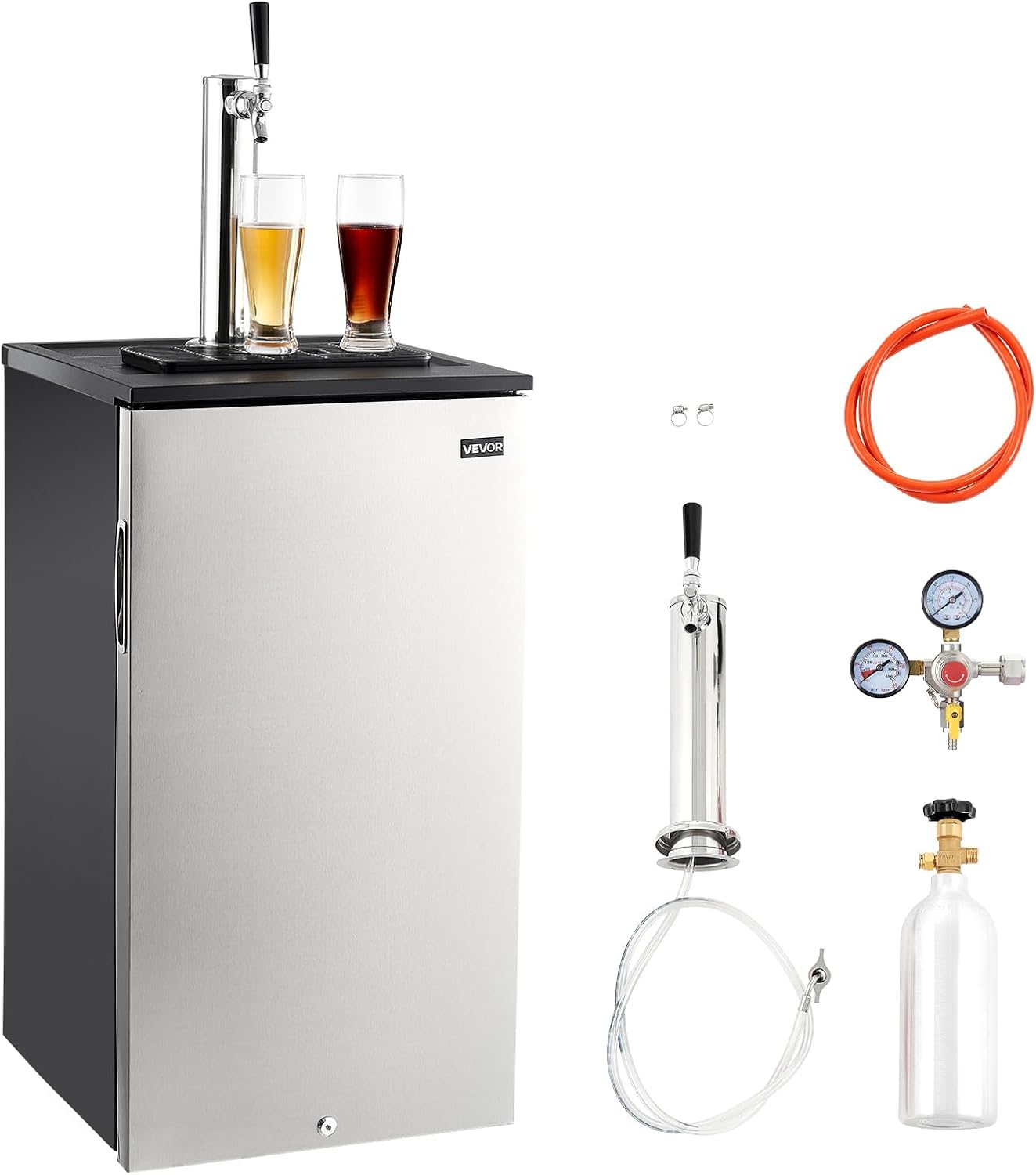
VEVOR Beer Kegerator BF92
| Capacity | 92 liters |
|---|---|
| Temperature range | 32 to 46°F (0 to 8°C) |
| Voltage | 115 volts |
| Included components | Faucet, handle, single-tap tower, clamps, 2.5 lbs CO₂ tank |
The VEVOR BF92 is a compact freestanding kegerator built to keep a sixth-barrel keg chilled and ready to pour at home or in a small commercial setting. It uses a compressor with fan-forced circulation and an auto-defrost system to maintain set temperatures between 32 and 46°F via a digital display and push-button controls, and it remembers settings after power loss. The interior fits a sixth keg plus a CO2 tank internally but also supports external tank placement for tighter installs. The unit ships with a single-tap tower, D-style coupler, regulator and a 2.5–5 lb CO2 tank and clamps, so you can get pouring straight away. Practical benefits include steady draft flow and removable shelving for storing bottles or switching to beverage cooler use. Trade-offs are its single faucet (limits simultaneous pours) and the footprint and weight typical of full-keg-capable units, which may require planning for placement and leveling.
Best for: Buyers who want a ready-to-run, reliable home kegerator that keeps a single sixth keg at draft-ready temperatures with minimal setup and maintenance.
Less Ideal for: Anyone needing multi-tap service, large-capacity draft for big parties, or a very compact countertop dispenser should consider other options.
- Included draft kit (tower, D-coupler, regulator, CO2 tank) lets you start serving immediately
- Digital temperature control with 32–46°F range and memory recall after power loss
- Supports internal or external CO2 tank placement for installation flexibility
- Fan-forced circulation and auto-defrost promote even cooling and reduced maintenance
- Single faucet limits serving multiple beers or simultaneous pours
- Unit is relatively heavy and requires adequate floor space and leveling during installation
Verdict: If you want a plug-and-play home kegerator that reliably chills and dispenses a single sixth keg with factory-quality controls and included draft hardware, the VEVOR BF92 is a solid choice.
Choosing the Right Kegerator for Homebrew: Key Factors to Consider
Cooling Consistency
Stable temperature control keeps carbonation and flavor consistent from the first pint to the last. Homebrewed beers are sensitive to temperature swings, which can cause over- or under-carbonation, promote off-flavors, or affect head retention.
Look for kegerators with a reliable thermostat and even internal airflow. Digital readouts and fine-grain temperature adjustment help you dial in lagering or ale-serving temps. Better cooling consistency reduces the need for frequent keg rotation and lowers the risk of spoilage during longer pours.
Keg Compatibility and Capacity
Homebrew kegs differ from commercial formats, and many homebrewers use converted ball-lock or pin-lock kegs. Make sure the cabinet internal dimensions, tower clearance, and coupler compatibility match the keg types you plan to use.
Capacity matters if you want to store multiple kegs or larger batches. Consider whether the kegerator can accept a single tall keg, two short kegs, or a combination of keg sizes with adapters. Internal storage layout and whether the tap tower is removable will affect how easily you load and secure kegs.
Draft Hardware Flexibility
The included faucet, tower, shank and tubing determine how easily you can connect homebrew couplers and gas lines. A flexible system that accepts common fittings and allows tubing upgrades simplifies setup and future upgrades.
Pay attention to the faucet type and whether the unit uses food-grade tubing and industry-standard threading. Removable towers and straightforward shank access speed cleaning and let you swap in a flow-control faucet or nitrogen setup for stouts and other styles.
Ease of Cleaning and Sanitation
Sanitation is central for homebrewers because residue and biofilms degrade flavor and increase contamination risk. A kegerator that allows easy access to lines, faucets, and the interior will save time and protect beer quality.
Look for features like removable drip trays, accessible shank fittings, and enough internal space to reach couplers and keg tops. Units that support line cleaning without disassembly or that have quick-release connections make routine sanitation less of a chore.
Insulation, Build Quality, and Noise
Good insulation keeps the compressor from running constantly and stabilizes interior temperature. Thicker cabinet walls and a solid door seal reduce temperature swings and energy use, which is especially helpful if the kegerator runs in a warm garage or basement.
Build quality also influences vibration and noise. Quieter compressors and vibration-dampening mounts help preserve beer clarity and make the unit more suitable for living spaces. Durable finishes and corrosion-resistant interiors extend service life when used with wet kegs and cleaning chemicals.
Serviceability and Upgrade Paths
Over time you may want to upgrade taps, add a regulator, or change the tower. A kegerator that is easy to service and upgrade increases long-term value and adaptability to different beer styles and serving setups.
Check whether common components are user-replaceable, how easy it is to access electrical and refrigeration parts, and whether the internal layout supports adding a second tap or an external CO2 cylinder mount. Simpler modifications reduce downtime and the need for professional help.
Sizing Your Kegerator to Your Brewing Output
Match the internal volume of the kegerator to how much beer you produce between brews. If you frequently brew five-gallon batches, a unit that comfortably fits a full-size converted keg or two smaller kegs will reduce the need for transfers and conditioning outside the kegator.
Think about vertical clearance for tall kegs and whether the tower can be removed to load large vessels. Also plan for extra room if you intend to store CO2 cylinders, cleaning equipment, or spare tubing inside or adjacent to the cabinet.
- Measure keg height and diameter before buying.
- Consider a unit with removable shelving or a removable tower for easier loading.
- Allow space for regulators or small CO2 bottles if you prefer internal mounting.
Setting Serving Temperature for Different Styles
Different beer styles are best served at different temperatures. Lagers typically need colder service temps than many ales, while stouts and porters are often better slightly warmer. Choose a kegerator that can reliably hold the temperature range you need and offers simple adjustment for occasional changes.
If you plan to serve multiple styles from the same unit, consider whether you will blend temperature needs or segregate styles into separate kegs with similar targets. Precision control makes switching styles simpler and reduces the risk of warming other kegs during adjustments.
- Use a thermometer probe to verify actual keg temperature rather than relying only on the cabinet dial.
- Allow adequate cool-down time when changing a keg or adjusting setpoints.
Connecting Homebrew Kegs and Couplers
Homebrew kegs often use ball-lock or pin-lock fittings that require specific disconnects or adapters. Confirm that the kegerator's included hardware or space for adapters will let you connect your existing kegs without irreversible modifications.
Many homebrewers prefer to use external quick-disconnects and a small CO2 tank mounted outside the cabinet for easier access. That approach simplifies regulator adjustments and reduces interior clutter, but requires planning for hose runs and secure mounting.
- Keep a set of clean disconnects for each beer to prevent cross-contamination.
- Label gas and beer lines to avoid accidental swaps during service or cleaning.
Maintaining Lines, Faucets, and Kegs
Regular cleaning prevents off-flavors and keeps pours consistent. Plan a routine for line cleaning after every keg or at least monthly for frequent use. Quick-access faucets and shanks speed this work and reduce the time your system is out of service.
Inspect seals and O-rings on a schedule and replace them if they show wear. Keep a small cleaning kit with recommended brewery cleaner and a line brush near the kegerator so maintenance becomes a straightforward part of your routine.
- Flush lines with warm water then cleaning solution, followed by thorough rinsing.
- Sanitize faucets and keg couplers whenever you change kegs.
Noise, Location, and Ventilation Considerations
Compressor noise and ventilation needs affect where you can comfortably place a kegerator. A unit with higher airflow needs or louder operation may be better suited to a garage or basement, while quieter models are preferable for kitchens and living areas.
Maintain proper clearance around ventilation openings and avoid placing the unit inside a cramped cabinet unless the manufacturer explicitly supports built-in use and provides adequate ventilation pathways.
- Check manufacturer clearance recommendations before installation.
- Avoid placing the kegerator in direct sunlight or near heat sources to reduce compressor load.
How We Chose the Best Kegerator for Homebrew
We evaluated kegerators for homebrew using criteria that matter to small-batch brewers and everyday home draft use. Core filters included temperature control precision, internal capacity and keg mounting options, and draft hardware compatibility with homebrew fittings. We prioritized units that allow close control over serving temperature and that accommodate common homebrew keg sizes or conversion equipment. We also considered build quality and insulation, because better insulation reduces compressor run time and protects beer flavor. Ease of cleaning and serviceability were included to reflect the higher sanitation needs of homebrew systems. Noise level and energy efficiency were judged for typical home environments where the kegerator may run for long periods. Excluded items included commercial-scale dispensers and temporary picnic coolers that lack integrated refrigeration controls. We did not consider units that require extensive irreversible modification to work with homebrew kegs. Final selections balance precise cooling, keg fit flexibility, and user-accessible maintenance features.
Our full evaluation process is outlined in our review methodology.
FAQ
Can I use a kegerator for homebrew with ball-lock or pin-lock kegs?
Often you can, but it depends on the interior fittings and the coupling hardware. Many kegerators accept common homebrew disconnects with adapters or by swapping the tap hardware. Verify interior clearance and that you can route gas and beer lines to your chosen disconnect types.
How cold should I set a kegerator for typical ales and lagers?
Ales usually serve well between 45 and 55 degrees Fahrenheit, while lagers benefit from colder temperatures around 38 to 45 degrees. Exact setpoints depend on the style and your preference, so choose a kegerator that offers fine temperature control within these ranges.
How often should I clean draft lines and faucets?
For regular home use, clean lines every two to four weeks or after changing kegs that have been conditionally fermented. Faucets and couplers should be cleaned and sanitized whenever you swap kegs to prevent flavor carryover and contamination.
Is it better to mount CO2 inside or outside the kegerator?
Both approaches work. External mounting gives easier access to regulators and reduces interior clutter, while internal mounting can save floor space. Choose based on your available space, convenience for regulator adjustments, and whether you have room to safely secure the cylinder.
Will a kegerator for homebrew handle long conditioning or secondary fermentation in the keg?
Many kegerators can support longer conditioning provided they maintain stable, appropriate temperatures and you monitor pressure and sanitation. Be mindful of headspace, pressure changes, and the need for periodic taste checks when conditioning beer in a keg.
Final Verdict
Prioritize temperature control, keg compatibility, and easy sanitation when choosing a kegerator for homebrew. Those three factors most directly affect beer flavor, carbonation stability, and the amount of maintenance you will face over time. Insulation and quiet operation are useful secondary concerns depending on where you plan to install the unit. Decide whether you need more internal capacity or greater hardware flexibility, and plan for routine cleaning and occasional upgrades to taps or regulators. With those priorities in mind, you can pick a kegerator that keeps your homebrew tasting its best and makes pouring draft beer at home a reliable, low-fuss experience.