
Note: This article contains affiliate links. If you click on these links and make a purchase, we may earn a small commission at no extra cost to you. This helps support our research and content. Read our full affiliate disclosure here.
If you brew with a French press, cold brew, or any method that needs a coarse grind, a purpose-built manual coffee grinder is a simple way to get reliable results without electricity. The right hand grinder gives you control over particle size, reduces heat and static, and often packs greater durability for regular coarse grinding. This guide shortlists the top manual coffee grinders for coarse grind across practical use cases, focusing on grind consistency, adjustment range, and long-term reliability. Below you will find our top picks, plus the key criteria we used to evaluate them and practical buying guidance to help you choose the best mill for your brewing routine.
Top Picks at a Glance
| Best Overall The best all-around choice for most situations | Hario Ceramic Coffee Mill MSS-1B |  |
| Best Quality Built to a higher standard if you want something more solid | 1Zpresso K-Ultra Manual Grinder |  |
| Best Value The sweet spot between price and what you get | CEVING Mini Manual Coffee Grinder MCG-01 | 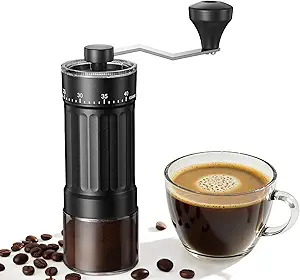 |
| Best Budget The cheapest option that still gets the job done reliably | Rsoilch Manual Coffee Grinder HS-011 |  |
| Top Rated A top-rated pick with lots of positive feedback | TIMEMORE Chestnut C3S Pro |  |
| Most Popular A crowd favorite that many people choose with confidence | JavaPresse Manual Coffee Grinder |  |
| Best Seller A high-volume bestseller chosen again and again | CEVING Manual Coffee Grinder MCG-02 | 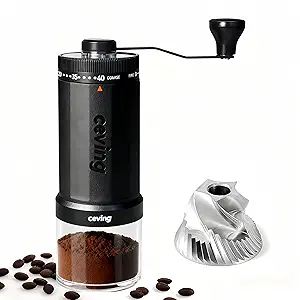 |
Hario Ceramic Coffee Mill MSS-1B

| Capacity | 2 cups |
|---|---|
| Material Type | Ceramic |
| Power Source | Manual |
The Hario Ceramic Coffee Mill is a hand-powered grinder built around a ceramic burr that resists rust and keeps flavors clean. You turn the removable handle to grind beans into the clear collection bottle, and grind size is adjusted by the nylon knob so you can dial in coarser settings suited for French press or other coarse-brew methods. Its slim, vertical profile stores easily without the handle attached and the parts disassemble for straightforward cleaning. The ceramic mill provides steady, consistent particle size compared with basic blade grinders, but because it is a compact manual unit it grinds more slowly than larger bench grinders and requires physical effort for larger batches. Capacity is modest, roughly two cups of grounds, so it is best for single-serve to small-batch grinding. If you want a portable, durable manual grinder that excels at coarse grinds and simple maintenance, this Hario model delivers predictable results in a small footprint.
Best for: Buyers who want a compact, durable manual grinder that reliably produces coarse grounds for single-serve or small-batch brewing and value portability and easy cleaning.
Less Ideal for: People who routinely grind large volumes or who need very fine, micro-adjustable espresso-level settings should choose a larger bench grinder instead.
- Ceramic burr resists rust and preserves coffee flavor
- Adjustable grind knob allows coarse settings suited for French press
- Slim design stores without the handle to save space
- Clear collection bottle lets you monitor grind amount
- Small capacity and manual operation make large batches time-consuming
- Not as fast or finely adjustable as dedicated larger burr bench grinders
Verdict: A compact, reliable manual grinder that produces consistent coarse grinds and stores easily, ideal for small-batch French press brewing.
1Zpresso K-Ultra Manual Grinder

| Burr material | Stainless steel |
|---|---|
| Burr size | 48mm |
| Adjustment | External dial, 100+ clicks, 20 microns per click |
| Capacity | 35-40 g catch cup |
| Power source | Manual |
The 1Zpresso K-Ultra is a metal-bodied hand grinder built around a 48mm stainless steel conical burr and an external adjustment dial that offers over 100 clicks at roughly 20 microns per click. It is used by turning the foldable crank to produce grounds for methods ranging from coarse brew to fine espresso, and the external dial makes dialing in a target particle size fast without disassembly. The magnetic catch cup snaps into place and holds about 35 to 40 g of grounds, which speeds workflow and makes it tidy during tamping or travel. Tool-free disassembly and included cleaning tools simplify maintenance, and the foldable handle plus a premium travel case make it convenient to carry. At the same time, it is a manual grinder so it requires physical effort and time for larger doses, and its capacity is limited compared with electric grinders when you need big batches. For someone focused on grind performance and consistency, the K-Ultra delivers a high level of control in a compact, durable package.
Best for: Buyers who prioritize grind accuracy and consistency for coarse and espresso-style brewing and who want a durable, portable grinder they can precisely tune.
Less Ideal for: People who need to grind large daily volumes quickly or prefer fully automated electric grinders for speed and convenience.
- 48mm stainless steel conical burr for consistent particle size and clarity
- External adjustment dial with 100+ clicks for precise, repeatable grind settings
- Magnetic catch cup that holds 35–40 g for quick, mess-free workflow
- Tool-free disassembly and included cleaning tools for easy maintenance
- Foldable handle and travel case make it highly portable
- Manual operation is slower and more effortful than electric grinders for large batches
- Limited ground capacity compared with countertop electric grinders
Verdict: Choose the K-Ultra if you want a compact, travel-ready manual grinder that gives precise, repeatable control over coarse and fine grind sizes.
CEVING Mini Manual Coffee Grinder MCG-01

| Capacity | 30 g |
|---|---|
| Material Type | Ceramic |
| Power Source | manual winding |
| Adjustable Settings | 40 |
The CEVING Mini Manual Coffee Grinder is a travel-friendly hand mill that grinds beans with a ceramic conical burr and an external 40-step adjustment ring. You use it by loading up to 30 g of beans, turning the crank, and selecting a grind size from fine to coarse without opening the chamber, which keeps grounds tidy. Ceramic burrs produce a relatively uniform grind while generating less heat, which helps preserve flavor when you are prepping pour-over, French press, or coarse brew. The grinder disassembles into a few parts for brushing out grounds and basic maintenance, and its light weight and compact shape make it convenient for camping or small kitchens. Important limitations are the modest 30 g capacity and the manual effort required for larger batches; it is slower than an electric grinder and not suited for daily large-volume use. Also the manufacturer recommends avoiding water cleaning, so you will rely on dry brushing to remove oils. For someone prioritizing portability and adjustable coarse grind control, it performs well.
Best for: Practical buyers who need an easy-to-adjust, portable grinder for occasional coarse grinds on the go or small households that prioritize consistency over speed.
Less Ideal for: Anyone who routinely grinds larger daily volumes or wants a hands-free, high-speed electric grinder should look elsewhere.
- Wide 40-step external adjustment lets you dial in coarse settings without opening the grinder
- Ceramic conical burrs deliver consistent grind size with low heat buildup
- Compact, lightweight design is easy to carry for travel, camping, or small kitchens
- Simple three-part construction makes disassembly and dry cleaning straightforward
- 30 g capacity requires multiple batches for larger servings
- Manual grinding is slower and requires physical effort compared with electric grinders
Verdict: Choose this grinder if you want a compact, highly adjustable manual mill that reliably produces coarse grinds for travel and small-batch brewing.
Rsoilch Manual Coffee Grinder HS-011

| Capacity | 30 g |
|---|---|
| Included Components | Ceramic Burr, Stainless Steel Body |
| Material Type | Ceramic, Plastic |
This compact manual grinder uses a ceramic conical burr and 40 adjustable grind clicks to produce consistent grounds for a range of brew methods from espresso to coarse French press. It is operated by a quiet hand crank and requires no power, making it useful for travel, camping, or small-kitchen daily use. The clear glass grounds jar lets you watch and measure output while keeping grounds contained, and the ABS plastic body keeps weight low for portability. Practical benefits include fine control over grind size and a burr design that preserves coffee oils for better flavor extraction. Limits are its small capacity — roughly 25 to 30 g per fill — which means more frequent refills for larger batches, and the plastic exterior will not feel as durable as metal-bodied grinders. For coarse grind-focused buyers it delivers usable, adjustable results but is best for single-serve or small-batch grinding rather than high-volume home use.
Best for: Buyers prioritizing an affordable, portable manual grinder who need precise control for coarse or other grind sizes and typically prepare single-servings or small batches.
Less Ideal for: Those who grind large daily volumes or want a heavy-duty, metal-bodied grinder for long-term high-use household grinding.
- Ceramic conical burr preserves oils and yields uniform grind
- 40 adjustable grind settings accommodate coarse to fine brewing
- Clear glass grounds container allows visual monitoring and reduces mess
- Lightweight, portable design suited for travel and camping
- Small 25–30 g capacity requires multiple fills for larger batches
- Plastic exterior less robust than metal-bodied grinders
Verdict: A budget-friendly, portable manual grinder that gives fine control over coarse grinds for single-serve and small-batch use.
TIMEMORE Chestnut C3S Pro

| Capacity | 25 g |
|---|---|
| Item Weight | 430 g |
| Power Source | manual |
The TIMEMORE Chestnut C3S Pro is a compact hand grinder built around an all-metal aluminum body and a patented S2C conical steel burr set aimed at consistent particle size. You use it by loading up to the bean hopper, setting one of roughly 36 grind positions with the adjustment nut, then turning the foldable crank to produce grounds into the 25 g catch cup. The upgraded S2C660 burrs and a double-bearing central axis make grinding smooth with less effort and more even output, which helps when targeting coarse settings for methods like French press or cold brew. Its foldable handle and metal construction make it portable and durable for travel or regular kitchen use, and the small capacity and light weight mean it is best for single-serve or small-batch grinding. The practical limits are its 25 g capacity and manual operation, so it is slower for large batches and requires hand effort compared with electric grinders, but for reliability and consistent coarse results it performs well.
Best for: Buyers who prioritize a dependable, well-built manual grinder that produces consistent coarse grinds for French press or cold brew and who value portability and longevity over high throughput.
Less Ideal for: People who need to grind large quantities quickly or who prefer fully automatic electric grinders for daily multi-cup brewing.
- All-metal aluminum body for durability and better heat dissipation
- S2C patent conical steel burrs that promote consistent grind size
- Double-bearing central axis and smooth operation reduce hand fatigue
- Foldable crank handle improves portability and storage
- Stepless adjustment with about 36 settings for fine-to-coarse control
- Small 25 g capacity requires multiple batches for larger servings
- Manual grinding is slower than electric options for big volumes
Verdict: Choose the C3S Pro if you want a rugged, travel-friendly manual grinder that reliably produces consistent coarse grinds.
JavaPresse Manual Coffee Grinder

| Adjustable settings | 18 settings |
|---|---|
| Burr type | Ceramic conical burr |
| Power source | Manual |
The JavaPresse Manual Coffee Grinder is a hand-crank conical burr grinder built for portability and control. It uses a ceramic burr assembly with 18 indexed settings so you can dial in coarseness from fine to coarse for espresso, pour-over, French press, and other brews. The manual crank eliminates most electric noise and needs no power, which makes it convenient for travel, camping, or small kitchens. Its stainless steel body and ceramic burrs are marketed for durability and consistent particle size, which helps extract cleaner flavors when grinding whole beans to coarse settings for French press or cold brew. On the downside, grinding larger doses by hand takes time and effort compared with electric grinders, and speed varies with bean roast and user pace. The grinder is compact and easy to pack, but cleaning small parts requires some care to avoid losing pieces. For buyers who value quiet, portable grinding and adjustable coarse settings, this delivers a reliable manual option; if you need fast high-volume grinding, an electric model is a better match.
Best for: Buyers who want a quiet, portable grinder that gives fine control over coarse-to-fine grind size and who prioritize reliability and social-proofed performance over speed.
Less Ideal for: People who regularly grind large daily doses or need rapid, hands-free operation should choose an electric grinder instead.
- 18 adjustable grind settings for precise coarseness control
- Ceramic conical burrs designed for consistent grind and long wear
- Manual crank eliminates most electric noise and requires no power
- Compact, stainless steel construction is travel- and camping-friendly
- Hand grinding is slower and more effort for larger quantities
- Small removable parts require careful cleaning and storage
Verdict: Choose this grinder if you want a compact, quiet manual burr grinder that gives reliable coarse grinds for travel or occasional French press use.
CEVING Manual Coffee Grinder MCG-02

| Capacity | 60 g |
|---|---|
| Adjustable settings | 40 |
| Burr type | Stainless steel conical |
The CEVING MCG-02 is a high-capacity manual grinder aimed at people who want consistent coarse-to-fine grinds without electricity. It holds up to 60 g of beans, so you can grind enough for multiple cups or a batch of coarse grounds for cold brew or French press in one session. The grinder uses CNC stainless steel conical burrs and an external click-ring with 40 settings, which makes dialing in a coarse range straightforward and repeatable. In practice the larger capacity and external adjustment cut down on fiddling and refilling when you need bigger doses, and the metal burrs deliver even particle size for better extraction compared with blade or cheap conical alternatives. It is designed to be portable and relatively lightweight for travel, but its larger hopper and metal construction give it a more substantial, countertop-friendly feel. The main compromises are manual effort for larger batches and the need to clean between roast changes, but for someone who prioritizes consistent coarse grinds and durability this grinder performs reliably.
Best for: Buyers who want a reliable, repeatable manual grinder that easily produces coarse grounds for French press, cold brew, or batch brewing and who value build quality and larger single‑session capacity.
Less Ideal for: People who need the fastest, least-effort solution for very large daily volumes or those who prefer fully automatic electric grinders.
- Large 60 g hopper lets you grind multiple cups or a full French press in one go
- 40 external click-ring settings make switching to coarse grinds quick and repeatable
- CNC stainless steel conical burrs provide uniform particle size for better extraction
- Portable and reasonably lightweight for travel or camping use
- Manual grinding requires more effort for larger batches compared with electric grinders
- Metal construction and larger capacity add some bulk versus ultra-compact travel mills
Verdict: Choose this grinder if you want a durable, large‑capacity manual mill that makes coarse, consistent grounds with an easy external adjustment ring.
Choosing the Right Manual Coffee Grinder for Coarse Grind: Key Factors to Consider
Coarse Grind Consistency
How uniform the grind is at coarse settings directly affects extraction for French press and cold brew. A grinder that produces consistent particle sizes reduces the amount of fine sediment and prevents over-extraction, which leads to muddiness and harsh flavors.
Look for manual grinders whose burr geometry and tolerances are optimized for larger particle sizes. Consistency matters more here than top-end fineness because coarse brewing tolerates larger particles but not a wide mix of fines.
Adjustment Range and Repeatability
A wide, well-marked adjustment range lets you dial in the exact coarse setting you need for different brew recipes. Repeatability means the grinder will return to the same coarse setting after disassembly or transport.
Pay attention to the design of the click stops or scale, and whether the adjustment mechanism locks. Repeatable coarse settings save time and eliminate guesswork when you switch between techniques like steeped cold brew and a shorter French press steep.
Burr Material and Durability
Burr material and construction determine how long the grinder holds a consistent grind profile under frequent use. Hardened steel and ceramic are common; steel tends to last longer under heavy use, while ceramic resists corrosion.
Durable burrs maintain edge geometry that supports coarse grinding without widening the particle distribution over time. Consider whether burrs are replaceable and how easily they are aligned during maintenance.
Ergonomics and Turn Speed
Coarse grinding requires more rotations per dose than fine grinding, so crank comfort and mechanical advantage matter. An ergonomic handle, stable base, and efficient burr pairing reduce wrist strain and make larger doses manageable.
Also evaluate how quickly the grinder produces a given coarse dose. Some designs prioritize torque for effortless turning, while others favor compactness at the cost of longer crank time.
Capacity and Portability
Consider how much coffee the grinder can hold and whether you need a compact unit for travel. Larger dose capacity means fewer refills for batch cold brew or multiple French press servings, but it often increases weight and footprint.
If you plan to take the grinder on trips, balance capacity with collapsible or detachable components that make the grinder easier to pack without sacrificing durability.
Ease of Cleaning and Maintenance
Coarse coffee leaves more residual grounds in the burr chamber and can trap oils that affect taste over time. A grinder that disassembles easily for brushing and occasional deep cleaning reduces flavor carryover and prolongs component life.
Look for designs that provide direct access to the burrs and collection chamber, and check whether parts are straightforward to reassemble without losing calibration.
Why Coarse Grind Settings Behave Differently
Coarse grinding produces larger particles and a narrower surface-area-to-volume ratio than fine grinds. That changes extraction dynamics because water contacts fewer surfaces and flows more freely through the bed. Small changes in particle distribution have an outsized effect on mouthfeel for steeped methods.
Because of this, grinders must produce a tight distribution of larger particles to avoid an excess of fines that will over-extract during long contact times. Manual grinders that are engineered for coarse work use burr geometries and clearance settings optimized for those larger sizes.
- Coarse grinds demand burr clearances that keep fines low
- Large particle consistency prevents muddy or astringent cups
- Grinder mechanics and crank ergonomics matter more for larger doses
Practical Tips for Using a Manual Grinder with Coarse Beans
Start with the manufacturer or grinder's recommended coarse setting as a baseline, then adjust up or down in small steps based on extraction time and taste. For French press, aim for a just-visible, chunky texture; for cold brew, slightly coarser and more uniform grinds are usually best.
Keep your grinder clean and dry before grinding for coarse methods. Residual fine particles or stale oils from past, finer grinds raise the proportion of fines and can compromise your batch. If you change between fine and coarse regularly, re-check your calibration after reassembly.
- Make small adjustment increments when calibrating
- Wipe or brush burrs before coarse batches
- Pre-weigh beans to avoid excessive crank time during large cold brew batches
Maintenance Routines That Preserve Coarse Performance
Regular brushing and occasional deeper cleaning extend burr life and maintain coarse grind quality. Use a soft brush to clear the burr chamber after each use and perform a more thorough disassembly every few weeks, depending on frequency of use.
Inspect burrs visually for nicks or uneven wear; replaceable burr sets are an advantage if you grind coarsely often. Reassemble carefully and re-calibrate coarse settings when you replace parts to restore repeatability.
- Brush grounds after each use to reduce buildup
- Schedule a deep clean at regular intervals based on usage
- Check and replace burrs when wear affects uniformity
Matching Grinder Capacity to Brewing Volume
Choose a grinder capacity that fits your typical batch sizes. If you make multiple French press servings or large cold brew batches, a higher-capacity hopper reduces the number of refills and crank sessions. For single-serve routines or travel, a compact capacity is often preferable.
Consider whether detachable catchers or modular hoppers are available so you can scale the grinder's effective capacity without increasing the device footprint for storage.
- Larger hoppers cut down on mid-brew refills
- Removable catchers ease dosing and cleaning
- Portability requires balancing capacity against weight
How to Test a Grinder's Coarse Capability at Home
To evaluate coarse performance, grind a measured dose at your intended coarse setting and inspect the output. Look for visibly uniform chunks with minimal dust. You can also use a simple sieve to separate fines from larger particles and estimate the proportion of undesirable fines.
Brew a standard recipe for French press or cold brew and taste for muddiness, over-extraction, or uneven flavor. If the cup tastes inconsistent or excessively bitter, dial the grinder coarser and re-test until extraction balances.
- Perform a visual check for fines and dust
- Use a repeatable brew recipe to evaluate extraction
- Adjust coarse settings incrementally and retest
How We Chose the Best Manual Coffee Grinder for Coarse Grind
We focused on factors that matter specifically for coarse brewing methods. First, we prioritized grind uniformity at coarse settings because even extraction for French press and cold brew depends on minimizing fines and avoiding wide particle distributions. Second, we evaluated adjustment range and repeatability so grinders can hit true coarse calibrations and hold settings between uses. Third, build quality and materials were assessed to ensure the hand mills withstand frequent coarse grinding without rapid wear. Fourth, ergonomics and turnover speed were considered since coarse doses demand more rotations and a comfortable crank reduces effort and fatigue. Lastly, cleaning and maintenance access were part of the evaluation because residual grounds and oils affect performance over time. We excluded electric and blade grinders, appliances with limited coarse adjustment, and mills that lack durable burrs. Our selection filters favored grinders with documented coarse-range performance, robust burr materials, secure adjustment mechanisms, and user-friendly ergonomics.
Our full evaluation process is outlined in our review methodology.
FAQ
Can I use the same manual grinder for espresso and coarse methods?
Some manual grinders offer a wide adjustment range that includes both fine and coarse settings. However, grinders optimized for coarse work often have burr geometry and tolerances tuned to larger particles, so performance at espresso fineness may be compromised. Expect more effort and potential inconsistency if you force a coarse-focused mill into fine duty.
How often should I clean a manual grinder used for coarse coffee?
Light brushing after each use helps keep residual grounds and oils from accumulating. Perform a deeper disassembly and cleaning every few weeks or more frequently with heavy use. Regular maintenance preserves grind consistency and prevents flavor carryover.
Do ceramic burrs or steel burrs work better for coarse grinding?
Both materials have advantages. Hardened steel burrs typically hold edge geometry longer under frequent use, while ceramic resists corrosion and can produce a clean flavor profile. The best choice depends on how often you grind and whether burr replaceability and durability are priorities.
Will a larger hopper make coarse grinding faster?
A larger hopper reduces the number of refills required for big batches, which can speed up the overall workflow. It does not change the mechanical crank effort per gram but can make batch work more efficient by minimizing interruptions.
How can I reduce fines when grinding coarse?
Use a grinder with burrs and tolerances suited for coarse settings, make small adjustments rather than large leaps, and regularly clean the burr chamber to prevent trapped fines from mixing with fresh grounds. Slower, steady cranking can also reduce fines compared with aggressive, high-speed turning.
Final Verdict
For coarse brewing methods, prioritize grinders that deliver tight particle distributions at larger settings, a stable and repeatable adjustment mechanism, and durable burrs that resist wear. Ergonomics and capacity matter for batch work because coarse grinds require more rotations and larger doses. Balance portability against capacity and choose a grinder you can maintain easily to preserve performance. Focus on coarse consistency and burr durability first, then evaluate adjustment design and ergonomics. With those priorities, you can confidently pick a manual grinder that makes clean, repeatable coarse coffee for French press and cold brew.