
Note: This article contains affiliate links. If you click on these links and make a purchase, we may earn a small commission at no extra cost to you. This helps support our research and content. Read our full affiliate disclosure here.
If you brew with a Moka pot you know grind size and consistency make the biggest difference in extraction and flavor. A purpose-suited manual coffee grinder helps you produce the medium-fine, uniform grounds a Moka needs while keeping noise, counter clutter, and cleanup to a minimum. This guide gathers seven shortlisted manual coffee grinders for Moka that prioritize grind consistency, durable construction, and straightforward dosing. Below we explain how each grinder was judged and what to expect from the top picks, so you can choose the right hand grinder to match your brewing routine and pot size.
Top Picks at a Glance
| Best Overall The best all-around choice for most situations | TIMEMORE Chestnut C2S |  |
| Best Quality Built to a higher standard if you want something more solid | 1Zpresso K-Ultra Manual Grinder |  |
| Best Value The sweet spot between price and what you get | CEVING Mini Manual Coffee Grinder MCG-01 | 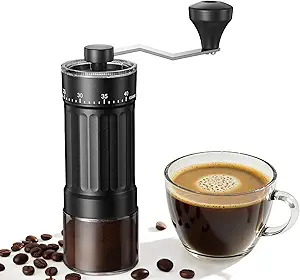 |
| Best Budget The cheapest option that still gets the job done reliably | Rsoilch Manual Coffee Grinder COGR001 |  |
| Top Rated A top-rated pick with lots of positive feedback | TIMEMORE Chestnut C3S Pro |  |
| Most Popular A crowd favorite that many people choose with confidence | JavaPresse Manual Coffee Grinder |  |
| Best Seller A high-volume bestseller chosen again and again | CEVING Manual Coffee Grinder MCG-02 | 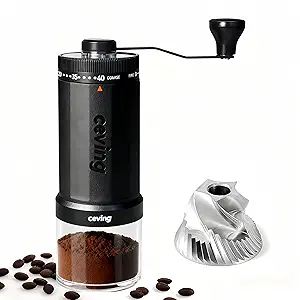 |
TIMEMORE Chestnut C2S

| Capacity | 0.25 kg |
|---|---|
| Material Type | Stainless Steel |
| Burr Size | 38 mm |
| Item Weight | 700 g |
The TIMEMORE Chestnut C2S is a compact, full-metal manual grinder built around a 38 mm CNC-cut stainless steel conical burr and a double-bearing central axis for steady, even grinding. It is designed for everyday brewing and travel, holding about 25 g of beans—enough for one to two cups—while the roughly 36-step adjustment lets you dial in grind size from coarse to fine for Moka pot brewing. The integrated metal body and upgraded top cover reduce fragility seen in prior models, and the built-in bearing gives a smooth turning feel that lowers hand fatigue during longer sessions. Cleaning is straightforward: the grinder disassembles for brushing and the stainless surfaces resist wear. Expect relatively small capacity and a manual workflow, so it is best when you value control and portability over speed or high-volume grinding. For Moka use the fine-to-medium range is reachable and consistent, but you will need multiple rotations for larger batches compared with an electric grinder.
Best for: Buyers who want a durable, precise manual grinder that balances daily home use and portability and who value grind control for Moka brewing.
Less Ideal for: People who need to grind large amounts quickly or prefer a fully automatic workflow should consider an electric grinder instead.
- Robust full-metal unibody improves durability versus plastic models.
- CNC-cut 38 mm stainless steel conical burrs deliver even particle size for consistent extraction.
- Double-bearing central axis and smooth handle reduce effort and improve grind uniformity.
- About 36 adjustable grind levels let you tune settings suitable for Moka pot brewing.
- Compact, travel-friendly form factor that is easy to disassemble and clean.
- Small 25 g capacity requires multiple fills for larger servings.
- Manual operation is slower than electric grinders for frequent or high-volume use.
Verdict: Choose the Chestnut C2S if you want a rugged, finely adjustable manual grinder that delivers consistent Moka-ready grounds in a compact, travel-friendly package.
1Zpresso K-Ultra Manual Grinder

| Burr material | Stainless steel |
|---|---|
| Burr size | 48mm |
| Adjustment | External dial, 100+ clicks |
| Catch cup capacity | 35–40 g |
| Power source | Manual |
The 1Zpresso K-Ultra is a high-performance hand grinder aimed at extract-driven brewing and fine dialing for espresso and moka pot use. It uses a 48mm stainless steel conical burr and an external adjustment dial with over 100 clicks at roughly 20 microns per click, so you can reliably move between fine espresso ranges and slightly coarser moka settings. The magnetic catch cup holds about 35 to 40 g of grounds and snaps on for faster workflow, while the foldable crank and included travel case make the unit easy to carry. Tool-free disassembly and the included cleaning brush speed maintenance, and the burrs are factory-calibrated to reduce wobble through long-term use. Expect a manual workflow that rewards patience: grinding for espresso or moka requires steady crank speed and can be slower than electric grinders, and the premium build and feature set place this grinder in the enthusiast price tier. For moka pot brewmasters who want precise, repeatable fine grinds without an electric grinder, the K-Ultra delivers consistent results and portable convenience.
Best for: Buyers who prize precise, repeatable fine grinds for moka pots and are willing to hand-crank for better control and portability.
Less Ideal for: People who prefer the speed and convenience of an electric grinder or who need to grind large daily volumes quickly.
- Large 48mm stainless steel conical burr for fast, consistent grinding at fine settings
- External micrometer-style adjustment with 100+ clicks for precise grind control
- Magnetic catch cup holds 35–40 g and speeds grounds collection
- Foldable handle and travel case make it genuinely portable
- Tool-free disassembly and included brush simplify cleaning and maintenance
- Manual operation is slower and requires physical effort compared with electric grinders
- Premium price positions it toward enthusiasts rather than casual moka users
Verdict: If you want precise, repeatable fine grinds for moka brewing and value build quality and portability, the K-Ultra is a top choice.
CEVING Mini Manual Coffee Grinder MCG-01

| Capacity | 30 g |
|---|---|
| Material Type | Ceramic |
| Power Source | manual winding |
| Adjustable Settings | 40 |
This compact hand grinder is built for travelers and everyday brewers who want consistent, adjustable grinds without electricity. It uses ceramic conical burrs and an external adjustment ring with 40 steps to dial in grind size for Moka pot, pour-over, French press, or espresso-adjacent fineness. The 30 g bean chamber fits a single brew, the three-piece design disassembles for basic cleaning, and the lightweight body makes it easy to pack for trips or use in small kitchens. Ceramic burrs tend to run cooler and are gentle on flavor, though they can be slightly slower than steel burrs and may wear differently over time. The manual winding action gives precise control but requires more effort than an electric grinder, which is expected for this class. Overall the grinder delivers targeted, consistent adjustments in a small, travel-friendly package, making it a practical choice when portability and grind control are top priorities.
Best for: Buyers who prioritize precise grind control and portability for single-cup or small-batch Moka brewing and need a compact, travel-ready grinder.
Less Ideal for: People who routinely grind for several servings, large Moka pots, or those who prefer the speed and convenience of an electric grinder.
- 40 external grind settings let you fine-tune particle size for Moka and other brew methods
- Ceramic conical burrs produce a uniform grind and generate less heat during grinding
- Compact, lightweight design is easy to carry for travel, camping, or small kitchens
- Simple three-part construction detaches for straightforward maintenance
- 30 g capacity is small for brewing multiple cups or larger Moka pots
- Manual cranking is slower and more labor-intensive than electric grinders
Verdict: A travel-friendly manual grinder that offers precise 40-step adjustments and ceramic burrs, making it a strong pick for portable Moka brewing when single-cup capacity and control matter.
Rsoilch Manual Coffee Grinder COGR001

| Material Type | Ceramic, Stainless Steel |
|---|---|
| Power Source | Manual |
| Number of Items | 1 |
This handheld grinder uses a ceramic burr and a stainless steel body to deliver a portable, durable way to grind beans for stovetop brews like Moka pots. It is adjusted via five grind settings so you can move from medium-fine for Moka to coarser grounds for other methods, and the manual crank makes it useful when traveling or when you want to avoid electric noise. The small footprint and removable parts make it easy to disassemble and rinse, and the included built components feel solid enough for daily use. Expect modest capacity and slower output compared with electric grinders, so plan extra time for multiple cups. For very fine, consistent espresso-level grinds the ceramic burr may be less uniform than higher-end conical steel grinders, but for Moka brewing this grinder gives good control and freshness at a low price point.
Best for: Buyers looking for an inexpensive, portable grinder to make fresh grounds for a Moka pot or other stovetop brews who value simplicity and travelability over high throughput.
Less Ideal for: People who need fast, large-batch grinding or the absolute most consistent ultra-fine grind for espresso should consider higher-end electric or premium manual grinders instead.
- Ceramic burr produces relatively consistent particle size for manual grinding
- Five adjustable grind settings to tune for Moka and other brew methods
- Compact, lightweight design that is easy to take camping or travel with
- Stainless steel construction offers durability and a solid feel
- Small capacity and slow manual operation is impractical for brewing many cups
- Ceramic burr can be less uniform than premium steel conical burrs for very fine grinds
Verdict: A budget-friendly, portable manual grinder that gives Moka pot users adjustable, freshly ground coffee without the need for electricity.
TIMEMORE Chestnut C3S Pro

| Capacity | 25 g |
|---|---|
| Item Weight | 430 g |
| Power Source | manual |
The TIMEMORE Chestnut C3S Pro is a portable manual grinder built around a full metal aluminum-alloy body and TIMEMORE's S2C660 conical steel burrs, designed to deliver consistent particle size for everyday brewing. You use it by adding up to a single-dose of beans to the 25 g hopper, setting the stepless grind adjustment to the desired coarseness, and turning the foldable crank; the double-bearing central axis and upgraded burrs make grinding smooth and require relatively little force. Its compact, integrated-metal construction resists cracking and helps dissipate heat during longer grinds, which preserves flavor for heat-sensitive methods like moka pot brewing. The 36-level-ish adjustment and precise burr geometry let you dial in a slightly finer setting than many pocket grinders, so you can reliably hit moka pot extraction ranges. Limits include the small 25 g capacity, which means multiple refills for larger servings, and the manual pace that may be slower than electric options for daily high-volume use.
Best for: Buyers who prioritize a reliable, durable hand grinder that produces consistent grinds for moka pot brewing and who value portability and build quality over high throughput.
Less Ideal for: Anyone who needs to grind large daily volumes quickly or prefers the convenience of an electric grinder should consider other options.
- All-metal aluminum alloy body for durability and better heat dissipation
- S2C660 patented steel conical burrs provide consistent, even grind size
- Double-bearing central axis and smooth crank reduce effort while grinding
- Foldable handle and compact form make it travel- and storage-friendly
- Small 25 g capacity requires repeated refills for multiple cups
- Manual grinding is slower than electric grinders for regular high-volume use
Verdict: Choose the Chestnut C3S Pro when you want a compact, factory-quality manual grinder that reliably produces consistent grinds suited to moka pot brewing.
JavaPresse Manual Coffee Grinder

| Material Type | Stainless Steel |
|---|---|
| Power Source | Manual |
| Included Components | Grinder |
| Recommended Uses For Product | Camping |
The JavaPresse Manual Coffee Grinder is a compact hand-crank burr grinder built for consistent, on-demand grinding when you want fresh coffee without the noise or power needs of an electric grinder. It uses a ceramic conical burr and an 18-step adjustable grind dial so you can dial in coarseness from fine to coarse for moka pots, espresso, pour over, or French press. The stainless steel body and compact form make it easy to pack for camping or travel, and the manual operation keeps grinding quiet and low-maintenance. In practice it produces even grounds for moka brewing when set to a slightly finer mid-range setting, though achieving perfectly uniform espresso-fine grinds takes patience and steady cranking. The grinder is lightweight and simple to disassemble for cleaning, and the ceramic burrs are marketed as long-lasting compared with steel. If you want a reliable, portable grinder with precise adjustment and minimal noise, this is a sensible choice; expect slower grind speed than electric models and a bit of hand effort for larger doses.
Best for: Buyers who value quiet, portable grinding and want precise manual control for moka pot brewing, especially those who prefer products proven by many users and backed by clear return/warranty policies.
Less Ideal for: People who need rapid, hands-free grinding for daily large batches or require consistently ultra-fine espresso-level precision without manual effort should consider an electric grinder instead.
- 18-step adjustable ceramic conical burr for precise grind control
- Quiet, cordless manual operation suitable for travel and camping
- Durable stainless steel construction that is easy to disassemble and clean
- Compact and lightweight design that packs easily
- Manual cranking is slower and requires effort for larger quantities
- Achieving ultra-fine, perfectly uniform espresso grinds is more difficult than with high-end electric grinders
Verdict: A compact, widely used manual burr grinder that gives reliable, adjustable grounds for moka pot brewing without noise or power.
CEVING Manual Coffee Grinder MCG-02

| Capacity | 60 g |
|---|---|
| Adjustable settings | 40 |
| Burr type | Stainless steel conical burr |
This CEVING manual grinder is built for people who want precise, repeatable grinds away from the kitchen. It holds up to 60 g of beans so you can grind a full moka pot dose in one go, and its external click-ring gives 40 clearly defined settings for dialing in from fine moka and espresso-adjacent grinds up to coarse for French press. CNC stainless steel conical burrs produce consistent particle size and faster throughput than cheaper blades, and the external adjustment avoids disassembly when you change grind size. The unit is compact and light enough for travel or camping while still feeling solid in hand. Expect some arm work compared with electric grinders, and if you need ultra-fast grinding for large household volumes an electric model will be quicker, but for stovetop moka use this grinder balances capacity, control, and portability very well.
Best for: Buyers who prioritize reliable, repeatable grind control for stovetop moka brewing and want a portable, factory-quality manual grinder they can use at home or on the road.
Less Ideal for: People who need hands-free, high-volume grinding every day or who prefer instant electric convenience should choose an electric grinder instead.
- 60 g capacity lets you grind a full moka pot dose in one session
- 40 external click-settings allow precise, repeatable adjustments for moka-range grinds
- CNC stainless steel conical burrs deliver uniform particle size and faster grinding than blade units
- Portable, lightweight design suitable for travel, camping, and small kitchens
- Manual operation requires physical effort and is slower than electric grinders
- Not ideal for very large daily volumes due to hand-grinding fatigue
Verdict: If you want a travel-friendly manual grinder that reliably delivers moka-appropriate, repeatable grinds with a single 60 g fill, this CEVING model is a strong pick.
Choosing the Right Manual Coffee Grinder for Moka: Key Factors to Consider
Grind Range and Steadiness
A grinder must reach the medium-fine setting Moka pots need without producing large clumps of fines or excessive coarse particles. Steadiness matters because uneven particle size will overextract some grounds and underextract others, producing bitter or thin cups.
Look for units with a proven burr geometry and an adjustment mechanism that holds its setting between sessions. If you make single-serve Moka brews, the grinder should be able to produce accurate small doses while maintaining the same particle distribution as larger doses.
Adjustment Mechanism
The quality of the adjustment system governs how precisely you can dial in the grind. Micro-adjustability lets you tune for slight changes in bean roast, age, or the specific Moka pot size you own. Coarse click stops are fine for general use but may be limiting if you chase exact extraction balance.
Consider whether the mechanism has clear markings, a detent or click system, and resistance that prevents accidental movement when grinding or packing your portafilter.
Burr Type and Material
Burrs determine how consistently beans are fractured. Conical steel burrs are common in manual grinders because they balance durability and sharpness, while ceramic burrs stay sharper longer but can be more brittle. The burr material affects heat transfer, wear rate, and the maintenance cycle.
For Moka brewing, burrs that maintain edge sharpness and produce minimal dust at the medium-fine setting help deliver cleaner cups and reduce the need for repeated adjustments.
Capacity and Dose Control
Manual grinders vary from single-dose, pocket-friendly designs to larger-hopper models that hold multiple brew doses. If you typically prepare one or two cups, a small, single-dose grinder reduces retention and speeds up rinsing between roasts. Larger-capacity models save time when brewing for multiple people but may hold more residual grounds.
Dose control also ties into how easy it is to reproduce grind settings. If you value repeatability, choose a grinder with clear physical stops or an indexed ring so you can return to a preferred setting quickly.
Ergonomics and Speed
How a grinder feels during use influences whether you will actually reach for it daily. Handle length, crank shape, and resistance under load affect perceived speed and fatigue. Long handles give better leverage and faster turning, while compact designs can be slower but more portable.
Speed matters less for single-cup Moka users and more when preparing several pots. Also consider how the grinder performs when pushing small doses repeatedly, and whether the turning action stays smooth as the burrs warm slightly during extended use.
Cleaning, Retention, and Maintenance
A grinder that is easy to disassemble and clean reduces flavor carryover between different beans. Look for designs with simple burr removal and few tiny crevices where grounds collect. Retention—the amount of coffee left trapped in the mechanism—affects freshness and dose accuracy.
Regular maintenance includes occasional deep cleaning of the burrs and housing. If you plan to travel with the grinder, consider how quickly you can reassemble it without tools and whether spare parts are straightforward to replace.
Why Moka Pots Need Medium-Fine Consistency
Moka pots extract under pressure generated by steam and hot water, which means the brew sits between filtered drip and espresso in terms of extraction dynamics. That makes particle size and uniformity especially important because uneven grounds produce a mix of underextracted sour notes and overextracted bitterness.
A manual grinder tuned for this style will help you reach a narrow window of particle sizes that yields balanced sweetness and body. Consistent results reduce the need to compensate with water temperature and tamping adjustments.
- Medium-fine target yields fuller body without harshness
- Uniform particles help avoid channeling and quick overextraction
- Repeatable settings let you adapt to roast level and bean age
Single-Dose Vs. Bulk Grinding for Moka
Single-dose grinders minimize retention and allow you to grind only what you need for each brew. This is useful for tasting different beans or preserving freshness. They typically require measuring and a steady hand but produce less stale residue between sessions.
Bulk-capacity grinders are faster when you prepare multiple pots in a row. They hold more ground coffee, which speeds workflow, but they also increase retention and can mix old and fresh grounds if you do not purge the chamber between grinds.
- Single-dose: less retention, better freshness, slower sessions
- Bulk: faster for multiple servings, higher retention risk
Travel and Portability Considerations
Many Moka users enjoy taking a compact manual grinder on trips or to the office. When traveling, weigh portability against grinding speed and durability. Lightweight materials reduce carry weight but may compromise long-term robustness.
Look for grinders with secure locking mechanisms and low-profile handles that stow easily. A model that disassembles without tools can be rinsed quickly after travel and reassembled before use.
- Stowable handles and low weight improve portability
- Secure adjustment and burr retention prevent mess in luggage
- Easy disassembly helps post-trip cleaning
How Roast Level Affects Grind Choice
Darker roasts are more brittle and will produce more fines at the same burr setting than lighter roasts. If you switch roast levels, you may need to coarsen the grinder slightly for a dark roast and tighten it for a lighter roast to maintain the same perceived extraction.
A grinder with fine adjustment steps reduces the need for large re-tuning when you change beans. Keep a log of settings against roast and bean age so you can return to a familiar baseline quickly.
- Dark roasts often need coarser clicks to avoid excess fines
- Light roasts may require tighter settings for adequate extraction
- Record preferred settings for common beans to speed setup
Maintaining a Consistent Routine
Consistency in dose, grind setting, and brewing temperature beats occasional tinkering. Use the same measurement method for dose and keep water temperature steady to isolate grind changes as the main variable. Over time this approach makes it easier to identify whether flavor shifts come from the grinder, beans, or brewing technique.
Simple habits such as purging a small amount of grounds before brewing and rinsing the brew chamber between sessions reduce carryover and keep extraction predictable.
- Weigh doses or use a repeatable scoop for accuracy
- Purge residual grounds to eliminate old fines
- Keep a small notebook of grind-setting notes for each bean
How We Chose the Best Manual Coffee Grinder for Moka
We selected grinders that reliably deliver the medium-fine grind and particle uniformity Moka brewing requires. Evaluation centered on grind consistency across the range, the precision and detent of the adjustment mechanism, and the ability to hold a repeatable setting for multiple short brewing sessions. Build quality and materials were weighed to predict durability with daily use and occasional travel. Usability factors included grind speed for small doses, handle ergonomics, noise level, and how quickly the device can be disassembled and cleaned. We also considered portability and storage footprint for countertop and travel use. Excluded from consideration were electric grinders and manual units that cannot achieve a steady medium-fine setting appropriate for Moka. We also filtered out designs with poor adjustment control or fragile parts that tend to degrade with repeated tuning. The final picks balance precision, durability, and practical use-case features important to Moka brewers.
Our full evaluation process is outlined in our review methodology.
FAQ
Can a manual grinder achieve true espresso fineness for Moka?
Manual grinders can reach a medium-fine range suitable for Moka, which is generally coarser than true espresso. Many manual burrs will not produce the extreme fine uniformity of high-end electric espresso grinders, but they can be tuned to deliver consistent results for stovetop extraction.
How often should I clean a manual grinder used for Moka?
Clean the grinder's burrs and chamber every few weeks with a quick brush if you use it daily, and perform a deeper disassembly and wash every month or as needed. Frequency depends on roast oiliness and how often you switch beans.
Does grind retention affect Moka brewing?
Yes. Retained grounds can stale and mix with fresh doses, altering flavor and dose accuracy. Low-retention, single-dose designs are preferable if you change beans often or care about maximum freshness.
Is a longer handle always better for hand grinding?
Longer handles provide greater leverage and can reduce effort, making grinding faster. However, they add bulk and can be inconvenient for storage or travel. Choose based on how often you grind multiple doses in one session.
Will ceramic burrs or steel burrs be better for Moka?
Both work well. Steel burrs tend to be more durable under impact and are common in manual units. Ceramic burrs stay sharper longer but can chip if dropped. Consider your routine and handling when choosing burr material.
Final Verdict
For Moka brewing prioritize a grinder that produces a steady medium-fine particle distribution, offers precise adjustments, and is simple to clean. Decide whether single-dose portability or larger capacity fits your routine, and weigh ergonomics and burr material against long-term durability. By focusing on grind consistency, adjustment control, and ease of maintenance you can pick a manual grinder that reliably improves your stovetop cups.