
Note: This article contains affiliate links. If you click on these links and make a purchase, we may earn a small commission at no extra cost to you. This helps support our research and content. Read our full affiliate disclosure here.
If you brew pour-over coffee, the grinder you use is as important as your kettle or filter. A manual coffee grinder for pour over gives you control over grind size and consistency without relying on electricity, letting you dial in extraction for cleaner flavor and better clarity in the cup. The right hand grinder reduces fines, holds a predictable setting, and is durable enough to survive daily use or travel. This guide shortlists the top manual coffee grinders suited for pour-over brewing. Each pick was evaluated for grind consistency, adjustment precision, build quality, and practical usability so you can pick a grinder that fits your workflow and budget. Read on for the criteria we used and the factors to weigh before you buy.
Top Picks at a Glance
| Best Overall The best all-around choice for most situations | TIMEMORE C5 ESP Pro Grinder | 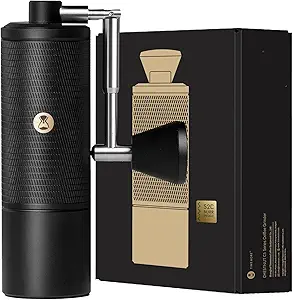 |
| Best Quality Built to a higher standard if you want something more solid | 1Zpresso J Manual Coffee Grinder |  |
| Best Value The sweet spot between price and what you get | Hario Mini-Slim Plus Grinder |  |
| Best Budget The cheapest option that still gets the job done reliably | PARACITY Manual Coffee Grinder |  |
| Top Rated A top-rated pick with lots of positive feedback | TIMEMORE Chestnut C3S Pro |  |
| Most Popular A crowd favorite that many people choose with confidence | JavaPresse Manual Coffee Grinder |  |
| Best Seller A high-volume bestseller chosen again and again | CEVING Manual Coffee Grinder MCG-02 | 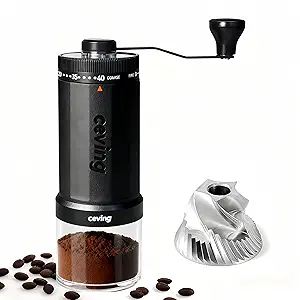 |
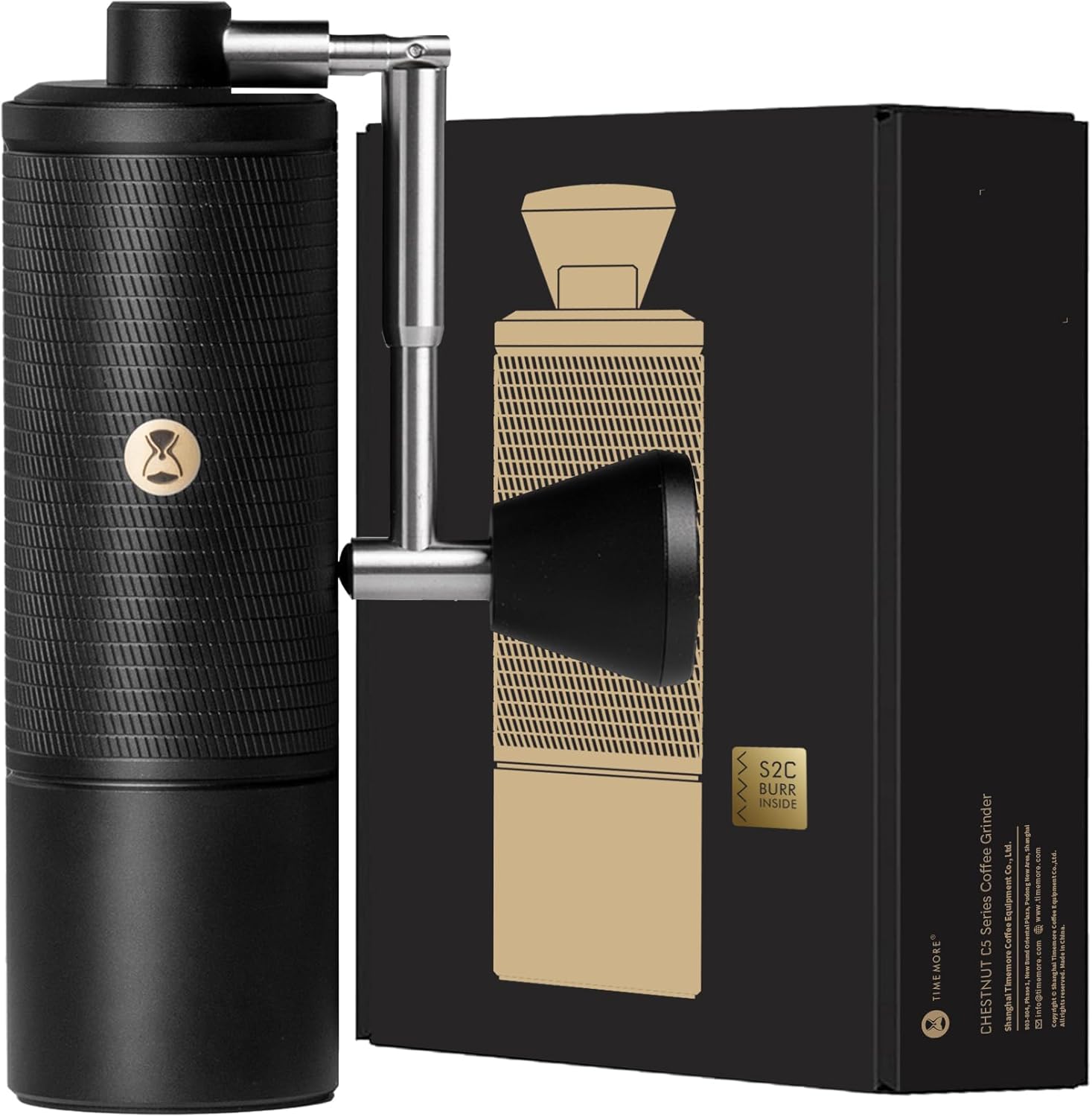
TIMEMORE C5 ESP Pro Grinder
| Burr type | S2C-042-III conical stainless steel |
|---|---|
| Burr size | 42 mm |
| Adjustment accuracy | 0.015 mm per click |
| Capacity | 25 g |
| Material | Aluminum body |
The TIMEMORE C5 ESP Pro is a hand grinder built for precision and portability, using 42mm S2C-042-III conical burrs and a fine 0.015mm-per-click adjustment to dial in grind size from fine to coarse. It is typically used for daily brewing and travel, letting you move between pour over and espresso settings by making very small adjustments to the grind. The one-piece metal body, double-bearing central axis, and enlarged burrs deliver consistent, uniform grounds with relatively low effort thanks to a smooth, lightly weighted handle that folds for transport. Practical benefits include a 25 g capacity suited to single-serve grinding, easy disassembly for brush cleaning, and a compact shape that fits small kitchens or bags. Limits to consider are the manual labor required for larger batches and the modest capacity if you brew for multiple people, plus the expected learning curve to find exact settings for specific pour over recipes. The grinder favors users who value control and build quality over speed or high-capacity convenience.
Best for: A user who wants a high-quality, portable manual grinder that offers precise control for pour over and espresso-style brewing and prioritizes consistent particle size and build quality.
Less Ideal for: People who regularly grind large quantities for multiple cups or who need a fast electric grinder for back-to-back brewing sessions should consider higher-capacity or electric options instead.
- Large 42mm stainless steel conical burrs for efficient, uniform grinding
- Very fine 0.015mm adjustment pitch for precise grind dialing
- All-metal CNC-machined body and double-bearing axis for durability and smooth rotation
- Foldable handle and compact profile make it portable for travel and small kitchens
- 25 g capacity limits batch size for multi-cup brewing
- Manual operation is slower than electric grinders for larger quantities
Verdict: Choose the C5 ESP Pro if you want a durable, travel-friendly manual grinder that gives exceptionally fine, repeatable grind control for pour over and espresso.
1Zpresso J Manual Coffee Grinder

| Burr size | 48mm stainless steel conical |
|---|---|
| Adjustment | 30 clicks per rotation (internal) |
| Capacity | 35 g |
The 1Zpresso J is a hand-operated burr grinder built around a 48mm stainless steel conical burr and an internal adjustment system that offers 30 clicks per rotation for fine control. It is primarily designed for pour-over but works across pour-over, French press, and similar methods; the larger burr and calibrated alignment deliver uniform grounds with less effort than many smaller manual grinders. The foldable crank and compact body make it easy to store or take on trips, and tool-free disassembly plus a included cleaning brush simplify maintenance. Capacity is modest, so it is best for single-cup to small-batch routines rather than large groups. The grinder is factory-calibrated for stability and rated for long lifespan, which should suit daily use by brew-focused drinkers; buyers should expect the physical effort of hand grinding and the time required compared with an electric grinder.
Best for: Buyers who prioritize grind consistency and control for pour-over and single-cup brewing and who are comfortable with manual grinding as part of the ritual.
Less Ideal for: People who need to grind large quantities quickly, prefer fully automatic operation, or frequently brew for groups of several people.
- Large 48mm stainless steel conical burr for consistent, efficient grinding
- 30-click internal adjustment provides precise, repeatable grind settings for pour-over
- Tool-free disassembly and included brush make cleaning quick and thorough
- Foldable crank and compact form factor for easy storage and travel
- Factory calibration and sturdy construction aimed at long service life
- 35 g capacity is small for group brewing or multiple cups
- Hand grinding requires physical effort and more time than an electric grinder
Verdict: Choose the 1Zpresso J if you want a travel-friendly manual grinder that delivers precise, consistent pour-over-ready grounds without spending on a motorized unit.
Hario Mini-Slim Plus Grinder

| Capacity | 13.34 g |
|---|---|
| Material Type | Stainless Steel |
| Included Components | 1 coffee grinder |
The Hario Mini-Slim Plus is a slim, lightweight manual grinder built around ceramic conical burrs that produce a consistent, uniform grind for pour-over brewing. You crank the ergonomic removable handle to grind small batches and can adjust the burr gap for different coarseness settings, which makes it useful for dialing in pour-over recipes. Its compact profile and detachable handle make it easy to pack for travel or tuck away in a kitchen drawer, while the ceramic burrs run cooler and reduce heat transfer compared with blade grinders. Practical limitations are its small capacity and slower grind speed—it is best for single cups or two servings rather than large batch grinding—and the compact hopper and portafilter-style output require more frequent refilling when brewing multiple cups. For buyers prioritizing reliable, portable manual grinding for pour-over, the Mini-Slim Plus delivers predictable grind quality in a pocket-friendly package.
Best for: Buyers who want a compact, reliable manual grinder to optimize single-cup pour-over routines and value portability and consistent grind quality.
Less Ideal for: People who regularly brew larger volumes, need very fast grinding, or prefer a hands-off electric grinder for daily use should consider other options.
- Ceramic conical burrs deliver even, low-heat grinding suited to pour-over extraction.
- Compact, lightweight design with detachable handle for easy travel and storage.
- Adjustable grind setting allows tuning for different pour-over grind sizes.
- Small 13–24 g capacity requires multiple refills for more than one or two cups.
- Hand grinding is slower and requires effort compared with electric grinders.
Verdict: A travel-friendly manual grinder that gives precise, low-heat burr grinding for pour-over fans who prioritize portability and consistent single-cup results.
PARACITY Manual Coffee Grinder

| Capacity | 1.4 pounds |
|---|---|
| Material Type | Stainless Steel |
| Power Source | Manual |
The PARACITY manual coffee grinder is a budget-friendly hand grinder built around a ceramic burr and a long stainless steel crank to make small-batch grinding quiet and low-effort. It is typically used for pour over, drip, French press, espresso-adjacent fine settings, and even coarser Turkish styles thanks to an adjustable grind control. The package includes two clear glass jars with silicone lids and a nonslip silicone base so you can grind directly into storage jars and take it on the go. Because it is manual and battery-free it is quiet and portable, and the removable construction makes it easy to disassemble for cleaning. Expect consistent, moderately uniform grinds for daily pour over, though a hand grinder of this price and size will be slower for large volumes and less precise than higher-end compact models. The glass parts are practical for visibility but require careful handling. For someone prioritizing low cost, simplicity, and portability, this grinder covers the basics well.
Best for: Buyers who want an inexpensive, portable grinder for single-cup or small-batch pour over that is simple to use and easy to clean.
Less Ideal for: Those who regularly grind large volumes, need rapid throughput, or want the most precise, consistent grind for specialty espresso should look at higher-end compact or electric grinders.
- Ceramic burr provides uniform grind and reduces heat build-up compared with blade grinders.
- Adjustable grind control lets you dial in coarse to fine settings for pour over, drip, and more.
- Includes two clear glass jars with silicone lids for grinding directly into storage or transport.
- Manual crank and no power source make it quiet, portable, and useful for travel or camping.
- Removable parts are washable for straightforward maintenance.
- Glass jars increase fragility and require careful handling.
- Slower to grind larger quantities compared with electric grinders.
Verdict: A low-cost, portable ceramic-burr grinder that gives reliable small-batch pour-over grinds for budget-minded coffee drinkers.
TIMEMORE Chestnut C3S Pro

| Capacity | 25 g |
|---|---|
| Power Source | manual |
| Item Weight | 430 g |
The TIMEMORE Chestnut C3S Pro is a hand coffee grinder built around a CNC-machined aluminum body and patent S2C conical steel burrs to deliver even, repeatable grinds for pour-over brewing. You use it by loading up to the small bean hopper, folding the crank and turning the handle; internal double bearings and a smooth shaft reduce wrist effort so you can grind a 25 g dose with little strain. Notable features include the full-metal integrated body for durability, S2C660 steel burrs for uniform particle size, roughly 36-step stepless adjustment for dialing in grind size, and a foldable handle for travel or compact storage. In practice it produces a clean, consistent medium-to-fine grind suited to pour-over and is easy to disassemble for cleaning. The main limitations are its small 25 g capacity, which means multiple batches for larger servings, and the manual pace compared with electric grinders, which may be slower for daily high-volume use.
Best for: Buyers who prioritize a durable, consistently performing manual grinder for pour-over and want a tool that feels solid and reliable in daily use.
Less Ideal for: Those who need to grind large quantities quickly or prefer the speed and convenience of an electric grinder should consider other options.
- All-metal aluminum body improves durability and resists cracking.
- S2C patent conical steel burrs deliver consistent particle size for clean pour-over extraction.
- Double bearing central axis and smooth shaft reduce hand effort during grinding.
- Stepless 36-level grind adjustment lets you fine-tune coarseness for different pour-over recipes.
- Foldable handle and compact form make it easy to pack for travel or store in small kitchens.
- Small 25 g capacity requires repeated batches for more than one cup.
- Manual grinding is slower than electric options for high-volume daily use.
Verdict: Choose the Chestnut C3S Pro when you want a rugged, factory-quality manual grinder that consistently produces pour-over-ready grinds and stands up to regular use.
JavaPresse Manual Coffee Grinder

| Power Source | Manual |
|---|---|
| Material Type | Stainless Steel |
| Included Components | Grinder |
The JavaPresse Manual Coffee Grinder is a handheld conical burr grinder designed for consistent, adjustable grinding without electricity. You set the grind with an 18-step adjustable ceramic burr and turn the hand crank to produce grounds suited to pour over, drip, French press, or espresso prep. Its ceramic burr claims greater longevity than steel alternatives and the manual operation is very quiet, which makes it convenient for early-morning routines or travel and camping. The stainless steel frame and compact shape are sturdy and easy to pack, and the grinder collects grounds in a small receptacle that is simple to empty. Because it is manual, expect slower throughput than an electric grinder and you will need to steady the unit while turning; very fine espresso grind requires more effort. For pour over use the grinder gives reliable, repeatable control over coarseness, helping improve extraction compared with preground beans.
Best for: Buyers who prioritize quiet, portable grinding and want precise control for pour over brewing while valuing social proof from a well-reviewed, established manual grinder.
Less Ideal for: Anyone who needs to grind large volumes quickly or who prefers automatic, one-button convenience should choose an electric grinder instead.
- 18-step adjustable ceramic conical burr for precise control over grind size
- Manual operation is quiet and does not require batteries or power
- Compact stainless steel build that is durable and travel-friendly
- Ceramic burr designed for long lifespan compared with typical steel burrs
- Manual grinding is slower than electric grinders, especially for fine grinds
- Small grounds receptacle means frequent emptying for multiple cups
Verdict: Choose this grinder if you want a well-reviewed, portable manual burr grinder that gives precise, quiet control ideal for pour over brewing.
CEVING Manual Coffee Grinder MCG-02

| Capacity | 60 g |
|---|---|
| Adjustable settings | 40 |
| Burr material | Stainless steel conical burrs |
| Item weight | 0.5 kg |
The CEVING MCG-02 is a travel-capable manual grinder built around a large 60 g bean hopper and CNC stainless steel conical burrs, intended to deliver consistent grinds for pour over and other brew methods. You set grind size with an external click-ring offering 40 indexed settings, which makes switching from medium-fine pour over to coarser drip or French press straightforward and repeatable. The 60 g capacity means you can grind enough for multiple cups in one session without refilling, useful for mornings or small groups. Its metal burrs and CNC construction promise durable, uniform particle size and reasonably fast hand-grinding compared with ceramic alternatives. Because it is manual, it is quiet, cordless, and highly portable for camping or travel, though hand effort is required for larger doses. There is no electric assist or integrated scale, so users who want zero manual work or instant micro-adjustments will prefer a powered grinder. For pour over brewers this grinder provides precise, repeatable settings and a hearty capacity that reduces interruptions during brewing prep.
Best for: Buyers who prioritize precise, repeatable grind control for pour over and want a robust, travel-ready manual grinder with enough capacity to grind multiple cups at once.
Less Ideal for: If you need one-touch, electric grinding for daily large-volume use or want integrated weighing and timed dosing, a powered grinder would be a better choice.
- Large 60 g hopper reduces refill frequency for multi-cup brewing
- 40 external indexed settings make grind changes quick and repeatable
- CNC stainless steel conical burrs for consistent particle size and durability
- Portable, cordless design suited to travel and quiet use
- Manual operation requires sustained hand effort for larger doses
- No built-in scale or motorized assistance for fully hands-off grinding
Verdict: A high-capacity, precision manual grinder that gives pour-over brewers repeatable, barista-style grind control while remaining portable and durable.
Choosing the Right Manual Coffee Grinder for Pour Over: Key Factors to Consider
Grind Consistency Across Brew Range
Consistent particle size is the most important factor for pour-over coffee because it directly affects extraction balance. A grinder that produces a narrow distribution of particle sizes reduces overextraction and underextraction pockets, resulting in a cleaner cup and clearer flavor notes. When evaluating grinders look for burr geometries and tolerances that target the medium-fine to medium-coarse range used by pour-over methods.
A grinder that performs well at multiple settings is valuable if you switch between filter sizes, brew ratios, or roast levels. Expect to adjust grind size for different beans; consistent stepping and minimal shift in the grind profile across settings help maintain predictable brewing results.
Adjustment Precision and Repeatability
Precise, repeatable adjustments let you home in on the ideal setting for a specific bean and recipe. Click stops or numeric scales are useful but not required; what matters is that the mechanism holds its position and returns to the same setting after disassembly or travel. Finer adjustment range is beneficial when dialing in medium-fine pours where a fraction of a notch can change extraction noticeably.
Consider how easy it is to mark and recall settings. Some grinders use stepped clicks, others micro-adjust threads. Both can work well, but the one you prefer depends on whether you value quick coarse changes or very small incremental tweaks.
Burr Material and Geometry
Burr material and cutting geometry govern how beans are fractured. Steel burrs tend to be durable and provide sharp cutting edges that maintain performance over time. Ceramic burrs can offer longevity and heat resistance but may be more brittle. The grind shape produced by the burr geometry affects how many fines are created and how even the particle distribution is.
For pour-over, choose burrs that prioritize a clean split with fewer fines. Conical and some flat burr designs excel at producing an even medium grind when properly engineered. Also consider whether replacement burrs are available and how easy they are to service.
Capacity and Practical Throughput
Capacity matters depending on how many cups you brew at once. A very small hopper or catch cup may be fine for single-cup brewing but becomes tedious for multiple servings. Throughput is also important; some hand grinders take considerably longer to grind higher doses, which affects morning routines.
Evaluate the tradeoff between compact size and usable capacity. If you often brew two or more cups, look for grinders with sufficient internal capacity and a handle design that allows efficient leverage to reduce crank time.
Ergonomics and Handling
Manual grinding is a physical task, so ergonomics influence comfort and consistency. An ergonomic crank and handle reduce wrist fatigue, and a stable base or non-slip footprint helps keep the grinder steady while you rotate. Weight distribution and how the grinder disassembles for refilling or cleaning affect the overall user experience.
Consider the grip on the hopper and catch cup, the length and shape of the crank arm, and whether the unit locks securely during use. These practical design details can make the difference between a grinder you enjoy using and one you avoid.
Ease of Cleaning and Maintenance
Coffee oils and fine particles build up over time and can alter flavor. A grinder that disassembles easily and exposes the burrs simplifies cleaning. Look for units with accessible burr retention systems and components that do not require specialized tools to service.
Maintenance considerations also include how easy it is to replace worn parts and whether the design prevents excessive retention of grounds. Low-retention designs reduce the need for frequent deep cleans and keep flavor consistent between grinds.
Why Manual Grinders Work Well For Pour Over
Hand grinders give you tactile control over grind speed and heat generation, which helps preserve delicate flavor compounds. Because you control the rate of grinding, manual mills often run cooler than fast electric burrs, reducing the risk of heat transfer that can affect aroma.
The mechanical simplicity of many manual grinders also means fewer electronic parts to fail and often easier field service. For pour-over brewing, where clarity and subtlety are prized, the tradeoff of physical effort for improved control is a benefit many brewers accept.
- Lower heat buildup preserves volatile aromatics
- Often simpler to disassemble and clean
- Compact and portable for travel or small kitchens
Setting Up Your Grind For Different Pour-Over Drippers
Different drippers favor different grind ranges. A flat-bottom dripper usually works well with a medium grind, while a conical dripper often performs best with a slightly finer setting. Start with a baseline medium grind and adjust by small increments, tasting the result and noting extraction time and flavor balance.
If you switch between drippers, mark preferred settings or use a consistent dosing routine so you can reproduce results. Keep water temperature, coffee dose, and pour technique constant while you test grind changes to isolate the effect of grind size.
- Flat-bottom dripper: medium grind for balanced extraction
- Conical dripper: slightly finer for clarity and sweetness
- Make incremental adjustments and record settings
Grinding Technique and Workflow Tips
Secure the grinder on a steady surface and use long, smooth strokes with the crank to reduce wrist strain. For larger doses, shorter bursts with a rest period can prevent your wrist from tiring and keeps the motion steady.
Grind directly into the brew basket or into a catch cup if your workflow requires transferring grounds. Tapping the catch cup gently before weighing helps settle grounds and provides a more reliable dose. If retention is a concern, perform a quick purge grind of a few grams to clear the burr path.
- Use steady, even strokes to avoid inconsistent particle size
- Weigh doses to maintain repeatability
- Purge a small amount if the grinder retains grounds
Maintaining Your Manual Grinder
Regular cleaning keeps flavors consistent. Disassemble the burrs as recommended and remove trapped fines with a brush. Avoid soaking metal parts unless the manufacturer instructions allow it; instead use a dry or lightly damp cloth for the exterior.
Inspect burrs periodically for wear or chipping and replace them when performance degrades. Lubricate any moving parts only if specified. Proper storage in a dry environment prevents rust or corrosion on steel components.
- Brush burrs and interior monthly for moderate use
- Check for burr wear after extensive grinding
- Store in a dry place to prevent corrosion
Travel and Small-Kitchen Considerations
If you plan to use a manual grinder away from home, prioritize compact dimensions, a secure locking mechanism, and a handle that collapses or detaches. Smaller grinders typically have lower capacity but are easier to pack, while larger hand mills offer better throughput but take more space.
Look for designs that minimize loose parts and retain settings during transport. A low-retention design reduces the mess risk in luggage or a backpack, and a sturdy travel case can protect delicate components.
- Choose compact models with detachable cranks for travel
- Secure adjustment settings to prevent movement in transit
- Consider capacity vs portability based on typical brew volume
How We Chose the Best Manual Coffee Grinder for Pour Over
We focused on attributes that directly affect pour-over extraction and everyday usability. Primary evaluation criteria included grind consistency across the pour-over range, the precision and repeatability of the adjustment mechanism, and burr material and design because these determine particle uniformity and flavor clarity. We also weighed build quality and ergonomics to ensure the grinder is comfortable for routine use, and measured capacity and portability for users who brew multiple cups or travel. Noise level and ease of cleaning were considered where relevant, since both affect daily maintenance and convenience. Products were excluded if they lacked a reliable grind adjustment, used poor burr geometries, or were clearly intended only for espresso or coarse brewing. We screened for units that offered stable settings across multiple uses and that were constructed with parts that tolerate regular disassembly. The final list reflects grinders that balance precision, durability, and user-friendly design for pour-over brewing.
Our full evaluation process is outlined in our review methodology.
FAQ
How fine should I set a manual grinder for pour-over?
It usually depends on your dripper and coffee. Start with a medium setting and adjust finer if the coffee tastes sour or faster than expected, and coarser if it tastes bitter or extracts slowly.
Can a manual grinder produce a consistent grind for multiple cups?
Yes. Many manual grinders maintain consistency across larger doses, but throughput and crank time vary. Choose a model with adequate capacity and comfortable ergonomics if you brew multiple cups regularly.
How often should I clean the burrs on a hand grinder?
For regular home use clean the burrs and interior every few weeks to monthly, depending on how often you grind. Frequent cleaning prevents oil buildup that can alter flavor and mechanical performance.
Do ceramic burrs or steel burrs work better for pour-over?
Both work well. Steel burrs are durable and hold sharp edges, while ceramic burrs resist heat and can last long but may be more brittle. The specific geometry and manufacturing tolerance often have a bigger impact than material alone.
Will manual grinding change my brew time compared with an electric grinder?
Manual grinding itself does not change extraction if grind size and dose are the same, but the time it takes to grind larger doses can affect your brewing routine. Consistency in grind size is the key factor for brew time and extraction.
Final Verdict
When choosing a manual coffee grinder for pour over, prioritize grind consistency and an adjustment mechanism that lets you reproduce settings reliably. Decide whether you value compact portability or higher capacity and faster throughput for multi-cup brewing. Consider burr material, ease of cleaning, and ergonomics to ensure the grinder fits your daily routine. Balance tradeoffs between precision and convenience: a highly adjustable grinder may take more time to operate but deliver finer control over extraction, while a simpler design can speed up your morning. Focus on the factors that affect cup clarity and repeatability to choose a grinder that helps you brew better pour-over coffee confidently.