
Note: This article contains affiliate links. If you click on these links and make a purchase, we may earn a small commission at no extra cost to you. This helps support our research and content. Read our full affiliate disclosure here.
Picking the right manual coffee grinder with ceramic burrs matters because grind consistency and burr durability directly affect extraction and flavor. Whether you brew with pour-over, AeroPress, or a French press, a steady, adjustable grind makes it easier to dial in taste without electric noise or power needs. This guide covers a curated shortlist of seven top manual grinders with ceramic burrs chosen for consistent particle size, durable construction, and user-friendly adjustment. Below you will find a concise evaluation of each grinder and the criteria we used to judge them, so you can match a model to your brewing routine and precision needs.
Top Picks at a Glance
| Best Overall The best all-around choice for most situations | CEVING Manual Coffee Grinder MCG-MEGA-60 |  |
| Best Quality Built to a higher standard if you want something more solid | Hario Mini Mill Slim MSS-1B |  |
| Best Value The sweet spot between price and what you get | HZBSGZR Hand Coffee Grinder |  |
| Best Budget The cheapest option that still gets the job done reliably | Rsoilch Manual Coffee Grinder HS-011 |  |
| Top Rated A top-rated pick with lots of positive feedback | Hario Skerton Pro Coffee Mill |  |
| Most Popular A crowd favorite that many people choose with confidence | LHS Manual Coffee Grinder |  |
| Best Seller A high-volume bestseller chosen again and again | CEVING Mini Manual Coffee Grinder MCG-01 | 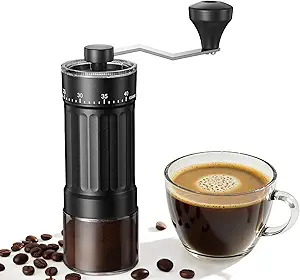 |
CEVING Manual Coffee Grinder MCG-MEGA-60

| Capacity | 60 g |
|---|---|
| Adjustments | 40 external settings |
| Burr type | Ceramic conical burr |
| Power source | manual winding |
The CEVING MCG-MEGA-60 is a portable hand grinder built for larger single-brew batches and precise grind control. It accepts up to 60 g of beans so you can grind enough for French press, pour-over, or cold brew in a single session, and the external click-ring gives 40 discrete settings that let you move quickly between espresso-fine and coarse grinds. The ceramic conical burrs produce consistent particles while limiting heat and preserving oils, and the manual winding design makes it quiet and usable anywhere without power. In practice it is handy for travel, camping, or a small kitchen where countertop grinders are impractical, and the larger capacity reduces the need for repeat grinding when making multiple cups. Expect the usual manual trade-offs: you need to hand-crank for each batch and it is slower than electric grinders, and very fine espresso-level grinding will take more effort. Still, for buyers who want portable, accurate ceramic-burr performance and larger batch capacity in a manual unit, this grinder delivers useful real-world benefits.
Best for: Buyers who want a portable manual grinder that balances larger batch capacity with precise, repeatable grind control for everyday brewing and travel.
Less Ideal for: People who need fast, hands-free grinding for frequent espresso shots or high-volume brewing should choose an electric grinder instead.
- Large 60 g capacity lets you grind enough beans for multiple cups in one session
- External 40-step adjustment ring provides quick, repeatable grind changes
- Ceramic conical burrs reduce heat and preserve coffee oils for cleaner flavor
- Portable, manual design works without electricity and stays quiet
- Manual cranking is slower and more effortful than electric grinders
- Very fine espresso grinds require significant hand effort to reach
Verdict: Choose this grinder if you want a portable ceramic-burr hand mill that grinds larger single batches with precise, easy-to-change settings.
Hario Mini Mill Slim MSS-1B

| Capacity | 2 cups |
|---|---|
| Material Type | Ceramic |
| Power Source | Manual |
The Hario Mini Mill Slim is a hand coffee grinder built around a ceramic burr that delivers consistent, rust-free grinding for fresh coffee at home. You adjust grind size with the knob and watch dose through the transparent glass jar, which doubles as the collection container. Its slim profile and removable handle make it easy to store and take on trips, while disassemblable parts simplify cleaning. Because it is manual, it is best used for single-serve or small-batch brewing where hand-crank control is acceptable; expect slower throughput compared with electric grinders. The ceramic burr resists corrosion and helps keep flavors clean, but ceramic can chip if handled roughly and it is less well suited to very high-volume use. Overall the Mini Mill Slim is a practical choice if you prioritize grind consistency and portability in a compact manual grinder and do not need rapid, large-quantity grinding.
Best for: Buyers who want a compact, performance-focused manual grinder for small-batch brewing and who value consistent ceramic-burr extraction over speed.
Less Ideal for: People who regularly grind large quantities, need very fast grinding, or prefer fully automatic electric grinders for convenience.
- Ceramic burr provides consistent, non-rusting grind and preserves flavor.
- Transparent glass jar lets you monitor dose and grind amount.
- Slim, removable-handle design stores easily and is travel-friendly.
- Parts disassemble for straightforward cleaning.
- Manual operation is slower than electric grinders for larger batches.
- Ceramic burrs can chip if dropped or knocked.
Verdict: Choose the Hario Mini Mill Slim when you want a compact, ceramic-burr manual grinder that delivers consistent small-batch performance and easy storage.
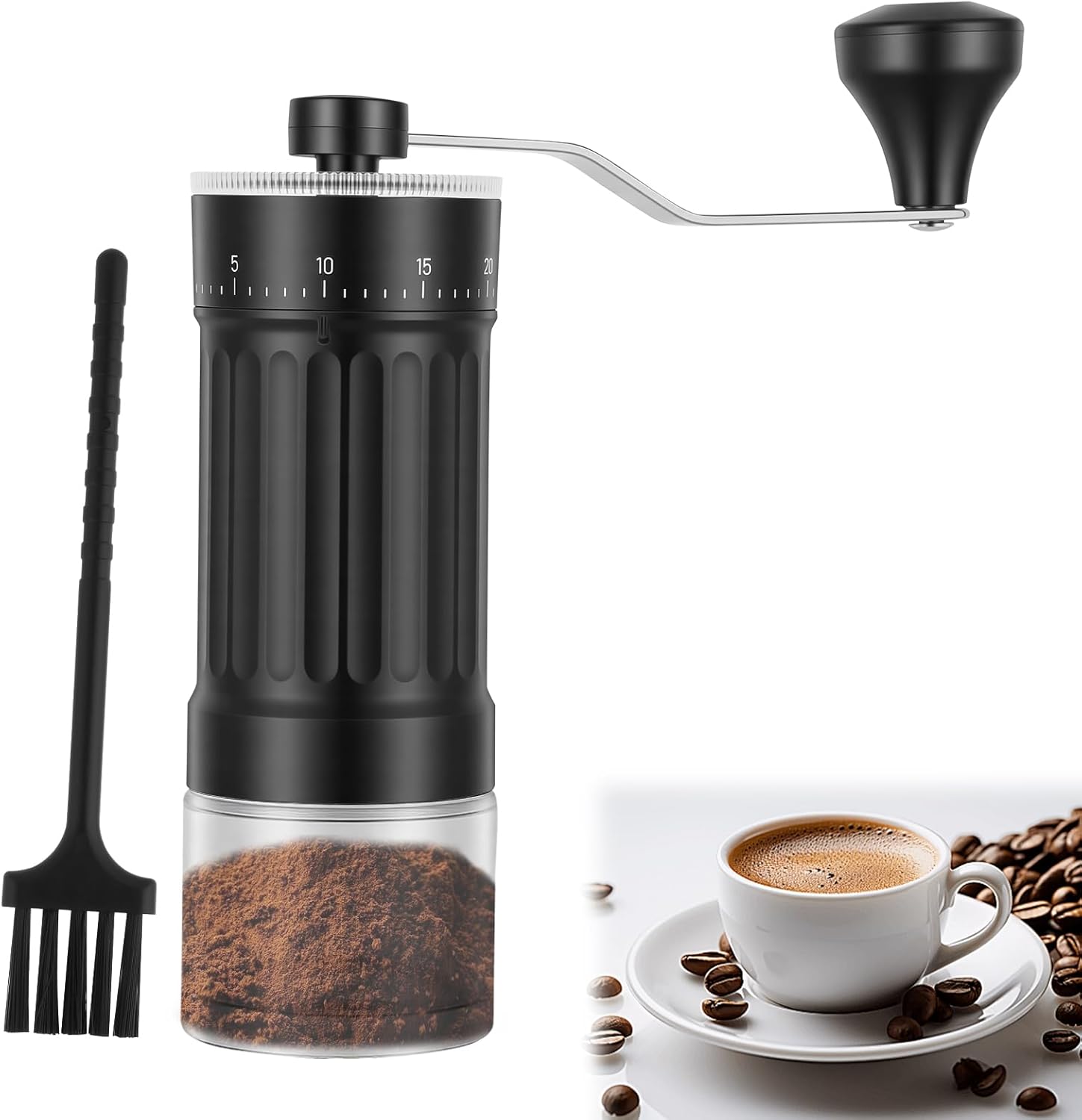
HZBSGZR Hand Coffee Grinder
| Capacity | 30 g |
|---|---|
| Material Type | Acrylonitrile Butadiene Styrene, Glass, Plastic |
| Power Source | Manual |
| Adjustable Settings | 40 levels |
| Included Components | Cleaning brush and manual |
This hand coffee grinder uses a ceramic conical burr and a 40-step adjustment system to deliver consistent, uniform grinds for a range of brew methods from fine to coarse. You load up to 30 g of beans into the transparent glass jar, set the grind size with the numbered adjustment, then turn the ergonomic hand crank to grind without electricity. The ceramic burr generates less heat and stays sharp longer, helping preserve flavor, and the clear jar makes it easy to watch grind progress and avoid spills. Its ABS body and lightweight build make it genuinely portable for travel or camping, and the included brush simplifies upkeep. Limitations are the small 30 g capacity—so you will refill for larger servings—and manual operation requires more time and effort than electric mills, especially for multiple cups. For single-serve brewing or on-the-go freshness, it balances precision and portability well.
Best for: Buyers who want precise, portable grinding for single-serve brewing or travel and prioritize flavor preservation and adjustable grind control over speed.
Less Ideal for: People who routinely grind beans for several cups at once or who prefer fast, effortless electric grinding should consider a larger or powered grinder.
- Ceramic conical burr preserves aroma and provides consistent grind size.
- 40 adjustable grind settings let you dial in settings for espresso through French press.
- Transparent glass jar prevents mess and lets you monitor grind progress.
- Lightweight, compact construction is easy to take on trips or camping.
- Includes cleaning brush and simple 3-step operation for easy maintenance.
- 30 g capacity is small for brewing multiple cups at once.
- Manual crank requires time and physical effort compared with electric grinders.
Verdict: A compact, flavor-focused manual grinder that gives precise 40-step ceramic-burr grinding for travelers and single-cup brewers.
Rsoilch Manual Coffee Grinder HS-011

| Capacity | 30 g |
|---|---|
| Included Components | Ceramic Burr, Stainless Steel Body |
| Material Type | Ceramic, Plastic |
| Adjustable Settings | 40 grind clicks |
This handheld grinder uses a ceramic conical burr and 40 adjustable grind clicks to produce consistent grounds for espresso, pour-over, and French press. You operate it by filling the top with beans, turning the low-noise hand crank and watching grounds collect in the clear glass jar, which helps avoid spills and shows grind progress. Its lightweight ABS body and compact profile make it easy to pack for travel or camping and convenient for daily small-batch use. The ceramic burr preserves oils and aroma better than blade grinders and the wide range of settings covers most brewing methods, but the 25–30 g capacity and manual effort mean it is best for one to two cups at a time rather than large batches. The grinder is power-free and quiet, but users who need very fast grinding or large-volume output will find it slow compared with electric models.
Best for: Buyers who want an affordable, portable grinder that delivers better-than-blade results for single-cup to two-cup brewing and who prioritize flavor and simplicity over speed.
Less Ideal for: People who routinely grind larger quantities, need very fast grinding, or prefer plug-in electric convenience should consider a powered grinder instead.
- Ceramic conical burr preserves flavor and yields uniform grind
- 40 adjustable grind settings cover espresso to French press
- Clear glass grounds container prevents spills and shows progress
- Compact, lightweight design suitable for travel and camping
- Small 25–30 g capacity requires multiple fills for larger servings
- Manual cranking is slower and more effort than electric grinders
Verdict: A budget-friendly, portable ceramic-burr hand grinder that gives consistent, flavorful grounds for travelers and single-cup brewers who value taste over speed.
Hario Skerton Pro Coffee Mill

| Capacity | 100 g |
|---|---|
| Material Type | Ceramic, Glass, Stainless Steel |
| Power Source | Manual |
The Hario Skerton Pro is a hand coffee mill built around ceramic conical burrs and a reinforced grind shaft for steadier, more consistent grinds. You turn the detachable stainless-steel crank to grind beans into the heat-proof glass bowl, and an improved adjustment screw lets you move between fine and coarse settings for methods from espresso-adjacent to French press. The 100 g capacity holds enough grounds for several cups, which makes it useful at home or for travel when you want larger batches. Its parts are easy to disassemble and fully washable, and the anti-slip base and sturdier handle reduce wobble during use. Expect the typical manual experience: you will need arm effort for larger quantities and the grind speed cannot match an electric grinder, but the ceramic burrs cut cleaner than blade units and generate less heat. For buyers prioritizing durability and consistent manual performance, the Skerton Pro balances capacity, serviceability, and grind control in a compact package.
Best for: Buyers who want a durable, serviceable manual grinder that produces consistent, low-heat grinds for home brewing or travel and value long-term reliability over speed.
Less Ideal for: Those who need very fast grinding for large daily volumes or who prefer a fully shatterproof, lightweight travel grinder should consider other options.
- Ceramic conical burrs deliver uniform grinds with less heat transfer than blade grinders.
- Reinforced grind shaft and improved handle reduce wobble and improve durability.
- 100 g glass hopper holds enough grounds for multiple cups, suitable for batch grinding.
- Detachable stainless-steel crank and washable parts make cleaning and packing easy.
- Adjustable grind screw provides a wide range of grind sizes for different brew methods.
- Manual operation requires noticeable effort for larger batches and takes longer than electric grinders.
- Glass hopper increases fragility compared with all-plastic bodies.
Verdict: Choose the Skerton Pro if you want a robust, easy-to-service ceramic-burr hand grinder that prioritizes consistent, low-heat grinds and long-term reliability.
LHS Manual Coffee Grinder

| Material Type | ABS plastic |
|---|---|
| Grinding Mechanism | Ceramic burr |
| Handle Material | Stainless steel |
| Adjustable Levels | 4 |
The LHS Manual Coffee Grinder is a no-frills hand mill built around a ceramic burr mechanism and a stainless steel crank, intended for everyday pour-over or drip brewing on the go. You load beans into the top hopper, set one of four coarseness levels with the central knob, and turn the handle to produce grounds into the lower container. Ceramic burrs generate less heat and preserve coffee flavor compared with blade grinders, and the grinder breaks down beans consistently enough for filter coffee and French press at the coarser settings. The plastic ABS body keeps the unit lightweight and portable for travel, and the parts disassemble for rinsing and basic cleaning. Expect modest capacity suitable for one to a few cups at a time and a manual grinding pace that requires more effort than electric grinders. The adjustment range is limited to four preset levels, so fine-tuning to an espresso-fine range is not practical. Given its build and materials, it is an affordable choice for hobbyists who want fresher grounds without electricity, but those needing large batches or espresso-level precision should look elsewhere.
Best for: Buyers who want a budget-friendly, portable way to get fresher grounds for pour-over or drip coffee and who value demonstrated user satisfaction when choosing a lower-cost manual grinder.
Less Ideal for: People who regularly grind large volumes or need precise, espresso-fine adjustments should choose a larger or more finely adjustable grinder instead.
- Ceramic burrs reduce heat and help preserve bean flavor during grinding
- Four-position adjustment knob provides simple coarse-to-fine control
- Lightweight, detachable design is easy to take apart and clean
- Stainless steel crank offers sturdy manual operation
- ABS plastic body is less durable than all-metal alternatives
- Limited to small batch grinding and not suited for espresso-level fineness
Verdict: A compact, budget-friendly manual grinder with ceramic burrs that delivers fresher, low-heat grounds for pour-over and travel use.
CEVING Mini Manual Coffee Grinder MCG-01

| Capacity | 30 g |
|---|---|
| Material Type | Ceramic |
| Power Source | manual winding |
| Adjustable Settings | 40 |
The CEVING Mini Manual Coffee Grinder is a portable hand mill that grinds beans using ceramic conical burrs and an external 40-step adjustment ring for dialed-in grind sizes from fine to coarse. It is used by loading up to about 30 g of beans, turning the manual crank, and adjusting the ring to suit espresso, pour-over, or French press routines. Ceramic burrs run cooler and deliver relatively uniform particles, which helps preserve flavor during hand grinding, and the external adjustment makes switching grind sizes quick and tidy. The unit breaks down into a few pieces for basic cleaning and fits easily in a travel bag or office drawer. Its small capacity and manual operation mean it is best for one to two cups at a time and requires a bit of effort compared with electric grinders, and the maker advises against using water for cleaning. For someone who wants consistent, low-heat grinding on the go, this grinder offers a reliable, no-power-required option with clear controls and easy portability.
Best for: Buyers who prioritize predictable, low-heat grinding and portability and prefer a straightforward, mechanically reliable grinder for travel or daily single-cup use.
Less Ideal for: Those who need to grind large quantities at once, want automatic or hands-free operation, or prefer a plug-in electric grinder for heavy daily use.
- 40 external grind settings for precise adjustment without disassembling the burrs
- Ceramic conical burrs that produce uniform grounds with less heat transfer
- Compact, lightweight design suited for travel and small kitchens
- Detachable three-part construction for simple assembly and dry cleaning
- 30 g capacity limits it to single-serve or small-batch grinding
- Manual cranking requires physical effort compared with electric grinders
Verdict: Choose this compact, travel-ready manual grinder if you want precise, low-heat ceramic burr grinding without electricity.
Choosing the Right Manual Coffee Grinder with Ceramic Burrs: Key Factors to Consider
Grind Consistency and Particle Distribution
A grinder that produces an even particle size across the selected range gives the most predictable extraction and flavor. Ceramic burrs are prized for retaining sharp edges longer than low-grade steel, which helps maintain uniformity over time.
Uneven particle distribution creates over- and under-extracted compounds that muddy taste. When evaluating manual grinders, consider testable aspects like how narrow the spread is at a chosen setting and whether the grinder maintains the same profile after repeated use.
Adjustment Range and Repeatability
Different brew methods require distinct grind sizes. A good manual grinder offers a wide and logically spaced adjustment range so you can move between fine and coarse settings without guesswork. Look for clear indexing or tactile stops that let you reproduce a setting reliably.
Repeatability matters if you switch frequently between brews. If markings are vague or adjustments are too sensitive, you will spend extra time dialing in and may not be able to return to a preferred setting precisely.
Build Materials and Long-Term Durability
Durability affects both performance and ownership costs. Ceramic burrs resist corrosion and can keep sharp edges for many uses, but the surrounding components must also be robust. Metal housings, reinforced axles, and quality fasteners reduce wobble and wear under repeated hand torque.
Pay attention to how the burrs are seated and secured. Loose components or cheap plastics can lead to misalignment, which undermines the advantages of ceramic burrs. The overall construction influences stability while grinding and the likelihood of maintenance down the road.
Ergonomics and Required Hand Effort
Manual grinding requires physical input, so ergonomics directly affect how often you will use a hand grinder. Handle length, knob comfort, and the rotational smoothness of the burrs determine how much effort is required for a given grind size.
Longer handles and low-friction bearings reduce effort, which is especially important for fine grinds. Consider whether the grinder offers a foldable or removable handle for storage and whether the hand position feels natural for quick morning routines.
Capacity and Hopper Design
Capacity matters for routine use and portability. A larger hopper reduces how often you refill but can add bulk. Transparent or removable hoppers make it easy to check bean levels and clean between roasts.
Hopper geometry also affects bean feeding into the burrs. A well-shaped hopper prevents jams and ensures a steady flow of beans, contributing to even grinding without sudden resistance spikes that could alter particle size distribution.
Maintenance and Ease of Cleaning
Regular cleaning preserves flavor and grinder function. Ceramic burrs can be cleaned without specialized tools, but the grinder should allow straightforward disassembly to reach burr surfaces and the grounds catcher.
Parts that are dishwasher-safe or snap apart without tools save time. Consider whether the design traps oils or fines in hard-to-reach crevices, because accumulated residue affects taste and may require more frequent deep cleaning.
Why Choose Ceramic Burrs in a Manual Grinder
Ceramic burrs offer a balance of hardness and corrosion resistance that helps maintain edge sharpness for a long time. In manual grinders where replacement is less frequent, ceramics can provide sustained particle uniformity without the need for frequent re-sharpening.
Because ceramic burrs heat less under friction than some metals, they can help preserve volatile aromatics during longer hand-grinding sessions. They are also chemically inert, which lowers the risk of off-flavors developing from metal oxidation.
- Ceramic resists rust and chemical reactions with oils
- Lower heat transfer helps protect coffee aromas
- Typically longer edge life between maintenance cycles
Matching Grind Settings to Brew Methods
Understand the common grind ranges for your preferred brews: very fine for espresso-style puck methods, medium-fine for AeroPress or pour-over, and coarse for French press. A manual grinder with a wide and well-indexed adjustment range gives you flexibility to experiment.
When testing a grinder, try a few representative grind sizes and look at the particle spread. Small operational differences in burr alignment or adjustment mechanism can have outsized effects at finer settings, so confirm a grinder performs acceptably across the range you use most.
- Fine: puck-style or very short extractions
- Medium: pour-over and drip
- Coarse: French press and cold brew
Portability and Storage Considerations
Manual grinders are often chosen for their portability. Pay attention to collapsed dimensions, whether the handle folds or detaches, and if the unit fits your travel bag. Weight is a tradeoff between sturdiness and packability.
Storage considerations also include how easy it is to clean after travel and whether the grinder has a secure latch or lid to prevent grounds from spilling during transport.
- Removable handles reduce packed length
- Locking catchers prevent spills
- Compact grinders may sacrifice speed for size
Common Maintenance Tasks and Tips
Routine maintenance includes brushing out fines from the burrs, wiping the hopper and catch, and checking for loose screws or worn parts. A monthly deeper clean helps if you use oily dark roasts frequently.
When reassembling, ensure burrs are seated correctly and that adjustment rings are returned to known reference points. Keep a small brush and a microfiber cloth nearby for quick daily upkeep.
- Brush burrs and exterior after each use
- Deep-clean by disassembling monthly or as needed
- Check alignment and torque on fasteners periodically
How Grind Effort Affects Your Routine
Hand-grinding time and required torque can change whether a manual grinder is practical for daily use. If you make multiple cups a day, prioritize models with smoother action and comfortable handles to reduce fatigue.
Consider whether you will grind at the counter or take the grinder on trips. Longer sessions for fine espresso-like grinds can be tiring on some compact units, so match expected effort to how often you will perform those grinds.
- Longer handles reduce required force
- Smooth bearings lower fatigue
- Compact units may need more rotations per dose
How We Chose the Best Manual Coffee Grinder with Ceramic Burrs
We focused on attributes that determine real-world grind quality and day-to-day usability. Primary evaluation criteria included grind consistency across settings, burr material and longevity, adjustment range and repeatability, ergonomics for hand grinding, and overall build quality including hopper and catch stability. We tested for how easily a grinder holds calibration between sessions and how straightforward it is to switch grind sizes for different brew methods. Durability considerations emphasized ceramic burr wear patterns and the robustness of drive mechanisms and fasteners. We excluded grinders with steel burrs or electric-only designs, and we did not consider models lacking meaningful adjustment or with known fitment issues. We favored products that balanced consistent particle distribution with reasonable manual effort and clear, repeatable indexing. Additional minor filters involved hopper capacity for daily use and how easy the grinder is to disassemble and clean. These criteria align with the scoring metrics used in each product entry to give you a transparent decision framework.
Our full evaluation process is outlined in our review methodology.
FAQ
Are ceramic burrs better than steel for manual grinders?
Ceramic burrs resist corrosion and can retain sharpness for a long time, which often improves consistency in manual use. Steel burrs can be tougher and are sometimes sharper initially, but they may require re-sharpening sooner depending on use.
How often should I clean a manual grinder with ceramic burrs?
Brush out grounds after each use and perform a deeper disassembly clean roughly once a month or more often if you use oily dark roasts. Regular cleaning prevents buildup that alters flavor and increases wear.
Can ceramic burrs chip if I grind hard beans?
Ceramic is hard but brittle, so it can chip if a stone or foreign object is present in the beans. Sorting and inspecting beans before grinding reduces this risk, and most modern designs protect the burrs behind a chute or screen.
Will a manual ceramic-burr grinder work for espresso?
Some manual ceramic-burr grinders can reach the fine range needed for puck-style brewing, but effort and repeatability vary. If you plan to grind fine regularly, prioritize models with precise adjustment and low-resistance mechanisms.
How do I know when the burrs need replacing?
Signs include a noticeable change in grind distribution, increased effort to grind, or visible wear on the burr edges. Ceramic burrs tend to wear slowly, so replacements are infrequent but necessary when performance declines.
Final Verdict
When choosing a manual coffee grinder with ceramic burrs, prioritize consistent grind distribution, a repeatable adjustment system, and solid construction that resists wobble. Balance ergonomics and effort against portability and capacity based on how and where you brew most often. By focusing on these tradeoffs, you can pick a grinder that reliably produces the particle sizes you need and stays serviceable for years.