
Note: This article contains affiliate links. If you click on these links and make a purchase, we may earn a small commission at no extra cost to you. This helps support our research and content. Read our full affiliate disclosure here.
Finding the right microwave combo toaster oven without air fryer matters because these hybrid units replace multiple small appliances while keeping countertop space and utility in balance. You want reliable microwave power for quick reheats plus a true convection or bake-toaster function for crusts, broiling, and toasting without the added fan-driven air-fry setting. This guide shortlists the top options across common kitchen needs, focusing on cooking consistency, usable interior capacity, ease of use, and durability. Below are the best picks for different cooking styles and kitchen sizes, followed by clear buying criteria to help you pick the right model.
Top Picks at a Glance
| Best Overall The best all-around choice for most situations | KoolMore 24" Built-In Oven Microwave Combo |  |
| Best Quality Built to a higher standard if you want something more solid | FORNO Compact Oven C-FMWDR3093 |  |
| Best Budget The cheapest option that still gets the job done reliably | Frigidaire EMW122 1.1 Cu Ft Microwave |  |
| Top Rated A top-rated pick with lots of positive feedback | Sharp SMC1585KB Convection Microwave |  |
| Best Seller A high-volume bestseller chosen again and again | thermomate 24" Built-In Microwave Convection |  |
KoolMore 24" Built-In Oven Microwave Combo

| Wattage | 1000 watts |
|---|---|
| Voltage | 120 volts |
| Heating Method | Convection |
| Capacity | 1.5 cubic feet |
| Number of Programs | 5 |
The KoolMore 24" built-in oven and microwave combo pairs a convection oven with a microwave to expand cooking options beyond simple reheating. It offers top and bottom heating plus fan-assisted convection to speed baking and distribute heat more evenly, and a broil mode for finishing dishes. The unit uses a 1000 watt microwave system and touch LCD controls with preset timers and four power levels for straightforward daily use. Cool Door Technology with double-layer glass keeps the exterior safer to touch while premium reinforced hinges make loading and unloading heavier pans easier. Installation requires a 20-amp NEMA 5-20P outlet, so plan electrical access before fitting it into a cabinet. Capacity is 1.5 cubic feet, making it suitable for mid-size dishes but not large sheet pans. Practical benefits include flexible cooking modes in one built-in footprint and a stainless steel interior that is easier to wipe clean, while buyers should note it is a specialized built-in appliance that needs appropriate cutout, power, and may not replace full-size ovens for very large baking projects.
Best for: Buyers who want a built-in unit that replaces a separate microwave and small oven with versatile cooking modes and safer exterior operation, and who value flexible preset controls in a mid-size kitchen.
Less Ideal for: Those needing full-size oven capacity or a plug-and-play countertop microwave without a dedicated 20-amp circuit should consider other options.
- Combines convection, broil, and microwave functions for versatile cooking.
- Fan-assisted convection reduces cook time and promotes even baking.
- Cool Door Technology with double-layer glass improves exterior safety.
- Reinforced hinges support heavier pans when loading and unloading.
- Touch LCD controls with preset programs simplify everyday use.
- Requires a 20-amp NEMA 5-20P outlet which may need an electrician to install.
- 1.5 cu ft capacity may be small for very large dishes or full sheet pans.
Verdict: Choose this unit if you want a built-in microwave-plus-convection oven that delivers flexible cooking modes in a mid-size footprint with safer exterior handling.
FORNO Compact Oven C-FMWDR3093

| Capacity | 1.6 cubic feet |
|---|---|
| Wattage | 1750 watts |
| Microwave Power | 1000 watts |
| Number of Programs | 8 |
| Number of Power Levels | 11 |
This Forno compact oven is a hybrid microwave and convection toaster oven designed for buyers who want faster microwave cooking plus the browning and roasting power of a convection oven in one countertop unit. It offers 1,000 W microwave power with a switchable 1,750 W convection mode, 11 power levels and eight programmed cooking modes including sensor cooking and multi-stage programming for hands-off results. The interior accessories — an enamel turntable, reversible rack and ceramic tray — make it easy to switch between reheating, defrosting, broiling and baking tasks. Touch controls, a clear LCD and child lock add convenience in everyday use. The unit is relatively compact at 1.6 cubic feet, so it fits smaller kitchens but will limit capacity for large casserole dishes, and its 81.6 lb weight means it is not especially easy to move. For cooks who prioritize performance and want one appliance that can both reheat quickly and produce convection-browned results, this model delivers usable power and useful presets in a single package.
Best for: Performance-minded cooks who need a single countertop appliance that can both reheat quickly and deliver convection-browned results without sacrificing programmed convenience.
Less Ideal for: Households that regularly cook large roasts, sheet trays, or party-sized dishes that require a deeper cavity or larger capacity.
- Combines 1,000 W microwave speed with a 1,750 W convection oven mode for versatile cooking.
- Multiple presets including sensor cooking and multi-stage programming simplify hands-off results.
- Touchscreen controls and an easy-to-read LCD make programming and monitoring straightforward.
- Includes practical accessories: enamel turntable, ceramic tray and reversible wire rack for different cooking methods.
- Compact 1.6 cu ft capacity limits the size of dishes you can cook at once.
- Heavy for a countertop unit, making relocation or frequent storage inconvenient.
Verdict: Choose this unit if you want a compact countertop microwave that doubles as a high-power convection toaster oven for performance cooking.
Frigidaire EMW122 1.1 Cu Ft Microwave

| Wattage | 1000 watts |
|---|---|
| Capacity | 1.1 cubic feet |
| Number of Power Levels | 10 |
| Turntable Diameter | 12 inches |
| Additional Features | inverter |
This Frigidaire EMW122 is a straightforward countertop microwave that uses inverter technology to deliver more even power and faster defrosting than basic on/off cycling units. It offers a 1.1 cu ft interior and a 12-inch removable glass turntable that fits plates and small casserole dishes for family meals or office use. Controls are soft-touch with one-touch auto-cook menus for common items, cook-by-weight and defrost-by-weight options, a speed-defrost mode, 10 power levels, and an end-of-cycle tone for convenience. The 1000-watt output heats quickly and the child safety lock and digital clock are practical everyday touches. Trade-offs include a conventional stainless exterior that needs wiping and a fixed countertop design, so it is not built for built-in installs, and the control panel is button-based rather than full touchscreen. For buyers who want reliable, simple performance and better-than-basic defrosting, this model covers the essentials without extra smart features or complex settings.
Best for: Shoppers who prioritize reliable, no-frills performance and even cooking on a budget and want straightforward controls and essential safety features for everyday home or office use.
Less Ideal for: Buyers who need built-in installation, Wi-Fi/smart features, or an appliance with advanced cooking modes and touchscreen controls.
- Inverter technology for more even heating and improved defrosting
- 1000-watt power for quick cooking and reheating
- One-touch auto-cook menus and cook-by-weight/defrost-by-weight for convenience
- Removable 12-inch glass turntable that is dishwasher-safe
- Designed only as a countertop unit so not suitable for built-in installation
- Simple button controls lack advanced touchscreen or smart features
Verdict: Choose this Frigidaire if you want an affordable countertop microwave that uses inverter technology for more even cooking without extra smart bells and whistles.
Sharp SMC1585KB Convection Microwave

| Capacity | 1.5 cubic feet |
|---|---|
| Wattage | 900 watts |
| Heating Method | Convection |
| Number of Power Levels | 10 |
| Turntable Diameter | 15.4 inches |
The Sharp SMC1585KB combines a 1.5 cubic foot cooking cavity with 900 watts of microwave power plus convection heating to handle everything from quick reheats to roasting and baking. It offers sensor cooking and auto defrost for more precise thawing and reheating, preset buttons and an express +60 second key for simple one-touch use, and ten power levels for finer control. Convection modes include auto broil, roast, and bake as well as Low Mix and High Mix settings that blend microwave and convection heat for faster, browned results. The stainless steel interior and dishwasher-safe 15.4-inch ceramic turntable make cleanup straightforward, and a bright white LED display is easy to read. Downsides are that at 900W it is not the most powerful countertop model for very large roasts and the family-size cavity may require careful rack placement for bulky bakeware; users who need heavy-duty baking capacity or faster microwave-only cook times may look elsewhere. For everyday mixed cooking tasks it delivers flexible performance and convenient controls.
Best for: Buyers who want a single countertop oven that handles reheating, baking, roasting and everyday cooking with easy presets and sensor convenience.
Less Ideal for: Those who need very high microwave power or large multi-rack baking capacity for frequent heavy-duty baking or commercial-style use.
- Convection plus microwave modes let you roast, bake, brown and reheat in one unit.
- Sensor cook and auto defrost remove much of the guesswork for timing.
- Dishwasher-safe 15.4" ceramic turntable and stainless steel interior simplify cleaning.
- Convenient one-touch +60s key, express cook presets, and ten power levels for easy control.
- 900W microwave output is moderate rather than high-end for very fast heating.
- Family-size interior may limit placement of large bakeware or multi-rack baking.
Verdict: A versatile countertop convection microwave that balances everyday reheating, baking and roasting needs in a single, easy-to-use unit.
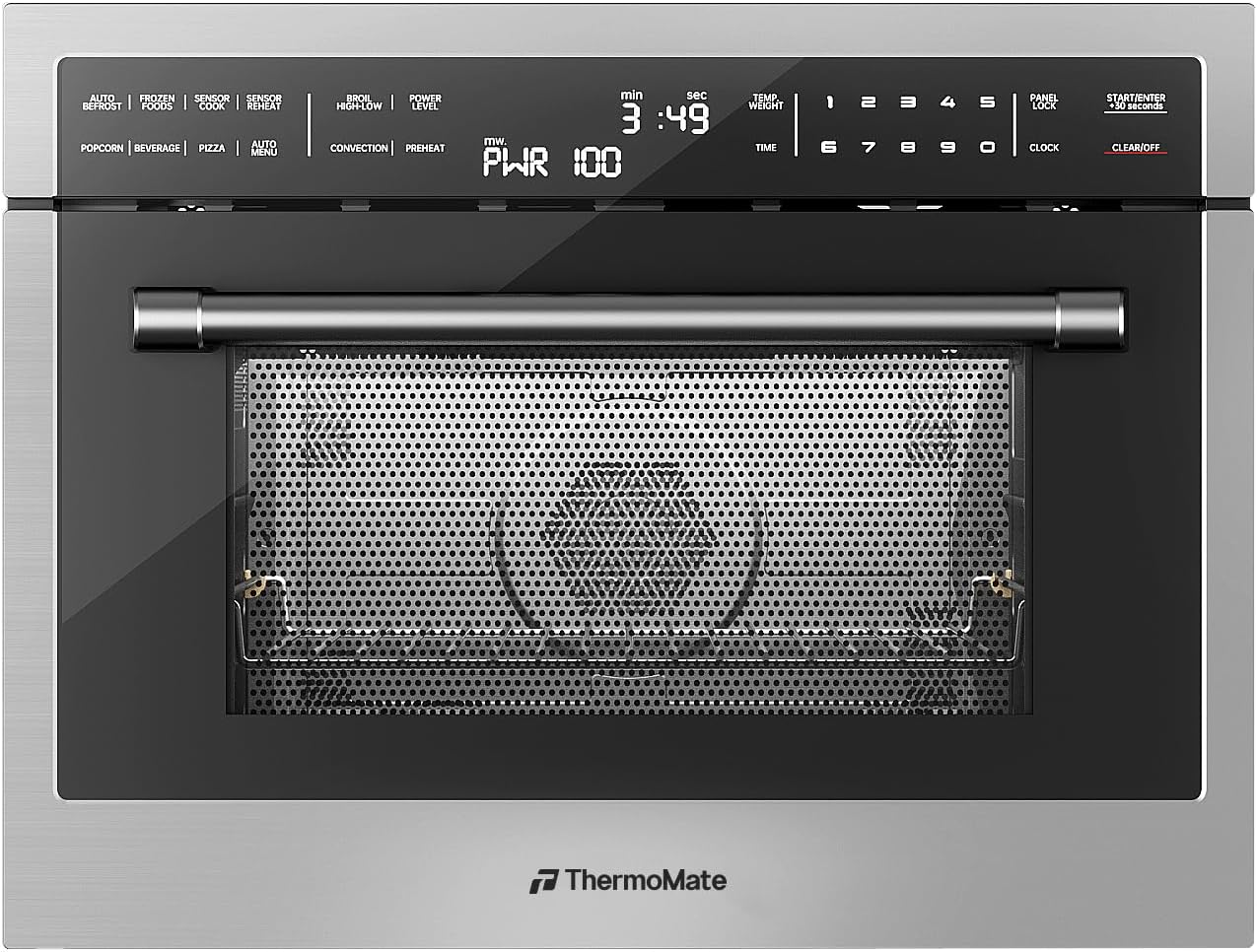
thermomate 24" Built-In Microwave Convection
| Capacity | 1.6 cubic feet |
|---|---|
| Power Consumption | 1000 watts |
| Heating Method | Convection, Electric |
| Number of Programs | 7 |
This thermomate combo pairs a 1.6 cu ft microwave with a convection oven to give you both fast microwave heating and oven-style results in one built-in unit. Typical use is everyday reheating and defrosting plus baking, broiling, and sensor-cook programs when you want browning or crisping that a microwave alone cannot deliver. Notable features include separate convection and broil heating elements, sensor cook, a reversible ceramic turntable and wire rack for multi-mode cooking, and a touchscreen control panel with a child safety lock. In practice the convection element and included rack make it easy to roast small pans or brown a casserole, while the sensor cook helps avoid overcooking common items. Trade-offs are the single listed microwave power level despite a 1000 watt microwave rating and the modest 1.6 cu ft capacity that limits very large dishes, and installation requires built-in/countertop planning. For buyers who want a simple, combined microwave and oven solution that handles basic baking and broiling without separate appliances, this model covers the essentials with a straightforward control set.
Best for: Buyers who want a low-risk, all-in-one built-in microwave and convection solution that replaces separate microwave and small oven tasks and values straightforward controls and safety features.
Less Ideal for: People who frequently cook for large groups or need a large interior for oversized baking pans should look at larger countertop ovens or full-size wall ovens instead.
- Combined microwave and convection oven modes for both fast reheating and oven-style browning
- Reversible ceramic turntable and wire rack let you switch between roasting, broiling, and microwave use
- Sensor cook and multiple preset programs simplify everyday cooking and reduce guesswork
- Touchscreen controls with child safety and control panel lock enhance user safety and convenience
- Modest 1.6 cu ft capacity restricts use with very large dishes
- Only one listed microwave power level despite 1000 watt rating, which may limit fine-grained power control
Verdict: A straightforward built-in microwave/convection combo that gives risk-averse buyers a single, safe unit for reheating, baking, and broiling without adding separate appliances.
Choosing the Right Microwave Combo Toaster Oven Without Air Fryer: Key Factors to Consider
Heating Consistency
Evenness between microwave and oven modes determines whether dishes cook uniformly when you use combined functions. Inconsistent microwave power or hotspots in the oven cavity cause uneven reheating, soggy centers, or burnt edges. Look for units that document microwave wattage and oven temperature accuracy, and that include convection or bake settings that maintain steady temperatures.
Cooking performance also affects how often you need to rotate or reposition food. Better heating consistency reduces the need for manual intervention during longer bake or reheat cycles and delivers predictable results across recipes.
Interior Capacity and Rack Configuration
Capacity affects what you can cook in a single cycle. Consider both total internal volume and the usable dimensions between racks. A nominal cubic-inch number is less useful than knowing whether a 9×13 pan, a dinner plate, or a whole chicken fits flat on a rack.
Multiple rack positions add flexibility for toasting, broiling, and baking. Removable crumb trays and accessible interior surfaces make cleaning easier, which matters if you plan to use both microwave and conventional oven functions frequently.
Control Usability and Presets
Controls should be intuitive for switching between microwave and oven functions. Well-labeled dials or a clear digital interface with dedicated presets for common tasks reduces mistakes and speeds up cooking. Presets for tasks like reheat, defrost, bake, and broil are helpful when you want consistent outcomes without memorizing power levels and times.
User-accessible adjustments such as power level selection for microwave mode and precise temperature entry for oven mode let you fine-tune results for specific recipes.
Build Quality and Ease of Maintenance
Durable materials and solid door seals prolong a unit's useful life and maintain consistent cooking performance. A well-built door and hinges keep microwave energy contained and oven heat stable. Interior finishes that resist staining and that can withstand scrubbing make long-term upkeep simpler.
Removable components like crumb trays, racks, and turntables that can be cleaned in the sink or dishwasher reduce the time you spend on maintenance and help keep cooking surfaces sanitary.
Safety Features and Insulation
Because these combined appliances operate at high microwave power and elevated oven temperatures, safety features are important. Look for good door interlocks, clear venting that directs heat away from cabinetry, and external surfaces that remain relatively cool during operation.
Proper insulation and explicit safety testing reduce heat transfer to surrounding countertops and minimize the risk of accidental burns or damage to nearby items. Automatic shutoffs and child-lock functions are additional safeguards to consider.
Size and Placement Tips for Small Kitchens
Measure both the countertop area and the vertical clearance before choosing a microwave combo toaster oven without air fryer. Some units have deeper cavities that require more clearance behind them for ventilation, so include space for airflow in your measurements.
If counter space is limited, consider models with a compact footprint but efficient interior layouts. A taller cavity may accept taller dishes while a wider cavity is better for sheet-pan style cooking. Also think about door swing direction and whether you need a unit that fits under cabinets.
- Allow several inches of clearance at the back and sides for venting.
- Check door swing direction to avoid blocking adjacent appliances.
- Consider models with removable feet or adjustable leveling to fit uneven counters.
Common Cooking Tasks These Units Handle Well
Microwave combo toaster ovens without air fry typically excel at quick reheating, defrosting, toasting bread, and baking small casseroles. They let you switch from microwave to conventional bake or broil functions when you need a crisp finish or browning.
For many home cooks, this combination replaces a standalone microwave plus a small toaster oven while avoiding the higher-heat, dry-air results of air frying. Expect reliable plate reheats, pan-toasted sandwiches, and small-batch baked goods.
- Efficient reheating of leftovers without overcooking edges.
- Broiling and toasting tasks that require direct top heat.
- Baking small dishes where oven-like heat is preferred to air-circulated crisping.
Maintenance Practices to Keep Performance Consistent
Regular cleaning preserves heating performance and prevents smoke or burnt odors. Clean the interior after spills, remove crumbs from trays, and keep the microwave turntable and any removable components free of residue.
Inspect door seals and hinges periodically. Loose or damaged seals can cause energy loss and uneven heating. Replace removable parts that show excessive wear and follow the manufacturer guidance for safe cleaning products and methods.
- Wipe interiors with a mild detergent and avoid abrasive cleaners.
- Clean crumb trays after every few uses to prevent buildup.
- Check seals and vents for obstructions monthly.
When to Choose Larger Capacity Units
Opt for larger interiors if you routinely cook family-sized casseroles, use larger baking pans, or want to reheat multiple plates at once. A larger cavity reduces the need to cut or rearrange dishes and can improve airflow around the food for more even cooking in oven modes.
Keep in mind that larger units consume more counter space and may require stronger ventilation planning. Balance the benefit of additional capacity against your kitchen layout constraints.
- Better for entertaining or batch cooking.
- Allows use of standard baking pans without modification.
- May have stronger convection or bake elements for faster browning.
Energy Use and Operating Costs
Combined units often have lower energy use for quick tasks because a microwave function heats food directly, but extended oven or broil cycles increase energy consumption. Choose a model with sensible standby behavior and efficient insulation to limit wasted energy.
If energy efficiency is a concern, favor units with programmable timers and quick preheat behavior to reduce run time. Using microwave mode for partial cooking and finishing with oven mode can also save energy compared with long conventional bakes.
- Use microwave mode for reheats to minimize energy draw.
- Employ timers and precise temperature control to avoid overcooking.
- Consider insulation quality to reduce heat loss during oven cycles.
How We Chose the Best Microwave Combo Toaster Oven Without Air Fryer
We focused on features and performance that actually affect everyday use of microwave combo toaster ovens without an air-fry function. Primary evaluation criteria included heating consistency across microwave and oven modes, interior capacity and rack configuration, control clarity and preset usefulness, build quality and ease of maintenance, and safety features relevant to combined microwave/oven operation. We prioritized units that offered clear temperature accuracy and repeatable results when switching between microwave and conventional heating modes. Excluded from consideration were models that rely primarily on aggressive air-fry airflow as a core cooking method, as well as units lacking basic oven functions or with ambiguous capacity specs. We also filtered out models with poorly documented safety or warranty coverage. Our process emphasized documented specifications, user-focused features, and design choices that make switching modes simple and dependable for everyday cooking.
Our full evaluation process is outlined in our review methodology.
FAQ
Can a microwave combo toaster oven without air fryer brown food?
Yes. These units combine microwave heating with oven bake or broil elements. Use the oven or broil mode for browning and the microwave for fast internal heating. Some models have dedicated broil settings that produce similar browning to small conventional ovens.
Will the microwave and oven functions run at the same time?
Many combo units offer sequential or combined modes where microwave power shortens cook time while oven elements provide browning. Availability of simultaneous operation varies by model, so check the control options to see whether combined-cycle cooking is supported.
How do I know the right rack position to use?
Rack position depends on the task. Use the middle rack for even baking and the top position for broiling or crisping. Lower positions work well for larger items needing bottom heat. Experiment with a familiar recipe to learn how positions affect results in your specific unit.
Are there special safety concerns for combo units?
Yes. Ensure door seals are intact to prevent microwave leakage, and keep vents unobstructed to prevent overheating. Also be cautious when switching between microwave and oven modes because surfaces can become hot quickly during oven or broil cycles.
How often should I clean the interior and parts?
Wipe spills promptly and clean crumb trays weekly if you use the toaster or broil functions often. Deep-clean the interior every few months or whenever you notice odors or smoke. Regular cleaning helps maintain heating consistency and prevents smoke during high-heat cycles.
Final Verdict
When choosing a microwave combo toaster oven without air fryer, prioritize heating consistency and usable interior space that match the dishes you cook most often. Controls and presets should make switching between microwave and oven modes straightforward, and durable construction plus easy-to-clean surfaces reduces maintenance time. Balance capacity against your countertop constraints and favor models with clear safety features and good insulation. Armed with these tradeoffs, you can confidently pick a unit that streamlines reheating, toasting, and baking without adding an air-fry function.