
Note: This article contains affiliate links. If you click on these links and make a purchase, we may earn a small commission at no extra cost to you. This helps support our research and content. Read our full affiliate disclosure here.
Setting up a safe, reliable dry-aging setup starts with the right mini fridge. Dry aging beef at home requires steady low temperatures, precise humidity management, and airflow that mimics professional coolers to limit spoilage while developing flavor. The wrong fridge will produce off-odors, uneven drying, or bacterial risk. This guide shortlists seven mini fridges that suit dry-aging use and explains the features that matter most. We focus on practical factors like temperature stability, humidity or moisture control, airflow patterns, and ease of sanitation so you can pick a unit that lets you age meat safely and predictably. Read on for the evaluation criteria and buying considerations that informed our selections.
Top Picks at a Glance
| Best Overall The best all-around choice for most situations | Cobalance Dry Aging Fridge |  |
| Best Quality Built to a higher standard if you want something more solid | VEVOR Dry Aging Fridge 99 lbs |  |
| Best Value The sweet spot between price and what you get | Upstreman CR32 3.2 Cu.Ft Mini Fridge |  |
| Best Budget The cheapest option that still gets the job done reliably | EUHOMY 1.7 Cu.Ft Mini Fridge |  |
| Top Rated A top-rated pick with lots of positive feedback | Upstreman Dry Aging Fridge DA35 |  |
| Most Popular A crowd favorite that many people choose with confidence | Midea 3.1 Cu.ft Mini Fridge WHD-113FSL |  |
| Best Seller A high-volume bestseller chosen again and again | BLACK+DECKER 2.5 Cu. Ft. Compact Refrigerator |  |
Cobalance Dry Aging Fridge

| Capacity | 2.1 cubic feet |
|---|---|
| Temperature range | 34°F to 72°F |
| Humidity range | 50% to 85% |
| Cooling method | Compressor |
| Number of shelves | 3 |
The Cobalance Dry Aging Fridge is a small-capacity, countertop dry-aging cabinet that gives home chefs and small food businesses precise control over meat maturation. It lets you set temperature from 34°F to 72°F and humidity between 50% and 85% while the built-in compressor and digital controls keep conditions steady for aging beef, pork, fish, cheese, and more. The unit includes three shelves and two detachable hooks to arrange cuts and make efficient use of the 2.1 cu ft interior, and its tankless humidity system automatically maintains moisture without manual refilling. In practice this means you can set a target profile for 14 to 65 days and let the cabinet run with minimal intervention, while stainless steel construction simplifies cleaning and holds up to regular use. Limitations are its small footprint, which restricts total yield for larger households or commercial operations, and the need to remove meat promptly after extended power outages. For buyers wanting a compact, user-friendly way to experiment with dry aging at home, it offers professional-style control in a space-saving package.
Best for: Home cooks or small-scale users who want a compact, low-maintenance way to try professional-style dry aging and prioritize precise environmental control over high volume.
Less Ideal for: Large households, high-volume restaurateurs, or anyone needing to age many full-size primal cuts at once should choose a larger commercial unit instead.
- Digital temperature and humidity control for precise aging profiles
- Tankless humidity system that maintains humidity automatically without refills
- Compact countertop design with three shelves and two detachable hooks for flexible storage
- Compressor cooling provides stable conditions for longer aging periods
- 2.1 cu ft capacity limits how much meat you can age at once
- Requires removal of product if power outage lasts more than a day
Verdict: If you want a countertop dry-aging cabinet that delivers precise, set-and-forget control for home dry aging without dealing with water tanks, this unit is a practical pick.
VEVOR Dry Aging Fridge 99 lbs

| Capacity | 99 pounds |
|---|---|
| Configuration | Freezerless |
| Cooling Method | Compressor |
| Shelf Type | Stainless Steel |
| Power | 115 volts AC |
This VEVOR dry aging fridge is a compact, freezerless unit built to reproduce a professional dry-aging environment at home or in a small commercial kitchen. It uses a compressor and an air circulation system to maintain stable temperature and humidity, and it includes removable hooks, a shelf and trays made from 304 food-grade stainless steel for hygienic contact with meat. Typical use cases are hanging whole cuts or placing primal pieces on shelves for multi-week aging to concentrate flavor and tenderize beef, pork, or lamb. The cabinet is designed for either built-in or freestanding installation and has a right-hand door with a lock for security. Practical benefits include a small footprint that fits undercounter, a relatively high 99 lb capacity for its size, and easy-clean stainless contact surfaces. Limits to consider are its single-shelf/rack layout which constrains large-volume commercial workflows, the need to buy optional items like Himalayan salt separately, and the weight and dimensions that require planning for placement and handling during install.
Best for: Buyers who prioritize replicating pro-level dry-aging results in a compact footprint and want a controlled, hygienic environment for multi-week aging of steaks and primal cuts.
Less Ideal for: Large-scale restaurants or butchers who need high throughput or multi-tier shelving should choose a larger commercial dry ager with greater capacity and more racks.
- Professional-style temp and humidity control for consistent aging results
- Food-grade 304 stainless steel contact surfaces that resist corrosion and are easy to clean
- Removable hooks, shelf, and trays for flexible organization and different cut types
- Built-in or freestanding design fits undercounter spaces and small kitchens
- Single internal shelf/rack limits simultaneous aging of many large cuts
- Unit is relatively heavy and will require adequate support and clearance during installation
Verdict: If you want professional-style dry aging in a compact, undercounter-ready unit, this VEVOR 99 lb fridge delivers controlled temp and humidity with hygienic stainless contacts.
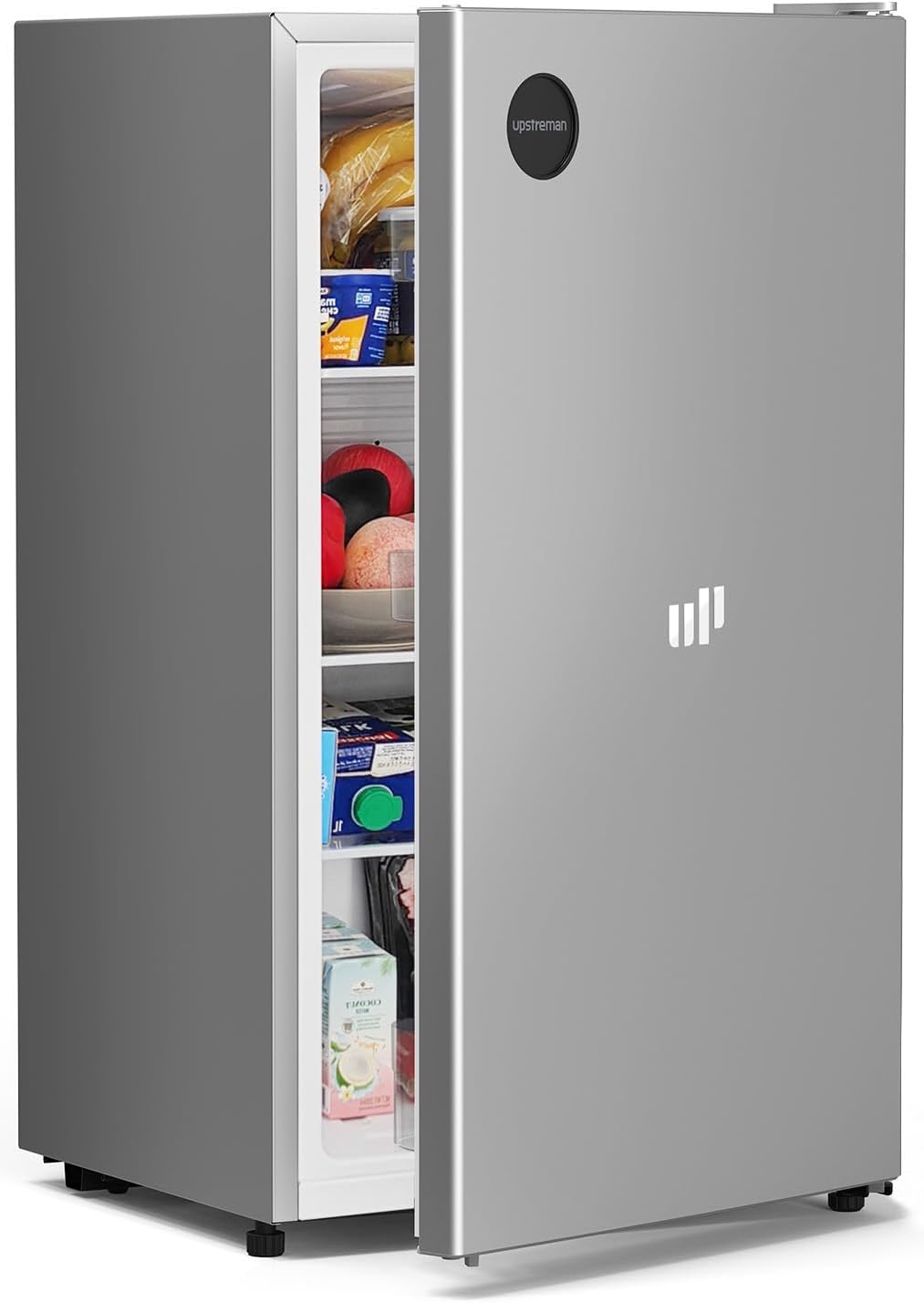
Upstreman CR32 3.2 Cu.Ft Mini Fridge
| Capacity | 3.2 cubic feet |
|---|---|
| Cooling method | Compressor |
| Defrost system type | Automatic |
| Voltage | 115 volts |
| Door orientation | Reversible |
The Upstreman CR32 is a compact, all-refrigerator unit designed for efficient everyday cooling in small spaces. It uses a compressor and R600a refrigerant to deliver reliable cold without a freezer compartment, and a 7-level thermostat (32°F to 50°F) lets you dial in temperatures for different food storage needs. The interior includes three removable glass shelves and three clear door bins for flexible organization, plus built-in LED lighting and two adjustable leveling feet for stable placement. Practical touches include a recessed hidden handle and a reversible door to fit tighter layouts. ENERGY STAR certification and a listed annual consumption of 258 kWh make it economical to run. Important limitations for dry-aging: the unit is not a purpose-built humidity- and airflow-controlled dry-aging cabinet, so achieving long-term, restaurant-quality beef aging would require external humidity control and frequent monitoring; the size also limits the quantity and cut sizes that can be aged. For short experimental dry-aging cycles or small home trials where budget and space are priorities, the CR32 is a sensible, energy-efficient option.
Best for: Buyers who want an energy-efficient, space-conscious refrigerator to experiment with short-term dry-aging or to store single cuts while prioritizing low running costs and easy placement.
Less Ideal for: Serious dry-agers or pros who need tight humidity control, dedicated airflow, and larger capacity for multi-week or larger-scale dry-aging projects should choose a purpose-built dry-aging cabinet.
- Seven temperature settings (32°F to 50°F) allow precise refrigeration for varied items
- ENERGY STAR certified with low annual energy use (258 kWh/year)
- Removable glass shelves and clear door bins provide flexible internal organization
- Reversible door and adjustable leveling feet simplify placement in tight spaces
- No built-in humidity or dedicated airflow controls needed for reliable dry-aging
- Limited internal volume restricts the number and size of cuts you can age
Verdict: A compact, energy-efficient fridge that works well for small-scale, short dry-aging experiments when paired with separate humidity and airflow management.
EUHOMY 1.7 Cu.Ft Mini Fridge

| Capacity | 1.7 cubic feet |
|---|---|
| Wattage | 550 watts |
| Voltage | 115 volts |
| Number Of Shelves | 1 |
The EUHOMY 1.7 Cu.Ft Mini Fridge is a compact, freestanding unit designed for dorms, offices, or tight countertops and includes a small freezer compartment and one removable wire shelf. It cools via an efficient compressor with an adjustable temperature knob rated from about 32°F to 50°F, making it straightforward to set colder or warmer conditions, and the reversible door gives installation flexibility in small spaces. The interior insulation and modest daily energy draw (about 0.55 kWh/day) help keep running costs low, and the manufacturer rates noise below 37 dB so it is quiet enough for bedrooms. For practical use you can remove the shelf to fit taller cuts or trays, and the freezer can hold ice or small packs. Important limitations for dry aging: the unit is small so airflow and humidity control are basic, there is no active humidity or dedicated temperature precision for long-term meat aging, and usable space is limited by the freezer compartment and single shelf. For short experiments or budget-minded setups it is usable, but it lacks the environmental controls needed for consistent long-term dry aging.
Best for: Buyers on a tight budget who want an inexpensive, compact fridge for short dry-aging trials, countertop cold storage, or small-batch experiments rather than a purpose-built aging chamber.
Less Ideal for: People planning consistent, long-term dry aging of large cuts or multiple pieces who need precise humidity and stable multi-day temperature control should look for a dedicated curing or aging appliance.
- Compact footprint fits on counters or under desks and has a reversible door for placement flexibility
- Adjustable thermostat with a range near 32°F to 50°F for cooler to near-refrigeration settings
- Low energy consumption (about 0.55 kWh per day) and quiet operation under 37 dB
- Removable wire shelf allows rearranging interior space for taller items or trays
- No dedicated humidity control or precision temperature regulation required for reliable long-term dry aging
- Very limited interior volume that restricts the size and number of cuts that can be aged at once
Verdict: A low-cost, compact fridge that lets budget-minded cooks try short dry-aging experiments but lacks the humidity and precision controls for reliable long-term aging.
Upstreman Dry Aging Fridge DA35

| Capacity | 3.5 cu.ft |
|---|---|
| Temperature Range | 34°F to 77°F |
| Humidity Range | 60% to 85% |
| Cooling Method | Compressor |
| Refrigerant | R-600A |
The Upstreman DA35 is a purpose-built 3.5 cu.ft dry-aging fridge that brings controlled meat aging to kitchens and small restaurants. It uses a compressor cooling system and an electronic touchscreen to set temperature (34°F to 77°F) and humidity (60% to 85%), so you can run multi-week aging cycles without external water hookups. The unit includes a salt tray, a shelf, and two hooks and adds UVC air purification plus Low-E glass with UV protection to limit light damage while maintaining stable conditions. Built-in LED lighting and a door lock make monitoring and secure storage simple, and the stainless steel door offers a professional look. Expect it to hold up to 149 lb of product in a compact footprint that can be built into cabinetry or used freestanding. Limitations include a single shelf layout and modest internal space, so heavy runs or large wholesale volumes will need a larger commercial unit, and the dry-age process still requires attention to trimming and timing to avoid excess weight loss.
Best for: Buyers who prioritize consistent, repeatable dry-aging results in a compact, professionally styled unit and want reliable environmental control for home or small-restaurant use.
Less Ideal for: Large restaurants, butcher shops, or anyone needing high-volume continuous aging should choose a larger multi-shelf commercial refrigerator instead.
- Precise temperature control from 34°F to 77°F for tailored aging cycles.
- Adjustable humidity range (60%–85%) to support consistent dry-aging conditions.
- Built-in UVC air purification and Low-E UV-protective glass to reduce contamination and light damage.
- Compact 3.5 cu.ft design that can be built into cabinetry or used freestanding for space-conscious kitchens.
- Includes practical accessories: salt tray, shelf, and hooks to start aging immediately.
- Single-shelf interior and limited capacity restricts batch size for serious commercial use.
- Item weight and built-in installation may complicate placement and moves.
- No multiple-shelf configuration included for flexible staging of different cuts.
Verdict: Choose the DA35 when you need a compact, factory-quality dry-aging fridge that delivers precise temperature and humidity control for dependable small-batch aging.
Midea 3.1 Cu.ft Mini Fridge WHD-113FSL

| Capacity | 3.1 cubic feet |
|---|---|
| Freezer Capacity | 0.92 cubic feet |
| Annual Energy Consumption | 270 kwh |
| Defrost System Type | Manual |
| Cooling Method | Compressor |
The Midea 3.1 cu ft mini fridge is a compact two-door refrigerator with a small freezer compartment and a mechanical thermostat that covers typical fridge and freezer temperature ranges. It uses an R600A compressor rated for low annual energy use and a multi-airflow system intended to keep temperatures more even, while removable glass shelves and a crisper drawer let you rearrange the interior for different loads. The reversible door and modest footprint make placement flexible in dorms, offices, or tight kitchen spaces. For controlled food projects like dry aging at small scale this model offers a quiet operation and predictable, manual temperature control, but it lacks dedicated humidity control or specialized air filtration, so you will need an external hygrometer and airflow adjustments to maintain ideal dry-aging conditions. The manual defrost freezer also requires occasional maintenance. In everyday use it is reliable for chilling beverages, storing fresh food, and light freezer tasks while keeping energy use low thanks to its Energy Star rating.
Best for: Buyers who prioritize proven, energy-efficient compact refrigeration for small-space projects and want a reliable, simple appliance backed by strong user feedback.
Less Ideal for: Not a good fit for users who need precise humidity control, multi-zone temperature management, or larger freezer capacity for professional-scale dry aging or long-term meat storage.
- Energy Star certified with low annual energy consumption (270 kWh) for lower operating cost
- Compact footprint and reversible door for flexible placement in small spaces
- Removable glass shelves and crisper drawer allow straightforward interior organization
- Quiet compressor operation suitable for bedrooms or shared spaces
- Top freezer offers basic frozen storage without taking extra room
- No built-in humidity or precise temperature control required for consistent small-batch dry aging
- Manual defrost freezer needs periodic thawing and maintenance
- Freezer compartment is small, limiting long-term frozen storage
Verdict: Choose this compact, energy-efficient mini fridge if you want a quiet, reliable small-unit refrigerator for tight spaces and low-energy operation while managing dry-aging needs with separate humidity and monitoring tools.
BLACK+DECKER 2.5 Cu. Ft. Compact Refrigerator

| Capacity | 2.5 cubic feet |
|---|---|
| Freezer Capacity | 0.2 cubic feet |
| Cooling Method | Compressor |
| Refrigerant | R-600A |
| Energy Certification | Energy Star |
This BLACK+DECKER compact refrigerator is a straightforward small-fridge solution that fits under counters or in tight spaces and offers basic cold storage with a shallow chiller compartment. It uses a compressor cooling system with a mechanical dial offering seven temperature settings, two removable glass shelves and door bins sized for cans and a 2-liter bottle, which makes organizing cuts and trays simple. The chiller is designed for short-term chilling and ice tray use but is not a true freezer for long-term freezing. Energy Star certification and an R600a refrigerant mean it runs more efficiently than older minis and keeps operating costs modest. Practical touches include a reversible door, adjustable leveling legs, and a manual defrost system that reduces electronics complexity but requires occasional maintenance. For dry aging small cuts you get predictable, compressor-driven cooling and configurable shelving, though the unit lacks dedicated humidity or airflow controls and the chiller is not suitable for deep freezing.
Best for: Buyers who prioritize a reliable, energy-efficient compact fridge with simple mechanical controls and flexible placement for small-scale food storage projects.
Less Ideal for: People who need a dedicated dry-aging setup with controlled humidity, specialized airflow, or a true freezer section for long-term freezing should look at purpose-built units.
- Compressor cooling with adjustable mechanical thermostat for steady temperatures
- ENERGY STAR certified and uses R600a refrigerant for efficient operation
- Removable glass shelves and door bins offer flexible storage layouts
- Reversible door and leveling legs make placement options easy
- Chiller compartment is not a true freezer and cannot deep-freeze cuts
- No built-in humidity or airflow controls needed for precise dry aging
- Manual defrost requires occasional user maintenance
Verdict: A dependable, energy-efficient compact compressor fridge that works well for small, low-risk cold storage projects but is not a substitute for a dedicated dry-aging chamber.
Choosing the Right Mini Fridge for Dry Aging Beef: Key Factors to Consider
Temperature Stability
Consistent low temperatures are essential for dry aging. Small fridges with weak thermostats or wide temperature swings increase bacterial risk and lead to uneven drying. Look for units that can hold within a narrow band, typically between 32 and 38 F, and that respond predictably to door openings and compressor cycles.
Temperature stability affects both safety and the pace of enzymatic breakdown that develops flavor. A unit that maintains setpoint with minimal overshoot or undershoot reduces the need for manual intervention and monitoring.
Humidity and Moisture Management
Control of relative humidity determines how quickly the meat surface desiccates and crusts. Too low humidity causes excessive weight loss and overly dry exterior; too high raises spoilage risk. Some mini fridges have naturally low humidity, while others require adding a small dehumidifier, humidifier, or moisture-absorbing container to reach a target relative humidity in the mid 60s to low 70s.
Consider how easy it will be to measure and adjust humidity inside the cabinet. A stable, adjustable moisture environment reduces trimming loss and supports consistent development of flavor and texture.
Airflow and Circulation
Even, gentle airflow prevents localized moisture pockets and keeps the drying process uniform across the surface of the meat. Refrigerators with poor circulation can cause one side to dry faster and develop uneven crusts. Models with rear-mounted evaporators and unobstructed interiors or the ability to add a small circulation fan are preferable.
Air movement should be modest; strong direct airflow can dry surfaces too quickly. Check cabinet layout to ensure shelving and hanging options do not block circulation paths.
Interior Materials and Cleanability
Sanitation is crucial when handling raw meat over multiple weeks. Interiors finished in smooth, nonporous materials with removable shelves and drainable bottoms are easier to sanitize between batches. Textured or glued surfaces can trap juices and bacteria, increasing contamination risk.
Consider whether shelves are stainless or coated metal that withstands frequent cleaning, and whether door gaskets and corners allow full access for disinfecting. Ease of cleaning reduces downtime and contamination risk.
Thermostat Accuracy and Probe Support
A reliable thermostat and the ability to use an external probe give you real-world feedback on cabinet versus meat temperature. Some factory controls are coarse or located away from the meat zone; a fridge that accepts an external probe connected to a controller lets you fine-tune conditions and log temperatures.
Probe support also simplifies alarm setups and helps you intervene if conditions drift, which is critical during multi-week aging cycles.
Preparing a Mini Fridge for Safe Dry Aging
Start by thoroughly cleaning and sanitizing the interior with a food-safe cleaner. Remove packaging films, adhesive residue, and any odor sources. Install removable shelving or hangers so you can position meat with good clearance on all sides.
Next, install monitoring equipment: a calibrated thermometer for air temperature, a digital probe that can log meat or ambient temperatures, and a small hygrometer for relative humidity. Run the unit empty for 24 to 48 hours with your monitoring gear in place to observe natural temperature and humidity behavior and to identify hot or cold spots.
- Sanitize interior surfaces and removable parts before first use
- Place sensors at typical meat locations rather than near the compressor
- Run a stabilization cycle to check daily swings and door-seal integrity
Common Modifications That Improve Performance
Many buyers add small, quiet circulation fans to improve air movement without lowering humidity too quickly. Fans keep drying uniform and reduce the chance of condensation forming on the meat surface. Position fans to create gentle cross-flow rather than direct blasts.
For humidity tuning, use food-safe saline pans, a small ultrasonic humidifier with adjustable output, or moisture-absorbing boxes depending on your starting cabinet humidity. Ensure any devices you add are suitable for enclosed refrigeration environments and that electrical additions are installed safely.
- Use clip-on fans rated for refrigeration use to avoid overheating
- Test humidification adjustments gradually and monitor weight loss weekly
- Avoid placing liquids where spills can pool near electrical components
Meat Handling and Safety Practices
Start with clean, properly trimmed primal cuts intended for dry aging and handle them with sanitized gloves and tools. Maintain a work log that notes start date, initial weight, and weekly observations. Trim the outer crust after aging but before cooking to remove surface microbial growth.
Rotate and inspect meat weekly. Look for off-odors, excessive slime, or discolored patches. Some surface molds are normal and can be trimmed away; however, conditions that produce unpleasant smells or sticky surfaces indicate spoilage risk and the need to halt the cycle.
- Label each cut with the start date and target aging duration
- Wear gloves and use clean utensils to avoid cross-contamination
- Record weekly weight to track moisture loss and yield
Space Planning and Capacity
Determine how much usable interior volume you need based on the size of the cuts you plan to age and whether you will hang or rack them. Hanging space requires height and clearance; racking needs sturdy shelves that allow airflow around pieces. Oversized cuts may require a larger cabinet or trimming into smaller portions to fit.
Also plan for accessories like moisture pans, fans, and probes which take up space. A slightly larger unit than your initial estimate gives room for equipment and prevents crowding that reduces airflow and increases spoilage risk.
- Measure interior usable height for hanging whole primals
- Leave at least 1 to 2 inches of clearance around meat for airflow
- Account for accessory placement when calculating capacity
Monitoring and Troubleshooting Tips
Keep a simple checklist: daily visual inspection, weekly weight and odor notes, and temperature log checks. If you notice rising temperatures or humidity spikes, check door seals, fan operation, and probe placement first. Small problems caught early rarely require aborting a cycle.
If drying is too rapid, reduce airflow or raise humidity slightly. If surface spoilage appears, increase circulation, verify temperature, and consider stopping the cycle if odors persist. Regular logging helps you spot trends and refine settings for future batches.
- Place backup thermometers in the cabinet in case a probe fails
- Inspect door gaskets monthly for compression and leaks
- Adjust settings incrementally and record the effect
How We Chose the Best Mini Fridge for Dry Aging Beef
We selected models that meet the specific environmental demands of dry aging beef rather than general compact refrigeration. Primary filters included proven temperature stability in the 32 to 38 F range, the ability to manage relative humidity or be adapted to do so, and unobstructed interior airflow or options to add a circulation fan. Units with overly aggressive automatic defrost cycles were excluded because defrosting interrupts a stable drying environment and can encourage surface spoilage. We also assessed interior layout and materials for easy cleaning and sanitizing, since nonporous surfaces and removable shelving reduce contamination risk. Additional criteria addressed noise level for home kitchens, energy efficiency for extended runs, and the availability of a reliable thermostat or external temperature probe interface. We prioritized models that allow simple modifications like adding a small humidifier or hygrometer and those with tight door seals to reduce moisture exchange. Units intended for specialty or commercial meat aging were excluded if they required complex installation or commercial power circuits. Overall, our approach favored practicality, controllability, and hygiene for safe home dry aging.
Our full evaluation process is outlined in our review methodology.
FAQ
What temperature should I set a mini fridge for dry aging beef?
Aim for a stable air temperature between about 32 and 38 F. Exact targets depend on your humidity and aging goals, but staying within that window minimizes bacterial growth while allowing enzymatic tenderizing. Use an external probe to monitor actual air and meat temperature.
Do I need a humidifier or dehumidifier in a mini fridge?
It depends on the cabinet's natural humidity. Many small fridges run drier than ideal and may need a small humidifying pan or ultrasonic unit. Conversely, if humidity is too high, desiccant boxes or controlled airflow help lower moisture. Always adjust gradually and monitor with a hygrometer.
Can I use a regular mini fridge or do I need specific features?
You can use many compact fridges, but choose one with good temperature stability, accessible interior for cleaning, and the ability to add monitoring probes and minor circulation. Avoid units with frequent automatic defrost cycles or porous interior finishes that trap juices.
How long can I safely dry age beef in a mini fridge?
Dry aging durations commonly range from a couple of weeks to several months depending on flavor goals. Safety depends on maintaining stable low temperatures, appropriate humidity, and good sanitation. Monitor conditions closely and inspect meat regularly for any signs of spoilage.
How do I prevent off-odors or unwanted mold growth?
Maintain steady temperature and appropriate humidity, keep airflow steady but gentle, and sanitize the cabinet between batches. Some surface mold is normal and can be trimmed; strong, unpleasant odors or sticky surfaces indicate contamination and usually require aborting the cycle.
Final Verdict
Choosing a mini fridge for dry aging beef is about control and hygiene more than capacity alone. Prioritize units that hold steady temperatures, allow you to measure and adjust humidity, and offer unobstructed airflow and easy cleaning. Expect to make modest modifications like adding a circulation fan or probe-based controller to optimize the environment. Balance capacity against the amount of equipment and monitoring you will run inside the cabinet. With the right setup and routines, a properly prepared mini fridge can produce consistent, safe dry-aged results at home. Focus on stability, sanitation, and monitoring to select confidently.