
Note: This article contains affiliate links. If you click on these links and make a purchase, we may earn a small commission at no extra cost to you. This helps support our research and content. Read our full affiliate disclosure here.
Choosing the right mini fridge for office use matters because it affects daily convenience, staff morale, and the overall noise and odour level in shared spaces. You want a unit that fits the available footprint, keeps food and drinks at safe temperatures, and runs quietly during work hours. This guide covers seven shortlisted mini fridges that meet common office needs and explains the practical tradeoffs between capacity, noise, and features. Below you will find the evaluation criteria used to select these top picks and quick guidance to match a model to your office layout and use pattern.
Top Picks at a Glance
| Best Overall The best all-around choice for most situations | Upstreman BR321 3.2 Cu Ft Mini Fridge |  |
| Best Quality Built to a higher standard if you want something more solid | Honeywell Beverage Cooler H115BCS |  |
| Best Value The sweet spot between price and what you get | EUHOMY WC-6B Mini Fridge | 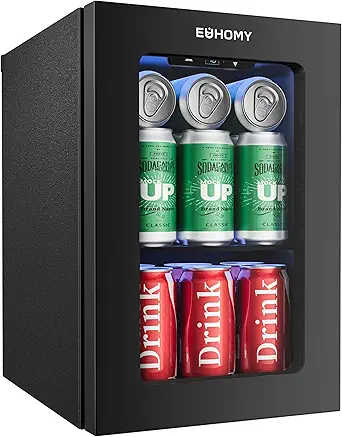 |
| Best Budget The cheapest option that still gets the job done reliably | Antarctic Star Compact Mini Fridge |  |
| Top Rated A top-rated pick with lots of positive feedback | Midea Compact Refrigerator WHS-65LB1 |  |
| Most Popular A crowd favorite that many people choose with confidence | Cooluli Classic 4L Mini Fridge |  |
| Best Seller A high-volume bestseller chosen again and again | Frostorm BC-90 Mini Fridge |  |
Upstreman BR321 3.2 Cu Ft Mini Fridge

| Capacity | 3.2 cubic feet |
|---|---|
| Freezer Capacity | 0.3 cubic feet |
| Cooling Method | Compressor |
| Defrost System Type | Manual Defrost |
| Annual Energy Consumption | 206 kwh |
The Upstreman BR321 is a straightforward 3.2 cu.ft mini fridge that pairs a modest internal layout with practical everyday features for office use. It uses a rotary scroll compressor and a manual-defrost freezer for reliable cooling, while a five-step adjustable thermostat (32°F to 50°F) lets you tune temperatures for drinks, dairy, and produce. The interior offers two adjustable glass shelves, a crisper drawer, and three door bins so bottles and snacks can be organized without wasted space. The reversible door and adjustable leveling feet make placement flexible in tight office corners, and the unit runs quietly at about 38 dB while meeting ETL and energy efficiency expectations. Expect basic, no-frills operation: defrosting is manual, there is no lock or advanced temperature display, and the 0.3 cu.ft freezer is only suitable for short-term frozen items. For a small office refrigerator that prioritizes compact footprint, quiet operation, and simple adjustable storage, this model delivers sensible performance at a practical level.
Best for: Buyers who want a quiet, energy-conscious office fridge with flexible shelving and a small freezer for beverages and perishables and who value a compact footprint and straightforward controls.
Less Ideal for: People needing a large freezer capacity, digital temperature management, or secure/locked storage should consider different models.
- Compact 3.2 cu.ft capacity fits small offices and tight spaces
- Adjustable thermostat with five temperature levels for diverse foods and drinks
- Reversible door and leveling feet allow flexible placement
- Two adjustable glass shelves plus door bins and crisper drawer for organized storage
- Quiet operation (~38 dB) suitable for work or study environments
- Manual defrost freezer requires periodic maintenance
- Small 0.3 cu.ft freezer cannot store large frozen items or ice cubes
- No lock, digital controls, or advanced temperature readout
Verdict: A quiet, energy-efficient 3.2 cu.ft mini fridge that balances compact size, flexible storage, and simple temperature control for everyday office use.
Honeywell Beverage Cooler H115BCS
| Capacity | 116 Can |
|---|---|
| Cooling Method | Thermoelectric |
| Temperature Range | 34°F–50°F |
| Door Material Type | Tempered Glass |
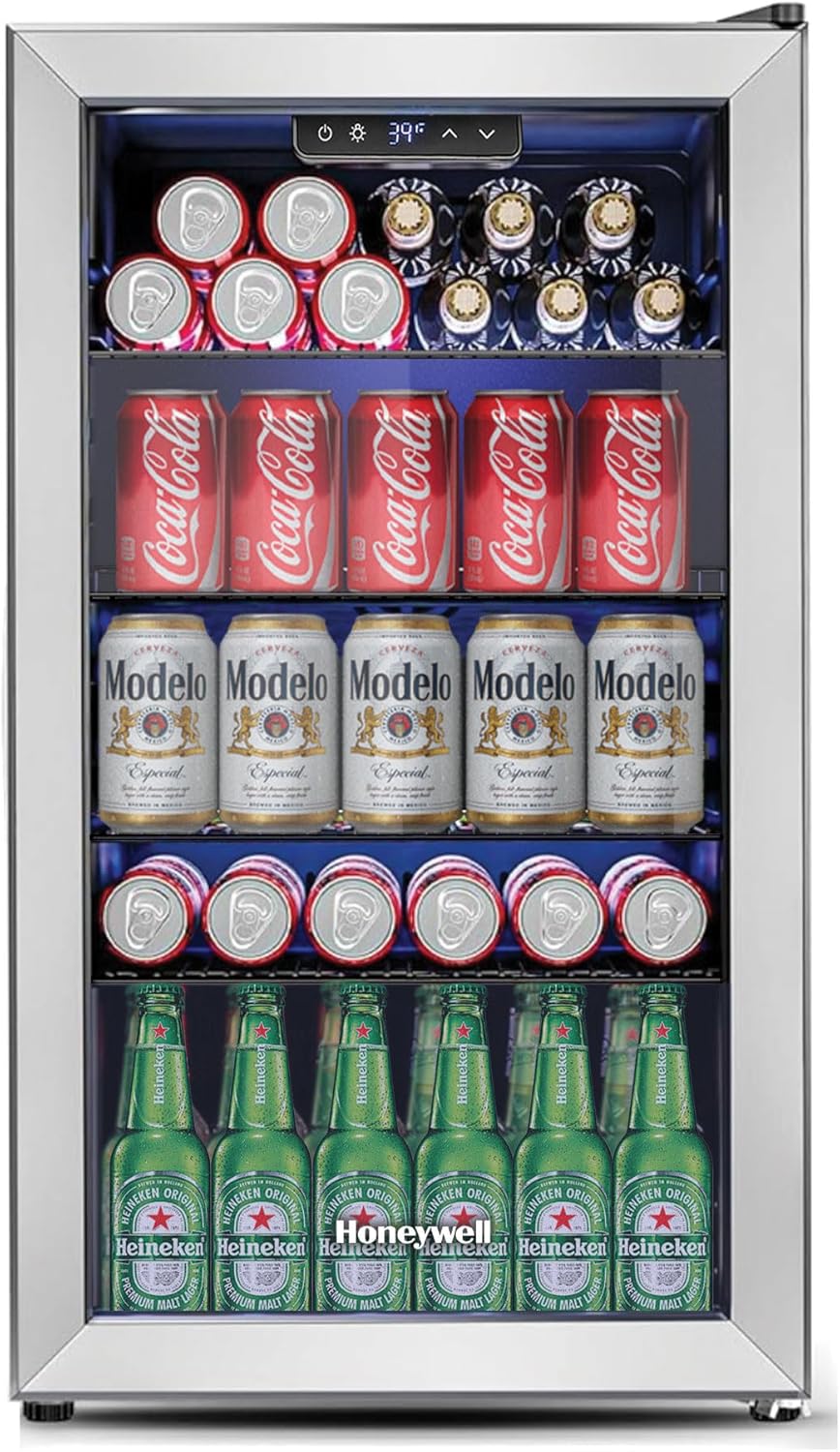
This Honeywell 116-can beverage cooler is a compact undercounter display refrigerator built for steady beverage storage in an office or small bar. It uses thermoelectric cooling and a digital thermostat with a 34°F–50°F range so you can dial in serving temperatures for beer, soda, or white wine, while the tempered three-pane glass door protects contents and provides soft interior LED lighting for easy selection. The interior includes three PVC-coated slide-out wire shelves and adjustable legs for leveling under counters, and the reversible door and recessed handle make placement flexible. Practical benefits are consistent, quiet operation suitable for shared spaces and the clear glass front that keeps inventory visible. Key limitations are that thermoelectric cooling can be less effective in very warm rooms and this model is intended for beverages rather than long-term food storage or heavy commercial use.
Best for: Buyers who prioritize steady, presentable beverage storage for an office, breakroom, or hospitality nook and want precise temperature control and easy access to inventory.
Less Ideal for: Those needing heavy-duty commercial refrigeration, rapid cooling in very warm rooms, or a unit for storing full meals should look at compressor-based refrigerators with larger capacity.
- Adjustable digital thermostat for precise beverage temperatures between 34°F and 50°F
- Tempered three-pane glass door with interior LED lighting for visible, presentable storage
- Slide-out PVC-coated wire shelves that are adjustable and removable for different can and bottle sizes
- Reversible door and adjustable legs allow flexible undercounter installation
- Thermoelectric cooling is less powerful than compressor systems in hot ambient conditions
- Designed for beverages rather than full-size food storage or heavy commercial workloads
Verdict: Choose this cooler when you want a quiet, countertop-friendly fridge that keeps drinks at precise serving temperatures and presents them behind a glass door.
EUHOMY WC-6B Mini Fridge

| Capacity | 18 liters |
|---|---|
| Cooling Method | Compressor |
| Temperature Range | 40°F to 61°F |
| Voltage | 115 volts |
The EUHOMY WC-6B is a countertop compressor mini fridge sized for small office or dorm use, with an 18L (0.6 cu ft) capacity that fits about 24 cans. It uses a compressor cooling system and offers digital temperature control from 40°F to 61°F, so it chills steadily and recovers temperature quickly after the door opens. The single removable shelf lets you switch between cans and a few short bottles, and the LED interior light and UV-protected door help visibility and reduce light exposure. Noise is kept low at under 40 dB, making it unobtrusive in a quiet office. Setup is simple since it is freestanding and runs on standard 115-volt power, but the net capacity is small so it is not suitable for storing large quantities or full-size bottles. Energy consumption is listed and the unit is lightweight for easy repositioning, though manual defrosting is required. For a small workspace wanting reliable, quiet cooling without a lot of extras, this model covers the basics effectively.
Best for: Office users who need a small, quiet refrigerated spot for drinks or single-day snacks and prioritize steady cooling and minimal desk noise.
Less Ideal for: People who need to store many beverages, large bottles, or a wider range of food items should look for larger-capacity units instead.
- Compressor cooling with digital temperature control for stable, quick chilling
- Quiet operation under 40 dB suitable for office environments
- Compact footprint that fits on countertops and is easy to move
- Removable shelf and LED light provide flexible storage and visibility
- Very limited net capacity best for a few drinks rather than bulk storage
- Manual defrost requires occasional maintenance
Verdict: A small, quiet compressor mini fridge that fits on an office countertop and reliably chills a day's worth of drinks.
Antarctic Star Compact Mini Fridge

| Capacity | 4 liters |
|---|---|
| Cooling Method | Thermoelectric |
| Voltage | 115/12V DC option |
| Number Of Shelves | 1 |
This Antarctic Star compact mini fridge is a countertop thermoelectric cooler intended for short-term storage of drinks, snacks, and cosmetics in small spaces like an office or dorm. It runs on AC or DC power, so you can plug it into standard 115V outlets or a 12V car socket, and the removable shelf lets you switch between storing cans and taller items. The unit cools approximately 32°F–59°F and claims a temperature drop of about 53°F–64°F below ambient within an hour or two, while quiet operation (around 25 dB) makes it suitable for workspaces. Because it uses thermoelectric cooling, it is lightweight and vibration-free but will not reach deep-freeze temperatures or perform as efficiently as compressor models in very warm rooms. Capacity is limited to about six cans, so it works best for individual use rather than shared office stocking. Build is simple and portable, with a right-hand door and an electronic lock for basic security.
Best for: Someone who needs a very compact, portable fridge for a single person’s drinks or skincare in an office or dorm and prioritizes low cost and quiet operation.
Less Ideal for: Teams wanting to store large quantities, users who need freezer temperatures, or those who require strong cooling in hot rooms should look at larger compressor models.
- Compact 4L capacity fits on a desk or small countertop
- AC/DC power support for home or car use
- Removable shelf increases internal flexibility for cans or taller items
- Quiet operation around 25 dB suitable for office environments
- Lightweight and portable design for easy relocation
- Very small capacity not suitable for multiple users
- Thermoelectric cooling is less effective than compressor units in hot conditions
Verdict: A budget-friendly, ultra-compact countertop fridge that delivers quiet, portable cooling for one person in an office or small space.
Midea Compact Refrigerator WHS-65LB1

| Capacity | 1.6 cubic feet |
|---|---|
| Annual Energy Consumption | 207 kilowatt hours per year |
| Defrost System Type | Automatic |
| Cooling Method | Compressor |
| Door Orientation | Reversible |
The Midea 1.6 cu.ft. compact refrigerator is a small, energy-efficient fridge intended for dorms, offices, or tight kitchen nooks. It uses an R600A compressor and is ENERGY STAR certified, so it runs with relatively low annual energy consumption while keeping beverages and small food items chilled. The unit has a separate chiller compartment for quick cooling, an adjustable thermostat with multiple settings, and a removable shelf that lets you fit taller or odd-shaped items. The reversible door increases placement flexibility in offices where layout matters, and the fridge operates quietly enough for shared workspaces. Practical limits are its small 1.6 cu.ft. capacity and the chiller is only for short-term cooling, so it will not freeze or store large frozen items. The unit is freestanding and best used for daily drinks, snacks, and meal prep items rather than full kitchen storage. For a reliable, low-cost secondary refrigerator in an office, this model delivers consistent cooling and low energy use, but expect constrained interior space.
Best for: Buyers who prioritize a dependable, energy-efficient secondary fridge for an office or small shared space and want simple, no-frills cooling that runs quietly and predictably.
Less Ideal for: Anyone needing significant refrigerated capacity or a true freezer for long-term frozen storage should choose a larger or dual-compartment model instead.
- ENERGY STAR certified with low annual energy consumption (207 kWh/year)
- Reversible door offers flexible placement in tight office layouts
- Adjustable thermostat and removable shelf for simple interior customization
- Quiet compressor operation suitable for shared workspaces
- Very limited 1.6 cu.ft. capacity restricts how much food or drink it can hold
- Chiller compartment is not a freezer and cannot store long-term frozen items
Verdict: A compact, energy-efficient mini fridge built for quiet, reliable everyday cooling in offices and small shared spaces.
Cooluli Classic 4L Mini Fridge

| Capacity | 4 liters |
|---|---|
| Cooling Method | Thermoelectric |
| Power Source | AC/DC/USB |
| Cools down to | 35°–40°F below ambient |
| Warms up to | 149°F (65°C) |
The Cooluli Classic 4L is a tiny thermo-electric mini fridge that cools or warms small items and is built for portability and flexibility. It runs on AC, DC or USB power and includes cords for each, so it can sit on a desk, travel in a car, or be powered by a 2A power bank for short periods. Inside the 4-liter cavity there are two small wire shelves and a single door shelf, enough for a few cans, skincare products, medications, or breast milk but not full-size containers. Cooling and warming modes are selected with a simple switch and the unit uses a semiconductor system that stays quiet and refrigerant-free. It is lightweight with a molded top handle for carrying and meets ETL specification for countertop use. Practical limitations are the very small capacity and modest temperature deltas inherent to thermoelectric cooling, so it will not replace a full fridge or a medical-grade refrigerator for strict temperature control.
Best for: Buyers who want a compact, portable cooler for an office desk or car and prioritize quiet operation and flexible power options backed by strong user feedback.
Less Ideal for: People who need to store large quantities, full-size food containers, or require strict, certified temperature control for long-term medical storage should look elsewhere.
- Multiple power options (AC, DC and USB) for desk, car, or portable use
- Dual-purpose cooling and warming with a simple switch
- Very quiet thermoelectric operation and no refrigerants
- Included cords and molded handle make it easy to move and start using right away
- Only 4 liters of usable capacity, fits a few cans or small skincare items
- Thermoelectric cooling has limited temperature drop compared with compressor fridges
- Not suitable for precise, long-term medical refrigeration needs
Verdict: A compact, quiet, plug-and-play mini fridge that’s ideal for keeping drinks, skincare, or meds cool on an office desk or in a car.
Frostorm BC-90 Mini Fridge

| Capacity | 3.2 cubic feet |
|---|---|
| Freezer Capacity | 0.3 cubic feet |
| Defrost System Type | Automatic |
| Voltage | 115 |
| Annual Energy Consumption | 210 kilowatt hours per year |
The Frostorm BC-90 is a compact upright mini fridge that pairs a 3.2 cu ft chilled compartment with a 0.35 cu ft internal freezer, making it useful for offices or small living spaces that need both cold drinks and occasional frozen storage. Setup is simple as a freestanding unit and the reversible door helps place it in tight layouts. A manual 1–5 mechanical thermostat and recommended mid setting provide straightforward temperature control, while adjustable glass shelves and door bins let you organize bottles, snacks, and meal prep. The unit is ETL certified and rated for modest energy use at about 0.6 kWh per day, so running costs are low. Expect the freezer to handle ice and short-term frozen items rather than deep freezing large quantities, and the fridge is heavier than some compact alternatives which can make moving it less convenient. For routine office refrigeration needs the BC-90 is practical, quiet, and economical, but those needing larger or true chest-style freezing capacity should look elsewhere.
Best for: Buyers who want a reliable, easy-to-use office refrigerator that balances usable chilled space with a small freezer and prioritizes low running costs and simple controls.
Less Ideal for: Not a good choice if you need heavy-duty freezing capacity, frequent portability, or a very compact under-desk footprint.
- Combined refrigerator and upright freezer compartment for both chilled and frozen items
- 3.2 cu ft capacity fits beverages, meal prep, and office snacks
- Reversible door lets you position the fridge to suit tight spaces
- Adjustable glass shelves and door bins support flexible organization
- ETL certified with modest daily energy consumption for lower running costs
- Freezer compartment is small and suited only for ice and short-term frozen storage
- Unit weight makes it less convenient to move frequently
Verdict: A dependable, energy-efficient mini fridge with an internal freezer that suits office use when you want straightforward controls and reliable everyday cooling.
Choosing the Right Mini Fridge for Office Use: Key Factors to Consider
Capacity and Usable Layout
Capacity matters, but usable layout matters more in compact fridges. A 3.2 cu ft rating can be very different depending on shelf arrangement, door bins, and whether the freezer compartment is removable. Consider how you plan to store items—tall bottles, milk cartons, takeaway containers, or lunch boxes—and choose a layout that accommodates those shapes.
Look for adjustable shelving and door bin flexibility so you can adapt the interior to changing needs. In offices, shared fridges are often loaded unevenly, so the ability to reposition shelves or remove a small freezer box can make a unit far more practical than a slightly larger but rigidly partitioned model.
Noise Output and Compressor Type
Noise is a primary concern in offices. The decibel rating and the compressor type determine whether a unit blends into background ambient noise or becomes a distraction during quiet tasks. Compressor-driven fridges tend to be colder and more consistent but can produce noticeable hums and cycles. Thermoelectric units are quieter and vibration-free but usually provide less cooling power, especially in warmer rooms.
Pay attention to where the fridge will sit relative to desks and meeting areas. A slightly larger unit placed in a dedicated break area may be fine, whereas a compact, low-noise model is better for individual offices or open-plan spaces where sound carries.
Temperature Control and Food Safety
Consistent temperature control keeps perishables safe and helps avoid odors and premature spoilage. Look for models with adjustable thermostats and clear temperature ranges so you can maintain safe refrigeration for dairy and prepared foods. Some units feature simple mechanical dials while others offer digital controls and readouts that make it easier to confirm set points at a glance.
If you plan to store a mix of drinks and lunches, ensure the fridge can maintain recommended refrigeration temperatures under typical office use patterns, such as frequent door openings during breaks.
Energy Use and Running Costs
Because office fridges run continuously, energy efficiency affects operating cost and environmental impact. Check energy consumption ratings where available and prefer models with efficient compressors and good insulation. Lower-wattage models or those rated for low annual kWh can save money over time, especially if multiple units run across a workplace.
Also consider features that reduce wasted cycling, such as tighter door seals and good internal insulation, which help the compressor run less frequently and stabilize internal temperatures.
Footprint, Placement, and Ventilation
Measure the installation spot carefully. Clearance for ventilation, door swing, and cable routing are common practical stumbling blocks. Units need a few inches of space behind and sometimes above for proper airflow; insufficient clearance increases run time and noise and can shorten service life.
Decide whether a freestanding countertop, under-desk, or floor-standing placement is best. Also consider whether the door hinge must be reversible to fit the layout and whether the unit's exterior finish matches a professional office aesthetic.
Maintenance, Cleaning, and Durability
Office fridges get heavy use and occasional neglect, so ease of cleaning and robust materials matter. Removable shelves, spill-proof surfaces, and a simple defrost routine reduce downtime for cleaning. Durable door seals, corrosion-resistant interiors, and a reliable hinge mechanism minimize repairs and messy leaks.
Consider models with straightforward serviceability and accessible condensers or filters if routine cleaning is required. A small up-front attention to maintenance features saves time and reduces the risk of odors or mold in busy shared fridges.
Quiet Vs Cooler: Choosing the Right Cooling Technology
Mini fridges use either compressor-based refrigeration or thermoelectric cooling, and each has tradeoffs for office use. Compressor units deliver stronger cooling and more consistent temperatures, which is helpful for mixed food storage. However, they typically produce more noise and vibration during compressor cycles.
Thermoelectric models are nearly silent and vibration-free, making them attractive for private offices or open-plan areas where noise matters most. They struggle in warm rooms and do not freeze items well, so they work best for beverages and short-term food storage.
- Compressor: Colder, more reliable in warm rooms, modest noise
- Thermoelectric: Very quiet, limited cooling capacity, best for drinks
Placement Planning and Ventilation Tips
Allow adequate clearance as specified by the manufacturer. Poor ventilation increases run time and noise and can reduce cooling performance. Avoid fully enclosed cabinetry unless the unit is rated for built-in use and follow recommended clearances on the top and rear.
Place the fridge away from direct sunlight and heat sources, such as radiators, space heaters, or windows with strong afternoon sun. Also plan for door swing and easy access so coworkers do not block walkways when retrieving items.
- Keep at least a few inches of rear clearance for airflow
- Avoid placing under direct sunlight or near heat sources
- Check door swing and hinge reversibility before final placement
Organizing a Shared Office Fridge
Shared fridges can become cluttered and unhygienic without simple ground rules and organization. Use clear bins or labeled shelves to separate personal items, beverages, and prepared foods. Encourage staff to remove expired items regularly and to clean spills immediately to prevent odors.
Designate tall bottle zones and small-item bins so that space is used efficiently. If the unit includes a small freezer compartment, reserve it for shared freezer-stable items or designate it for items that need long-term storage.
- Use labeled shelves or baskets for personal items
- Assign a weekly cleanup rotation to reduce odors
- Reserve freezer space for communal or long-term items
Energy Savings and Office Sustainability
Small changes can reduce the cumulative energy impact of mini fridges in an office. Choose models with better insulation and efficient compressors, and avoid overstocking the fridge which makes the compressor work harder. Regularly defrost manual-freeze compartments if frost builds up, since heavy frost reduces efficiency.
Consider grouping beverages together and keeping the door closed as much as possible during peak hours. Also, check for Energy Star or equivalent efficiency indications when available and prefer models with lower continuous power draw for multi-unit environments.
- Defrost manual-freeze compartments when frost exceeds a quarter-inch
- Limit frequent door openings by organizing high-use items in front
- Consolidate items to reduce empty space that requires more cooling
Security, Aesthetics, and Office Policy
Decide whether you need a lock for confidential or perishable office items. Some mini fridges offer keyed locks or compatible hasp locations for a small padlock. Choose a finish and size that fits the office decor and visual expectations, whether that is a discreet under-desk unit or a stainless-style unit for a communal break area.
Set clear policies about labeling, removal of unlabeled food, and acceptable items to store. Clear guidelines reduce conflicts and keep the unit sanitary and functional for everyone.
- Look for reversible doors and professional finishes for shared areas
- Consider lock options if office security or shared perishables are a concern
- Publish a simple fridge etiquette policy to minimize disputes
How We Chose the Best Mini Fridge for Office Use
We prioritized features that matter most to people buying a mini fridge for office use: interior storage layout and usable capacity, noise output during typical work hours, temperature control and food safety, energy efficiency for continuous operation, and build quality for low-maintenance ownership. We focused on models that balance compact footprints with practical shelving, reversible doors or right-hand/left-hand access, and reliable thermostat controls rather than specialty or novelty designs. Units were excluded if they were designed primarily for outdoor, automotive, or refrigeration lab use, or if they lacked clear specifications for noise or interior configuration. We favored fridges with adjustable shelving, clear crisper or beverage storage options, and straightforward user controls. Durability features such as reversible doors, lock options, and corrosion-resistant interiors were also important because office units face frequent opening and varied contents. Our selection process emphasized real-world usability in shared workspaces rather than extreme cooling performance or single-use specialty features.
Our full evaluation process is outlined in our review methodology.
FAQ
How quiet should a mini fridge be for an open-plan office?
Aim for a unit with a low operational decibel rating and minimal vibration. Models under typical conversation noise levels are less likely to be disruptive. Thermoelectric units are usually quieter but offer less cooling power than compressors.
Can a mini fridge stay on 24/7 in an office?
Yes, these units are designed for continuous operation, but energy use and ventilation matter. Choose an efficient model, ensure adequate airflow, and follow maintenance recommendations to keep it running reliably.
Is a small freezer compartment worth having in an office mini fridge?
A small freezer is useful for ice packs or long-term storage but occupies usable refrigerator space. If you mainly store beverages, a freezer may be unnecessary. Consider a removable freezer shelf if you want flexibility.
How often should we clean a shared office mini fridge?
Clean spills immediately and perform a more thorough cleaning at least once a month. Remove expired food weekly and wipe shelves with a mild detergent. More frequent cleaning is recommended in high-use communal spaces.
Will a countertop mini fridge cool as well as a full-size fridge?
Countertop and compact fridges can maintain safe refrigeration for small loads but have less thermal mass, so they warm up faster with frequent door openings. They are best for short-term storage and moderate volumes rather than replacing a full-size refrigerator.
Final Verdict
Choosing the right mini fridge for office use means balancing capacity, noise, and temperature stability against the available footprint and maintenance expectations. Prioritize usable interior layout and low noise for work-adjacent placements, or select stronger cooling if you regularly store perishable lunches. Factor in ventilation needs and energy efficiency if multiple units will run continuously. A clear policy for labeling and cleaning combined with a unit that offers adjustable shelving and dependable temperature control will keep the office fridge practical and low-maintenance. Focus on the tradeoffs most important to your workspace and pick the configuration that aligns with daily habits and placement constraints.