
Note: This article contains affiliate links. If you click on these links and make a purchase, we may earn a small commission at no extra cost to you. This helps support our research and content. Read our full affiliate disclosure here.
Finding the right mini fridge for small kitchens matters because limited space magnifies every design decision. You need a unit that balances usable interior capacity, a compact footprint, and reliable cooling without overwhelming your layout or utility load. This guide shortlists the top compact refrigerators suited to tight kitchen footprints and apartment cookspaces. We evaluated models across practical factors that affect daily use in small kitchens, including internal layout, footprint, energy efficiency, and noise. Read on for our top picks and the evaluation criteria that make these units well suited to cramped or efficiency-style kitchens.
Top Picks at a Glance
| Best Overall The best all-around choice for most situations | BLACK+DECKER Compact Refrigerator BCRK25V |  |
| Best Quality Built to a higher standard if you want something more solid | EUHOMY 3.2 cu ft Mini Fridge |  |
| Best Value The sweet spot between price and what you get | KRIB BLING Mini Refrigerator |  |
| Best Budget The cheapest option that still gets the job done reliably | Frestec 1.7 Cu Ft Mini Fridge |  |
| Top Rated A top-rated pick with lots of positive feedback | Midea Compact Refrigerator WHS-65LB1 |  |
| Most Popular A crowd favorite that many people choose with confidence | Upstreman 3.2 Cu.Ft Mini Fridge BR321 |  |
| Best Seller A high-volume bestseller chosen again and again | Frostorm BC-90 Mini Fridge |  |
BLACK+DECKER Compact Refrigerator BCRK25V

| Capacity | 2.5 cubic feet |
|---|---|
| Freezer Capacity | 0.2 cubic feet |
| Cooling Method | Compressor |
| Refrigerant | R-600A |
| Energy Certification | Energy Star |
The BLACK+DECKER 2.5 cu. ft. compact refrigerator is a freestanding mini fridge designed for tight spaces like small kitchens, dorms, or home offices. It uses a compressor cooling system with R600a refrigerant and offers a full-width chiller compartment (not a freezer) plus two slide-out glass shelves and door bins for cans and a 2-liter bottle. Temperature is set with a simple mechanical dial across seven settings, and the reversible door and adjustable leveling legs make placement flexible. Because it is ENERGY STAR certified and uses a scroll compressor, it runs efficiently compared with thermoelectric units and can handle everyday food and beverage storage reliably. The small chiller holds ice trays and chilled items but is not meant for long-term freezing. Installation is plug-and-play as a freestanding unit, though users should plan for the compact internal layout when storing taller items. If you want a straightforward, energy-efficient mini fridge that prioritizes usable shelf space and reliable cooling over a true freezer, this model performs well.
Best for: Buyers who need a reliable, energy-efficient mini fridge that fits under counters or in very small kitchens and want straightforward manual controls and flexible shelving.
Less Ideal for: People who need a true freezer for long-term frozen storage or who require large internal capacity for bulk food storage.
- ENERGY STAR certified compressor cooling for better efficiency than many compact alternatives
- Two removable glass shelves and door bins provide flexible, usable storage
- Reversible door and leveling legs allow flexible placement in tight kitchens
- Mechanical dial with seven settings makes temperature adjustments simple and predictable
- Chiller compartment is not a full freezer and will not keep items fully frozen long-term
- Compact capacity limits storage for larger families or bulk items
Verdict: A compact, energy-efficient compressor mini fridge that maximizes usable shelf space for small kitchens and tight spots.
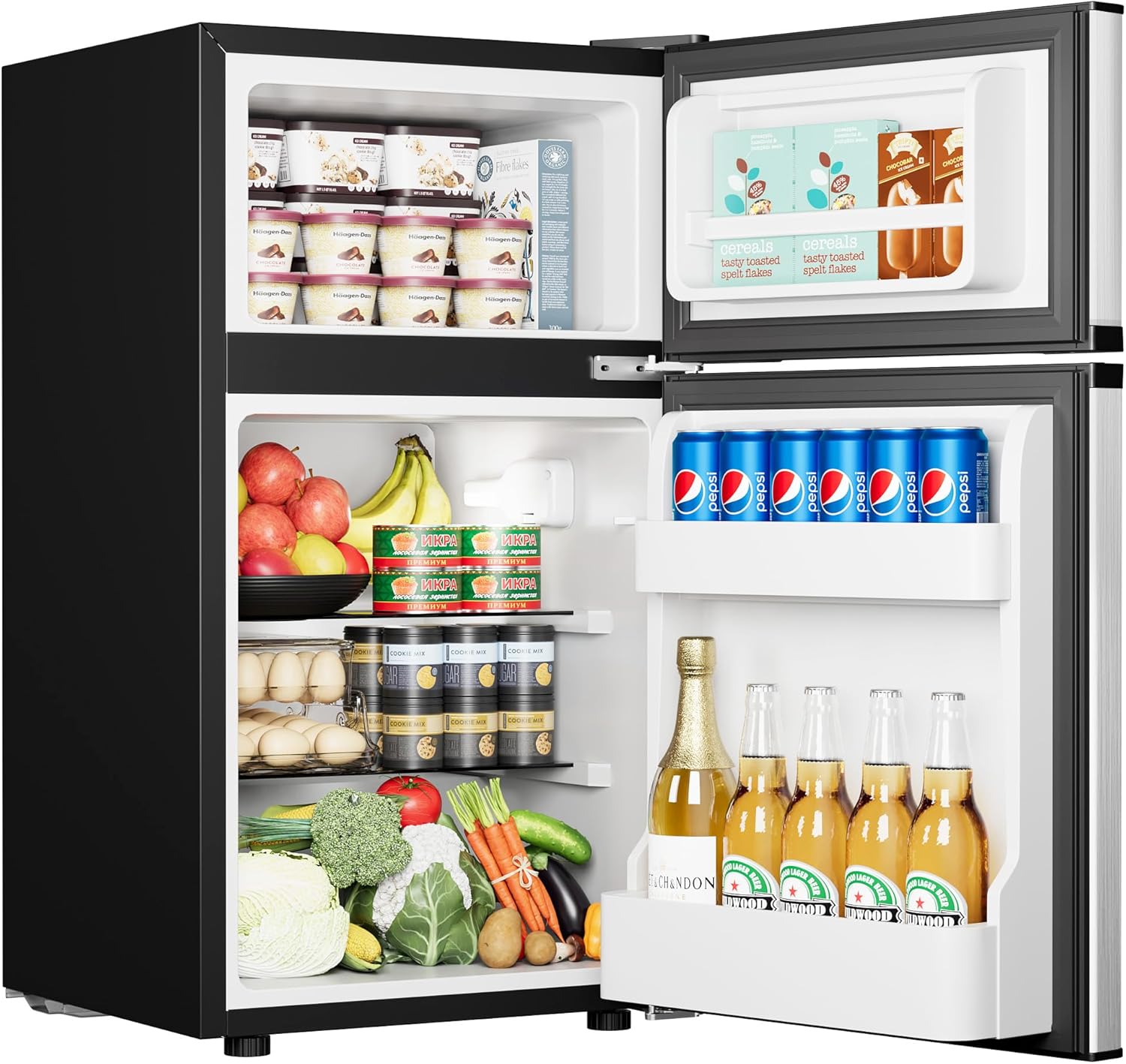
EUHOMY 3.2 cu ft Mini Fridge
| Capacity | 3.2 cubic feet |
|---|---|
| Freezer Capacity | 0.96 cubic feet |
| Cooling Method | Compressor |
| Defrost System Type | Automatic |
| Voltage | 115 volts |
This EUHOMY mini fridge pairs a small refrigerator compartment with a 0.96 cu ft top freezer to give usable fridge and freezer space in a compact footprint. It uses a rotary scroll compressor with inverter capability, so it cools efficiently for everyday foods and cold drinks while keeping noise low enough for kitchens or small open-plan spaces. Adjustable glass shelves, a crisper drawer and door bins make organization straightforward, and the interior LED light helps when accessing items in tight kitchen layouts. The reversible door and adjustable feet add installation flexibility for narrow or oddly oriented kitchen nooks. Energy use is listed and the unit meets UL specifications, but buyers should expect modest annual energy draw relative to its size. The freezer is best for short-term frozen items rather than bulk long-term storage, and the unit's compact capacity limits how much fresh food you can store at once. For a small kitchen that needs both a fridge and a freezer without a full-size appliance, this model delivers sensible cooling performance and practical features.
Best for: Buyers who prioritize dependable cooling performance in a tight kitchen and need a true fridge-plus-freezer arrangement that fits small footprints.
Less Ideal for: Those who need large freezer capacity or want a primary refrigerator for a multi-person household should consider larger units instead.
- Combined fridge and top freezer gives both refrigerated and frozen storage in a compact footprint
- Compressor with inverter and rotary scroll design for efficient, relatively quiet cooling
- Adjustable glass shelves and crisper drawer allow flexible organization
- Reversible door and adjustable feet improve installation options for tight kitchens
- Interior LED light makes locating items easier in small spaces
- Freezer space is limited and not suited for large or long-term frozen storage
- Compact capacity restricts how much fresh food a small household can store
Verdict: A compact, performance-focused mini fridge that delivers real fridge and freezer functionality for small kitchens where space and quiet operation matter.
KRIB BLING Mini Refrigerator

| Capacity | 3.5 cubic feet |
|---|---|
| Freezer Capacity | 1.2 cubic feet |
| Cooling Method | Compressor |
| Defrost System Type | Manual Defrost |
| Installation Type | Freestanding |
This compact refrigerator pairs a 3.5 cubic foot fresh food compartment with a 1.2 cubic foot top freezer to give sensible refrigerated and frozen storage for a dorm, office, or small kitchen. It uses a compressor cooling system with a seven-level adjustable thermostat and removable glass shelves so you can organize bottles and food and tweak temperatures for better preservation. The unit is freestanding, has a right-hand door swing, and a quiet operation claim that makes it suitable for bedrooms or shared spaces. Practical touches include an electronic lock, included ice tray, and guidance to let the compressor sit upright 24 hours after shipping. Expect manual defrosting rather than frost-free convenience, and the listed annual energy number is relatively high, so it is not optimized for the lowest possible power use. The fridge is compact and easy to place, but buyers should plan for the need to defrost occasionally and accept basic, no-frills controls.
Best for: Buyers who need a straightforward, space-saving refrigerator with decent cold performance and adjustable temperature control for a dorm, small kitchen, office, or bedroom.
Less Ideal for: People who want a frost-free, ultra-energy-efficient model or advanced temperature management should consider other options.
- Compact 3.5 cu ft capacity with a 1.2 cu ft freezer fits tight spaces
- Compressor cooling provides reliable cold performance versus thermoelectric units
- Removable glass shelves allow flexible storage and easier cleaning
- Seven-level adjustable thermostat for targeted temperature control
- Electronic lock adds security for shared or public spaces
- Manual defrost freezer requires periodic maintenance to remove frost
- Annual energy consumption figure is relatively high compared with efficient models
Verdict: A practical, compressor-cooled mini fridge that maximizes usable storage and temperature control in tight kitchen spaces.
Frestec 1.7 Cu Ft Mini Fridge

| Capacity | 1.7 cubic feet |
|---|---|
| Freezer Capacity | 0.2 cubic feet |
| Cooling Method | Compressor |
| Defrost System Type | Manual |
| Noise Level | 37 dB |
This 1.7 cubic foot Frestec mini fridge is a simple, space-saving refrigerator meant for dorms, offices, or tiny kitchens. It uses a compressor cooling system with a 0.2 cu ft freezer on top and one glass shelf that can be removed to fit taller items, while the reversible door and adjustable feet make placement flexible. Temperature is set using a 0–6 thermostat knob and defrosting is handled with a one-touch manual defrost control, keeping maintenance straightforward. It is relatively quiet at about 37 dB and rated to use roughly 0.55 kWh per day, which helps on energy bills for continuous use. The interior includes three door shelves for bottles and small items but capacity is limited, so it works best as a supplemental fridge rather than a primary kitchen unit. Buyers should expect basic, no-frills operation without advanced features like automatic defrost, digital controls, or high freezer capacity.
Best for: Buyers needing an inexpensive, compact secondary refrigerator for a dorm, office, or tiny kitchen who prioritize space savings and low running noise over advanced features.
Less Ideal for: Anyone seeking a primary kitchen fridge, large freezer capacity, or digital controls for precise temperature management should look at larger or more feature-rich models.
- Very compact footprint fits under desks or in small kitchen nooks
- Low operating noise around 37 dB suitable for bedrooms and offices
- Reversible door and adjustable feet increase placement flexibility
- Removable glass shelf and door shelves allow basic interior organization
- Energy-efficient daily consumption (~0.55 kWh/day) for lower running cost
- Very limited overall capacity, not suitable as a full-size kitchen refrigerator
- Manual defrost requires occasional intervention
- Basic controls with no digital thermostat or advanced cooling features
Verdict: A compact, low-noise, energy-conscious mini fridge that works well as an affordable secondary refrigerator for tight kitchens and small spaces.
Midea Compact Refrigerator WHS-65LB1

| Capacity | 1.6 cubic feet |
|---|---|
| Annual Energy Consumption | 207 kilowatt hours per year |
| Defrost System Type | Automatic |
| Door Orientation | Reversible |
| Cooling Method | Compressor |
The Midea 1.6 cu.ft. compact refrigerator is a no-frills mini fridge built for small kitchens, dorms, or offices where space and energy use matter. It uses an R600a compressor and is ENERGY STAR certified, which keeps annual electricity use low while delivering steady compressor cooling and an internal chiller compartment for quick cool-downs. The single reversible door and removable glass shelf make it simple to reconfigure storage for taller bottles or odd-shaped items, and a door rack holds frequently used beverages. Controls are mechanical and straightforward, offering multiple temperature settings down toward the mid-30s Fahrenheit, and the unit runs quietly enough for close quarters. Expect basic features rather than premium extras: the chiller is intended for short-term cooling only and the single shelf limits organized capacity. For buyers prioritizing reliable, efficient refrigeration in a tight footprint, this model delivers predictable performance with minimal fuss.
Best for: Buyers who need a dependable, energy-efficient mini fridge for a small kitchen, dorm room, or office and prefer simple mechanical controls over advanced features.
Less Ideal for: Those who need significant frozen storage, large-capacity refrigeration, or advanced features like digital controls and smart connectivity should consider larger or feature-rich models.
- ENERGY STAR certified with R600a compressor for lower annual energy consumption
- Reversible door and removable shelf let you adapt layout to fit bottles and taller items
- Mechanical thermostat with multiple settings for simple temperature control
- Compact footprint fits small kitchens, dorms, and offices without taking much space
- Very limited internal capacity suitable only for small loads
- Chiller compartment is for short-term cooling and cannot reliably freeze or store frozen foods
Verdict: A compact, energy-efficient mini fridge that provides reliable, quiet cooling for small kitchens and tight spaces.
Upstreman 3.2 Cu.Ft Mini Fridge BR321

| Capacity | 3.2 cubic feet |
|---|---|
| Freezer Capacity | 0.3 cubic feet |
| Cooling Method | Compressor |
| Defrost System Type | Manual Defrost |
| Voltage | 115 volts |
The Upstreman BR321 is a compact refrigerator designed for small kitchens, dorms, offices, or bedrooms where space is limited but usable capacity matters. It uses a rotary-scroll compressor and offers a 0.3 cu ft freezer plus about 2.9 cu ft of refrigeration, split across two adjustable glass shelves and door bins for bottles and condiments. Temperature is user-controlled with five settings (32°F to 50°F) so you can tune cooling for drinks, produce, or dairy, and the reversible door and adjustable leveling feet help it fit tight layouts. The unit is relatively quiet at about 38 dB and is ETL listed and Energy Star rated, which keeps energy use modest for continuous operation. Maintenance is manual defrost, and the fridge lacks a lock or advanced features like automatic defrost or smart controls, so it is straightforward but basic. Overall it balances reasonable interior space and efficient, quiet cooling in a narrow footprint, making it a practical choice when you need a reliable small refrigerator without bells and whistles.
Best for: Buyers who want a proven, space-efficient fridge with solid user reviews and energy-conscious operation for a small kitchen, studio, dorm, or office where quiet, reliable cooling matters.
Less Ideal for: People who need a full-size freezer, automatic defrost, smart connectivity, or heavy-duty food storage for a family kitchen should look at larger or feature-rich models.
- Generous usable interior for its class with a 3.2 cu ft capacity and adjustable glass shelves
- Adjustable thermostat with five settings for flexible cooling needs
- Reversible door and adjustable leveling feet for easy placement in tight kitchens
- Quiet compressor operation (~38 dB) suitable for bedrooms or offices
- Energy Star certified and ETL listed for efficient, safe operation
- Manual defrost requires occasional maintenance
- Not suitable for freezing ice cream or making ice cubes due to limited freezer capability
- No lock, smart features, or automatic defrost functionality
Verdict: A quiet, energy-efficient mini fridge that maximizes usable storage in a narrow footprint, ideal for small kitchens and compact living spaces.
Frostorm BC-90 Mini Fridge

| Capacity | 3.2 cubic feet |
|---|---|
| Freezer Capacity | 0.3 cubic feet |
| Defrost System Type | Automatic |
| Voltage | 115 |
| Number Of Shelves | 2 |
The Frostorm BC-90 is a compact upright mini fridge designed for small kitchens, dorms, or offices that need a bit more usable space without a full-size appliance. It offers 3.2 cubic feet total capacity with a 0.35 cu ft upright freezer for ice and short-term frozen items, plus two adjustable glass shelves and door bins to organize drinks and groceries. Temperature is controlled with a simple 1–5 mechanical dial and the unit is ETL certified and rated to use standard 115V power. The reversible door and freestanding installation give placement flexibility in tighter kitchen layouts. It is marketed as energy efficient, consuming about 0.6 kWh per day, which keeps operating costs low. Expect basic, reliable cooling rather than precise digital temperature control, and the freezer is best suited to small items rather than bulk frozen storage; manual defrosting of the freezer area is the maintenance approach. For users who want straightforward performance and low daily running costs, this model covers essentials without complicated features.
Best for: Buyers who prioritize low operating cost, simple reliable cooling, and flexible placement in small kitchens or studio apartments.
Less Ideal for: Users who need large or long-term frozen storage, precise temperature control for sensitive foods, or advanced smart features.
- Generous 3.2 cu ft total capacity for a mini fridge, with a dedicated freezer compartment
- Adjustable glass shelves and door bins for flexible organization
- Reversible door allows installation in tight kitchen layouts
- Energy-efficient operation with low daily power consumption
- ETL certified for basic safety and standard 115V compatibility
- Freezer is small and suited only to ice and short-term frozen items
- Mechanical thermostat lacks precise digital control
Verdict: A practical, energy-efficient mini fridge that gives small kitchens a roomy 3.2 cu ft footprint with a compact freezer and simple dependable controls.
Choosing the Right Mini Fridge for Small Kitchens: Key Factors to Consider
Footprint and Clearance
Measure the available floor or counter space before choosing a mini fridge. The listed cabinet dimensions do not always reflect required clearance for ventilation and door swing. In small kitchens, losing even a few inches to poor fit can block walkways or prevent cabinet doors from opening fully.
Consider the orientation of nearby cabinets and whether the unit will sit under a counter or stand alone. Reversible doors and shallow-depth models help in tight aisles. Also confirm required side, rear, and top clearances in the product specifications to ensure adequate airflow and long-term reliability.
Usable Interior Capacity
Pay attention to how interior space is arranged rather than only the total cubic feet. Shelf positions, their removability, and door-bin sizing determine what you can actually store. A fridge with flexible shelving and a tall door bin will handle bottles and meal prep containers more effectively than a slightly larger unit with fixed shelves.
If you need a freezer compartment, check its actual size and whether it impedes usable refrigerator shelving. For meal prep and leftovers, shallow but wide shelves can be more practical than a deep, awkward layout. Think about the items you commonly refrigerate and match the interior configuration to those needs.
Energy Consumption and Power
In small kitchens, especially in older buildings or efficiency apartments, circuit capacity may be limited. Choose a unit with modest energy consumption to avoid excessive load on the kitchen circuit and to keep running costs down.
Look for energy-efficient compressors or well-insulated designs. Consider estimated annual energy use and any energy-certification labels. Lower-power models often sacrifice some cooling speed, so balance efficiency with the need for rapid temperature recovery after door openings.
Noise and Vibration
Because mini fridges in small kitchens are often near living spaces or bedrooms, operating noise matters. Compressor cycles, fan noise, and vibration can be disruptive in compact apartments. Check reported operating decibel levels when available and look for units with vibration-dampening feet or quieter rotary compressors.
Placement affects perceived noise as well. A unit tucked into cabinetry may amplify vibration if it touches surrounding surfaces. Allow a small vibration gap and use anti-vibration pads if you find the unit transmits sound into cabinets or counters.
Temperature Control and Cooling Performance
Consistent interior temperatures preserve food and reduce waste. Evaluate how precisely a mini fridge can hold safe refrigeration temperatures across the whole cabinet, not just at a single point. Some small units have simple dial thermostats while others offer more precise digital controls.
Consider how quickly the fridge recovers after the door is opened and whether the design promotes even cooling across shelves. If you use the freezer section for ice or frozen meals, verify that it reaches and maintains standard freezer temperatures without excessively chilling adjacent shelf space.
Maintenance and Serviceability
Routine upkeep is straightforward for some mini fridges and more involved for others. Removable shelving, accessible condenser coils, and a defrost procedure that matches your tolerance for manual maintenance are important factors in a small kitchen environment where access may be limited.
Check whether defrosting is manual or automatic, how easy it is to clean spill-prone surfaces, and if the door seal is replaceable. In tight spaces, being able to slide the unit out for cleaning or service without dismantling surrounding cabinetry is an advantage.
Sizing a Mini Fridge to Your Kitchen Layout
Start by sketching the placement area and measuring width, depth, and height precisely. Account for the door swing, hinge side, and any handles that add to the overall depth. For under-counter installations, confirm that the unit fits under the counter lip and that venting requirements match the installed location.
Think vertically when horizontal space is scarce. Taller, narrower models often provide more usable shelving while keeping a small footprint. If you plan to put the unit on a raised platform or rolling cart, ensure stability so the door aligns correctly and the fridge sits level for proper drainage and operation.
- Measure both the appliance and the clearance needed to fully open the door.
- Confirm whether the model requires vents in the rear or front for airflow.
- Consider shallow-depth models designed for tight counters or alcoves.
Organizing Interior Space for Maximum Usability
Use removable bins and stackable containers to make the most of limited interior volume. Bottle racks and slim door bins free up shelf area for meal containers and produce. Clear, uniform containers help you see contents at a glance and prevent small items from getting lost in the back.
Reserve a dedicated shelf or bin for leftovers to avoid cross-contamination with raw items. If your mini fridge has a small freezer, use it for emergency ice packs or compact frozen meals rather than bulk storage, which can quickly consume usable refrigerator space.
- Rearrange shelves to create space for tall bottles or meal prep trays.
- Use slim trays for soft fruits and deli items to keep them accessible.
- Label containers to streamline food rotation in a small storage area.
Installation Tips for Small Kitchen Spaces
Allow for proper ventilation and leave the recommended clearance around the unit. When a mini fridge is enclosed in cabinetry, consider front-venting or models designed for built-in installation. For plug placement, avoid extension cords or shared high-load outlets that may trip breakers.
If the unit will sit next to heat-producing appliances, such as a range or microwave, increase clearance to maintain efficiency and longevity. Level the fridge on adjustable feet to ensure the door seals correctly and the compressor operates without excessive vibration.
- Use a dedicated outlet on the same circuit as other small appliances when possible.
- Place anti-vibration pads under the feet to reduce noise transfer.
- Check that the door hinge can be reversed if needed to avoid blocking adjacent cabinet doors.
Energy Tips for Operating a Mini Fridge in a Small Kitchen
Set the thermostat to a consistent, moderate temperature rather than overcooling. Overly low settings increase energy use and can cause excessive cycling. Keep warm items out of the fridge and minimize door-open time to reduce the compressor workload.
Defrost manual-freeze models on a schedule to maintain efficiency and prevent ice buildup that reduces usable space. Regularly clean condenser coils if accessible to ensure good heat dissipation and lower power draw.
- Avoid placing the fridge beside heat sources that force the compressor to run harder.
- Group similar items together to reduce how long the door needs to stay open.
- Consider a fridge thermometer to monitor actual internal temperatures rather than relying solely on the dial setting.
When to Choose a Freezer-Equipped Mini Fridge
A small freezer compartment is useful for ice, frozen meals, and extending the life of perishable items. Choose a freezer-equipped mini fridge if you occasionally need frozen storage but do not plan to store large amounts. Keep in mind that freezer presence can reduce usable refrigerator shelving or create zones of uneven cooling.
If you frequently freeze bulk items, a dedicated compact freezer or a larger refrigerator with a proper freezer section may be more practical. For occasional use, a modest freezer compartment in a mini fridge provides convenience without requiring separate appliances.
- Verify freezer size and whether it has a door or is an open compartment.
- Allow extra time for the fridge to recover after door openings when a freezer is present.
- Use the freezer for compact items to avoid taking up too much refrigerator space.
How We Chose the Best Mini Fridge for Small Kitchens
We focused on factors that directly influence how a mini fridge performs in a constrained kitchen. Selection began with units sized and rated for compact home use; oversized or commercial-rated refrigerators were excluded. We prioritized usable interior volume over headline cubic feet by inspecting shelf flexibility and door storage options. Energy efficiency and operating power were weighted to reflect the limited electrical capacity common in small apartments and dorms. Noise level and thermal stability were also key, since living areas are often adjacent to the appliance. Additional filters included usable layout features such as adjustable shelving, reversible doors, and separate freezer compartments. We excluded units intended solely for outdoor, commercial, or specialty beverage-only use because their duty cycles and venting differ. Final choices balanced interior usability, small footprint, reasonable energy draw, quiet operation, and straightforward maintenance. These are the dimensions we scored across each shortlisted mini fridge.
Our full evaluation process is outlined in our review methodology.
FAQ
How much clearance does a mini fridge need for proper ventilation?
Most mini fridges require a small gap at the rear and sometimes the sides or top to allow airflow. The exact clearance varies by model, but allowing at least one to two inches behind the unit is a common recommendation to prevent heat buildup and preserve efficiency.
Can a mini fridge run on the same circuit as other kitchen appliances?
Often a mini fridge can share a circuit with low-draw appliances, but it depends on the circuit capacity and what else is on it. For safety and to avoid tripped breakers, avoid pairing the fridge with high-draw devices like microwaves or space heaters on the same circuit.
Are front-venting mini fridges better for cabinet installations?
Yes. Front-venting models are designed to operate with little to no clearance at the back or sides and are better suited for built-in or under-counter installations. They exhaust heat from the front so cabinets do not trap hot air and raise operating temperatures.
How do I reduce noise from a mini fridge in a small kitchen?
Place the unit on a level surface and use anti-vibration pads to dampen transmitted sound. Keep the fridge slightly separated from cabinetry to avoid resonance, and check that internal components like shelves are seated properly to prevent rattling during compressor cycles.
Is a manual-defrost mini fridge harder to maintain than an auto-defrost model?
Manual-defrost models require periodic defrosting, which can be more hands-on but sometimes offers better cooling efficiency and lower energy use. Auto-defrost units are more convenient but may cycle more frequently and can slightly reduce usable freezer space due to drain and heating components.
Final Verdict
For small kitchens, prioritize a unit that fits your available footprint while offering a flexible interior layout and efficient operation. Tradeoffs are inevitable: models with larger usable capacity often require a bit more depth or height, and freezer-equipped units reduce refrigerator shelf space. Focus on usable shelving, energy draw, and noise to match the appliance to your daily routine. Choose the mini fridge that best aligns with your space constraints and usage habits. When you balance footprint, cooling consistency, and maintenance needs, you can find a compact refrigerator that performs reliably without overwhelming a small kitchen.