
Note: This article contains affiliate links. If you click on these links and make a purchase, we may earn a small commission at no extra cost to you. This helps support our research and content. Read our full affiliate disclosure here.
Living and traveling in a van changes how you think about food storage. A well-chosen mini fridge keeps perishables safe, reduces food waste, and frees you from daily grocery runs. For van owners, size, power consumption, and secure mounting matter as much as cooling performance. This guide shortlists the seven best mini fridge options for van use and explains the practical factors that make them suitable for small, mobile living spaces. We evaluated each pick against power, capacity, portability, and durability so you can match a unit to your rig and travel style.
Top Picks at a Glance
| Best Overall The best all-around choice for most situations | Feelfunn 21QT Car Refrigerator |  |
| Best Quality Built to a higher standard if you want something more solid | Frigidaire 21qt Portable Fridge Freezer |  |
| Best Value The sweet spot between price and what you get | EUHOMY CFC-18 19QT Car Refrigerator |  |
| Best Budget The cheapest option that still gets the job done reliably | Stopsad 11-Quart Car Refrigerator 805 |  |
| Top Rated A top-rated pick with lots of positive feedback | BougeRV CR22 23-Quart Portable Refrigerator |  |
| Most Popular A crowd favorite that many people choose with confidence | Cooluli Classic 4L Mini Fridge |  |
| Best Seller A high-volume bestseller chosen again and again | Upstreman BR321 3.2 Cu.Ft Mini Fridge |  |
Feelfunn 21QT Car Refrigerator

| Capacity | 21 quarts |
|---|---|
| Voltage | 12 volts_of_direct_current |
| Cooling method | Compressor |
| Temperature range | -4-68°F (-20-20°C) |
| Noise level | 45 dB |
The Feelfunn 21QT Car Refrigerator is a portable compressor fridge designed for van, RV, and road‑trip use that runs on 12/24V DC or 110–240V AC and can be controlled via a smartphone app. It cools quickly, reaching fridge temps in about 15 minutes and down to deep‑freeze temperatures in around 45 minutes, which makes it useful for chilling drinks or keeping frozen meals on longer trips. The unit offers frost‑free operation, a single internal shelf for basic organization, a built‑in ice pack for extended cold retention, and an ECO mode that reduces power draw to about 28W. It is moderately quiet at about 45 dB and includes anti‑shake anchor points to help keep contents stable while driving. Important limitations are its modest 21 QT capacity—large items or long provisioning require a bigger fridge—and the single shelf layout limits internal organization. Also, while the app and battery‑protection features are convenient, actual runtimes between vehicle power and standalone cooling will depend on ambient temperature and how often the lid is opened.
Best for: Van and camper owners who want a compact, vehicle‑friendly fridge that cools quickly and can be monitored remotely for weekend trips and short overland adventures.
Less Ideal for: People who need large capacity or more internal organization for long trips, group camping, or transporting bulky frozen items should consider a larger portable fridge.
- Fast cooling capable of reaching fridge and deep‑freeze temperatures within minutes
- Works on both 12/24V DC and 110–240V AC for vehicle and home use
- App control lets you monitor and change temperature settings remotely
- Energy efficient ECO mode and built‑in ice pack extend cooling during power interruptions
- Anti‑shake anchors and frost‑free compressor maintain stable cooling on the move
- 21 QT capacity is limited for extended trips or multiple people
- Single shelf and simple interior layout reduce organization options
Verdict: A compact, fast‑cooling compressor fridge with app control and AC/DC power that fits van owners who prioritize rapid cooling and energy efficiency on short trips.
Frigidaire 21qt Portable Fridge Freezer

| Capacity | 0.74 cubic feet |
|---|---|
| Voltage | AC 100-240V / DC 12V/24V |
| Temperature range | -4°F to 68°F |
| Cooling method | Compressor |
| Annual energy consumption | 100 kwh |
The Frigidaire 21qt Portable Fridge Freezer is a compact compressor cooler that doubles as a fridge or freezer, aimed at road trips, camping and van life. It runs on dual voltage (AC 100-240V and DC 12/24V) and includes a cigarette lighter cable for straightforward in-vehicle use, while the compressor system and R600a refrigerant deliver efficient cooling across a -4°F to 68°F temperature range. Controls are digital with an intuitive display and the interior light and single wire shelf make organizing drinks and perishables simple. At roughly 0.74 cu ft it holds a few days worth of essentials but will require thoughtful packing for longer trips. Manual defrosting is required for freezer use and the unit is not designed for bulk storage, though it operates quietly at about 45 dB which is helpful in a van. The reversible door and portable form factor make installation flexible but expect the usual compressor power draw compared with thermoelectric coolers. For short trips or as a primary small-capacity fridge in a van, it offers reliable, adjustable cooling in a compact package.
Best for: Van dwellers and road trippers who prioritize reliable, adjustable compressor cooling in a compact, vehicle-friendly unit for short trips and daily essentials.
Less Ideal for: Anyone needing large-capacity refrigeration or frequent long-term cold storage should look for a larger fixed fridge or a full-size aftermarket camper fridge.
- Dual-voltage operation with included cigarette lighter cable for easy car and AC use
- Compressor cooling with R600a refrigerant supports temperatures from -4°F to 68°F
- Quiet operation around 45 dB suitable for confined living spaces
- Digital temperature control and interior light for easy monitoring and access
- Small 0.74 cu ft capacity limits how much food and drink it can hold
- Requires manual defrosting for freezer mode
Verdict: A compact, vehicle-ready compressor fridge-freezer that delivers quiet, adjustable cooling for van life and short road trips.
EUHOMY CFC-18 19QT Car Refrigerator

| Capacity | 18 liters / 19 QT |
|---|---|
| Voltage | 12 volts (DC) and 100–240V AC |
| Cooling method | Compressor (Rotary Scroll) |
| Temperature range | -4°F to 68°F (-20°C to 20°C) |
The EUHOMY CFC-18 is a 19‑quart portable compressor fridge that doubles as a small freezer and is built for mobile use in cars, vans, and trucks. It runs from 12/24V DC or 100–240V AC and uses an efficient rotary compressor to drop interior temperature quickly; the listing claims it can go from 77°F to 32°F in about 15 minutes while drawing roughly 45W. The unit offers app and Bluetooth control, touch controls, and selectable ECO/MAX cooling modes plus a magnetic-sealed lid and gasket for better insulation. Practical features for van life include three-level battery protection to avoid draining a vehicle battery, a low-noise compressor around 42 dB, and an anti-shock design for use on bumpy roads. Limitations are its small 19QT capacity, which fits day-to-day supplies but not long multi-person trips, and it is a chest style that requires reaching into the top rather than shelving access. If you need a compact, energy-efficient fridge that protects your van battery and cools quickly, this model is a sensible choice; if you prioritize large capacity or front-access shelving, look elsewhere.
Best for: Buyers fitting a compact, energy-conscious refrigerator into a van who prioritize reliable cooling, low noise, and built-in battery protection for mobile use.
Less Ideal for: People who need high-capacity cold storage, frequent upright shelving access, or long-term food storage for multiple travelers should consider larger or upright models.
- Compact 19QT capacity that fits tight van spaces
- Runs on both 12/24V DC and 100–240V AC for flexibility on road or at camp
- Three-level battery protection prevents vehicle battery drain
- Fast compressor cooling with low power consumption (~45W) and quiet operation (~42 dB)
- Magnetic-seal lid and good insulation improve thermal retention
- Limited 19QT internal volume not suited for larger groups or extended trips
- Chest design requires reaching in to access items rather than front-facing shelves
Verdict: A compact, efficient compressor fridge built for van life that delivers fast cooling, quiet operation, and adjustable battery protection for worry-free mobile use.
Stopsad 11-Quart Car Refrigerator 805
| Capacity | 10 liters (11 QT) |
|---|---|
| Cooling method | Compressor |
| Temperature range | -4°F to 68°F |
| Power supply | 12/24V DC, 110–240V AC |
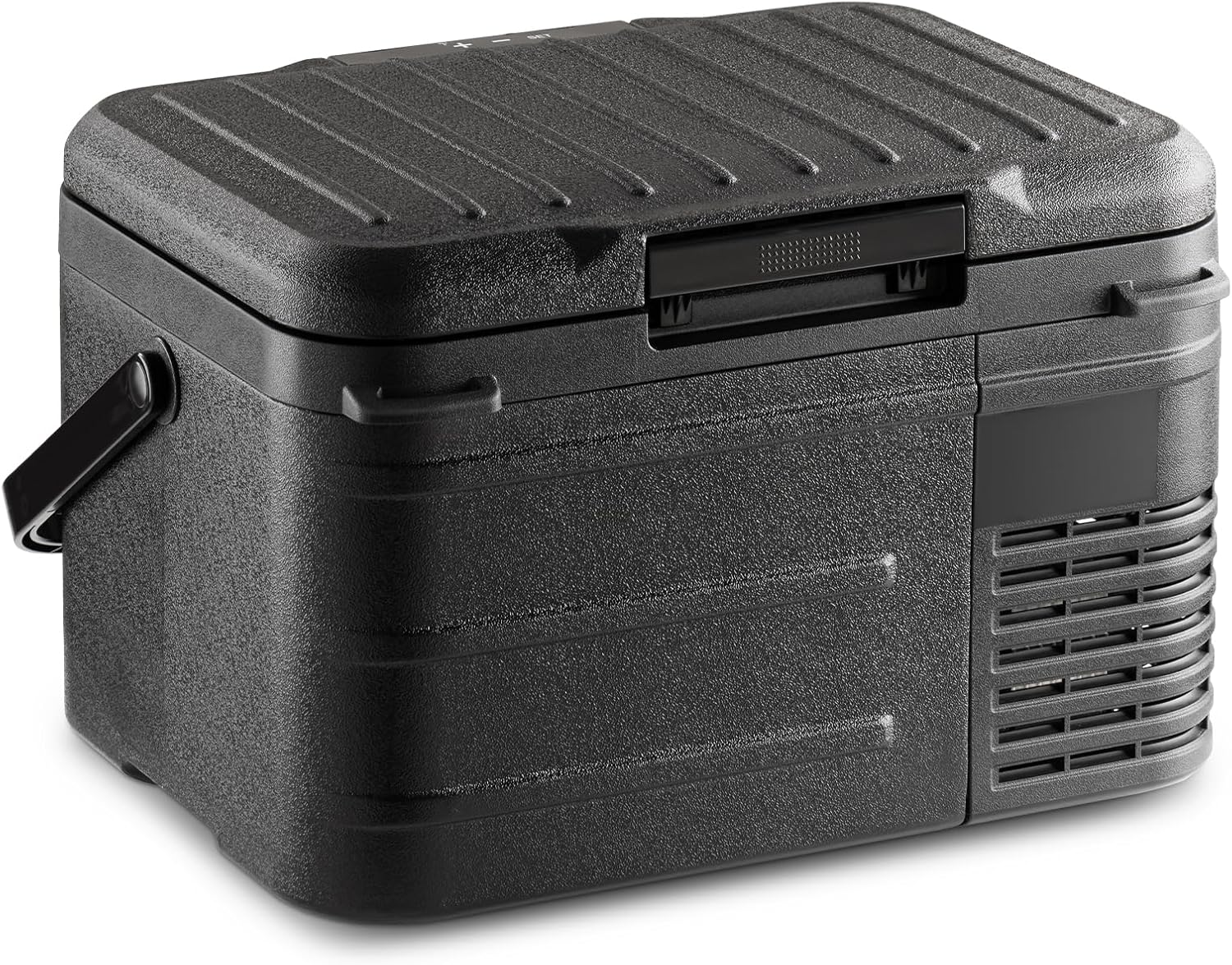
This compact 11-quart portable refrigerator is a compressor cooler meant for use in cars, RVs, trucks, and small van builds where space and reliable cooling matter. It runs on 12/24V DC or 110–240V AC and offers a wide temperature span from -4°F to 68°F, plus ECO and MAX modes for energy-saving or fast cooling. The unit includes a variable-frequency compressor and composite insulation for steady temperatures, an LCD control panel for simple adjustments, a built-in handle for carrying, and three-level battery protection to avoid draining a vehicle battery. At about 16 pounds it is light enough to move and is rated to run quietly at roughly 40 dB. Trade-offs are its small 11-quart capacity, which limits how much food or tall bottles fit, and modest annual energy usage that buyers should consider for long trips without shore power. For van conversions where footprint and reliable compressor cooling matter, this is a practical, budget-friendly option.
Best for: Van builders and travelers who need a compact, compressor-powered fridge that can run from a vehicle or shore power and prioritize reliable cooling on a budget.
Less Ideal for: People who need to store lots of groceries, tall bottles, or want a larger-capacity fridge for full-time off-grid living should choose a bigger unit.
- Runs on both 12/24V DC and 110–240V AC for versatile in-vehicle or home use
- Compressor cooling with -4°F to 68°F range supports freezing and refrigeration
- Lightweight and portable with an integrated handle for easy placement and transport
- Three-level battery protection helps prevent vehicle battery drain during use
- Small 11-quart capacity limits storage for larger trips or bulky items
- Annual energy consumption is notable for continuous off-grid use
Verdict: A budget-friendly, compressor mini fridge that delivers reliable cooling for vans and vehicle adventures while running from either DC or AC power.
BougeRV CR22 23-Quart Portable Refrigerator

| Capacity | 23 quarts |
|---|---|
| Temp range | -8℉ to 50℉ (-22℃ to 10℃) |
| Power source | 12/24V DC, 110V AC |
| Cooling method | Compressor |
| Noise level | 45 dB |
The BougeRV CR22 is a 23‑quart portable compressor refrigerator built for van life, road trips, and camping where reliable cooling is important. It runs from 12/24V DC or 110V AC and uses a compressor system to reach temperatures as low as -8°F and as quickly as about 15 minutes down to 32°F, so it keeps food and drinks cold without ice. Practical features include an electronic lock, a manual defrost, low-noise design aimed at about 45 dB operation, and a three-level battery protection system so you can set a safe shutoff voltage to avoid draining your vehicle battery. The unit is reasonably compact and includes both car and wall power cords. Trade-offs are its single chest compartment and manual defrosting, which means you will need to plan for occasional frost removal and it lacks dual-zone separation for simultaneous fridge/freezer use. Energy draw is low in ECO mode but actual runtime from a vehicle battery depends on temperature settings and ambient heat when mounted in a van.
Best for: Van dwellers and overland travelers who prioritize dependable, compressor-based cooling and battery protection for extended trips off-grid.
Less Ideal for: Users who need two separate temperature zones, frequent quick-access shelving, or a completely maintenance-free frostless system should consider other formats.
- Compressor cooling achieves fast low temperatures without ice
- Runs on 12/24V DC or 110V AC for flexible in-van or shore power use
- Built-in three-level battery protection prevents vehicle battery drain
- Relatively quiet operation suitable for sleeping in a van
- Includes DC and AC power cords out of the box
- Single chest compartment with no true dual-zone separation
- Manual defrost required, adding occasional maintenance
- Top-opening chest layout can be less convenient in tight van installs
Verdict: Choose the CR22 when you want a compact, compressor-driven van fridge that cools fast and protects your vehicle battery for reliable off-grid use.
Cooluli Classic 4L Mini Fridge

| Capacity | 4 liters |
|---|---|
| Cooling Method | Thermoelectric |
| Power Source | AC/DC/USB |
| Cools to | 20°–22°C below ambient |
The Cooluli Classic 4L is a lightweight thermo-electric mini fridge that cools or heats small items and is designed for portability and flexible power. It runs on AC, DC or USB power, so you can use it at a countertop, in a car, or in a van when paired with a 12V outlet or a suitable power bank. The unit cools roughly 20°–22°C below ambient and also switches to a warming mode that reaches up to about 65°C, making it useful for skincare, medications, snacks, and a few cans. Its molded top handle and 4-liter interior fit a few cans or small jars, while two internal shelves help organize contents. Thermoelectric cooling is quiet and refrigerant-free, but it is less effective than compressor fridges in very hot conditions and cannot freeze items. The Classic is compact and energy-efficient for short trips and on-the-road use, though buyers needing larger capacity or strong cooling under high ambient heat should consider a compressor-based solution.
Best for: Buyers who need a very portable climate-controlled box for skincare, medications, or a few drinks during short van trips and value flexible power and quiet operation.
Less Ideal for: People planning to store larger loads, frozen items, or who camp in hot climates where a compressor fridge is required for reliable cooling.
- Multiple power options: AC, DC and USB for countertop, car or power-bank use
- Dual-mode cooling and warming lets you chill skincare and warm small items
- Very compact and lightweight with a molded handle for easy transport
- Quiet, refrigerant-free thermoelectric operation that is energy-efficient
- Thermoelectric cooling is modest and struggles in high ambient temperatures
- Only 4 liters of capacity, suitable for a few cans or small items only
Verdict: A tiny, easy-to-power cooler/warmer that is ideal for keeping skincare, medications, and a few drinks chilled on short van trips.
Upstreman BR321 3.2 Cu.Ft Mini Fridge

| Capacity | 3.2 cubic feet |
|---|---|
| Freezer Capacity | 0.3 cubic feet |
| Cooling Method | Compressor |
| Defrost System Type | Manual Defrost |
| Annual Energy Consumption | 206 kwh |
The Upstreman BR321 is a straightforward 3.2 cubic foot mini refrigerator designed for tight spaces like dorms, offices, or small vehicle use where a compact cooler is needed. It uses a rotary scroll compressor and a manual-defrost freezer (0.3 cu ft) with a five-step adjustable thermostat that lets you set temperatures between 32°F and 50°F, so it can keep drinks and perishables chilled without complex controls. Inside there are two adjustable glass shelves, a crisper drawer and three door shelves to organize bottles and snacks, and the reversible door plus leveling feet make siting flexible. The unit is ETL listed and rated for energy efficiency, with annual consumption listed at 206 kWh and reported quiet operation around 38 dB, which helps when parked in a van or sleeping nearby. Expect manual defrosting and limits on deep-freeze items — it is not suitable for long-term frozen storage or ice cream — and packing it into very tight or built-in van cabinets requires checking the listed external dimensions first.
Best for: Buyers who prioritize a reliable, energy-efficient compact fridge that can be tucked into a van, tiny living space, or office and who want simple controls and quiet operation rather than advanced features.
Less Ideal for: People who need a built-in freezer or significant frozen storage, or van setups that require a true low-voltage 12V fridge designed for vehicle hardwiring should look elsewhere.
- Compact 3.2 cu ft capacity fits small spaces while offering usable interior layout
- Adjustable thermostat with five settings for flexible cooling needs
- Low noise operation (~38 dB) suitable for sleeping or working nearby
- Reversible door and leveling feet let you install it in different orientations
- Adjustable glass shelves and crisper drawer provide practical organization
- Manual defrost freezer requires occasional maintenance
- Freezer space is minimal and not intended for ice cream or long-term freezing
Verdict: A compact, quiet, and energy-efficient mini fridge that provides reliable refrigerated storage for tight van setups where simple, factory-quality cooling is the priority.
Choosing the Right Mini Fridge for Van: Key Factors to Consider
Power Source and Energy Use
How a mini fridge draws power is core to van integration. Many vans use 12V DC systems, solar panels, or portable batteries, so prefer units that specify DC input or have low-wattage running modes. Lower continuous energy consumption extends off-grid run time and reduces reliance on the alternator or generator.
Also consider startup surge current, which can be higher than steady-state draw and affect inverter sizing. If you plan to run the fridge from a battery bank, calculate daily amp-hour usage based on ambient temperatures and expected duty cycle to size batteries and solar accordingly.
Physical Size and Interior Layout
Cabinet space in a van is limited and often irregular, so overall footprint and usable internal volume must be weighed together. A compact exterior with a tall, narrow interior may store taller bottles but fewer bulky items. Removable shelves, adjustable door bins, and simple organizers improve usable space.
Measure the installation area, allowing clearance for door swing, ventilation, and any mounting hardware. Consider how the fridge will integrate with existing cabinetry and whether it needs to slide out for access or servicing.
Cooling Performance and Temperature Stability
Cooling ability affects food safety and freezer add-ons. Look for consistent temperature control across loads and locations inside the compartment. In a van, ambient temperatures can swing widely, so a fridge that can maintain cold temperatures in warm conditions is important for perishable goods.
Evaluate stated temperature ranges and whether the unit has adjustable thermostats or multiple modes. Consider how often the compressor or cooling element cycles; frequent on/off cycling can indicate inefficiency or inadequate insulation.
Mounting Options and Vibration Resistance
Vehicles create constant vibration and occasional shocks; a fridge intended for van life should have solid mounting points, non-skid feet, or a design that tolerates motion. Mounting provisions reduce the risk of tipping or damage while driving and help keep internal items from shifting.
Also check door latches, hinge robustness, and seals. A door that rattles open on rough roads can spill contents and increase power use as the compressor works harder to recover set temperature.
Weight, Portability, and Installation
Weight affects where and how easily you can install the fridge. If you plan to move the unit periodically or convert different layouts, choose lighter designs with convenient handles or a slide-out shelf system. Conversely, heavier models might offer better insulation or larger capacity but require more secure fastening.
Consider how permanent the installation should be. Plug-and-play units are easier to retrofit, while built-in installations may benefit from added insulation or ventilation modifications.
Maintenance and Serviceability
Routine maintenance keeps a van fridge reliable. Units with accessible condensers, serviceable filters, or simple removable interiors are easier to clean and repair on the road. Also evaluate how easy it is to diagnose power issues and whether the control panel is intuitive for quick adjustments.
Longer-term, having straightforward replacement parts and clear documentation reduces downtime when you are traveling and away from full-service repair options.
12V Vs AC Operation in a Van
Most van conversions rely on 12V DC systems powered by house batteries and solar. Choosing a fridge that natively supports 12V reduces conversion losses and inverter wear. If a unit requires AC, ensure your inverter can handle both continuous and startup loads; oversized inverters add weight and complexity.
Some mini fridges offer dual-voltage operation or bundled DC adapters. Test or verify actual power draw at typical setpoints because manufacturers sometimes list peak rather than average consumption. For off-grid users, lower average wattage is usually more valuable than short-term cold recovery speed.
- Verify DC input options and connector type before purchase
- Check startup current to size inverter and battery capacity
- Consider refrigeration mode presets for eco or high-performance use
Placement, Ventilation, and Heat Management
Proper ventilation prevents heat buildup behind and beneath the fridge, which keeps compressors efficient and reduces cycling. Many mini fridges need a few inches of clearance for airflow; if space is tight in a van cabinet, plan for forced ventilation or a vented panel.
Avoid installing the fridge in direct sunlight or next to heat-generating equipment. In colder climates, condensation management matters too; insulating surrounding cabinetry can mitigate thermal bridging and improve overall efficiency.
- Allow clearance as recommended by the manufacturer
- Consider venting panels or small exhaust fans for enclosed installs
- Keep heat sources and sunlight away from the fridge location
Organizing the Interior for Maximum Use
The way you organize contents affects what the fridge can hold and how often it needs to run. Use stacking containers and collapsible bins to prevent items from blocking airflow. Position frequently used items near the front to limit door-open time.
If you rely on frozen items, prioritize a layout that keeps frozen goods in a dedicated compartment or at the bottom where cold air pools. Magnetic or bungee retentions can keep lightweight items in place when the van is in motion.
- Use small bins for dairy, condiments, and snacks
- Avoid overpacking; maintain airflow pathways
- Secure loose items to prevent shifting while driving
Insulation and Auxiliary Cooling Strategies
Adding a removable insulating cover for when the van is parked in hot conditions can reduce runtime. Reflective covers and foam panels help block radiant heat during the day. Insulation around the cabinet opening reduces thermal leakage and improves efficiency.
For extended off-grid stays, pair the fridge with a battery monitor and a low-voltage cutout to protect the house battery. Portable ice packs or a small dedicated freezer chest can handle overflow or frozen items without forcing the fridge into a lower, more energy-intensive temperature.
- Use insulating covers when parked in hot weather
- Install a battery monitor and low-voltage cutoff
- Employ ice packs or a secondary small freezer for peak demand
Common Installation Mistakes to Avoid
A frequent error is mounting the fridge in a tight, unventilated space without accounting for heat dissipation. That raises compressor duty cycle and shortens component life. Always follow ventilation guidelines or plan for active ventilation.
Another mistake is underestimating door swing and access needs. A fridge that is hard to open or blocks walkways reduces functional living space. Finally, insecure mounting that allows the unit to slide or tip can damage the fridge and its contents during travel.
- Do not block ventilation paths with cabinetry or panels
- Check door clearance before final mounting
- Use straps, brackets, or bolted mounts to secure the unit
How We Chose the Best Mini Fridge for Van
We focused on features that matter specifically to van users and to compact, mobile refrigeration. Selection began by filtering for units with documented low power draw, compact footprints that fit typical van cabinets or under-seat spaces, and a range of interior capacities to suit single users through small groups. We also prioritized refrigerators with secure mounting options or flat, stable bases for safe use during transit. Evaluation criteria included measured or rated energy consumption under typical settings, usable interior volume versus exterior footprint, temperature control range and stability for both fresh and frozen items, physical durability and vibration resistance, and user-focused details like door swing, shelving layout, and serviceability. We excluded products that require complex installation beyond standard 12V/DC wiring or that lack clear documentation on power draw and mounting provisions. The final list emphasizes units that balance run-time on common van power systems, practical interior layout, and build features that withstand the motion and vibration of road travel.
Our full evaluation process is outlined in our review methodology.
FAQ
Can I run a mini fridge from a standard van battery?
Often you can run a small fridge from a van house battery for limited periods, but runtime depends on battery capacity, fridge energy draw, and ambient temperature. Use a battery monitor and consider a low-voltage cutoff to avoid draining the starting battery.
How much ventilation does a mini fridge need in an enclosed cabinet?
Most mini fridges need several inches of clearance behind and above the unit for heat to escape. If the cabinet is tight, add a vent or small fan to move warm air out and prevent the compressor from overworking.
Should I choose a compressor fridge or a thermoelectric model for van use?
Compressor fridges are generally more efficient and can reach lower temperatures, making them better for perishable food and freezing. Thermoelectric models are lighter and simpler but struggle in high ambient temperatures and use more energy to achieve the same cooling.
How do I keep a mini fridge from tipping or shifting while driving?
Secure the unit with brackets, straps, or bolted mounting points to the cabinet floor. Non-skid pads help reduce movement, and door latches or locks prevent contents spilling. Check mounts regularly for loosening due to vibration.
Will a mini fridge run on solar power alone?
It can, depending on solar array size, battery capacity, and average sun exposure. Calculate daily energy needs and match them to solar generation and storage. Efficiency improvements, insulation, and lower setpoints reduce the required solar capacity.
Final Verdict
Choosing the right mini fridge for van life is about balancing energy use, usable capacity, and how the unit mounts and vents inside your specific layout. Prioritize low continuous draw and a layout that fits your food habits, then confirm that mounting and ventilation needs match your van build. Accept tradeoffs between capacity and power consumption: larger units hold more but demand more energy, while compact models conserve battery but limit storage. With clear priorities and attention to installation details, you can pick a fridge that keeps food safe and fits your travel routine.