
Note: This article contains affiliate links. If you click on these links and make a purchase, we may earn a small commission at no extra cost to you. This helps support our research and content. Read our full affiliate disclosure here.
A Mini-Split Air Conditioner can give you targeted, efficient cooling without ductwork, making it a strong option for rooms that need steady temperature control. Choosing the right unit matters for comfort, running cost, and installation simplicity. In this guide we shortlisted the best mini-split models across common capacities and installation needs so you can match a unit to room size, insulation, and noise tolerance. Below you'll find our top picks and the key technical and practical criteria we used to evaluate them, including cooling capacity, energy efficiency, and installation considerations.
Top Picks at a Glance
| Best Overall The best all-around choice for most situations | Albott 12,000 BTU Mini Split SAC001 |  |
| Best Quality Built to a higher standard if you want something more solid | Daikin Entra 18,000 BTU Mini-Split |  |
| Best Value The sweet spot between price and what you get | Rellytech Mini Split 9000 BTU |  |
| Best Budget The cheapest option that still gets the job done reliably | CAAIR 12,000 BTU Mini Split |  |
| Top Rated A top-rated pick with lots of positive feedback | GrowthWing AuraCore HP12N 12,000 BTU |  |
| Most Popular A crowd favorite that many people choose with confidence | SereneLife 12,000 BTU Mini Split |  |
| Best Seller A high-volume bestseller chosen again and again | Senville LETO 12000 BTU Mini Split |  |
Albott 12,000 BTU Mini Split SAC001

| Cooling Power | 12000 BTU |
|---|---|
| SEER | 18 |
| Voltage | 115 volts |
| Operating Range | 5°F to 122°F |
| Floor Area | up to 750 sq ft |
The Albott 12,000 BTU mini split is a ductless heat pump designed to cool and heat a single zone of roughly 750 square feet while providing dehumidifying and fan modes. It uses an inverter compressor and SEER2 18 efficiency to deliver steady temperature control with lower energy draw than a basic non-inverter unit, and the system supports app and remote control for convenient scheduling and adjustments. Notable features include built-in WiFi, a self-cleaning mode, removable mesh filters for easy maintenance, and a quiet indoor operation rated near 29 dB. The unit requires a new outdoor condenser and professional or experienced installation to ensure proper refrigerant handling, and the package includes filters and hoses but not a power cord. Practical limits are the need for an outdoor unit and installation work, and annual energy consumption is listed around 700 kWh which buyers should compare against local rates; the unit is optimized for one room or open plan area rather than whole-home use. For buyers seeking an efficient, quiet single-zone mini-split with smart controls, this model covers the essentials well.
Best for: Buyers who want an energy-efficient, quiet single-zone mini-split with smart controls for a bedroom or medium living area and who are willing to arrange professional installation.
Less Ideal for: People looking for a plug-and-play portable solution or those needing whole-house cooling without installing an outdoor condenser should look elsewhere.
- Inverter compressor with SEER2 18 for improved efficiency and steady temperature control
- Built-in WiFi plus remote gives app scheduling and remote operation
- Self-cleaning function and removable mesh filters simplify maintenance
- Quiet indoor noise level around 29 dB suitable for bedrooms or living rooms
- Requires a new outdoor unit and professional installation for refrigerant and line set work
- Power cord is not included, so additional purchase or wiring may be needed
Verdict: A quiet, energy-conscious 12,000 BTU mini-split with smart controls that fits a single-zone room when you plan for professional outdoor-unit installation.
Daikin Entra 18,000 BTU Mini-Split

| Cooling Power | 18000 british thermal units |
|---|---|
| Refrigerant | R-32 |
| SEER | 18 |
| Voltage | 230 volts |
| Included Components | Indoor fan coil, condenser, remote, 15 ft refrigerant line kit, mounting bracket |
The Daikin Entra 18,000 BTU mini-split is a single-zone heat pump system designed to cool or heat rooms up to about 1,000 square feet using a variable-speed DC inverter compressor. It includes a wall-mounted indoor fan coil, a compact outdoor condenser pre-charged with R-32 refrigerant, a remote control, and a 15 ft installation kit with mounting bracket for typical retrofit or new-addition installs. Notable features include 18 SEER2 and 9 HSPF2 efficiency ratings, ECO+ and Powerful Operation modes, a Titanium Apatite Photocatalytic air-purifying filter, and quiet operation around 37 dB. In practice the inverter compressor gives steady temperature control and better part-load efficiency than fixed-speed units, and the adjustable air direction reduces direct drafts on occupants. Trade-offs are the need for professional or competent DIY installation for refrigerant line connections and wall penetration, and the system is single-zone so whole-house coverage requires additional indoor units. For buyers who prioritize performance and year-round comfort in a single space, this model offers reliable efficiency and useful comfort features.
Best for: Buyers who want a high-performance, energy-efficient single-zone heating and cooling solution for a primary living space or large room and who prioritize steady temperature control and low operating costs.
Less Ideal for: People seeking whole-house HVAC coverage or a plug-and-play portable solution should look at multi-zone systems or different product types instead.
- High seasonal efficiency with 18 SEER2 for lower running costs in cooling-dominant climates
- DC inverter compressor provides smoother temperature control and improved part-load performance
- Includes indoor unit, outdoor condenser pre-charged with R-32, remote, and 15 ft installation kit for straightforward single-zone setup
- Quiet operation around 37 dB suitable for bedrooms and living areas
- Built-in air-purifying Titanium Apatite filter and ECO+ mode for improved indoor air quality and efficiency
- Single-zone system only, so additional units are required for multi-room cooling
- Installation requires refrigerant line connections and wall penetration, typically needing professional service
Verdict: Choose this Daikin Entra mini-split when you need a quiet, high-efficiency single-zone heat pump that delivers strong year-round performance for a primary room.
Rellytech Mini Split 9000 BTU
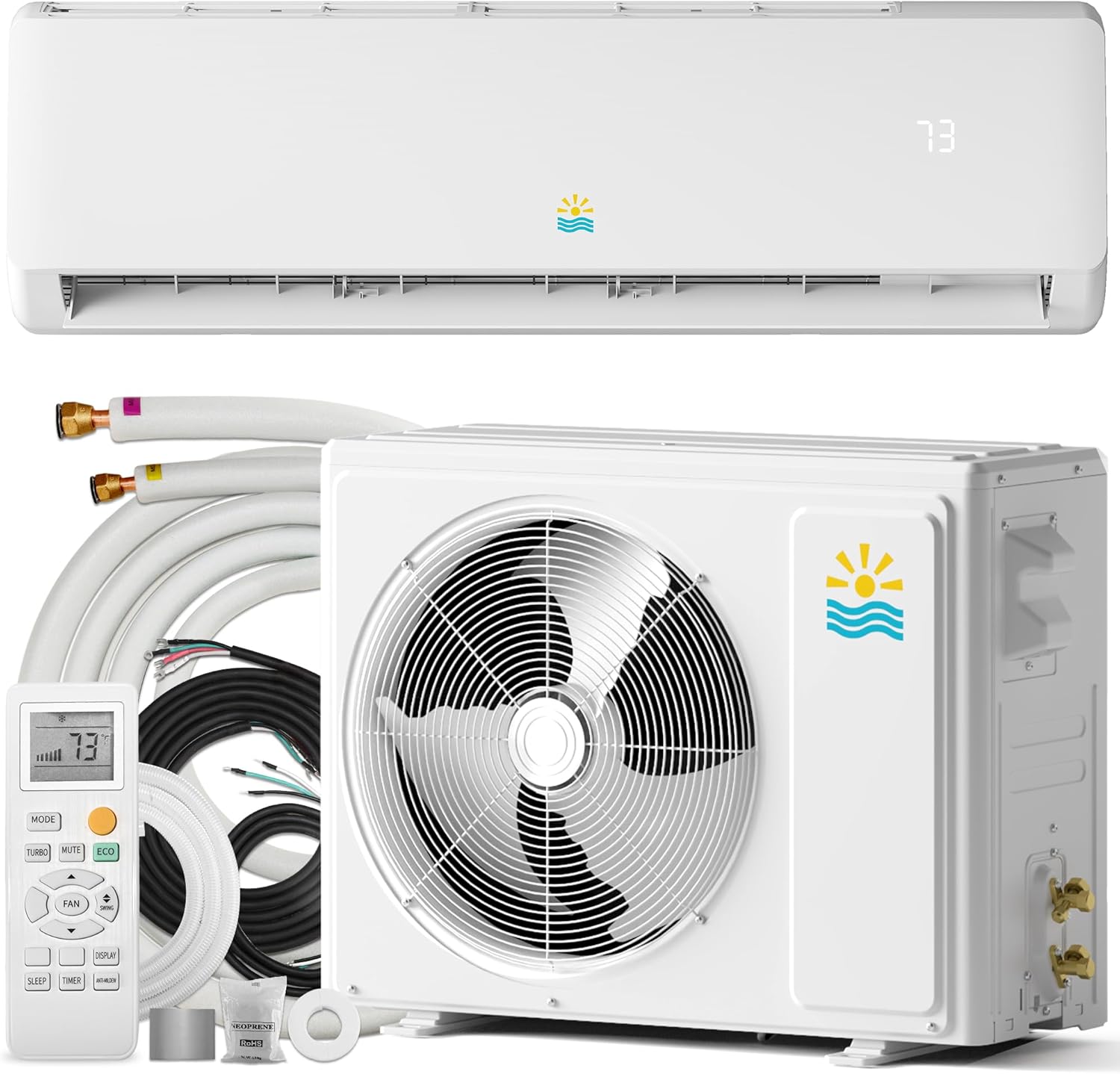
| Cooling Power | 9000 BTU |
|---|---|
| Voltage | 115 volts |
| SEER | 19 |
| Floor Area | 450 square_feet |
| Refrigerant | R-32 |
The Rellytech 9000 BTU mini-split is a compact ductless heat pump designed to cool or heat single rooms up to about 450–550 sq ft. It uses inverter technology and R-32 refrigerant to maintain set temperatures more efficiently than fixed-speed units, and the 19 SEER2 / HSPF2 8.5 ratings indicate solid seasonal efficiency. Typical use is wall-mounted indoor operation paired with the outdoor compressor; the unit includes an installation kit but professional installation is recommended for refrigerant handling. Controls are simple via remote and there are multiple modes — cooling, heating, fan, dry, ECO and sleep — plus a 24-hour timer and vertical swing for broader airflow. At 42 dB the indoor unit is quiet enough for bedrooms. Practical limitations: it requires a 115V circuit and the package dimensions and weight mean installation needs planning, and full Wi-Fi app control is not available on this exact listing. For buyers who want an energy-efficient room heat pump with basic smart features and low noise, this model delivers dependable performance.
Best for: Homeowners seeking an efficient, quiet single-room heating and cooling solution who prioritize running costs and steady temperature control.
Less Ideal for: People who need integrated smart app control out of the box, or those wanting a DIY plug-and-play portable unit without professional installation.
- Inverter compressor with R-32 refrigerant for better energy efficiency
- 19 SEER2 and HSPF2 8.5 ratings reduce seasonal energy use
- Includes indoor and outdoor units plus a comprehensive installation kit
- Quiet indoor operation around 42 dB suitable for bedrooms
- Multiple operating modes (cool, heat, fan, dry, ECO, sleep) and remote control
- No built-in Wi-Fi app control on this specific 9000 BTU listing
- Professional installation recommended which adds to overall cost
Verdict: Buy this if you want a quiet, energy-efficient 9000 BTU mini-split that reliably heats and cools a single room while lowering seasonal energy use.
CAAIR 12,000 BTU Mini Split

| Cooling Power | 12000 BTU |
|---|---|
| SEER | 17 SEER2 |
| Voltage | 230 volts |
| Floor Area | 750 square_feet |
The CAAIR 12,000 BTU mini split is a ductless wall-mounted heat pump that provides both cooling and heating for single-zone rooms. It uses a DC inverter compressor to modulate output rather than cycling on and off, which supports faster temperature changes and steadier room conditions while improving efficiency. Typical use is for bedrooms, living rooms, small apartments, or home offices where a dedicated zone is needed; the system includes an indoor and pre-charged outdoor unit plus a 13 ft copper line set and drain hose for professional installation. Notable features include 4 operating modes (cool, heat, fan, dry), 4-way auto-swing airflow, built-in Wi‑Fi for app and voice control, a quiet indoor unit rated around 25 dB, and a self-cleaning high-temperature cycle with washable filters. Practical benefits are efficient year-round comfort, remote scheduling, and quieter operation suitable for sleeping spaces. Important limitations are that it requires professional HVAC installation, the outdoor unit must be new (no reuse), and warranty coverage is limited to 1 year for parts and 3 years for the compressor.
Best for: Buyers who want an energy-efficient, single-zone heating and cooling solution for a 1-room space and prioritize lower ongoing energy costs over DIY installation.
Less Ideal for: People seeking a DIY plug-and-play window-style solution or those who need multi-zone coverage without installing separate outdoor units.
- Efficient inverter compressor with 17 SEER2 for lower energy use
- Built-in Wi‑Fi plus app and remote control for convenient scheduling and voice control
- Quiet indoor operation around 25 dB suitable for bedrooms
- Includes pre-charged outdoor unit and installation kit components for professional hookup
- Self-cleaning cycle and washable filters help reduce mold and odors
- Requires professional installation and at least 30 minutes vacuuming time before commissioning
- Outdoor unit compatibility requires a new outdoor unit, preventing reuse of existing condensers
- Limited parts warranty of 1 year (compressor 3 years)
Verdict: A quiet, energy-efficient single-zone mini-split that delivers year-round comfort and smart controls while keeping operating costs low for budget-minded buyers.
GrowthWing AuraCore HP12N 12,000 BTU

| Cooling Power | 12000 BTU |
|---|---|
| SEER | 20 |
| Voltage | 115 volts |
| Wattage | 1240 watts |
| Floor Area | 750 square_feet |
The GrowthWing AuraCore HP12N is a 12,000 BTU inverter-driven mini-split intended for year-round cooling and heating in medium rooms. It uses a rotary scroll inverter compressor with R-32 refrigerant and variable-speed operation to adjust output for steady temperature control and improved efficiency, advertised at 20 SEER2. Controls include a remote, mobile app and Alexa voice support for scheduling and remote monitoring, while AutoClean and a washable filter reduce routine maintenance. The unit comes pre-charged and includes an installation kit, but professional HVAC installation is recommended to ensure correct refrigerant line and electrical setup and to protect warranty coverage. Practical benefits are quiet operation down to about 28 dB, fast turbo cooling for quick recovery, and modest annual energy use claims. Limitations are typical for split systems: installation complexity and the need for a qualified installer add cost, and the one-year parts warranty requires registration to access extended coverage on the unit and compressor.
Best for: Buyers prioritizing steady, energy-efficient year-round comfort who want a quiet, app-controlled mini-split for bedrooms or living spaces and value factory-quality performance and support.
Less Ideal for: People who need a simple plug-and-play window or portable solution or who cannot arrange professional installation should consider other options.
- Inverter compressor for variable-speed operation and improved efficiency
- 20 SEER2 efficiency rating for lower energy use compared with non-inverter units
- App, remote, and voice controls with scheduling and remote access
- Quiet operation rated around 28 dB for low-noise rooms
- Includes installation kit and arrives pre-charged with R-32 refrigerant
- Requires professional HVAC installation for best performance and warranty protection
- Standard limited parts warranty is short unless extended via registration
Verdict: Choose the AuraCore HP12N if you want a quietly efficient, inverter mini-split that delivers dependable year-round comfort with smart controls and factory-ready components.
SereneLife 12,000 BTU Mini Split

| Cooling Power | 12000 BTU |
|---|---|
| SEER | 20 |
| Voltage | 115 volts |
| Annual Energy Consumption | 1260 kwh |
| Control Method | App, Remote |
The SereneLife 12,000 BTU mini‑split is a wall‑mounted split system that delivers both cooling and heating for a single room or open area. It is intended for residential use and offers app and remote control, multiple operating modes (auto, cool, dry, fan, heat), programmable timer, and an included installation kit with copper line. The unit advertises energy‑efficient performance with a 20 SEER rating and automatic restart after power loss, which helps maintain set temperatures without manual resets. Noise is relatively low in operation and the package includes a remote and hoses so a professional or handy DIYer can complete installation. Trade-offs to consider are the need to confirm compatible professional installation and the 1‑year warranty, which is shorter than some factory replacements; buyers should verify contractor support and local code requirements before purchase. The system is practical for year‑round temperature control but buyers should plan for refrigerant line routing and outdoor unit placement during installation.
Best for: Buyers who prioritize measurable performance and want a year‑round wall‑mounted solution with smart controls and an included installation kit, and who value products with a substantial review base to gauge reliability.
Less Ideal for: Those needing long factory warranties or a totally plug‑and‑play portable solution should consider other product types or models with extended support.
- Combined cooling and heating in one wall‑mounted mini‑split
- WiFi and remote control for convenient remote adjustments
- Energy efficient 20 SEER rating for lower operating costs
- Includes installation kit (pipe, hose, remote) to simplify setup
- 1‑year warranty may be short compared with some competitors
- Installation requires routing refrigerant lines and outdoor unit placement, which can add professional cost
Verdict: A smart, energy‑efficient 12,000 BTU mini‑split that delivers year‑round comfort with app control and an installation kit, making it a practical choice for buyers seeking a proven wall‑mounted HVAC option.
Senville LETO 12000 BTU Mini Split

| Cooling Power | 12000 british thermal units |
|---|---|
| Voltage | 110 volts |
| Wattage | 1020 watts |
| SEER | 20.8 |
| Capacity | 1 tons |
The Senville LETO 12,000 BTU mini-split is a ductless wall-mounted heat pump designed to cool, heat, dehumidify, and circulate air for a single large room or open living area. It uses a DC inverter compressor for variable-speed operation that raises efficiency and keeps noise low, and the unit supports app and Alexa voice control plus a standard remote for everyday adjustments. Practical benefits include a relatively high SEER rating for lower seasonal energy use, an included indoor air handler and outdoor condenser with a 16-foot pre-charged line set for straightforward placement, and a turbo mode for faster temperature changes. Installation requires a trained HVAC technician and the product ships pre-charged only for short line runs, so longer installations add refrigerant and labor. Noise is advertised low, but wall placement and correct setup matter for quiet performance. Warranty coverage is manufacturer-backed for parts and the compressor, though labor is not included. For risk-averse buyers the LETO balances established inverter tech, smart controls, and solid efficiency, with the main caveat being professional installation and potential extra costs for longer line sets.
Best for: Buyers who prioritize reliable, energy-efficient year-round climate control with smart connectivity and prefer a proven factory replacement-style mini-split backed by manufacturer support.
Less Ideal for: People seeking a DIY window-style solution, those who cannot accommodate professional installation, or buyers needing portable temporary cooling for multiple rooms.
- Inverter compressor for improved efficiency and steadier temperature control
- Works with Alexa and app control in addition to a physical remote
- Includes indoor air handler, outdoor condenser, and a 16 ft pre-charged line set for typical installs
- High SEER rating for the class, which reduces seasonal energy use
- Multi-function unit: cooling, heat pump heating, dehumidifier, and fan modes
- Requires professional installation and may need additional refrigerant or labor for long line runs
- Warranty covers parts and compressor but does not include installation labor
- Electrical requirements and proper siting must be verified before purchase
Verdict: Choose the Senville LETO 12,000 BTU if you want a quiet, energy-efficient inverter mini-split with smart controls and factory-backed support for dependable year-round comfort.
Choosing the Right Mini-Split Air Conditioner: Key Factors to Consider
Cooling Capacity and Room Size
Proper cooling capacity is the single biggest factor for selecting a mini-split. An undersized unit will run continuously without reaching setpoint, while an oversized unit cycles frequently and can create humidity issues. Match the unit's rated BTU output to the square footage, ceiling height, insulation quality, window area, and typical occupancy for the room.
When you estimate capacity needs, account for heat gain sources such as sun-facing windows and kitchen appliances. Manufacturers publish sizing guides that are a good starting point, but consider adjustments for rooms with high ceilings or poor insulation. Correct sizing reduces runtime, improves comfort, and can lower energy use over the system lifetime.
Seasonal Efficiency and Operating Cost
Seasonal efficiency ratings reflect how the system performs across a range of conditions and are a reliable indicator of long-term energy use. Higher-rated systems typically cost more upfront but deliver lower electricity consumption, especially in climates with long cooling seasons.
Look for published seasonal ratings and compare estimated annual operating costs based on your local climate or usage patterns. Efficiency also affects how the system performs at partial loads; more efficient inverter-driven units maintain comfort with lower power draw during mild conditions.
Indoor Unit Sound Levels
Noise from the indoor head affects how comfortable the room feels, particularly in bedrooms, home offices, and living rooms. Manufacturers list sound levels in decibels for different fan speeds; lower numbers mean quieter operation and less disturbance during sleep or focused work.
Consider both the indoor unit and the outdoor condenser noise because placement near windows or living spaces can matter. Some units offer very low-sound modes or 'quiet' fan settings that are useful for nighttime operation.
Installation Scope and Line Set Length
Mini-splits require refrigerant lines between the indoor and outdoor units and a suitable wall or ceiling opening for the indoor head. The distance between indoor and outdoor units affects installation complexity and cost because longer line sets and additional fittings may be needed.
Check the maximum recommended line length and elevation difference for the system and plan whether the outdoor unit can be placed on a slab, wall bracket, or balcony. Some installations need a professional with HVAC and refrigeration certification, while simpler single-zone installs can sometimes be handled by an experienced contractor.
Controls, Zoning, and Smart Features
Control options influence daily convenience and how easily you can integrate the mini-split into a home automation setup. Basic remotes offer temperature and fan control, while advanced units add smartphone apps, Wi-Fi, and programmable schedules for precise energy management.
If zoning or multi-room control is important, check whether the system supports multiple indoor heads on a single outdoor condenser and how each head can be controlled independently. Features like activity-based presets, temperature offsets, and compatibility with voice assistants can improve usability.
Maintenance Requirements and Serviceability
Mini-splits need routine filter cleaning and occasional coil and drain maintenance to keep airflow and dehumidification working well. Easy-to-remove washable filters and accessible drain lines simplify upkeep and reduce the need for service calls.
Consider the availability of replacement filters and common service parts in your area. Systems with straightforward diagnostics and accessible electrical panels make professional service faster and less expensive when repairs are necessary.
Sizing a Mini-Split for Different Rooms
Calculate required cooling capacity by combining square footage with modifiers for ceiling height, window exposure, and activity level. A sunny, south-facing living room will need a higher output compared with an interior bedroom of the same size. Use published sizing charts as a starting point and round up when the room has high solar gain or poor insulation.
When in doubt, prioritize a unit that can modulate output with an inverter compressor rather than one that simply cycles full on and off. Variable-capacity systems maintain steady temperatures with fewer swings and better humidity control.
- Measure square footage and ceiling height.
- Add capacity for high sun exposure or large windows.
- Adjust for kitchens or rooms with many occupants.
- Prefer inverter models for smoother temperature control.
Placement and Outdoor Unit Considerations
Choose an outdoor unit location that provides good airflow and easy service access. Mounting on a concrete pad or sturdy bracket prevents vibration transfer and keeps the compressor level. Avoid placing the condenser where noise will be a nuisance to outdoor living spaces or neighbors.
Consider elevation limits and line-set routing early in the planning stage. Short, straight runs reduce the need for additional fittings and lower the chance of leaks or performance loss.
- Allow clearance for airflow and service access.
- Minimize line-set length and vertical rises.
- Isolate mounting to reduce vibration and noise.
Dehumidification and Climate Effects
Mini-splits vary in how well they remove moisture while cooling. Systems with low-speed, steady-run modes and good coil design tend to dehumidify better than units that frequently cycle. In humid climates, prioritize steady-state operation and appropriate sizing to avoid a cold, clammy feeling.
In dry climates, efficient cooling and variable-speed compressors can provide comfortable temperatures without overcooling. Check manufacturer guidance on operation modes intended for humid or dry conditions.
- Prefer steady-run inverter systems in humid climates.
- Avoid oversizing to prevent short-cycling and poor dehumidification.
- Look for dedicated dehumidify modes if humidity control is a priority.
Electrical Requirements and Circuit Protection
Mini-split systems have specific electrical needs for the outdoor unit, including recommended circuit size and disconnects. Verify that your service panel can support the unit's startup and running amperage. Many installs require a dedicated breaker and a means to isolate power at the outdoor unit.
Plan for professional electrical work when the installation crosses thresholds for service upgrades or new circuits. Proper circuit protection and wiring reduce the risk of nuisance trips and extend equipment life.
- Check startup and running amperage before installation.
- Use a dedicated circuit with the recommended breaker size.
- Install an outdoor disconnect for service safety.
Noise Management Strategies
If indoor quiet is a priority, place the indoor head away from primary seating or sleeping positions and choose a low-sone unit. Soft-start compressors and variable-speed fans reduce audible spikes during startup and load changes.
Outdoor unit noise can be mitigated with rubber isolation pads, staggered mounting, or locating the condenser where the building mass shields sound. Always check published sound levels for both indoor and outdoor units to set realistic expectations.
- Select low-sone indoor units for bedrooms and offices.
- Use vibration isolation for outdoor mounting.
- Position heads to minimize direct sound exposure in living spaces.
How We Chose the Best Mini-Split Air Conditioner
We focused on the technical and practical traits that most directly affect everyday performance, running cost, and ease of installation for mini-split systems. Primary evaluation criteria included cooling capacity relative to room size, seasonal energy efficiency ratings, indoor unit sound levels, and the typical installation scope and accessory requirements. We also considered refrigeration circuit design and reliability cues such as compressor type and warranty coverage patterns, plus controls and connectivity options that affect usability. Units were excluded if they lacked clear published efficiency ratings or cooling capacities, if they required uncommon installation components, or if they were aimed only at highly specialized commercial applications. Our filters prioritized widely applicable residential capacities, standard single-zone and multi-zone configurations, and models that balance energy performance with manageable installation needs. The resulting shortlist reflects products that are practical to install and operate in real homes while delivering consistent temperature control and predictable energy use.
Our full evaluation process is outlined in our review methodology.
FAQ
How do I know what size mini-split I need for a single room?
Estimate capacity by multiplying the room square footage by a baseline BTU-per-square-foot factor, then adjust for ceiling height, window exposure, and insulation. If you have higher solar gain or frequent occupancy, increase capacity. When possible, consult a sizing chart or installer to refine the estimate.
Can a mini-split provide enough cooling for an entire small home?
A single-zone mini-split can cool one room effectively. For whole-house cooling in a small home, multi-zone systems with multiple indoor heads connected to one outdoor condenser are usually a better solution. The right approach depends on layout, ductwork availability, and zoning needs.
Do mini-splits need regular maintenance?
Yes. Regular maintenance includes cleaning or replacing filters, checking drain lines, and periodic coil and refrigerant checks. Routine upkeep preserves efficiency and prevents airflow or moisture problems. Some maintenance can be done by owners, but annual professional service is often advisable.
Are inverter mini-splits worth the extra cost?
Inverter-driven systems adjust compressor speed to match cooling demand, which generally improves comfort, reduces cycling, and lowers energy use over time. Whether they are worth the extra cost depends on your cooling hours and priorities for efficiency and quiet operation.
What should I ask a contractor before installation?
Confirm the recommended unit capacity for each room, maximum line-set length, mounting location options, electrical circuit requirements, and any permits required. Ask about included installation warranties and what typical service calls cover to avoid surprises after installation.
Final Verdict
Choose a mini-split by prioritizing the capacity match, seasonal efficiency, and acceptable noise levels for the intended space. Installation complexity and electrical requirements are the main practical constraints; plan placement and line-set routing to minimize those costs and risks. By weighing these tradeoffs and focusing on steady, inverter-style operation for most home uses, you can select a unit that balances comfort, energy use, and long-term reliability.