
Note: This article contains affiliate links. If you click on these links and make a purchase, we may earn a small commission at no extra cost to you. This helps support our research and content. Read our full affiliate disclosure here.
If you rely on long-simmered stews, tender roasts, or hands-off weeknight meals, picking the right multi-cooker for slow cooking matters. Slow cooking in a multi-cooker is less about raw power and more about consistent low temperatures, roomy capacity, and predictable timing. The wrong unit can overcook delicate proteins or underperform on long braises. This guide shortlists the top multi-cookers for slow cooking and explains the factors that separate reliable low-heat performers from mediocre ones. We evaluated options across control precision, capacity, heat distribution, and ease of use so you can pick a model that fits your routine and meal plans. Read on for the features that matter and practical tips before the product listings.
Top Picks at a Glance
| Best Overall The best all-around choice for most situations | Ninja PossibleCooker PRO MC1001 |  |
| Best Quality Built to a higher standard if you want something more solid | Breville Fast Slow Pro BPR700BSS | 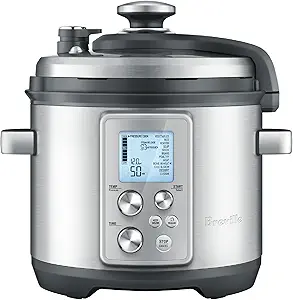 |
| Best Value The sweet spot between price and what you get | Hamilton Beach 6-Quart Slow Cooker |  |
| Best Budget The cheapest option that still gets the job done reliably | BELLA 6-Quart Slow Cooker | 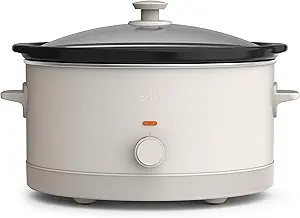 |
| Top Rated A top-rated pick with lots of positive feedback | Cosori 6-Quart Pressure Cooker |  |
| Most Popular A crowd favorite that many people choose with confidence | Instant Pot Duo 6-Quart |  |
| Best Seller A high-volume bestseller chosen again and again | Instant Pot Rio Mini 4‑Quart |  |
Ninja PossibleCooker PRO MC1001

| Capacity | 8.5 quarts |
|---|---|
| Wattage | 825 watts |
| Control Method | Touch |
| Oven Safe | Pot to 500°F |
| Number of settings | 8 |
The Ninja PossibleCooker PRO is a large-capacity multi-cooker built for one-pot meals and batch cooking. It uses Ninja's Triple Fusion Heat with bottom, side, and steam elements to speed up roasting and baking while offering functions such as sear, sauté, slow cook, steam, roast, bake, and keep warm, effectively replacing many countertop appliances. The rectangular 8.5-qt nonstick pot is oven safe to 500°F so you can finish dishes under high dry heat, and the included integrated spoon-ladle and recipe guide make it easy to start. In everyday use it shines for feeding a crowd or prepping large batches — you can brown proteins, add liquids, and switch to slow cook without transfers, which reduces dishes and hands-on time. Practical limits are its large footprint and 825-watt power draw, which mean it needs decent counter space and longer electrical runtime for very large cooks; also the nonstick pot, while convenient, still needs gentle care to maintain the coating. For buyers who value a single versatile cooker for family meals and entertaining, it delivers predictable, time-saving results.
Best for: Buyers who want a single, versatile cooker that handles large batches, entertaining, and meal prep with reliable, faster-than-oven results and built-in cooking guidance.
Less Ideal for: Those with very limited counter space or anyone seeking a compact, lightweight air fryer-style unit for small households.
- Large 8.5-qt rectangular pot fits full racks of ribs or a 9 lb brisket for batch cooking
- Triple Fusion Heat combines bottom, side, and steam elements to cook up to 30% faster than a conventional oven
- Nonstick pot is oven safe to 500°F so dishes can finish in the oven for crisping
- Built-in functions let you sear, sauté, roast, steam, bake, slow cook, and keep warm in one vessel
- Integrated spoon-ladle and chef-curated recipe guide simplify getting started
- Large footprint requires significant counter or storage space
- 825-watt power draw and large capacity can mean longer run time for extended high-heat cooks
- Nonstick coating requires careful handling to avoid wear over time
Verdict: Choose this when you need a roomy, all-in-one cooker that speeds up oven-style roasting and simplifies batch meals for families and entertaining.
Breville Fast Slow Pro BPR700BSS

| Capacity | 6 quarts |
|---|---|
| Wattage | 700 watts |
| Control Method | Touch |
| Number of settings | 11 |
The Breville Fast Slow Pro is a 6-quart multi-cooker that combines pressure, slow, and steam cooking with one-press operation and an LCD that shows pressure, temperature and a countdown timer. Dual sensors at the top and bottom continuously monitor conditions so the cooker can adjust time, temperature and pressure across 11 preset programs, which makes it convenient for recipes that need both fast pressure cooking and low-and-slow braising. Practical touches include a removable dishwasher-safe lid, a ceramic-coated inner bowl that doubles as a serving dish, and included stainless steel steamer basket and rack. Safety features are robust with a three-way lid safety system and an automatic hands-free steam release that selects quick, pulse or natural release depending on the cycle. The unit is well suited to cooks who want precise control without manual juggling, though its 6-quart capacity and relatively heavy build mean it is best for families and serious home cooks rather than single-serve meal prep. Power and voltage notes should be checked for your region.
Best for: Home cooks who prioritize cooking performance and precise, hands-off control for recipes that benefit from both high-pressure and low-and-slow methods.
Less Ideal for: People who need a compact, lightweight cooker for single portions or who want the simplest, cheapest multi-cooker for occasional use.
- One-press multifunction operation with 11 pressure and slow-cook settings for consistent results
- Dual top-and-bottom sensors that adjust time, temperature and pressure for precise cooking
- Hands-free auto steam release that selects the correct release method for safety and convenience
- Removable dishwasher-safe lid and ceramic-coated inner bowl that doubles as a serving dish
- 6-quart capacity and heavier construction make it less ideal for single-person households
- Voltage and wattage vary by region, so compatibility should be confirmed before purchase
Verdict: Choose this model if you want a performance-focused 6-quart cooker that automatically balances pressure and slow cooking for reliably precise results.
Hamilton Beach 6-Quart Slow Cooker

| Capacity | 6 quarts |
|---|---|
| Wattage | 265 watts |
| Voltage | 120 volts |
| Number of settings | 3 |
| Material | Glass, Stoneware |
The Hamilton Beach 6-Quart Slow Cooker is a straightforward, family-sized slow cooker designed to handle large meals with minimal fuss. You load the removable stoneware crock with ingredients, choose Low, High, or Keep Warm on the simple dial, and let it simmer for several hours—perfect for roasts, stews, and one-pot dinners. Its oval stoneware fits a whole 6 lb chicken or a 4 lb roast and the full-grip handles make carrying to the table or a potluck easier. The stoneware and glass lid are dishwasher-safe, which keeps cleanup quick after busy days. Performance is what you expect from a basic slow cooker: consistent low-and-slow heat without fancy programming or timers. Trade-offs are that it lacks programmable timers, digital controls, and advanced features like automatic shutoff or searing function, so you need to manage cook times manually. For its price and capacity, it is a dependable, no-frills cooker for routine family meals.
Best for: Buyers who prioritize reliable, easy-to-use cookware that delivers large, home-style meals with proven performance and clear user reviews backing the choice.
Less Ideal for: If you want programmable schedules, digital controls, or smart features for hands-off timing, look at models with timers and automatic shutoff instead.
- Large 6-quart stoneware holds full chicken or 4 lb roast for family meals
- Three simple heat settings (Low, High, Keep Warm) make operation intuitive
- Removable stoneware and glass lid are dishwasher-safe for easy cleanup
- Full-grip handles aid carrying to table or gatherings
- No programmable timer or automatic shutoff for unattended precision cooking
- Basic mechanical controls lack digital convenience features
Verdict: A roomy, dependable slow cooker that delivers straightforward, family-sized meals with easy cleanup and simple controls.
BELLA 6-Quart Slow Cooker
| Capacity | 6 quarts |
|---|---|
| Wattage | 260 watts |
| Number of settings | 3 |
| Material | Glass, Plastic, Stoneware |
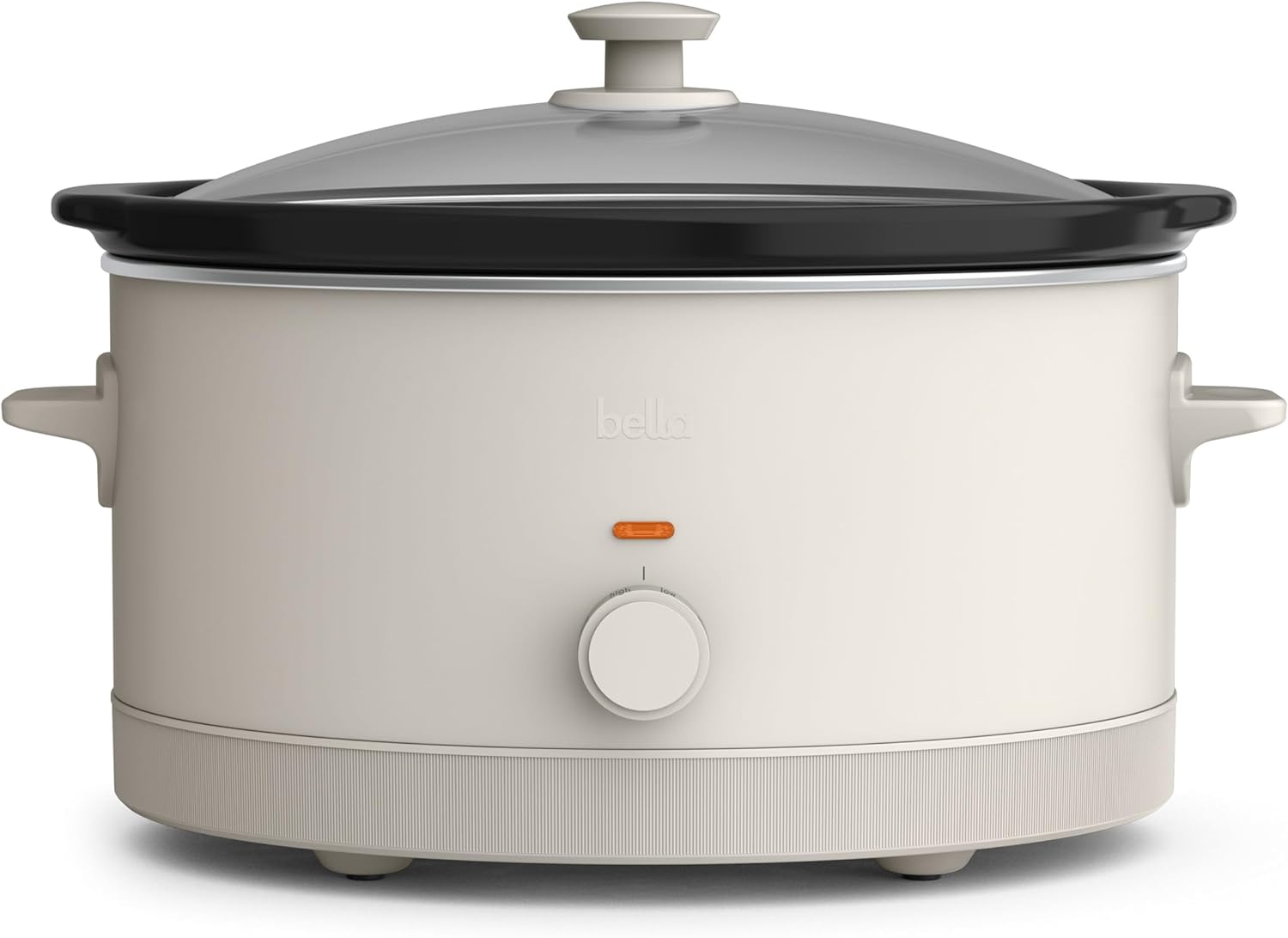
The BELLA 6.0 qt slow cooker is a straightforward, budget-friendly appliance for batch cooking soups, stews, roasts, and meal prep. It uses a removable stoneware pot with an EverGood ceramic nonstick coating and a shatter-resistant tempered glass lid so food releases easily and you can check progress without lifting the lid. Controls are manual via a mechanical knob with three heat settings—low, medium, and high—so it is simple to operate without programming. Practical touches like cool-touch handles, non-skid feet, and cord storage make it safe and easy to move and store, and the stoneware is dishwasher-safe for easier cleanup. The cooker is not programmable and lacks timed auto-switch or advanced presets, so you need to monitor cooking schedules manually. For cooks who want a reliable, no-frills slow cooker that handles large batches and cleans up quickly, this model delivers solid everyday performance at a low price point.
Best for: Buyers seeking an affordable, no-frills slow cooker that reliably handles large batches and is easy to use and clean for weeknight dinners and meal prep.
Less Ideal for: Users who want digital controls, programmable timers, or advanced cooking presets should consider more feature-rich models instead.
- Large 6-quart capacity suitable for family meals and meal prep
- EverGood ceramic nonstick stoneware for easier food release and cleaning
- Simple, durable mechanical knob with three heat settings for easy operation
- Tempered shatter-resistant glass lid lets you monitor food without losing heat
- Cord wrap, cool-touch handles, and non-skid feet for safer handling and tidy storage
- No programmable timer or automatic keep-warm function
- Basic control set limits fine-tuned temperature control for delicate recipes
Verdict: A practical, budget-friendly 6-quart slow cooker that offers big-batch performance and easy cleanup for everyday cooking needs.
Cosori 6-Quart Pressure Cooker
| Capacity | 6 quarts |
|---|---|
| Wattage | 1100 watts |
| Inner Pot | Non-stick ceramic coating |
| Control Method | Touch with physical buttons |
| Voltage | 120 volts |
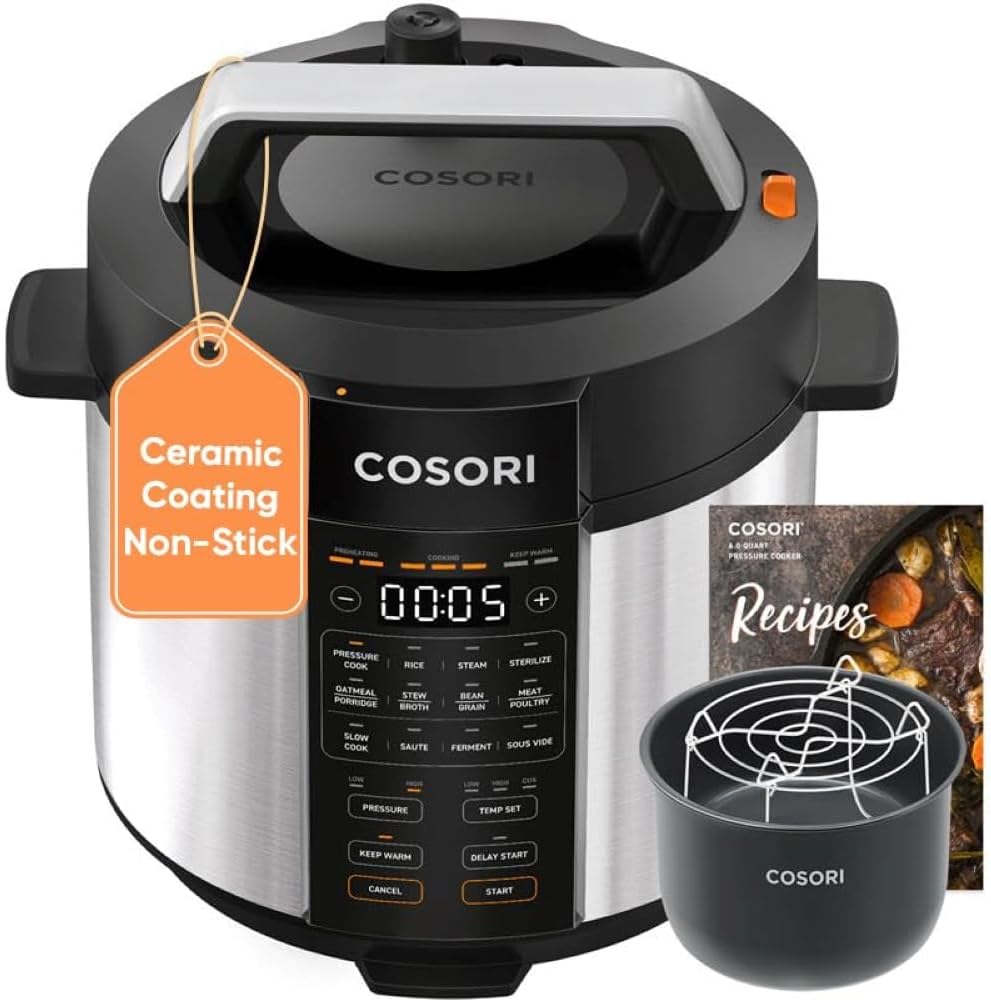
The Cosori 6-quart electric pressure cooker is a multi-function countertop cooker that handles pressure cooking, rice, steaming, slow cooking, sautéing, sous vide, fermenting and keep-warm in one unit. It is typically used to speed braises, make tender meats, cook rice and beans, or finish hands-off one-pot meals using the 13 presets and 9 cooking functions. Notable features include an 1100W heating element for reasonably quick come-to-pressure times, a non-stick ceramic inner pot that is dishwasher-safe, a touch control panel with manual-button backup, and a venting design that places the seal/vent control away from the steam release for safer venting. Practical benefits for everyday kitchens are faster cook times compared with conventional methods, easy cleanup thanks to the ceramic pot and dishwasher-safe lid, and built-in safety protections including a double-layer anti-scalding lid and overheat protection. Limitations to keep in mind are the 6-quart capacity, which may be small for very large batches or canning full pressure-canning loads, and the unit weight and footprint that take counter space; also the recipe presets simplify use but power and cycle details are not adjustable to the same degree as some pro cookers.
Best for: Home cooks who prioritize safe, easy-to-use multi-function appliances and want a reliable electric pressure cooker for everyday meals with minimal fuss.
Less Ideal for: People who plan to do frequent, large-batch pressure canning or require a certified pressure canner for preserving high-acid and low-acid foods should choose a dedicated, tested pressure canner instead.
- Multiple built-in presets and 9 cooking functions for one-pot versatility
- Ceramic non-stick inner pot that is dishwasher-safe and BPA-free for food contact
- Safer venting design with seal/vent control positioned away from the steam release
- 1100W power for reasonably quick pressurization and cooking
- Several safety features including double-layer anti-scalding lid and overheat protection
- 6-quart capacity may be limiting for large-batch canning or very large families
- Not a dedicated canner so lacks documented tested canning cycles and may not replace a pressure canner for home canning guidance
Verdict: Choose this Cosori if you want a safe, user-friendly multi-cooker that speeds everyday meals and simplifies cleanup while offering multiple built-in cooking presets.
Instant Pot Duo 6-Quart

| Capacity | 5.68 liters |
|---|---|
| Wattage | 1000 watts |
| Control Method | Touch |
| Voltage | 120 |
The Instant Pot Duo is a versatile 7-in-1 electric cooker built for everyday family meals and faster stovetop-style results without constant monitoring. It lets you pressure cook stews, dals and rice up to 70% faster than slow cooking, then switch to sauté for browning or use the steam and rice programs for one-pot Indian meals. The stainless steel inner pot with tri-ply bottom supports good searing and even heat, and the appliance includes 13 one-touch smart programs and an easy-release steam switch for safe venting. Cleanup is straightforward because the removable inner pot and lid are dishwasher-safe, and the unit includes a stainless steamer rack for batch cooking or steaming vegetables and dhokla. Limitations to note are its 6-quart capacity, which is sized for families but may be tight for very large batches, and the learning curve if you are new to electric pressure cookers and menu timing. For balanced home cooks who want a reliable, multi-function cooker that speeds up traditional Indian recipes, the Duo hits the mark.
Best for: Home cooks seeking a single reliable appliance to speed up everyday Indian meals who value versatility, safety, and easier cleanup.
Less Ideal for: Large households that cook very large batches regularly or cooks who prefer full manual stovetop pressure control should consider larger or different options.
- Seven cooking functions in one appliance for pressure cooking, slow cooking, sautéing, steaming, rice, yogurt and warming
- Stainless steel inner pot with tri-ply bottom for even heat and good searing
- 13 one-touch smart programs simplify common recipes
- Easy-release steam switch and multiple safety mechanisms for secure use
- Dishwasher-safe inner pot and lid for easier cleanup
- 6-quart capacity may be limiting for very large families or bulk batch cooking
- Takes time to learn optimal settings and timing for specific traditional recipes
Verdict: Choose the Instant Pot Duo if you want a safe, all-in-one electric cooker that speeds up traditional Indian dishes while simplifying cleanup.
Instant Pot Rio Mini 4‑Quart

| Capacity | 4 quarts |
|---|---|
| Wattage | 800 watts |
| Functions | Pressure cook, slow cook, sauté, steam, rice, yogurt, keep warm |
| Control Method | Touch |
| Voltage | 120 volts |
The Instant Pot Rio Mini 4‑Quart is a small, beginner-friendly multi-cooker built to handle everyday meals for one to four people. It offers seven functions—pressure cook, slow cook, sauté, steam, rice, yogurt, and keep warm—so you can make stews, rice, yogurt, and one-pot dinners without juggling multiple appliances. The 800‑watt unit has a touch control interface and an outer lid with an auto-sealing locking mechanism and overheat protection for safe, set-and-forget cooking. Its stainless steel inner pot is dishwasher-safe, and the progress indicator and anti-spin design make stirring and monitoring easier than with many compact cookers. Because it is only 4 quarts, it is best for singles, couples, or small families; larger-batch cooking or big roasts will require more frequent batches. The compact size makes it easy to store or take to a second kitchen, and the included steam rack and condensation collector are useful extras for steaming and safe storage between uses.
Best for: Buyers who want a simple, safe, and compact cooker for everyday meals and prefer an appliance with clear controls and built-in safety features.
Less Ideal for: Users who regularly cook large batches, whole roasts, or meals for many people should choose a larger-capacity model instead.
- Seven cooking functions in one compact unit for versatile meal options
- Auto-sealing lid and built-in safety features reduce user error and increase confidence
- Dishwasher-safe stainless steel pot and removable parts simplify cleanup
- Small footprint that is easy to store or move between kitchens
- Touch controls and progress indicator make operation straightforward for beginners
- 4‑quart capacity limits batch cooking and large-family meals
- Lower wattage than larger models means slightly longer pressure-up times
Verdict: A compact, safety-focused multi-cooker ideal for beginners and small households who want reliable, easy one-pot cooking.
Choosing the Right Multi-Cooker for Slow Cooking: Key Factors to Consider
Temperature Control Accuracy
Slow cooking depends on holding a steady low temperature for hours. Small swings can change textures and moisture loss, so a cooker with precise temperature sensors and incremental settings is valuable. Look for appliances that let you select specific low-temperature ranges or have proven low, medium, and high slow-cook presets.
Accurate control also reduces the need to check or adjust food mid-cook. That matters when you want true "set and forget" operation for overnight or all-day braises.
Low-Heat Consistency
Consistency is distinct from accuracy. A unit can read the correct temperature but still cycle heat in a way that creates hotspots or temperature drift over long periods. Consistent low-heat delivery prevents burning at the edges and ensures even tenderness throughout large cuts of meat or layered casseroles.
Consider how the cooker applies heat: bottom-only elements can be fine with a well-designed pot, but units with diffused heat or integrated heating around the base typically produce fewer hot spots during prolonged cooking.
Capacity and Pot Shape
The size and shape of the inner pot influence what you can cook. A wider, shallower pot is better for large roasts and sheetlike braises, while a taller pot suits whole chickens and stocks. Capacity determines how many servings you can make and whether you can batch-cook and freeze meals.
Also think about headspace for long simmering and whether the pot fits in your cabinets for storage. Removable pots that are oven-safe expand flexibility for finishing or browning ingredients before slow cooking.
Programming and Scheduling Options
Practical slow cooking often relies on delayed starts, automatic keep-warm modes, and simple presets for low-temperature braising. Easy-to-use scheduling reduces the risk of leaving food at unsafe temperatures and can handle multi-step recipes that start with a sear or pressure phase.
Clear displays and tactile controls make setting long cooks less error-prone, especially when you want to set a timer before leaving the house or overnight.
Ease of Cleaning and Maintenance
Long cooks leave concentrated juices and sticky residues that must be cleaned thoroughly. Removable, dishwasher-safe inner pots and simple lid assemblies save time and reduce long-term maintenance hassle. Seals, steam valves, and clip fittings should be easy to disassemble and rinse.
Durable nonstick coatings or stainless interiors resist staining and scratching, which matters if you plan frequent slow-cooker use. Consider how easy it is to inspect and replace worn gaskets if the appliance uses them.
Safety Features and Construction
Slow cooks run for many hours, so safety features matter more than with quick-cook appliances. Look for stable, weighted lids or reliable locking mechanisms that prevent accidental opening, and well-insulated exteriors to reduce the risk of contact burns.
Auto-shutoff timers tied to keep-warm transitions and fail-safes for overheating are useful safety redundancies. Solid construction and a stable base reduce the chance of tipping, especially when filling larger pots.
How Low-Heat Modes Differ From Pressure Cooking
Low-heat slow cooking relies on maintaining a gentle, steady temperature for extended periods, whereas pressure cooking uses sealed high-pressure steam to rapidly break down connective tissue. The results and techniques differ: slow cooks create a different texture and moisture profile, often producing moister, more uniform tenderness without the flavor concentration that pressure models can produce quickly.
When choosing a multi-cooker for slow cooking, ensure the unit offers a true low-heat setting rather than just a reduced-pressure program. The user interface should clearly indicate slow-cook modes and allow time and temperature adjustments appropriate for multi-hour braises.
- Low-heat cooks: long duration, gentle breakdown of collagen.
- Pressure cooks: fast, intense, needs quick-release or natural release methods.
- Some multi-cookers offer both but verify that low-heat mode holds consistent temperatures.
Practical Capacity Planning for Meal Prep
Think about typical meal sizes and how often you want leftovers. A 4-quart pot might be adequate for two to three people, while families and batch-cooking routines usually require 6 quarts or more. Also consider whether you will use the cooker for stock making, which benefits from taller pots for reduced splatter during long simmers.
If you plan to sear or brown in the same insert, a broader base provides more contact area for efficient caramelization before the slow-cook phase. Check the shape and whether the insert is oven safe to expand finishing options.
- Match capacity to household size and meal-planning habits.
- Choose pot shape based on recipes you cook most often.
- Removable inserts that fit in the oven add flexibility.
Programming Tips for Set-and-Forget Slow Cooks
Use delayed start only with recipes that begin at safe, cool temperatures. For most slow-cooked meat dishes, sear first and then program the slow-cook cycle so the food spends less time in the temperature danger zone. If your device has a reliable keep-warm mode, use it to maintain safe serving temperatures after the main cook.
Favor models with clear timers and audible confirmations. Simple presets for "low" and "high" slow-cook are fine if accompanied by time controls. When recipes call for long unattended cooks, choose units with robust safety features and a reliable automatic keep-warm transition.
- Avoid delayed start for raw meat without refrigeration steps.
- Sear ingredients beforehand for better flavor where possible.
- Use keep-warm to bridge finishing when serving is delayed.
Maintenance Routines to Prolong Performance
After long slow cooks, soak the insert and clean seals and vents to prevent residue buildup. Regularly inspecting gasket condition and the lid vent prevents steam-flow issues that can affect long-term temperature control.
Store the insert and lids separately when not in use to allow components to dry fully. Replace any worn gaskets as soon as you notice cracks or deformations to maintain safe seals and consistent heat performance.
- Soak inserts promptly to avoid stuck-on residue.
- Disassemble and clean steam valves per the manual.
- Check gaskets periodically and replace if brittle or misshapen.
Recipes That Showcase Slow-Cooker Strengths
Hearty braises, bone-in stews, and pulled meat recipes show the advantages of long, gentle cooking. These dishes benefit from the breakdown of connective tissue and collagen over many hours, yielding tender, pull-apart textures that are difficult to match with quick methods.
Vegetable-forward ragouts and soups also do well in low-heat environments because flavors deepen without rapid evaporation. For thicker sauces, finish with a short uncovered simmer on a stovetop or in an oven-safe insert to reduce volume and concentrate flavors.
- Bone-in short ribs and pork shoulder excel with steady low heat.
- Beans and legumes benefit from consistent simmering to reach tenderness.
- Vegetable stews develop depth without shrinking into dryness.
How We Chose the Best Multi-Cooker for Slow Cooking
We focused on attributes that directly affect slow-cooking results and everyday usability. Primary evaluation criteria included temperature control accuracy and granularity, which determines whether a cooker can hold stable low temperatures for 6 to 12 hours. We also measured capacity and pot shape suitability for common slow-cooked dishes so readers can match meal size and braising needs. Heat distribution and build of the inner pot were another priority because even, low-level heat prevents hot spots and sticking during long cooks. Controls and programming flexibility mattered for convenience: units with easy scheduling, delay-start safety, and clear low-heat presets rated higher. Practical maintenance factors such as ease of cleaning and durability of seals and lids were included since long cooks make cleanup a frequent burden. We excluded devices that only offer pressure-cook-only operation without reliable low-temperature modes, and we filtered out units with poor user controls or fragile inner pots. Our picks emphasize models that consistently deliver gentle, steady heat and straightforward day-to-day handling.
Our full evaluation process is outlined in our review methodology.
FAQ
Can I use a multi-cooker slow-cook mode overnight?
Often yes, but only when the cooker reliably maintains low, consistent temperatures and has a dependable keep-warm transition. Verify the unit has safety features like auto-shutoff or secure lids and follow recipe guidance to avoid extended time in the temperature danger zone.
Is it safe to put raw meat in a delayed-start slow-cook?
Usually not recommended. Delayed starts can let perishable food sit at unsafe temperatures before cooking begins. If you need a delay, refrigerate the prepared ingredients and set the cooker to start only when they are taken out of cold storage or use a model with proven food-safety programming.
Do I need to brown meat before slow cooking in a multi-cooker?
Browning is optional but improves flavor through caramelization. If your insert is oven-safe or the cooker supports initial sear or sauté steps, browning first will add depth. It is not strictly necessary for tenderness, which primarily comes from time and gentle heat.
How do I avoid a watery or diluted sauce after long slow cooking?
Finish with an uncovered simmer to reduce liquid or thicken with a slurry or a short period under high heat in an oven-safe insert. Starting with less liquid and allowing some evaporation near the end preserves flavor concentration.
What pot material is best for slow cooking?
Heavy-gauge stainless steel and coated cast aluminum inserts that distribute heat evenly tend to perform well. Nonstick coatings ease cleanup but inspect durability if you plan to use metal utensils or frequent oven finishing.
Final Verdict
For slow cooking, prioritize models that hold steady low temperatures, offer the right capacity for your household, and provide simple scheduling with reliable safety features. Expect tradeoffs between insert shape and searing flexibility, and weigh ease of cleaning against performance features. Choose a multi-cooker that matches the size of the meals you make most often and has proven low-heat consistency. That approach will deliver the predictable textures and hands-off convenience that make slow cooking worthwhile.