
Note: This article contains affiliate links. If you click on these links and make a purchase, we may earn a small commission at no extra cost to you. This helps support our research and content. Read our full affiliate disclosure here.
Choosing the right night-vision security camera makes a major difference in how well you can monitor a property after dark. You want dependable image quality, motion detection that reduces false alerts, and a setup that fits your home wiring or wireless layout. This guide shortlists seven strong night-vision security camera options that cover a range of installation styles and capabilities. We assess each pick against the practical criteria that matter most for night surveillance, including image clarity, detection reliability, storage flexibility, and installation needs. Read on to find cameras that suit the areas you need to protect and the level of detail you require after dusk.
Top Picks at a Glance
| Best Overall The best all-around choice for most situations | Blink Mini 2K+ |  |
| Best Quality Built to a higher standard if you want something more solid | ANNKE 8CH DVR with 8 Cameras |  |
| Best Value The sweet spot between price and what you get | WYZE Cam v4 |  |
| Best Budget The cheapest option that still gets the job done reliably | Tapo C101 Indoor Camera |  |
| Top Rated A top-rated pick with lots of positive feedback | Ring Outdoor Cam (Stick Up Cam) Battery |  |
| Most Popular A crowd favorite that many people choose with confidence | Blink Outdoor 4 3-Cam Kit |  |
| Best Seller A high-volume bestseller chosen again and again | TP-Link Tapo C100 Indoor Camera |  |
Blink Mini 2K+

| Video resolution | 2K |
|---|---|
| Zoom | Up to 4x |
| Bundled quantity | 2 cameras |
The Blink Mini 2K+ is a small plug-in security camera aimed at everyday home monitoring where clear video and easy setup matter. It records sharper 2K footage with up to 4x zoom, offers night vision for low-light monitoring, and improved two-way audio with noise cancellation so conversations sound clearer. Typical use cases include monitoring entryways, living rooms, nurseries, and pet areas; the camera can sit on a shelf or be mounted using the included stand and mounting kit. It integrates with Alexa for voice interactions and can act as a chime for a Blink Video Doorbell when paired. Clips can be saved to the cloud with Blink subscription plans, and extended outdoor use is possible with an optional weather-resistant power adapter. Limitations include reliance on cloud storage for advanced detection and clip retention and the need for a constant power connection since it is not battery powered.
Best for: Home users who want an inexpensive, easy-to-install indoor camera that prioritizes sharper night and daytime video plus clear two-way audio for routine room monitoring.
Less Ideal for: Users who need entirely local storage, battery-powered placement, or fully featured on-device analytics without a subscription should look elsewhere.
- 2K video resolution with up to 4x zoom for clearer detail in recordings
- Improved two-way audio with noise cancellation for clearer conversations
- Simple plug-in setup with included mounts and USB power cables
- Works with Alexa and can function as a chime for Blink Video Doorbell
- Cloud subscription required for advanced detection features and long-term clip storage
- Requires continuous power and is not battery operated
Verdict: Choose the Blink Mini 2K+ if you want an affordable, plug-in indoor camera that delivers sharper 2K night and daytime video with clear two-way audio and very simple setup.
ANNKE 8CH DVR with 8 Cameras

| Connectivity Technology | Wired |
|---|---|
| Video Capture Resolution | 1080p |
| Number of Channels | 8 |
| Memory Storage Capacity | 1 TB |
| Night Vision Range | 100 feet |
This ANNKE kit pairs an 8-channel H.265+ DVR with eight wired 1080p bullet cameras and a preinstalled 1TB hard drive to deliver continuous local recording and remote viewing. It is typically mounted around a property for 24/7 surveillance, using BNC cabling and the DVR's HDMI/VGA outputs for local monitoring while phones and tablets connect through the ANNKE app for remote live view and playback. Notable features include AI human and vehicle detection to reduce false alerts, dual-light cameras that switch between IR and color night vision, and support for up to 3K/5MP cameras if you upgrade individual cameras later. Practical benefits are solid night coverage with claimed 100 ft black-and-white and about 66 ft color night vision, long recording times thanks to H.265+ compression, and the ability to continue recording without internet. Trade-offs include that the included cameras are 1080p rather than true 3K, the system requires wired installation and power cabling for each camera, and full feature access depends on learning the app and DVR menu system.
Best for: Buyers focused on reliable, performance-oriented perimeter surveillance who want continuous local recording, AI-based motion filtering, and stronger night-vision detail from a wired system.
Less Ideal for: Users who need a completely wireless or plug-and-play camera solution or who prioritize the highest native camera megapixel counts out of the box.
- Complete 8-camera wired kit with DVR and 1TB HDD for out-of-the-box continuous recording
- AI human and vehicle detection to cut down false alarms and speed event search
- Dual-light cameras offer both IR and color night vision for clearer nighttime details
- H.265+ compression reduces storage and bandwidth use for longer recording retention
- Works offline for local recording; remote access available via app when online
- Included cameras are 1080p, not the higher-resolution 3K cameras the DVR can accept
- Wired setup requires running BNC/power cables to each camera and basic installation work
- Advanced configuration and app learning curve for some users
Verdict: A performance-focused wired 8‑camera kit that delivers continuous local recording, AI human/vehicle alerts, and improved color night vision for reliable night-time surveillance.
WYZE Cam v4

| Video Capture Resolution | 2k |
|---|---|
| Effective Video Resolution | 1440 |
| Field of View | 120 degrees |
| Night Vision Range | 100 feet |
| Storage | Micro SD up to 512 GB |
The Wyze Cam v4 is a compact indoor/outdoor security camera that records in 2.5K QHD and is built around nighttime visibility and practical monitoring. It is typically mounted on a porch, garage, or inside a living area and connected to 2.4 GHz Wi‑Fi; setup uses the Wyze app and Bluetooth and the magnetic base makes placement easy. Notable features include enhanced color night vision driven by a Starlight sensor and a 72‑lumen motion-activated spotlight, a 99 dB siren for active deterrence, two-way audio for remote talk/listen, and support for local microSD recording up to 512 GB so you can avoid mandatory cloud fees. On-device AI and activity zones reduce false alerts by focusing on people, pets, packages, or vehicles, and integrations with Alexa and Google Assistant make voice viewing simple. Trade-offs are modest: frame rate is a conservative 20 fps and reading distant license plates at night is not guaranteed, and the camera requires a nearby power source and 2.4 GHz connectivity for reliable operation. For buyers who prioritize nighttime clarity and local recording, it is a strong, budget-conscious option.
Best for: People who want a practical, cost-conscious outdoor or porch camera that prioritizes clear nighttime color footage and the ability to record locally without subscription fees.
Less Ideal for: Buyers who need battery-powered placement, ultra-high frame rates for sports or fast action, or guaranteed long-range license plate reading at night should consider other specialized options.
- High 2.5K QHD resolution for clearer facial and package detail near entryways
- Enhanced color night vision with a 72-lumen spotlight for vivid low-light footage
- IP65 weather resistance for year-round outdoor use
- Supports local microSD recording up to 512 GB so you can record without a subscription
- On-device AI and activity zones reduce false motion alerts and improve relevance
- Requires continuous power and 2.4 GHz Wi‑Fi which may limit placement options
- 20 fps frame rate is lower than some higher-end cameras for very smooth motion
Verdict: Choose the Wyze Cam v4 if you want an affordable indoor/outdoor camera with standout color night vision and local recording so you can capture clear overnight detail without a subscription.
Tapo C101 Indoor Camera

| Video Capture Resolution | 1080p |
|---|---|
| Frame Rate | 15 Frames Per Second |
| Night Vision Range | 30 feet |
| Connectivity Protocol | Wi-Fi |
| Memory Storage Capacity | 512 GB |
The Tapo C101 is an affordable indoor security camera built for basic home monitoring and night use. It streams 1080p video at 15 fps over 2.4 GHz Wi‑Fi, sends instant push alerts for motion, people, or baby crying, and records to a microSD card (up to 512 GB) or Tapo Care cloud. Two‑way audio with a built‑in siren lets you talk to family or pets and deter intruders, while IR night vision reaches up to about 30 feet for low‑light coverage. Installation is simple as a freestanding or wall‑mounted unit powered by the included DC adapter; it is not battery powered. The camera also supports RTSP/ONVIF for basic NVR integration. Expect clear daytime footage and usable night images for entryways, hallways, or nurseries, but note the 15 fps video and box form factor prioritize affordability over high‑frame, ultra‑smooth footage or advanced analytics without a subscription.
Best for: Buyers wanting an inexpensive, no‑frills indoor camera for overnight monitoring, pet checking, or nursery use who value reliable night vision and simple app alerts over premium features.
Less Ideal for: Users needing wireless/battery operation, high‑frame security footage, or advanced on‑camera analytics should consider more capable or higher‑end models.
- 1080p HD video with up to 30 ft infrared night vision for reliable day and night monitoring
- Instant push alerts for motion, person detection, and baby crying without extra fees
- Two‑way audio plus built‑in siren for remote communication and deterrence
- Supports local microSD storage up to 512 GB and optional cloud backup
- Works with Alexa and Google Assistant and offers RTSP/ONVIF for basic NVR integration
- Requires constant power via corded adapter; not battery powered
- Frame rate is 15 fps which may produce less-smooth motion than higher‑frame cameras
Verdict: If you want an inexpensive indoor camera with dependable 30‑ft night vision and simple local or cloud recording, the Tapo C101 is a strong budget pick.
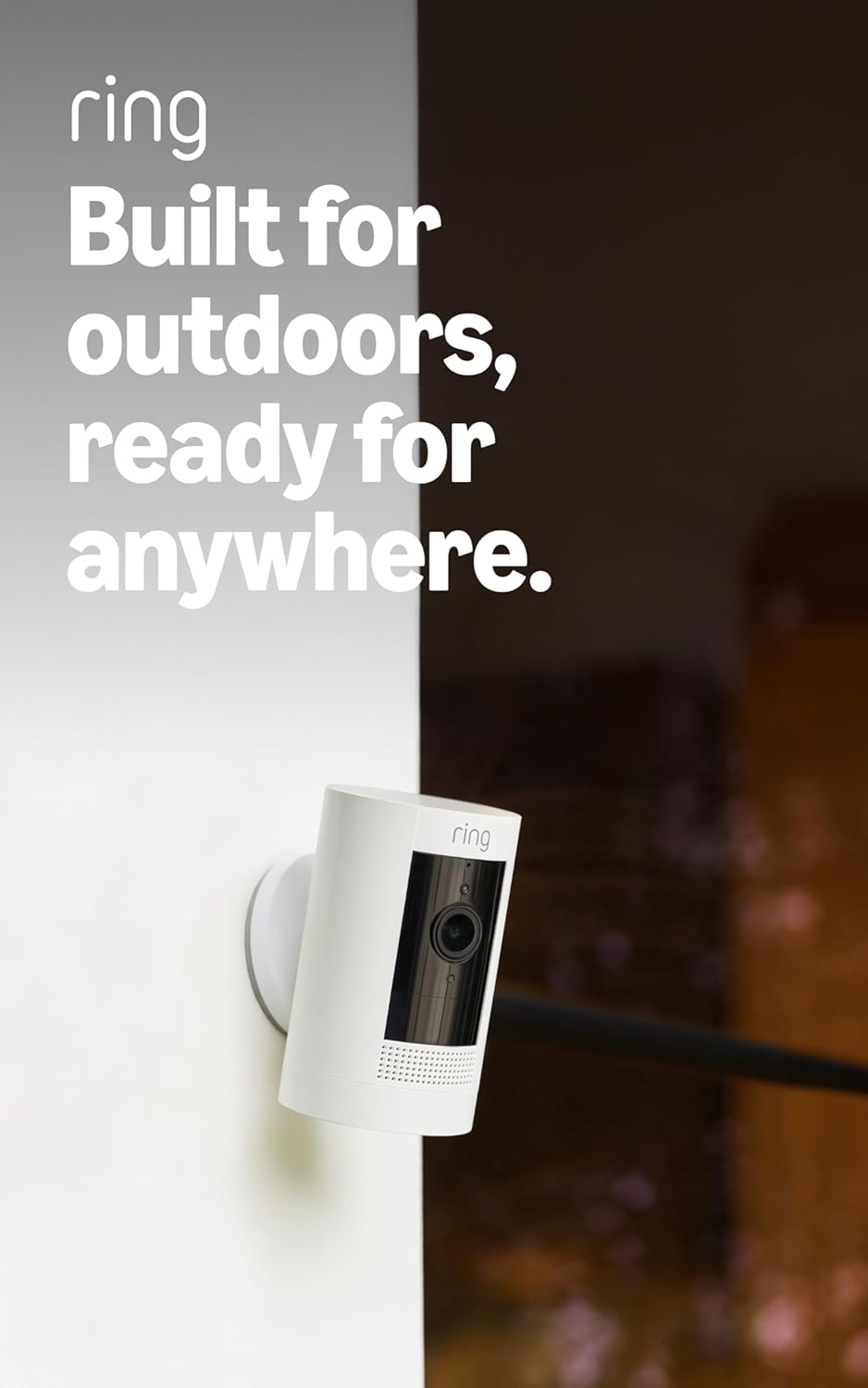
Ring Outdoor Cam (Stick Up Cam) Battery
| Power | Rechargeable battery |
|---|---|
| Connectivity | Wi-Fi |
| Features | Live View, Two-Way Talk, Color Night Vision |
| Compatibility | Works with Alexa |
The Ring Outdoor Cam (Stick Up Cam) Battery is a weatherproof, battery-operated security camera designed for flexible placement around a home or small business. It connects to Wi-Fi and streams HD live view to the Ring app, lets you speak through two-way talk, and offers color night vision for clearer low-light footage. The rechargeable battery pack makes installation simple because you can mount it on a wall or place it on a flat surface without wiring, and the versatile bracket supports several orientations. Motion alerts and cloud recording (with a Ring Protect subscription) let you review events, and Alexa integration enables hands-free viewing on Echo devices. Limitations include reliance on Wi-Fi and the need for a subscription to access video history and advanced alerts, and battery life will vary with frequency of use and night-vision activity. For buyers who prioritize reliable, always-on local recording without subscriptions or hardwired power, consider wired or local-NVR options instead.
Best for: Buyers who want a dependable, easy-to-install outdoor camera with clearer nighttime color footage and hands-free integration into a smart-home setup.
Less Ideal for: Users who need continuous local recording without subscriptions or who prefer a permanently hardwired camera for guaranteed uptime should consider wired or NVR-based systems instead.
- Weather-resistant design for outdoor installation
- Rechargeable battery allows wire-free placement and easy setup
- HD live view with two-way talk for real-time monitoring and communication
- Color night vision improves low-light image clarity compared with standard IR-only cameras
- Video history and advanced alerts require a Ring Protect subscription
- Performance depends on home Wi-Fi strength and the camera’s battery charge
Verdict: Choose this Ring Outdoor Cam if you want a reliable, weatherproof battery camera that delivers clear color night vision and easy, wire-free placement.
Blink Outdoor 4 3-Cam Kit

| Video resolution | 1080p HD |
|---|---|
| Night vision | Infrared |
| Included cameras | 3 |
| Power | AA Energizer lithium batteries (included) |
| Sync module | Sync Module Core included |
The Blink Outdoor 4 three-camera kit is a battery-powered outdoor security system designed for simple installation and long unattended runtime. Each camera streams 1080p HD live view, supports infrared night vision, and provides two-way audio through the Blink app so you can check footage and speak to visitors from your phone. Enhanced dual-zone motion detection reduces useless alerts and person detection is available with an optional subscription, while the included Sync Module Core links the cameras and enables cloud storage via Blink plans; local storage requires different Sync Module models sold separately. Setup ships with AA Energizer lithium batteries and mounting hardware so you can place cameras quickly around a property, and integration with Alexa enables voice-activated multi-camera viewing. The main trade-offs are that local backup is not supported by the included Sync Module Core and advanced features like person detection require a subscription or additional hardware for local recording, so buyers seeking fully local-only storage or immediate edge recording should plan accordingly.
Best for: Buyers who want an affordable, easy-to-install outdoor camera system with strong night-vision performance and minimal maintenance between battery changes.
Less Ideal for: Users who require native local recording or want all advanced detection features without any subscription or additional hardware.
- Long battery life rated up to two years with included AA Energizer lithium batteries
- 1080p HD live view with infrared night vision for clear nighttime monitoring
- Includes Sync Module Core and three mounting kits for fast, out-of-the-box setup
- Enhanced dual-zone motion detection reduces irrelevant alerts
- Sync Module Core does not provide local storage so cloud subscription or different Sync Module is needed for local backup
- Person detection and some advanced CV features require an optional subscription
Verdict: A straightforward, battery-powered outdoor kit with reliable night vision and up-to-two-year runtime that suits buyers wanting low-maintenance security with cloud backup options.
TP-Link Tapo C100 Indoor Camera

| Video Capture Resolution | 1080p |
|---|---|
| Night Vision Range | 30 feet |
| Field Of View | 110 degrees |
| Wireless Technology | 2.4GHz Wi‑Fi |
| Video Encoding | H.264 |
The Tapo C100 is an indoor Wi‑Fi security camera that captures 1080p video and sends motion alerts to your phone while offering local microSD or optional cloud storage. It is typically mounted on a wall or placed on a shelf to monitor nurseries, living rooms or pet areas and streams a 110 degree view at 15 fps using H.264 encoding. The camera includes two‑way audio with a built‑in siren so you can talk to family or pets and deter intruders, and the app supports custom activity zones, schedules and four‑camera group views. Night vision reaches up to about 30 feet and the IR provides usable black‑and‑white nighttime footage. Setup is straightforward on 2.4 GHz Wi‑Fi and the camera works with voice assistants for viewing on smart displays. Limitations to note are the modest 15 fps frame rate and reliance on 2.4 GHz Wi‑Fi only, which can affect motion smoothness and network placement flexibility, and continuous cloud features require a subscription while microSD cards are sold separately.
Best for: Buyers who want a simple, reliable indoor camera with clear night vision and easy app controls for everyday home or pet monitoring and who prefer the option of local storage to avoid recurring fees.
Less Ideal for: Users who need high‑frame‑rate or professional-grade surveillance, or those who require battery power or 5 GHz Wi‑Fi compatibility for flexible placement.
- 1080p HD video for clear daytime monitoring
- Two‑way audio plus built‑in siren for remote communication and deterrence
- Night vision up to 30 feet for reliable low‑light monitoring
- Local microSD storage support (up to 512 GB) to avoid mandatory cloud dependency
- App features like activity zones, scheduling and multi‑camera view for focused alerts
- Frame rate is limited to 15 fps which can make fast motion look choppy
- Only supports 2.4 GHz Wi‑Fi, which may limit placement in crowded networks
Verdict: Choose the Tapo C100 if you want an affordable, easy‑to‑set‑up indoor camera with solid 1080p night vision and local storage options for low‑hassle home monitoring.
Choosing the Right Night-Vision Security Camera: Key Factors to Consider
Image Sensor and IR Illumination
The sensor type and the quality of infrared illumination determine how much usable detail a camera captures at night. Better sensors and well-designed IR arrays reveal facial features, license plates, and movement at greater distances, which is critical when you need actionable evidence. Consider the advertised IR range as a guide but also look for sensors with proven low-light sensitivity and any supplemental features like low-light color modes.
Poorly matched IR can wash out close objects or leave distant areas too dark. Optics quality, sensor size, and IR wavelength all interact, so prioritize cameras that balance illumination with sensor capability rather than relying on IR range numbers alone.
Detection Algorithms and False Alerts
Motion detection that simply triggers on any pixel change will produce many false alerts from shadows, insects, or passing headlights. Cameras with smarter algorithms, such as human-shape recognition, customizable zones, or adjustable sensitivity, help reduce unnecessary notifications. Reliable detection saves battery life for wireless units and reduces time spent reviewing footage.
Also check whether the camera supports multiple detection presets and scheduling so you can tailor sensitivity during known activity windows. Integration with other sensors or systems can further sharpen accuracy by confirming motion with an external trigger.
Power and Connectivity Options
How a camera is powered and how it connects to your network affects where you can place it and how dependable it will be. Hardwired PoE or AC-powered cameras offer continuous operation and stable bandwidth for high-resolution night footage. Battery-powered or solar-capable cameras allow flexible placement but require consideration of battery life, cold-weather performance, and recharge intervals when night monitoring is frequent.
Connectivity is equally important. Cameras that support dual-band Wi-Fi or wired Ethernet provide more consistent streaming. Also evaluate whether the device supports local storage, cloud uploads, or both to match your privacy preferences and data redundancy needs.
Mounting, Field of View, and Coverage
Night-vision cameras vary in lens focal length, field of view, and mounting options, all of which impact how much area you can monitor effectively. A wide-angle lens covers broad zones but reduces detail at longer distances, while a narrow field improves identification range. Adjustable mounts, pan/tilt mechanisms, and recommended mounting heights can help you position the camera for optimal night coverage.
Think through typical intrusion paths, sightlines, and potential obstructions like eaves or landscaping when planning coverage. Multiple strategically placed cameras often provide better night oversight than a single high-powered unit.
Weatherproofing and Long-Term Maintenance
Night monitoring usually requires outdoor-rated hardware. Look for cameras with an IP rating that matches your climate to resist rain, dust, and temperature swings. Durable housings and sealed connectors reduce moisture intrusion that can degrade infrared LEDs and optics over time.
Maintenance considerations include ease of cleaning the lens and IR window, firmware update support, and accessory availability. Regular checks and firmware updates are important to maintain night performance and security posture.
Privacy, Data Storage, and Access Control
How footage is stored and who can access it matters for both privacy and practicality. Cameras that offer local encrypted storage let you keep night footage in your control, while cloud options provide offsite redundancy and easier remote access. Evaluate account security features such as two-factor authentication, end-to-end encryption, and granular user permissions.
Also consider data retention policies and whether the system allows automatic export of event clips. For shared properties or multi-user setups, clear access controls prevent accidental exposure of sensitive recordings.
Setting Up Cameras for Optimal Night Coverage
Placement and aiming are critical for reliable night monitoring. Position cameras so infrared illumination can evenly reach the primary area of interest without reflecting off nearby surfaces that create glare. Avoid pointing IR-equipped cameras directly at glass or reflective siding to prevent bloom and loss of detail.
Height and angle matter. Mount cameras above head height and angle them downward slightly to reduce the chance of direct glare from vehicles and to capture faces more effectively. If using multiple cameras, overlap fields of view modestly so a subject leaves one camera's range and immediately appears in another's coverage.
- Avoid direct line-of-sight to bright lights and reflective surfaces.
- Aim for a mix of wide coverage and at least one camera focused on identification zones.
- Test at night after installation and adjust IR angle or sensitivity as needed.
Balancing Resolution and Night Performance
High resolution helps with identification, but at night it is only useful if the sensor and IR illumination can produce enough light to fill those pixels. In low-light scenes, a moderate-resolution sensor with strong low-light sensitivity can outperform a higher-megapixel sensor with poor night capability.
If you rely on remote viewing, consider bandwidth limitations. Higher-resolution night footage uses more data and may introduce lag or dropped frames on congested networks. When in doubt, prioritize steady, clear night imaging over raw pixel count.
- Prioritize sensor sensitivity and IR quality over megapixel counts for night clarity.
- Consider adjustable recording profiles that reduce resolution at night to save bandwidth while keeping detection reliable.
Integrating Night Cameras Into a Home Security System
Night-vision cameras can be part of a broader security setup that includes alarms, door sensors, and lighting. Linking cameras to lighting or alarm triggers can illuminate an area when motion is detected, improving both deterrence and image capture. Ensure the integration method maintains night imaging capabilities and does not create blinding light that ruins footage.
Check compatibility with your central monitoring or network video recorder if you plan to record continuously or aggregate multiple feeds. Standard protocols like ONVIF and RTSP support easier integration in many systems, but verify that the camera supports the specific functions you need for event tagging and synchronized playback.
- Use lighting smartly to improve identification while avoiding direct glare into the lens.
- Confirm protocol support if you plan to use a local recorder or third-party monitoring solution.
Maintenance Tips to Preserve Night Performance
Keep lenses and IR windows clean from dust, spider webs, and water spots that can scatter IR and reduce effective range. Inspect housings periodically for cracked seals or moisture ingress, which can degrade IR LEDs and sensors over time.
Apply firmware updates when available to benefit from improved detection algorithms and security patches. For battery cameras, monitor battery health closely in winter months when capacity can drop, and plan auxiliary power or more frequent servicing if night surveillance is continuous.
- Schedule quarterly visual inspections and cleanings for outdoor cameras.
- Track firmware releases and enable automatic updates if available.
Legal and Privacy Considerations for Night Surveillance
Night-vision cameras are powerful tools, but you must use them responsibly. Avoid aiming cameras at private neighbor spaces or areas where people have an expectation of privacy. Local laws and ordinances can restrict audio recording or certain types of monitoring, so confirm legal requirements before full deployment.
Consider visible signage or notifications in shared properties to inform visitors and residents that surveillance is active. Privacy-respecting practices also include limiting access to stored footage and using secure accounts with strong authentication.
- Check local regulations about audio recording and surveillance placement.
- Limit footage access and use clear data retention rules.
How We Chose the Best Night-Vision Security Camera
We focused on the real-world performance and usability aspects that determine how effective a night-vision security camera is at protecting a home after dark. Primary evaluation criteria included low-light image clarity, which measures sensor sensitivity and infrared illumination; motion detection accuracy, accounting for false-positive reduction and detection range; connectivity and storage options, covering local recording, cloud support, and bandwidth needs; installation flexibility, including mounting types, weather resistance, and power options; and durability and maintenance needs, such as IP rating and ease of cleaning optics. Products were screened for clear night imaging performance and reliable detection first; cameras lacking adequate infrared range, poor low-light sensitivity, or no practical storage options were excluded. We also excluded devices intended solely for indoor pet monitoring or novelty night-vision toys. The remaining selections represent models that balance nighttime visibility, dependable motion handling, flexible installation, and reasonable upkeep demands.
Our full evaluation process is outlined in our review methodology.
FAQ
How far can a typical night-vision security camera see?
Night range varies widely with sensor sensitivity and the strength of the infrared illumination. Many units provide effective identification at 20 to 50 feet, while specialized sensors and larger IR arrays extend useful coverage farther. Consider both stated IR range and real-world performance factors like lens aperture and scene reflectivity.
Do night-vision cameras record in color after dark?
Some cameras offer low-light color modes that retain color information when there is minimal ambient illumination, often aided by wide-aperture optics. However, most night-vision recording defaults to monochrome infrared imaging once light levels fall below the camera's color threshold.
Will outdoor temperature affect battery-powered night cameras?
Yes. Cold temperatures reduce battery capacity and can shorten operating intervals between charges. If you rely on battery models for night monitoring, plan for shorter runtimes in winter and consider cold-rated batteries or supplemental power sources.
Can IR illumination cause glare or wash out nearby objects?
Infrared light can reflect off nearby surfaces and create glare that reduces detail in close-range scenes. Proper placement and spacing from reflective surfaces, or choosing cameras with adjustable IR intensity, help minimize bloom and preserve usable night images.
Is cloud storage necessary for night footage?
Cloud storage offers offsite redundancy and easier remote access to night clips but is not strictly necessary. Local encrypted storage provides privacy and avoids recurring fees. Choose the storage approach that balances your need for accessibility, redundancy, and data control.
Final Verdict
Pick a night-vision security camera based on the night imaging capability that matches the distances and identification needs of your property. Prioritize sensor sensitivity and detection accuracy over headline megapixel counts, and choose a power and storage approach that fits your installation constraints. Account for weatherproofing and maintenance requirements to keep night performance consistent. Decide first on the areas you need to identify clearly after dark, then match cameras to those coverage and mounting needs. That approach will yield reliable nighttime monitoring without unnecessary complexity.