
Note: This article contains affiliate links. If you click on these links and make a purchase, we may earn a small commission at no extra cost to you. This helps support our research and content. Read our full affiliate disclosure here.
If you want a toaster oven that heats quickly without introducing questionable chemicals, choosing a non-toxic convection toaster oven matters for both food flavor and long-term kitchen health. You likely use a toaster oven for everything from reheating leftovers to broiling small roasts, so interior finishes, coatings, and temperature control affect what ends up on your plate as well as how long the unit lasts. This guide shortlists seven top picks that prioritize safer materials and reliable convection performance. We evaluate each option on build safety, cooking consistency, and ease of cleaning to help you find a toaster oven that fits daily use. Read on for practical criteria and tips to match a non-toxic model to your cooking style.
Top Picks at a Glance
| Best Overall The best all-around choice for most situations | Nuwave Bravo Pro 21QT |  |
| Best Quality Built to a higher standard if you want something more solid | Ninja French Door Premier FO101BK |  |
| Best Value The sweet spot between price and what you get | VAL CUCINA VCO25RIB 26.3-Qt Oven |  |
| Best Budget The cheapest option that still gets the job done reliably | GreenLife Air Fry Oven |  |
| Top Rated A top-rated pick with lots of positive feedback | Kismile Air Fryer Toaster Oven 25QT |  |
| Most Popular A crowd favorite that many people choose with confidence | Our Place Wonder Oven |  |
| Best Seller A high-volume bestseller chosen again and again | Nuwave Bravo XL Pro | 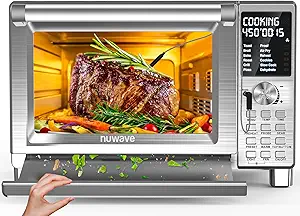 |
Nuwave Bravo Pro 21QT

| Capacity | 21 quarts |
|---|---|
| Wattage | 1800 watts |
| Temperature range | 50–450°F |
| Control type | Touch Control |
| Number of functions | 10 |
The Nuwave Bravo Pro combines an air fryer, convection oven, and toaster oven into a compact 21‑quart countertop unit designed for everyday cooking. It offers 10 presets including air fry, roast, bake, pizza, toast, broil, waffle, and dehydrate, and adds adjustable fan speeds plus independent upper and lower heater control so you can tune browning and crust versus top heat on the fly. The 1800‑watt heater and the redesigned high‑speed fan aim to deliver faster, more even results across multiple rack layers, which is handy when you want a crisp finish with less oil. The touch control panel and updated display make program selection straightforward, and the included fry basket, baking pan, and rack cover common tasks. Because the unit is marketed as PFAS free and uses tempered glass and stainless steel surfaces, it fits cooks who prioritize lower‑toxicity kitchen gear. Expect a learning curve dialing in custom heater ratios and fan speeds, and the 21‑quart footprint is compact but still limits very large sheet pans or multi‑tier baking for bigger households.
Best for: Home cooks who want a versatile, lower‑toxicity countertop oven that can air fry, roast, bake, and toast while offering cook customization and faster results.
Less Ideal for: People who regularly need very large baking sheets or who prefer a simple plug‑and‑play toaster oven with minimal settings and no tuning.
- Multiple built‑in cooking presets cover common tasks from air frying to dehydrating
- Adjustable upper/lower heater and 3 fan speeds let you customize browning and airflow
- 1800W power and high‑speed fan enable faster, more even cooking with less oil
- PFAS‑free construction and stainless steel/tempered glass surfaces reduce exposure to certain chemicals
- 21‑quart capacity is compact and may not fit large sheet pans or very large roasts
- Feature-rich controls require some experimentation to learn optimal settings
Verdict: A versatile, PFAS‑free countertop combo that delivers fast, customizable cooking for buyers seeking an all‑in‑one unit with precise heat and airflow control.
Ninja French Door Premier FO101BK

| Capacity | 5 quarts |
|---|---|
| Wattage | 1800 watts |
| Power Source | electric |
| Control Type | Button Control |
The Ninja French Door Premier combines a roomy French-door oven layout with 10 cooking modes so you can air fry, roast, bake, broil, toast, dehydrate and more without swapping appliances. It uses 450°F cyclonic air and Smart SurroundAir flow to speed cooking and promotes even crisping without a rotating basket, while the included 5-qt air fry basket and sheet pan let you cook family portions in one cycle. Controls are simple button-style inputs and accessories are dishwasher-safe, which makes cleanup straightforward. Notably, all cooking surfaces are made without PFAS, which supports non-toxic cooking goals. The oven runs at 1800 watts, so it heats quickly and reaches high temperatures for searing or broiling, but that power also means it draws substantial current and can be louder during high-heat cycles. The unit occupies countertop space comparable to small countertop ovens, so plan for a dedicated spot if you will use it for regular meal prep.
Best for: Buyers who prioritize fast, high-performance cooking and want a single countertop oven that crisps like a fryer while avoiding PFAS on food-contact surfaces.
Less Ideal for: Those with very limited counter space or who need an ultra-quiet appliance for open-plan living should consider smaller or lower-power models instead.
- Large air fry basket and included sheet pan support family-sized portions in a single cook cycle
- 450°F cyclonic air and surround-air design for faster, evenly crisp results
- PFAS-free cooking surfaces for non-toxic meal prep
- Dishwasher-safe accessories simplify cleanup
- Multiple cooking functions replace several countertop appliances
- High 1800W power draw requires a properly rated outlet and can produce stronger fan noise at peak settings
- Relatively large footprint needs counter space and may not fit in tight kitchens
Verdict: Choose this Ninja French Door Premier if you want a high-performance, PFAS-free countertop oven that air-fries and roasts family-sized portions quickly.
VAL CUCINA VCO25RIB 26.3-Qt Oven

| Capacity | 26.3 quarts |
|---|---|
| Wattage | 1650 watts |
| Temperature Range | 200-450℉ |
| Control Type | Knob Control |
The VAL CUCINA VCO25RIB is a family-size countertop air fryer toaster oven that combines infrared heating with convection airflow and an enamel-coated interior for healthier cooking. It is typically used for baking, roasting, air frying, and toasting for groups, easily fitting a 12-inch pizza or up to six toast slices and includes an enamel baking pan, wire rack, air-fry basket, and removable crumb tray. Knob controls and a 200 to 450°F temperature range make it simple to set time and heat, while the 1650W power and infrared elements speed up browning and help deliver crisp results. The non-toxic enamel lining on the cavity's side walls simplifies cleanup and resists staining compared with bare metal interiors, though the bottom and top are not enamel-coated. Practical buyers will appreciate the adjustable rack and the combination of presets that reduce guesswork, but the unit is relatively large and moderately heavy for a countertop oven, so plan counter space accordingly.
Best for: Buyers who want a practical, family-size countertop oven focused on safer cooking surfaces and versatile presets to simplify everyday baking, roasting, and air frying.
Less Ideal for: Those with very limited counter space or who need a compact, lightweight toaster oven for occasional solo use.
- Non-toxic enamel interior on side walls for easier cleaning and reduced sticking
- Infrared heating plus convection fan for faster browning and even cooking
- Large 26.3-quart capacity fits a 12-inch pizza or whole chicken
- Includes enamel baking pan, wire rack, air-fry basket, and removable crumb tray
- Top and bottom cavity surfaces are not enamel-coated
- Relatively large footprint and weight for some countertops
Verdict: Choose this enamel-interior convection oven if you want a family-size, non-toxic cooking cavity with infrared-assisted, easy-to-use performance for everyday meals.
GreenLife Air Fry Oven

| Capacity | 18 liters |
|---|---|
| Wattage | 240 watts |
| Temperature Range | 0-450 °F |
| Control Type | Knob Control |
The GreenLife Air Fry Toaster Oven combines a small footprint with flexible cooking modes to toast, bake, broil, reheat, and air fry in one unit. It uses dual heating elements and simple knob controls for quick, even cooking across the interior that fits four slices of bread or a 9" pizza, and it comes with a removable air fry basket, rack, and a PFAS-free ceramic baking pan. The ceramic nonstick surfaces and crumb door make cleanup straightforward, and the clear heat-resistant window and indicator light help you monitor progress without guessing. At 240 watts it is intended for typical countertop use rather than heavy commercial loads, and the single-shelf interior limits how much you can cook at once compared with larger ovens. The straightforward controls keep the learning curve low, making this a practical choice for everyday meals, small families, or anyone prioritizing a toxin-free cooking surface on a budget.
Best for: Buyers who want an affordable, space-saving countertop oven that delivers healthier, non-toxic cooking and simple, reliable performance for everyday family meals.
Less Ideal for: Those who need a high-power oven for large households, multi-rack baking, or commercial-style cooking should consider larger, higher-wattage models instead.
- PFAS-free ceramic nonstick baking pan and air fry basket for toxin-free cooking and easier cleanup
- Dual heating elements for faster, more even cooking results
- Compact footprint that still fits 4 slices of bread or a 9" pizza
- Includes useful accessories: air fry basket, baking tray, and rack
- Lower wattage limits heavy-duty or high-volume cooking
- Single shelf interior restricts simultaneous batch cooking
Verdict: A budget-friendly, compact toaster oven that gives toxin-free ceramic nonstick cooking and versatile countertop performance for everyday home use.
Kismile Air Fryer Toaster Oven 25QT

| Capacity | 25QT |
|---|---|
| Temperature range | 70–450°F |
| Power | 1700W |
| Control type | Digital screen + knob controls |
| Included accessories | Rack, air fryer basket, baking pan, crumb tray |
This Kismile 25QT air fryer toaster oven combines a family-sized cavity with convection heating and a coating-free steel interior aimed at safer cooking. It offers 12 preset modes accessed via a digital screen plus knob controls, letting you air fry, bake, roast, broil, toast, and reheat without juggling separate appliances. The 1700W heating system reaches 70–450°F and the included basket, rack, baking pan, and crumb tray make it ready to use out of the box. Practically, the roomy interior fits a whole chicken or a 12-inch pizza and the non-coated interior avoids PFAS and typical nonstick coatings, which simplifies maintenance and reduces concerns about surface degradation. Trade-offs are that a larger, higher-power oven takes up counter space and draws more power than compact units, and precise temperature calibration may vary a bit compared with premium brand controllers. For buyers prioritizing a non-toxic, versatile toaster oven with family-sized capacity, this model offers a robust, no-coating option.
Best for: Buyers who want a non-toxic, versatile countertop oven that handles family-sized meals and prefer straightforward preset controls and included accessories.
Less Ideal for: People with very limited counter space, low electrical capacity, or those who need a compact travel or single-serve appliance.
- Coating-free cold-rolled steel interior for non-toxic cooking
- 1700W convection heating for faster, more even cooking
- 25QT interior that fits a whole chicken or 12-inch pizza
- Twelve preset modes with digital screen and knob control for easy operation
- Comes with rack, air fryer basket, baking pan, and crumb tray
- Takes significant countertop space and draws high power compared with compact models
- No listed warranty information in the product details
Verdict: If you want a non-coated, family‑sized convection toaster oven that replaces multiple appliances and prioritizes safer cooking surfaces, this Kismile 25QT is a practical choice.
Our Place Wonder Oven

| Wattage | 1400 watts |
|---|---|
| Temperature Range | 200°F to 450°F |
| Capacity | 12.7 quarts |
| Number of Shelves | 2 |
The Our Place Wonder Oven is a small countertop convection toaster oven built to replace multiple appliances for everyday cooking. It heats quickly with a 1400W convection system and a 200–450°F temperature range, and the two cooking levels plus included wire rack, air fry basket, bake pan, and crumb tray make it useful for whole chickens, pizzas, roasted vegetables, and reheating. A standout is the steam-infusion feature that requires just a teaspoon or two of water to add moisture back into breads and proteins, which helps avoid drying during air-fry and roast cycles. Controls are simple knob dials, so it is straightforward to set and monitor without a learning curve. The unit is marketed as non-toxic and PFAS-free and uses stainless-steel construction with a tempered glass door, which suits buyers prioritizing safer cookware surfaces. Limitations are its compact interior — designed for 2–4 servings — and basic mechanical controls that lack presets or app connectivity, so power users who want precise digital programming or very large batches may find it restrictive.
Best for: Buyers who want a safe, non-toxic countertop oven that consolidates air-frying and baking into one compact unit and value straightforward, reliable performance backed by broad user approval.
Less Ideal for: Households that regularly cook for large groups or users who need advanced digital controls, app features, or precise multi-stage programming.
- Six cooking modes in one unit (air fry, bake, roast, toast, broil, reheat) for flexible meal prep
- Steam-infusion restores moisture to foods like bread and proteins with minimal effort
- Comes with practical accessories: air fry basket, wire rack, bake pan, and removable crumb tray
- Fast preheat and 360° convection circulation deliver even, crisp results without a full oven
- Compact interior limits batch size to meals for about 2–4 people
- Knob controls lack digital timers, presets, or app integration
Verdict: Choose the Wonder Oven if you want a compact, PFAS-free convection toaster oven that delivers versatile, evenly cooked results with a simple, user-friendly design.
Nuwave Bravo XL Pro

| Capacity | 30 quarts |
|---|---|
| Wattage | 1800 watts |
| Temperature Range | 50-500 °F |
| Number of Shelves | 4 |
The Nuwave Bravo XL Pro is a high-powered countertop convection oven that combines air frying, toasting, roasting, baking, grilling, dehydrating, and more in a single 30‑quart unit. It uses an upgraded fan and Linear T heat technology to deliver faster, crispier results and supports three selectable fan speeds plus adjustable top and bottom heater output for fine control of browning and crust. The oven includes 12 cooking functions, 100 one-touch presets, a smart temperature probe, and multiple rack positions for multi-layer cooking with a reported 0–1°F layer variance. At 1800 watts and a 50–500°F range in 5°F increments it reaches high temperatures quickly, which is useful for searing or crisping pizza and proteins. Practical benefits include the large capacity for batch cooking and the included probe and accessories, while trade-offs are its large footprint for a single-user kitchen and the power draw that may be overkill for occasional small meals. Controls are push buttons and a dial, and the stainless steel build with tempered glass feels sturdy and easy to clean.
Best for: A buyer who prioritizes performance and versatility and wants a single, powerful appliance that can crisp and sear like a full oven while handling larger batches or varied cooking methods.
Less Ideal for: Someone with very limited counter space or who only needs a compact air fryer for single meals should consider smaller low‑wattage models instead.
- Powerful 1800W heating with 50–500°F range for fast preheat and high‑temp searing
- Adjustable top and bottom heater output plus three fan speeds for precise browning
- Large 30‑quart capacity and four rack positions for multi-layer cooking
- 100 one‑touch presets and included temperature probe simplify repeatable results
- Large physical footprint and capacity may be excessive for a single-person countertop
- High power consumption relative to smaller compact air fryers
Verdict: Choose this if you want a high‑performance, full‑feature countertop convection oven that crisps quickly and gives precise control over browning and airflow.
Choosing the Right Non-Toxic Convection Toaster Oven: Key Factors to Consider
Interior Finish And Coating
The interior finish determines what types of chemicals might come into contact with food or food vapors. Look for fully disclosed materials such as uncoated stainless steel, glazed ceramic, or enamel finishes specified as free of PFOA and PFAS. Even if a manufacturer claims a non-stick surface, check whether that coating is bonded and rated for oven temperatures; some non-stick layers can degrade under repeated high-heat cycles and release undesirable compounds.
Choosing an oven with removable, uncoated racks and a clearly labeled crumb tray reduces the surfaces that require harsh cleaning and lowers the risk that abrasive scrubbing will damage a safe finish. The more transparent a brand is about finish chemistry, the easier it is to evaluate long-term safety.
Convection System And Airflow
Convection performance affects cook time, browning, and how evenly foods cook. A true convection system uses a dedicated fan and baffle to circulate air; design details like fan placement and internal baffling influence hot spots. For a non-toxic oven, efficient convection reduces the need for excessively high temperatures or long cook cycles that could stress interior finishes.
Consider whether the fan has multiple speed settings or an auto mode, and whether the unit specifies how it offsets temperature when convection is engaged. Consistent airflow also helps prevent localized overheating that can accelerate finish breakdown.
Temperature Range And Accuracy
Accurate, stable temperatures let you cook at the lowest effective heat for a given task, which helps preserve interior coatings and reduces the chance of byproduct formation. Look for models that list calibrated temperature ranges and include a broil or high-heat mode if you need searing power. If possible, verify accuracy with an independent thermometer when you first use the oven; many buyers correct a +/- discrepancy in the first month.
Ovens that recover temperature quickly after opening the door waste less energy and expose internal finishes to fewer thermal cycles. Temperature stability is especially important for baking and roasting delicate foods.
Materials And Construction
The outer materials and internal support structure affect long-term safety and performance. Heavy-gauge stainless steel or enamel-clad interiors resist chipping and provide inert surfaces that are easy to inspect. Hinges, door seals, and rack supports should be robust; loose fittings can expose underlying metal or allow grease to accumulate in gaps, which complicates cleaning and may lead to accelerated material breakdown.
A well-built cabinet also reduces vibration and wear on electrical components. Short-lived plastics or thin sheet metal can warp under heat and should be avoided when durability for safe operation is a priority.
Ease Of Cleaning And Maintenance
Regular, gentle cleaning preserves finishes and prevents buildup that could char and create off-odors or smoky conditions. Look for removable crumb trays, rack positions that allow access to the interior without scraping, and smooth interior corners that do not trap grease. Some ovens offer oven-safe removable accessories or dishwasher-safe trays, but confirm that those parts are made from approved materials and that dishwasher detergents will not degrade any coatings.
Avoid designs with hard-to-reach crevices near heating elements or around control knobs. Maintenance accessibility, like quick access to the crumb tray and easily removable racks, reduces the need for harsh chemical cleaners.
Size, Capacity, And Fit For Your Kitchen
Capacity determines what you can cook at once and how evenly air can circulate. A smaller cavity can concentrate heat and speed up browning but may force you to crowd pans, which undermines convection performance. Conversely, a very large cavity may take longer to preheat and require more energy.
Check external dimensions and venting clearances to ensure the oven fits your countertop or shelf. Consider how many rack positions are offered and whether the unit accommodates common cookware sizes you already own.
Why Non-Toxic Finishes Matter In Toaster Ovens
Interior finishes are the direct interface between your food and the oven environment. High heat can change surface chemistry, so materials that remain inert at cooking temperatures prevent unwanted transfer of odors or compounds to food. This is particularly important for repetitive tasks such as broiling or toasting, where the same areas repeatedly reach high temperatures.
Choosing finishes that resist chipping and avoid perfluorinated compounds reduces the risk of long-term degradation. In practice this means preferring mechanically polished metals, vitreous enamel, or certified ceramic glazing when possible.
- Inert surfaces limit flavor transfer and off-gassing.
- Durable finishes require less abrasive cleaning.
- Verified material disclosures let you make informed choices.
How To Test Temperature Accuracy At Home
A simple oven thermometer lets you check whether the unit reaches and holds the set temperature. Place the thermometer in the center of the rack, set the oven to a common baking temperature, and allow it to preheat fully before recording readings. Repeat at a higher temperature and at a lower temperature to get a range.
If you see consistent variance, note the offset and adjust cook times or use the oven's temperature calibration feature if available. Accurate temperature reduces the need for repeated high-heat cycles that could stress finishes.
- Place thermometer in center rack for best baseline.
- Test at least two widely separated temperatures.
- Repeat tests after a few uses to account for initial seasoning.
Cleaning Routines That Protect Safe Finishes
Adopt cleaning methods that remove grease without abrading or chemically attacking interior coatings. Warm, soapy water and a non-abrasive cloth are usually sufficient for routine upkeep. For baked-on residues, allow a soak with a damp cloth while the cavity is warm but not hot to loosen debris before wiping.
Avoid oven cleaners and abrasive pads on coated surfaces. For stainless or enamel interiors, use pH-neutral cleaners and soft brushes. Regular cleaning prevents residue buildup that can char and create odors or smoke during cooking.
- Clean crumb trays and racks weekly with mild detergent.
- Soak and wipe rather than scrape at stubborn spots.
- Avoid harsh chemical cleaners on enamel and ceramic glazes.
Matching Capacity To Cooking Habits
Think about the meals you cook most often. If you mainly reheat or toast, a compact cavity is efficient and heats quickly. If you plan to roast a small chicken or fit a 9-inch baking pan, ensure the unit lists usable interior dimensions and has at least two practical rack positions.
Remember that crowding pans reduces convection effectiveness, so leaving space for air to circulate often yields better results than squeezing in larger pieces of cookware.
- Measure common cookware before buying.
- Prioritize usable interior height for taller dishes.
- Consider extra rack positions for flexible cooking.
Common Misconceptions About Non-Stick Surfaces
Many buyers assume any non-stick label means safe at oven temperatures. The reality is that non-stick coatings vary in chemistry and heat tolerance. Some are engineered for stovetop pans and may not hold up to repeated broil cycles in a toaster oven.
When evaluating claims, look for temperature ratings and clear declarations about which chemistries are excluded. If a non-stick surface is essential for your routine, prefer removable trays with explicit material statements so you can replace them independently if needed.
- Non-stick does not equal non-toxic unless materials are disclosed.
- Check maximum temperature ratings for coated parts.
- Removable, replaceable accessories mitigate long-term risk.
How We Chose the Best Non-Toxic Convection Toaster Oven
We focused on features that matter specifically when selecting a non-toxic convection toaster oven. Safety of interior materials was the first filter: models with PFOA- or PFAS-based coatings, unclear finish specifications, or removable parts with unknown finishes were excluded. Next we prioritized verified metal or ceramic interior surfaces, minimally treated racks, and drawer or crumb-tray designs that avoid hidden coatings. Cooking performance mattered because a safe finish is only useful if the oven cooks well. We assessed reported convection uniformity, temperature accuracy, and airflow design documented by manufacturers or reputable sources. Ease of cleaning and maintenance was another practical filter since abrasive cleaning or high temperatures can degrade finishes over time. Usability items such as intuitive controls, reliable bake/broil/convection modes, and clear temperature ranges were considered. Durability and serviceability were applied as a final gate: robust door seals, replaceable racks, and accessible crumb trays increase long-term value and reduce the chance of finish breakdown. We excluded models lacking clear material disclosures or with multiple user reports of coating degradation. The resulting shortlist balances verified safety details with measurable cooking and upkeep characteristics.
Our full evaluation process is outlined in our review methodology.
FAQ
Are enamel and stainless steel interiors both safe choices?
Yes, both can be safe when properly finished. Enamel provides a glass-like inert surface that resists chipping when well applied. Stainless steel is inert and durable but may develop hotspots if thin; choose heavier gauge construction for long-term durability.
Can I remove non-stick trays and use my own cookware instead?
Often yes. Many toaster ovens accept standard oven-safe pans and removable trays. Using your own uncoated bakeware reduces reliance on manufacturer-applied coatings and simplifies cleaning. Verify interior clearance and rack positions before assuming compatibility.
How often should I test a new toaster oven for temperature accuracy?
Test it when you first get the oven and again after a few uses. Re-check seasonally or after extended heavy use. Small offsets are common and can be compensated for in recipes once you know the typical variance.
Do convection modes affect the lifespan of interior finishes?
Convection itself is not inherently damaging, but faster airflow and higher effective heat transfer can concentrate thermal stress in certain areas. Efficient convection that reduces cook time may actually be gentler on finishes compared with repeatedly cooking at higher set temperatures to compensate for slow airflow.
Is it safe to run the oven empty to preheat at high temperatures?
Avoid leaving an electric toaster oven empty at very high temperatures for long periods. Running empty increases internal air temperature without the thermal mass of food to absorb heat, which can stress components and finishes over time.
Final Verdict
Prioritize clear material disclosures and practical cooking performance when choosing a non-toxic convection toaster oven. Focus on interior finish safety, verified convection design, and ease of cleaning to minimize long-term exposure risks and avoid premature finish degradation. Balance capacity and temperature accuracy with your regular cooking tasks so you do not overwork the oven. A carefully chosen unit will let you cook efficiently while minimizing questionable surface chemistries. Use the evaluation criteria here to weigh tradeoffs and pick a model that fits how you cook, how often you clean, and how long you expect the oven to remain in service.