
Note: This article contains affiliate links. If you click on these links and make a purchase, we may earn a small commission at no extra cost to you. This helps support our research and content. Read our full affiliate disclosure here.
If you manage a large property, the right outdoor security camera changes how you monitor perimeter activity and protect assets. Distance, detection range, and image clarity matter more on expansive sites because blind spots grow and single cameras must cover greater areas. This guide shortlists the top outdoor security camera options for large properties and explains the practical tradeoffs involved. We evaluate models against coverage, long-range night vision, detection reliability, and installation flexibility so you can match a camera to your landscape and security goals. Read on for the key factors that separate effective long-range cameras from models better suited to smaller yards.
Top Picks at a Glance
| Best Overall The best all-around choice for most situations | REOLINK RLK8-410B6-5MP System |  |
| Best Quality Built to a higher standard if you want something more solid | REOLINK 12MP PoE Camera System |  |
| Best Value The sweet spot between price and what you get | Vosker VKX Solar V300 |  |
| Top Rated A top-rated pick with lots of positive feedback | Fociey 4K Solar 4-Cam Kit |  |
| Most Popular A crowd favorite that many people choose with confidence | Blink Outdoor 4 5-Camera System |  |
| Best Seller A high-volume bestseller chosen again and again | aosu D1 Classic 4-Cam Kit |  |
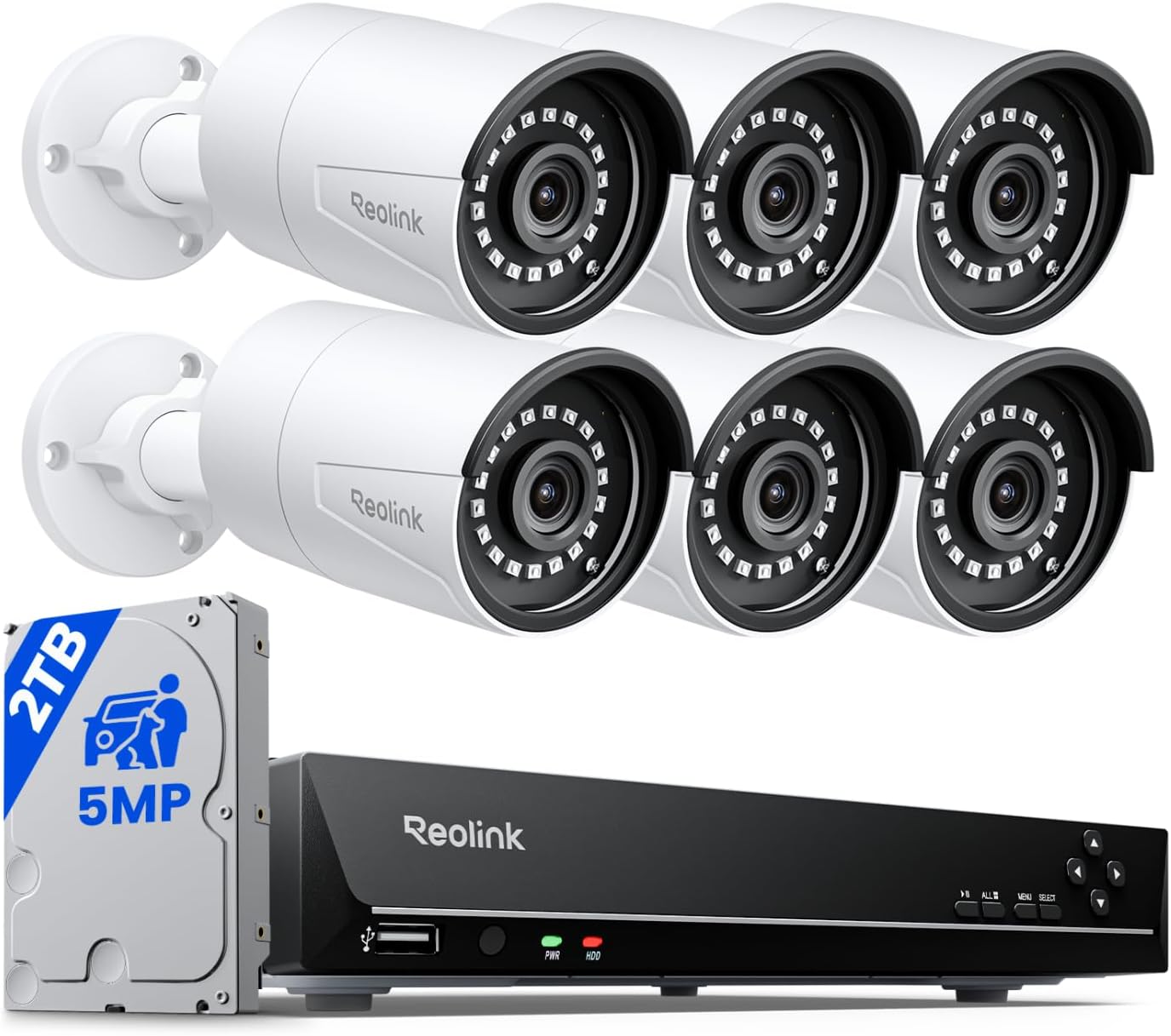
REOLINK RLK8-410B6-5MP System
| Number of Channels | 8 |
|---|---|
| Video Capture Resolution | 1920p (5MP cameras) |
| Memory Storage Capacity | 2 TB (preinstalled) |
| Frame Rate | 25fps |
| Night Vision Range | 100 feet |
This REOLINK kit supplies a full 8-channel PoE system that pairs six 5MP outdoor PoE cameras with an 8-channel NVR that has a 2TB HDD preinstalled. The cameras use PoE so each camera needs only a single Ethernet run for power and video, making DIY installation straightforward for large properties. In real-world use you get 5MP recording at up to 25fps, IR night vision to about 100 feet, and on-device microphone audio for ambient sound. The NVR supports continuous 24/7 recording, motion and scheduled recording, customizable motion zones, and smart person/vehicle/pet detection that reduces false alerts. The system is designed to work with Reolink cameras only, but it is expandable and supports higher-capacity storage via SATA and eSATA up to 16TB total for longer retention. Trade-offs to note are reliance on wired PoE runs for each camera and the kit does not integrate third-party cameras or cloud-only operation for remote access without internet; remote viewing requires internet and the Reolink app or client.
Best for: Buyers who need a robust, wired PoE system to cover a large property with a mix of continuous and event-triggered recording and who prefer a self-hosted NVR approach rather than cloud-only solutions.
Less Ideal for: People who want a wireless or cloud-centric camera setup, those who cannot run Ethernet to camera locations, or users who need guaranteed multi-brand camera compatibility.
- Six 5MP outdoor PoE cameras for wide-area coverage with single-cable power and data
- Preinstalled 2TB HDD and NVR that supports 24/7, motion, and scheduled recording
- Smart person/vehicle/pet detection and customizable motion zones to reduce false alarms
- Night vision up to 100 feet for reliable nighttime coverage
- Expandable storage up to 16TB (SATA + eSATA) for longer video retention
- System is intended to work only with Reolink cameras and may reject third-party cameras
- Requires running Ethernet cable to each camera, which adds installation work on large properties
- Remote access depends on internet and use of Reolink app/client
Verdict: A turnkey PoE NVR kit that delivers high-resolution wired coverage, long-night visibility, and smart detection tailored for large outdoor properties.
REOLINK 12MP PoE Camera System

| Video Capture Resolution | 12MP (4512×2512) @20fps |
|---|---|
| Compression Format | H.265 |
| Memory Storage Capacity | 4 TB built-in HDD |
| Night Vision Range | 100 feet |
| Number of Channels | 16 (expandable) |
This REOLINK kit pairs an RLN16-410 NVR with eight 12MP PoE bullet cameras to deliver high-resolution surveillance across a large property. It records at 4512×2512 (12MP) at up to 20 fps and uses H.265 compression to keep long continuous or scheduled recordings manageable on the included 4TB HDD. The cameras support full-color spotlight night vision plus IR, two-way talk, and smart detection that distinguishes people, vehicles, and pets to reduce false alerts. PoE simplifies installation by combining power and network over single Ethernet runs, and the NVR provides HDMI/VGA outputs and remote access via iOS/Android and Windows/Mac clients. Practical limitations include the cameras being designed to work only with Reolink PoE NVRs and the 20 fps cap at full 12MP resolution which may show less fluid motion than lower-resolution higher-frame-rate systems. The kit is robust for outdoor use with IP67-rated housings and is aimed at property-scale coverage rather than single-camera convenience.
Best for: Buyers who need high-resolution, property-scale outdoor surveillance and prioritize image detail and centralized recording for performance-focused monitoring.
Less Ideal for: Users who want cameras compatible with third-party ONVIF/RTSP NVRs or who need very high frame rates for fast-action capture should look elsewhere.
- Very high 12MP resolution for detailed images across large areas
- PoE design simplifies cabling by carrying power and data on one Ethernet cable
- Smart detection for people, vehicle, and pet reduces nuisance alerts
- Built-in spotlight color night vision plus IR for clearer nighttime identification
- NVR supports 24-channel expansion and remote access on mobile and PC clients
- Cameras are proprietary to Reolink PoE NVRs and will not work with third-party NVRs
- Maximum 20 fps at 12MP which is lower than some lower-resolution cameras' frame rates
Verdict: Choose this REOLINK kit when you need high-resolution, PoE-powered outdoor surveillance across a large property with centralized recording and smart detection.
Vosker VKX Solar V300

| Power Source | Solar Powered |
|---|---|
| Video Capture Resolution | 1080p |
| Connectivity Technology | Wireless |
| Alert Type | Motion |
| Battery Average Life | 6 months |
The Vosker VKX V300 is a self-contained outdoor security camera built for remote properties where Wi-Fi is unavailable. It uses an integrated solar panel and user-replaceable batteries to offer long autonomy — the listing claims up to six months between recharges — and transmits photos and on-demand 15-second video clips over 4G LTE using the included SIM card and a Vosker data plan. Setup is screw-in installation and app control makes it straightforward to receive motion alerts, pause detections, and request clips when you need them. The camera is IP65 rated and has a rugged antenna and a deterrent light to improve reliability and discourage intruders in harsh conditions like farms, cabins, and jobsites. The main limitations are the lack of continuous live streaming and the requirement of a paid data plan for media transmission, so this is better suited to occasional on-demand checks and motion-triggered monitoring rather than always-on surveillance.
Best for: Buyers who need dependable, low-maintenance surveillance for large or remote properties where Wi-Fi is impractical and occasional on-demand video and motion-triggered photos are sufficient.
Less Ideal for: Users who need continuous live streaming, real-time two-way audio, or want surveillance without an ongoing cellular data plan.
- Solar panel and swappable front-access batteries enable long off-grid operation
- 4G LTE with built-in SIM card supports monitoring without Wi-Fi
- IP65 weather resistance and rugged antenna for reliable outdoor use
- App control with motion alerts and on-demand 15-second video requests
- No continuous live streaming; only photos and short on-demand video clips
- Requires a Vosker data plan for photo and video transmission
Verdict: A self-sufficient solar 4G camera made for large, remote properties that need reliable motion-triggered monitoring without Wi-Fi.
Fociey 4K Solar 4-Cam Kit

| Video Capture Resolution | 4k |
|---|---|
| Effective Video Resolution | 8 MP |
| Power Source | Solar Powered |
| Night Vision Range | 33 feet |
| Flash Memory Installed Size | 32 GB |
This Fociey kit bundles four solar-powered, 8MP (4K) outdoor bullet cameras with a local storage base and app control for continuous, subscription-free monitoring of large properties. Each camera pans and tilts a full 360 degrees and offers automatic motion tracking and cross-camera follow so moving subjects can be tracked across multiple fields of view, while live view supports tap-to-zoom for detail. The included base has 32 GB built-in storage (expandable to 128 GB) so footage is kept locally and recordings are triggered by smart, AI-driven motion detection to reduce false alerts. Setup is straightforward: the cameras come pre-paired to the base and the base connects to your router by Ethernet, which stabilizes Wi-Fi links and supports both 2.4 GHz and 5 GHz networks. Practical strengths are no monthly fees, weatherproof design, and solar charging that minimizes recharging chores. Expect limitations in prolonged low-sun periods where battery life can fall after many cloudy days and occasional reliance on the base for a stable connection rather than direct camera Wi-Fi.
Best for: Buyers who prioritize continuous, low-maintenance surveillance across wide outdoor areas and want a factory-quality, subscription-free system that minimizes wiring and recurring costs.
Less Ideal for: People who need guaranteed offsite cloud backup or those in regions with long stretches of limited sunlight should consider systems with robust cloud storage or hardwired power options instead.
- True 4K/8MP live view and tap-to-zoom for clear detail at distance.
- 360° pan and automatic cross-camera tracking reduces blind spots on large properties.
- Local storage base with 32 GB included and expandable to 128 GB eliminates required subscription fees.
- Solar power with updated charging circuit reduces need for manual recharging.
- Pre-paired cameras and Ethernet-connected base make setup and stable networking easier.
- Solar charging can struggle after many consecutive cloudy or rainy days and may require occasional USB charging.
- System depends on the local storage base for reliable connection and storage rather than storing directly to cloud.
Verdict: A subscription-free, solar-powered 4K camera kit with 360° tracking and local storage built for reliable, low-maintenance coverage of large outdoor properties.
Blink Outdoor 4 5-Camera System

| Cameras included | 5 cameras |
|---|---|
| Video resolution | 1080p HD |
| Night vision | Infrared night vision |
| Battery | AA Energizer lithium (included) |
The Blink Outdoor 4 five-camera system provides an affordable way to add wireless surveillance across a large property without hardwiring. Each camera records 1080p HD video, offers infrared night vision and two-way audio for remote communication, and uses enhanced dual-zone motion detection to cut down on irrelevant alerts. Blink includes a Sync Module Core and AA Energizer lithium batteries rated to last up to two years, so initial setup is quick and low-maintenance; mounting kits and a USB-C power adapter are also in the box. Local storage is not provided by the Sync Module Core, so continuous on-site recording requires upgrading to a Sync Module XR or Sync Module 2 (sold separately) or relying on cloud storage via a Blink subscription. Person detection and advanced CV features are available through the subscription as well. Integration with Alexa adds convenient voice-based live view and system control. For broad coverage the kit is cost-effective, but buyers should plan how they want to archive footage because native local backup is not included with the Core module.
Best for: Buyers who want a ready-to-install, battery-powered camera pack to cover multiple outdoor zones on a large property and value simple setup and low-maintenance operation.
Less Ideal for: Anyone who requires built-in local recording out of the box or wants advanced analytics without a subscription should consider alternative systems with native on-device storage and on-premise management.
- Five wireless 1080p cameras provide wide coverage without running cables
- Two-year battery life with included Energizer lithium AAs reduces frequent battery changes
- Enhanced dual-zone motion detection lowers false alerts across outdoor areas
- Includes Sync Module Core and mounting kits for quick setup
- Works with Alexa for voice control and multi-camera live view
- Sync Module Core does not provide local storage, requiring cloud subscription or separate Sync Module for local backups
- Advanced person detection and CV features require a paid Blink subscription
Verdict: A budget-friendly, low-maintenance five-camera kit that delivers wireless 1080p outdoor coverage across large properties when cloud storage or a separate local storage module is acceptable.
aosu D1 Classic 4-Cam Kit

| Power Source | Solar Powered |
|---|---|
| Video Capture Resolution | 2K/3MP |
| Night Vision Range | 33 feet |
| Flash Memory Installed Size | 32 GB |
| Waterproof Rating | IP65 |
The aosu D1 Classic 4-Cam Kit is a self-contained outdoor surveillance system aimed at homeowners who want continuous coverage without cloud subscriptions. Each weatherproof camera offers pan/tilt 360° coverage, automatic motion tracking, and 2K/3MP video with digital 6x zoom, and the included aosuBase supplies 32GB of local encrypted storage so recordings stay on-site. Solar-powered operation and an IP65 rating let you mount cameras in exposed locations and reduce the need for wired power. The system supports full-color night vision using four spotlights, two-way audio, siren and light alerts, and app-based live viewing of up to four cameras at once, plus Alexa and Google Assistant control. Practical benefits include simpler long-term costs thanks to local storage, wide area coverage for large properties, and fewer wiring constraints. Expect trade-offs typical of wireless solar kits: performance depends on good sun exposure for reliable charging and Wi‑Fi range matters for camera responsiveness despite the base's signal boost, and very long retention beyond the stated local storage will require additional storage planning.
Best for: Homeowners who prioritize on-site privacy, low ongoing costs, and wide wireless coverage for monitoring large outdoor areas without professional installation.
Less Ideal for: Sites with poor sun exposure or weak Wi‑Fi where wired power and Ethernet-backed systems are required for reliable 24/7 operation.
- Local 32GB encrypted storage avoids monthly subscription fees
- Solar-powered cameras reduce or eliminate external power wiring
- 360° pan/tilt with automatic motion tracking covers large areas without blind spots
- Full-color night vision with four spotlights improves nighttime identification
- App control with multi-cam live view and smart assistant support
- Solar charging depends on adequate sunlight and may struggle in consistently shaded or very cloudy locations
- Wireless performance depends on home Wi‑Fi coverage despite the base unit’s signal boost
Verdict: Choose this kit if you want a subscription-free, solar-powered 4-camera system with 360° tracking and on-site storage for broad outdoor coverage.
Choosing the Right Outdoor Security Camera for Large Properties: Key Factors to Consider
Detection Range and Zoom
On large properties the distance a camera can reliably detect and identify a person or vehicle is critical. Detection range determines how many cameras you need and where to place them. Cameras with optical zoom or motorized PTZ functionality let you track activity farther away without losing detail.
Consider both reported detection distance and how resolution and lens quality affect usable identification range. Longer reported ranges are only useful if the camera preserves enough image detail at that distance for alerts or evidence.
Field Of View and Coverage Strategy
A single wide field-of-view camera might cover a large area but can lack detail at the edges, so balance wide-angle coverage with cameras positioned to capture key approach vectors. Larger properties often benefit from a mix of fixed wide-view units for general monitoring and narrower, long-range cameras for driveways, gates, and entry points.
Think about sightlines, elevation, and potential obstructions like trees or outbuildings when planning coverage. Overlapping fields of view reduce blind spots and allow one camera to hand off tracking to another.
Night Vision, Low-Light Performance, and Lighting
Most security incidents happen at night, so a camera's low-light performance and type of night vision matter. Infrared illumination can reach far distances but renders monochrome images; some cameras combine IR with low-light color sensors or supplemental white light for identification.
Evaluate claimed IR range alongside real-world usability: long-range IR can wash out close objects and miss mid-range details. Also consider whether built-in lighting or compatibility with external lighting will be needed to achieve usable night images across the property.
Power Options and Installation Logistics
How you power cameras across a large property affects complexity and cost. Wired PoE or hardwired power provides reliability and easier continuous recording, while battery or solar options simplify installs where running cable is impractical. For very large sites, hybrid approaches—PoE for critical points and solar for remote outbuildings—are common.
Factor in cable runs, conduit needs, and whether existing network infrastructure supports long-distance connections. Also plan for maintenance access when cameras are mounted high or in remote locations.
Network Connectivity and Recording Strategy
Cameras that can stream reliably over your available network are essential on large properties. Evaluate whether you will use central NVR/DVR recording, cloud storage, or a hybrid approach. Onsite recording reduces bandwidth needs but requires secure local storage and backup strategies.
Also check how cameras handle alerts and event clipping over long-distance links, and whether they offer adjustable sensitivity, person/vehicle classification, and grouped motion zones to reduce false positives from wildlife or swaying vegetation.
Durability and Weather Resistance
Outdoor cameras on large properties face extended exposure to sun, wind, rain, dust, and temperature swings. Look for robust environmental ratings and construction suitable for the local climate. Corrosion-resistant mounts and housings matter in coastal or humid environments.
Durability also includes ingress protection for connectors and lenses, and the expected lifespan of moving parts for PTZ units. Easier field serviceability reduces downtime across a large network of devices.
Planning Coverage for Expansive Sites
Begin by mapping the property and identifying critical assets, approach routes, and likely concealment points. Prioritize gates, driveways, equipment yards, and any buildings that require monitoring.
Use simple sightline sketches to decide mounting heights and approximate camera spacing. For long driveways, place cameras to catch license plates at typical approach speeds and add overlapping coverage at entrance points to ensure clear identification from multiple angles.
- Sketch approach routes and mark likely obstruction zones
- Plan for overlapping views at high-risk points
- Mount some cameras higher for broad coverage and others lower for identification detail
Choosing Between Fixed, Varifocal, and PTZ Cameras
Fixed cameras are steady and reliable for covering known points of interest, while varifocal lenses allow you to tune the tradeoff between width and detail during installation. PTZ cameras can actively track subjects and cover very large areas, reducing the number of units needed but adding mechanical complexity.
Consider using a mix: fixed units for continuous monitoring of entrances and sensitive spots, varifocal cameras where initial setup requires framing adjustments, and PTZ for large open fields or when occasional long-distance tracking is required.
- Fixed: stable, low-maintenance coverage
- Varifocal: adjustable framing without replacing hardware
- PTZ: dynamic tracking with higher maintenance needs
Lighting and Image Clarity at Distance
Even the best sensor has limits. Supplementing camera night capability with targeted lighting improves identification outcomes. Use shielded, directional lights to avoid glare and to preserve natural scenes while illuminating approaches.
When natural light is limited, choose cameras with larger sensors and good noise reduction. Test cameras at intended mounting distances during twilight to confirm whether IR, white light, or a combination produces usable images for identification.
- Prefer shielded lights to reduce backscatter
- Test candidate cameras at real mounting distances when possible
- Balance IR range with added white illumination for color detail
Managing Bandwidth and Storage for Multiple Long-Range Cameras
High-resolution streams from long-range cameras can quickly consume network bandwidth and storage. Use adjustable recording profiles that drop resolution or frame rate during idle periods and increase it on motion events to save resources.
Consider local edge recording for high-traffic cameras and stagger retention policies by location importance. Efficient codecs and event-based upload strategies reduce the need for continuous high-bandwidth connectivity across the entire property.
- Use event-triggered high-res recording
- Implement tiered retention based on camera importance
- Leverage efficient compression and edge storage to limit bandwidth
Maintenance and Seasonal Considerations
Large properties require a maintenance plan for camera cleaning, firmware updates, and vegetation control. Schedule quarterly checks and after major weather events to confirm mounts are secure and lenses are clear.
Seasonal changes affect sightlines and required coverage. Foliage can create blind spots in summer and reduce false positives in winter. Make seasonal adjustment part of your operational plan so cameras remain effective year-round.
- Quarterly physical inspections and firmware maintenance
- Adjust detection zones seasonally to account for vegetation
- Maintain access plans for mounted cameras in remote locations
How We Chose the Best Outdoor Security Camera for Large Properties
We focused on criteria that matter when protecting large properties and excluded products built for confined residential yards or indoor use. Our selection prioritized devices with true long-range performance, flexible mounting and power options, and proven environmental durability. We required evidence of reliable night vision over extended distances, configurable detection zones, and support for integration with common recording and alert systems. Usability on-site was another filter: cameras had to offer manageable installation options for long runs of cable or robust wireless links and include features that reduce false alerts across large fields of view. Excluded from the list were cameras designed only for close-range monitoring, models lacking weatherproof ratings suitable for outdoor exposure, and units without adjustable optics or zoom capability. The factors we measured and compared include detection range and field of view, image quality at distance, low-light and IR performance, mounting and power flexibility, and network recording and alert features. These evaluation dimensions guided our shortlist and align with the scoring criteria used in each product block.
Our full evaluation process is outlined in our review methodology.
FAQ
How many cameras do I need for a large property?
It depends on property layout and risk zones. Map approaches and high-value areas first; some sites need only a few long-range cameras plus several coverage units, while sprawling sites often require a dozen or more to eliminate blind spots.
Are wireless cameras reliable for long distances?
Wireless systems can be reliable with proper line-of-sight and robust point-to-point links, but performance depends on signal path, interference, and available network infrastructure. For mission-critical spots, wired PoE or fiber-backed links are usually more dependable.
Can night vision identify license plates at long range?
Identification at long range requires both sufficient optical zoom and appropriate lighting. IR alone may not yield readable plates at great distances; supplemental illumination or a camera with strong optical zoom is often necessary for plate capture.
Should I use cloud or local recording for a large site?
Many large properties use a hybrid approach: local NVR storage for continuous, high-bandwidth cameras and selective cloud backup for critical events. This balances bandwidth costs with redundancy and remote access needs.
How do I reduce false alerts from wildlife or weather?
Tune detection zones and sensitivity, enable person and vehicle classification if available, and position cameras to minimize exposure to moving foliage and reflective surfaces. Regularly review alert patterns and adjust settings as conditions change.
Final Verdict
For large properties prioritize cameras that deliver proven long-range detection, flexible mounting and power options, and reliable night imaging. Plan a mixed deployment that balances wide coverage with targeted high-detail cameras to capture identification-critical areas. Tradeoffs are inevitable: fewer PTZ units reduce hardware counts but raise maintenance and risk of mechanical failure; more fixed long-range cameras increase installation complexity and cost. Focus on detection range, network and storage strategy, and durability to choose a system that meets your coverage needs with manageable upkeep.