
Note: This article contains affiliate links. If you click on these links and make a purchase, we may earn a small commission at no extra cost to you. This helps support our research and content. Read our full affiliate disclosure here.
If you need nonstop surveillance around your home or property, selecting the right outdoor security camera for continuous recording matters. Continuous recording demands cameras designed for sustained write cycles, efficient heat management, and predictable storage behavior so you get usable footage day after day. In this guide we shortlisted the top options built for 24/7 capture and steady uptime, and we evaluate them on the specs and real-world features that matter to continuous recording setups. Read on for the factors we used to vet each camera and the practical tradeoffs to consider before you wire or mount a permanent system.
Top Picks at a Glance
| Best Overall The best all-around choice for most situations | REOLINK E1 Outdoor SE PoE |  |
| Best Quality Built to a higher standard if you want something more solid | REOLINK RLK8-520D4 5MP System |  |
| Best Value The sweet spot between price and what you get | TKENPRO ZY-C7 Solar Security Camera |  |
| Best Budget The cheapest option that still gets the job done reliably | realhide CB54 2K Outdoor Camera |  |
| Top Rated A top-rated pick with lots of positive feedback | Tical Solar Outdoor Security Camera 4MP |  |
| Most Popular A crowd favorite that many people choose with confidence | Kasa Smart KC420WS Outdoor Camera |  |
| Best Seller A high-volume bestseller chosen again and again | Tapo C675D 4K Pan/Tilt Camera |  |
REOLINK E1 Outdoor SE PoE

| Video Capture Resolution | 4k |
|---|---|
| Frame Rate | 25 frames_per_second |
| Pan & Tilt | 355° pan, 50° tilt |
| Night Vision Range | 12 meters |
| Flash Memory Supported Size Maximum | 512 GB |
The REOLINK E1 Outdoor SE PoE is an outdoor PoE PTZ dome camera designed for continuous 24/7 monitoring of yards, driveways, and other residential perimeters. It captures 4K video at 25 fps with an 8MP CMOS sensor and F1.6 aperture for brighter low-light images, and built-in 3000K spotlights enable color night vision as well as traditional IR illumination. The camera pans 355° and tilts 50° with auto tracking and up to 64 preset points, so a single unit can cover most of a property without blind spots. PoE makes installation tidier by combining power and network over one cable, and storage can be local to a microSD card (up to 512 GB), a Reolink NVR, or FTP for continuous recording without ongoing subscription fees. Smart detection differentiates people, vehicles, and animals and supports push alerts and a built-in siren for deterrence. Limitations include lack of optical zoom and reliance on wired Ethernet only, which means planning cable runs or a PoE switch is necessary for remote locations.
Best for: Buyers who want a single, hardwired outdoor camera that can run continuous local recording and deliver high-resolution color footage at night while covering a wide area with pan/tilt tracking.
Less Ideal for: Someone who needs wireless installation flexibility or optical zoom for long-distance identification should consider different camera types.
- 4K (8MP) resolution with F1.6 aperture and 3000K spotlights for clearer daytime and color night images
- 355° pan and 50° tilt with auto tracking and 64 preset points for comprehensive coverage
- PoE connectivity simplifies installation and provides stable power plus network over one cable
- Multiple local recording options (microSD up to 512 GB, Reolink NVR, FTP) for continuous 24/7 recording without subscription
- Smart detection for people, vehicles, and animals plus two-way talk and built-in siren for active deterrence
- No optical zoom, only digital zoom
- Requires wired Ethernet/PoE and compatible switch or injector, no Wi‑Fi option
Verdict: Choose the E1 Outdoor SE PoE if you want a wired 4K outdoor camera built for continuous local recording and wide-area coverage with pan/tilt auto-tracking.
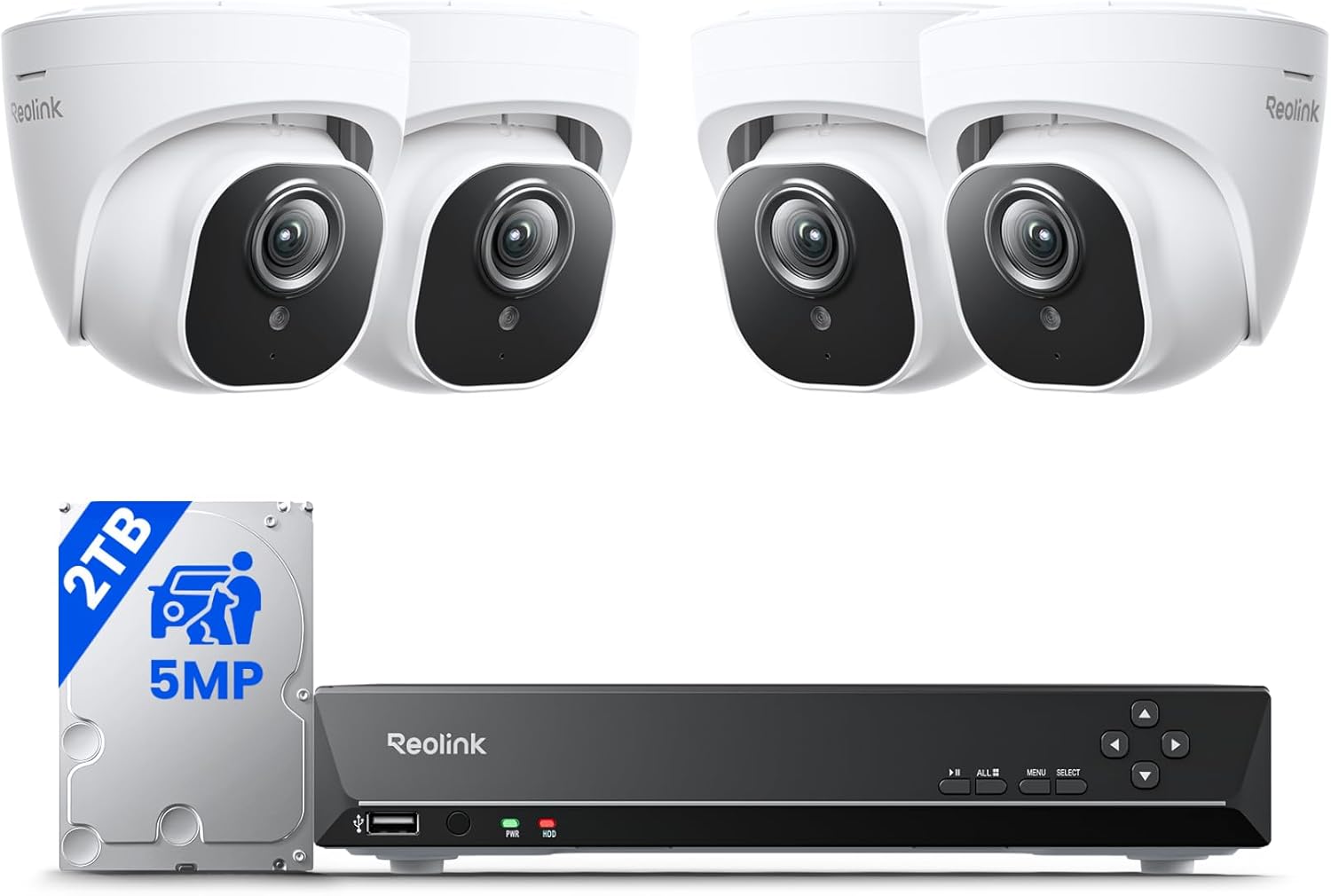
REOLINK RLK8-520D4 5MP System
| Video Capture Resolution | 5MP (2560 × 1920) |
|---|---|
| Number of Channels | 8 |
| Memory Storage Capacity | 2 TB |
| Night Vision Range | 100 feet |
| Frame Rate | 25fps |
This REOLINK kit bundles an 8-channel NVR with a preinstalled 2TB hard drive and four 5MP PoE dome cameras for 24/7 local recording and remote access. The cameras deliver 5MP video at 25fps with an 80 degree horizontal field of view and up to 100 ft of night vision, which helps capture useful detail day or night. PoE simplifies installation by carrying power and data over a single Ethernet cable, and the NVR exposes HDMI/VGA outputs and USB ports for local playback and management. Smart person/vehicle/pet detection and customizable motion zones reduce false alerts, while the Reolink apps and desktop clients let you review footage and receive push/email notifications. The kit is scalable — the NVR supports larger drives (up to 16TB total) and additional Reolink cameras — but it only works with Reolink cameras. Expect basic fixed lenses and no optical zoom, so framing depends on placement, and advanced analytics beyond person/vehicle detection are limited. For continuous outdoor recording where reliable local storage and PoE convenience matter, this system is a straightforward choice.
Best for: Buyers who prioritize continuous, high-resolution local recording and a simple PoE installation for outdoor perimeter monitoring where reliable footage detail matters.
Less Ideal for: Users who need cross-brand camera compatibility, motorized zoom or very wide fisheye coverage should consider other solutions.
- Preinstalled 2TB HDD for immediate 24/7 local recording
- 5MP resolution at 25fps for clearer detail than 1080p cameras
- Power over Ethernet simplifies wiring by delivering power and data on one cable
- IP67-rated cameras with 100 ft IR night vision suitable for outdoor use
- Smart person/vehicle detection and motion zone customization reduce false alarms
- Only compatible with Reolink cameras so you cannot mix brands
- Fixed 4.0 mm lens with 80° field of view offers no optical zoom or wide-angle options
Verdict: A robust PoE kit built for reliable, continuous outdoor recording with high-resolution 5MP cameras and ready-to-use local storage.
TKENPRO ZY-C7 Solar Security Camera

| Power Source | Solar Powered |
|---|---|
| Connectivity Technology | 2.4GHz Wi-Fi |
| Video Capture Resolution | 2k |
| Built-In Media | 24/7 continuous recording security camera; solar panel; accessories package |
The TKENPRO ZY-C7 is an outdoor bullet camera built for always-on recording without frequent maintenance. It records at 2K resolution with low-frame standby and high-frame capture when motion is detected, and stores footage locally on a microSD card (up to 512GB) or optionally to cloud. The camera connects over 2.4GHz Wi-Fi and pairs with an iOS/Android app for setup, live view, two-way talk, and preset patrol points; AI detection distinguishes humans and vehicles and supports a claimed 98 ft detection range. A built-in 8W solar panel and a high-capacity rechargeable battery aim to keep the camera running continuously while the IP65 weatherproof rating protects it outdoors. H.265 compression reduces storage needs for extended recording. Expect straightforward wall mounting and practical features like 360 degree panoramic coverage with preset points, but plan storage and network capacity for 24/7 footage and verify Wi-Fi reach to the camera location before buying.
Best for: Buyers who want a low-maintenance outdoor camera that emphasizes nonstop recording, long detection range, and solar power to minimize upkeep while still using an app-driven system.
Less Ideal for: Users with weak or hard-to-reach 2.4GHz Wi-Fi coverage or those who prefer completely battery-free wired power or NVR-only setups should consider other options.
- 24/7 continuous recording with low-frame standby to conserve power
- 8W solar panel plus rechargeable battery reduces need for manual recharging
- 2K resolution with color night vision for clearer day and night footage
- AI human and vehicle detection with long detection range to reduce false alerts
- H.265 compression and local microSD support up to 512GB for extended storage
- Requires reliable 2.4GHz Wi-Fi at the camera location for live streaming and app features
- Continuous recording demands significant storage or a cloud plan to avoid overwriting older footage
Verdict: Choose the ZY-C7 if you want a solar-powered outdoor camera engineered for continuous 2K recording and long-range AI detection with minimal hands-on charging.
realhide CB54 2K Outdoor Camera

| Effective Video Resolution | 2000 |
|---|---|
| Frame Rate | 30 frames per second |
| Night Vision Range | 8 meters |
| Power Source | Battery Powered |
| Connectivity Technology | Wireless |
The realhide CB54 is a wireless outdoor security camera designed for easy installation and low-maintenance monitoring. It records 2K UHD video at 30 fps, offers full-color night vision via a built-in spotlight, and supports two-way audio so you can speak with visitors from the companion app. The camera connects over 2.4GHz or 5GHz Wi-Fi and saves footage to either free cloud storage or a local microSD card up to 256GB, which makes it straightforward to set up continuous recording if you provide sufficient local storage and power. A rechargeable battery claims up to six months between charges under light-use conditions, which helps when continuous recording is not desired but periodic playback is; heavy continuous recording or frequent motion-triggered clips will shorten runtime. IP66 weatherproofing and auto focus make it usable year-round outdoors, and motion alerts with AI detection reduce false alarms. Expect to trade some continuous-recording runtime for battery life unless you use a wired power option or schedule recordings to optimize storage and power.
Best for: Buyers who want an affordable, easy-to-install outdoor camera with good daytime and night image quality and the option to store video locally without subscription fees.
Less Ideal for: Users who need uninterrupted 24/7 continuous recording without dealing with recharging, wired power, or frequent SD card management should consider a hardwired camera solution instead.
- 2K UHD video and full-color night vision for clearer day and night footage
- Dual storage options: free cloud backups plus local SD card support up to 256GB
- Dual-band Wi-Fi (2.4G/5G) for stable live view and smoother playback
- IP66 weatherproof design suitable for outdoor mounting
- Rechargeable battery offering long standby between charges under light use
- Battery power limits true 24/7 continuous recording unless supplemented by wired power or careful scheduling
- Continuous recording will quickly consume battery and large SD capacity, requiring frequent recharging or large cards
Verdict: Choose this camera if you want budget-friendly outdoor monitoring with quality 2K footage and local storage options while avoiding subscription fees.
Tical Solar Outdoor Security Camera 4MP

| Video Capture Resolution | 4MP |
|---|---|
| Power Source | Solar Powered |
| Night Vision Range | 49 feet |
| Flash Memory Supported Size Maximum | 128 GB |
| Connectivity Protocol | Wi-Fi |
These Tical cameras are a practical option for continuous outdoor recording where running power is inconvenient. Each unit pairs a built-in rechargeable battery with a 3W solar panel and a long cable so you can mount the camera and place the panel for better sun exposure, reducing the need for frequent recharges. The cameras stream 4MP video with 355° pan and 90° tilt plus 4x digital zoom, and color night vision out to about 49 feet, so footage is usable day and night. The system supports local microSD storage up to 128 GB and an 8-second rolling cloud history via the app, and the PIR-based AI detection reduces false alerts by distinguishing humans and vehicles. Two-way audio and a built-in spotlight let you interact or deter on-site. Expect typical limitations of battery+solar setups: recording quality and recording duration depend on sunlight and placement, and digital zoom is not the same as optical zoom. Setup is app-driven and straightforward, but ideal continuous operation requires inserting a memory card and positioning solar panels where they get steady sun.
Best for: Buyers who prioritize a low-maintenance, always-on outdoor recording setup without running power lines and who want reliable app-managed footage and AI filtering.
Less Ideal for: People who need guaranteed uninterrupted recording in low-light or shaded locations without supplemental power or who require optical zoom and professional-grade video for forensic detail.
- Solar-powered with included 3W solar panels for extended runtime without wiring
- 4MP resolution with wide pan/tilt coverage and 4x digital zoom for detailed views
- Supports continuous 24/7 local recording on microSD up to 128 GB
- AI PIR motion detection with human and vehicle classification reduces false alarms
- Built-in spotlight and 2-way audio for active deterrence and communication
- Continuous performance depends on solar exposure and battery condition
- Zoom is digital only, so image detail falls off when heavily zoomed
Verdict: A solar-powered four-pack built for long-term, app-managed 24/7 recording where reliable sunlight and local microSD storage deliver low-maintenance continuous surveillance.
Kasa Smart KC420WS Outdoor Camera

| Video Capture Resolution | 1440P, 1080P, 4MP |
|---|---|
| Night Vision Range | 98 feet |
| Waterproof Rating | IP65 |
| Power Source | Corded Electric |
| Memory Storage Capacity | 256 GB |
The Kasa Smart KC420WS is a wired outdoor dome camera built for continuous monitoring and clear footage. It captures 4MP (2K) video and uses a starlight sensor plus dual spotlights to deliver color night vision up to about 98 feet, which helps when you need identifiable detail after dark. The camera supports 24/7 recording to a local microSD card (up to 256 GB) or optional cloud plans, and it offers AI-powered person detection and custom activity zones to reduce false alerts. Two-way audio and a one-tap built-in siren let you communicate or deter visitors from the Kasa app. IP65 weather resistance and a corded power design make it a dependable fixed-install outdoor device, though the wired power requirement means planning for a nearby outlet or power run. Setup is straightforward through the Kasa app and it works with Alexa and Google Assistant for basic voice streaming. This is a practical choice when uninterrupted recording and clear nighttime identification are the priorities.
Best for: Buyers who prioritize reliable, always-on outdoor surveillance with clear daytime and nighttime detail and want local storage plus smart motion filtering for fewer false alerts.
Less Ideal for: People who need a battery-powered or wireless camera for locations without convenient power or users who prefer an integrated professional monitoring service out of the box.
- Sharp 4MP (2K) video provides clear detail for identifying faces and objects.
- Color night vision with dual spotlights plus starlight sensor extends usable night footage to long range.
- Supports continuous 24/7 local recording up to 256 GB and optional cloud storage for long-term archives.
- AI person detection and custom activity zones reduce false alerts and focus recordings on important events.
- Built-in two-way audio and siren allow communication and active deterrence from the app.
- Requires corded power so it is not battery- or wire-free and needs a nearby outlet or power run.
- No mention of advanced encryption details for cloud/local video in the product info.
Verdict: Choose the KC420WS if you need a weatherproof, corded outdoor camera that delivers continuous 2K recording and reliable color night vision for clear, long-range surveillance.
Tapo C675D 4K Pan/Tilt Camera

| Video Capture Resolution | 4k |
|---|---|
| Power Source | Solar Powered |
| Wireless Technology | 2.4GHz Wi-Fi, Wi-Fi |
| Night Vision | Night Color |
| Built-In Media | Includes camera and solar panel; microSD storage supported (card sold separately) |
The Tapo C675D KIT pairs a 169° ultra-wide 4K lens with a pan/tilt 4K zoom lens so you can see broad context and automatically track subjects without needing multiple cameras. It is designed for outdoor use and runs on a built-in 10,000 mAh battery that the included solar panel can recharge, which TP-Link says can deliver up to three months per charge under standard use. The camera runs on-device AI to distinguish people, vehicles, and pets and supports 24/7 Continuous Capture by taking interval snapshots and switching to full recording when motion occurs, plus local microSD storage (up to 512 GB) if you prefer no cloud subscription. Dual-band Wi‑Fi, two-way audio, a customizable siren and light deterrent, and color night vision extend practical usability day and night. Limits to plan for are battery performance varying with settings and sunlight, and the camera uses digital zoom rather than an optical telephoto, so extreme close-up detail depends on distance and zoomed image quality.
Best for: Buyers who prioritize continuous, subscription-free outdoor recording and want a single, solar-powered camera that captures both wide coverage and tracked close-ups with intelligent alerts.
Less Ideal for: Those who need guaranteed optical zoom for high-detail identification at long range or who cannot provide reliable sunlight or Wi‑Fi for regular solar charging and connectivity.
- Dual 4K lenses deliver a wide 169° field and a separately tracked zoom view for simultaneous context and detail
- Solar panel plus 10,000 mAh battery supports long run times and reduces manual recharging
- On-device AI detection reduces false alerts and supports person/vehicle/pet classification without mandatory subscription
- 24/7 Continuous Capture with configurable intervals gives round-the-clock visibility beyond motion clips
- Supports local microSD storage up to 512 GB so recordings can be kept subscription-free
- Battery life depends heavily on settings, Wi‑Fi, temperature, and sunlight so real-world runtime may be shorter than lab claims
- Zooming uses digital zoom from the 4K sensor rather than optical zoom, which can degrade fine detail at high magnification
Verdict: Choose the Tapo C675D KIT if you want a solar-ready outdoor camera that records continuously with dual 4K views and built-in AI detection without forcing a cloud subscription.
Choosing the Right Outdoor Security Camera for Continuous Recording: Key Factors to Consider
Recording Mode and Bitrate Controls
How a camera handles continuous recording bitrates directly affects storage consumption and network load. Cameras with adjustable bitrate profiles let you scale quality for critical areas while reducing bitrate for less important angles.
Look for devices that let you set profile schedules or region-of-interest recording so continuous capture focuses bandwidth and storage on key portions of the frame. Fixed high-bitrate streams can quickly overwhelm local storage or congest network uplinks, so bitrate control is essential for sustainable 24/7 operation.
Storage Architecture and Overwrite Policies
Continuous recording requires reliable storage that can absorb constant writes without data corruption. Options include onboard SD cards, local NVRs, and network-attached storage. Each has tradeoffs: onboard cards are simple but wear over time, NVRs centralize recording for multiple cameras, and NAS devices offer flexible retention and redundancy.
Understand how the camera manages loop recording and file segmentation. Devices that write short, atomic files and clearly document overwrite behavior reduce the risk of losing chunks of footage. Also check whether the camera supports scheduled retention windows, external backup, or automatic archival to ensure critical footage is preserved beyond simple loop overwrite.
Power Delivery and Redundancy
Uninterrupted power is a cornerstone of continuous recording. Cameras that support Power over Ethernet provide a single-cable solution for power and data, simplifying installation and enabling UPS-backed switches for redundancy. Where PoE is not available, robust AC or DC adapters and weatherproof power feeds are necessary.
Consider whether the installation can include battery backup or dual-power paths. A camera that loses power during a storm defeats the purpose of 24/7 recording, so plan for backup power at the switch or camera feed when continuous capture is required.
Thermal Management and Outdoor Durability
Recording continuously forces camera electronics to operate steadily, which generates heat. Outdoor-rated cameras must dissipate heat without throttling image quality or causing premature failure. Look for solid thermal design, metal housings, and firmware that monitors device temperature.
Weatherproofing ratings and ingress protection determine whether a camera tolerates sunlight, rain, dust, and temperature swings. Components that can withstand the local climate reduce downtime and maintenance for continuous deployments.
Network Infrastructure and Bandwidth Planning
Continuous streams from multiple cameras can saturate local networks and internet uplinks. Plan network topology with PoE switches, segmented VLANs, and quality-of-service policies to prioritize video traffic. Determine whether recording will be primarily local or cloud-backed, since cloud uploading increases ongoing bandwidth needs.
Calculate expected throughput using resolution, frame rate, compression standard, and bitrate settings. Overprovisioning network capacity and choosing wired connections where possible will minimize packet loss and frame drops during high-activity periods.
File Formats, Compression, and Playback Tools
The camera's codec, file container, and segmentation strategy affect storage efficiency and the ease of reviewing footage. Modern codecs deliver better compression, but compatibility with NVRs, NAS software, and forensic tools matters.
Check whether the device supports standard codecs and provides easy export options. Reliable timestamping and consistent file indexing are important for searching and retrieving clips after long recording periods.
Setting Up Continuous Recording Without Overloading Storage
Start by deciding retention targets: how many days of footage you need at a usable resolution. From there, work backwards to estimate daily storage requirements per camera given your chosen resolution, frame rate, and bitrate. This gives you a clear baseline for what storage capacity and retention policies the system must support.
Use a combination of bitrate tuning, frame rate limits, and region-of-interest streams to lower storage demands without losing important visual detail. Where possible, configure cameras to reduce frame rates during low-activity times while maintaining full-frame capture for peak hours.
- Calculate storage needs using resolution, frames per second, and estimated bitrate.
- Segment storage into short files to limit corruption risk and ease file transfers.
- Use scheduled bitrate drops overnight or during predictable quiet periods.
Wiring and Power Best Practices for 24/7 Operation
Prefer wired power options such as Power over Ethernet to simplify deployment and provide centralized UPS protection. PoE enables you to back up camera power at the switch level, protecting against brief power interruptions and reducing the number of weather-exposed power adapters.
If PoE is not available, use weatherproof conduit and industrial-grade adapters. Plan for surge protection on external runs and consider an inline power-monitoring device to detect outages early.
- Terminate outdoor runs in a sheltered, vented enclosure with surge protection.
- Label and map power feeds so you can quickly identify affected cameras during an outage.
- Use UPS-backed PoE switches where continuous operation is a requirement.
Network Design to Prevent Packet Loss and Frame Drops
Segment video traffic onto its own VLAN and apply QoS to ensure steady packet flow. Isolating camera traffic prevents interference from bulk file transfers and streaming that can otherwise cause dropped frames during important events.
Use wired Ethernet for fixed outdoor cameras whenever possible. Wi-Fi can work for some placements but is more susceptible to interference and variable throughput, which can compromise continuous streams.
- Reserve uplink bandwidth for video and monitor link utilization.
- Prefer multi-gig uplinks for sites with several high-resolution cameras.
- Monitor packet loss and latency; aim for stable, low-latency links for continuous recording.
Maintenance and Monitoring for Long-Term Reliability
Continuous systems require proactive maintenance. Implement health-check alerts for camera uptime, storage free space, and file integrity so you can address issues before they result in significant data loss. Schedule periodic firmware updates and verify changelogs to avoid unexpected behavior changes.
Swap SD cards or test storage devices on a regular cadence if onboard media is used. For centralized storage, verify RAID health and perform restorations from backups occasionally to confirm that archived footage is actually recoverable.
- Set automated alerts for low storage and device offline status.
- Keep a documented maintenance schedule and test restore procedures.
- Replace consumable storage media on a planned schedule to avoid wear-related failures.
Balancing Image Quality and Practical Surveillance Needs
High-resolution, high-frame-rate streams provide more detail but multiply storage needs and network load. For many continuous applications, modest resolution with higher compression and consistent frame delivery gives more usable footage over time than occasional bursts of ultra-high bitrate video.
Prioritize clarity where it matters most such as entry points or vehicle lanes, and reduce resource use for wide peripheral views. Use digitally zoomable fields of view and careful camera placement to maximize useful detail without escalating system requirements.
- Use fixed-focus positioning to cover critical areas rather than relying on high zoom.
- Choose resolution and frame rate combinations that match your retention targets.
- Leverage compression profiles optimized for continuous streaming.
How We Chose the Best Outdoor Security Camera for Continuous Recording
We focused on devices engineered for sustained, 24/7 recording rather than cameras optimized only for event- or motion-based capture. Our evaluation emphasized the hardware and system design elements that influence long-duration reliability and footage integrity. Key criteria included sensor and image subsystems for low-light and HDR response, continuous-write robustness including onboard or NAS-friendly storage options, thermal management and power delivery for uninterrupted operation, network throughput and stability for high-bitrate streams, and firmware features such as loop overwrite policies and health monitoring. We also considered installation flexibility for outdoor placements, including weather resistance ratings and mounting options, plus software tools for storage configuration and remote playback. We excluded devices that only support motion-triggered recording or that lack clear documentation for continuous record workflows. The resulting shortlist prioritizes cameras that pair sensible hardware with storage and networking features built specifically to survive and perform under continuous-recording demands.
Our full evaluation process is outlined in our review methodology.
FAQ
Can I run continuous recording on an SD card?
Yes, many outdoor cameras support continuous recording to SD cards, but cards wear out faster under constant write cycles. Use high-endurance cards, monitor their health, and plan a replacement schedule or pair the camera with centralized storage for longer retention.
How much storage do I need for 24/7 recording?
Storage needs depend on resolution, frame rate, and bitrate. Estimate per-camera daily usage from those settings and multiply by desired retention days. Lowering bitrate and frame rate or using more efficient codecs can significantly reduce required capacity.
Is wired PoE necessary for continuous recording?
Wired PoE is highly recommended because it simplifies power and data delivery and enables centralized UPS protection. It is not strictly required, but battery or AC-powered setups increase the risk of downtime unless you have redundant power arrangements.
Will continuous recording drain my network bandwidth?
Continuous streams can saturate local networks and uplinks if not planned. Use wired connections, VLANs, and QoS to prioritize video, and calculate expected throughput so you do not exceed available bandwidth.
How do cameras handle overwriting old footage?
Most systems use loop recording that deletes the oldest files when storage is full. Look for configurable retention policies, file segmentation settings, and options to lock or export important clips so they are not overwritten automatically.
Final Verdict
Continuous recording changes the priorities for an outdoor security camera: you must balance image quality, storage management, power reliability, and network capacity. Prioritize devices and configurations that offer adjustable bitrate controls, robust storage options, and PoE or other redundant power strategies. Plan storage retention and maintenance upfront so footage you need remains available, and design the network to isolate and protect video traffic. With those tradeoffs accounted for, you can choose a system that reliably captures the coverage you need around the clock.