
Note: This article contains affiliate links. If you click on these links and make a purchase, we may earn a small commission at no extra cost to you. This helps support our research and content. Read our full affiliate disclosure here.
If you run a small business, choosing the right paper shredder affects both data security and daily workflow. A compact, reliable shredder prevents sensitive documents from being exposed while fitting into a busy office routine. This guide highlights the top shortlisted paper shredders for small businesses across different capacities and security levels. We evaluated models on how they handle continuous use, the types of media they destroy, ease of maintenance, and safety features. Read on to find pick options tailored to different daily volumes and security needs, and to see which factors matter most for your office.
Top Picks at a Glance
| Best Overall The best all-around choice for most situations | bonsaii Auto Feed Shredder C283-A |  |
| Best Quality Built to a higher standard if you want something more solid | Fellowes Powershred 225Ci |  |
| Best Value The sweet spot between price and what you get | Bonsaii 12-Sheet Cross Cut Shredder C275-A |  |
| Best Budget The cheapest option that still gets the job done reliably | Amazon Basics 8-Sheet Strip Cut Shredder |  |
| Top Rated A top-rated pick with lots of positive feedback | Aurora AU1210MA Micro-Cut Shredder |  |
| Most Popular A crowd favorite that many people choose with confidence | Amazon Basics 8-Sheet Cross Cut Shredder |  |
bonsaii Auto Feed Shredder C283-A

| Cut Type | Micro Cut |
|---|---|
| Standard Sheet Capacity | 200 |
| Continuous Run Time | Auto: 60-Min / Manual: 30-Min |
| Capacity | 8.1 gallons |
| Audible Noise | 58 db |
The bonsaii C283-A is a high-capacity office shredder built for frequent use and secure disposal. It offers an auto-feed mode that handles up to 200 sheets hands-free and a manual feed slot for credit cards, staples and small batches, so it covers both routine paper dumps and occasional specialty items. The micro-cut head meets P-4 security by turning documents into fine 4 x 12 mm pieces, and the large 8.1-gallon pull-out bin (on casters) reduces interruptions during busy shredding sessions. Notable practical features include a long 60-minute continuous auto run time, a quiet operating level around 58 dB that is office-friendly, and an energy-saving auto-sleep mode to cut power when idle. The unit is designed with jam-proof mechanisms and ships with lubricant sheets to help maintain the cutters. Trade-offs are its substantial footprint and weight compared with small home models and the fact that truly classified data requiring higher than P-4 security would need a cross-check with stricter standards, but for everyday confidential business paperwork this model balances throughput, security and usability well.
Best for: Small business managers and office administrators who need a reliable, high-throughput shredder that can handle frequent batch jobs and keep confidential paperwork secure without constant supervision.
Less Ideal for: Organizations that require the highest classified destruction standards or very compact portable shredders for tight workspaces should look at higher-security or smaller models instead.
- 200-sheet auto-feed for hands-free high-volume shredding
- 60-minute continuous run time suitable for sustained office use
- Micro-cut (P-4) security that reduces document legibility
- Large 8.1-gallon pull-out bin with casters for fewer stops and easy mobility
- Quiet operation (~58 dB) and auto-sleep energy-saving mode
- Larger and heavier than typical home shredders, so needs dedicated floor space
- P-4 micro-cut is secure for most business use but not the highest security level available
Verdict: Choose the C283-A when you need hands-free, high-volume shredding with P-4 micro-cut security and long continuous run time for small business workflows.
Fellowes Powershred 225Ci

| Cut Type | Cross Cut |
|---|---|
| Capacity | 16 gallons |
| Standard Sheet Capacity | 20 |
| Power Source | Corded Electric |
| Operation Mode | Automatic |
The Fellowes Powershred 225Ci is built for steady, high-volume use in small offices and shared workspaces. It shreds up to 22 sheets per pass into small cross-cut particles (P-4 security) and handles staples, credit cards, paper clips, and CDs/DVDs, so it covers typical office disposal needs. Its continuous-duty motor and 100% Jam Proof system with auto-reverse let teams run long shredding sessions without cool-down breaks or frequent interruptions. Safety features like SafeSense stop the shredder when hands touch the feed and an LED bin-full indicator makes maintenance straightforward. The unit includes a 16-gallon pull-out bin and runs quietly enough for open work areas. Trade-offs are its large, heavy footprint and corded electric power, which make it more of a fixed office appliance than a portable home unit, and setup or moving will be harder because of weight.
Best for: Small business teams or shared workspaces that prioritize uninterrupted, high-throughput document destruction and need P-4 level security for sensitive paperwork.
Less Ideal for: Individuals or micro-offices who need a lightweight, portable shredder or who have very limited floor space and need something compact and easy to move.
- 22-sheet per pass cross-cut capacity for high throughput
- Continuous-duty motor supports non-stop shredding without cool-down
- 100% Jam Proof with auto-reverse reduces interruptions and clears jams automatically
- SafeSense protection that stops shredding when hands touch the feed
- Large 16-gallon pull-out bin with LED bin-full indicator for less frequent emptying
- Heavy, not designed for easy relocation
- Corded electric operation limits placement options
Verdict: Choose the Powershred 225Ci when you need a robust, continuous-duty shredder that clears jams automatically and keeps a small office shredding non-stop.
Bonsaii 12-Sheet Cross Cut Shredder C275-A

| Cut Type | Cross Cut |
|---|---|
| Standard Sheet Capacity | 12 |
| Capacity | 21 liters |
| Operation Mode | Automatic |
The Bonsaii C275-A is a practical cross-cut shredder aimed at home offices and small-business users who need secure daily shredding without a large footprint. It shreds up to 12 sheets per pass plus credit cards, staples, and small clips into P-4 security particles roughly 5 x 20 mm, which is suitable for routine sensitive documents. The unit runs continuously for about six minutes before a 40-minute cool-down and includes auto start/stop, manual forward/reverse, an anti-jam feature that reverses the feed, and overheat protection that shuts the motor off if needed. A transparent 5.5 gallon pull-out bin and a portable handle on the head make it easy to check and empty. Trade-offs are the relatively short continuous run time for higher-volume days and the compact bin that requires more frequent emptying compared with larger office machines, but its size and safety features make it convenient for small teams or personal office use.
Best for: Small-business owners or solo operators who prioritize compact, secure daily shredding and want a convenient, easy-to-use machine for routine document disposal.
Less Ideal for: Businesses that need sustained high-volume shredding or a larger waste capacity for frequent heavy use should consider larger commercial units.
- Cross-cut P-4 security produces small, hard-to-reconstruct particles.
- Handles up to 12 sheets at once plus credit cards and staples.
- Auto start/stop with manual reverse and anti-jam reduces paper jams.
- Transparent 5.5 gallon pull-out bin makes monitoring and emptying simple.
- Compact, portable design fits under desks or in small office corners.
- Only 6 minutes of continuous run time before a long 40-minute cool-down makes it less suited for heavy daily shredding.
- 5.5 gallon bin requires frequent emptying in busy offices.
Verdict: A compact, secure cross-cut shredder that fits small-business desksides and delivers easy, everyday shredding for routine sensitive documents.
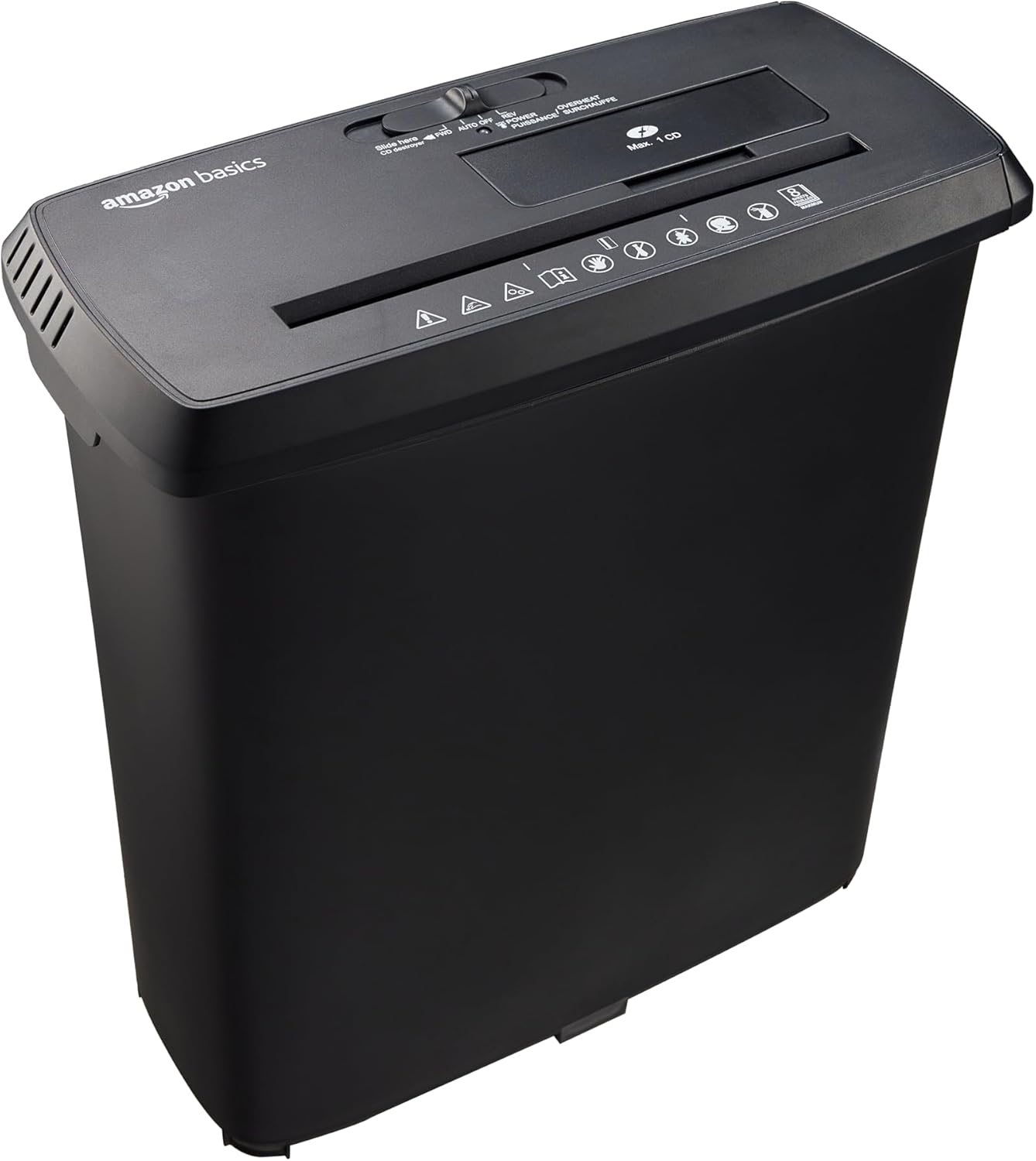
Amazon Basics 8-Sheet Strip Cut Shredder
| Cut Type | Strip Cut |
|---|---|
| Capacity | 3.4 gallons |
| Standard Sheet Capacity | 8 |
| Operation Mode | Automatic |
This Amazon Basics strip-cut shredder is a straightforward, budget-friendly option for light office use. It shreds up to eight 20-pound sheets at once and will also process single CDs, DVDs, and credit cards, which makes it useful for routine document disposal and occasional media destruction. The unit runs for about 2.5 minutes before requiring a 15-minute cool down, and an automatic start-stop feature helps with simple, hands-off operation. Waste collects in a 3.4 gallon pull-out bin that is easy to empty for daily use. Expect basic P-2 level security with 0.24-inch wide strips, so it is fine for nonconfidential paperwork but not for highly sensitive documents. The compact footprint and light weight make it easy to tuck under a desk or move between rooms, but the short run time and strip-cut output limit heavy continuous shredding and high-security needs. For small teams that need an inexpensive, no-frills shredder for routine jobs, this model covers the essentials.
Best for: Small offices or single-user workstations looking for a low-cost, compact shredder for routine paperwork and occasional media disposal.
Less Ideal for: Businesses that regularly shred large volumes or require high-security cross-cut shredding for sensitive documents should choose a higher-capacity or higher-security model.
- Handles up to 8 sheets at a time and accepts staples and small paper clips
- Can shred single CDs, DVDs, and credit cards
- Automatic start-stop makes operation simple and hands-free
- Compact, lightweight design with an easy-empty 3.4 gallon bin
- Strip-cut (P-2) security produces wide strips not suitable for highly confidential documents
- Short 2.5 minute run time requires a 15 minute cool-down for extended use
Verdict: A cost-conscious, compact shredder that covers everyday document and occasional media disposal for small offices that do not need high-security or continuous heavy use.
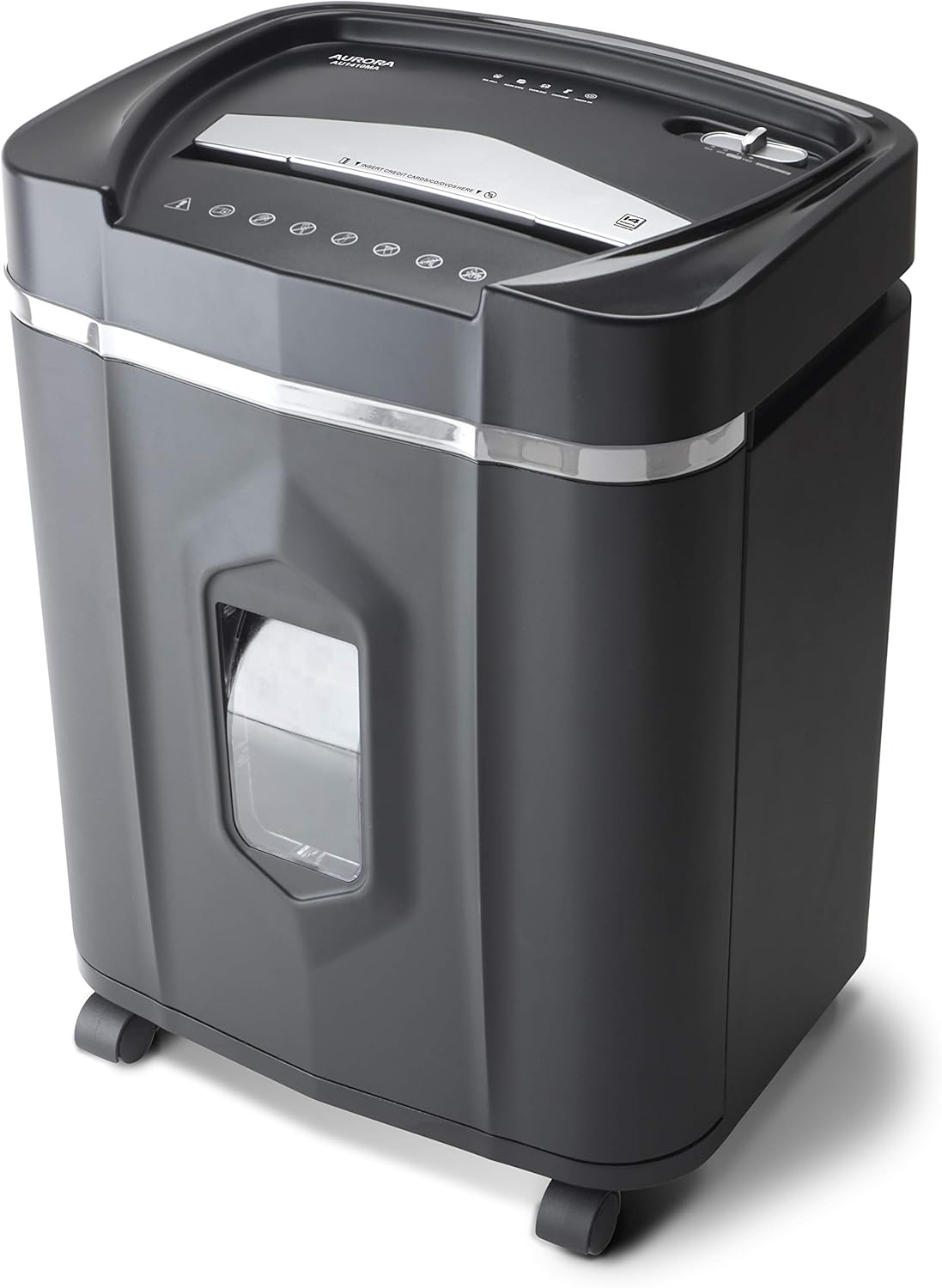
Aurora AU1210MA Micro-Cut Shredder
| Cut Type | Micro Cut |
|---|---|
| Standard Sheet Capacity | 12 |
| Operation Mode | Automatic |
| Power Source | AC adapter |
| Capacity | 5 gallons |
The Aurora AU1210MA is a small-office focused micro-cut shredder built for steady, reliable use. It shreds up to 12 sheets at once into P-4 level micro pieces and will also accept CDs, DVDs and credit cards, making it useful for routine secure disposal. The unit is designed for long runs, with a 60-minute continuous runtime and an anti-jam auto-reverse to clear misfeeds, while LED indicators report bin full, overheat and overload conditions. A 5.0-gallon pullout basket with casters keeps maintenance simple and the machine is engineered for relatively quiet operation so it is less disruptive in shared workspaces. Trade-offs include a modest bin capacity compared with larger commercial models and a midweight build that requires some floor space, but for a small business needing consistent, secure daily shredding the AU1210MA offers a practical balance of performance and durability.
Best for: Small-business operators who prioritize dependable, secure daily shredding and need a machine that can run continuously with minimal intervention.
Less Ideal for: Very high-volume departments or centralized mailrooms that require larger-capacity industrial shredders with bulk feed and larger waste bins.
- Micro-cut P-4 security that destroys paper, CDs, DVDs and credit cards
- 60-minute continuous run time suitable for sustained small-office use
- Anti-jam auto-reverse reduces interruptions from misfeeds
- LED indicators for standby, overheat, bin-full and overload status
- Pullout 5.0-gallon basket with casters for easy emptying and mobility
- 5.0-gallon bin is smaller than commercial models, so more frequent emptying is required
- Relatively heavy and takes floor space compared with compact desktop shredders
Verdict: Choose the AU1210MA when you need a reliable, quiet micro-cut shredder that can run for long periods and securely destroy paper and media for a small office.
Amazon Basics 8-Sheet Cross Cut Shredder

| Cut Type | Cross Cut |
|---|---|
| Standard Sheet Capacity | 8 |
| Capacity | 3.7 gallons |
| Operation Mode | Automatic |
| Audible Noise | 70 db |
This Amazon Basics cross-cut shredder is built for light office use and small-business workstations that need reliable document destruction without a lot of fuss. It shreds up to eight 20-lb sheets at once into P-4 level pieces roughly 0.2 x 0.7 inches, and will accept one credit card at a time plus staples and small paper clips. Operation is simple thanks to an auto/on, off, reverse, and forward switch with LED indicators for power, overload, and overheating. The unit has a 3 minute continuous runtime with a 30 minute cool-down and an automatic shutoff to protect the motor, and its 3.7 gallon pull-out bin is easy to empty. Noise is listed around 70 dB, so it is noticeable but typical for compact shredders. This model is straightforward and value-oriented, but the short run time and single-credit-card capacity limit throughput for heavier daily shredding and it is not suited to shredding metal cards.
Best for: Small-business owners or office managers who need an affordable, reliable shredder for intermittent daily destruction of sensitive paperwork and occasional credit cards.
Less Ideal for: High-volume shredding environments or departments that require long continuous run times or to process many credit cards and large stacks of documents.
- Meets P-4 cross-cut security for confidential documents
- Shreds up to 8 sheets of 20-lb paper at once and handles staples and small paper clips
- Automatic operation with reverse and overload/overheat LED indicators
- Easy-empty 3.7 gallon bin and compact footprint for small offices
- Short 3 minute runtime with a 30 minute cool-down limits continuous shredding
- Can only shred one credit card at a time and cannot handle metal cards
Verdict: A budget-friendly P-4 cross-cut shredder that reliably handles light to moderate small-business shredding needs in a compact package.
Choosing the Right Paper Shredder for Small Businesses: Key Factors to Consider
Daily Throughput and Duty Cycle
How many sheets a shredder can reliably process per day determines whether it will keep up with your office workload. Duty cycle describes how long the unit can run before it needs a cool-down period. Machines with higher throughput and longer duty cycles reduce interruptions and the need for multiple shifts of shredding. For a small business, underestimating volume leads to frequent downtime, employee frustration, and potential backlog of sensitive material. Consider both the rated sheets-per-pass and the manufacturer's stated daily capacity when sizing a shredder for consistent use.
Security Level and Shred Size
Different records require different levels of destruction. Basic two- or three-strip crosscut shredding might be adequate for internal memos, while financial, legal, or client records often require finer particle shredding to meet privacy requirements. Shred size and type (stripcut, crosscut, microcut, or confetti) directly affect how reconstructible documents are. Choose a security level that aligns with regulatory needs, the sensitivity of documents handled, and the amount of physical storage space available for shredded material. Higher-security cuts reduce the risk of data exposure but usually decrease throughput and increase bin fill rate.
Jam Resistance and Feed Mechanism
Paper jams are the most common source of downtime for shredders. Robust feed mechanisms, wider feed openings to accommodate small staples and occasional light cardboard, and intelligent sensors that detect and reverse potential jams improve uptime. Automatic reverse, anti-jam technology, and multi-sheet detection can prevent frequent clearance tasks. For a busy small office, a shredder that tolerates mixed media and recovers quickly from near-jam conditions saves time and reduces the need for hands-on intervention.
Maintenance Requirements and Consumables
Routine maintenance affects long-term performance and operating cost. Some machines need periodic oiling of the cutting head, while others have self-oiling systems that reduce upkeep. Consider how easy the bin is to empty and whether replacement bags or filters are required. The availability and cost of recommended oil, specialized bags, or service parts factor into total cost of ownership. A unit that is easy to clean and maintain minimizes service interruptions and extends the life of the shredder in a small-business environment.
Bin Capacity and Waste Handling
Large bin capacity reduces how often staff need to empty shredded material and keeps traffic flow uninterrupted. However, larger bins add weight and bulk, which may be problematic in smaller offices. Look for clear bin-level indicators or viewing windows so you can schedule emptying proactively. Some units accept standard replacement bags or have integrated compactors for high-volume sites. Evaluate how bins are accessed and whether emptying requires two people or can be done by a single staff member to fit your office routines.
Safety and Operational Controls
Shredders should include features that protect users and prevent accidental operation. Look for automatic shutoff when hands are detected near the feed, child-locks, and easy-to-read control panels. Overheat protection and thermal cutoff switches safeguard the motor during extended use. Clear labeling and accessible power switches help staff stop the machine quickly if foreign objects or tangles occur. Good safety design reduces workplace risk and helps meet basic occupational safety expectations for shared workspaces.
Sizing a Shredder to Your Business Workflow
Estimate typical daily paper volume by tracking how much sensitive material your team discards in a week, then divide to a daily average. Factor in peak days when reports, client files, or end-of-month paperwork might spike demand.
Match that volume to a shredder's rated throughput and duty cycle rather than only looking at sheets-per-pass. A machine with a high sheets-per-pass rating but a short duty cycle can still cause bottlenecks during busy periods.
- Track weekly shredding for two weeks to find realistic daily averages.
- Include occasional media like credit card receipts and small staples when estimating load.
Handling Mixed Media: Beyond Plain Paper
Offices often need to destroy items besides plain paper, such as staples, paperclips, credit cards, and thin cardboard. Verify the shredder's ability to handle these media types without voiding warranty or causing excessive wear.
If you regularly process multiple media types, choose a unit explicitly rated for them and plan for slightly reduced throughput when mixed loads are common.
- Look for explicit ratings for staples, small paperclips, credit cards, and CDs.
- Limit thicker plastics and hard materials that might damage cutting cylinders.
Maintenance Tips to Maximize Uptime
Regularly scheduled maintenance prevents many common failures. Depending on the model, this may include oiling the cutting head, clearing small jams, and emptying the bin before it overflows. Keep a small maintenance kit and the recommended oil on hand to avoid reactive downtime.
Educate staff on correct loading practices and how to respond to a jam safely. A short internal procedure sheet posted near the machine reduces risky attempts to clear clogs and speeds troubleshooting.
- Oiling frequency varies; follow manufacturer guidance and increase frequency under heavy use.
- Train at least two staff members on safe operation and basic maintenance.
Integration and Placement in a Small Office
Place the shredder where it is accessible but not obstructing high-traffic walkways. Noise level, bin emptying logistics, and electrical access influence where the unit works best. For shared spaces, a central location near administrative staff typically minimizes unnecessary movement.
Consider ventilation and clearance around the device to avoid overheating during long runs. Avoid cramped closets where airflow is restricted.
- Measure clearance for bin removal and servicing before choosing a location.
- Account for power outlet placement and avoid using long extension cords.
Security and Compliance Considerations
Determine whether your business must meet specific privacy or record-retention rules. In many cases, shredded paper must reach a particular particle size to satisfy industry or legal recommendations. Document the security level you need and ensure the shredder's specifications match that level.
Keep a simple log of destroyed materials when compliance demands it, noting dates and types of records processed. Combining a suitable shredder with basic administrative controls closes gaps in document security.
- Use microcut shredding for highly sensitive documents when required.
- Maintain a destruction log for audits or internal accountability.
How We Chose the Best Paper Shredder for Small Businesses
We prioritized criteria that matter to small-business users who need consistent, secure document destruction without frequent downtime. Our selection filters emphasized daily throughput and duty cycle to ensure machines can handle typical office volumes. Security level was a second essential criterion, focusing on shred size and compliance with common privacy standards for business records. We also evaluated jam resistance and auto-reverse systems because frequent jams slow operations and increase maintenance time. Ease of maintenance and consumable costs were considered, including how simple it is to empty the bin and whether oiling or special care is required. Finally, safety features such as automatic shutoff, sensor responsiveness, and child- or pet-safety locks were included because many small businesses share space with varied foot traffic. We excluded consumer-grade units rated only for occasional home use and any models with unclear continuous-duty specifications. The resulting list favors machines whose specifications and features align with real-world small-business workflows.
Our full evaluation process is outlined in our review methodology.
FAQ
How many documents can a typical small-office shredder handle per day?
It depends on the model's rated daily throughput and duty cycle. Many small-business units are designed for several hundred sheets per day, but continuous-run industrial models handle far more. Check both sheets-per-pass and duty cycle to estimate realistic daily capacity.
Can I shred credit cards and CDs in a standard paper shredder?
Some shredders are rated to handle credit cards and optical discs, but not all. Verify the manufacturer's media ratings before feeding these items. Processing such media can reduce throughput and may require different maintenance practices.
How often should I oil my shredder?
Oiling frequency varies by usage. Under light home-office use, monthly oiling may suffice, while busy small-business machines often need oiling weekly or according to the manufacturer's schedule. Self-oiling systems reduce manual upkeep requirements.
What causes a shredder to overheat and shut down?
Overheating is usually caused by extended continuous use beyond the duty cycle or by frequent clearing of jams that strain the motor. Allow the machine to cool for the recommended interval and address underlying jam causes to prevent repeated shutdowns.
Is microcut shredding always better than crosscut for businesses?
Microcut offers higher security but typically reduces throughput and increases bin fill. Choose microcut if documents are highly sensitive or if regulatory guidance requires it. For routine internal records, a high-quality crosscut may provide an acceptable balance of speed and security.
Final Verdict
For small businesses, the best shredder balances the security level you need with enough daily throughput and a duty cycle that fits your workload. Prioritize machines with strong jam resistance and straightforward maintenance to keep operations moving. Consider bin capacity and safety features when planning placement and staff responsibilities. By matching shredder specs to your real-world volume and security requirements, you can minimize downtime and maintain consistent document-destruction practices.