
Note: This article contains affiliate links. If you click on these links and make a purchase, we may earn a small commission at no extra cost to you. This helps support our research and content. Read our full affiliate disclosure here.
Choosing the right pizza oven for restaurants affects speed of service, product consistency, and kitchen workflow. A well-matched oven keeps cook times predictable, produces an even crust, and handles your peak ticket volume without creating bottlenecks. This guide covers our shortlisted top pizza ovens for restaurant use, focusing on capacity, bake quality, and ease of daily operation. Use the evaluation criteria to match an oven to your menu, expected covers, and staff skill level. Read on to see which types of ovens suit different production needs and kitchen footprints.
Top Picks at a Glance
| Best Overall The best all-around choice for most situations | CROSSON Commercial Double Deck Pizza Oven |  |
| Best Quality Built to a higher standard if you want something more solid | Omcan Conveyor Pizza Oven 11387 |  |
| Best Value The sweet spot between price and what you get | BIG HORN 14-Inch Pizza Oven GP9022PRC |  |
| Best Budget The cheapest option that still gets the job done reliably | SIMOE Electric Pizza Oven |  |
| Top Rated A top-rated pick with lots of positive feedback | Presto Pizzazz Plus 03430 |  |
| Best Seller A high-volume bestseller chosen again and again | BIG HORN 12" Multi-Fuel Pizza Oven |  |
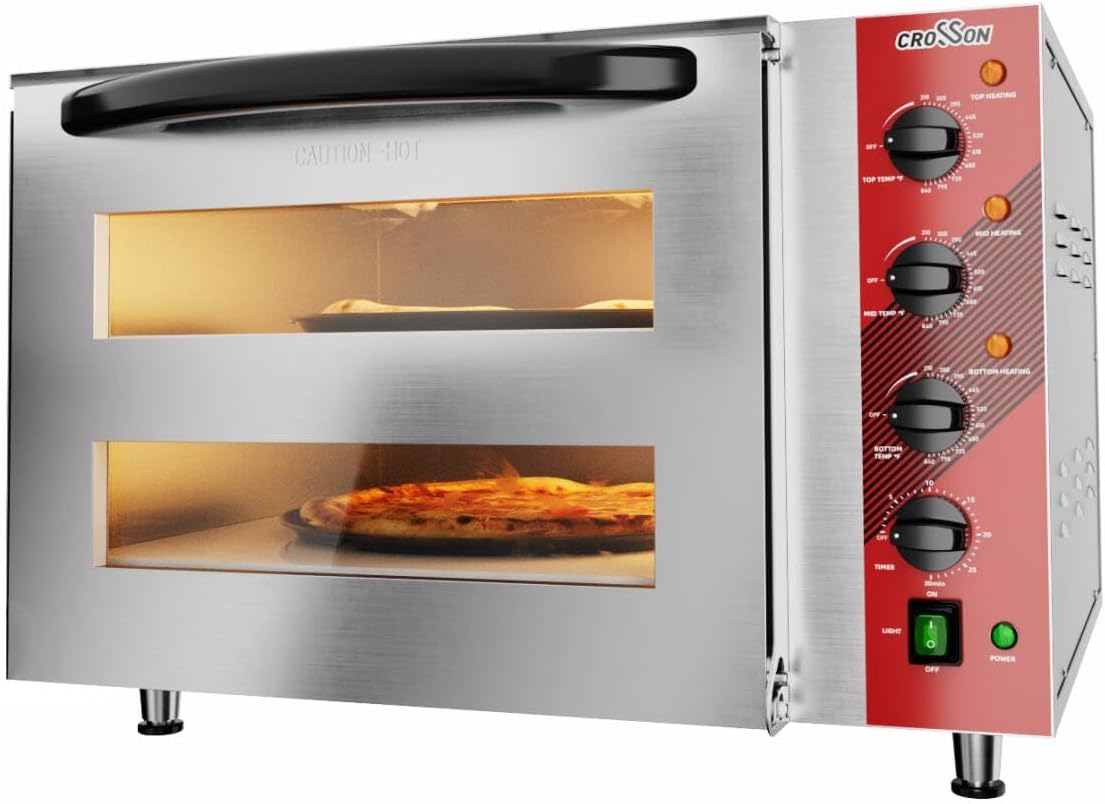
CROSSON Commercial Double Deck Pizza Oven
| Wattage | 4500 watts |
|---|---|
| Power Source | electric |
| Size | 18 Inch |
| Capacity | 12 liters |
| Control Type | Knob Control |
This CROSSON double-deck countertop pizza oven is built for small commercial kitchens that need high throughput and quick heat-up. Each deck has independent knob controls and its own heating elements so you can run different temperatures on the two chambers, and the 4500W element provides fast preheat and short cook cycles suited to high-volume service. The included 15mm pizza stone helps retain and distribute heat for crisp crusts while the interior light and tempered glass door make it easy to monitor progress without opening the oven. A 30-minute timer and straightforward controls keep operation simple for staff. Expect heavy-duty stainless steel construction appropriate for restaurant use, but note the oven draws significant power and requires a 240V/30A-style supply and adequate ventilation in a commercial kitchen. The large double chamber increases capacity but also increases footprint and energy use compared with single-deck units.
Best for: Operators of small pizzerias, cafes, or busy restaurant kitchens who need to bake multiple 18-inch pizzas quickly and want the flexibility to run different temperatures on two decks.
Less Ideal for: Home cooks with standard household wiring or operations with very limited counter space should choose a smaller, lower-power oven instead.
- Double-deck chamber doubles output for simultaneous baking of two 18-inch pizzas
- Independent controls per deck let you run different temperatures for varied menu items
- High 4500W power for faster preheat and shorter cook times
- 15mm pizza stone improves heat retention and helps produce crisp crusts
- Stainless steel construction and interior light support commercial kitchen durability and visibility
- Requires a high-power 240V electrical hookup and appropriate circuit capacity
- Large footprint and high energy draw compared with smaller countertop ovens
Verdict: A high-power, double-deck countertop oven that delivers restaurant-capacity cooking and independent deck control for operators who need fast, repeatable results.
Omcan Conveyor Pizza Oven 11387

| Capacity | Sixteen 14" pizzas/hour (or 19 12" / 25 9") |
|---|---|
| Wattage | 3.6 KW |
| Power Source | Electric Corded NEMA 6-20 |
| Temperature Range | 70 – 260°C / 158 – 500°F |
The Omcan conveyor pizza oven is a commercial countertop oven built to keep throughput steady in busy kitchens and diners. It uses a 14-inch conveyor belt with infrared heaters and knob controls for temperature and belt speed, letting you bake or reheat multiple pizzas, bagels, or bread items at consistent temperatures between about 158 and 500°F. The unit is ventless and constructed in stainless steel, which simplifies cleaning and suits back-of-house use. Rated at 3.6 kW and wired for a NEMA 6-20 plug, it delivers enough power for high-volume cycles and is sized for continuous run without complex setup. Practical limits: it is not intended for frozen pizzas and has a relatively short opening height, so very tall or heavily topped pizzas may need adjustment. Expect standard commercial durability and a one-year parts-and-labor manufacturer warranty, but plan for proper electrical supply and kitchen placement before purchase.
Best for: Kitchen operators who prioritize steady output and consistent bake quality for high-volume pizza, bagel, or bread service in a restaurant or cafe environment.
Less Ideal for: Small home users, low-volume operators, or kitchens without 240V single-phase electrical capacity should consider simpler countertop ovens or different equipment.
- Continuous conveyor belt for steady throughput
- Infrared heaters and variable speed/temperature controls for consistent baking
- Stainless steel body that is durable and easy to clean
- High power (3.6 kW) suitable for commercial use
- Not suitable for properly cooking frozen pizzas
- Requires 240V / NEMA 6-20 electrical connection which may need dedicated circuit
Verdict: Choose this Omcan conveyor oven when you need reliable, continuous pizza throughput with consistent infrared heating for a busy restaurant or cafe.
BIG HORN 14-Inch Pizza Oven GP9022PRC

| Wattage | 2200 watts |
|---|---|
| Power Source | electric |
| Temperature Range | 220 to 850℉ |
| Capacity | 0.6 cubic feet |
The BIG HORN 14-inch pizza oven is a high-heat countertop unit designed to deliver restaurant-style pizzas quickly. It uses a PID temperature controller and dual upper and lower heating tubes to hit temperatures from 220 to 850°F and preheats in about 15 minutes, so it can cook a 14-inch pizza in roughly three minutes at the highest setting. The oven includes a 14-inch cordierite-style stone and a lightweight peel, and offers six presets plus a manual mode for different pizza styles and other baked items. Its flip-up, space-saving door reduces footprint and the removable stone simplifies cleanup. At 2200 watts it provides strong, consistent heat but requires a standard 110–120V outlet, so it fits typical commercial prep counters with appropriate circuit planning. Limitations for high-volume restaurant use are the modest 0.6 cu ft capacity and single-pizza chamber, meaning you will need multiple units or staggered cooking to match a busy service period, and the countertop size and weight make it better suited to prep areas than tight pass-through hotlines.
Best for: Small restaurants, cafés, or pizzerias that prioritize fast, high-heat baking and want a compact countertop oven to produce restaurant-style 14-inch pizzas without installing specialized gas or wood equipment.
Less Ideal for: High-volume pizzerias that need continuous, multi-pizza throughput or full-size deck ovens should choose larger commercial units designed for a restaurant line.
- Very high max temperature (up to 850°F) for fast, charred-style pizzas.
- PID temperature control and dual heating elements that promote even baking.
- Six preset programs plus manual mode for versatile pizza styles and other baked goods.
- Includes a 14-inch pizza stone and peel so it is ready to use out of the box.
- Flip-up door and removable stone make storage and cleaning easier in tight kitchens.
- Single-chamber, 14-inch capacity limits throughput for busy restaurant service.
- Requires a dedicated 110–120V circuit at full output; not suitable where higher-voltage commercial circuits are needed.
Verdict: If you run a small restaurant or café that needs rapid, restaurant-style 14-inch pizzas from a compact countertop unit, this high-heat electric oven delivers the speed and temperature control to do it well.
SIMOE Electric Pizza Oven

| Wattage | 1450 watts |
|---|---|
| Capacity | 12 inches |
| Control Type | Knob Control |
| Power Source | AC adapter |
The SIMOE Electric Pizza Oven is a small stainless steel countertop oven aimed at quick pizza cooking and light roasting tasks. It heats between about 536°F and 608°F and the manufacturer says a 12-inch pizza can be ready in roughly nine minutes, which makes it useful for fast turnaround on individual pies. Controls are simple knob-style dials with a 30-minute timer and automatic shut-off for safety, and the oven includes a removable baking tray, wire rack, crumb tray and an insulated folding handle to make loading and cleaning easier. At 1450 watts it delivers strong top-end heat in a compact footprint, but the interior fits only a single 12-inch pizza so it is not built for high-volume batch cooking. The sliding door and stainless finish are easy to wipe down, though the oven surface and handle can run hot in use so care is needed. For restaurants or foodservice, this unit works best as a supplemental station for small batches, test kitchens, or prep where space and budget are limited rather than a primary pizza oven for sustained high-volume service.
Best for: A budget-minded operator or small-scale kitchen needing a cheap, space-saving pizza oven for single pizzas, appetizers, or test batches where cost and countertop footprint are the primary concerns.
Less Ideal for: Full-service restaurants or high-volume pizzerias that require continuous output or multiple simultaneous pizzas should look at commercial deck or conveyor ovens instead.
- High heat output (1450W) that reaches pizza-ready temperatures quickly
- Compact countertop size that fits a single 12-inch pizza and saves space
- Removable tray, wire rack and crumb tray simplify cleanup
- Insulated folding handle and automatic shut-off add safety and convenience
- Interior capacity limited to one 12-inch pizza so throughput is low
- Not intended for continuous high-volume restaurant use
Verdict: A low-cost, compact electric oven that delivers quick single 12-inch pizzas and works well as a budget supplemental unit for small kitchens.
Presto Pizzazz Plus 03430

| Wattage | 1235 watts |
|---|---|
| Control Type | Knob Control |
| Power Source | Electricity |
| Size | 12-Inch |
The Presto Pizzazz Plus is a small, dedicated countertop pizza oven designed to bake frozen and fresh pizzas quickly using a continuously rotating pan and independently controlled top and bottom heating elements. You use the knob controls to select top, bottom, or both elements and set the mechanical timer; the rotating tray helps promote even browning without flipping. The removable nonstick baking pan makes cleanup and compact storage straightforward, and the unit's 1,235-watt output cooks pizzas faster than a conventional oven while using less energy. Practical benefits include simple, reliable operation for 7- to 12-inch pizzas and other convenience foods, plus a built-in timer with automatic shutoff for consistent results. Limitations are its single-purpose size—it fits small pizzas only—and manual knob controls mean fewer precision settings compared with digital countertop ovens. The oven's compact footprint is great for tight counters but restricts capacity and prevents larger dishes.
Best for: Buyers who prioritize a proven, simple pizza-focused appliance that reliably cooks 7–12 inch pizzas quickly and want the reassurance of a long-running popular model with strong user feedback.
Less Ideal for: People who need a multi-function countertop oven for larger dishes or who require precise digital controls and programmable presets.
- Rotating tray promotes more even baking without repositioning food
- Independently controlled top and bottom heating elements for flexible browning
- Removable nonstick pan for easy cleanup and compact storage
- Compact footprint that heats faster and uses less energy than a conventional oven
- Only accommodates small pizzas and limited food sizes
- Basic knob controls lack programmable or precise digital settings
Verdict: If you want a straightforward, compact pizza oven that bakes small pizzas faster and more evenly than a conventional oven, the Presto Pizzazz Plus is a reliable choice.
BIG HORN 12" Multi-Fuel Pizza Oven

| Fuel Type | Wood Pellet |
|---|---|
| Heating Method | Radiant |
| Installation Type | Freestanding |
| Size | 12-inch pizzas |
The BIG HORN 12" Multi-Fuel Pizza Oven is a portable stainless steel outdoor oven designed to reach very high temperatures quickly for fast stone-baked pizzas. It primarily runs on hardwood pellets for an authentic smoky flavor, and it can be fitted with separately sold gas or electric burner attachments for different fuel options. Setup is straightforward: folding legs and tool-free assembly make it easy to move and store, and the included 12" square pizza stone heats up during the roughly 18-minute preheat to deliver pizzas in about 60–90 seconds when the oven is at top heat. In practice it is best for Neapolitan-style pies with light toppings because the intense radiant heat cooks crust and toppings rapidly; heavier, thick-crust pizzas need more attention and turning to avoid overcooking toppings. There is no built-in thermometer so an infrared gun is recommended for accurate temperature checks, and optional burners must be purchased separately if you want gas or electric operation. The unit is well suited to backyard cookouts, tailgating, and camping where portability and high heat are priorities.
Best for: Buyers who want a reliable, easy-to-set-up outdoor pizza oven that produces high-heat, restaurant-style pizzas quickly and who prefer a low-hassle portable unit for backyard cooking and travel.
Less Ideal for: Home cooks who need a full-featured countertop electric oven with precise built-in temperature controls or those who only want an out-of-the-box gas or electric appliance without buying extra attachments.
- Portable, lightweight stainless steel construction with folding legs for easy transport and storage
- Preheats quickly to very high temperatures for 60–90 second pizzas on the included 12" stone
- Multi-fuel flexibility via optional gas or electric burner attachments in addition to pellet mode
- Simple tool-free assembly and easy-to-clean design suited for outdoor use
- No built-in thermometer so buyers should use an external infrared thermometer for accurate temps
- Gas and electric burners are not included and must be purchased separately
Verdict: Choose this oven if you want a portable, high-heat outdoor pizza oven that delivers authentic fast-cooked pizzas and the option to add gas or electric burners later.
Choosing the Right Pizza Oven for Restaurants: Key Factors to Consider
Oven Type and Cooking Method
The basic oven type determines how heat is delivered and what crust characteristics you can rely on. Deck ovens produce radiant heat and are excellent for a classic, slightly chewy crust with good bottom coloration. Conveyor ovens offer consistent bake time and are ideal for high-volume kitchens that require uniform results and minimal training. Brick or stone hearth ovens produce the fastest, highest-heat bakes and can create blistered, artisanal crusts, but they typically demand more hands-on operation.
Consider how the cooking method aligns with your menu. If you need fast, repeatable results across many orders, conveyor or multi-deck options often work best. If your menu emphasizes artisan pies with high-temperature bakes, a hearth-style oven may be more suitable despite slower throughput and greater operator skill requirements.
Throughput and Capacity
Throughput affects how many orders you can complete during peak service and is usually measured in pizzas per hour or the number of pies that fit across the cooking surface. Deck ovens with multiple layers increase simultaneous capacity but may require more floor or counter space. Conveyor ovens control bake time via belt speed, which simplifies staffing and training while delivering steady output.
Estimate typical and peak covers before choosing. A restaurant with heavy lunch and dinner shifts needs an oven whose continuous output exceeds peak demand with some margin to avoid service delays. Also factor in staging space before and after the oven to keep a steady flow of pies without blocking the line.
Temperature Range and Recovery
Maximum temperature capability and how quickly an oven recovers after loading determine the consistency of final product across a service. High maximum temperatures enable faster bakes and certain crust textures, but the oven must also regain setpoint quickly after frequent door openings or loading to avoid undercooked or uneven pies.
Check published recovery times and how controls manage setpoint changes. Kitchens that run continuous, heavy loads benefit from ovens with robust heating elements or burners and good insulation to reduce thermal drift. For multi-shift operations, consistent recovery reduces waste and reworks.
Control Precision and Usability
Precise temperature and timing controls reduce reliance on operator judgment and make it easier to train staff. Digital controls with programmable presets simplify repeatability across shifts. Mechanical gauges or simple thermostats are robust but may offer less repeatability for complicated recipes.
Consider how many presets you need, whether incremental temperature adjustments are necessary for specialty items, and how intuitive the controls are for line cooks. Ease of operation lowers error rates during busy periods and shortens onboarding for new staff.
Cleaning, Maintenance, and Serviceability
Daily cleaning routines and routine maintenance determine long-term reliability and sanitation compliance. Look for ovens with accessible crumb trays, removable hearth stones or conveyors that can be cleaned without special tools, and surfaces that resist food buildup. Components exposed to grease and flour should be serviceable without lengthy downtime.
Also consider how easy it is to replace common wear parts and whether the oven design keeps critical components away from direct food contact. Simpler maintenance means less downtime and lower lifecycle cost for a restaurant.
Footprint, Ventilation, and Installation Needs
A commercial pizza oven is part of a larger kitchen system that includes ventilation, gas or electrical supply, and floor plan considerations. The oven footprint determines where it can sit in the kitchen and how it impacts flow. Some high-heat hearth-style ovens need specific clearances and heavy-duty ventilation, while electric deck units may require substantial electrical service.
Coordinate oven selection with your kitchen layout and utility capacity. Installing an oven that exceeds your existing power or venting can lead to expensive retrofits. Consider service access for technicians and whether the unit can be rolled or moved for deep cleaning and maintenance.
Matching Oven Type to Menu Style
Decide whether your menu prioritizes speed, artisan quality, or a balance of both. Conveyor ovens excel when you need consistent, quick throughput and simple staff training. Deck ovens are versatile for traditional pies and can be stacked to increase capacity while retaining a more hands-on approach. Hearth or stone ovens are well suited to menus that emphasize high-temperature, artisanal bakes and visible showmanship.
- Conveyor: predictable timing and easy scaling for high-volume lines
- Deck: traditional bake profile, good for flexible menus
- Hearth: highest heat and characteristic crust, requires skilled operation
Operational Workflow and Line Integration
Think about the oven as part of the production line. Where will dough be launched and finished? How much staging space is needed for toppings and finished pies? The ideal oven placement minimizes staff travel and avoids cross-traffic during service.
Also plan for integration with other equipment, such as prep tables and warming cabinets. An oven that matches the speed of your prep and finishing stations reduces bottlenecks and helps maintain food quality from oven to table.
- Provide clear staging areas before and after the oven
- Align oven output with finishing and plating capacity
- Allow staff sightlines and safe access for loading and unloading
Energy Source Considerations
Commercial pizza ovens typically run on gas, electric, or wood. Each energy source has tradeoffs in terms of heat characteristics, installation complexity, and running costs. Gas can provide rapid heat-up and good control, electric units are cleaner to operate and easier to install in some kitchens, and wood-fired ovens create unique flavor profiles but require specialized ventilation and operator skill.
Verify your kitchen utilities and local code requirements before selecting an energy type. Also consider the predictability of fuel supply and how fuel choice affects ongoing operating procedures and ventilation needs.
- Gas: fast heating and good responsiveness
- Electric: cleaner footprint, simpler venting in many cases
- Wood: distinct flavor and high heat, requires more management
Sanitation and Health-Code Readiness
Commercial kitchens must meet local health regulations, so choose ovens with smooth, non-porous surfaces, sealed seams where possible, and removable parts for cleaning. Consider how the oven handles spilled cheese, sauces, and flour to avoid buildup in hard-to-reach areas.
Documentable cleaning procedures and accessible parts reduce the risk of failed inspections and make daily routines faster. Ask your maintenance team how the oven design supports quick cleaning between shifts.
- Removable trays and accessible interiors simplify sanitation
- Rounded corners and sealed seams reduce trapped debris
- Check manufacturer guidance for recommended cleaning agents
Noise, Heat Load, and Kitchen Comfort
Ovens contribute to the kitchen environment. High-heat units increase ambient temperature and may affect staff comfort and downstream equipment. Noise from blowers or conveyors can also impact communication on the line. Consider ventilation capacity and staff scheduling when placing high-heat ovens.
Plan for heat mitigation with proper exhaust, make-up air, and staff rotation if necessary. Choosing an oven with efficient insulation and lower exhaust heat can improve comfort without sacrificing performance.
- Assess exhaust and make-up air requirements
- Consider insulation and door design to limit heat bleed
- Account for noise when placing ovens near order screens or pass areas
How We Chose the Best Pizza Oven for Restaurants
We prioritized features and performance metrics that matter to busy restaurant kitchens. Our selection focused on ovens able to maintain stable deck or chamber temperatures under sustained use, with visible evidence of consistent bake results across multiple pies. Throughput and capacity were central filters, so we favored units whose cooking cavity, conveyor speed, or deck count realistically supports commercial service runs. Build quality and the durability of oven components were assessed to reflect long-term uptime in a restaurant environment. Usability factors included control precision, recovery time after door openings or heavy loads, and how straightforward routine cleaning and maintenance are. Energy source and efficiency were considered for kitchens with differing utility setups. Excluded from consideration were small residential units and ovens intended only for domestic use, plus machines lacking basic commercial safety and sanitation features. The final shortlist balances commercial performance, operational reliability, and practical kitchen fit.
Our full evaluation process is outlined in our review methodology.
FAQ
What oven type yields the fastest cook times for pizzas?
High-temperature hearth-style ovens typically have the fastest cook times, often under a few minutes, but they require skilled operators. Conveyor ovens can also be fast and offer more consistency across many pies with less operator input.
How do I estimate the pizza-per-hour capacity I need?
Calculate your peak-hour covers and add a margin for unexpected demand. Consider bake time per pie, how many pies fit in the oven at once, and continuous loading capability. It helps to map out a typical busy service to see whether the oven's throughput matches your flow.
Is it better to choose gas or electric for a restaurant pizza oven?
It depends on your kitchen utilities and menu goals. Gas often provides quicker heat-up and strong recovery, while electric units can be simpler to install and maintain. Local code and ventilation constraints may also influence the best choice.
How important is oven insulation and recovery time?
Very important for consistent results during service. Good insulation reduces temperature drop when loading and lowers energy waste. Fast recovery helps maintain even bakes across continuous orders and reduces the need for manual adjustments.
What maintenance should I plan for a commercial pizza oven?
Routine cleaning of surfaces, removal of crumbs and grease, and inspection of heating elements or burners are typical. Schedule periodic checks for seals, belts, and electrical or gas connections. Following a maintenance plan reduces downtime and extends service life.
Final Verdict
Choose a pizza oven for restaurants by matching oven type and throughput to your menu and expected service volumes. Prioritize bake consistency, recovery performance, and ease of cleaning to reduce downtime and maintain quality during peak periods. Balance footprint and installation needs with long-term durability and staff usability. With those tradeoffs in mind, pick the oven that aligns with your daily output targets and operational constraints to ensure reliable service.