
Note: This article contains affiliate links. If you click on these links and make a purchase, we may earn a small commission at no extra cost to you. This helps support our research and content. Read our full affiliate disclosure here.
When summer temperatures spike, a compact, efficient cooling solution makes the difference between a restless night and a comfortable caravan trip. A Portable Air Conditioner for Caravan needs to balance raw cooling power with compact size, manageable installation, and low noise so you can sleep without fuss. This guide covers a shortlist of six top options chosen for caravan use and explains the practical tradeoffs that matter when buying mobile cooling for small living spaces. Read on to compare capacity, noise, and ease-of-use so you can find the right unit for your camper setup.
Top Picks at a Glance
| Best Overall The best all-around choice for most situations | DREO Portable Air Conditioner 318S |  |
| Best Quality Built to a higher standard if you want something more solid | ZAFRO Inverter Portable AC 16000 BTU |  |
| Best Value The sweet spot between price and what you get | ZAFRO Portable Air Conditioner 12000 BTU |  |
| Top Rated A top-rated pick with lots of positive feedback | BLACK+DECKER Portable Air Conditioner BPACT08WT |  |
| Most Popular A crowd favorite that many people choose with confidence | BLACK+DECKER Smart Portable Air Conditioner BPACT12WT |  |
| Best Seller A high-volume bestseller chosen again and again | Hisense HAP0825TWD Portable AC |  |
DREO Portable Air Conditioner 318S

| Cooling Power | 8000 BTU (ASHRAE) / 5000 BTU (DOE SACC) |
|---|---|
| Noise | 45 db |
| Refrigerant | R-32 |
| Power | 115 volts, 1040 watts |
| Modes | Cool / Dry (Dehumidify) / Fan |
The DREO 318S is a portable 8000 BTU ASHRAE (5000 BTU DOE/SACC) unit designed to cool small rooms and bedrooms while also functioning as a dehumidifier and fan. It is typically wheeled into place, vented through the included window kit, then controlled with the touch panel, remote, DREO app, or voice assistants. Notable features include a true drainage-free design that self-evaporates condensate under typical humidity levels, a large LED display, and multiple control methods for convenience. The unit claims a low noise profile around 45 dB at its quietest setting and works with Alexa, Google Assistant, and Siri for hands-free adjustments. Practical benefits include easy installation with the window mount kit, useful dehumidify mode for damp conditions, and app-based monitoring of temperature and humidity. Limitations to consider are its modest DOE cooling rating (best for single small rooms up to the listed floor area) and non-inverter compressor which can mean higher energy draw during heavy use; it also may require draining in very high humidity or prolonged continuous operation.
Best for: Buyers who want an easy-to-install, smart-controlled portable AC that handles cooling and moisture control in small enclosed spaces and value quiet, app-enabled operation.
Less Ideal for: People needing to cool large open RVs or caravans for long periods or seeking the highest energy efficiency should consider higher-capacity or inverter-equipped systems instead.
- 3-in-1 functionality: cooling, dehumidify, and fan modes for flexible use
- Self-evaporating drainage system reduces manual emptying in typical humidity
- Multiple control options: app, remote, touch, and voice assistants
- Includes window mount kit and drain hose for straightforward setup
- Relatively quiet operation at lowest setting (~45 dB) suitable for bedrooms
- DOE/SACC cooling rating is modest so best suited to small spaces rather than larger caravans
- Uses a non-inverter rotary/scroll compressor which can be less efficient under heavy load
Verdict: A compact, smart-controlled portable AC that delivers quiet, flexible cooling and dehumidification for small enclosed spaces where easy setup and app/voice control matter.
ZAFRO Inverter Portable AC 16000 BTU

| Cooling Power | 16000 british thermal units |
|---|---|
| Floor Area | 800 square_feet |
| Noise | 42 db |
| Refrigerant | R-32 |
| Control Method | App, Remote, Touch |
The ZAFRO 16000 BTU inverter portable AC is built to deliver fast, even cooling in large spaces using a dual-hose design and a high airflow rate. It uses an inverter compressor to hold temperature precisely and reduce cycling, and an Extra Mode can push the unit to its lowest setpoint for quick relief during heat spikes. Smart features include app, touch, and remote control plus a 24-hour timer, filter reminders, and sleep mode that reduces noise to about 42 dB. The self-evaporating condensate system lets the unit run drainage-free for up to 72 hours in typical humidity levels, and a drain hose is included for very humid conditions. Energy efficiency is strong for the class with a listed SEER/CEER of 12.8, but expect a heavy, bulky cabinet and the usual portability compromises for a high-capacity unit. Installation requires routing the exhaust and using the included multi-piece window panel, so plan for a short setup and clear window access. For large rooms this model provides robust, smart-controlled cooling but takes up floor space and needs a dedicated window opening for the exhaust setup.
Best for: Buyers who prioritize strong, responsive cooling for large rooms and want smart controls and energy-efficient inverter performance to maintain steady comfort.
Less Ideal for: People who need a compact, lightweight cooler for small rooms or frequent moves between locations should consider smaller, lighter models instead.
- Dual-hose design and high airflow for faster, more even cooling in large rooms.
- Inverter compressor for stable temperature control and improved energy efficiency (SEER/CEER 12.8).
- Smart controls: app, remote, and touch with 24-hour timer and scheduling.
- Self-evaporating system provides up to 72 hours drainage-free operation in normal humidity.
- Multiple modes including Extra and Sleep for rapid cooling or quiet overnight use.
- Large and heavy for a portable unit, requiring dedicated floor space and window access.
- May need active draining in very humid environments despite the self-evaporating feature.
Verdict: Choose this unit if you need powerful, energy-efficient inverter cooling and smart remote control for reliably cooling large rooms.
ZAFRO Portable Air Conditioner 12000 BTU
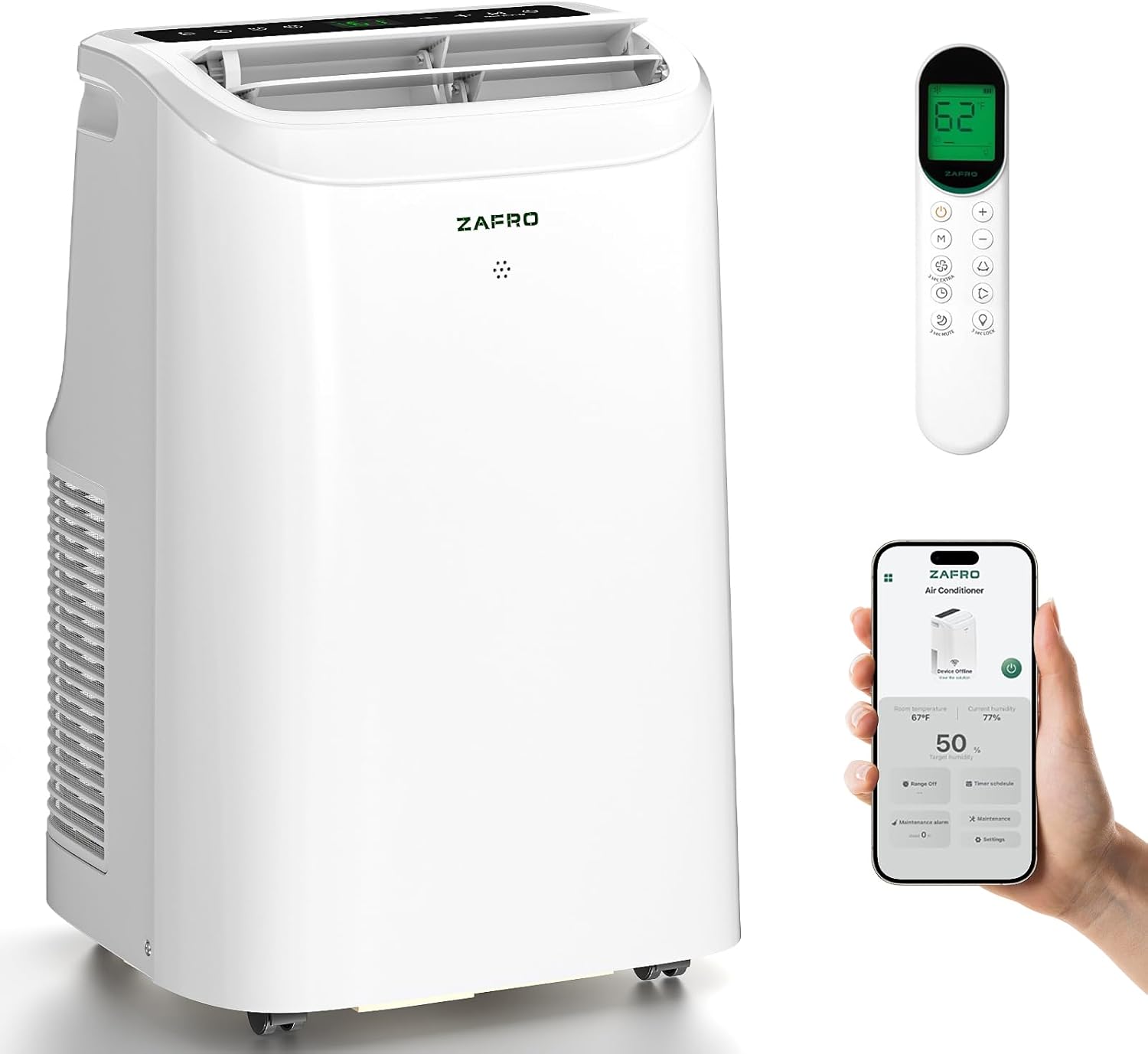
| Cooling Power | 12000 british thermal units |
|---|---|
| Noise | 47 db |
| Wattage | 1070 watts |
| Capacity | 500 cubic feet |
| Control Type | App Control, Remote Control, Touch Control |
The ZAFRO Portable Air Conditioner provides versatile spot cooling with a rated 12,000 BTU (8,000 BTU SACC) output and three modes: cooling, dehumidifying, and fan. It supports temperature set points between 61 and 86°F, four fan speeds plus auto, and programmable 24-hour timer for scheduled use. Smart controls via the ZAFRO app, Alexa and Google Home plus a long-range remote make it easy to operate from a distance, and touch controls give direct access on the unit. The unit's self-evaporating system reduces the need to empty a water tank for up to about 72 hours and the detachable filter simplifies maintenance. At 47 dB in sleep mode it is reasonably quiet for overnight use, and included casters and side handles help moving and installing the unit with the supplied adjustable window kit. Expect typical portable-AC limits: the SACC cooling figure is lower than the nominal BTU and the unit is relatively heavy and bulky for tight caravan spaces, so plan placement and ventilation carefully.
Best for: Buyers who prioritize practical, scheduleable cooling with remote smart control and minimal maintenance in a compact portable package for use in small living spaces.
Less Ideal for: Caravan owners with very limited floor space or strict weight constraints who need the lightest, smallest dedicated caravan air solution.
- Three operating modes (cooling, dehumidifier, fan) for flexible comfort control
- Smart app, Alexa and Google Home compatibility plus long-range remote for remote operation
- Self-evaporating condensate system that reduces frequent drainage
- Four fan speeds, auto mode and 24-hour timer for customizable schedules
- Detachable filter and included window kit for straightforward installation and maintenance
- Relatively heavy and large for very tight caravan interiors
- Rated SACC cooling (8,000 BTU) is lower than the 12,000 BTU nominal figure, affecting effective cooling area
Verdict: A smart, low-maintenance portable AC that delivers flexible cooling and remote scheduling for travelers who want convenient climate control without constant drain management.
BLACK+DECKER Portable Air Conditioner BPACT08WT

| Cooling Power | 9000 BTU (5,300 BTU SACC) |
|---|---|
| Power | 115 volts, 935 watts |
| Functions | Air conditioner, dehumidifier, fan |
| Refrigerant | R-32 |
| Control | Remote with Follow Me |
This BLACK+DECKER portable air conditioner is a straightforward, no-frills unit designed to cool small spaces and double as a dehumidifier and fan. It ships with a complete window installation kit, casters and side handles for moving between rooms, and a full-function remote with a Follow Me thermostat feature so you can measure temperature where you are sitting. The unit uses R-32 refrigerant and a rotary scroll compressor, runs on standard 115V power, and advertises self-evaporating operation so you typically do not need to empty condensate during normal cooling. In practice it delivers comfortable cooling for bedrooms, offices, or small living areas and the washable filter is easy to remove and clean. Trade-offs are typical for portable ACs: it is heavy to lift and needs a vented exhaust to a window or wall, and noise is noticeable on higher fan settings. For someone who wants dependable seasonal cooling with simple setup and routine maintenance, this model covers the essentials without complicated features.
Best for: Buyers who prioritize a dependable, easy-to-install cooling solution for small enclosed spaces and want simple maintenance and reliable operation over advanced smart features.
Less Ideal for: People who need ultra-quiet operation, lightweight units for frequent vehicle moves, or air conditioners that do not require a vented exhaust should consider other options.
- Includes complete window installation kit for horizontal or vertical windows
- Full-function remote with Follow Me thermostat for localized temperature control
- Self-evaporating operation reduces need to manually drain condensate
- Washable, removable filter for simple maintenance
- Casters and side handles make it reasonably mobile within a home or caravan
- Relatively heavy for a portable unit and can be awkward to lift
- Requires a vented window or wall opening which may limit placement in some caravans
- Noise becomes noticeable on higher fan or cooling settings
Verdict: A solid, easy-to-install portable AC that delivers reliable cooling and simple maintenance for small enclosed spaces like caravans or small rooms.
BLACK+DECKER Smart Portable Air Conditioner BPACT12WT
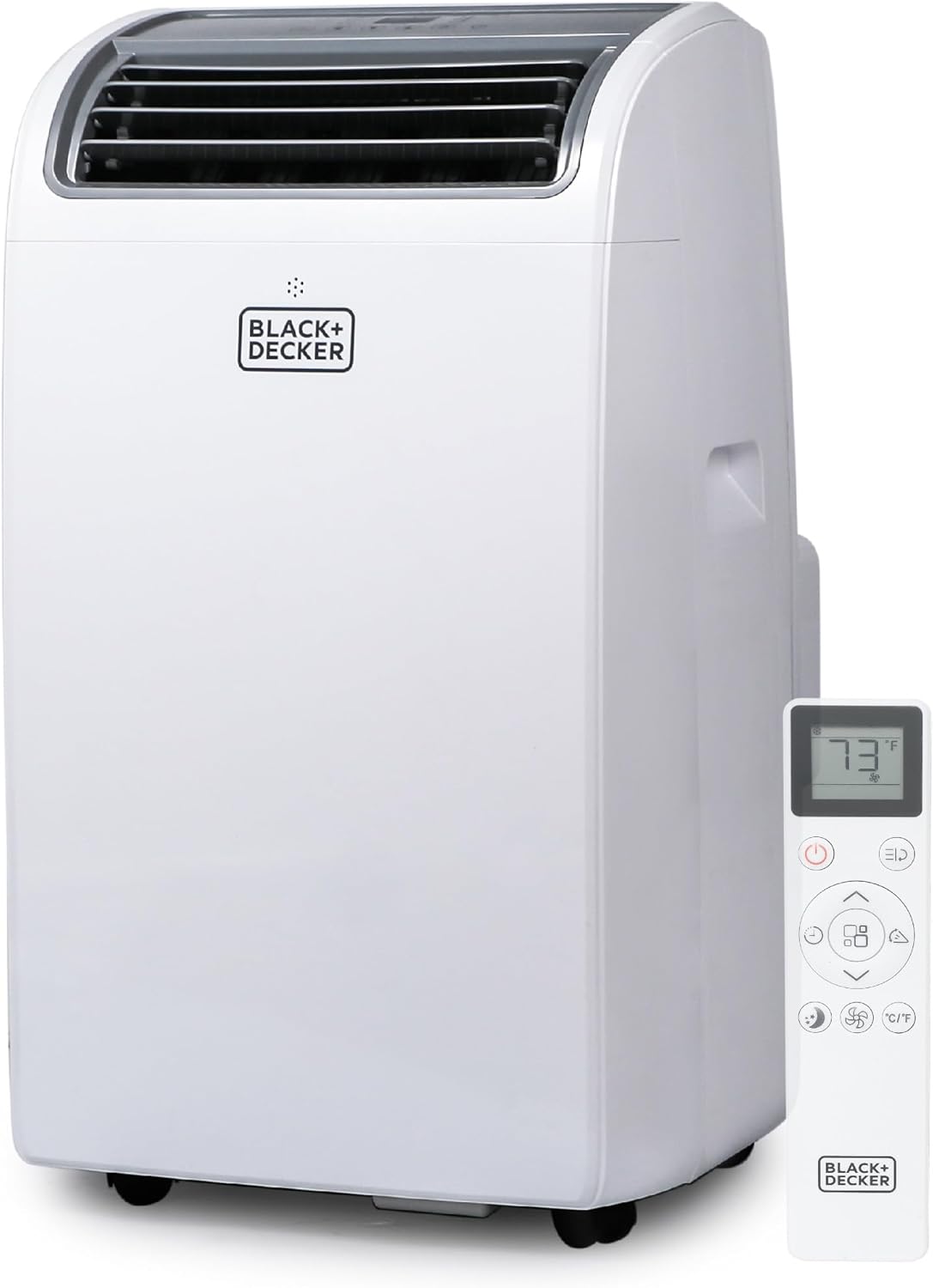
| Cooling Power | 12000 BTU |
|---|---|
| SACC Cooling | 8,350 BTU SACC |
| Power Source | 115 volts, corded electric |
| Noise | 54 db |
| Filter Type | Washable |
This BLACK+DECKER portable AC is a 3‑in‑1 unit that provides cooling, dehumidifying, and fan modes for spaces up to about 550 sq ft using 12,000 BTU (8,350 BTU SACC) rated capacity. It is designed to be vented through a window or wall using the included installation kit, and it offers Wi‑Fi control via the BLACK+DECKER app plus voice control compatibility, a 24‑hour timer, sleep mode, and a follow‑me remote that can act as a remote thermostat. The unit has washable filters, four power levels, adjustable louvers, casters and side handles for moving between locations, and a small internal tank for dehumidification. Practical limits for caravan use are its physical footprint and weight, and it requires a standard 115V/60Hz outlet and a venting opening; it is not a low‑power or inverter model, so energy draw and noise (around mid 50 dB reported) are relevant when power and quiet operation matter. The included window kit and clear setup instructions make installation straightforward where venting is possible, and smart controls simplify remote operation once set up.
Best for: Buyers who prioritize proven, app‑enabled cooling and dehumidifying performance and plan to operate the unit where a standard household outlet and a vent opening are available in the caravan.
Less Ideal for: People who need a compact, low‑power, or battery/off‑grid cooling solution for very small caravans or camper vans with no practical option to vent to the outside.
- Three-in-one operation: cools, dehumidifies, and functions as a fan.
- Smart controls with Wi‑Fi and voice assistants for remote operation.
- Comes with a full installation kit and a follow‑me remote for simpler setup and targeting.
- Washable filter and casters make maintenance and relocation easier.
- Requires a standard 115V outlet and a vent opening so not suited to off-grid or fully sealed caravan setups.
- Relatively heavy and bulky compared with small caravan-specific air conditioners, which affects portability and storage.
Verdict: If your caravan can provide a standard outlet and a vent opening, this smart 3‑in‑1 BLACK+DECKER unit delivers strong, app‑controlled cooling and dehumidification for reliably comfortable trips.
Hisense HAP0825TWD Portable AC

| Cooling Power | 8000 BTU DOE/SACC (10,000 ASHRAE) |
|---|---|
| Noise | 42 db |
| Refrigerant | R-32 |
| Wattage | 700 |
The Hisense HAP0825TWD is a dual-hose portable air conditioner that cools, dehumidifies, and circulates air using an inverter compressor and cross-flow fan for steadier temperatures and quieter operation. It is typically placed on the floor and vented through a snap-together window kit, while controls can be managed via app, remote, or touch panel and it supports voice assistants. The dual-hose design and inverter promise faster, more efficient cooling than single-hose units and lower running noise around 42 dB, which helps for overnight use. Practical benefits include a drain-free cooling mode, included installation kit and remote, and a claimed coverage of roughly 350 sq ft. Important limitations are its physical footprint and weight compared with caravan-focused models, and the unit expects standard window venting and 115V mains power, so it may need planning for electrical and venting setups in mobile or small recreational vehicles.
Best for: Buyers who prioritize reliable, quieter cooling and energy efficiency and plan to use a mains-powered unit in a larger caravan or stationary camper setup where window or venting space is available.
Less Ideal for: Those seeking a lightweight, low-power 12V or roof-mounted caravan-specific air conditioner for off-grid travel should consider dedicated RV units instead.
- Dual-hose system for more consistent and faster cooling than single-hose units
- Inverter compressor for improved energy efficiency and steadier temperature control
- Multiple control methods including app, remote, touch, and voice assistants
- Includes window installation kit and remote control for out-of-box setup
- Designed for floor/window installation and requires standard 115V mains power, limiting straightforward use in some caravans
- Relatively heavy and bulky compared with dedicated caravan air conditioners
Verdict: Choose this Hisense portable AC if you want a mains-powered, energy-efficient dual-hose unit that delivers quieter, faster cooling for a larger caravan setup with available venting space.
Choosing the Right Portable Air Conditioner for Caravan: Key Factors to Consider
Cooling Capacity Relative to Caravan Size
Cooling capacity, typically expressed in BTU or watts, determines how quickly and effectively a unit will lower cabin temperature. Caravans have much smaller cubic volumes than typical rooms, so oversized residential units waste energy and can short-cycle, while undersized units will struggle to reach comfortable temperatures. Measure your caravan's interior volume and match it to a unit rated for that size, giving a little headroom for very hot days or poor insulation.
Also account for heat sources inside the caravan such as occupants, cooking, and sunlight through windows. Higher capacity may be worth the tradeoff if you frequently camp in hot climates, but remember that greater cooling capacity usually increases power draw and noise.
Noise Level and Sleep Comfort
Noise is a critical factor in a caravan where sleeping quarters are close to the unit. Look for published decibel ratings at different fan speeds and pay attention to how manufacturers describe low-noise modes. Even a few decibels can change subjective comfort over a night of sleep.
Consider placement options that dampen sound, such as mounting the unit farther from the sleeping area where hoses or ducting allow. If noise concerns are primary, prioritize models with quieter compressors or multi-speed fan control and test the unit at its lower settings whenever possible.
Power Draw and Caravan Electrical Limits
Caravan electrical systems often rely on limited mains input, shore power, or onboard batteries and inverters. Check a unit's power consumption at typical operating modes and whether it needs a dedicated circuit or high starting current. Lower power draw units reduce the chance of tripping breakers or overloading an inverter.
Think about runtime if you depend on battery power: higher-efficiency models extend usage between charges. Some units include eco or low-power modes that reduce consumption by sacrificing peak cooling for longer run times.
Venting, Hose Compatibility, and Installation
Portable units require an exhaust pathway for hot air and condensation management. For caravan use, confirm that a unit can vent safely through an existing caravan window, a dedicated vent, or a roof opening. Compatibility with flexible hose lengths and adapter kits is essential so installation does not require permanent modification.
Also evaluate how condensate is handled. Some units self-evaporate moisture into the exhaust stream, while others need regular drainage or a pump. Easy, reversible installation protects the caravan interior and preserves resale value.
Size, Weight, and Storage
Space is at a premium in a caravan, so the unit's physical footprint and weight affect both installation options and where the unit will be stored when not in use. Choose a compact design that fits common storage compartments and that two people can lift safely if needed.
Also consider build features such as recessed handles, caster wheels that lock for travel, and whether the unit disassembles for storage. Smaller units may be easier to stow but could compromise peak cooling.
Controls, Features, and Usability
Controls should be straightforward and usable in a compact living environment. Useful features include multi-speed fans, programmable timers, remote control or app integration, and thermostatic operation to maintain a steady cabin temperature without constant manual adjustment.
Extras like sleep modes, auto-restart after power interruptions, and clear display panels increase usability in the field. When venting constraints are present, look for models that offer flexible cycle modes or dehumidification-only operation.
Sizing Your Portable Unit for Different Caravan Layouts
Caravans vary from single-berth vans to family layouts with multiple sleeping areas and an open-plan lounge. Instead of relying on generic room-size charts, calculate your caravan's internal cubic volume and match it to the unit's rated cooling capacity. For open-plan layouts, account for heat transfer between areas and choose a slightly higher capacity to maintain consistent comfort.
Placement matters. A unit positioned centrally with flexible ducting can distribute cool air more evenly than one tucked into an end cabinet. If installing near the kitchen or under direct sunlight exposure, upsize the capacity or add shading to windows to reduce cooling load.
- Measure internal length, width, and height to calculate cubic feet or meters.
- Add extra capacity for poor insulation or strong sun exposure.
- Prefer central placement for even air distribution, when possible.
Venting Options for Caravan Installations
Most portable air conditioners expel hot air through a flexible exhaust hose. For caravans, check available vent routes: a sliding window, dedicated vent port, or a removable panel are common solutions. Shorter hose lengths help maintain efficiency, so choose a unit whose hose can reach the nearest exit without tight bends.
If a roof vent is used, confirm the unit's hose diameter and any adapter requirements. Some caravan owners prefer small exterior vent kits that allow the unit to exhaust directly outside while retaining a neat interior finish.
- Avoid long, kinked hoses that reduce performance.
- Use adapter plates or window seals designed for caravans where possible.
- Consider hose diameter compatibility to prevent leaks or backpressure.
Managing Condensate and Humidity
Condensate management is often overlooked but crucial in a caravan. Some portable units evaporate condensate into the exhaust airflow, which reduces the need for a drain. Others collect water in a tray that must be emptied periodically or pumped out. For overnight trips, a self-evaporating design or built-in condensate pump reduces maintenance.
Humidity control improves comfort and reduces condensation on windows, which can be a problem in small, poorly ventilated spaces. Look for units with a dedicated dehumidify mode and a removable water reservoir that is easy to access in cramped quarters.
- Prefer self-evaporating systems for shorter trips.
- Check access to water trays for easy emptying.
- Use dehumidify mode for damp climates to reduce interior condensation.
Power Considerations and Runtime Planning
Confirm your caravan's shore power rating and inverter capacity before selecting a unit. Many portable air conditioners require a significant starting current; check starting amps and continuous draw. If you plan to run from an inverter or generator, factor in surge capacity and fuel or battery consumption.
Plan runtime by understanding how long the unit will operate at different fan speeds and in varying ambient temperatures. Using thermostatic control and timers reduces unnecessary run time and conserves power when shore power is not available.
- Match unit power requirements to your caravan power source rating.
- Use timers and thermostats to limit run time and conserve energy.
- Consider generator or upgraded inverter options if you need extended operation off-grid.
Noise Reduction Strategies
When a unit must sit close to sleeping quarters, apply simple noise-mitigation tactics. Soft mounts, a foam isolation pad, or placing the unit on a carpeted surface can reduce vibration transmission. Routing the exhaust away from the sleeping area and using lower fan speeds overnight will also improve perceived quiet.
If you are sensitive to noise, prioritize units with quiet sleep modes and test the unit at its lower settings before committing to a purchase. Remember that lower speeds reduce cooling output, so ensure the reduced setting still maintains comfort.
- Use vibration-damping pads under the unit.
- Orient exhaust away from sleeping areas where practical.
- Run at lower speeds overnight and compensate with shading or ventilation.
How We Chose the Best Portable Air Conditioner for Caravan
We prioritized criteria that matter specifically for caravan use rather than residential features that do not translate to a mobile lifestyle. Key evaluation points included cooling capacity in relation to small cabin volumes, measured noise output at typical fan speeds, compact footprint and weight for limited storage, and venting or hose requirements that affect simple installation through caravan vents or a window. We also considered power draw and how it interacts with typical caravan electrical systems, plus built-in controls and features that ease operation while traveling. Units were excluded if they required extensive permanent installation, specialized 240V hardwiring not common in caravans, or excessive weight and size that made them impractical to stow or move. We focused on models with clear specifications for BTU or cooling power, stated decibel ratings, and documented hose or venting options so buyers can judge fit before purchase. The result is a practical set of picks that balance portable cooling performance, user-friendly setup, and suitability for mobile living.
Our full evaluation process is outlined in our review methodology.
FAQ
Can a portable air conditioner cool a caravan overnight?
Often, yes. If the unit has sufficient cooling capacity for the caravan's volume and you manage heat sources and ventilation, a portable air conditioner can maintain comfortable overnight temperatures. Success depends on insulation, outside temperature, and unit placement.
Do portable units need permanent venting in a caravan?
No. Most portable units use a removable exhaust hose that can vent through a window, a removable panel, or a roof vent. Permanent modification is unnecessary if you choose a model with compatible hose adapters and plan for a reversible installation.
How much power does a caravan portable air conditioner use?
Power usage varies by capacity and mode. Smaller units draw less power at low fan speeds, while larger units or high-cooling modes increase consumption. Check the unit's continuous and starting current specs and compare them to your caravan's power source before use.
What is the best way to handle condensate in a caravan?
Self-evaporating units or models with built-in condensate pumps are easiest for caravan use because they reduce the need to empty tanks frequently. If a unit uses a reservoir, place it where you can access it easily and plan routine emptying during trips.
Will a portable unit run on a caravan inverter?
It depends on the inverter's continuous and surge capacity relative to the unit's requirements. Some portable air conditioners have high startup current demands that exceed small inverters. Verify the starting amps and continuous wattage, and consider a higher-capacity inverter if you plan to operate off-grid.
Final Verdict
Choosing the right Portable Air Conditioner for Caravan comes down to balancing cooling capacity, noise, and power demands against the physical constraints of your camper. Prioritize a unit sized for your caravan's volume, with venting and condensate handling that suit your installation preferences. Be realistic about power availability and place the unit to minimize noise near sleeping areas. With those tradeoffs in mind, you can select a compact, efficient unit that keeps your caravan comfortable without complicated modifications.