
Note: This article contains affiliate links. If you click on these links and make a purchase, we may earn a small commission at no extra cost to you. This helps support our research and content. Read our full affiliate disclosure here.
If you need a quick, budget-friendly way to cool a small room, portable air conditioners are one of the most practical options. A well-chosen unit can lower room temperature, reduce humidity, and move where cooling is needed without permanent installation. This guide shortlists seven top-performing portable air conditioners under $300 and explains the most important tradeoffs: cooling capacity, noise output, installation effort, and energy use. Use the evaluation notes to match a unit to your room size and tolerance for noise, and then move on to the product summaries below.
Top Picks at a Glance
| Best Overall The best all-around choice for most situations | Shinco SPF1-12C Portable AC |  |
| Best Quality Built to a higher standard if you want something more solid | Whynter ARC-102CS Portable Air Conditioner |  |
| Best Value The sweet spot between price and what you get | EUHOMY 8,000 BTU Portable Air Conditioner |  |
| Best Budget The cheapest option that still gets the job done reliably | PeakPursuit 8,000 BTU Portable AC |  |
| Top Rated A top-rated pick with lots of positive feedback | BLACK+DECKER Portable Air Conditioner BPACT08WT |  |
| Most Popular A crowd favorite that many people choose with confidence | BLACK+DECKER Portable Air Conditioner BPACT10WT |  |
| Best Seller A high-volume bestseller chosen again and again | Hisense Portable Air Conditioner HAP0825TWD |  |
Shinco SPF1-12C Portable AC

| Cooling Power | 12000 BTU (ASHRAE) / 7,500 BTU (SACC) |
|---|---|
| Dehumidification | 43.2 L/day |
| Noise | 52 db |
| Power Source | Corded Electric |
| Timer | 24 Hours |
The Shinco SPF1-12C is a rollaway portable air conditioner that combines cooling, dehumidifying, and fan functions in one unit for seasonal use across bedrooms and living spaces. It is designed to vent through a window using the included exhaust hose and adjustable window kit, and the unit moves on four casters for easy relocation. Controls are via remote and the top LED panel, with three fan speeds, auto swing louver, and a 24-hour timer for scheduled operation. In practice the SACC rating of 7,500 BTU gives a realistic expectation for cooling performance in typical rooms, while the stated dehumidification capacity and self-evaporation reduce the need to manually empty a bucket during normal use. Expect noticeable operating noise from the internal compressor when cooling, and the unit's SEER and annual energy numbers indicate it is not the most efficient choice for continuous, whole-home cooling. The included installation kit and washable filter make setup and basic maintenance straightforward, making this a practical option for renters or rooms that need intermittent cooling and dehumidifying.
Best for: Buyers who want a single, budget-friendly unit to cool and dehumidify individual rooms seasonally and value easy setup and portability.
Less Ideal for: People seeking a highly efficient, whisper-quiet solution for continuous whole-home cooling or very large open-plan spaces should consider larger or ducted options.
- Three-in-one operation: cooling, fan, and dry modes cover seasonal needs.
- Includes remote, exhaust hose, and adjustable window sealing kit for quick installation.
- Self-evaporating system and large dehumidification capacity reduce manual draining.
- Portable design with four casters and washable filter simplifies maintenance and relocation.
- Real-world SACC cooling capacity (7,500 BTU) is lower than the ASHRAE number, so expect modest cooling in larger rooms.
- Noise level from the internal compressor can be noticeable on higher fan speeds.
- SEER and annual energy consumption figures indicate higher energy use during extended operation.
Verdict: A practical, easy-to-install portable AC that gives balanced cooling and dehumidifying for single rooms at a budget-friendly value.
Whynter ARC-102CS Portable Air Conditioner
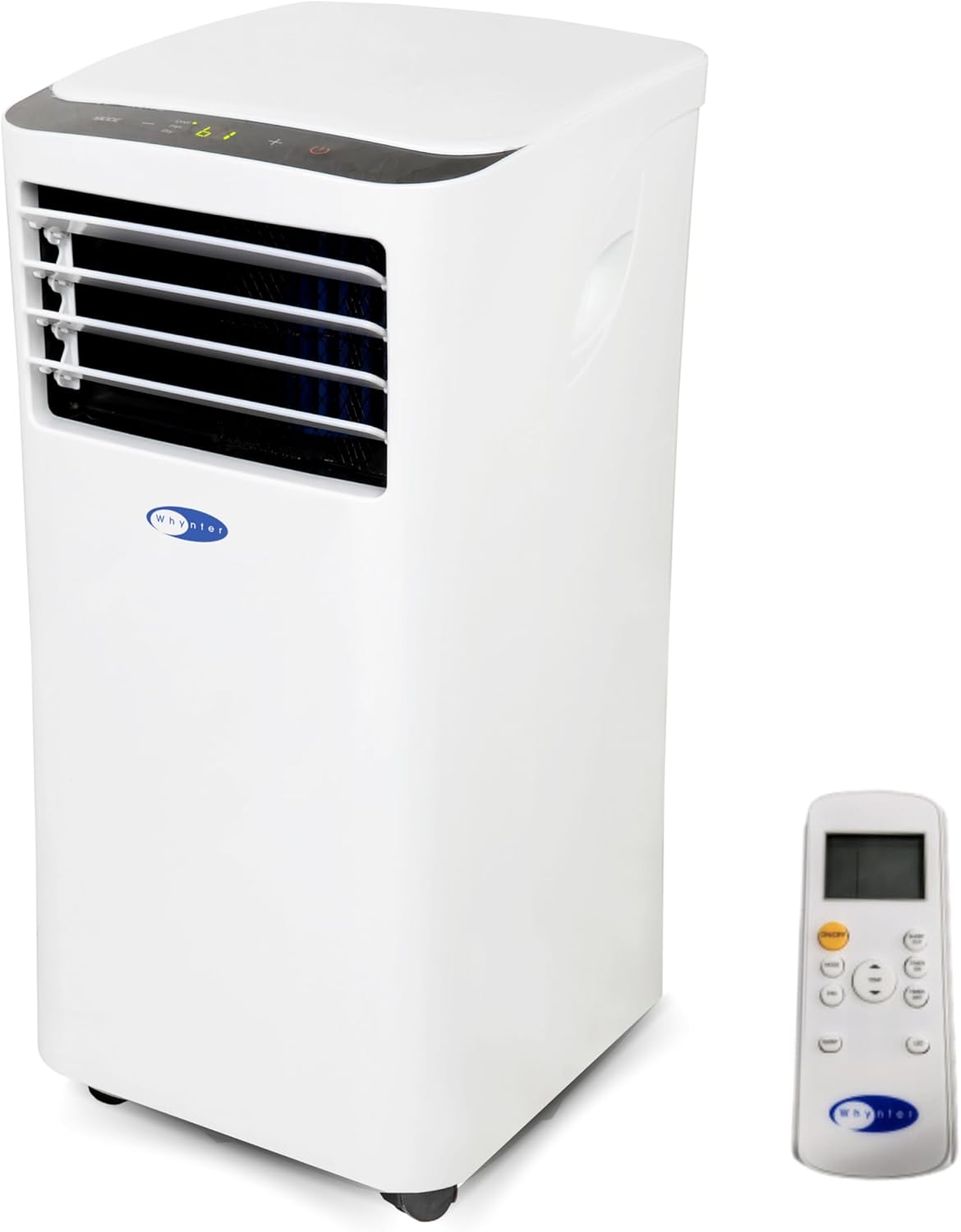
| Cooling Power | 10000 BTU |
|---|---|
| SACC | 7,000 BTU SACC |
| Coverage | Up to 300 sq. ft. |
| Dehumidifying Capacity | 68 pints/day |
| Power Consumption | 1110 watts |
The Whynter ARC-102CS is a compact portable air conditioner designed to cool, dehumidify, and fan a single room up to roughly 300 square feet. In practice it delivers strong cooling for its size thanks to a 10,000 BTU rating (7,000 BTU SACC) and a dual-hose layout that helps maintain cooling performance during longer runs. The unit also doubles as a dehumidifier with an auto-drain function and a sizable 68-pint capacity, which is useful in humid climates or damp rooms where moisture control matters. Controls include a remote and onboard panel, and washable pre-filters plus an activated carbon filter improve indoor air quality. Noise at lower fan speeds is moderate around 51.5 dB, so it is acceptable for daytime use but can be noticeable in very quiet bedrooms. It runs on standard 115V power and pulls up to about 1,110 watts, so expect a meaningful energy draw during heavy use. The compact footprint and caster wheels make setup and repositioning straightforward, though the exhaust hose and window kit still require a nearby open window.
Best for: Buyers who prioritize cooling performance in a compact portable unit and need effective dehumidification for single rooms up to about 300 sq ft.
Less Ideal for: People seeking the quietest bedroom unit or ultra-low energy operation should consider alternatives with lower noise and better efficiency.
- Strong cooling relative to size with 10,000 BTU (7,000 BTU SACC) and dual-hose design
- Built-in dehumidifier with patented auto-drain for continuous operation
- Washable pre-filter plus activated carbon filter for improved air quality
- Compact footprint with caster wheels makes placement and storage easier
- Moderate noise level around 51.5 dB that can be distracting in very quiet rooms
- Higher power consumption around 1,110 watts during peak operation
Verdict: If you need strong, compact cooling with reliable dehumidification for a single room under $300, this unit delivers performance-focused results in a small footprint.
EUHOMY 8,000 BTU Portable Air Conditioner

| Cooling Power | 8,000 BTU |
|---|---|
| Floor Area | 350 square_feet |
| Wattage | 760 watts |
| Noise | 50 db |
| Refrigerant | R-32 |
The EUHOMY 8,000 BTU portable air conditioner is a compact freestanding unit built for cooling small-to-medium rooms. It provides 8,000 BTU (5,000 SACC) and 350 CFM airflow, and offers four modes: cool, dry, fan, and sleep, with low/high fan speeds and a 24-hour timer for scheduled operation. Setup is straightforward using the included window kit and exhaust hose for 20–50 inch windows, and the unit is controlled via the top touch panel or the included remote. Practical features include a removable washable filter, drainage-free operation for typical use, and reasonably quiet running at about 50 dB in sleep mode. Expect moderate energy use given the listed 760 W wattage and SEER of 6.3, so it is best for rooms where targeted cooling is needed rather than whole-home efficiency. The unit is relatively heavy for a portable AC and lacks inverter technology, so it cycles on and off rather than modulating output. For buyers focused on straightforward setup, simple controls, and reliable spot cooling under $300, this model delivers a sensible balance of features and performance.
Best for: Buyers who want a no-nonsense portable AC that installs quickly, offers remote/touch control and timer scheduling, and reliably cools a single room without extra setup complexity.
Less Ideal for: People seeking the most energy-efficient or whisper-quiet inverter units or those who need a very lightweight, highly portable solution for frequent relocation.
- Effective spot cooling for rooms up to 350 sq ft with 8,000 BTU and 350 CFM airflow
- Includes full window installation kit compatible with 20–50 inch windows for quick setup
- Remote and touch controls plus a 24-hour timer for convenient scheduling
- Removable washable filter and drainage-free design reduce maintenance and fuss
- Quiet sleep mode rated around 50 dB for bedroom use
- No inverter compressor so the unit cycles rather than modulates for quieter, more efficient operation
- Annual energy consumption and SEER indicate moderate electricity use compared with higher-efficiency models
- Relatively heavy unit may be harder to move between rooms
Verdict: A straightforward, easy-to-install 8,000 BTU portable AC that reliably cools rooms up to 350 sq ft while keeping controls and maintenance simple.
PeakPursuit 8,000 BTU Portable AC

| Cooling Power | 8000 british thermal units |
|---|---|
| Wattage | 860 |
| Voltage | 115 |
| Capacity | 45 pints |
| Noise | 50 db |
This PeakPursuit 8,000 BTU portable air conditioner is a budget-friendly unit aimed at cooling small rooms and bedrooms. It offers four modes—cooling, fan, dehumidifier and a sleep setting—and comes with a remote and a window installation kit for quick setup. In everyday use it cools modest spaces effectively, reduces humidity with its dehumidifier function, and runs at a reported noise level around 50 dB that is acceptable for living rooms and many bedrooms. The compact, wheeled cabinet makes it easy to move between rooms, and controls are straightforward via the remote and onboard panel. Practical limitations include modest cooling capacity best suited to single rooms up to the stated coverage and an annual energy consumption figure that matters if you plan long daily runtimes. For buyers focused on value, this unit delivers core cooling and dehumidifying features without extras like smart controls or advanced filtration.
Best for: Buyers looking to cool a single bedroom or small living area on a tight budget who prioritize straightforward setup, basic dehumidifying and portability over advanced features.
Less Ideal for: People who need to cool large open-plan rooms, whole apartments, or who require smart home integration and advanced filtration should consider higher-capacity or feature-rich models.
- 4-in-1 functionality: cooling, fan, dehumidifier and sleep mode in one unit
- Includes remote control and window installation kit for easy setup
- Compact, wheeled design for room-to-room portability
- Reasonable noise level (~50 dB) suitable for bedrooms and living areas
- 8,000 BTU cooling is best for small to modest rooms and may struggle in larger spaces
- No smart/Wi-Fi controls or advanced air filtration features
Verdict: A practical, low-cost portable AC that delivers basic cooling, dehumidifying and easy portability for single rooms under $300.
BLACK+DECKER Portable Air Conditioner BPACT08WT

| Cooling Power | 9000 BTU (5,300 BTU SACC) |
|---|---|
| Refrigerant | R-32 |
| Power Source | Corded Electric |
| Wattage | 935 watts |
| Filter Type | Washable filter |
The BLACK+DECKER BPACT08WT is a compact portable air conditioner designed for roughly 300 to 400 sq ft spaces and combines cooling, dehumidifying, and fan modes in one unit. It installs with the included window kit and vents through a threaded exhaust hose, and its casters and side handles make it easy to move between rooms. The unit includes a full-function remote with a Follow Me thermostat feature for localized temperature control and an LCD top control panel for direct operation. Practical conveniences include a washable filter, self-evaporating operation to minimize emptying, and a 24-hour timer plus sleep mode for overnight use. Performance is consistent with its 9,000 BTU rating (5,300 BTU SACC), offering solid cooling for bedrooms or small living areas, though it is not an inverter model and runs on a rotary scroll compressor. Noise and efficiency are typical for portable units, and installation requires a suitable window opening and venting. For buyers prioritizing dependable, straightforward cooling and easy seasonal storage, this model covers the essentials without complex setup or advanced smart features.
Best for: Buyers who want a reliable, no-frills portable cooling solution that is easy to install, move, and store seasonally and who value straightforward operation over advanced smart features.
Less Ideal for: People needing ultra-quiet operation, the highest energy efficiency at variable loads, or powerful cooling for large open-plan rooms should consider different solutions.
- Three-in-one functionality: air conditioner, dehumidifier, and fan in a single portable unit.
- Includes full installation kit and threaded exhaust hose for venting through windows or walls.
- Follow Me remote control enables localized temperature sensing and convenient operation.
- Washable filter and self-evaporating drain reduce routine maintenance.
- Casters and side handles allow easy room-to-room mobility and seasonal storage.
- Cooling capacity is rated as 9,000 BTU ASHRAE but 5,300 BTU SACC, so real-world output is suited to small to medium rooms rather than large spaces.
- Not an inverter model, which can mean less efficient part-load operation compared with inverter units.
- Noise and power draw are typical for portable units and may be noticeable in very quiet bedrooms.
Verdict: A dependable, easy-to-install portable 3-in-1 air conditioner that delivers straightforward cooling and mobility for small to medium rooms.
BLACK+DECKER Portable Air Conditioner BPACT10WT

| Cooling Power | 10000 BTU |
|---|---|
| Floor Area | 450 square_feet |
| Refrigerant | R-32 |
| Control Method | Remote |
| Wattage | 1220 watts |
The BLACK+DECKER BPACT10WT is a 3-in-1 portable air conditioner designed to cool, dehumidify, and fan medium rooms without permanent installation. It ships with a window installation kit, exhaust hose, and a full-function remote that includes a Follow Me thermostat feature for more precise temperature control. On wheels and with side handles it is easy to move between bedrooms, living rooms, or offices, and the reusable washable filter simplifies routine maintenance. Practical benefits include quick setup for temporary cooling, a dehumidify mode with a small water collection tank, and four power levels for basic control. Expect typical portable AC noise and a moderate efficiency rating, so running it continuously will draw significant power on hot days. The unit lacks inverter technology and is heavier than some competitors, which makes long-distance moves awkward. For buyers focused on straightforward, moveable cooling with a reliable brand and solid installation accessories, this model covers the essentials well, but those seeking the quietest, most energy-efficient option should comparison-shop other designs.
Best for: Buyers who prioritize proven, easy-to-install portable cooling with clear user feedback and prefer a unit that works reliably out of the box for temporary or seasonal cooling needs.
Less Ideal for: People who want the quietest or most energy-efficient continuous-use unit, or who need a lightweight model for frequent long-distance moves.
- Includes window installation kit and exhaust hose for quick setup
- Full-function remote with Follow Me thermostat for localized temperature control
- 3-in-1 operation: cooling, dehumidifying, and fan modes
- Washable reusable filter reduces replacement costs and simple caster mobility for room-to-room use
- No inverter compressor, so efficiency and power draw are average
- Relatively heavy to lift despite casters, which can make relocation harder
- Noise level is noticeable compared with quieter, higher-end models
Verdict: A straightforward, easy-to-install portable AC that delivers reliable cooling and dehumidifying for medium rooms, making it a practical choice for buyers seeking a proven, no-surprises unit under $300.
Hisense Portable Air Conditioner HAP0825TWD

| Cooling Power | 8000 BTU DOE/SACC (10,000 ASHRAE) |
|---|---|
| Floor Area | 350 square_feet |
| Noise | 42 db |
| Refrigerant | R-32 |
| Control Method | App, Remote, Touch |
This Hisense HAP0825TWD portable air conditioner uses a dual-hose design and inverter compressor to deliver steady cooling for medium-to-large rooms while running quieter and more efficiently than many single-hose units. It is typically placed on the floor near a window and installed with the included snap-together window kit; controls are available by touchscreen, included remote, or the ConnectLife app with Google and Alexa support. Key practical benefits are faster, more consistent temperature control from the dual-hose airflow, energy savings from the inverter motor, and drain-free operation in cooling mode for simpler maintenance. At about 42 dB in silent mode it is suitable for bedrooms and living areas where noise matters. Limitations to consider are its weight and footprint compared with compact single-hose units and that the product here is a renewed model with a limited warranty period, so buyers seeking full new-unit coverage should factor that in.
Best for: Buyers who want a quieter, more energy-efficient portable AC that cools medium-sized rooms reliably and prefer the reassurance of a familiar brand and straightforward installation.
Less Ideal for: People who need an ultra-lightweight or very compact unit to move frequently between rooms or those who require a full factory warranty and brand-new packaging.
- Dual-hose system provides faster, more consistent cooling than single-hose portable ACs
- Inverter compressor improves energy efficiency and reduces runtime compared with fixed-speed compressors
- Multiple control options including app, voice (Google and Alexa), remote, and touch panel
- Drain-free operation in cooling mode simplifies maintenance and installation with the included window kit
- Heavier and bulkier than many single-hose portable units, making moves between rooms more difficult
- Renewed condition comes with a shorter limited warranty compared with new models
Verdict: A solid energy-efficient dual-hose portable AC for risk-averse buyers who want quiet, consistent cooling for medium rooms under $300.
Choosing the Right Portable Air Conditioner: Key Factors to Consider
Cooling Capacity and Room Size
Cooling capacity, typically expressed in BTU, determines how effectively a portable air conditioner cools a given space. If you undersize the unit relative to your room, it will run continuously without reaching a comfortable temperature. Oversizing can lead to short cycling, higher relative humidity, and wasted energy.
Match the unit's rated capacity to your room's square footage while accounting for ceiling height, sun exposure, and the number of occupants. For the under-$300 segment you should expect modest BTU ratings meant for small rooms, studios, or office spaces rather than whole-house cooling.
Noise Output
Portable air conditioners are located inside the living space, so noise is a major comfort factor. Manufacturers report noise in decibels, but perceived loudness depends on fan speed and the distance from the unit. Lower-priced models often trade quieter fans for reduced airflow or cooling power.
Consider how you will use the unit: bedroom use requires lower noise at night, while a home office may tolerate slightly higher sound. Look for units with multiple fan speeds and night or low-noise modes to balance cooling and comfort.
Installation and Venting
Although portable air conditioners do not require permanent installation, they do need a venting setup to expel hot air. Typical kits include a window adapter and exhaust hose. The ease of installing that kit—how well it fits your window type and how simple it is to assemble—affects how quickly you can use the unit and whether it will seal effectively.
Check whether the kit supports your window configuration and whether the package includes necessary adapters. Portability is only practical if the venting hardware is straightforward and stores neatly when not in use.
Energy Efficiency and Operating Cost
Lower purchase price can hide higher operating costs. Energy efficiency determines how much electricity the unit consumes to remove a given amount of heat. For budget units, you should inspect the energy-saving features such as eco modes, programmable timers, and accurate thermostats.
Estimate expected runtime during peak use and consider the effect on your electric bill. More efficient units may cost more up front but reduce operating expenses, an important tradeoff even within a constrained budget.
Moisture Management and Drainage
Portable air conditioners remove moisture from the air as they cool. Some models auto-evaporate condensate into the exhaust stream, while others use internal tanks that require periodic draining. The choice affects convenience and placement—units that need frequent manual draining are less desirable for continuous night use.
Look for features like continuous drain ports, visible water-level indicators, and easy-to-empty collection trays. Reliable condensate management prevents leaks and reduces maintenance time.
Maintenance and Filter Access
Routine upkeep keeps performance steady. Filters capture dust and airborne particles and should be easy to access and clean. Units with simple snap-out filters or washable elements lower ongoing costs and effort.
Also consider how easy it is to access internal panels for any occasional service. Durable exterior finishes and robust casters or handles make moving and storing the unit easier over seasons.
Sizing a Portable Unit for Small Rooms
Calculate the required cooling capacity by multiplying square footage by a rule-of-thumb BTU factor adjusted for ceiling height and sun exposure. For many compact rooms under about 300 square feet, look for units sized to handle that specific area rather than assuming higher BTU always means better performance.
If a room receives heavy afternoon sun or houses multiple occupants or heat-producing electronics, choose the higher end of the capacity range. Conversely, shaded rooms with high insulation needs can often use a slightly smaller unit effectively.
- Measure the room floor area and ceiling height first.
- Raise the required BTU for sun-exposed or high-occupancy rooms.
- Lower the requirement slightly for well-shaded, insulated spaces.
Practical Venting Tips
Proper exhaust routing preserves cooling efficiency. Keep the exhaust hose as short and straight as possible to avoid back pressure. Avoid kinking or compressing the hose, since that reduces airflow and increases noise.
Use foam or sealing strips around the window adapter to reduce hot-air infiltration. If you plan to move the unit between rooms frequently, keep a simple, flexible vent kit handy and store extra sealing pieces with the unit for a quicker setup.
- Short, straight exhaust = better performance.
- Seal gaps at the window adapter to prevent hot air return.
- Store venting pieces together for fast redeployment.
Noise Management Strategies
Place the unit away from bed heads or primary seating to minimize perceived loudness. Slight repositioning can change the way sound reflects in a room and reduce disturbance without altering performance.
Use lower fan speeds overnight and program timers to match your sleep schedule. If noise is a decisive factor, prioritize models with documented low-decibel modes and stable fan control rather than one with only aggressive high-speed cooling.
- Aim the discharge away from sitting areas.
- Use night mode or lower fan speeds during sleep hours.
- Consider simple sound-absorbing textiles in the room to dampen reflections.
Placement and Mobility
Portable units are more useful when they are easy to move and stable in position. Look for smooth-rolling casters and convenient handles. When setting up, ensure the unit sits on a flat surface and that the exhaust hose can reach the window without obstructing doorways.
Consider storage space when the season ends. Compact footprint and the ability to detach hoses and adaptors easily make offseason storage cleaner and less likely to suffer damage.
- Check caster quality and handle ergonomics before final placement.
- Keep the hose length minimal while ensuring mobility.
- Store all accessories together to prevent loss.
Seasonal Storage and Off-Season Care
Before storing a portable air conditioner, drain any internal reservoirs fully and clean washable filters. Moisture left inside can lead to mildew or corrosion during storage.
Cover the unit or store it in a dry, temperature-controlled space. If possible, elevate the unit off a garage or basement floor to avoid damp contact and check it briefly before the next season to confirm free movement of the fan and casters.
- Fully drain and dry internal tanks before storage.
- Clean or replace filters to avoid mold buildup.
- Store in a dry place and inspect before redeployment.
How We Chose the Best Portable Air Conditioner
We evaluated units that are commonly marketed as portable air conditioners and fall within the under $300 price constraint. Our selection filters emphasized measurable, buyer-relevant specs rather than marketing claims. Key evaluation criteria included cooling capacity relative to room size, measured noise output during typical operation, installation simplicity and included venting hardware, energy efficiency ratings or estimated runtime on a typical circuit, and build features that affect daily use such as water management and filter access. We excluded any window-only or permanently installed systems and products that require professional installation. Units lacking clear spec sheets for cooling capacity or noise levels were not considered. The list favors devices that combine adequate cooling for one- to two-room spaces with tolerable noise and straightforward setup, while also accounting for durability and ease of maintenance.
Our full evaluation process is outlined in our review methodology.
FAQ
Will a portable air conditioner cool my entire apartment?
Usually not. Portable air conditioners are designed for single rooms or small open-plan spaces. Effectiveness depends on the unit's cooling capacity and your apartment layout. For multiple rooms, you will typically need separate units or a different cooling approach.
How loud are budget portable air conditioners at night?
Noise varies by model and fan speed. Budget units often run between moderate and loud at high fan settings but many include a low-noise or sleep mode that reduces fan speed. Expect some background fan sound, and place the unit away from sleeping areas if possible.
Do I need to drain the water tank manually?
It depends on the unit. Some units auto-evaporate most condensate into the exhaust stream, while others collect water in an internal tank that needs periodic emptying. Look for continuous-drain options if you want minimal manual maintenance.
Can I use a portable unit in a room with high ceilings?
High ceilings increase the volume of air the unit must cool and can reduce effectiveness. You may need a unit with higher rated capacity or supplement the portable unit with fans to improve circulation in rooms with tall ceilings.
Are portable air conditioners energy efficient?
They can be efficient for spot cooling small areas, especially models with programmable timers and eco modes. However, portable units generally use more electricity per BTU than larger, dedicated systems. Match capacity to room size and use timers to limit runtime for better efficiency.
Final Verdict
When choosing a portable air conditioner under $300, prioritize the combination of cooling capacity and noise performance that matches how and where you plan to use it. Balance modest BTU ratings against room size, sun exposure, and how sensitive you are to fan noise. Tradeoffs are inevitable at this price point: expect simpler vent kits and more basic energy-saving features. Focus on correct sizing, easy venting, and reliable moisture management to get the most useful, trouble-free cooling for a single room or small living area.