
Note: This article contains affiliate links. If you click on these links and make a purchase, we may earn a small commission at no extra cost to you. This helps support our research and content. Read our full affiliate disclosure here.
Picking the right portable air quality monitor matters whether you want to track indoor pollution at home or check air when you travel. A good monitor gives timely, reliable readings on particles, gases, and humidity so you can take sensible actions to improve breathing conditions. This guide shortlists the top portable air quality monitors across typical home and on-the-go use, then evaluates them by the most relevant performance and usability criteria. Expect coverage of sensor accuracy, battery life, data reporting, and ease of use to help you choose the best option for your situation.
Top Picks at a Glance
| Best Overall The best all-around choice for most situations | BREATHE Airmonitor Plus Gen 2 |  |
| Best Quality Built to a higher standard if you want something more solid | Atmotube PRO 2 |  |
| Best Value The sweet spot between price and what you get | GoveeLife Air Quality Monitor H5106 |  |
| Best Budget The cheapest option that still gets the job done reliably | Temtop S1 Air Quality Monitor | 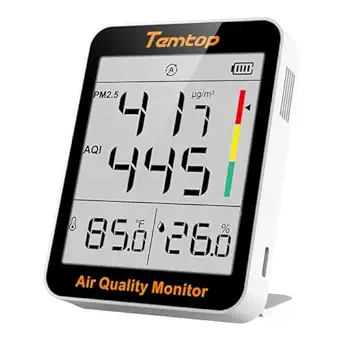 |
| Top Rated A top-rated pick with lots of positive feedback | Aranet4 Home CO2 Monitor |  |
| Most Popular A crowd favorite that many people choose with confidence | Amazon Smart Air Quality Monitor |  |
| Best Seller A high-volume bestseller chosen again and again | YNAK 16-in-1 Air Quality Monitor AK22A |  |
BREATHE Airmonitor Plus Gen 2

| Monitors | CO₂, PM1/PM2.5/PM10, TVOC, HCHO, Temp, Humidity |
|---|---|
| CO₂ Sensor | NDIR, ±50 ppm accuracy |
| Data History | Up to 90 days (app) |
| Connectivity | 2.4 GHz Wi‑Fi |
| Power Source | Rechargeable battery + USB-C (corded electric) |
The BREATHE Airmonitor Plus Gen 2 is a portable, app-connected indoor air quality monitor designed for home, office, or classroom use. It continuously measures eight parameters — CO₂ (NDIR), PM1/PM2.5/PM10, TVOC, formaldehyde (HCHO), temperature and humidity — and shows real-time readings on a color display while sending configurable alerts through the Breathe Tech app. The unit pairs to 2.4 GHz Wi‑Fi for remote monitoring, stores up to 90 days of history and can export CSV files for deeper analysis. A built-in rechargeable battery allows 1–2 hours of untethered use in typical settings and up to 6 hours on the Gen 2, while continuous monitoring is possible when plugged into USB‑C power. Practical benefits include professional-grade NDIR CO₂ accuracy (±50 ppm), multi-sensor coverage so you can correlate cooking or cleaning events with spikes in particles or VOCs, and compact portability for spot checks. Limitations include short battery-only runtime for extended portable use and the need for the app and Wi‑Fi to access the full historical and export features.
Best for: Buyers who want a single, easy-to-use device to monitor multiple indoor pollutants and review trends over time for healthier indoor spaces.
Less Ideal for: Those who need long-duration portable monitoring away from power for many hours or professional field testing with lab-grade calibration procedures.
- Measures eight key indoor parameters including NDIR CO₂, PM1/2.5/10, TVOC and formaldehyde for broad visibility into air quality
- Stores up to 90 days of data in the app with CSV export for trend analysis
- Compact, portable design with USB-C power and a rechargeable battery for spot monitoring
- Configurable real-time alerts via the Breathe Tech app for CO₂ and PM2.5
- Battery-only runtime is limited, so continuous monitoring requires plugging into USB power
- Full functionality (historical data and exports) depends on app connectivity and 2.4 GHz Wi‑Fi
Verdict: Airmonitor Plus Gen 2 is a compact, app-backed all-in-one monitor for buyers who want broad, time-trended indoor air insights in a portable package.
Atmotube PRO 2

| Sensors | CO2, PM1/PM2.5/PM10, TVOC, NOx, Temperature, Humidity, Pressure |
|---|---|
| Connectivity | Bluetooth 5.0, USB-C |
| Battery | 2300 mAh, up to 12 days |
| Data storage | Up to 45 days |
| APIs | Open BLE API, Open USB API |
The Atmotube PRO 2 is a pocket-sized, performance-focused air quality tracker for people who want lab-grade sensing on the go. It continuously measures CO2, PM1/PM2.5/PM10, TVOC, and NOx while also logging temperature, humidity, and barometric pressure, and it stores up to 45 days of history. The unit pairs to the Atmotube app over Bluetooth 5.0 for live alerts, mapping, and hourly or longer trend views, and an open BLE and USB API make it useful for data-driven projects. A 2300 mAh battery provides long runtimes—advertised up to 12 days depending on sampling interval—and USB-C charging makes recharges simple. Practical benefits include quick CO2 nudges to clear stuffy meeting rooms, real-time smoke and pollution alerts during travel, and the ability to export CSVs for deeper analysis. Expect small-sensor limitations typical of portable monitors: absolute lab accuracy for some gases can vary and readings depend on sampling conditions, and richer functionality requires the mobile app and occasional charging. For users prioritizing portable, research-capable monitoring and actionable mobile alerts, the PRO 2 is a strong choice.
Best for: Buyers who want a portable, research-capable air monitor to collect real-world exposure data, map pollution, and get real-time alerts while commuting, traveling, or testing indoor spaces.
Less Ideal for: Those who need continuous, laboratory-grade stationary monitoring for regulatory compliance or who prefer an always-plugged home appliance without managing battery life or app-based data.
- Wide sensor suite covering CO2, PM1/PM2.5/PM10, TVOC, NOx, temperature, humidity, and pressure
- Long claimed battery life up to 12 days with USB-C charging
- Built-in GPS, accelerometer, and 16 MB memory for mapping and up to 45 days of logged data
- Bluetooth 5.0 connectivity plus open BLE and USB APIs for data export and integration
- Portable sensor sampling can be less precise than full-size lab instruments and depends on placement and conditions
- Full feature set depends on using the companion mobile app and occasional recharging
Verdict: Choose the Atmotube PRO 2 if you need a portable, sensor-rich monitor that delivers mapped exposure data, long battery life, and open connectivity for performance-focused tracking.
GoveeLife Air Quality Monitor H5106

| PM2.5 Accuracy | ±15 µg/m³ (0–100 µg/m³), ±15% (100–1000 µg/m³) |
|---|---|
| Temperature Accuracy | ±0.54°F |
| Humidity Accuracy | ±3%RH |
| Response Time | 2 seconds |
| Included Components | Air quality monitor, Type‑C cable |
The GoveeLife H5106 is a compact, powered air quality monitor that continuously tracks PM2.5, temperature, and relative humidity and displays results on an LED panel. It refreshes readings every two seconds, which makes it useful for spotting quick changes after cooking, cleaning, or when changing ventilation. The unit connects via 2.4 GHz Wi‑Fi or Bluetooth for remote monitoring and can export up to two years of historical data through the app, plus it can trigger compatible GoveeLife appliances when thresholds are crossed. Setup is straightforward but requires a constant power connection via the included Type‑C cable and only supports 2.4 GHz networks. The monitor reports PM2.5 with stated accuracy margins and includes a simple multi‑mode display with night and bright modes and four quality indicator levels. This is a practical tool for someone who wants live, shareable indoor air data and automation integration, though it is not battery powered and depends on app connectivity for advanced features.
Best for: Buyers who want an accurate, always‑on indoor air sensor to monitor and log air quality, and who value remote access and automation with other smart home devices.
Less Ideal for: People who need a truly portable, battery‑powered monitor for on‑the‑go measurements or who cannot use 2.4 GHz Wi‑Fi networks.
- Fast 2‑second refresh shows near real‑time changes in PM2.5, temperature, and humidity.
- Wi‑Fi and Bluetooth connectivity with app access and up to two years of exportable data.
- Can automate other GoveeLife devices when air quality crosses set thresholds.
- Clear LED display with switchable clock, night mode, and four air quality indicator levels.
- Requires constant USB power; no internal battery for portable untethered use.
- Only supports 2.4 GHz Wi‑Fi which may limit some home networks.
Verdict: Choose the GoveeLife H5106 if you want a fast, app‑connected indoor sensor that logs long‑term air data and can automate other smart home devices.
Temtop S1 Air Quality Monitor

| PM2.5 measuring range | 0-999 µg/m³ |
|---|---|
| Temperature measuring range | 14-140°F |
| Humidity measuring range | 0-99.9% RH |
| Battery life | ≥20 days (Smart) ≥60 days (Eco) |
| Display | 3.3-inch segment code screen |
The Temtop S1 is a small, battery-powered air quality monitor meant for portable indoor use where quick visibility of particle levels and basic climate data matters. It displays PM2.5, an AQI readout, temperature, and humidity on a simple segment screen and uses a laser particle sensor for reliable PM2.5 measurements. Two-button controls and a three-color alert indicator make it easy to check conditions at a glance, and multiple placement options include standing, surface mount, or magnetic attachment. The unit favors energy efficiency: an Eco mode can stretch standby to about 60 days while the active Smart mode runs around 20 days, so you can move it between rooms without frequent charging. Accuracy is reasonable for consumer monitoring, though it does not provide CO2, VOC, or formaldehyde readings or a smartphone app for logging. For those who want a straightforward, low-cost portable detector to compare rooms, check nursery or office air, and track PM2.5 trends casually, the S1 offers practical performance; power users needing advanced sensors or remote data will want a higher-end model.
Best for: Buyers on a tight budget who need a simple, portable device to check PM2.5 and basic comfort metrics around the home, nursery, office, or while traveling.
Less Ideal for: Users who need multi-pollutant monitoring, continuous logging, app connectivity, or professional-grade measurements should choose a more advanced monitor.
- Portable, lightweight design that can stand, mount, or magnetically attach for flexible placement
- Measures PM2.5 and reports AQI plus temperature and humidity on a clear display
- Very long battery life with Eco mode up to about 60 days and Smart mode around 20 days
- Simple two-button interface and three-color alert indicator for quick status checks
- No CO2, VOC, or formaldehyde sensing and no smartphone app or data logging
- Basic segment display lacks graphing or detailed historic data
Verdict: A budget-friendly portable monitor that gives reliable PM2.5, AQI, temperature, and humidity readings with exceptional battery life for casual indoor tracking.
Aranet4 Home CO2 Monitor

| Measures | CO2, temperature, humidity, pressure |
|---|---|
| Sensor type | NDIR CO2 sensor |
| Display | E-ink with color coding |
| Data history | Up to 90 days in app |
| Power | 2 AA batteries |
The Aranet4 Home is a compact, battery-powered indoor air quality monitor built for steady, long-term use. It uses an NDIR CO2 sensor for accurate CO2 readings and also reports temperature, relative humidity, and atmospheric pressure on a low-power e-ink display that can run for up to four years on two AA batteries. The device is truly portable and wireless, so you can move it between rooms, classrooms, or offices without plugging in cables, and the color-coded display and optional buzzer make elevated CO2 easy to notice at a glance. A free smartphone app stores up to 90 days of history and provides graphs and configuration options for trend tracking. Practical limits are its single-device display size for quick reference and reliance on the app for deeper data analysis, but for anyone prioritizing dependable sensor technology and long battery life in a simple package, the Aranet4 delivers consistent, fuss-free monitoring.
Best for: Buyers who want a dependable, low-maintenance air quality monitor they can place around a home, classroom, or small office and trust for accurate CO2 and basic climate readings over long intervals.
Less Ideal for: Users who need large on-device dashboards or advanced local logging beyond 90 days should consider more feature-rich or wired models.
- Accurate NDIR CO2 sensing for reliable readings
- Very long battery life up to four years on two AA batteries
- Portable, wireless design suitable for moving between rooms
- E-ink display with clear numeric readout and color coding
- Free smartphone app with up to 90 days of historical data
- Small display limits at-a-glance detail compared with larger monitors
- Deeper data review requires using the smartphone app rather than the device screen
Verdict: Choose the Aranet4 Home when you need a portable, battery-efficient monitor with accurate NDIR CO2 sensing and straightforward long-term reliability.
Amazon Smart Air Quality Monitor

| Measured parameters | PM2.5, VOCs, CO, humidity, temperature |
|---|---|
| Connectivity | Works with Alexa |
| Alerts | Phone notifications and Echo announcements |
| Power | Plug-in |
The Amazon Smart Air Quality Monitor is a compact plug-in sensor that keeps track of five indoor air measurements—PM2.5, volatile organic compounds, carbon monoxide, humidity, and temperature—and surfaces an easy-to-read air quality score in the Alexa app. Setup is straightforward: plug it in, open the Alexa app, and follow the guided connection steps, after which the monitor provides a color-coded LED on the device plus detailed trend data and alerts in the app. It integrates with Alexa so you can receive notifications on Echo devices and create Routines to automatically run compatible purifiers, dehumidifiers, or fans when air quality shifts. The device is best for users who want simple, continuous monitoring tied into a smart home rather than a standalone diagnostic tool; it reports meaningful changes and lets you act on them through automation. Limitations include reliance on the Alexa ecosystem for full functionality and the absence of a large onboard display or advanced local data export for deeper analysis.
Best for: Buyers who want continuous, easy-to-understand indoor air monitoring that ties directly into an Alexa-driven smart home and automations.
Less Ideal for: People who need a standalone professional-grade monitor with comprehensive local data logging or who do not use the Alexa ecosystem.
- Monitors five key indoor metrics including PM2.5, VOCs, CO, humidity, and temperature.
- Color-coded LED plus an air quality score in the Alexa app makes readings easy to interpret.
- Real-time alerts and Echo announcements keep you informed without checking the phone.
- Integrates with Alexa Routines to automate purifiers, fans, and thermostats based on air quality.
- Simple plug-and-play setup through the Alexa app.
- Full feature set depends on using the Alexa app and Echo devices for notifications and automations.
- No large built-in display or local data export for advanced analysis.
Verdict: Choose this monitor if you want simple, continuous indoor air readings and automated responses through the Alexa smart-home ecosystem.
YNAK 16-in-1 Air Quality Monitor AK22A

| Detects | CO2, PM2.5, PM1.0, PM10, HCHO, TVOC, Temperature, Humidity, AQI |
|---|---|
| Display | 7-inch LED with three brightness settings |
| Alerts | 7 AQI alert buzzers with mute option |
| Power | USB-C charging adapter included |
This YNAK air quality monitor is a tabletop device that tracks a broad set of indoor air metrics and makes them easy to read with a large 7-inch display. In daily use it continuously measures CO2, PM2.5, PM1.0, PM10, formaldehyde (HCHO), TVOC, temperature, humidity and reports an AQI value while offering seven distinct alert buzzers for different conditions. The bright display and three brightness settings make readings legible across rooms, and on-device controls let you set time format and alarm functions without a phone. Sensor sampling and the manufacturer claim of high precision mean it responds quickly to changes such as cooking, cleaning, or wildfire smoke, and the included USB-C power supply simplifies placement. Limitations are typical of consumer monitors: it does not replace lab-grade instruments for certification, and accuracy can be affected if sensors are contaminated or exposed to strong odors, so periodic careful placement and avoidance of direct sprays are advised. For someone who wants visible, immediate indoor air feedback and alerts, this unit is straightforward and practical.
Best for: Buyers who want an easy-to-read, all-in-one tabletop monitor to visibly track common indoor pollutants and receive audible alerts so they can act quickly on poor air or smoke events.
Less Ideal for: People who need lab-grade, certified measurements for professional testing or regulatory compliance should choose specialized equipment instead.
- Large 7-inch display with three brightness settings for easy at-a-glance readings
- Monitors multiple pollutants including CO2, PM2.5, PM1.0, PM10, HCHO and TVOC
- Real-time AQI alerts with seven distinct buzzer modes and a mute option
- Uses external high-precision sensors and direct air sampling for responsive readings
- Includes USB-C charging adapter for flexible placement
- Not a replacement for laboratory-grade instruments for certification-level testing
- Sensor accuracy can degrade if sensors are touched or exposed to strong perfumes or sprays
Verdict: A user-friendly tabletop monitor that delivers broad, real-time pollutant readings and clear audible alerts for everyday home air quality awareness.
Choosing the Right Portable Air Quality Monitor: Key Factors to Consider
Sensor Types And Coverage
Different portable air quality monitors include different sensors, and the sensors they include determine what pollutants you can track. PM2.5 sensors measure fine particulate matter linked to combustion and many health effects. VOC sensors detect a range of volatile organic compounds produced by paints, cleaners, and some building materials. Some units also measure CO2, formaldehyde, or ozone, which are relevant in specific indoor scenarios.
Choosing a monitor with the right sensor mix matters because no single sensor captures every indoor air threat. If you are focused on wildfire smoke or traffic pollution, prioritize reliable PM2.5 sensing. If chemical exposures from renovation or cleaning are your concern, consider a device with VOC or formaldehyde detection. Understand that adding sensor types can increase cost and complexity, so balance breadth of coverage with the specific pollutants you need to monitor.
Sensor Accuracy And Calibration
Accuracy varies across sensor technologies and manufacturers, and portable units often trade lab-grade accuracy for size and cost. Look for monitors that specify the sensor technology used and any calibration procedure. Optical particle counters are common for PM measurements but can drift or be biased by particle type and humidity. Calibration against reference instruments, factory calibration certificates, or accessible firmware updates improves long-term reliability.
Consider whether the device supports field recalibration or software-based correction. For portable use, sensors that deliver consistent relative changes and responsive readings are often more useful than a single nominal accuracy number because they let you spot trends and episodes even if absolute values need adjustment.
Battery Life And Power Options
Battery life is a key practical factor for portable monitors since many users will move the device between rooms or take it outdoors. Runtime depends on sensor scan frequency, display and wireless features, and battery capacity. Some monitors can run for a single day on a charge, while others offer multi-day operation when set to lower sample rates.
Also check charging options and whether the monitor can operate while charging. USB charging is convenient for travel, and replaceable batteries can be useful in extended field work. Plan for your typical usage patterns: continuous sampling requires longer runtimes or frequent charging, while spot checks let you conserve power by sampling briefly.
Data Reporting And Connectivity
How a monitor presents data affects how useful it is. On-device displays give immediate feedback, while mobile apps and cloud dashboards allow trend analysis, alerts, and data export. Some monitors provide raw sensor readings and CSV downloads, which are important if you want to perform your own analysis. Others only show simplified air-quality indices.
Consider whether you need live alerts for threshold breaches and whether the device stores data locally when out of range of a phone. For travel, offline logging and later sync can be essential. Prioritize monitors whose reporting matches how you intend to act on the data.
Size, Durability, And Usability
Portability is not just weight and dimensions. The device should be small enough to carry, robust enough to tolerate being moved, and simple to operate one-handed. Physical controls, screen legibility in daylight, and whether the unit has a protective case or mounting options all affect real-world usability.
If you plan to use the monitor outdoors or in work sites, look for units with rugged housings and ingress resistance. For home use, compact designs with easy-to-read displays and intuitive menus reduce friction and make it more likely you will measure regularly.
Reporting Timeframe And Responsiveness
How quickly a monitor detects changes matters for identifying short-term pollution events and for correlating activities to air-quality changes. Sampling interval and sensor response time determine how promptly a device will register a smoking oven, a nearby idling vehicle, or a cleaning spray.
Faster sampling gives a more immediate picture but can reduce battery life. Conversely, longer averaging intervals smooth noise but may hide brief spikes. Choose a monitor whose reporting cadence aligns with whether you need fast alerts or longer-term trend tracking.
Understanding PM2.5, VOCs, And CO2 Readings
Interpreting measurements requires knowing what each pollutant indicates about air quality. PM2.5 readings reflect fine particles that penetrate deep into the lungs. Elevated PM2.5 is often linked to combustion sources, cooking, or outdoor smoke intrusion. VOC readings are broader and may indicate the presence of many organic chemicals; spikes commonly follow cleaning, painting, or use of fragranced products. CO2 is a proxy for ventilation and occupancy rather than a direct pollutant, and high indoor CO2 typically signals inadequate fresh air exchange.
When reading results, look at trends and peaks rather than single values. Short spikes can be informative if they coincide with activities, while sustained elevation points to persistent sources or ventilation issues. Many portable monitors report both raw concentrations and simplified indices to help interpret severity.
- Use PM2.5 to detect smoke and combustion-related particles.
- Use VOCs to spot chemical exposures from products or building materials.
- Use CO2 levels to assess whether a space needs better ventilation.
Practical Use Cases For Portables
Portable monitors are versatile tools for spot-checking and targeted monitoring. Use them to compare air quality between rooms, verify the effect of air cleaners, or check hotel rooms and classrooms. Travel use includes checking cabin air in shared spaces and identifying smoke or strong odors in rental properties. For homeowners, portables are useful for monitoring during cooking, renovations, or when operating combustion appliances.
Remember that a portable monitor supplements, but does not replace, fixed whole-home ventilation assessments. It is best used to answer specific questions and to guide immediate actions, such as increasing ventilation or avoiding a space temporarily.
- Room-to-room comparisons for indoor pollution hotspots.
- Verifying the impact of air cleaners and ventilation changes.
- Short-term checks during travel, renovations, or combustion events.
Setting Thresholds And Interpreting Alerts
Decide in advance what concentrations will trigger an action for you. Public health guidelines can inform thresholds for PM2.5, but you may choose more conservative or permissive values depending on sensitivity and context. Configure alerts where available so the monitor notifies you when a threshold is exceeded. For portable units, audible alerts and push notifications are the most actionable when you are nearby.
Avoid alarm fatigue by setting thresholds aligned with realistic scenarios. For example, brief cooking-related PM2.5 spikes may not require prolonged measures, while sustained elevations suggest opening windows or using filtration.
- Base PM2.5 thresholds on health guidance and personal sensitivity.
- Use alerts for sustained breaches rather than every brief spike.
- Combine monitor alerts with simple actions like ventilating or isolating sources.
Maintaining And Storing A Portable Monitor
Routine maintenance preserves measurement quality. Keep sensor inlets clear of dust and debris and follow manufacturer guidance for cleaning exterior ports. Avoid exposing the unit to direct moisture or extreme temperatures, which can shorten sensor life. If the monitor has replaceable filters or consumables, track replacement intervals and store spares if you rely on the device frequently.
For storage, keep the monitor charged or at a stable battery level and in a dry, temperate environment. When transporting, use a protective case to prevent shocks or contamination of the sensor inlet. Regularly check firmware updates and sync logs to avoid losing historical data.
- Keep sensor inlets free from dust and blockages.
- Store in a dry, temperate location and use a protective case for travel.
- Monitor firmware updates and replace consumables per guidance.
Common Limitations Of Portable Units
Portable monitors trade some accuracy and breadth of features for size and convenience. Small optical sensors can be influenced by particle composition and humidity, producing biases compared with laboratory instruments. Some gas sensors are broadly responsive to classes of compounds and cannot speciate individual chemicals. Expect variability in readings between different device types and even between identical units over time.
Understanding limitations helps set realistic expectations: use portable monitors to detect relative changes, identify events, and guide simple mitigations rather than to produce regulatory-grade measurements.
- Smaller sensors may show biases with certain particle types or humidity.
- Gas sensors often detect classes of compounds rather than specific chemicals.
- Use portables for trends and alerts, not regulatory compliance measurements.
How We Chose the Best Portable Air Quality Monitor
We selected monitors that deliver dependable, repeatable measurements without requiring advanced setup. Key evaluation criteria included sensor accuracy across common pollutants, responsiveness under changing conditions, and calibration approach. We also weighed battery life for real-world portable use and the quality of data reporting, including on-device readouts and mobile or cloud connectivity. Build quality and portability were assessed to ensure a compact, durable footprint for travel and everyday handling. We excluded devices that rely solely on crude estimates or lack transparent sensor specifications. Products that did not provide PM2.5 readings or at least one gas sensor commonly linked to indoor air quality were removed from consideration. The final list emphasizes monitors that balance trustworthy detection, practical battery runtimes, straightforward user interfaces, and usable data export or logging features.
Our full evaluation process is outlined in our review methodology.
FAQ
How often should I take readings with a portable monitor?
It depends on your goal. For real-time event detection, continuous sampling or frequent intervals are best. For spot checks or travel, take short measurements before and after activities. Balance sampling rate with battery life.
Can a portable monitor replace a whole-home air quality assessment?
Usually not. Portable monitors are excellent for targeted checks and identifying sources, but they do not replace a comprehensive assessment of whole-home ventilation, distribution, and fixed HVAC filtration systems.
Do portable monitors need calibration?
Some benefit from periodic calibration or software corrections. Devices that document calibration methods or allow field recalibration tend to maintain accuracy better over time. Expect lower-cost portables to require more frequent verification against a reference.
Will humidity affect readings?
Yes. High relative humidity can skew particle sensor readings because moisture droplets register as particles. Some monitors apply humidity compensation, but you should be cautious interpreting PM readings in very humid environments.
Are VOC sensors specific to particular chemicals?
Most VOC sensors detect classes of volatile organic compounds rather than identifying individual chemicals. They are useful for spotting relative changes or identifying when a space has elevated chemical emissions, but they do not provide speciation.
Final Verdict
When choosing a portable air quality monitor, prioritize the sensors that match the pollutants you care about, reliable reporting, and sufficient battery life for your intended use. Expect tradeoffs between breadth of detection, size, and continuous runtime. For most users, a compact monitor with accurate PM2.5 sensing, clear data reporting, and multi-day battery life or convenient charging will cover both home and travel needs. Focus on monitors that provide transparent sensor information and usable outputs so you can act confidently on the measurements.