
Note: This article contains affiliate links. If you click on these links and make a purchase, we may earn a small commission at no extra cost to you. This helps support our research and content. Read our full affiliate disclosure here.
If you want true espresso-quality extraction away from your kitchen, the right portable coffee grinder matters. A grinder built for espresso gives you the fine, consistent particle distribution that espresso machines require, and it must do so reliably in compact, travel-ready form. This guide shortlists the top portable coffee grinders for espresso, focusing on consistent grind size, durable construction, and usable dosing for real-world espresso shots. Below you will find our top picks and the evaluation criteria we used to assess grind performance, build, and daily usability.
Top Picks at a Glance
| Best Quality Built to a higher standard if you want something more solid | TIMEMORE C5 ESP Pro Manual Grinder | 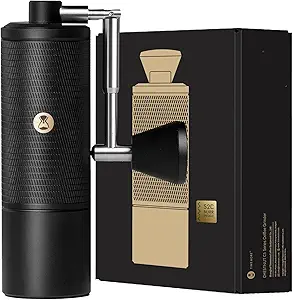 |
| Best Value The sweet spot between price and what you get | Lamido E96T Portable Burr Grinder |  |
| Best Budget The cheapest option that still gets the job done reliably | Rsoilch Manual Coffee Grinder HS-011 |  |
| Top Rated A top-rated pick with lots of positive feedback | CEVING Manual Coffee Grinder MCG-MEGA |  |
| Most Popular A crowd favorite that many people choose with confidence | JavaPresse Manual Coffee Grinder |  |
| Best Seller A high-volume bestseller chosen again and again | CEVING Manual Coffee Grinder MCG-02 | 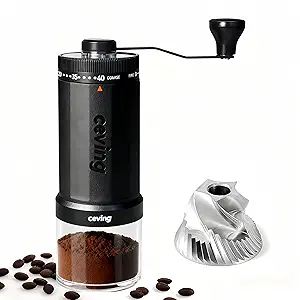 |
TIMEMORE C5 ESP Pro Manual Grinder
| Burr | S2C-042-III conical 42 mm |
|---|---|
| Adjustment accuracy | 0.015 mm per click |
| Capacity | 25 g |
| Material Type | Aluminum |
| Power Source | manual winding |
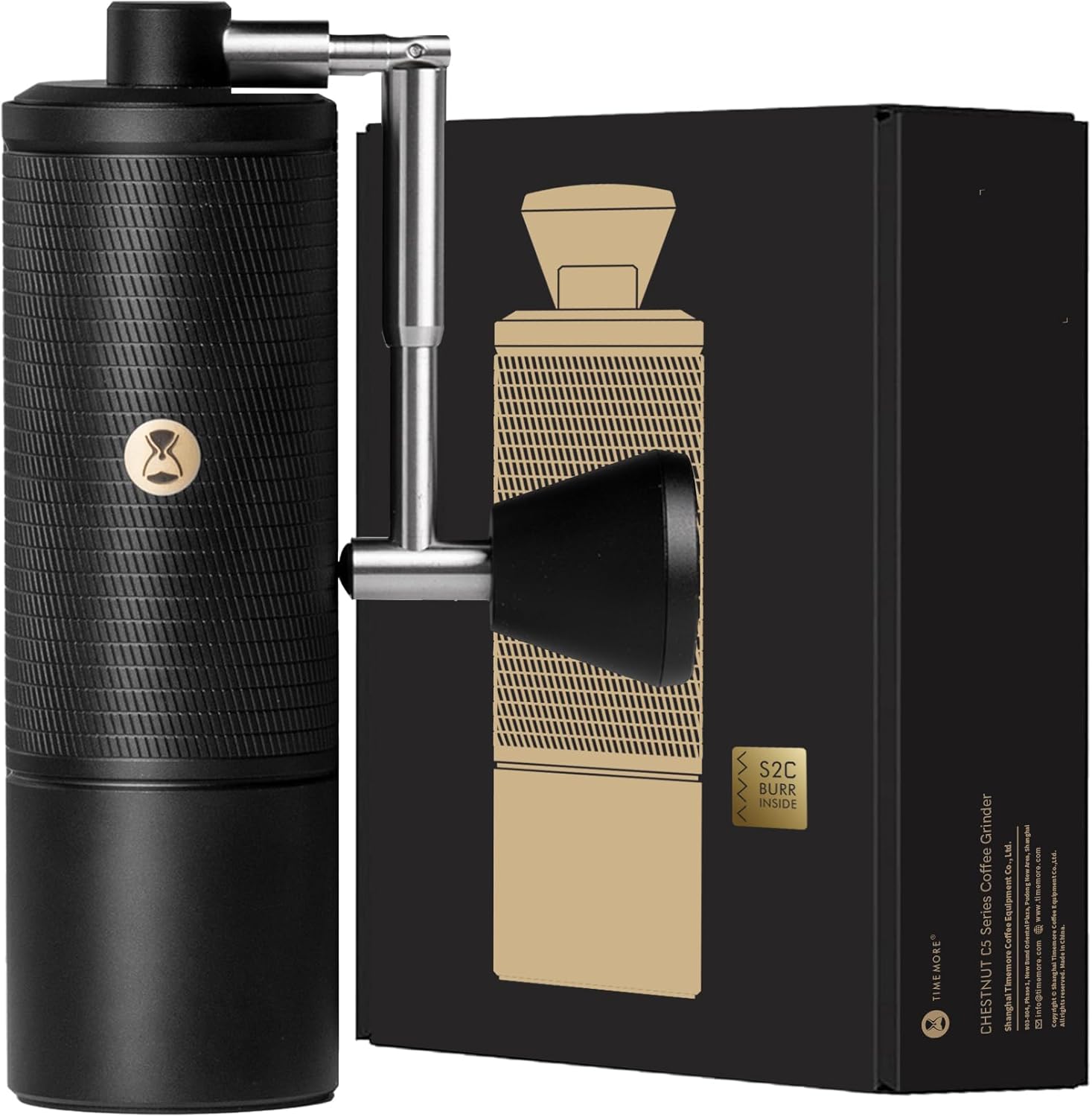
The TIMEMORE C5 ESP Pro is a metal-bodied hand grinder built around a 42 mm S2C-042-III conical burr and a very fine stepped adjustment of 0.015 mm per click, which lets you dial in espresso-level fines as well as coarser settings for pour-over and French press. It grinds with surprisingly little effort thanks to a well-engineered bearing and a compact handle that folds for travel, making short grind sessions comfortable and portable. The larger 42 mm burrs and one-piece metal construction boost grinding efficiency and consistency compared with smaller hobby hand grinders, and the stepped adjustment with roughly 50 levels helps reproduce settings reliably. Capacity is modest at about 25 g, so it is best used for single shots or small batches rather than bulk grinding. Disassembly for brushing is straightforward, but because it is fully metal and precision-machined, servicing or replacing parts will be less simple than on simpler plastic models. For someone prioritizing espresso performance and repeatable micrometric adjustment while still needing a travel-capable grinder, the C5 ESP Pro delivers a premium manual solution.
Best for: Buyers who prioritize precise, repeatable espresso grinding in a portable hand grinder and value metal construction and fine adjustment over large capacity.
Less Ideal for: Those who need to grind large quantities at once, want an electric grinder, or prefer the simplest, lowest-cost manual models for casual brewing.
- 42 mm S2C-042-III conical stainless steel burrs for efficient, consistent grinding
- Finer 0.015 mm per-click adjustment for precise espresso dialing
- All-metal one-piece body improves durability and grind stability
- Foldable handle and compact form make it easy to carry for travel
- 25 g capacity limits usefulness for preparing multiple servings at once
- All-metal precision construction may require professional servicing if damaged
Verdict: If you want a travel-capable manual grinder that can be precisely dialed for espresso, the C5 ESP Pro delivers professional-grade adjustment and consistent metal-built performance.
Lamido E96T Portable Burr Grinder
| Capacity | 25 g |
|---|---|
| Battery | 2000 mAh |
| Grind settings | 38 external settings |
| Burr type | Ceramic burr |
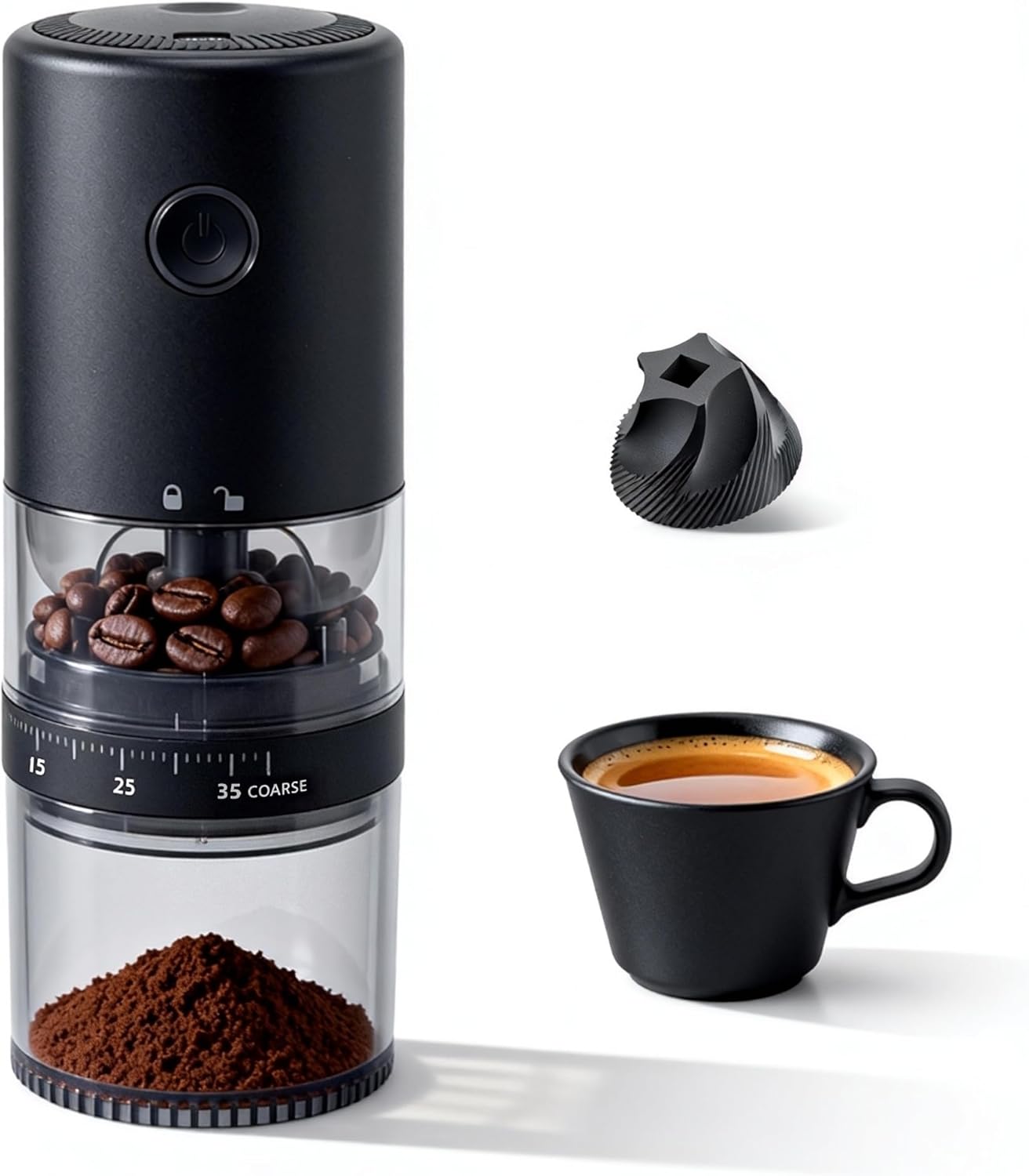
The Lamido E96T is a compact, travel-friendly electric burr grinder designed for quick, repeatable grinding away from a kitchen counter. It uses a ceramic burr and an externally adjustable 38-setting gear to dial in grind size for espresso and other brew methods, and its transparent 25 g hopper and 50 g grounds container make dosing visible and straightforward. The built-in 2000 mAh battery supports USB-C charging and Lamido says you can grind while charging, which is useful when the battery is low or you need multiple doses on a trip. The grinder's modular three-part design keeps most pieces dishwasher-safe for easier cleaning, and the auto-stop safety feature prevents overgrinding. Limitations to note are the small 25 g hopper capacity and relatively light-duty motor compared with full-size home espresso grinders, so expect to grind in small batches rather than continuous cafe-level throughput. For espresso use you can reach fine settings, but achieving ultra-consistent micro-adjustments common to higher-end bench grinders may require patience and trial runs.
Best for: Buyers who prioritize compact, travel-ready gear and want a grinder that reliably produces espresso-capable fines in small batches for home, office, or camping use.
Less Ideal for: Anyone who needs to grind large daily volumes for multiple back-to-back espresso shots or requires the absolute finest, ultra-stable grind consistency of a high-end bench grinder.
- Portable, battery-powered design with USB-C charging for use on the go
- 38 external grind settings give a wide range from fine to coarse without disassembly
- Ceramic burrs and modular parts that are mostly dishwasher-safe simplify maintenance
- Grind-while-charging feature prevents interruptions when battery is low
- Visible bean hopper and grounds container let you monitor dose and grind progress
- Small 25 g hopper limits batch size so multiple grinds are needed for several espresso shots
- Not as consistent for extremely fine espresso dial-in as larger bench grinders
Verdict: Choose the Lamido E96T if you want a genuinely portable, battery-powered burr grinder that can deliver espresso-capable grinds in small, convenient batches.
Rsoilch Manual Coffee Grinder HS-011

| Capacity | 30 g |
|---|---|
| Included Components | Ceramic Burr, Stainless Steel Body |
| Material Type | Ceramic, Plastic |
| Model Number | HS-011 |
This hand coffee grinder uses a ceramic conical burr and 40 adjustable grind settings to deliver consistent, evenly crushed grounds for espresso, pour-over, and French press. You tighten or loosen the grind collar to move through 40 clicks, then turn the detachable crank to grind; grounds collect in a clear glass jar so you can monitor progress and avoid spills. The ABS body and stainless trim keep weight low for travel or camping, and the manual, power-free design runs quietly without batteries or charging. Practical benefits include true portability, fine-to-coarse range suitable for espresso when dialed in, and the burr system that preserves oils for better flavor. Limitations are the small 25–30 g capacity, which means multiple batches for larger servings, and the plastic exterior feels less premium than full-metal alternatives, which may affect long-term durability under heavy use.
Best for: Buyers who want an affordable, truly portable grinder for dialing in espresso and other brew methods while traveling or on a budget.
Less Ideal for: Those who need to grind large daily volumes, want a heavy-duty metal build, or expect professional café-level throughput should choose a larger or electric grinder instead.
- Ceramic conical burr preserves oils and produces uniform grounds for consistent extraction
- Wide 40-click adjustment lets you reach fine settings suitable for espresso
- Clear glass grounds jar lets you watch grind progress and reduces spills
- Lightweight, battery-free design is easy to pack for travel or camping
- Small ground-bean capacity requires repeated grinding for multiple cups
- ABS plastic body is less durable and premium-feeling than metal-bodied grinders
Verdict: A budget-friendly, travel-ready manual grinder that offers espresso-capable grind control without electricity.
CEVING Manual Coffee Grinder MCG-MEGA

| Capacity | 60 g |
|---|---|
| Settings | 40 external settings |
| Burr type | Ceramic conical burr |
| Power source | manual winding |
The CEVING MCG-MEGA is a manual hand grinder built around a larger-than-normal 60 g capacity and a ceramic conical burr designed to preserve flavor by minimizing heat. It is used by filling the top hopper, selecting one of 40 external click-stop grind settings, and cranking by hand to produce grounds for espresso, pour-over, or coarser methods. The big hopper means fewer refills when making multiple shots or brewing for two, and the external dial makes switching from fine espresso settings to coarser brews quick and repeatable. The ceramic burr produces consistent particle size while reducing metallic heat transfer, which helps preserve oils and aroma for a cleaner cup. Because it is fully manual and portable, it is excellent for travel and camping, but you should expect longer grind times versus electric grinders and moderate physical effort for finer espresso settings. Build appears focused on practical, repeatable performance rather than lightweight gimmicks, making it a dependable choice for someone who needs precise, on-the-go grinding without electricity.
Best for: Buyers who prioritize consistency and dependability in a portable grinder and want precise, repeatable settings for espresso and other brew methods while traveling or off-grid.
Less Ideal for: Those who need ultra-fast, one-handed grinding at home or who prefer the convenience of an electric grinder for daily heavy use.
- Large 60 g hopper reduces the need for multiple refills
- 40 external click settings let you switch grind size quickly and repeatably
- Ceramic conical burr preserves flavor by minimizing heat during grinding
- Portable manual design works anywhere without power
- Manual operation requires more time and physical effort for fine espresso grinds
- Relatively heavier and larger than ultra-compact travel grinders
Verdict: Choose this grinder if you want a reliable, portable manual mill that delivers precise, repeatable espresso-capable grinds without electricity.
JavaPresse Manual Coffee Grinder

| Adjustable settings | 18 |
|---|---|
| Burr type | Ceramic conical |
| Power source | Manual |
The JavaPresse Manual Coffee Grinder is a compact hand-crank grinder that uses a ceramic conical burr and an 18-step adjustable mechanism to produce consistent grounds for espresso, pour-over, drip, and French press. You set the grind by turning the adjustment knob between very fine and coarse settings, then rotate the removable crank to mill beans into a small catch container. Its ceramic burrs are quieter than electric grinders and resist wear better than typical steel burrs, making it suitable for travel, camping, or quiet home use. The stainless steel body feels sturdy and the grinder requires no battery or power, so it is truly portable. Limitations are its small capacity and manual effort required to grind larger amounts for multiple servings, and dialing in exact espresso dial settings may take practice compared with calibrated electric grinders. For someone prioritizing portability, durability, and quiet operation, it delivers reliable, consistent grinds in a simple package.
Best for: Buyers who want a reliable, travel-ready grinder that produces near-espresso-quality grounds without electricity and who value durability and quiet operation backed by strong user feedback.
Less Ideal for: People who routinely need to grind large volumes, want instant one-handed operation, or who prefer the absolute speed and repeatability of a calibrated electric espresso grinder.
- Ceramic conical burrs for consistent grind and longer wear
- 18 adjustable grind settings for a wide range of brew methods including espresso
- Compact, lightweight, and fully manual for true portability
- Quiet operation compared with electric grinders
- Small bean and grounds capacity makes large batches tedious to grind
- Manual grinding requires physical effort and more time than electric grinders
Verdict: Choose this grinder if you want a durable, quiet, and portable manual grinder that can produce espresso-capable grounds on the go.
CEVING Manual Coffee Grinder MCG-02

| Capacity | 60 g |
|---|---|
| Adjustable settings | 40 |
| Burr type | Stainless steel conical burr |
This CEVING manual grinder is built for people who want precise, consistent grinds on the go and enough capacity to skip repeat batches. It uses CNC stainless steel conical burrs and an external click-ring with 40 settings, letting you dial from fine espresso to coarse French press without opening the unit. The 60 g bean chamber is larger than most hand grinders, so you can grind enough for multiple espressos or a small shared brew session in one pass. Because adjustments are external and incremental, it is easy to reproduce the same grind size each time, which helps extraction and shot consistency. It is hand-powered and compact, so you trade electric speed for portability and quiet operation, and heavy-duty daily cafe throughput will be slower than a motorized grinder. For risk-averse buyers, the solid metal burrs and clear adjustment mechanism give a predictable, durable feel that should hold up with normal home use.
Best for: Buyers who prioritize consistent, repeatable grind control and portability and want a durable manual grinder that produces espresso-capable fine grinds without relying on electricity.
Less Ideal for: Users who need fast, high-volume grinding or hands-free operation for frequent daily espresso shots should consider an electric grinder instead.
- 60 g bean capacity reduces the need for repeated small batches
- 40 external settings let you quickly switch grind sizes with repeatable clicks
- CNC stainless steel conical burrs provide uniform, cafe-style grinds
- Compact and lightweight for travel, camping, and portable espresso prep
- Manual hand-crank operation is slower than electric grinders for high-volume use
- Lacks motorized convenience and may require effort for dense espressos
Verdict: If you want a portable, predictable manual grinder that can produce espresso-fine grinds and hold a full small batch, this CEVING model delivers precise control and larger capacity than typical hand mills.
Choosing the Right Portable Coffee Grinder for Espresso: Key Factors to Consider
Grind Consistency at Espresso Settings
Espresso requires a much finer and more uniform particle distribution than other brew methods. A grinder that produces uneven particle sizes will make shots taste sour, bitter, or muted depending on which fraction dominates. When evaluating portable grinders look for burr geometry and tolerances that support tight slotted or conical burr alignment at fine settings. Consistency also affects how often you need to tweak dose and grind size, which can be frustrating on the road.
Because portable units often sacrifice mass and motor power, pay attention to whether the design maintains even feed and avoids clogging when set very fine. Consistent performance across multiple short shots is important if you plan to pull consecutive espressos away from home.
Adjustment Precision and Repeatability
Small increments in grind setting create large swings in espresso shot timing and flavor. A portable grinder should offer micro-adjustment or a well-indexed stepped system so you can reliably return to a previous setting. Without precise adjustment it is hard to dial in a puck, especially with varying beans, roast levels, and temperatures.
Repeatability matters when you travel and reassemble gear. Knobs, click stops, or marked steps help recreate a previously successful setting. Consider whether the grinder holds its calibration under movement and whether adjustments are intuitive to use while preparing espresso.
Build Materials and Durability
Frequent fine grinding places stress on burrs, bearings, and housings. Durable burrs (hardened steel or quality ceramic), solid shafts and low-play bearings, and a strong outer shell increase longevity for a portable espresso grinder. Lightweight plastics reduce weight but can flex and change tolerances over time, which hurts consistent grind.
Also consider finish and weather resistance if you use the grinder outdoors. Corrosion-resistant materials and easy-to-service components lengthen life and preserve performance.
Portability, Size, and Power Source
The need for compactness competes with hopper capacity, motor size, and ergonomics. Think about how often you will carry the grinder and whether it needs to fit in luggage, a daypack, or a small drawer. Smaller grinders are lighter but may require more cranking or limit dose size, which affects convenience for multiple shots.
Power matters if the grinder is electric. Battery-assisted or USB-chargeable motors add convenience but check run-time, recharge speed, and how they perform at fine settings. Manual grinders avoid batteries but demand effort and can be slower for larger doses.
Dose Capacity and Retention
Dose capacity determines whether you can grind enough for single or multiple espressos without repeated loading. Portables often have smaller chambers, so confirm the usable capacity at fine settings. Retention, or how much ground coffee remains trapped in the grind path, affects consistency between shots and wastes precious beans on short trips.
Lower retention designs and easy access to the burrs for brushing reduce waste and make back-to-back shots simpler when you need them.
Ease Of Cleaning And Maintenance
Espresso-grade grinding produces fines that can pack into crevices and accelerate staling. A portable grinder that disassembles easily for cleaning will perform better over time. Look for removable dosing cups, simple burr removal, and straightforward access to the grind chute.
Regular cleaning prevents flavor carryover between beans and reduces the need for repeated dial-ins. Consider whether common tools are required to service the unit and whether replacement parts are logically accessible.
Manual Vs Electric Portable Grinders
Manual grinders remain popular for portability and reliability. They are lighter, do not depend on batteries, and often provide tactile control over grind speed and dosing. For espresso, a manual grinder must have a stable burr alignment and a comfortable crank design so you can maintain consistent pressure and speed while producing fine grounds.
Electric portable grinders add speed and convenience, especially for multiple shots. Battery-powered or USB-chargeable motors can achieve fine settings without fatigue, but check whether the motor maintains torque at very fine settings and whether charging fits your travel routines.
- Manual: lighter, no batteries, more physical effort required
- Electric: faster, better for multiple shots, depends on battery life and motor torque
How Burr Type Affects Espresso Grinding
Conical and flat burrs both can make excellent espresso grinds, but they behave differently. Conical burrs tend to be more forgiving with particle size distribution and often work well with lower-powered motors. Flat burrs can deliver extremely uniform particles but typically require tighter tolerances and more stable motor performance.
In portable units, burr material and machining quality are often more important than the theoretical burr geometry. Look for burrs designed for fine grinding with a reputation for holding tolerances under load.
- Conical: forgiving, often good for manual or lower-power designs
- Flat: very uniform when well-built, may need stronger motor or sturdier build
Dosing Strategies for Travel Espresso
When you are away from home, minimizing steps helps. Pre-weighing doses before travel or using simple dosing cups can speed preparation. For one-off shots, keep doses small and consistent so you do not grind more than you need. If you plan to make multiple drinks, prepare several doses in resealable containers to avoid repeated adjustment and grind waste.
Also consider tamping options and how you will distribute grounds into a portafilter or a puck-friendly basket. Some portable grinders deliver grounds directly into single-dose cups that pair well with small portafilters.
- Pre-weigh beans for each shot
- Use single-dose cups to reduce retention issues
- Prepare multiple doses if making several drinks
Maintaining Consistent Results Over Time
Keep a basic cleaning schedule to remove fines and oils that alter flavor and affect grind flow. Brush out the burrs and chute after a travel day and periodically perform deeper cleaning to remove buildup. Small amounts of wear can change grind distribution, so regularly check your favorite setting by pulling test shots when you can.
If your grinder has replaceable burrs or user-serviceable parts, learn the disassembly steps so you can perform maintenance while traveling. Carry a small brush and a spare dose cup or container to avoid cross-contamination between beans.
- Brush and empty the grind chamber after sessions
- Check and log settings to detect drift
- Carry a compact cleaning brush and spare parts when possible
Packing And Protecting A Portable Grinder
When packing a grinder for travel, protect the adjustment mechanism and burrs from impact. Use padded compartments or a dedicated case, and separate the grinder from liquids and fine grounds. Avoid compressing fragile parts in luggage by placing the grinder in a rigid or semi-rigid container.
If the grinder is manual, store the crank and any removable components to prevent bending. For battery-powered grinders, remove batteries for long trips or ensure the unit is fully charged and protected from shocks that could alter calibration.
- Use a padded case or wrap the grinder in soft clothing
- Remove or secure removable parts to avoid damage
- Keep the grinder dry and away from heavy items in luggage
How We Chose the Best Portable Coffee Grinder for Espresso
We focused on factors that directly affect espresso extraction when using a portable grinder. Grind consistency at espresso ranges was the first filter, requiring a tight particle distribution and reliable adjustment at fine settings. Build quality and materials were next, since small grinders face heavy wear from frequent fine grinding; durable burrs and robust housings extend useful life. Adjustment precision and repeatability mattered because tiny setting changes have large effects on shot behavior. Portability and power were evaluated together, weighing compact size and weight against motor strength and ergonomics for manual or battery-assisted operation. Usability features such as dose capacity, retention, ease of cleaning, and how simply the grinder integrates into an espresso workflow were also considered. We excluded grinders that could not reliably reach espresso-fine settings or that lacked essential durability. Overall, we selected products that balanced precise fine grinding with the size and features people need for travel and on-the-go espresso.
Our full evaluation process is outlined in our review methodology.
FAQ
Can a small portable grinder produce authentic espresso-quality shots?
Often yes, but it depends on the grinder's ability to reach and maintain fine settings with consistent particle distribution. Durable burrs and precise adjustment are key determinants.
How much coffee can a typical portable grinder hold for espresso dosing?
Capacity varies widely. Many portables hold a single to a few double-shot doses. Check usable dose capacity at fine settings because densely packed grounds reduce the effective amount you can grind.
Are manual grinders better for travel than electric ones?
Manual grinders are lighter and do not require charging, which can be advantageous for remote travel. Electric models offer speed and reduced effort, which helps when making multiple shots.
How often should I clean a portable espresso grinder?
Brush the burrs and empty the grind chamber after each trip or day of use. Perform deeper cleaning periodically depending on usage and oil buildup from dark roasts.
Will battery-powered portable grinders maintain torque at espresso settings?
It depends on motor design and battery capacity. High-quality designs maintain torque at fine settings, but lower-powered units may struggle and produce inconsistent results.
Final Verdict
Choosing the right portable coffee grinder for espresso means balancing grind precision, durability, and how you plan to use it on the road. Prioritize a grinder that reaches fine settings with minimal retention and offers precise, repeatable adjustments. Consider whether you prefer the simplicity and light weight of a manual unit or the convenience of a battery-powered grinder capable of sustained torque. Focus on consistency first, then weigh portability, maintenance, and dosing features to find a travel grinder that reliably produces great espresso.