
Note: This article contains affiliate links. If you click on these links and make a purchase, we may earn a small commission at no extra cost to you. This helps support our research and content. Read our full affiliate disclosure here.
If you rely on steady ice for parties, daily drinks, or light commercial use, a portable countertop ice maker with a water line connection can remove the chore of frequent refills. These units combine the convenience of a small footprint with the reliability of a plumbed water feed, so you get continuous ice production without interrupting use. This guide covers the top shortlisted models in the category and explains practical differences buyers should consider, including production rate, ice size, installation complexity, and maintenance. Read on to see which features matter most for your setup and which options fit typical home or catering scenarios.
Top Picks at a Glance
| Best Quality Built to a higher standard if you want something more solid | VEVOR Commercial Ice Maker 80 lb/24h |  |
| Best Value The sweet spot between price and what you get | NUNET 3-in-1 Countertop Ice Maker |  |
| Best Budget The cheapest option that still gets the job done reliably | ROVSUN Commercial Ice Maker 90lb | 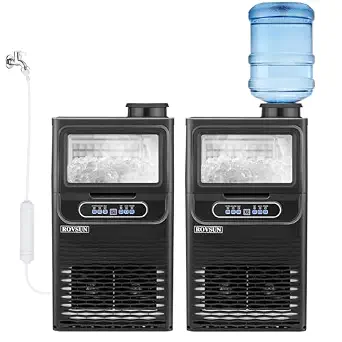 |
| Top Rated A top-rated pick with lots of positive feedback | Avalon A-ICE2 Nugget Ice Maker |  |
| Most Popular A crowd favorite that many people choose with confidence | ROVSUN Countertop Ice Maker 70lbs |  |
| Best Seller A high-volume bestseller chosen again and again | NUNET 3-in-1 Ice Maker |  |
VEVOR Commercial Ice Maker 80 lb/24h

| Ice Production per Day | 80 pounds |
|---|---|
| Capacity | 13 pounds |
| Wattage | 280 watts |
| Voltage | 110 volts |
| Refrigerant | R290a |
This VEVOR countertop ice maker is built for steady, high-volume ice production in small commercial or heavy home use, turning out roughly 32 cubes every 8 to 10 minutes for up to 80 pounds per day. It sits on a counter or under a cabinet and connects to a water inlet and drain hose for automated filling and draining, while the LED panel lets you change freezing time to adjust cube thickness, run a one-touch self-clean, and monitor alerts like full-ice and low-water. The stainless steel exterior and cyclopentane foam insulation help keep harvested ice colder for hours when power is off, and the included scoop and leveling feet make day-to-day handling straightforward. Important trade-offs are that the unit is a true workhorse rather than a slim portable cooler alternative, and it requires a water line and a bit of clearance and routine condenser cleaning to maintain peak output and reliability.
Best for: Buyers who need reliable, high-rate ice production for parties, small foodservice shifts, or frequent entertaining and prioritize output and control over extreme portability.
Less Ideal for: People who want a lightweight, truly portable plug-and-play ice maker for occasional home use without a water line should consider simpler, smaller machines instead.
- High daily output up to 80 lb, suitable for busy periods
- LED control panel with adjustable ice thickness, timer, and alerts
- Integrated insulation and stainless steel body help preserve ice
- Auto-fill/drain capability with included inlet and drain hoses
- Requires a water line and regular condenser cleaning to sustain output
- Larger, heavier footprint compared with ultra-portable countertop models
Verdict: Choose this unit when you need a countertop ice maker with dependable, high daily output and adjustable cube control for heavy entertaining or light commercial service.
NUNET 3-in-1 Countertop Ice Maker

| Wattage | 310 watts |
|---|---|
| Installation Type | Countertop |
| Number of settings | 2 |
| Upper Temperature Rating | 194 °F |
| Lower Temperature Rating | 32 °F |
This NUNET 3-in-1 Countertop Ice Maker combines a hot/cold water dispenser with a built-in ice machine, designed for countertop use or direct hookup to a water line via the included 10 ft inlet hose and adapters. It makes bullet-style ice at a claimed daily rate of up to 44 pounds while holding about 4 pounds in the storage bin, and offers three taps for hot, ambient, and chilled water with touch controls and indicator lights. The unit is compact and finished in stainless look, and the compressor noise is advertised under 46 dB, so it is suitable for kitchens, small offices, or party setups where continuous ice and beverage temps are helpful. Practical features include manual fill or continuous water-line operation, an insulated bottle for hot water, and a removable drip tray for cleaning. Expect typical countertop limitations: the 4 lb onboard storage means frequent retrieval or planning for larger events, and build-quality and long-term reliability are uncertain given mixed reviews. It is a space-saving option when you need integrated ice plus hot and cold water without plumbing major changes.
Best for: Buyers who want a single countertop unit that delivers both continuous ice and hot/cold water and prefer the option to connect to a dedicated water line to avoid frequent manual refills.
Less Ideal for: People who need large on-device ice storage for big gatherings or who prioritize proven long-term reliability from established commercial brands.
- Produces up to 44 lb of ice per day for continuous supply
- Two refill methods: manual reservoir or water-line hookup with included 10 ft hose and adapters
- Integrated hot, room-temperature, and cold water taps for versatile beverage use
- Compact countertop footprint with removable drip tray and touch controls
- Onboard ice storage is only about 4 lb so it needs frequent emptying during heavy use
- Power and compressor claims are manufacturer provided and long-term durability is unclear based on limited reviews
Verdict: Choose this unit if you want a compact countertop dispenser that can be plumbed to a water line for continuous ice production and hot/cold water without major installation.
ROVSUN Commercial Ice Maker 90lb

| Ice Production per Day | 90 pounds |
|---|---|
| Capacity | 11 pounds |
| Voltage | 110 volts |
| Refrigerant | R290a |
This ROVSUN countertop ice maker is a compact commercial-style unit aimed at steady ice production for small foodservice or heavy home use. It makes chewable 0.9-inch cubes, cycles roughly every 11–20 minutes, and claims about 90 pounds of ice per 24 hours while storing up to 11 pounds in the bin. The machine offers two water inlet options—tap or bottled—and includes an inlet hose with a filter, a drain hose, and an ice scoop, which makes it straightforward to hook to a water line or use standalone. Controls let you adjust cube thickness and set a 24-hour timer, and the stainless steel exterior is easy to wipe down. Practical limits are the modest built-in storage compared with its daily output and the need to place it upright for 24 hours before first use; expect to empty the bin frequently during busy periods. The unit runs on 110 volts and uses R290a refrigerant, so check local installation and ventilation needs for continuous operation.
Best for: Buyers who need an affordable countertop unit that can be connected to a water line and deliver consistent commercial-style ice for small restaurants, bars, or busy home entertaining.
Less Ideal for: Not a good fit for venues needing large on-demand storage or high-volume continuous dispensing without an external bin or daily manual emptying.
- High daily ice output suitable for frequent service with up to 90 lb/24h production
- Dual water inlet (tap or bottled) with included filter for water-line hookup
- Adjustable ice thickness and timer for some control over yield and scheduling
- Stainless steel body and food-grade interior that are easy to clean
- Small 11 lb storage bin requires frequent emptying during heavy use
- Requires upright sit time before first use and basic ventilation considerations for continuous running
Verdict: If you want a budget-friendly countertop ice maker that can hook to a water line and reliably produce commercial-style chewable cubes, this ROVSUN 90 lb/day unit delivers steady output for small bars and busy households.
Avalon A-ICE2 Nugget Ice Maker

| Ice Production per Day | 38 pounds |
|---|---|
| Capacity | 38 pounds |
| Wattage | 175 watts |
| Voltage | 115 volts |
| Refrigerant | R600a |
The Avalon A-ICE2 is a countertop nugget ice maker designed for continuous, on-demand ice production by connecting directly to a water line. It makes soft chewable "opal"-style ice and claims up to 38 pounds of output per day while storing about 5.5 pounds in the removable drawer. Key conveniences include an installation kit with tubing and adapters, a dual filtration system (sediment plus carbon block) for cleaner water, an LED control panel, and an automated self-clean cycle to simplify maintenance. With 175 watts and standard 115V operation it fits typical home or small commercial electrical setups and uses R600a refrigerant. The unit is best used in kitchens, break rooms, or home bars where steady ice supply is needed without manual filling, though the storage bin is small so frequent use drains storage quickly even while production continues. Buyers should also plan for line installation and periodic filter replacement to keep water quality high.
Best for: Buyers who prioritize a reliable, continuously fed countertop ice source for home bars, small offices, or light commercial use and want a low-touch machine that filters and self-cleans.
Less Ideal for: Those who need large ready-to-use ice storage without frequent emptying or anyone unwilling to run a permanent water line and maintain replacement filters.
- Connects directly to a water line for continuous automatic replenishment
- Produces nugget/chewable ice preferred for drinks and smoothies
- Includes installation kit and dual filters for improved water quality out of the box
- Automated self-clean cycle and LED controls simplify maintenance and monitoring
- High daily production rate (38 lb/day) suitable for heavy intermittent use
- Small built-in storage capacity requires frequent dispensing despite high production
- Filter cartridges will require periodic replacement to maintain water taste and performance
Verdict: If you want a dependable countertop nugget ice maker with a direct water-line feed, onboard filtration, and self-cleaning for steady, low-maintenance ice production, the Avalon A-ICE2 is an excellent choice.
ROVSUN Countertop Ice Maker 70lbs

| Ice Production per Day | 70 pounds |
|---|---|
| Capacity | 11 pounds |
| Voltage | 110 volts |
| Refrigerant | R290a |
This ROVSUN countertop ice maker is built for heavy home or small commercial use where a continuous ice supply is important. It uses a compressor-based system to make 32 small clear cubes per cycle in about 11 to 20 minutes and can produce up to 70 pounds in 24 hours while storing roughly 11 pounds in the insulated bin. The unit accepts either tap or bottled water via two inlet options and includes a replaceable inline filter so tap water can be used without a separate filtration setup. Controls are simple: an intuitive panel lets you adjust ice thickness and set a 24-hour timer to schedule production. The stainless steel exterior and food-grade PP liner wipe clean easily, and the package includes an inlet hose with filter, drain pipe, and scoop for quick setup. Be prepared for the usual compressor noise and the limited onboard storage, so frequent use benefits from a drain or external bin arrangement rather than relying on the small internal bin alone.
Best for: Buyers who want a high-capacity countertop ice maker they can connect to a water line and expect straightforward setup with included accessories and basic controls.
Less Ideal for: Users seeking a virtually silent, low-profile ice solution or those who need large on-board storage for long unattended events should consider other formats.
- High output up to 70 lbs of ice per day suitable for parties or light commercial use.
- Dual water inlet with inline filter allows connection to tap or bottled water.
- Adjustable ice thickness and 24-hour timer provide usable control over production.
- Stainless steel exterior and food-grade liner for easier cleaning and durability.
- Includes hoses, drain pipe, and ice scoop for out-of-the-box setup.
- Internal storage is only about 11 lbs so you may need an external bin for continuous service.
- Compressor-based machines produce noticeable operational noise compared with small portable motors.
Verdict: Choose this unit if you need a countertop ice maker that reliably produces high daily output and supports tap-water connection with an inline filter.
NUNET 3-in-1 Ice Maker

| Capacity | 44 pounds |
|---|---|
| Wattage | 400 watts |
| Voltage | 115 volts of alternating current |
| Ice Production per Day | 44 pounds |
| Refrigerant | R600a |
This NUNET 3-in-1 combines a portable ice maker with a hot and cold water dispenser, aimed at countertop use in kitchens, offices, or small event spaces. It can produce up to 44 lb of ice per day and stores about 4 lb for immediate dispensing, while offering hot, room-temperature, and chilled water through separate faucets. You can fill the internal reservoir manually, use the included pump to draw from bottled water, or attach a 10 ft inlet hose to a filtration or supply line with 1/2" and 1/4" adapters, which makes it useful when a permanent water line is preferred. Controls are touch-based with a child lock and LED indicators, and the compressor uses a small refrigerant with claimed noise under 46 dB when running. Practical strengths include the multiway water input, relatively high daily ice output, and stainless steel finish that fits on a counter. Important limitations are the modest on-board ice storage, reliance on the ice bin for supply recycling, and that performance will depend on room temperature and water source quality.
Best for: Buyers who prioritize a low-risk, countertop solution that can run from a direct water connection or bottled supply and want both beverage dispensing and substantial daily ice production without complex installation.
Less Ideal for: Large households or commercial venues that need large on-demand ice bins or continuous high-volume dispensing without frequent refills should consider more heavy-duty or dedicated equipment.
- Supports direct water-line hookup with included 10 ft inlet hose and 1/2" and 1/4" adapters
- Produces up to 44 lb of ice per day and makes batches approximately every 6–8 minutes
- Provides hot, room-temperature, and chilled water from the same unit for versatile beverage service
- Touch controls with child safety lock and LED indicators simplify operation
- Built-in ice storage is small (about 4 lb), so frequent use may require regular emptying or supplementation
- Daily output and cold performance depend on ambient temperature and water quality
Verdict: Choose this unit if you want a countertop ice maker that also delivers hot and cold water and can be plumbed to a water line for steady, low-hassle operation.
Choosing the Right Portable Countertop Ice Maker with a Water Line Connection: Key Factors to Consider
Ice Production Rate and Duty Cycle
How many pounds of ice the machine can produce in a 24-hour period directly determines whether it will meet your needs. For occasional home use you may only need modest output, but for parties or light catering you should look for higher continuous production numbers. Duty cycle matters too because portable countertop units can overheat or throttle if run at maximum output for extended periods. Verify the rated hourly or daily output and check whether the manufacturer specifies any recommended cool-down periods.
Consider peak demand patterns. If you expect sustained usage, choose a machine rated for continuous plumbed operation rather than one intended primarily for intermittent use. A higher production rate also reduces the chance of running out of ice during busy stretches, but it may require better ventilation and a more robust water line.
Plumbing Compatibility and Installation Complexity
A plumbed portable ice maker needs a reliable water source and a suitable drain plan. Evaluate how the unit connects to a water line, whether it accepts standard hose fittings, and if it includes a shutoff valve or check valve to prevent backflow. Some units require adapter parts or a dedicated faucet line, which can add to installation time.
Consider where you will place the unit and whether a gravity drain or condensate pump is required. Short runs to an existing drain are easiest, while longer routes may need a utility pump. Also assess the flexibility of the connection points and whether the unit can work with the water pressure available at the installation site.
Ice Size, Shape, and Quality
Not all ice is equal for every application. Cubed, nugget, and bullet-style ice melt at different rates and are suited to different uses. Check whether the machine offers size or shape options and how that impacts production rate. Denser cubes last longer in drinks but can take longer to form, whereas smaller, softer ice produces more volume faster.
Water filtration or scale-prevention features also affect ice clarity and taste. If you have hard water, minerals can cause cloudy ice and faster scale buildup inside the machine. Look for machines that allow inline filters or have accessible scale-removal access points.
Reservoir Capacity and Drain Handling
Even with a water-line connection, a reservoir is often used to buffer the feed and collect overflow. Reservoir size affects how much ice the machine can hold between harvest cycles and whether the unit will pause production due to a full bin. A well-designed drain or overflow routing helps avoid spills and reduces the need to monitor the unit constantly.
Consider whether the unit has an internal overflow sensor and if the ice bin is easy to remove for emptying and cleaning. Also examine how meltwater is handled and whether the drain path is user-accessible for routine clearing.
Maintenance, Descaling, and Filter Access
Plumbed units run continuously and therefore need a realistic maintenance plan. Regular descaling prevents performance loss and reduces bacterial growth. Check how simple the descaling process is and whether the unit provides reminders or easy access for cleaning parts. Machines that allow quick removal of the ice tray, access to internal pumps, and replacement of inline filters reduce downtime and long-term servicing costs.
Also look for corrosion-resistant materials and clear manufacturer directions for sanitation intervals. Ease of finding replacement parts and intuitive maintenance interfaces are important for keeping the unit reliable over time.
Planning Your Installation
Map the intended placement before buying. Measure clearances for ventilation, access for plumbing, and space to remove the ice bin. Heat dissipation is an often-overlooked factor; allow manufacturer-recommended airflow around the cabinet to prevent thermal cutback during long runs.
Decide on drain routing upfront. If the unit will sit near a sink, a short gravity drain to an existing trap works well. For counters that lack a nearby drain, plan for a condensate pump or an elevated drain loop to prevent siphoning. Confirm local plumbing codes if you are connecting to potable water lines.
- Confirm water pressure and line size at install location
- Allow 2 to 3 inches clearance at rear and sides for airflow
- Plan a drain path to avoid standing water around the unit
- Consider a shutoff valve and check valve for safety
Water Filtration and Scale Control
Hard water accelerates scale buildup, which reduces ice clarity and can harm performance. Incorporating an inline filter or softening cartridge between the supply and the machine helps preserve internal components and improves ice taste.
Look for units that accept common filter housings or provide a straightforward filter-installation point. Regularly replacing filters and performing scheduled descaling will extend service life and maintain steady production rates.
- Use a sediment or carbon filter for taste and particulate removal
- Add a scale-reduction cartridge if water hardness is above recommended levels
- Follow a descaling schedule based on local water chemistry
Sizing for Use Case: Home, Party, or Light Catering
Match the ice maker's daily capacity to how you plan to use it. For a household that uses ice intermittently, lower-capacity models may be adequate. For frequent entertaining or small catering gigs, choose a machine with higher continuous output and a larger ice-holding bin.
Also consider cycle time and harvest frequency. A machine that makes more per hour will recover faster between busy periods, while a slower unit may require more storage or backup planning.
- Estimate peak hourly ice needs and add a safety margin
- Check whether the unit throttles after continuous runs
- Factor in storage space for extra ice during events
Ventilation and Heat Management
Portable countertop ice makers generate heat that must be vented. Poor ventilation causes the compressor to run longer, reducing efficiency and increasing the chance of production limits during hot ambient conditions. Place the unit away from direct sunlight and heat-producing appliances.
If you plan frequent long runs, ensure surrounding cabinetry or shelving does not trap heat. Some units draw ventilation air from the front; others vent at the rear. Confirm vent orientation to avoid blocked airflow.
- Keep the unit at least a few inches from walls or cabinetry
- Avoid installing under heat sources like stoves
- Ensure vents are unobstructed during operation
Daily Operation Tips
Run the machine through a short cycle before major events to ensure the ice is fresh and to clear any standing water. Periodically inspect water connections for leaks and tighten fittings if needed. Empty and clean the ice bin weekly if usage is high to prevent odours and bacterial growth.
Use the machine's controls to select ice size that best suits your beverages; larger cubes will melt slower for cocktails, while smaller or nugget styles chill quickly for soft drinks.
- Perform a visual leak check at each use
- Rotate ice sizes to match drink requirements
- Keep a small towel nearby for occasional drainage or spills
How We Chose the Best Portable Countertop Ice Maker with a Water Line Connection
We shortlisted units that are purpose-built for countertop placement and support a direct water-line hookup for continuous operation. Our selection prioritized measurable specs and real-world convenience instead of marketing claims. Primary evaluation criteria included sustained ice production rate, ease of water-line integration, long-run reliability under continuous feed, and maintainability for routine cleaning. We excluded machines that only offer manual fill or require frequent emptying in high-use scenarios. We also omitted models designed solely for built-in installation or heavy commercial walk-in use. Filters favored machines with clear plumbing interfaces, corrosion-resistant water connections, and accessible serviceability features like removable ice bins and straightforward descaling procedures. We focused on actionable buyer concerns: how much ice a unit makes per 24 hours, how simple plumbing and drain routing are, how ice quality and size options affect use, and what upkeep looks like over months of regular use. The final list balances hands-free operation with realistic installation effort and long-term maintenance needs.
Our full evaluation process is outlined in our review methodology.
FAQ
Can I connect a portable countertop ice maker directly to my kitchen water line?
Often you can. Many portable countertop ice makers support a direct water-line hookup using standard fittings, but you should verify the unit's specified connection type and water pressure requirements before installation.
Do plumbed portable ice makers need a drain connection?
A drain is usually required to handle meltwater and overflow. Some setups allow for internal evaporation in low-use scenarios, but for continuous plumbed operation a proper drain or condensate pump is recommended.
How often should I descale a plumbed countertop ice maker?
Descale frequency depends on water hardness and usage. In hard-water areas, monthly or bi-monthly descaling is common. In softer-water locations, descaling every few months may be sufficient.
Will a water filter affect ice production rate?
A correctly sized inline filter generally has minimal impact on production rate. Very fine filtration or clogged filters can reduce flow and marginally slow production, so replace filters per the manufacturer's schedule.
Can I install the water connection myself?
Many installations are straightforward for a homeowner with basic plumbing skills, especially when using included adapters. If you are unsure about local codes or lack confidence working with potable lines, consult a plumber.
Final Verdict
Prioritize sustained production rate, straightforward plumbing, and accessible maintenance when choosing a portable countertop ice maker with a water line connection. Tradeoffs are common: higher output machines usually need better ventilation and clearer drain planning, while simpler units are easier to install but may limit continuous use. Choose the machine that matches your typical peak demand and installation constraints, and plan for routine descaling and filter replacement. With the right combination of capacity, plumbing compatibility, and serviceability you can enjoy continuous, hands-free ice for daily use or entertaining.