
Note: This article contains affiliate links. If you click on these links and make a purchase, we may earn a small commission at no extra cost to you. This helps support our research and content. Read our full affiliate disclosure here.
When cold nights threaten to cut a trip short, the right portable heater for tent can make the difference between shivering and sleeping comfortably. You need gear that delivers steady warmth, manages fuel or battery use efficiently, and prioritizes safety inside an enclosed shelter. This guide highlights the top shortlisted portable heaters for tent use, chosen for their heat output, safety features, runtime, and suitability for small shared spaces. Below you will find concise evaluations and the criteria we used to pick them, so you can decide which heater suits your camping style and tent size.
Top Picks at a Glance
| Best Overall The best all-around choice for most situations | Heat Hog 9,000 BTU Portable Heater |  |
| Best Quality Built to a higher standard if you want something more solid | Mr. Heater Buddy FLEX MH11BFLEX |  |
| Best Value The sweet spot between price and what you get | AeriePrecium Portable Propane Heater GS-05 |  |
| Best Budget The cheapest option that still gets the job done reliably | Lerat K40 Portable Space Heater |  |
| Top Rated A top-rated pick with lots of positive feedback | CAMPLUX NanoAir 2 Portable Propane Heater |  |
| Most Popular A crowd favorite that many people choose with confidence | GiveBest Portable Space Heater PTC-905 |  |
| Best Seller A high-volume bestseller chosen again and again | Mr. Heater Portable Buddy F232000 |  |
Heat Hog 9,000 BTU Portable Heater

| Heat Output | 9000 british thermal units |
|---|---|
| Heating Coverage | 225 sq. ft. |
| Fuel Type | Propane |
| Heating Method | Radiant |
| Number of Speeds | 4 |
The Heat Hog 9,000 BTU portable propane heater delivers focused radiant warmth for small tents, garages, and outdoor activities without needing electricity. It runs on a 1 lb cylinder or can connect to a 20 lb tank with an accessory hose and offers up to 9,000 BTU of heat that the manufacturer rates for about 225 sq. ft., although in a tent you will feel the benefit most when placed close to the seating or sleeping area. The tiltable head and curved plaque broaden and direct the heated zone, and the lightweight pedestal design with a heavy-duty handle makes it easy to move and aim. Built-in safety features include a tip-over switch, an Oxygen Depletion Sensor, and a protective guard, which are important for indoor tent use when ventilation is limited, but users must still follow safe propane and ventilation practices. Runtime depends on tank size and setting, and loudness is low since no fan is required, though radiant heat is directional so it will not evenly warm large spaces.
Best for: Campers and outdoor tent users who want a portable, non-electric heater they can aim directly at a small seating or sleeping area and value built-in safety features.
Less Ideal for: People who need whole-tent or large-space uniform heating or who cannot provide safe ventilation for propane use should consider other heating methods.
- Runs on 1 lb cylinder or 20 lb tank with accessory for flexible fuel options
- Tiltable head and curved plaque concentrate and widen the heated area for targeting warmth
- Lightweight pedestal design with handle for easy transport and placement
- Safety features include tip-over switch, Oxygen Depletion Sensor, and protective guard
- Radiant, directional heat does not evenly warm larger interiors
- Actual runtime and heat spread depend heavily on tank size and ventilation conditions
Verdict: Choose this heater if you need a lightweight, tiltable propane radiant heater that provides targeted, non-electric warmth for small tents and outdoor setups.
Mr. Heater Buddy FLEX MH11BFLEX
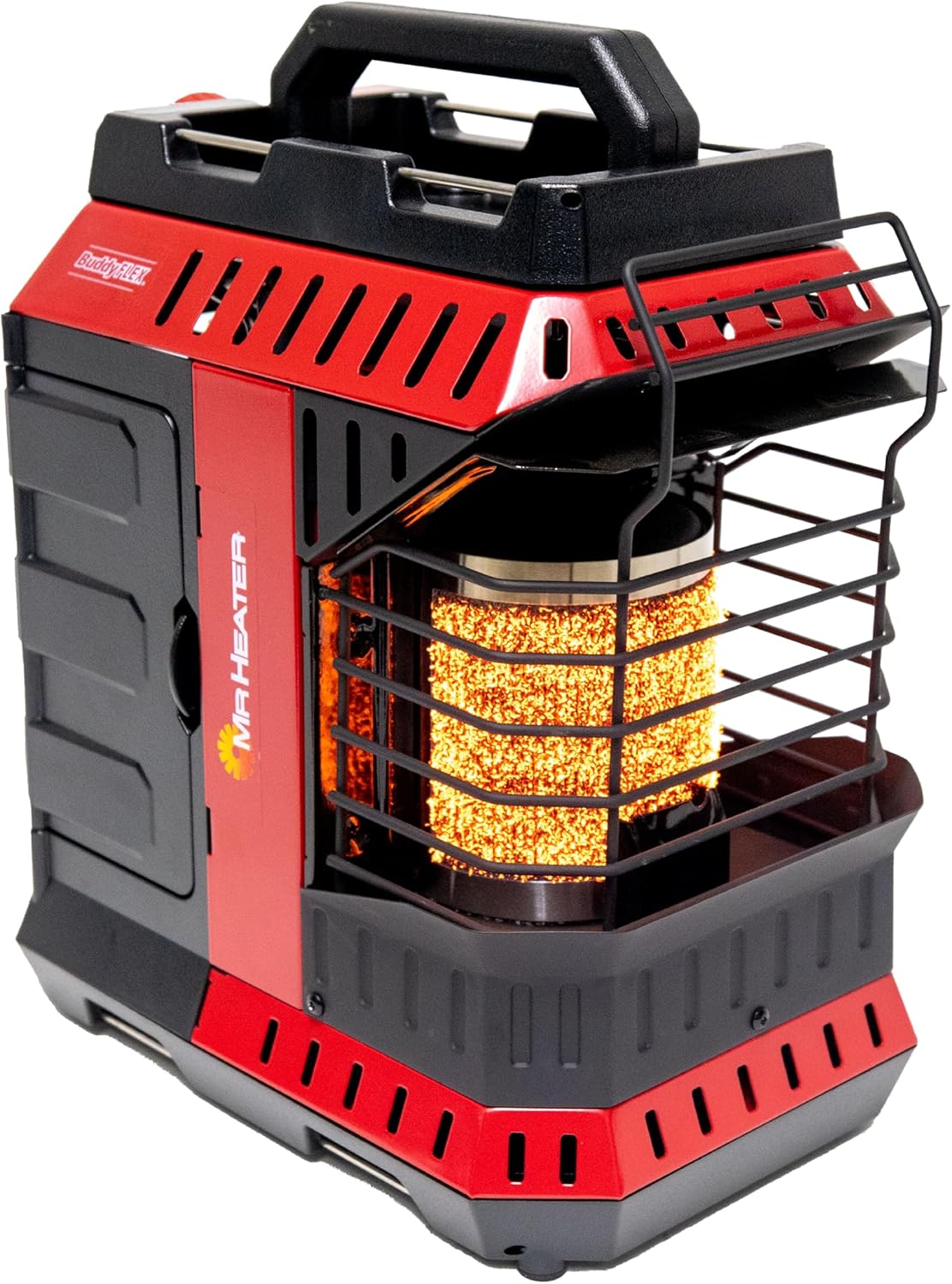
| Heat Output | 11000 BTU (max) |
|---|---|
| Heating Coverage | 275 square feet |
| Fuel Type | Propane |
| Run Time | 3.5 hours on low / 2 hours on high |
| Indoor/Outdoor | Indoor, Outdoor |
The Mr. Heater Buddy FLEX is a compact propane radiant heater designed for indoor and outdoor use that delivers variable heat between 8,000 and 11,000 BTU. It uses an omni-directional fiber mesh burner and optimized wind barrier to spread heat evenly, and it runs on a 1 lb cylinder with an optional connection to a 20 lb tank for extended runtime. Practical controls include a manual thermostat, two heat settings, and an integrated electric ignition for easy starts, while built-in safety features cover low-oxygen shutoff and tip-over protection. In real use it excels at quickly warming small enclosed spaces such as tents, workshops, or tailgate shelters and resists light wind better than simple open-flame heaters. The trade-offs are typical of propane radiant units: it requires good ventilation for safe operation indoors, limited run time on a small cylinder, and you need to manage fuel and a regulator if you want longer use from a larger tank. For performance-focused users who need portable, robust heat in temporary shelter setups, the Buddy FLEX is a capable choice.
Best for: Buyers who prioritize strong, directional warmth in portable setups and need a compact heater that performs reliably in tents, tailgates, or small workshops.
Less Ideal for: People who want continuous, long-duration heat without refilling fuel or those who prefer electric heating that does not require combustion or ventilation.
- High variable output (8,000–11,000 BTU) suitable for quickly warming small enclosed spaces
- Omni-directional fiber mesh burner and wind-resistant design for more consistent heat distribution outdoors
- Integrated electric ignition and manual thermostat for straightforward control
- Built-in safety features including low-oxygen shutoff and tip-over protection
- Shorter runtime on a 1 lb cylinder compared with larger-tank setups
- Requires careful ventilation and fuel management when used inside tents or enclosed spaces
Verdict: A performance-focused portable propane heater that delivers strong, wind-resistant radiant heat ideal for warming tents and other small temporary shelters.
AeriePrecium Portable Propane Heater GS-05

| Heat Output | 8500 BTU |
|---|---|
| Heating Coverage | 200 sq.ft. |
| Fuel Type | Propane |
| Power Source | Gas powered |
The GS-05 portable propane heater is a lightweight, single-tank tabletop unit intended for short outdoor use in well-ventilated spaces such as tents, patios, and ice-fishing shelters. It delivers up to 8500 BTU and uses a push-button piezo ignition for quick starts, while a firepower regulating valve lets you dial back output to conserve fuel. The heater includes a foldable cylinder base for added stability, a stainless steel protective mesh around the heating core, and a threaded connection that the listing says achieves a leak-resistant seal. On a 1-lb propane cylinder it can run roughly 2.5 hours at full power, making it a good choice for small groups or brief outings. Important limits are that it is for outdoor use only, requires propane cylinders (not ISO butane), and offers single-speed radiant heat rather than a variable fan-driven option, so it is best for spot warming rather than whole-tent climate control.
Best for: Buyers who prioritize packable, fast-starting heat for short outdoor trips and want a simple, stable tabletop propane solution for warming small groups.
Less Ideal for: People needing continuous all-night heating, multi-room temperature control, or a unit certified for enclosed indoor tent use should look at larger or electric alternatives.
- Compact and lightweight for easy transport and storage
- Push-button piezo ignition for quick, tool-free startup
- Adjustable output valve to control heat and extend run time
- Foldable cylinder base and protective mesh increase stability and safety
- Rated up to 8500 BTU with ~200 sq ft coverage for spot heating outdoors
- Runs about 2.5 hours at max power on a 1-lb cylinder so needs spare fuel for longer trips
- Not compatible with ISO butane cylinders
- Designed for outdoor well-ventilated use only, not safe for indoor/tight tents
Verdict: A compact, easy-to-use propane tabletop heater that delivers quick spot warmth for short outdoor tent trips and day-use scenarios.
Lerat K40 Portable Space Heater

| Heat Output | 500 watts |
|---|---|
| Power Source | Corded Electric |
| Form Factor | Tabletop Mount |
| Indoor Outdoor Usage | Indoor |
| Number of Speeds | 1 |
The Lerat K40 is a tiny 500W PTC ceramic tabletop heater built for personal heating in close quarters. It plugs in and produces quick, energy-light warmth suited to a desk, nightstand, or a small tent when used safely inside a vehicle or enclosed shelter. The unit is marketed as ultra-quiet (about 20 dB), so it will not interfere with sleep or work, and its compact footprint makes it easy to move and tuck into tight spots. Safety features include overheating protection, tip-over auto shutoff, an anti-slip base, and flame-retardant housing, which are all practical for casual indoor use. Expect single-speed heat output with no thermostat or multiple power settings, so temperature control is blunt and best for short periods of supplemental warmth rather than heating a whole room. Its lightweight, low-power design is very budget-friendly but not intended for large spaces or continuous high-demand use.
Best for: Buyers who want a very inexpensive, portable personal heater for short-term use in tents, dorms, or at a desk and prioritize quiet, compact gear over high output.
Less Ideal for: People who need to heat larger tents or maintain steady temperatures for long periods should choose a higher-output or thermostatic heater instead.
- Fast PTC ceramic heating for quick personal warmth
- Very compact and lightweight for easy placement and transport
- Ultra-quiet operation suitable for sleep or study environments
- Built-in safety features: overheating protection and tip-over auto shutoff
- Only a single heat setting with no thermostat for precise temperature control
- 500W output is suitable only for very small spaces or brief use
Verdict: A tiny, budget-friendly 500W ceramic heater that delivers quiet, quick personal warmth for small tents or close-up use.
CAMPLUX NanoAir 2 Portable Propane Heater

| Heat Output | 8500 BTU |
|---|---|
| Heating Coverage | 200 Square Feet |
| Fuel Type | Propane |
| Number of Speeds | 2 |
The CAMPLUX NanoAir 2 is a lightweight, propane-powered radiant heater built for on-the-go warmth in tents, patios, fishing spots and small workshops. It delivers up to 8,500 BTU with two heat settings so you can dial back output for milder nights or boost it when temperatures drop, and a detachable tripod base and carry handle make setup and transport straightforward. Safety features include a tilt shutoff and an oxygen depletion sensor that cut fuel if the unit tips or oxygen falls, which is important when using a gas heater in half-enclosed spaces. Because it runs on propane it provides heat where there is no electricity, but you will need to manage fuel supply and store cylinders safely; it is not silent like an electric heater and requires clearances from combustible materials. The included storage bag and very small footprint make it easy to add as a reliable backup or campsite heater, especially when portability and simple mechanical controls are priorities.
Best for: Buyers who prioritize a dependable, non-electric heat source for camping, ice fishing, or emergency warmth in tents and similar outdoor or semi-enclosed settings and value simple, safety-focused operation.
Less Ideal for: People who need quiet, continuous whole‑room heating or who cannot safely use or store propane cylinders should choose an electric or larger fixed heater instead.
- Strong 8,500 BTU output for rapid radiant warmth in small outdoor or semi-enclosed spaces
- Two-speed adjustable heat lets you match output to conditions and conserve fuel
- Built-in safety features: tilt shutoff and oxygen depletion sensor for safer tent or garage use
- Very lightweight and portable with a carry handle, tripod base and storage bag for easy transport and packing
- Requires propane cylinders and safe handling so it is not as convenient as electric heaters
- Radiant heat is directional and best for close-range warming rather than heating large areas
Verdict: A lightweight, safety-minded propane heater that delivers reliable, portable radiant heat for tents and other small outdoor or semi-enclosed spaces.
GiveBest Portable Space Heater PTC-905

| Heat output | 1500 watts |
|---|---|
| Heating coverage | 200 sq.ft |
| Number of speeds | 2 |
| Power source | Corded Electric |
| Max temperature setting | 158 °F |
The GiveBest PTC-905 is a compact ceramic space heater intended to warm small indoor areas quickly using PTC technology and a high-speed fan. It offers two heat modes (1500W and 750W) plus a cool fan setting, and an adjustable thermostat that cycles the unit on and off to hold your chosen temperature. Safety is a priority: the body uses flame-retardant ABS, and the heater includes overheat shutoff and tip-over protection that cuts power if it is knocked over. Its carry handle and lightweight design make it easy to move between rooms, and the manufacturer rates it for coverage up to about 200 sq ft, which matches typical bedroom or office use. Expect fairly quiet operation suited to sleeping or working, but like most electric heaters it relies on being placed in the space you occupy rather than heating large shared areas. Also note it is a corded electric unit that needs a 120V source and should be kept away from moisture and enclosed tents or unventilated small structures where carbon monoxide or fuel-burning risks would apply.
Best for: Buyers who value proven safety features and solid user feedback and need a portable, plug-in heater to warm a small personal space quickly.
Less Ideal for: People who need off-grid heating, waterproof or outdoor-rated equipment, or a heater to warm very large open areas should look elsewhere.
- Two heat settings (1500W and 750W) plus a cool fan for year-round use
- Adjustable thermostat that cycles to maintain a preset temperature
- Multiple built-in safety features including overheat shutoff and tip-over protection
- Lightweight with a built-in carry handle for easy portability
- Quiet operation suitable for bedrooms or home offices
- Requires a 120V corded connection so not usable without mains power
- Intended for indoor, dry use and not appropriate for wet or confined non-ventilated spaces
Verdict: A compact, safety-focused plug-in heater that reliably warms a small indoor space and is easy to move where you need localized heat.
Mr. Heater Portable Buddy F232000

| Heat Output | 9000 BTU |
|---|---|
| Heating Coverage | 225 sq. ft. |
| Fuel Type | Propane |
| Number of Speeds | 2 |
| Run Time (high) | ~2.4 hours on 1-lb cylinder |
The Mr. Heater Portable Buddy is a small, pedestal-style propane radiant heater made for quick, personal warmth on patios, in garages, or at campsites and tents (when ventilation and safety guidance allow). It offers two heat settings—about 4,000 and 9,000 BTU—so you can choose lower fuel use or stronger output, and it runs directly from a 1-lb propane cylinder or can connect to a larger tank with optional accessories. Practical safety features include an oxygen depletion sensor, thermal shutoff, and tip-over switch, and the unit has a piezo igniter and an easy-grip handle for carrying. Expect roughly three hours of run time on high from a 1-lb cylinder and longer on low. Trade-offs are the reliance on disposable or external propane and the bright radiant-only heat pattern, which warms objects and people in front of the heater rather than heating a sealed space uniformly. For risk-averse buyers this model's built-in safety cutouts and simple mechanical controls make it straightforward to operate, but remember to follow the manufacturer rules about indoor use and ventilation for tents.
Best for: Buyers who prioritize a simple, safety-minded portable heater for short-term outdoor or semi-enclosed use and want a unit that is easy to carry and operate without complex setup.
Less Ideal for: People seeking a continuously vented, electric-style heater for fully enclosed sleeping spaces or those who want even, whole-room convection heating should look elsewhere.
- Two heat settings for adjustable output and run time.
- Runs on a common 1-lb propane cylinder with option to hook to a larger tank.
- Built-in safety systems: oxygen depletion sensor, thermal shutoff, and tip-over switch.
- Portable pedestal design with carry handle and piezo igniter for quick startup.
- Requires propane fuel and accessories for longer run times or larger tanks.
- Radiant heating focuses warmth directionally rather than evenly heating enclosed air.
Verdict: A compact, safety-focused propane radiant heater that gives reliable, portable warmth for short-term outdoor and semi-enclosed tent use when used with proper ventilation.
Choosing the Right Portable Heater for Tent: Key Factors to Consider
Heat Output and Coverage
Heat output determines how quickly a heater can raise and sustain temperature inside a tent. Look for clear wattage or BTU ratings and guidance on the cubic feet or square feet they are designed to serve. A heater that lists short-run peak output but poor sustained output may feel warm initially but struggle to maintain a comfortable temperature through a cold night.
Coverage matters because tent interiors are compact and heat is easily lost through thin fabric and ventilation. A choice with focused directional heat will warm a small sleeping area more efficiently, while a unit with wider dispersion may be better for larger family tents. Match the stated coverage to your tent's volume rather than relying on cubic footage estimates alone.
Safety Features for Enclosed Spaces
Because tents are enclosed and often have limited ventilation, safety systems are critical. Essential features include tip-over shutoff, overheat protection, and oxygen depletion or low-oxygen sensors when combustion is involved. Electric heaters should have thermal cutoffs and grounded plugs or double-insulated designs.
Pay attention to element or grill placement so hot surfaces are not exposed to sleeping bags or gear. Some units have protective cages, cool-touch handles, or mounting options that reduce contact risk. Consider how the heater will be positioned in your tent and whether the model's safety features align with that placement.
Fuel Type, Runtime, and Efficiency
Heaters use a variety of energy sources: propane, butane, liquid fuel, or electricity from batteries or external power. Each fuel type has tradeoffs in runtime, refuel logistics, and warmth per unit of fuel. Runtime information helps determine how much fuel or battery capacity you will need for an overnight trip.
Efficiency affects both weight carried and ongoing operating cost. For battery-powered models, compare run time at realistic heat settings rather than just idle claims. For gas heaters, check canister compatibility, burn rate at high and low settings, and whether the unit supports low-temperature operation without flame-out.
Portability and Physical Fit
Portability is about weight, packed volume, and how easy the heater is to carry into camp. Backpacking tents need lightweight, compact units; car campers can accommodate larger, heavier heaters with longer runtimes. Consider whether the unit disassembles or has a dedicated carry case and how it stows alongside other gear.
Also think about footprint and placement inside the tent. A small footprint reduces tripping hazards but may concentrate heat in one area. Verify clearances required around the heater to maintain safety and whether mounting or suspension options exist for off-the-floor placement.
Noise, Controls, and Ease of Use
Noise level affects sleep quality when a heater runs all night. Fans increase heat distribution but also add noise; some campers prefer radiant or catalytic units for quieter operation. Controls should be intuitive and operable while wearing gloves, with clear settings for power level and ignition.
Consider ignition method and the need for spare parts such as igniters or replacement batteries. Units with simple manual controls are often more reliable outdoors than those requiring complex electronics. Also confirm how easy it is to refuel or recharge the unit in the field.
Durability and Weather Resistance
Outdoor use exposes heaters to moisture, abrasion, and occasional impacts. Durable construction and corrosion-resistant materials extend service life. Check for sealed switches, coated metals, and protective feet or bumpers that reduce wear from tent floors and camp surfaces.
Weather resistance does not mean submersion proof, but look for models that tolerate damp conditions and handle temperature swings without component failure. A heater that survives rough handling and variable conditions is more dependable on multi-night trips.
Choosing the Right Size for Your Tent
Estimate your tent's internal volume by multiplying floor area by peak height to gauge heating demand. Smaller two-person tents need far less sustained heat than multi-room family tents, so pick a heater whose output and recommended coverage match the space.
Also factor in insulation and expected nighttime low temperatures. Single-wall lightweight tents lose heat quickly and may need more continuous output, while thicker canvas or double-wall designs retain warmth longer, letting you cycle the heater more.
- Match heater output to tent volume rather than just capacity rating.
- Account for ventilation requirements that might increase heat loss.
- Consider a slightly oversized heater if you expect very low overnight temperatures.
Placement and Ventilation Best Practices
Proper placement maximizes warmth while reducing risk. Position heaters on stable, heat-resistant pads and keep them away from sleeping bags, gear, and fabric walls. If the model supports a low-profile or edge-mounted placement, follow the manufacturer guidance for required clearances.
Ventilation is essential, especially with combustion heaters. Even with efficient units, maintain a small vent opening to ensure fresh air exchange and prevent condensation buildup. Monitor for fumes and never seal the tent completely when running a combustion heat source.
- Use a dedicated heat-resistant mat under the unit.
- Maintain recommended clearance distances from tent walls and gear.
- Keep a small ventilation opening to reduce carbon monoxide risk and moisture.
Battery and Power Management
For electric heaters or models that use battery-assisted ignition, plan power needs in advance. Battery capacity dictates how long you can run a heater at a given output before recharge or replacement is required. Bring spare batteries or a means to recharge if you expect extended use off-grid.
If you plan to run a heater from a portable power station, check continuous wattage limits and any startup surge requirements. Low-power modes extend runtime but may reduce comfort, so balance power draw with heat needs.
- Calculate expected amp-hour drain for multi-night trips.
- Verify inverter or power station continuous output ratings.
- Consider supplemental hand warmers or sleeping bags to reduce heater runtime.
Maintenance and Field Servicing
Regular maintenance keeps heaters reliable. Clean air intakes, inspect fuel lines or connectors, and check igniters before each trip. For combustion units, verify seals and replace worn gaskets to prevent leaks.
Pack a small repair kit with spare igniters, o-rings, and basic tools. Knowing simple field repairs can prevent a single component failure from ruining a night in cold conditions.
- Clean and dry the heater before storage to prevent corrosion.
- Inspect seals and connectors each season.
- Carry spare consumables recommended by the manufacturer.
Quiet Heat Options for Sleep-Friendly Nights
If sleeping comfort is a priority, consider heaters that do not rely on forced-air fans. Radiant and catalytic units typically operate more quietly and can provide steady background warmth. These options often trade some rapid heat distribution for reduced noise and vibration.
Also evaluate control granularity. Models with multiple low-power settings let you run quietly while still maintaining temperature, which helps preserve battery life and reduce disturbance in shared tents.
- Radiant or catalytic heaters are usually quieter than fan-forced models.
- Look for low-power modes for overnight use.
- Consider ear protection or positioning the unit away from sleeping areas if noise persists.
How We Chose the Best Portable Heater for Tent
We focused on features and performance that matter for heating enclosed tents safely and efficiently. Key evaluation criteria included measurable heat output capacity and distribution, integrated safety systems designed for enclosed spaces, run time and fuel or battery efficiency under realistic loads, and the physical size and portability needed for backpacking or car camping. We also considered ease of ignition and control, the noise level during operation, and durability for outdoor conditions. We excluded heaters intended only for indoor household use without explicit outdoor or tent-rated guidance, and any units lacking basic safety features such as tip-over shutoff or low-oxygen sensors. Our shortlist favors heaters with documented heat delivery relative to fuel/battery consumption, clear safety interlocks, and form factors compatible with common tent interiors. The result is a set of practical options suitable for different tent sizes and camping styles.
Our full evaluation process is outlined in our review methodology.
FAQ
Is it safe to run a portable heater inside a tent overnight?
It can be safe when the heater is specifically designed or rated for tent use and has built-in safety features like tip-over shutoff and low-oxygen detection. Always provide minimal ventilation and follow placement guidelines to avoid fire and fume risks.
Which fuel type lasts the longest for multi-night trips?
Runtime depends on the specific heater and burn rate, but liquid-fuel or larger canister systems typically offer longer continuous operation than small disposable canisters. Battery-powered units vary widely with battery capacity and are best for short overnight use unless paired with a large power source.
How much clearance does a heater need from tent walls and gear?
Clearance requirements vary, but most manufacturers recommend several feet of space from fabric walls and any combustible materials. Always consult the unit's clearances and use a heat-resistant pad to protect tent floors.
Can I use a heater with a closed tent to keep condensation down?
Using a heater can reduce condensation by raising interior air temperature, but sealing a tent completely increases fume and oxygen-depletion risks. Keep a small vent open to balance moisture reduction with fresh air exchange.
What should I do if a heater smells or emits soot?
Shut the unit off immediately and ventilate the tent. Soot or unusual smells can indicate incomplete combustion, a dirty burner, or a fuel leak. Inspect and service the heater before further use and do not run it in an enclosed space until resolved.
Final Verdict
Choosing a portable heater for tent use means balancing heat output, safety, and portability. Prioritize units with explicit safety features for enclosed spaces and match output to your tent volume and expected temperatures. Consider runtime and fuel logistics against how you camp, and plan placement and ventilation to reduce risk. When in doubt, favor a slightly more conservative heat capacity with stronger safety systems rather than pushing a small heater to its limits. That approach keeps nights warmer and safer while giving you predictable performance on the trail.