
Note: This article contains affiliate links. If you click on these links and make a purchase, we may earn a small commission at no extra cost to you. This helps support our research and content. Read our full affiliate disclosure here.
If you spend time on the road, a dedicated portable refrigerator for cars makes hauling perishables and drinks simple and safe. Choosing the right unit matters because size, power draw, and cooling capability directly affect how long food stays cold, how the car battery is used, and how easily the fridge fits into your vehicle. This guide covers seven shortlisted portable refrigerators for cars that performed well on practical decision points like cooling speed, energy efficiency, and installation flexibility. Below we explain the evaluation criteria and practical tradeoffs so you can pick the right model for daily commutes, camping, or road trips.
Top Picks at a Glance
| Best Overall The best all-around choice for most situations | EKOJUCE XCF-50 Portable Car Refrigerator |  |
| Best Quality Built to a higher standard if you want something more solid | BougeRV Rocky V3.0 55QT |  |
| Best Value The sweet spot between price and what you get | EUHOMY CFC-18 19QT Car Refrigerator |  |
| Best Budget The cheapest option that still gets the job done reliably | Wagan 6-Quart Portable Cooler/Warmer |  |
| Top Rated A top-rated pick with lots of positive feedback | BODEGACOOLER MCD50 53QT |  |
| Most Popular A crowd favorite that many people choose with confidence | Cooluli Classic 4L Mini Fridge |  |
| Best Seller A high-volume bestseller chosen again and again | BougeRV CR22 23-Quart Portable Refrigerator |  |
EKOJUCE XCF-50 Portable Car Refrigerator

| Capacity | 53 QT (50 liters) |
|---|---|
| Temperature Range | -4°F to 68°F (-20°C to 20°C) |
| Power | 12/24V DC and 100–240V AC |
| Compressor Type | Digital Inverter |
| Defrost System Type | Frost Free |
The EKOJUCE XCF-50 is a compressor-style portable refrigerator designed for road trips, trucks, RVs and outdoor use where reliable cooling and moderate capacity matter. It runs from 12/24V DC or 100–240V AC and uses a digital inverter compressor to reach temperatures between -4°F and 68°F, with a MAX mode for quicker cooling and an ECO mode for energy savings. The unit includes an LCD touch panel plus Bluetooth app control, electronic lock, two shelves and cup/device slots for organized storage. Practical features include reversible door, two wheels for easier moving, low-noise operation around 32 dB, R-600A refrigerant and three-level battery protection to avoid vehicle drain. Trade-offs are its bulk for tight cabin spaces and the absence of explicit dual-zone capability on this model, so it is best for uniform cooling rather than simultaneous fridge/freezer separation. Expect good cooling performance and mobile convenience, but plan placement in your vehicle and power source accordingly.
Best for: Buyers who want a roomy, reliable portable compressor fridge for extended road trips, RVs or truck use and value app control and battery protection for vehicle power management.
Less Ideal for: People who need a lightweight, ultra-compact cooler for day trips or who require independent dual-zone fridge/freezer separation in the same unit.
- Large 53‑qt (50 L) capacity suitable for multi-day trips or group outings
- Runs on both 12/24V DC and 100–240V AC for vehicle and household use
- Fast-cooling MAX mode plus ECO mode for lower energy use
- Bluetooth app and LCD touch control for easy temperature monitoring and adjustments
- Three-level battery protection and low-noise compressor suited to vehicle use
- Relatively large and heavy for tight cabin spaces or frequent carrying
- Not a dual-zone model so it cannot simultaneously maintain two separate temperature zones
Verdict: Choose the EKOJUCE XCF-50 when you need a large, app-controlled portable compressor fridge that cools quickly and protects your vehicle battery for longer trips.
BougeRV Rocky V3.0 55QT
| Capacity | 55 quarts |
|---|---|
| Temperature Range | -4°F to 68°F |
| Power Source | Battery Powered |
| Cooling Method | Compressor |
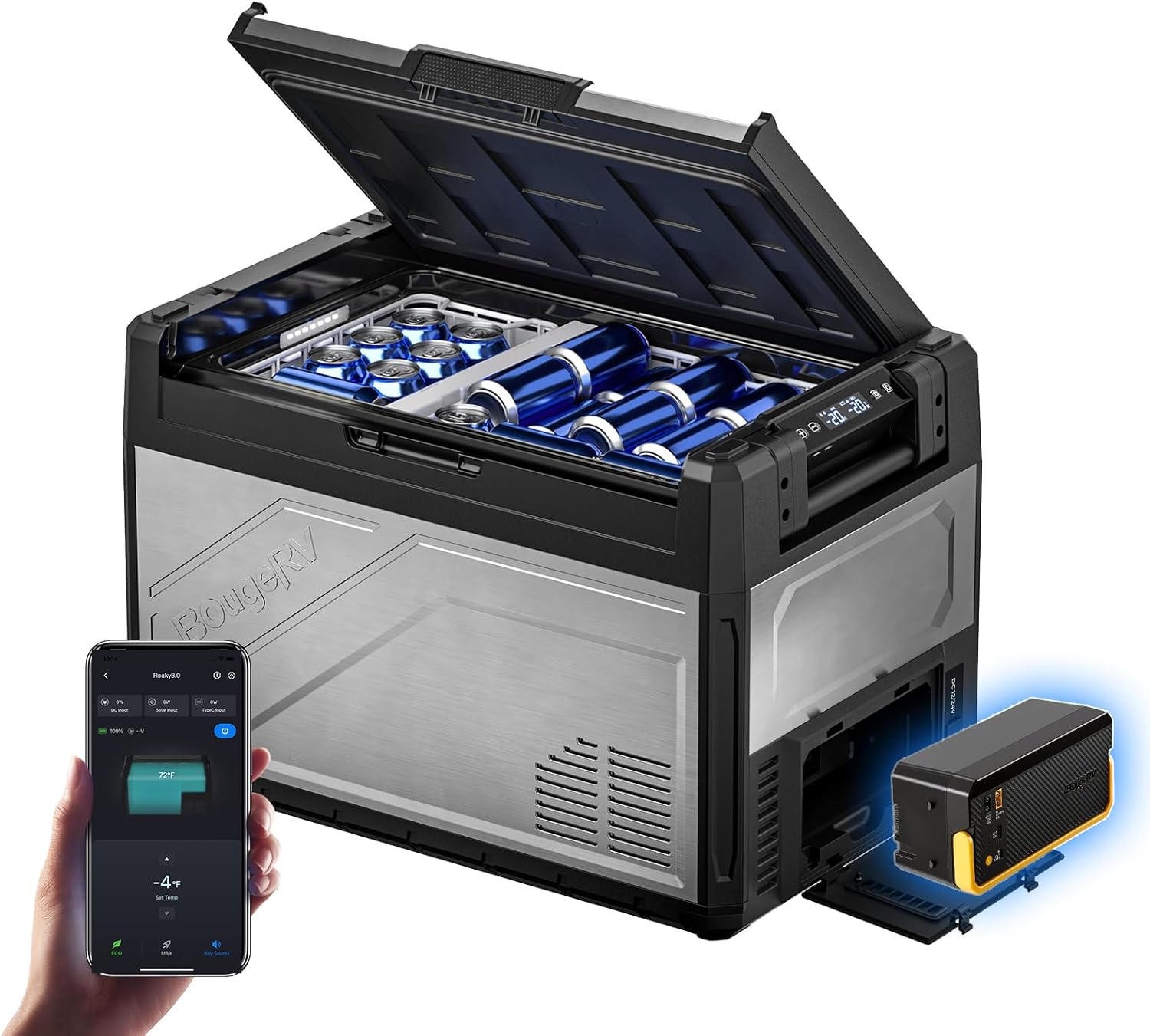
The BougeRV Rocky V3.0 is a compressor car fridge designed for multi‑day road trips and off‑grid use where performance matters. It can operate as a single large compartment or split into two independently controlled zones, letting you freeze and chill different items at the same time; temperature is adjustable from -4°F to 68°F and can be managed locally or via the BougeRV app. The included detachable 240Wh LiFePO4 battery attaches with pogo pins for tool‑free setup and can run the fridge for many hours depending on conditions, and the compressor cooling gives faster, more consistent temperatures than thermoelectric units. Practical touches include removable baskets for organization, manual defrost, and both DC and AC power cords for vehicle or campsite use. Expect a heavy, full‑size portable unit—it delivers capacity and cooling power but is bulkier to move and needs planning for long continuous off‑grid operation beyond the battery's runtime. The metal exterior and compressor performance make it a strong option for buyers prioritizing reliable refrigeration on the road.
Best for: Buyers who need reliable, compressor‑level cooling on multi‑day road trips or camping and prioritize temperature performance and flexible storage over lightweight portability.
Less Ideal for: Users who want an ultra‑light or very compact cooler for short day trips or who need extremely long off‑grid runtime without additional power sources.
- True compressor cooling for faster, stable cooling and freezing
- Flexible single or dual zone layout for simultaneous frozen and chilled storage
- Detachable 240Wh LiFePO4 battery with pogo‑pin connection for easy off‑grid use
- Large 55‑quart capacity suitable for multi‑day trips
- App control for remote temperature and mode adjustments within range
- Included battery provides limited runtime and may require solar or vehicle power for extended trips
- Manual defrost requires periodic maintenance to prevent ice buildup
Verdict: Choose the Rocky V3.0 if you want a high‑performance portable car refrigerator with true compressor cooling and flexible dual‑zone storage for multi‑day trips.
EUHOMY CFC-18 19QT Car Refrigerator

| Capacity | 18 liters |
|---|---|
| Voltage | 12 volts |
| Cooling Method | Compressor |
| Defrost System Type | Frost Free |
| Included Components | AC adaptor, DC power cord, User Manual |
The EUHOMY CFC-18 is a compact 19‑quart compressor fridge built to run from 12V DC in vehicles or 100‑240V AC at home. It cools to freezer temperatures and offers two operating modes (ECO and MAX) plus a fast-chill compressor that can drop interior temperature quickly; an app and Bluetooth control let you monitor and adjust settings remotely. The lid uses a magnetic seal and a rubber gasket to improve insulation, and a low‑noise, anti‑shock design helps it stay quiet and stable on the move. It also includes 3‑level battery protection to prevent vehicle drain and comes with AC and DC power cords and a user manual. Trade-offs are its small capacity—best for drinks, snacks, and short trips—and the chest form factor which limits upright stacking and organization compared with taller models. Energy consumption is listed and it is a freestanding unit, so plan placement in a vehicle or on a countertop.
Best for: Buyers who want a compact, energy‑efficient car fridge that can run from a vehicle or household outlet and who prioritize quiet operation and battery protection for road trips and daily use.
Less Ideal for: Those needing large-capacity refrigeration for long overland trips, group outings, or upright shelving for tall bottles should consider larger or different-format units.
- Dual power inputs for AC and 12V DC use for home and vehicle flexibility
- Compressor cooling that reaches freezing temperatures and supports fast chilling
- Bluetooth and app control for remote temperature monitoring and adjustments
- Three-level battery protection to reduce risk of draining a vehicle battery
- Magnetic sealing lid and gasket for improved insulation and durability
- 19‑quart capacity is small for long trips or for families
- Chest layout limits vertical storage and makes finding items deeper in the unit less convenient
Verdict: A compact, quiet compressor car refrigerator with AC/DC power and battery protection ideal for practical road‑trip and daily-use cooling needs.
Wagan 6-Quart Portable Cooler/Warmer

| Capacity | 6 quarts |
|---|---|
| Cooling method | Thermoelectric (Peltier) |
| Cooling performance | Up to 36°F below ambient |
| Power | 12V DC (vehicle) |
The Wagan 6-Quart Portable Cooler/Warmer is a small thermoelectric fridge that plugs into a vehicle 12V outlet to keep drinks and small food items cool or warm on the road. It cools up to about 36°F below ambient and heats to roughly 140°F, so it can maintain chilled beverages or keep prepared food warm during short trips. The unit holds about nine 12 oz cans and includes a detachable 6 ft DC cord, two external cupholders, and an adjustable nylon carrying strap for easy transport between car and home. Because it uses a thermo-electric Peltier system with no refrigerant, it is lightweight and quiet but not as cold as compressor models and best for short drives or supplemental use rather than long-term refrigeration. It is slim and stable in most vehicle locations and comes UL listed, but it requires the vehicle power source and an optional AC adapter if you want home use. For buyers prioritizing a low-cost, portable solution this unit balances size, convenience, and basic warming/cooling performance.
Best for: Buyers on a tight budget who need a small, portable fridge/warmer for road trips, commuting, or short grocery runs and value convenience over deep cooling performance.
Less Ideal for: Anyone needing long-term cold storage, true freezer temperatures, or heavy-duty transport of temperature-sensitive items should choose a compressor-based or larger model instead.
- Dual cooling and warming modes cover both chilled drinks and hot foods
- Compact 6-quart capacity that fits small spaces and holds about nine 12 oz cans
- Runs from a 12V DC vehicle outlet with a detachable 6 ft cord for easy in-car use
- Lightweight thermoelectric design with included carrying strap and external cupholders
- No refrigerant used, making it quiet and eco-friendly for short trips
- Thermoelectric cooling is less powerful than compressor refrigerators so it cannot sustain very low temperatures in hot conditions
- Designed for 12V vehicle power; AC adapter is sold separately for reliable home use
Verdict: A budget-friendly, lightweight car cooler/warmer that delivers convenient on-the-go cooling and heating for short trips when deep refrigeration is not required.
BODEGACOOLER MCD50 53QT

| Capacity | 53 quarts |
|---|---|
| Temperature range | -4°F to 68°F |
| Cooling method | Compressor |
| Power support | 12/24V DC and 100–240V AC |
| Additional features | IPX4 splash-proof, App control, 31 dB low noise |
The BODEGACOOLER MCD50 is a portable compressor fridge built for road trips, RVs, and tailgating where steady cooling and flexibility matter. It uses a DC compressor to reach temperatures from -4°F to 68°F, offers fast cooling in a high power mode and an ECO mode to conserve battery, and supports 12/24V DC as well as 100–240V AC. Practical touches include an IPX4 splash‑resistant exterior, reversible detachable doors, interior LED lighting, and app control to monitor and change settings remotely. The unit advertises low noise operation (~31dB) and battery protection with H/M/L thresholds so it can run from a vehicle without draining the battery. Tradeoffs are its weight and footprint for a 53QT class cooler and the fact that very low temperatures and fastest cooling rely on higher power draw, so off‑grid runtime depends on the power source and mode chosen. For buyers who prioritize dependable compressor cooling and vehicle-ready features, this fridge balances performance and rugged convenience.
Best for: Someone who needs a rugged, vehicle-ready refrigerator that reliably holds freezer or fridge temperatures on trips and values remote control and battery protection.
Less Ideal for: Buyers wanting an ultra-light, backpackable cooler or those who need long runtime from small portable battery packs without access to AC or high-capacity DC power.
- Wide temperature range from -4°F to 68°F for freezer or cooler use
- Compressor cooling with fast‑cool MAX mode and ECO mode for extended runtime
- Multiple power options (12/24V DC and 100–240V AC) plus battery protection settings
- IPX4 splash resistance and anti‑shock design for vehicle and outdoor use
- App control and interior LED light for remote monitoring and convenience
- Larger physical footprint and weight compared with smaller portable coolers
- Fastest cooling and lowest temperatures require higher power, impacting off‑grid runtime
Verdict: Choose the MCD50 when you want a dependable, vehicle-ready compressor fridge that delivers fast cooling, app monitoring, and battery protection for road and RV use.
Cooluli Classic 4L Mini Fridge

| Capacity | 4 liters |
|---|---|
| Cooling Method | Thermoelectric |
| Power Source | AC/DC/USB |
| Voltage | 110 volts |
| Number Of Shelves | 2 |
The Cooluli Classic 4L is a lightweight thermo-electric mini fridge that cools or warms small items and is built for portable use in bedrooms, offices, dorms, and cars. It runs on AC, DC, or USB power and includes cords for each, so you can plug it into a wall outlet, a vehicle, or a compatible power bank. The unit cools roughly 20°–22°C (35°–40°F) below ambient and warms up to about 65°C (149°F), making it useful for drinks, snacks, skincare products, breast milk, and medications that need moderate cooling or gentle warming. Its molded top handle and 4-liter capacity fit a few cans or jars, and the quiet semiconductor operation is energy-efficient and refrigerant-free. Limitations include the small capacity—only a few items fit at once—and the thermo-electric method cannot reach freezer temperatures or perform as efficiently as compressor fridges in very hot conditions or sustained long trips. The simple controls and included cords make it easy to use on the go, but buyers needing true refrigeration performance or larger storage should consider a compressor model instead.
Best for: Buyers who want a compact, grab-and-go fridge for short road trips, car use, or storing skincare and meds on a countertop and prioritize portability and flexible power options backed by many user reviews.
Less Ideal for: People who need freezer-level cooling, sustained cold performance in hot environments, or capacity for multiple beverages and food items should choose a compressor-based or larger portable refrigerator instead.
- AC, DC and USB power options for wall, vehicle, or power-bank use
- Quiet, energy-efficient thermo-electric cooling that uses no refrigerants
- Very lightweight and portable with a molded handle for easy carrying
- Simple cool/heat switch and included cords make setup straightforward
- Small 4-liter capacity limits how much you can store at once
- Thermo-electric cooling cannot reach freezer temperatures and is less effective in very hot ambient conditions
Verdict: Choose the Cooluli Classic 4L when you need an ultra-portable, multi-power mini fridge for short car trips and countertop storage.
BougeRV CR22 23-Quart Portable Refrigerator

| Capacity | 23 quarts |
|---|---|
| Temp range | -8°F to 50°F (-22°C to 10°C) |
| Power source | 12/24V DC, 100–240V AC |
| Cooling method | Compressor |
| Noise level | 45 dB |
The BougeRV CR22 is a compact 23‑quart compressor refrigerator that doubles as a freezer and is aimed at camping, road trips, and vehicle use. It uses a compressor cooling system to reach low temperatures quickly — the manufacturer claims cool-down to 32°F in about 15 minutes and to -5°F in roughly 50 minutes — and runs from 12/24V DC or 110V AC using the included cords. Practical features include a top-opening chest form factor, an electronic lock, a manual defrost, and a three-level battery protection system so you can set a shutoff voltage to avoid draining a vehicle battery. The unit is relatively quiet at around 45 dB and is engineered to operate on uneven terrain and up to a 30° tilt. Trade-offs are its modest 23‑quart capacity and roughly 22 lb weight, which limit how much you can store and where it fits in tight vehicle spaces, and the lack of app or Wi‑Fi control. For buyers who prioritize reliable cooling, vehicle-safe operation, and energy efficiency in a small portable package, the CR22 is a practical choice.
Best for: Buyers who want a dependable, vehicle‑friendly fridge that cools quickly, protects a car battery, and performs quietly on trips or overlanding.
Less Ideal for: People who need large-capacity refrigeration for long family trips or who require smart app control and remote monitoring features.
- Compressor cooling delivers faster, lower temperatures than thermoelectric models.
- Multi-power inputs: runs on 12/24V DC and 100–240V AC with included cords.
- Built-in 3-level battery protection to prevent vehicle battery drain.
- Relatively quiet operation (~45 dB) and can operate tilted up to 30° for off-road use.
- Compact 23‑quart capacity that fits in many cars and vans.
- No app, Wi‑Fi, or remote monitoring available.
- Manual defrost requires occasional maintenance.
- Not large enough for extended group trips or heavy grocery hauls.
Verdict: A compact, vehicle‑safe compressor fridge that cools quickly and protects your car battery, making it a reliable choice for risk‑averse travelers.
Choosing the Right Portable Refrigerator for Cars: Key Factors to Consider
Cooling Performance
How quickly and how far a portable refrigerator can lower its internal temperature affects food safety and convenience. Faster cool-down times let you put groceries in after a shop and reach safe temperatures before they spoil. The unit's ability to hold set temperatures under hot ambient conditions also matters if you plan to use it in summer or in a parked car.
Look at rated temperature delta below ambient and whether the unit uses compressor or thermoelectric cooling, because those technologies have different strengths. Also consider temperature control resolution and whether the fridge can switch modes between fridge and freezer settings.
Power Draw and Vehicle Compatibility
Power consumption determines how long the refrigerator can run from a vehicle electrical system. Low idle draw is important for overnight use or long stops without running the engine. Units that support 12V DC input with built-in low-voltage cutoffs reduce the risk of draining a car battery.
Check for multiple power input options such as 12V DC, 24V DC (for larger vehicles), and AC adapter support for home use. Also note if the fridge has an efficient compressor and whether manufacturers provide real-world current draw figures rather than just wattage ratings.
Size, Capacity, and Internal Layout
A refrigerator that fits the available space in your vehicle and carries the right mix of items is more useful than a larger unit that barely fits. Consider both external footprint and internal usable volume. Shelves, dividers, and removable baskets let you organize bottles, meal packs, and loose items more effectively.
Think about lid swing direction and whether the unit fits under seats, in a trunk, or on a truck bed. Also account for the volume you need for expected trips versus occasional use; oversized capacity can waste energy, while undersized units force compromises.
Cooling Reliability and Insulation
Reliable components and good insulation determine how well the fridge holds temperature when briefly unplugged or when compressor cycles are long. High-quality insulation reduces compressor workload and improves efficiency, while robust seals prevent warm air ingress.
Consider construction materials and gasket quality, plus whether the unit uses dual-layer insulation or vacuum panels. Durable hinges and lid latches are also important because they see frequent use in mobile environments.
Installation, Mounting, and Portability
How you secure and power the refrigerator affects safety and convenience. Look for units with built-in tie-down points, optional mounting kits, and easy-to-access power ports. Weight and carry handles influence portability for moving the fridge between vehicle and campsite.
Also evaluate how simple it is to route power cables and whether the unit comes with vehicle-compatible plugs. Quick-disconnect power leads or dedicated vehicle wiring adapters make installation cleaner and reduce the chance of accidental unplugging while driving.
Controls, Monitoring, and Safety Features
User controls determine how precisely you can set and monitor temperatures on the road. Digital controls with clear displays are easier to use while driving, and features such as temperature memory, alarms, and battery-protect settings add practical safety.
Important safety features include low-voltage cutoffs, fuses or circuit protection, and thermal overload protection for the compressor. Remote monitoring or smartphone connectivity can be useful, but prioritize reliable local controls for everyday use.
Compressor Vs Thermoelectric Cooling
Two common cooling technologies appear in portable refrigerators for cars: compressor-based systems and thermoelectric units. Compressor refrigerators operate like small home fridges and can reach much lower temperatures and maintain them under higher ambient heat, making them suitable for perishable food and freezer use.
Thermoelectric coolers are lighter and quieter but typically cannot achieve or hold very low temperatures, especially in hot environments. Choose compressor models if you need freezer-level temperatures or reliable performance in warm climates. For short drives and beverages, a thermoelectric solution may be adequate.
- Compressor: lower temps, better in heat, higher power draw but more effective.
- Thermoelectric: lighter, lower upfront cost, limited cooling in hot ambient conditions.
Managing Power on the Road
Plan how you will power the refrigerator during stops and overnight. Many car refrigerators run directly from a 12V accessory socket while driving, but long idling periods require attention to avoid battery drain. Use units with adjustable low-voltage cutoffs or pair with an auxiliary battery or battery isolator if you expect long stationary use.
When running from an inverter or campsite power, confirm the unit's AC input compatibility and whether an efficient external adapter is supplied. Monitoring real-world current draw during the first few uses helps set realistic expectations for runtime between charges.
- Enable low-voltage cutoff to protect car battery.
- Consider an auxiliary battery for long stops or camping.
- Measure current draw at your intended setpoint to estimate run time.
Practical Installation Tips
Measure the available footprint in your vehicle and test-fit the unit before committing. Consider how the fridge will be accessed from seating positions and whether the lid orientation allows convenient loading in tight spaces. If you plan to secure the unit, use integrated tie-down points or a mounting kit.
Route power cables to minimize trip hazards and avoid pinching when closing lids or doors. For permanent installs, consider a fused inline connection to the vehicle battery with a switch or relay controlled by the ignition.
- Test lid clearance and swing direction in the vehicle.
- Use mounting points or skid-resistant mats to reduce movement.
- Protect wiring with conduit or split-loom tubing where it passes through body panels.
Organizing the Interior for Different Uses
Think about how you will use the refrigerator day to day. Removable baskets, dividers, and bottle holders help separate frozen goods from chilled items and make access faster. Using insulated containers or resealable bags can improve organization and reduce cold air loss when the lid is opened.
For mixed loads, set aside a basket for everyday snacks and another for raw ingredients to limit cross-contamination. Labeling sections or baskets can speed retrieval while traveling and helps prevent leaving perishables behind.
- Use removable baskets for quick access.
- Store frequently used items near the top to minimize lid-open time.
- Group similar items together to maintain stable internal temperatures.
Maintaining and Troubleshooting On the Road
Regular maintenance extends the life of a portable refrigerator. Keep the exterior and interior clean, check seals and gaskets for wear, and inspect power connections regularly. A quick pre-trip checklist that verifies power leads and setpoints helps avoid surprises.
If you notice unusual noises or higher than expected current draw, verify ventilation around the condenser and look for obstructed airflow. Inconsistent temperatures can stem from poor sealing, frequent lid opening, or a failing compressor; address these issues promptly to protect stored food.
- Clean the gasket and interior after spills to prevent odors.
- Ensure ventilation space around compressor areas during operation.
- Carry spare fuses and a multimeter for basic diagnostics.
How We Chose the Best Portable Refrigerator for Cars
We applied a focused set of filters to identify portable refrigerators suited specifically for use in cars. First, we required proven cooling performance across typical car voltage inputs so units can reach and maintain safe temperatures in warm conditions. Second, energy efficiency and low idle draw were prioritized to minimize the impact on a vehicle battery during short stops or overnight use. Third, we evaluated size and internal layout to ensure the refrigerator fits common vehicle cargo spaces while offering practical storage configurations. Fourth, build quality and insulation effectiveness were considered because durable construction and good insulation improve cooling retention and reduce compressor runtime. Fifth, installation and power options were assessed, including 12V DC compatibility, optional AC adapters, and battery-protection features. We excluded units intended only for home or stationary use and any products that lack vehicle-specific power compatibility. The final shortlist emphasizes measurable specs—cooling delta, current draw at typical setpoints, usable internal volume, and physical footprint—along with real-world usability factors such as mounting points, lid orientation, and service access.
Our full evaluation process is outlined in our review methodology.
FAQ
Can I run a portable refrigerator from my car accessory socket?
Often yes, many portable refrigerators are designed for 12V accessory sockets. However, accessory sockets vary in rated current, so check the fridge's current draw and confirm the socket can handle continuous use. For long durations, a direct fused connection to the battery or an auxiliary battery is safer.
Will a portable car refrigerator drain my vehicle battery overnight?
It depends on the fridge's idle draw and whether the engine is running. Models with low-voltage cutoffs and efficient compressors minimize the risk, but extended overnight use without an auxiliary power source can drain a battery. Use a cutoff feature or a separate battery to avoid unplanned depletion.
What size refrigerator should I pick for a weekend trip?
Choose capacity based on the number of people and the type of food you plan to carry. For two people on a weekend, a compact unit with organized interior space often suffices. If you need to store frozen items or supply for more people, opt for a larger usable volume but ensure it fits your vehicle.
How do I secure the refrigerator while driving?
Use built-in tie-down points, mounting brackets, or non-slip mats to prevent shifting. For permanent installs, secure a fused power connection and consider mounting hardware that attaches to existing anchor points in the vehicle. Proper securing reduces wear and improves safety in sudden stops.
Is a compressor fridge noisy inside a car?
Compressor units do produce noise during cycling, but many modern designs are engineered to be relatively quiet. Noise perception depends on vehicle insulation and placement. If interior quiet is a priority, test or ask for typical operating noise levels before choosing a unit.
Final Verdict
Choosing the right portable refrigerator for cars comes down to matching cooling capability, capacity, and power management to your travel habits. Prioritize compressor-based cooling if you need freezer temperatures or frequent use in hot conditions, and emphasize low idle draw and battery protection for long stops. Fit and installation are equally important: choose a size and mounting approach that keep the unit secure and accessible. Balance the tradeoffs between efficiency, interior layout, and portability based on how you travel. With the evaluation criteria above, you can narrow options quickly and pick a refrigerator that reliably keeps food safe and beverages chilled on the road.