
Note: This article contains affiliate links. If you click on these links and make a purchase, we may earn a small commission at no extra cost to you. This helps support our research and content. Read our full affiliate disclosure here.
If you want to speed up dinner, reduce hands-on time, and get reliably tender results, choosing the right pressure cooker matters. The best options balance fast heating and consistent pressure with simple controls and safe, serviceable construction. This guide gathers a shortlist of seven top-rated pressure cookers that cover common home uses, from weeknight stews to batch-cooking grains and beans. We evaluated each model for cooking performance, safety features, ease of cleaning, and long-term durability so you can focus on the most useful differences. Read on for the top picks and the specific features to weigh before buying.
Top Picks at a Glance
| Best Overall The best all-around choice for most situations | Ninja HyperHeat Pressure Cooker PC201SP |  |
| Best Quality Built to a higher standard if you want something more solid | Breville Fast Slow Go 6-Quart |  |
| Best Value The sweet spot between price and what you get | COMFEE' 6-Quart Electric Pressure Cooker |  |
| Best Budget The cheapest option that still gets the job done reliably | OLIXIS 10‑in‑1 Electric Pressure Cooker |  |
| Top Rated A top-rated pick with lots of positive feedback | Cosori Pressure Cooker 6QT |  |
| Most Popular A crowd favorite that many people choose with confidence | Instant Pot Duo 6-Quart |  |
| Best Seller A high-volume bestseller chosen again and again | Instant Pot RIO Mini 4‑Quart |  |
Ninja HyperHeat Pressure Cooker PC201SP
| Wattage | 1200 watts |
|---|---|
| Capacity | 6 quarts |
| Operation Mode | Both Manual and Automatic |
| Special Features | Keep Warm Setting |
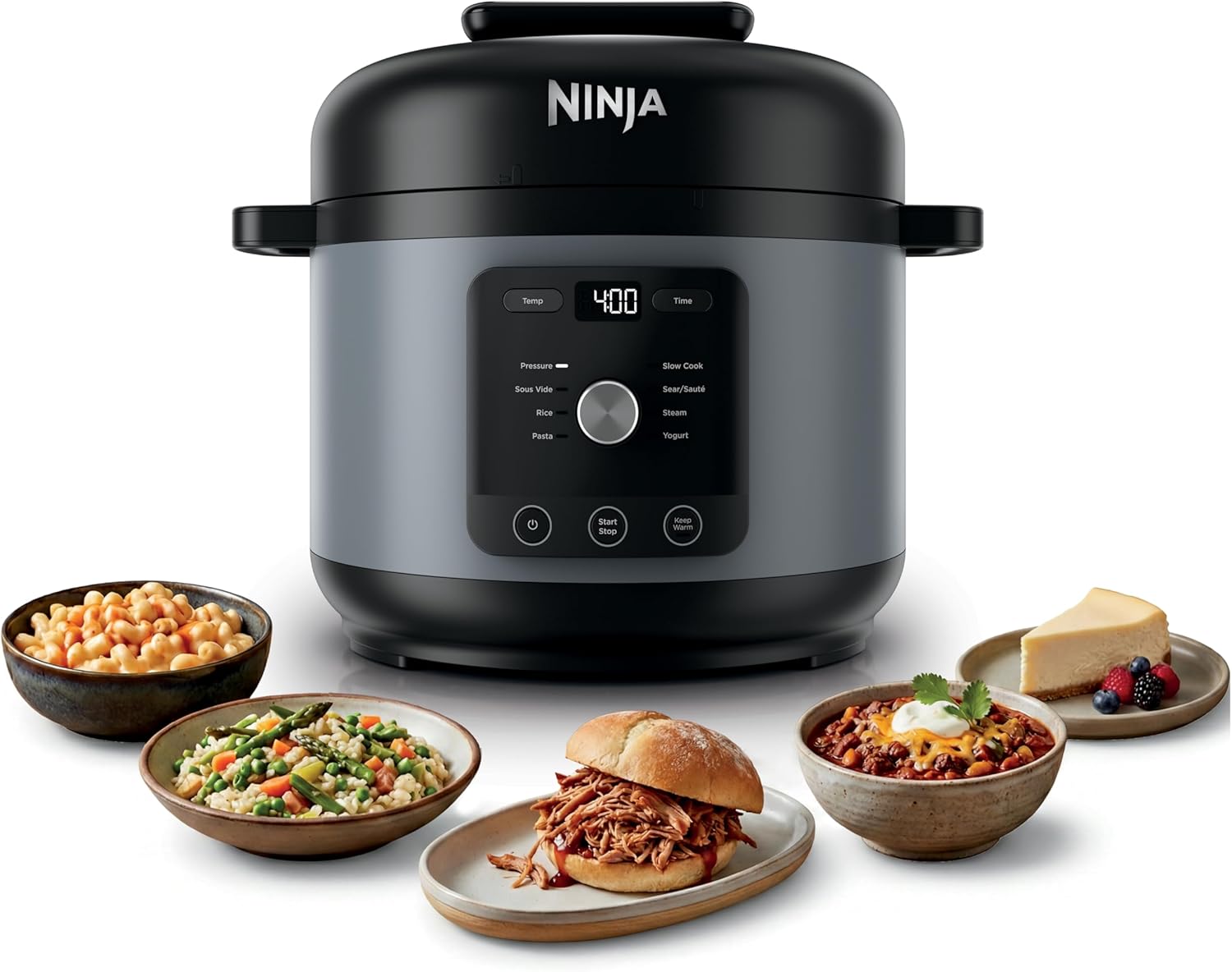
The Ninja HyperHeat Pressure Cooker is a versatile 9-in-1 multi cooker that combines pressure cooking, slow cooking, rice, sous vide, steaming, searing/sautéing, and yogurt-making in a single 6.5-quart unit. HyperHeat technology and a 1200-watt base bring the pot up to pressure quickly, shortening cook times compared with traditional slow methods, while the wide 9.5-inch cooking surface makes it practical to sear and brown without extra pans. The removable SimpliServe pot with a PFAS-free ceramic nonstick finish lets you serve directly from the pot and simplifies cleanup after high-heat use. Controls are push-button with both manual and automatic modes and a keep-warm setting for finishing and holding food. Trade-offs to consider are the unit weight and footprint, which are substantial compared with smaller multi-cookers, and ceramic nonstick can need gentler utensils to preserve the surface. For everyday home cooks who want a single appliance that replaces several others, this model delivers powerful, flexible performance and easy serving.
Best for: Home cooks who want a single, capable appliance to pressure cook, sear, steam, sous vide, and serve without swapping pans and who value faster cook times and easy cleanup.
Less Ideal for: Buyers who need a very compact, lightweight cooker for small kitchens or who prefer stainless steel inner pots that tolerate metal utensils and rougher handling.
- 9-in-1 functionality replaces multiple appliances for a wide range of recipes
- 1200-watt HyperHeat system reaches pressure quickly for faster cook times
- Removable SimpliServe pot enables serving straight from the cooker
- PFAS-free ceramic nonstick pot makes cleanup easier after high-heat cooking
- Relatively heavy and takes up more counter space than compact models
- Ceramic nonstick surface can be more delicate than metal finishes
Verdict: Choose this Ninja if you want a powerful, all-in-one pressure cooker that speeds cooking and serves directly from a removable pot.
Breville Fast Slow Go 6-Quart

| Wattage | 1100 |
|---|---|
| Voltage | 120 |
| Number of settings | 14 |
| Capacity | 6 quarts |
The Breville Fast Slow Go is a versatile 6‑quart electric multi‑cooker built for cooks who want performance and flexibility in one appliance. It offers 14 preset modes including pressure cook, slow cook, sauté, steam, risotto, yogurt and sous‑vide, all accessed via responsive touch controls. Dual sensors at the top and bottom provide tighter temperature and pressure control, and a three‑way safety system with automatic steam release makes high‑pressure cooking safer and less fussy. The stainless steel inner bowl and an easy‑clean moat help keep maintenance straightforward, and included accessories like a trivet and condensation collector are useful out of the box. Practical downsides are its relatively heavy build and that mastering all the shortcuts takes a few tries to get consistent results compared with simple single‑function cookers. For performance‑minded users the Fast Slow Go delivers reliable, repeatable cooking and useful precision features, though it demands a bit of counter space and a short learning curve to fully exploit its capabilities.
Best for: Aiming for restaurant‑style results at home, this suits cooks who prioritize precision, versatility, and control across pressure cooking, sous‑vide and slow cooking workflows.
Less Ideal for: If you want a simple, lightweight cooker for occasional one‑pot meals or very limited counter space, a basic single‑function pressure cooker would be a better fit.
- Wide range of 14 preset cooking modes for pressure, slow, sous‑vide, yogurt and more
- Dual top and bottom sensors for more accurate temperature and pressure control
- Stainless steel inner bowl with easy‑clean moat reduces sticking and simplifies cleanup
- Three‑way safety system and automatic steam release improve safe high‑pressure operation
- Heavier, bulkier unit that requires significant counter or storage space
- Multiple presets and shortcuts require time to learn for consistently repeatable results
Verdict: Choose the Breville Fast Slow Go if you want a high‑performance, multi‑function 6‑quart cooker that delivers precise temperature and pressure control for ambitious home cooks.
COMFEE' 6-Quart Electric Pressure Cooker

| Capacity | 6 quarts |
|---|---|
| Wattage | 1000 |
| Control Method | Touch |
| Cooking Program | Cook, Keep Warm, Reheat, Simmer, Steam |
| Voltage | 120 volts |
The COMFEE' 6-quart electric pressure cooker is a versatile countertop multicooker that handles pressure cooking, slow cooking, steaming, sautéing and more through its 14 presets. You use it like other one‑pot multicookers: choose a preset or set a custom time, lock the lid, and let the unit build pressure to speed up meals or use the slow cook and keep warm modes for set‑and‑forget cooking. Notable features include a touch control panel, a 24‑hour delay timer, and ten safety protections including auto pressure release and a lid lock. The included accessories like a rice ladle, measuring cup and steam rack make it ready to use out of the box. Practical benefits are fast braises, tender beans and hands‑off rice with fewer dirty pans, plus dishwasher‑safe parts for easier cleanup. Tradeoffs are typical for aluminum inner pots: they heat quickly but can be less durable than stainless steel and may require careful care to avoid scratching the nonstick surface, and the unit is a mid‑range 1000W model so it will not reach extremely high pressure speeds compared with higher‑wattage commercial units.
Best for: Practical home cooks who want a single, programmable cooker to speed weekday meals and replace several appliances with an easy-to-use, safety-minded unit.
Less Ideal for: Users seeking a heavy-duty, professional-grade pressure cooker with the fastest pressure build times or those who prefer stainless-steel inner pots for long-term durability.
- 14 programmable presets cover pressure cooking, slow cooking, steaming, sauté and yogurt making
- Touch control panel with 24-hour delay timer for convenient meal planning
- Ten safety features including auto pressure release and lid-safety lock
- Comes with useful accessories like rice ladle, measuring cup and steam rack
- Aluminum inner pot may be less durable than stainless steel and can scratch if not carefully maintained
- 1000W power is adequate for home use but slower to reach pressure than higher-wattage models
Verdict: A practical, safety-focused 6-quart multicooker that simplifies everyday meals with a wide set of presets and convenient timer features.
OLIXIS 10‑in‑1 Electric Pressure Cooker

| Capacity | 3 quarts |
|---|---|
| Wattage | 700 watts |
| Controller Type | Digital |
| Special Features | Programmable |
The OLIXIS 10‑in‑1 Electric Pressure Cooker is a small, budget-focused multi cooker meant for everyday meals in one to two person kitchens. It offers ten presets—rice, meat, stew, yogurt, canning, steam and more—operated from a simple digital panel and a 24‑hour delay start so you can time meals ahead. The 3‑quart ceramic‑coated inner pot makes food release and cleanup easier than bare stainless steel, while the stainless outer housing looks sturdy. Rated at 700 watts, it reaches cooking pressure quickly and claims faster finish times versus conventional methods, and built‑in pressure release valves and heat sensors add safety for routine use. Because it is compact, it is best for small portions and counter spaces and will not replace a larger family cooker for big batch meals. The control set is straightforward but lacks advanced customization found on pricier models. For a low cost cooker that saves time and handles daily staples with minimal fuss, this OLIXIS unit does the job well.
Best for: Buyers on a tight budget who need an affordable, easy-to-use multi cooker for daily meals in small households and limited counter space.
Less Ideal for: Those who regularly cook for families, host dinners, or need precise, high‑power pressure cooking for large batches should choose a larger or more advanced model.
- Ten one‑touch presets cover common meals for quick hands‑off cooking
- Ceramic nonstick inner pot simplifies food release and cleanup
- Compact 3‑quart size fits small kitchens and cooks small portions efficiently
- 24‑hour delay start and automatic keep‑warm make meal timing flexible
- Triple safety protections including pressure release valves and heat sensors
- 3‑quart capacity is too small for large families or batch cooking
- Limited power and fewer advanced settings compared with higher-end models
Verdict: A low‑cost, compact multi cooker that delivers convenient one‑touch pressure cooking for small households.
Cosori Pressure Cooker 6QT
| Capacity | 6 quarts |
|---|---|
| Wattage | 1100 watts |
| Control Method | Touch |
| Inner Pot | Ceramic nonstick, BPA-free |
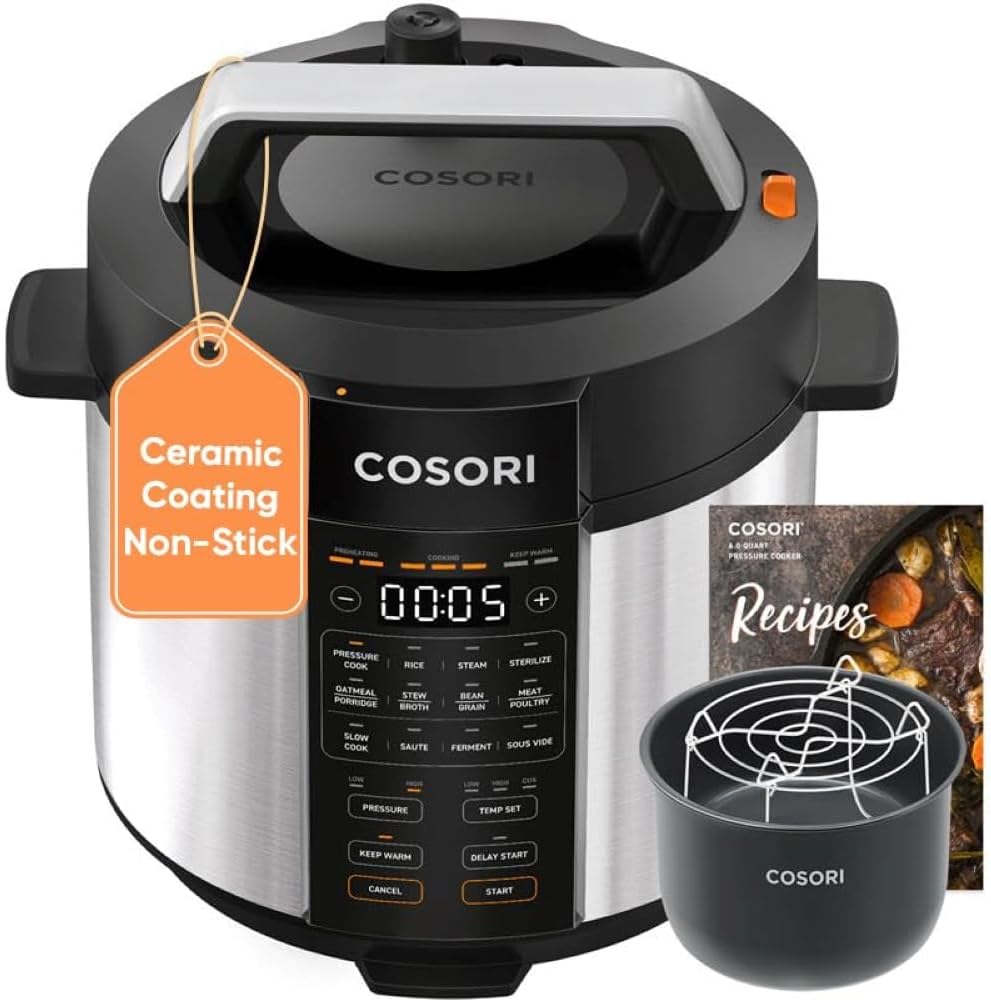
The Cosori 6‑quart pressure cooker is a versatile electric multi-cooker designed to handle everything from rice and beans to sous vide and fermenting, consolidating many tasks into a single countertop appliance. It offers 9 core cooking functions and 13 presets controlled via a touch panel, plus manual physical buttons for straightforward operation. Key practical features include an easy lid-locking alignment, a widened gap for simpler cleaning, a dishwasher-safe lid, and a BPA-free nonstick ceramic inner pot that reduces sticking and washes easily. Safety gets attention with a backward-angled steam release, a seal/vent button placed away from the steam path, a double-layer anti-scald lid, and overheat protection. At 1100 watts it brings pressure up quickly for faster cooking, and the included steam rack and recipe book add useful convenience. Limitations to note are the 6‑quart capacity, which may be small for large families or batch cooking, and the stainless steel exterior adds weight and footprint compared with more compact models. For buyers prioritizing an all-in-one, safety-minded cooker, this delivers reliable everyday performance.
Best for: Someone who wants a dependable, safety-focused multi-cooker that replaces several single-use appliances and delivers consistent results for everyday meals.
Less Ideal for: Buyers who need very large batch capacity or a lightweight, ultra-compact unit for limited counter space should consider other options.
- Multiple cooking modes and 13 presets cover pressure cook, rice, steam, sous vide, ferment, slow cook, and more
- BPA-free ceramic nonstick inner pot that is dishwasher-safe for easier cleanup
- Built-in safety features including angled steam release, separated seal/vent button, double-layer anti-scald lid, and overheat protection
- 1100 W power brings pressure up quickly for shorter cook times
- 6-quart capacity may be too small for large households or frequent batch cooking
- Relatively heavy and sizable stainless steel housing takes more counter space than compact alternatives
Verdict: A safety-minded, all-in-one 6‑quart multi-cooker that reliably speeds up everyday cooking while simplifying cleanup.
Instant Pot Duo 6-Quart

| Capacity | 5.68 liters |
|---|---|
| Wattage | 1000 watts |
| Control Method | Touch |
| Voltage | 120 |
| Material | Stainless steel |
The Instant Pot Duo is a versatile countertop multicooker that replaces several appliances by offering pressure cook, slow cook, sauté, steam, rice, yogurt, and keep-warm functions. You use it to speed braises, cook beans and rice, make soups and stews, or finish weeknight meals with one-touch programs; the unit's 13 preset smart programs simplify common recipes while the touch controls make operation straightforward. Its 1000-watt heater and tri-ply stainless steel inner pot handle searing and even heat distribution better than thin aluminum inserts, and the included steamer rack expands steaming options. Safety features include an easy-seal lid and multiple protections for worry-free pressure cooking, and the dishwasher-safe lid and inner pot ease cleanup. Limits are typical for this class: it takes counter space and has a learning curve for pressure timings versus traditional methods, and you must follow release instructions to avoid hot steam. For buyers valuing proven performance and broad recipe support, this model delivers reliable, everyday results.
Best for: Buyers who want a reliable, well-proven all-in-one cooker with broad recipe support and visible social proof from many users, prioritizing safety and everyday versatility.
Less Ideal for: If you need a single-purpose device or have extremely limited counter space, a dedicated appliance or a more compact cooker would be a better fit.
- Seven built-in cooking functions replace multiple appliances
- Stainless steel inner pot with tri-ply bottom for better searing and even heat
- 13 one-touch programs simplify common recipes
- Multiple safety mechanisms including easy-seal lid and overheat protection
- Dishwasher-safe inner pot and lid for easier cleanup
- Learning curve for pressure settings and steam-release procedures
- Requires dedicated counter/storage space
Verdict: Choose the Instant Pot Duo if you want a safe, proven multicooker that consolidates seven kitchen tasks into one dependable 6-quart appliance.
Instant Pot RIO Mini 4‑Quart

| Capacity | 4 quarts |
|---|---|
| Wattage | 800 watts |
| Control Method | Touch |
| Voltage | 120 volts |
The Instant Pot RIO Mini is a small, versatile multi‑cooker built for everyday home cooking where counter space is limited. It packs seven functions into a 4‑quart stainless steel pot so you can pressure cook stews and beans, slow cook, sauté ingredients, steam vegetables, cook rice, make yogurt, or keep food warm without switching appliances. The unit uses an 800‑watt, touch control interface and includes a sealing ring, steam rack, and condensation collector for practical use. The clear progress indicator and auto‑sealing lid simplify operation for cooks who prefer low‑risk, set‑and‑return cooking, and the dishwasher‑safe lid and pot make cleanup straightforward. Because it is compact, it is best for singles, couples, or small families rather than large batches, and the lower wattage and smaller volume mean longer hands‑off times compared with larger, higher‑powered models when filling multiple portions. Safety features such as overheat protection and an auto‑sealing locking lid make it a reassuring choice for cautious buyers.
Best for: Buyers who prioritize safety, simplicity, and space‑saving design and want a reliable all‑in‑one cooker for small households or everyday meals.
Less Ideal for: Not a good fit for users who need to prepare large family meals or cook big batches frequently, or for those who want the fastest possible high‑power cooking performance.
- Seven cooking modes in one compact footprint for versatile meal prep
- Auto‑sealing lid and overheat protection for safer unattended cooking
- Dishwasher‑safe stainless steel pot and lid parts simplify cleanup
- Clear progress indicator and touch controls make operation easy to monitor
- 4‑quart capacity limits batch cooking for larger families
- 800 watts is lower than larger models so some recipes may take longer
Verdict: A safe, compact multi‑cooker that delivers the core Instant Pot experience for small households and cautious buyers who want dependable, easy-to-use pressure cooking.
Choosing the Right Pressure Cooker: Key Factors to Consider
Pressure Performance
How quickly a cooker reaches target pressure and how stably it holds that pressure determines cooking time accuracy and recipe reliability. Faster time-to-pressure shortens total meal time but requires consistent sealing and a capable heat source. Stable pressure during long cycles matters for foods like beans or tough cuts of meat that need steady conditions to tenderize evenly.
When evaluating pressure performance, consider whether the cooker offers multiple pressure settings and how straightforward those settings are to use. Also check how the cooker vents and re-pressurizes during short steam releases, since that affects repeated cook cycles and can change results in multi-stage recipes.
Safety Features
Pressure cookers store significant energy, so redundant safety systems are essential. Look for secure lid locks that prevent opening under pressure, clearly labeled pressure-release valves, and automatic pressure-limiting mechanisms. A visible pressure indicator helps you confirm when it is safe to open the lid.
The design of the lid handle and release mechanism affects how easily you can perform controlled steam releases without risking burns. A pressure cooker with simple, well-documented safety steps reduces the chance of user error and provides peace of mind during first-time use.
Capacity And Shape
Capacity determines how much you can cook in a single cycle and affects how a cooker fits into your kitchen routine. Smaller pots heat faster and suit singles or couples, while larger capacities are better for families or batch cooking. The internal shape matters too; wider, shallow pots brown and reduce liquid faster, while taller, narrower pots are better for stacks or whole roasts.
Consider how often you will cook larger quantities versus single portions, and whether the appliance will need to store easily. Also think about whether you will use inserts, steaming baskets, or separators that change the effective usable volume.
Material And Build Quality
The materials used for the pot and lid affect heat transfer, longevity, and maintenance. Heavy-gauge stainless steel and solid-clad bases provide more even heating and resist warping. Nonstick interiors make cleanup easier but may wear over time, while bare stainless steel tolerates higher-heat searing and is generally more scratch resistant.
Pay attention to gasket material and how the lid seals to the pot, since replacement parts determine long-term upkeep costs. Robust handles and well-mounted hinges also extend the useful life of the cooker under frequent use.
User Controls And Ergonomics
Controls should be intuitive and reliable. For electric models, clear presets and simple timers reduce the learning curve. For stovetop units, ease of adjusting heat while monitoring pressure matters. Large, accessible handles and a lid that locks and unlocks cleanly improve everyday usability.
Small details like whether the lid can be set aside safely, how easy it is to remove and clean the gasket, and whether measurement markings are present inside the pot all affect daily convenience.
Cleaning And Maintenance
Routine cleaning affects both hygiene and appliance longevity. Removable gaskets, dishwasher-safe parts, and simple lid designs make upkeep fast and less error prone. Trapping of food in crevices or around valves can lead to odors or degraded seals over time, so a design that minimizes hidden nooks is preferable.
Also consider the availability and ease of replacing wear items, such as gaskets and pressure valves. A cooker that is easy to maintain will perform reliably for longer and avoid unexpected failures.
Stovetop Versus Electric Pressure Cookers
Stovetop units usually heat faster and allow more direct control over pressure by adjusting stove heat, which appeals to cooks who prefer manual intervention. Electric pressure cookers provide convenience through presets and automatic timing, making them easier for repeatable recipes and hands-off cooking.
Think about how you cook most often. If you like to brown ingredients directly in the pot and fine-tune heat, a stovetop unit may be preferable. If you want set-and-forget convenience and integrated timers, an electric model simplifies workflow.
- Stovetop: faster heat response, better for high-heat searing.
- Electric: built-in timers, consistent automation, more safety interlocks.
- Both types benefit from good gasket maintenance and clear pressure indicators.
How To Size A Pressure Cooker For Your Household
Choose capacity based on typical batch sizes. Singles and couples often find 3 to 4 quart pots sufficient, while families and batch cooks usually prefer 6 to 8 quarts. If you frequently cook whole chickens or larger roasts, prioritize a larger internal volume.
Also account for headspace required when cooking foods that expand, such as rice or dried beans. Overfilling a pressure cooker increases the risk of clogging valves and uneven cooking.
- 3 to 4 quarts: singles, small households, quick sides.
- 5 to 6 quarts: couples and small families.
- 7+ quarts: larger families, batch cooking, whole birds.
Routine Care And Gasket Replacement
The gasket is a wear item that affects sealing and pressure performance. Inspect it regularly for cracks, compression set, or food buildup. A worn gasket can slow time-to-pressure and cause inconsistent results.
Keep a small kit of replacement parts or know the replacement interval. Cleaning the gasket and lid after each use and storing the lid propped or inverted helps prevent odors and preserves elasticity.
- Wipe and air-dry the gasket after each use.
- Replace the gasket when it shows visible wear or when pressure performance degrades.
- Clean valves and steam ports with a soft brush to avoid clogging.
Common Cooking Techniques For Pressure Cooking
Pressure cookers excel at braising, cooking dried beans, tenderizing tough cuts, and steaming grains quickly. Use high pressure for dense, slow-cooked foods and lower pressure for delicate proteins and vegetables. Brown ingredients first when flavor development is important.
Adapt recipes by reducing liquid and time compared with conventional stove or oven methods. Many recipes designed for other methods can be converted with reliable timing charts or tested conversion formulas.
- Browning before pressure improves depth of flavor.
- Reduce cooking liquid because less evaporation occurs under pressure.
- Allow natural pressure release for large roasts and beans to prevent foaming.
Storage And Countertop Considerations
Think about where the cooker will live when not in use. Larger electric units occupy significant counter space, while stovetop pots can be stored on a shelf or hung. The ability to nest accessories or remove the lid for compact storage can be important in small kitchens.
Also consider cord storage for electric cookers and whether the unit's footprint fits common cabinet shelf heights if you plan to store it away.
- Measure countertop or cabinet space before buying.
- Confirm accessory storage options to keep the pot organized.
- Consider weight if you plan to move the cooker frequently.
How We Chose the Best Pressure Cooker
We shortlisted pressure cookers that demonstrate reliable time-to-pressure, stable pressure maintenance, and consistent cooking results across a range of common recipes. Priority went to units with proven safety features such as pressure-release systems and secure locking lids, plus straightforward, clearly labeled controls for pressure and cook time. Durability factors included build materials, lid and gasket quality, and user-serviceable parts that help extend working life. We also examined ease-of-cleaning, including whether key components are dishwasher-safe or simple to disassemble, and assessed whether the pot geometry and heat distribution support even cooking. Excluded from consideration were multi-function appliances that primarily act as slow cookers or air fryers with a pressure mode as a secondary feature. We focused on cookers designed primarily for stovetop or dedicated electric pressure cooking to keep the comparisons directly useful. The resulting criteria emphasize safety, pressure performance, build durability, user ergonomics, and upkeep cost as the dimensions that matter most to everyday cooks.
Our full evaluation process is outlined in our review methodology.
FAQ
How full can I safely fill a pressure cooker?
Most manufacturers recommend filling no more than two thirds full for general cooking and no more than half full for foods that expand or foam, such as dried beans or grains. Leaving adequate headspace reduces the risk of food clogging the steam valve and ensures stable pressure.
Can I brown meat directly in an electric pressure cooker?
Many electric pressure cookers include a sauté or browning mode that allows you to brown meat before sealing and pressurizing. If a model lacks that feature, brown meat in a separate pan and then transfer it to the cooker to finish under pressure.
How do I release pressure safely after cooking?
There are two common methods: natural release, where you let the cooker cool until the pressure drops on its own, and quick release, where you open the valve to vent steam. Use natural release for dense dishes and quick release for vegetables or delicate foods to avoid overcooking.
How often should I replace the gasket?
Gasket life depends on frequency of use and care, but inspect it before each use for cracks or distortion. Replace the gasket when you notice loss of sealing performance, persistent odors, or visible wear to maintain proper pressure performance.
Is it safe to cook beans under high pressure?
Yes. Beans are commonly cooked under pressure and benefit from shorter cooking times and consistent heat. Follow recommended fill levels and use enough liquid to prevent burning. For starchy beans that foam, consider a natural release to reduce sputtering.
Final Verdict
Choosing the right pressure cooker means balancing speed, capacity, and convenience against safety and long-term maintenance. Prioritize a cooker with stable pressure performance and clear safety features if you want predictable results. If ease of use and automation matter more, electric models with intuitive controls are preferable; if you need quick response and high-heat searing, stovetop units are better. Ultimately, pick the size and material that match your typical meal volumes and maintenance willingness. With attention to gasket care and cleaning, a well-chosen pressure cooker will reliably shorten cook times and expand what you can prepare at home.