
Note: This article contains affiliate links. If you click on these links and make a purchase, we may earn a small commission at no extra cost to you. This helps support our research and content. Read our full affiliate disclosure here.
If you run a commercial kitchen or need restaurant-grade performance at scale, a Professional Deep Fryer is a must-have tool. The right unit gives you steady temperature, large usable capacity, and reliable recovery so you can sustain service during busy periods. This guide covers five shortlisted professional deep fryers selected for real-world kitchen use and evaluates them on the metrics that matter to chefs and operators. Below you will find focused guidance on capacity, temperature control, cleanup, and durability to help you pick the right fryer for your operations. The product list that follows contains the top picks we vetted against those criteria.
Top Picks at a Glance
| Best Quality Built to a higher standard if you want something more solid | CookRite ATFS-40 Floor Fryer |  |
| Best Budget The cheapest option that still gets the job done reliably | Swinod Commercial Deep Fryer 8L |  |
| Top Rated A top-rated pick with lots of positive feedback | VEVOR Commercial Deep Fryer EF-2018 |  |
| Most Popular A crowd favorite that many people choose with confidence | TANGME Commercial Deep Fryer 12L |  |
| Best Seller A high-volume bestseller chosen again and again | VEVOR Commercial Deep Fryer |  |
CookRite ATFS-40 Floor Fryer

| Burners | 3 independent manual control |
|---|---|
| Per BTU | 34,000 (NG)/30,000 (LP) per burner |
| Total BTU | 102,000 (NG)/90,000 (LP) |
| Material | Stainless Steel |
The CookRite ATFS-40 is a heavy-duty floor fryer intended for commercial kitchens that need continuous, high-volume frying. It uses three independently controlled burners with a thermo-tube design that increases oil contact and speeds heat transfer, which shortens recovery times between loads and lowers idle fuel use. The rugged stainless steel tank and removable, nickel-plated baskets make load handling and cleaning straightforward, and adjustable legs help level the unit on uneven floors. Standby pilots and stable flame control provide consistent cooking between about 200°F and 400°F, so you can maintain fry quality across busy service periods. Expect a substantial footprint and weight typical of a commercial floor fryer, and plan for a natural gas connection sized for the unit's high BTU output. This model is practical for kitchens that prioritize throughput and fast recovery, though it requires proper ventilation and installation by qualified personnel.
Best for: Buyers who need a high-throughput, performance-oriented commercial fryer for continuous service and value fast heat recovery and durable construction.
Less Ideal for: Home users, small caterers, or anyone without a dedicated commercial kitchen, gas connection, and proper ventilation should choose a smaller countertop unit instead.
- Thermo-tube heating increases oil contact for faster heat-up and quick recovery.
- Three independent burners allow flexible temperature control across baskets.
- Durable stainless steel tank and removable baskets simplify cleaning and maintenance.
- Standby pilots and stable flame provide consistent cooking temperatures during service.
- Requires professional gas hookup and adequate kitchen ventilation.
- Large, heavy commercial unit that needs dedicated floor space and handling.
Verdict: A robust, three-burner floor fryer built for busy kitchens that need fast recovery and consistent high-volume frying.
Swinod Commercial Deep Fryer 8L
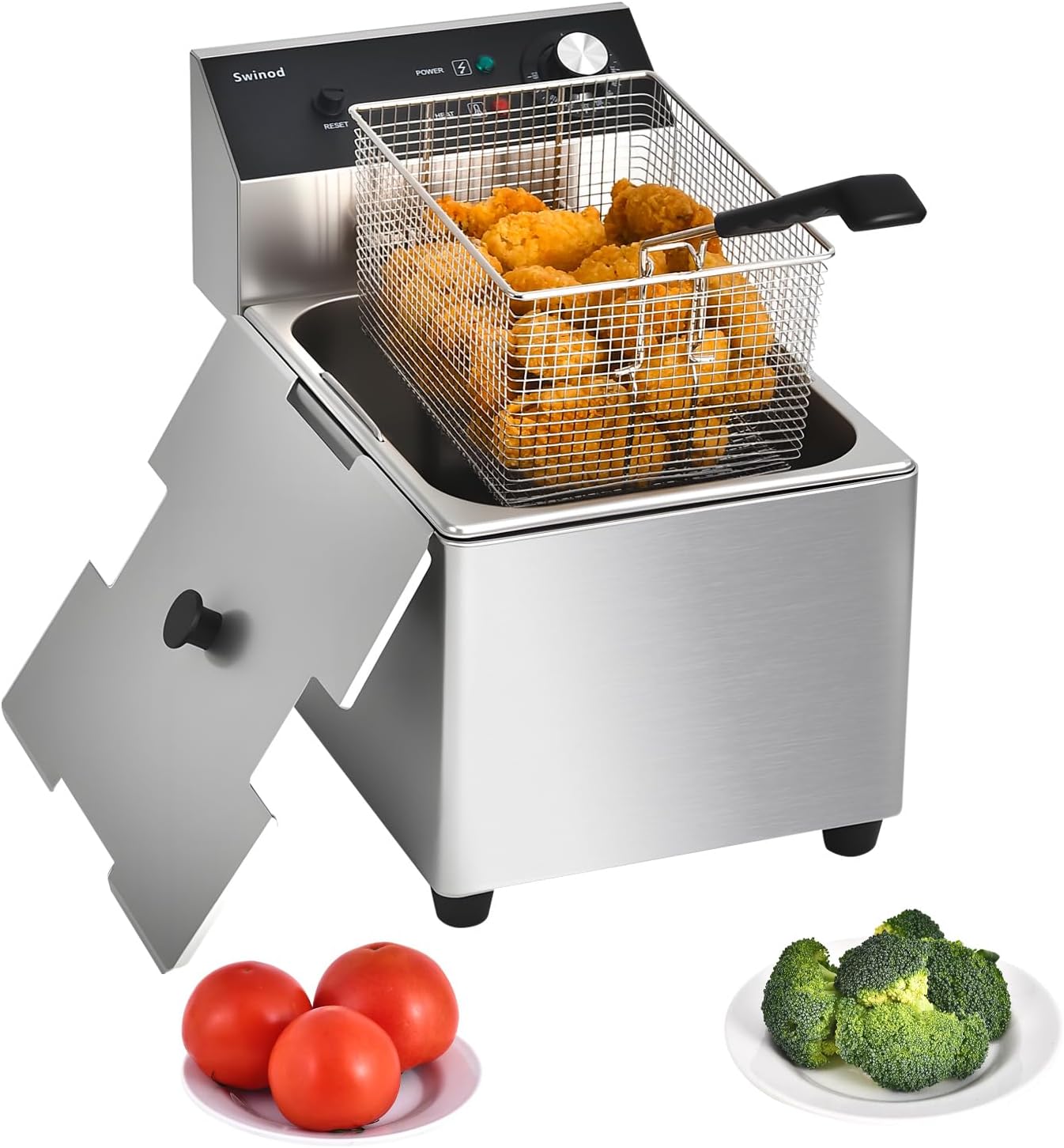
| Oil Capacity | 8 liters |
|---|---|
| Wattage | 1700 watts |
| Material | Stainless Steel |
This Swinod commercial deep fryer is a heavy-duty countertop fryer aimed at high-volume home cooks and small food-service operators. It uses a 1700W heating element and an integrated thermostat with a rotary knob to reach and hold frying temperatures between 122°F and 482°F, which speeds preheat and lets you dial in settings for different foods. The 0.6mm thickened stainless steel housing, reinforced fry basket and non-slip foot pads give it a tougher, more stable feel than typical consumer models, and the basket hooks to the body for convenient draining. Safety features include a temperature limiter backup, anti-scald handles and a fitted lid to reduce oil splatter. Most components except the main heating head are detachable for easier cleaning. The unit is large enough to handle small batches for a commercial setting, but its size and stainless-steel construction mean it needs a dedicated counter area and careful oil management.
Best for: Buyers who need a budget-friendly but commercially capable fryer for frequent small-batch frying in a cafe, food truck, or busy home kitchen and prioritize faster heating and durable construction.
Less Ideal for: Those with very limited counter space or users who want a compact, fully portable fryer for occasional home use.
- High 1700W power for fast heating and reduced preheat time
- Thickened 0.6mm stainless steel construction for durability
- Large 8 liter oil capacity suitable for small commercial batches
- Dual overheat protection (thermostat plus temperature limiter) for safety
- Detachable components and basket hook design simplify draining and cleaning
- Large footprint requires dedicated counter space
- Main heating head is not detachable, making deep cleaning of the unit base more involved
Verdict: A robust, budget-friendly commercial-style fryer that delivers fast heating and large-batch capacity for small food-service operations.
VEVOR Commercial Deep Fryer EF-2018

| Wattage | 3100 watts |
|---|---|
| Material | Stainless Steel |
| Oil Capacity | 21 quarts |
| Temperature Range | 122°F to 392°F (50–200°C) |
This VEVOR commercial deep fryer is built for heavy kitchen use, offering a single large oil tank that holds about 21 quarts and dual heating elements to bring oil up to temperature quickly. It is typically used in small restaurants, concession stands, or for large-batch cooking where frying whole chickens or big batches of fries is required. Notable features include independent thermostatic control with a 122°F to 392°F range and safety cutoffs for extreme overtemperature, a fitted lid to reduce splatter, an interlayer so different foods can be separated, and a front drain valve for easier oil removal. The stainless steel exterior wipes clean and the included XL basket and hanging hook make draining and handling fried food straightforward. Expect industrial-style performance and fast heat-up times, but plan for the physical footprint and the need for a dedicated high-power circuit given the ~3000W rating; this is not a compact, low-power countertop appliance. For operators who need capacity and dependable heat control, this fryer delivers practical, restaurant-ready function.
Best for: Small-restaurant operators, concession stands, and serious home cooks who prioritize dependable, high-capacity frying and need fast, consistent heat for large batches.
Less Ideal for: Casual home users with limited counter space or weak electrical circuits and anyone who prefers compact, digitally timed consumer fryers.
- Large 21 qt oil tank supports frying whole chickens and large batches
- Dual heating elements provide faster heat-up and consistent cooking
- Independent thermostat with wide 122°F–392°F range and automatic overtemp shutoff
- Stainless steel exterior and front drain valve simplify cleaning and oil removal
- Requires a high-power circuit and has a substantial footprint that may not fit small kitchens
- No built-in timer or digital controls for precise repeatable cycles
Verdict: Buy this fryer if you need a durable, high-capacity commercial electric fryer that heats quickly and gives precise manual temperature control for professional kitchens.
TANGME Commercial Deep Fryer 12L

| Wattage | 3400 watts |
|---|---|
| Oil Capacity | 12 liters |
| Temperature Range | 140℉ to 374℉ |
| Material | Stainless Steel |
This TANGME dual-basin deep fryer is a straightforward commercial-style fryer that pairs two 1700W heating elements for a combined 3400W output and fast heat recovery. It is built from thickened stainless steel with removable oil tanks and baskets, so cleaning and maintenance are practical for frequent use; most components except the heating elements can be washed or run through a dishwasher. Temperature is adjustable from about 140 to 374 degrees Fahrenheit and an indicator light shows when the unit is heating, which helps dial in results for fries, chicken, shrimp, and other fried foods. The included lids and basket hooks reduce splatter and make draining easier. Expect a sizeable footprint and heavy weight consistent with a 12 liter capacity unit, so plan counter space and a dedicated circuit for reliable performance. The fryer is utilitarian rather than feature-rich—there are no digital timers or advanced safety interlocks—so it fits cooks who want raw power and easy servicing rather than bells and whistles.
Best for: Buyers who prioritize reliable, commercial-style frying performance and easy maintenance backed by many user reviews and real-world use, especially for small restaurants, food trucks, or serious home cooks.
Less Ideal for: Users who want compact, lightweight fryers with digital controls, programmable presets, or a focus on consumer-style convenience features should look elsewhere.
- Dual 1700W heating elements (3400W total) for quick recovery and consistent frying temperatures
- Heavy-duty 0.8mm stainless steel construction with removable tanks and baskets for easier cleaning
- Adjustable thermostat from 140°F to 374°F for versatile frying of different foods
- Includes lids, removable baskets with hooks, and indicator light to reduce splatter and simplify draining
- No digital controls, timers, or advanced safety interlocks for precise programming
- Large footprint and substantial weight require dedicated counter space and proper electrical planning
Verdict: A workmanlike, commercial-capacity dual-basin fryer that delivers fast heating and easy cleaning for small professional kitchens and heavy-duty home use.
VEVOR Commercial Deep Fryer

| Wattage | 3000 watts |
|---|---|
| Material | Stainless Steel |
| Temperature range | 122°F–392°F (50–200°C) |
| Oil Capacity (each) | Max 8.5Qt/8L each |
This VEVOR commercial deep fryer is built for small-business cooking where you need to fry two foods separately and keep flavors from mixing. Each tank has its own heating element, adjustable thermostat (122°F–392°F) and timer, so you can run different oil temps simultaneously and stagger batches during busy service. The stainless steel housing, flip-up heating tubes and front-mounted drain valves make routine cleaning and oil changes more practical than many home-style fryers, and included baskets, covers and cool-touch handles improve safety and handling. The unit delivers fast heat-up thanks to its 3000W total power, but it is a heavy countertop appliance that needs a dedicated circuit and space. Controls are straightforward without digital complexity, which helps reliability, but the fryer lacks advanced safety interlocks or filtration systems found on higher-end commercial models. For everyday frying needs in a deli, concession stand or small restaurant this fryer offers sensible features and solid capacity, though businesses with very high throughput may want larger, professional-grade units with built-in oil filtration and automated controls.
Best for: Buyers who want a straightforward, reliable dual-tank fryer for a small commercial kitchen or busy catering setup and prioritize separate-cooking capability and easy cleaning over automated filtration.
Less Ideal for: Large restaurants or high-volume kitchens that need integrated oil filtration, automated controls, or higher-capacity continuous-use equipment.
- Dual independent tanks let you fry two items separately and maintain different oil temperatures
- Adjustable temperature (50–200°C) and timer per tank for consistent results
- Stainless steel exterior and flip-up heating elements simplify cleaning and durability
- Front-mounted drain valves and included baskets/covers make oil changes and handling easier
- Requires substantial power and countertop space and may need a dedicated circuit
- No built-in oil filtration or advanced automation found on higher-end commercial fryers
Verdict: A practical dual-tank commercial fryer that delivers reliable, separate-batch frying and easy cleaning for small food businesses.
Choosing the Right Professional Deep Fryer: Key Factors to Consider
Oil Capacity and Usable Vat Volume
Capacity determines how many portions you can cook per batch and how often you must change or top up oil. Restaurants and high-volume operations benefit from larger usable vat volumes that do not sacrifice heat transfer efficiency.
Pay attention to the usable volume rather than the advertised total. Some units list full tank capacity but reserve space for basket clearance and safe fill levels. A fryer with an efficiently shaped vat and clear maximum fill indicators reduces the risk of overflow during loading and allows more predictable batch sizing.
Temperature Control and Recovery Time
Precise thermostat control and rapid recovery after basket loading are essential for consistent product quality. If the oil temperature drops too far when food is added, the result is greasy, unevenly cooked food. Faster recovery means shorter cycle times and higher throughput.
Look for accurate temperature dials or digital controllers, reliable heating elements, and a well-matched burner or electric element layout. Consistent control also reduces oil breakdown because prolonged low-temperature cooking stresses the oil less than unstable cycling.
Construction, Materials, and Durability
Commercial kitchens are harsh environments, so build quality matters. Stainless-steel vats, reinforced pan supports, and corrosion-resistant exterior panels extend service life and simplify sanitation.
Durable construction also includes well-mounted controls, robust basket supports, and heavy-duty elements or burners that are replaceable. Units designed for easy access to service points reduce downtime and can lower lifecycle maintenance costs.
Filtration, Oil Management, and Maintenance
Efficient oil management lowers operating expense and improves food quality. Built-in filtration systems, easy-to-drain vats, and straightforward straining workflows keep oil cleaner longer and reduce the frequency of full oil changes.
Consider how the fryer handles spent particles and how easy it is to integrate filtering into a shift routine. Options that permit in-place filtering or that include compatible filtering accessories reduce labor. Also evaluate how drain valves and pans are arranged to minimize spills and speed cleanup.
Safety Features and Compliance
Safety features protect staff and help the fryer meet local health and fire codes. High-limit thermostats, automatic shutoffs, clear drain procedures, and well-marked controls all contribute to safer operation under pressure.
Also check for cool-touch surfaces where staff regularly interact, secure basket handles, and stable feet or mounting options to prevent tipping. Safety-focused design reduces the risk of accidents during busy service periods and simplifies training for new staff.
Sizing a Professional Fryer for Your Kitchen
Choose capacity based on typical batch sizes and peak service demand rather than solely on square footage or menu breadth. Calculate how many portions you need per hour and then estimate the number of batches required. Allow extra headroom for peak shifts and special events.
Also consider footprint and ventilation limits. Larger fryers often require more hood or ventilation capacity and may need dedicated plumbing for safe drainage. If space is tight, multiple smaller fryers can offer flexibility but add complexity to oil management.
- Estimate portions per hour at peak service
- Match vat size to basket and batch needs
- Plan for ventilation and drainage requirements
Electric Vs Gas Heating in Professional Units
Electric fryers provide even heat distribution and precise electronic control, which can simplify temperature management. They are often chosen where gas supply is limited or where installation simplicity is a priority.
Gas-fired fryers typically offer faster heat-up and strong recovery under continuous load, which benefits high-throughput kitchens. Installation requires appropriate gas lines and compliance with local codes, so factor in installation costs and service when deciding.
- Electric: precise control, simpler installation
- Gas: fast recovery, may require more infrastructure
Cleaning and Scheduled Maintenance Tips
Design a daily and weekly maintenance plan that includes skimming, filtering, and scheduled full-oil changes. Regularly remove solids and particles to extend oil life and reduce off-flavors. Clean cooling fins, burners, and exterior surfaces to maintain efficiency and sanitation.
Train staff on safe draining and cleaning procedures to avoid burns and spills. Keep a service log of element replacement, thermostat calibration, and any repairs to help spot recurring issues early.
- Daily skimming and filtering routine
- Weekly deep clean and vat inspection
- Keep a maintenance and service log
Workflow and Layout Considerations
Place fryers near staging and plating areas to minimize walk time but maintain safe clearances from other equipment. Ensure basket pickup and drop zones are organized to prevent cross-traffic and to keep fries or fried items warm and crisp.
Consider pairing fryers with holding cabinets or heat lamps designed for fried foods to preserve texture. Also plan waste oil routing and storage so spent oil can be removed without contaminating food prep areas.
- Minimize steps between fryer and plating
- Provide clear basket staging zones
- Plan safe routing for waste oil removal
Upgrades and Accessories That Improve Efficiency
Options such as integrated filtration carts, replaceable heating modules, and fry screens reduce downtime and make daily operation smoother. Look for accessories that match your chosen unit and can be retrofitted without major modification.
Programmable timers and preset temperature profiles can speed service and reduce operator error, especially during busy shifts. Modular components that are easy to replace will reduce repair time and keep the fryer in service longer.
- Built-in or attachable filtration systems
- Replaceable heating elements or modules
- Programmable controls and presets
How We Chose the Best Professional Deep Fryer
We prioritized features and build attributes that directly affect commercial frying performance and total cost of ownership. Key evaluation criteria included oil capacity and usable vat volume to ensure units can meet batch sizes; heating system design and temperature control accuracy because these determine cook consistency and recovery time; construction quality and serviceability so units stand up to daily heavy use and are easy to maintain; filtration and oil-management options that reduce oil turnover and labor; and safety and compliance features such as high-limit thermostats, cool-touch exteriors, and clear drain procedures. Our selection excluded small consumer countertop fryers and any units intended only for occasional or household use. We also excluded fryers lacking basic safety controls or those with nonstandard vat geometries that complicate basket handling or filtration. Where available, we gave preference to commercial-design elements such as stainless-steel vats, replaceable heating elements, and accessible control panels. The result is a shortlist focused on performance, durability, and efficient day-to-day operation under professional workloads.
Our full evaluation process is outlined in our review methodology.
FAQ
How often should I change the oil in a professional deep fryer?
Oil change frequency depends on load, food type, and filtering routine. With regular skimming and filtering, many operations extend oil life to several days or a week; heavy use or batter-heavy frying may require more frequent full changes.
What vat shape or design works best for even frying?
A vat with smooth corners and a uniform depth promotes even heat distribution and simplifies cleaning. Narrow or irregularly shaped vats can create hotspots and make basket handling awkward.
Can I install a professional fryer in a small kitchen?
Yes, but you must account for required clearances, ventilation capacity, and proper drainage. In constrained spaces, consider unit footprint, hood capacity, and whether multiple smaller fryers or a single larger unit better fits workflow.
Are built-in filtration systems worth the investment?
Often yes for medium to high-volume kitchens. Built-in filtration reduces labor for oil maintenance, extends oil life, and improves food consistency. The payback depends on labor costs and how much it reduces full oil changes.
What safety checks should staff perform daily?
Staff should verify thermostat operation, inspect for oil leaks, confirm drain valves and baskets function correctly, and ensure that high-limit protections are present and operational. Documenting these checks helps prevent service interruptions.
Final Verdict
Selecting a Professional Deep Fryer comes down to balancing capacity, temperature stability, and serviceability for your volume and menu. Prioritize accurate controls and fast recovery for consistent cook results, and choose construction and filtration features that reduce maintenance and extend oil life. Consider installation requirements such as ventilation and drainage early in the decision process to avoid costly modifications later. Focus on the metrics that match your busiest service conditions and staffing model. That approach will guide you to a fryer that maintains product quality during peak periods and keeps operating costs predictable.