
Note: This article contains affiliate links. If you click on these links and make a purchase, we may earn a small commission at no extra cost to you. This helps support our research and content. Read our full affiliate disclosure here.
If you spend time working in a chilly garage, a dedicated propane heater can transform comfort and productivity. Picking the right propane heater for garages matters because garages are often uninsulated, drafty, and used intermittently, which affects the heat output and safety requirements you need. This guide shortlists the top propane heaters that fit garage use, focusing on models that deliver reliable heat, strong safety systems, and practical installation or portability. Below you will find our top picks along with the evaluation criteria we used to vet them and clear guidance on matching a heater to your space.
Top Picks at a Glance
| Best Overall The best all-around choice for most situations | Mr. Heater 60,000 BTU Propane Heater |  |
| Best Quality Built to a higher standard if you want something more solid | DEWALT Forced Air Propane Heater DXH70CFAV |  |
| Best Value The sweet spot between price and what you get | Flame King 60,000 BTU Forced Air Heater |  |
| Best Budget The cheapest option that still gets the job done reliably | LAANPOLE 15000BTU Propane Heater |  |
| Top Rated A top-rated pick with lots of positive feedback | Modine Hot Dawg HD45AS01-21 |  |
| Most Popular A crowd favorite that many people choose with confidence | Mr. Heater Portable Buddy F232000 |  |
| Best Seller A high-volume bestseller chosen again and again | Amazon Basics 46,000 BTU Patio Heater |  |
Mr. Heater 60,000 BTU Propane Heater
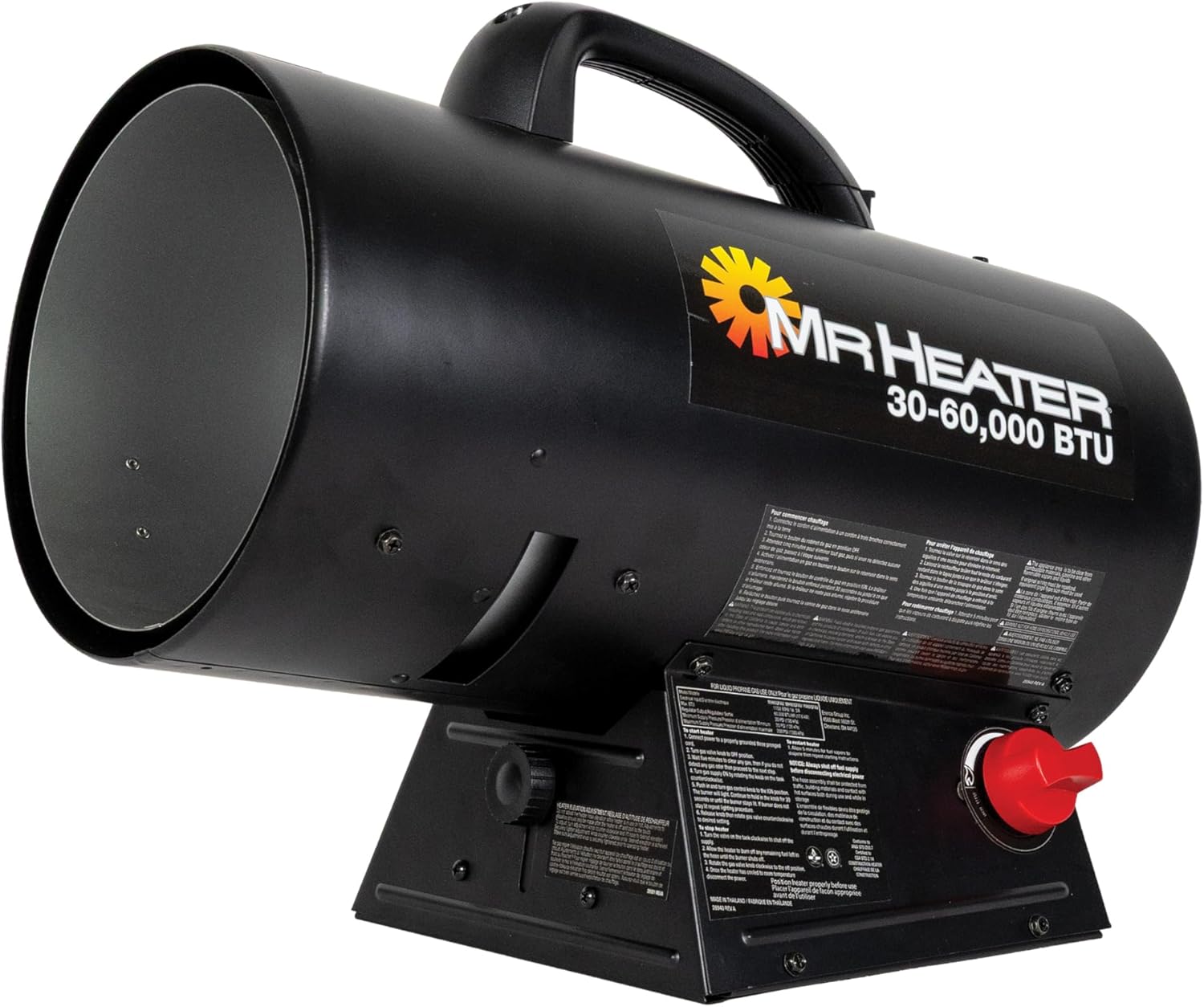
| Heat Output | 60,000 BTU (variable 30,000–60,000) |
|---|---|
| Heating Coverage | 1500 |
| Fuel Type | Propane |
| Power Source | 115 volts |
| Special Features | QBT quiet-burner technology |
The Mr. Heater 60,000 BTU Forced-Air Propane Heater is a jobsite-style pedestal heater designed to move a lot of warm air quickly. It hooks to a standard 20 lb propane tank and to 110VAC for the fan and continuous ignition, and offers variable output from 30,000 to 60,000 BTU so you can dial heat to conditions. Notable features include patented QBT quiet-burner technology, a heavy-duty fan, thermostatic control and a 10 foot hose and regulator. In practice it is straightforward to use: roll it into a garage or work area, connect the tank and plug in, then adjust the thermostat for steady heat; it is rated to cover roughly 1,250–1,500 sq ft and can run many hours on a tank depending on output. Trade-offs are typical for forced-air propane units — it requires ventilation when used in enclosed spaces, needs a power outlet for the blower and ignition, and at 60,000 BTU it is overkill for small rooms. For garage or workshop heating where fast, robust output and durability matter, this model is a practical choice.
Best for: Buyers who want dependable, high-output heat for garages or workshops and prioritize durable, jobsite-capable performance with adjustable output and quieter operation.
Less Ideal for: People needing heat for small, lightly insulated rooms, or those who cannot provide ventilation or a standard 110V outlet should consider lower-output or electric alternatives.
- High maximum heat output for large garages and jobsite spaces
- Variable 30,000–60,000 BTU output for adjustable heating
- QBT quiet-burner reduces noise compared with standard torpedo heaters
- Includes 10 foot hose and regulator and continuous ignition for easy setup
- Rugged steel construction and heavy-duty fan suited for workshop use
- Requires 110V power for the fan and ignition so it is not purely LPG-powered
- Not intended for tightly enclosed living spaces without proper ventilation
- Large output can be more than needed for small garages or single-car bays
Verdict: If you need rugged, adjustable, high-output heat for a garage or workshop, this Mr. Heater delivers strong, quieter forced-air performance.
DEWALT Forced Air Propane Heater DXH70CFAV

| Heat Output | 68,000 BTU |
|---|---|
| Heating Coverage | 1,7000 square feet |
| Power Source | Propane |
| Heating Method | Forced Air |
| Voltage | 120 volts |
The DEWALT DXH70CFAV is a freestanding forced-air propane heater built to deliver high heat output for workshops and garages. It runs on propane and produces up to 68,000 BTU, which the manufacturer rates for large coverage, and it includes a 10-foot cable, hose and regulator assembly, and a carry handle for jobsite mobility. Typical use is spot- or zone-heating in ventilated garages, construction bays, or outdoor work areas where quick, powerful warm-up is needed. The heater's hybrid mention of electric or propane power suggests flexibility on power controls, while its freestanding form and included regulator make setup straightforward. Practical benefits are fast heat delivery and portability, plus DEWALT's rugged styling that suits rough use. Important limitations are the need to operate it only in appropriately ventilated spaces and the usual propane refilling and storage considerations; it is not a whole-house solution and lacks explicit safety interlock details in the product listing.
Best for: Buyers who need fast, high-output spot heating for large garages, workshops, or jobsite spaces and prioritize performance and portability over whole-home heating.
Less Ideal for: People seeking a permanent whole-house or fully indoor-safe heating solution for small, poorly ventilated rooms should consider alternate electric or ducted systems.
- High heat output rated at 68,000 BTU for rapid heating of large garage spaces
- Freestanding, portable design with handle and included hose and regulator for easy setup
- Made for garage and jobsite use with robust DEWALT build and 120V-compatible controls
- Requires proper ventilation and propane management, so not suited for enclosed unventilated rooms
- Listing lacks detailed safety interlocks and some control specifics for indoor-focused operation
Verdict: Choose this DEWALT heater if you need a rugged, high-BTU portable propane unit that delivers rapid warming for large garage or jobsite spaces.
Flame King 60,000 BTU Forced Air Heater

| Heat Output | 60,000 BTU |
|---|---|
| Heating Coverage | 1500 square_feet |
| Power Source | Propane |
| Included Components | Hose & Regulator Assembly |
The Flame King 60,000 BTU forced-air heater is a portable propane blower designed to warm large, open spaces such as job sites, garages, and covered patios. It connects to a standard 20 lb propane tank with the included hose and regulator and features built-in Piezo ignition and a gas control button for adjusting output. In practice it produces rapid, concentrated heat and the blower design helps distribute warmth across a wide area; Flame King rates coverage up to 1,500 square feet and claims about eight hours of run time at full output on a 20 lb cylinder. Safety features include an automatic fuel shutoff and tip-over cutout, and the unit is CSA certified. Trade-offs are typical for high-BTU propane blowers: it requires good ventilation and is not intended for tightly enclosed spaces, and the fan/noise and fuel use at high output may be more than smaller garage heaters. The heater is straightforward to move and operate thanks to a sturdy handle and included regulator, making it a practical option for workshop or construction use where fast, powerful heat is needed.
Best for: Buyers who prioritize fast, high-output heating for open or well-ventilated garages, workshops, or job sites and need a portable, ready-to-use propane solution.
Less Ideal for: People looking for a quiet, electric garage heater for fully enclosed spaces or those who cannot provide adequate ventilation should consider alternatives.
- High 60,000 BTU output suitable for large, open garages and job sites
- Included hose and regulator let you hook up to a standard 20 lb propane tank
- Built-in Piezo ignition and gas control button for easy start and flame adjustment
- Safety features like automatic fuel shutoff and tip-over protection; CSA certified
- Portable with a sturdy handle and blower design for faster heat distribution
- Not for use in enclosed, unventilated spaces due to combustion and ventilation requirements
- Fan noise and fuel consumption can be substantial at full output
Verdict: If you need powerful, portable propane heat to quickly warm a large, ventilated garage or jobsite, this 60,000 BTU Flame King heater is a practical choice.
LAANPOLE 15000BTU Propane Heater

| Heat Output | 15000 british thermal units |
|---|---|
| Fuel Type | Propane |
| Number of Speeds | 3 |
| Indoor Outdoor Usage | Indoor, Outdoor |
This LAANPOLE propane pedestal heater delivers up to 15,000 BTU of heat across three adjustable settings, making it a straightforward option for warming garages, patios, or campsites. It hooks to a standard propane cylinder and the rotating head helps spread warmth over a wider area, while the protective grille and heat-resistant mesh reduce accidental contact. The unit includes safety features such as an automatic gas cut-off valve and tip-over protection that stop fuel flow if the heater is knocked over, which is useful in a busy garage. Construction uses lightweight metal for easier transport, though that also means it is not as heavy-duty as commercial shop heaters. Expect quick, direct radiant heat rather than whole-room convection warmth, and plan fuel use accordingly since propane runs through cylinders. For someone who needs an affordable, portable heat source for spot heating in a garage, this heater is a practical, no-frills choice.
Best for: Buyers seeking an inexpensive, portable propane heater for occasional garage use or spot heating who prioritize quick warmth and basic safety features.
Less Ideal for: People needing continuous whole-garage heating, heavy-duty workshop use, or a hardwired permanent heater should look at larger commercial or electric garage-specific heaters.
- Powerful 15,000 BTU output for rapid spot heating
- Three heat settings let you adjust output to conditions
- Built-in safety: automatic gas cut-off and tip-over protection
- Rotating head and protective grille improve heat distribution and safety
- Lightweight metal construction may feel less durable than commercial shop heaters
- Radiant design provides spot heat rather than quickly warming an entire large garage
Verdict: A budget-friendly portable propane heater that delivers strong spot heating and basic safety features for occasional garage use.
Modine Hot Dawg HD45AS01-21

| Power Source | Propane |
|---|---|
| Form Factor | Direct Vent |
| Heat Output | 45 KW |
| Heating Coverage | 1500 square feet |
| Voltage | 120 volts |
The Modine Hot Dawg HD45AS01-21 is a direct-vent, ceiling-mounted propane heater intended for garages and similar spaces. It produces about 45,000 BTU of heat output and uses forced-air distribution from a radiant-style element to warm areas up to roughly 1,500 square feet, while supporting side-wall or roof venting via a power exhaust. Typical installation is permanent ceiling mounting with a propane supply and vent connection; once installed the unit runs quietly and offers wide temperature range control from 40 to 150°F. The 120-volt exhaust fan simplifies venting and installation compared with more complex systems, and its certification for residential, commercial, and industrial use makes it durable for repeated seasonal use. Limitations include the need for professional installation and gas hookup, fixed ceiling placement that reduces portability, and a substantial physical size and weight that require adequate support and clearance in the garage layout.
Best for: Buyers who prioritize a reliable, heavy-duty garage heating solution that will be permanently installed and provide consistent, quiet heat for a single large space.
Less Ideal for: People who need a portable, temporary, or multi-zone heating option or who cannot accommodate a gas hookup and ceiling-mounted installation.
- High heat output suitable for large garages (about 45,000 BTU).
- Direct-vent design with power exhaust simplifies side-wall or roof venting and keeps combustion products out of the space.
- Quiet operation for less disruptive use in attached garages and workshops.
- Certified for residential, commercial, and industrial applications, indicating robust construction.
- Requires permanent propane hookup and professional installation.
- Ceiling-mount, heavy unit is not portable and needs adequate structural support.
- No built-in portability or multi-zone distribution features.
Verdict: Choose the Modine Hot Dawg if you want a durable, quiet, professionally installed propane heater that reliably warms a large garage.
Mr. Heater Portable Buddy F232000

| Heat Output | 9000 BTU |
|---|---|
| Indoor Outdoor Usage | Indoor, Outdoor |
| Heating Coverage | 225 sq ft |
| Fuel Type | Propane |
| Number of Speeds | 2 |
The Mr. Heater Portable Buddy is a small, carry-handle propane radiant heater built for quick spot heating in garages, patios, and campsites. It offers two heat settings—about 4,000 BTU and 9,000 BTU—so you can warm a single workbench or a modest garage area up to roughly 225 square feet. It runs on a 1 lb. propane cylinder with optional hookup for a larger tank, and runtime is roughly 5.4 hours on low and 2.4 hours on high from a 1 lb. bottle. Safety features include an oxygen depletion sensor, tip-over switch, and thermal shutoff, which make it suitable for intermittent indoor use when monitored. The pedestal form and built-in handle make it easy to move and aim the radiant element where you need it, but because this is a radiant spot heater it does not circulate warm air like a forced-air unit and is best for people who need direct, localized warmth rather than whole-garage heating. Controls are simple and the unit is lightweight, but expect limited runtime on small cylinders and the need to follow ventilation and safety guidance for indoor operation.
Best for: Buyers who want a proven, safety-minded portable propane heater for spot warming in garages or workshops and who value community-validated reliability over experimental models.
Less Ideal for: People who need to heat large, poorly insulated garages continuously or who prefer forced-air circulation and thermostat-controlled whole-room heating.
- Provides up to 9,000 BTU for strong, direct radiant heat.
- Approved for indoor and outdoor use with built-in safety systems (oxygen depletion sensor, tip-over switch, thermal shutoff).
- Runs on a standard 1 lb propane cylinder and offers optional 20 lb tank hookup for longer use.
- Compact, lightweight pedestal design with easy-grip handle for quick repositioning.
- Radiant design heats people and surfaces directly but does not warm large rooms evenly.
- Short runtime on a 1 lb cylinder at high setting compared with larger tank systems.
- Limited to two heat settings with no thermostat for precise temperature control.
Verdict: A compact, safety-focused portable propane radiant heater that reliably delivers direct spot heat for garages and workshops.
Amazon Basics 46,000 BTU Patio Heater

| Heat Output | 46,000 BTU |
|---|---|
| Heating Coverage | 9 feet |
| Power Source | Propane |
| Special Features | Wheels |
| Form Factor | Tower |
This Amazon Basics tower-style patio heater runs on a standard 20 lb propane tank and is built to warm outdoor spaces up to roughly a 9-foot radius. It uses a one-touch ignition and an adjustable temperature knob so you can dial down output for milder nights or crank it up for colder evenings, and the wheeled base makes positioning easier. For safety it includes a tilt shutoff valve, a chain to secure the tank, and a water box in the base to add weight and stability. The powder-coated finish resists the elements for routine outdoor use, and the 46,000 BTU output makes it suitable for patios, small commercial patios, or garage-adjacent work areas where ventilation is adequate. Limitations to keep in mind are that it is designed for outdoor use and requires clearance from combustible materials, it depends on a vertical heater footprint that may not fit tight garage layouts, and it needs a full propane cylinder and simple assembly. For buyers who want straightforward, powerful propane heat with common safety features, this model is a practical, no-frills option.
Best for: Buyers who prioritize a straightforward, powerful propane heater with simple controls and standard safety features for warming outdoor patios or well-ventilated garage-adjacent areas.
Less Ideal for: People needing an indoor or confined-space heater, those with very low ceilings or tight garage layouts, or buyers who require thermostatic or electric heating alternatives.
- High 46,000 BTU output for fast, noticeable warmth
- One-touch ignition plus adjustable knob for simple operation
- Wheeled base and chain for easier positioning and tank security
- Tilt shutoff and weighted base option add basic safety for outdoor use
- Powder-coated exterior resists weathering during regular outdoor use
- Designed for outdoor use only and requires safe clearances from combustibles
- Tall tower form factor may not fit cramped or low-ceiling garage spaces
Verdict: Choose this model if you want a powerful, easy-to-use propane patio heater with basic safety features and simple mobility for outdoor or well-ventilated garage-side use.
Choosing the Right Propane Heater for Garages: Key Factors to Consider
Heat Output and Garage Size
Heat output determines how quickly and effectively a propane heater will warm a garage. Look at rated BTUs and the manufacturer's suggested square-foot coverage, but remember that recommended coverage assumes a certain ceiling height and some level of insulation.
For uninsulated or very drafty garages, choose a heater with higher BTU capacity than the nominal room size suggests. Ceiling height and whether the garage door will remain open or closed during use further influence how much heat you actually need.
Safety Features and Sensors
Because garages are enclosed or semi-enclosed spaces with limited ventilation, safety features are critical. Oxygen depletion sensors (ODS) cut fuel flow if oxygen levels fall too low, and tip-over switches shut off the unit if it falls. Reliable flame failure protection and overheat shutoffs add layers of safety.
Evaluate how the heater signals faults and whether it has lockout behavior to prevent repeated unsafe restarts. If you plan to use the heater in a workspace, consider models with certified safety listings and clear instructions for safe clearance distances.
Installation, Mounting, and Ventilation
Installation choices affect both performance and safety. Some propane heaters are freestanding and portable, while others mount to walls or ceilings for permanent placement. Mounting options change heat distribution and free up floor space, but they often require more careful placement to meet clearance rules.
Ventilation needs vary by design. Indoor-rated garage heaters should be used according to manufacturer ventilation guidance. Confirm whether your chosen unit needs fresh-air intake or a specific clearance from combustible materials before finalizing installation.
Fuel Type, Cylinder Size, and Run Time
Propane cylinder size and heater efficiency determine how long a unit will run between refills. Higher-BTU heaters burn fuel faster, which shortens run time on a standard cylinder. If you plan frequent, long sessions, compare estimated run times at typical output levels.
Consider accessibility for cylinder changes. Portable heaters with side-mounted cylinders are easier to swap than permanently plumbed systems. Also factor in whether you prefer a heater that accepts common 20-pound cylinders or a different supply arrangement.
Durability and Workshop Conditions
Garages expose equipment to dust, tools, and occasional bumps. A durable heater with a robust housing and protective grille will last longer under workshop conditions. Corrosion resistance matters if the garage is damp or if you store chemicals nearby.
Look for designs that protect critical components from debris and that allow replacement parts or easy service. A metal housing and straightforward access to controls and burners help with longevity and maintenance.
Controls, Thermostatic Operation, and Ease of Use
Controls influence day-to-day convenience. Simple on/off heaters are easy to operate but can be less fuel efficient than models with thermostatic control that cycle to maintain a target temperature.
Check whether the unit uses an adjustable thermostat, multiple heat settings, or a remote control. Also consider ignition method and whether the unit provides clear indicators for fuel level, fault conditions, or maintenance needs.
Sizing Your Heater to Garage Layout
Calculate required BTUs by factoring your garage's square footage, ceiling height, insulation level, and how airtight the space is. As a rule of thumb, plan for higher output in uninsulated garages and reduce capacity for insulated or climate-controlled spaces.
Positioning matters. A centrally mounted ceiling unit warms a larger area evenly, while a floor or wall-mounted heater can provide directed heat to a workbench or vehicle. Account for clearance and airflow to avoid dead zones.
- Measure floor area and multiply by ceiling height for volume when ceilings exceed 10 feet.
- Add 20 to 30 percent capacity for poorly insulated garages.
- Aim heaters toward work areas rather than walls for better perceived warmth.
Portable Vs. Fixed Mount Options
Portable propane heaters are convenient for workshops where you move around or need heat in different bays. They are typically easier to set up but require safe placement and stable, flat surfaces.
Fixed or ceiling-mounted heaters free up floor space and provide more consistent distribution, which is useful if you regularly heat the entire garage. Installation permanence increases safety but may limit flexibility.
- Portable: easy cylinder swaps, flexible placement, need secure footing.
- Fixed: cleaner installation, steady coverage, requires mounting and clearances.
Safe Operation and Common Installation Mistakes
Common mistakes include placing a heater too close to combustibles, ignoring required clearance distances, and using indoor-rated units in poorly ventilated garages. Always follow the manufacturer's placement and ventilation guidelines.
Also avoid running a heater unattended for extended periods and ensure any fresh-air requirements are met. Test safety cutoffs periodically and keep the area around the heater free of flammable materials.
- Maintain recommended clearance on all sides and above the unit.
- Do not store flammable liquids near the heater.
- Check ignition and shutoff components before each heating season.
Maintenance Tips to Keep a Heater Running Safely
Regular maintenance prolongs life and preserves safety. Clean dust and debris from the grille and burner area, inspect hoses and connections for wear or leaks, and replace filters if the unit uses them.
Before long idle periods, protect the heater from moisture and confirm that seals and gaskets remain intact. Address any unusual odors, soot buildup, or intermittent ignition immediately, as these are signs a service check is needed.
- Wipe exterior surfaces and remove dust from vents monthly during heavy use.
- Perform a leak check on cylinder connections after each swap.
- Schedule professional service for burner or gas-flow issues.
Using Heaters in Multiuse Garage Spaces
If your garage doubles as a workshop, you may want targeted heat for the workbench and lower background heat elsewhere. Consider combining a small portable unit for task heating with strategic insulation improvements to reduce the overall BTU requirement.
For garages where vehicles are worked on, position the heater to avoid direct exposure to fuel spills or open container areas and ensure ventilation is sufficient when engines are running.
- Use directional heat for task zones and save fuel with thermostatic control.
- Keep heaters out of splash or spill zones.
- Supplement heating with insulation for longer-term efficiency gains.
How We Chose the Best Propane Heater for Garages
We filtered available propane heaters for garages using practical, safety-first standards that reflect real-world garage conditions. We prioritized measurable technical specs and user-facing features that matter for intermittent, sometimes-unfinished spaces. Key evaluation criteria included heat output and coverage to ensure a heater can reach typical garage square footage; safety systems such as tip-over protection, oxygen depletion sensors, and flame controls; build and mounting options that affect installation and stability in workshop environments; fuel efficiency and run time so a heater can operate for reasonable periods without frequent cylinder changes; and ease of operation and maintenance including ignition reliability and serviceability. We excluded heaters designed only for indoor living spaces or decorative use, as well as units that lack required safety features for enclosed or semi-enclosed garages. We also deprioritized specialty units that require professional installation beyond basic mounting or ventilation. The resulting shortlist reflects heaters that balance robust heat delivery with sensible safety and usability for garage owners.
Our full evaluation process is outlined in our review methodology.
FAQ
Can I use a propane heater in an attached garage?
Often you can, but it depends on ventilation and the heater's safety features. Use units rated for enclosed or semi-enclosed spaces and follow required clearances. Ensure any door between the garage and house is closed and monitored, and avoid running the heater unattended for long periods.
How do I calculate the BTUs needed for my garage?
Start with square footage and adjust for ceiling height and insulation. Increase the recommended BTU capacity for uninsulated or drafty garages. Manufacturer coverage guidance is useful but add margin for poor insulation or high ceilings.
What safety checks should I perform before using the heater each season?
Inspect fuel connections for leaks, confirm ignition and safety shutoffs work, and remove dust from vents and burner areas. Verify required clearances are maintained and test tip-over and oxygen-depletion sensors if accessible.
Are wall or ceiling-mounted heaters better for garages than portable units?
It depends on your needs. Mounted heaters offer more even coverage and keep floor space clear, while portable units provide flexibility and easy cylinder replacement. Choose based on whether you prioritize full-space heating or targeted, moveable warmth.
How long will a standard propane cylinder run a garage heater?
Run time depends on the heater's BTU output and cylinder size. Higher-BTU units will consume more fuel and shorten run time. Check manufacturer run-time estimates at typical operating settings to plan for refills.
Final Verdict
Prioritize safety and the right heat capacity when choosing a propane heater for garages. Match BTU output to your garage volume and insulation level, and favor units with oxygen-sensing, tip-over protection, and clear installation guidance. Consider whether portability or a fixed mount better serves how you use the space, and plan for fuel needs and routine maintenance. With safety systems and proper installation in place, a correctly sized propane heater provides dependable, comfortable heat for workshop tasks and vehicle projects. Focus on the tradeoffs between raw output, run time, and placement to pick the option that best fits your garage routine.