
Note: This article contains affiliate links. If you click on these links and make a purchase, we may earn a small commission at no extra cost to you. This helps support our research and content. Read our full affiliate disclosure here.
When you need dependable heat without running power cords, a propane space heater can be a practical solution for garages, workshops, screened porches, and emergency backup. Choosing the right unit affects how quickly a space reaches comfortable temperatures, how safe the setup is, and how convenient daily use becomes. This guide shortlists the top propane space heaters across common home use cases. We evaluated each option for measurable heat output, safety systems, fuel efficiency, and ease of setup so you can pick the heater that fits your space and routine. Read on for our top picks and the criteria we used to evaluate them.
Top Picks at a Glance
| Best Overall The best all-around choice for most situations | DEWALT Forced Air Propane Heater DXH70CFAV |  |
| Best Quality Built to a higher standard if you want something more solid | Amazon Basics 46,000 BTU Patio Heater |  |
| Best Value The sweet spot between price and what you get | GASLAND MHA18B Propane Heater |  |
| Best Budget The cheapest option that still gets the job done reliably | SANAUGAS Propane Camping Heater BTT-01KG-B |  |
| Top Rated A top-rated pick with lots of positive feedback | Mr. Heater 540 Tank Top Heater |  |
| Most Popular A crowd favorite that many people choose with confidence | Mr. Heater Portable Buddy F232000 |  |
| Best Seller A high-volume bestseller chosen again and again | ProCom Ventless 25,000 BTU Fireplace |  |
DEWALT Forced Air Propane Heater DXH70CFAV

| Heat Output | 68,000 BTU |
|---|---|
| Heating Coverage | 1,7000 square feet |
| Power Source | Propane |
| Heating Method | Forced Air |
| Cable Length | 10 feet |
The DEWALT DXH70CFAV is a freestanding forced-air propane heater designed to warm large, semi-enclosed spaces such as garages and jobsite areas. It runs on propane, delivers up to 68,000 BTU and is intended for indoor or outdoor use where ventilation and safety protocols are followed. The unit includes a hose and regulator assembly and a 10-foot power cable for the electric ignition, so setup is straightforward and it can be moved to different work areas. Its hybrid power note indicates it pairs battery/electric ignition with propane fuel for reliable starts, and the high heat output makes it useful for quickly raising air temperatures in drafty spaces. Trade-offs are typical for high-BTU propane heaters: it requires adequate ventilation and propane supply, and its size and output are overkill for small rooms. For planned workshop or jobsite heating it provides strong, no-frills performance, but it is not meant for continuous use in tightly sealed living spaces.
Best for: Buyers who need a robust, portable heater for workshops, garages, or jobsite spaces and prioritize fast, high-capacity warm-up over quiet or low-output operation.
Less Ideal for: Those looking for a quiet, low-BTU room heater for small indoor living areas or continuous whole-home heating should consider other options.
- High heat output at 68,000 BTU suitable for large, drafty garages and jobsite areas
- Freestanding, portable design with included hose and regulator for quick setup
- Electric/battery-assisted ignition with 10-foot cable improves reliable starts
- Built for indoor and outdoor use when safety and ventilation requirements are met
- Very powerful output requires good ventilation and steady propane supply
- Not appropriate for small or tightly sealed living spaces due to high BTU and combustion
Verdict: Choose this DEWALT if you need a tough, high-BTU portable propane heater to quickly warm large garages or jobsite spaces.
Amazon Basics 46,000 BTU Patio Heater

| Heat Output | 46,000 BTU |
|---|---|
| Heating Coverage | 9 feet radius |
| Power Source | Propane |
| Special Features | Wheels |
This Amazon Basics patio heater is a tall, propane-fueled tower meant to warm outdoor seating areas such as patios, porches, and small commercial terraces. It uses a single liquid propane tank in the base, one-touch ignition, and an adjustable control knob to vary output within its 46,000 BTU range, which the manufacturer rates to cover roughly a 9-foot radius. Practical touches include tilt-safety shutoff, a weighted water box and chain to secure the tank, plus a wheel kit for repositioning the unit. In use it produces strong, direct infrared-style heat that is best for standing or seated clusters rather than heating large open yards. Assembly and startup are straightforward for anyone comfortable with small gas appliances, though the unit is tall and benefits from a stable, level surface. Expect effective localized warmth and simple controls, while remembering it requires a 20-pound LP cylinder and appropriate clearances from combustibles for safe operation.
Best for: Buyers who prioritize strong, performance-focused outdoor heating for patios, small restaurant terraces, or gatherings and want a straightforward, no-frills propane tower heater.
Less Ideal for: People seeking whole-yard or large-area heating, or those who prefer electric heaters and do not want to handle propane tanks or store outdoor fuel.
- High heat output at 46,000 BTU for strong localized warmth
- One-touch ignition and adjustable control knob for easy operation
- Wheels and a chained weighted base make repositioning and securing the tank straightforward
- Built-in tilt safety shutoff and weighted base improve operational safety
- Designed for spot heating rather than warming large open areas
- Requires a 20 lb propane tank stored in the base, which adds installation and replacement tasks
Verdict: Choose this unit when you need a high-BTU, portable propane tower heater that reliably delivers strong, focused outdoor warmth.
GASLAND MHA18B Propane Heater
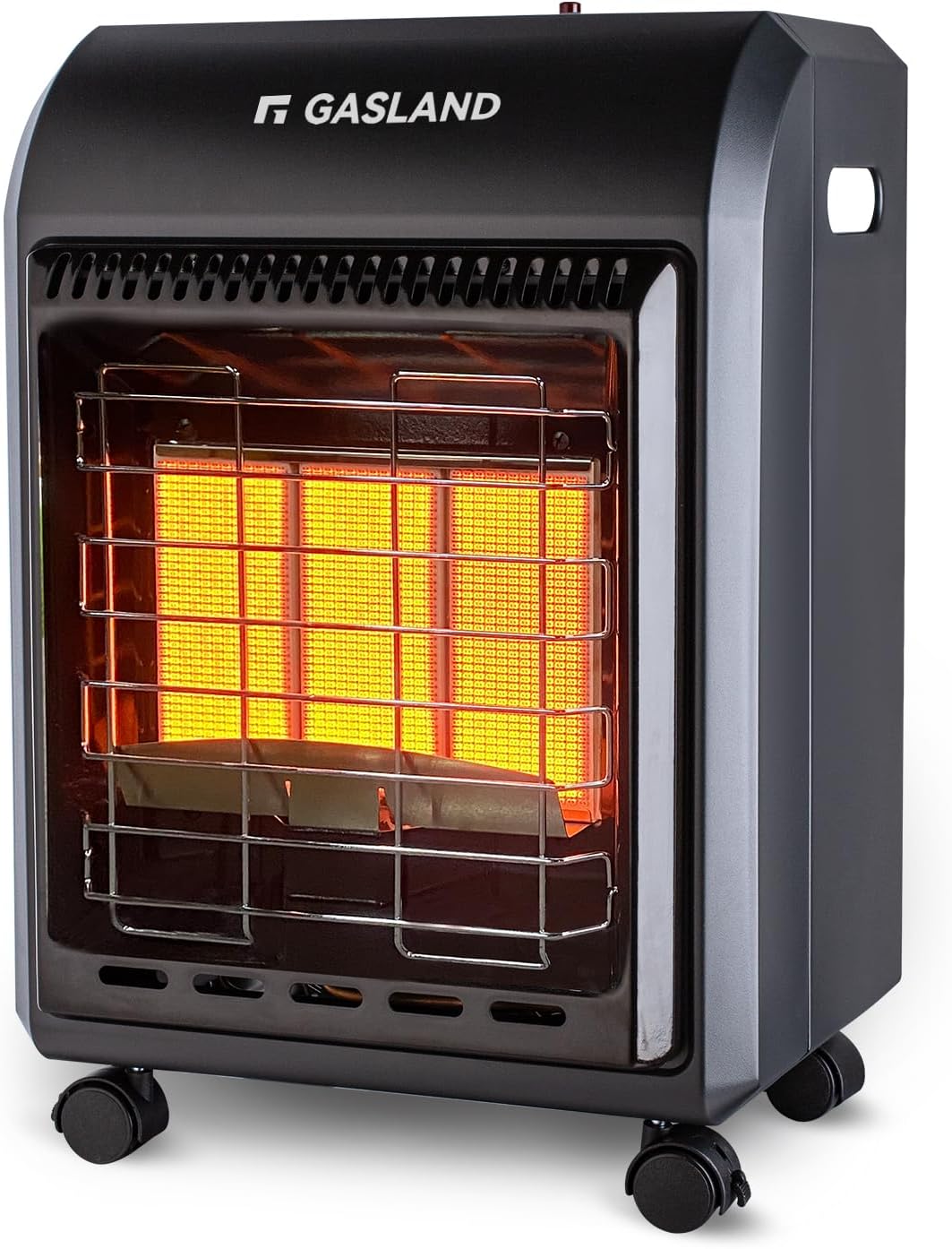
| Heat Output | 18,000 BTU |
|---|---|
| Fuel Type | Propane |
| Heating Coverage | Up to 450 square feet |
| Ignition Type | Piezo |
| Safety Features | Tip-Over Shutoff, Oxygen Depletion Sensor |
This GASLAND MHA18B is a portable propane radiant cabinet heater that delivers up to 18,000 BTU across high, medium, and low settings for flexible warmth in garages, patios, workshops, and construction sites. It runs from a standard 20 lb LP tank stored inside the cabinet, includes a regulator and hose, and offers built-in wheels and a carry handle for easy repositioning. Safety features include a tip-over shutoff and an oxygen depletion sensor, and the piezo ignition means no external power is needed, so it works during outages. Practical benefits are straightforward: strong radiant heat for localized areas, long run time on low, and quiet operation for use around people. Limitations are that it is rated for outdoor or well-ventilated spaces only, cannot run on natural gas, and you must provide your own propane cylinder and follow ventilation and clearance rules for safe operation.
Best for: Buyers who want a reliable, no-electricity propane heater to warm garages, covered patios, or jobsite areas and who prioritize portability, safety features, and simple operation.
Less Ideal for: People seeking a heater for fully enclosed indoor rooms, natural gas hookups, or those who need a fixed hardwired heating solution.
- Delivers up to 18,000 BTU with three heat settings for adjustable warmth
- Runs on a standard 20 lb propane tank stored in the cabinet for tidy setup
- Includes safety features: tip-over shutoff and oxygen depletion sensor
- Portable design with built-in wheels and carry handle for easy movement
- Piezo ignition requires no electricity, useful during power outages
- Intended for outdoor or well-ventilated use only, not safe for enclosed indoor spaces
- Propane tank is not included so an additional purchase is required
Verdict: A portable, safety-minded propane radiant heater that delivers strong, quiet heat for ventilated garages, patios, and jobsite spaces without needing electricity.
SANAUGAS Propane Camping Heater BTT-01KG-B

| Heat Output | 6200 BTU |
|---|---|
| Fuel Type | Propane |
| Heating Method | Radiant |
| Power Source | gas_powered |
This compact propane camping heater delivers focused radiant heat for personal outdoor use and small shelters, advertised to warm up to about 200 sq ft with a peak output around 6200 BTU. It runs from standard 1 lb disposable propane cylinders and has an adjustable control valve so you can dial the flame and runtime; on low it can run several hours from a single tank. The stainless steel burner, wide stabilizing base, and built-in pressure regulator plus a safety grid give it decent durability and stable operation on uneven ground. It is lightweight and portable with a storage bag included and even ships with a USB lighter for ignition. Expect straightforward, single-purpose heating for camping, fishing, tailgating, or emergency outdoor warmth rather than whole-room comfort or indoor continuous use. Because it is designed for outdoor use and propane fuel, users must follow clearance and ventilation guidance and plan for spare cylinders for extended outings.
Best for: Buyers looking for an inexpensive, no-frills outdoor heater for camping, tailgates, or short-term emergency warmth who prioritize portability and straightforward operation.
Less Ideal for: People seeking an indoor space heater, long continuous run-times from a single fuel source, or heating larger areas should consider larger propane or electric models instead.
- Portable, lightweight design that is easy to carry and store
- Adjustable flame/control valve for variable heat and longer runtime
- Stable wide base and pressure regulator for secure 1 lb cylinder connection
- Durable stainless steel burner suitable for outdoor conditions
- Rated for outdoor use only so it is not suitable for indoor whole-room heating
- Limited run-time tied to small 1 lb propane cylinders, requiring spares for extended use
Verdict: A budget-friendly, portable propane radiant heater that delivers reliable personal outdoor warmth for campers and short outdoor activities.
Mr. Heater 540 Tank Top Heater

| Heat Output | 45,000 / 36,000 / 30,000 BTU |
|---|---|
| Fuel Type | Propane |
| Heating Method | Radiant |
| Mounting Type | Mounts to 20 lb tank, floor or wall mount options |
| Run Time on High | Approx. 9.5 hours (20 lb tank) |
The Mr. Heater 540 tank-top radiant propane heater is a straightforward, reliability-oriented outdoor heater that mounts directly to a 20 lb propane tank for true portability. It uses a 360 degree burner head and 180 degree multi-directional bracket to direct radiant heat where you need it, and a three-position regulator offers high, medium, and low outputs (45,000 / 36,000 / 30,000 BTU). Practical features include a push-button thermoelectric valve, soft-nose P.O.L. connection, and a tip-over safety shut-off for safer job site or tailgate use. The unit is quiet in operation and meant for outdoor spaces where direct radiant warmth is preferred; a full tank on high runs roughly 9.5 hours. Limitations are typical of tank-top radiants: it needs a 20 lb tank to operate, provides direct radiant heat rather than whole-area convection, and is intended for outdoor use only, so it is not a drop-in garage or indoor heating solution. If you want simple, durable warmth you can position quickly, this unit does the job without unnecessary complexity.
Best for: Buyers who prioritize dependable, no-frills outdoor heat for job sites, tailgates, or camping and want a durable, easy-to-use radiator they can position quickly.
Less Ideal for: Do not choose this if you need whole-area convection heating, an indoor-safe heater, or integrated fuel supply and controls for extended enclosed-space use.
- Mounts directly to standard 20 lb propane tank for true portability
- 360° burner head with 180° swivel bracket lets you aim radiant heat
- Three output settings (high/medium/low) for flexible run time and heat
- Tip-over safety shut-off and thermoelectric valve improve safe operation
- Quiet, simple design with approximately 9.5 hour runtime on high with 20 lb tank
- Provides direct radiant heat rather than warming large volumes of air
- Outdoor use only so not suitable for enclosed indoor heating
- Requires a 20 lb propane tank and basic handling of fuel
Verdict: Choose this Mr. Heater 540 if you want a rugged, portable propane radiant heater that reliably delivers aimed warmth with simple, safety-minded controls.
Mr. Heater Portable Buddy F232000

| Heat Output | 9000 BTU |
|---|---|
| Heating Coverage | 225 |
| Fuel Type | Propane |
| Number of Speeds | 2 |
The Mr. Heater Portable Buddy is a compact propane radiant heater designed for small to medium spaces where quick, directional warmth is needed. It runs on a 1 lb propane cylinder (with optional adapter for larger tanks) and offers two heat settings that deliver up to 9,000 BTU to heat roughly 225 square feet, making it suitable for garages, patios, and campsite use. Practical features include an easy-grip handle, piezo igniter, and a Life Safety System with oxygen depletion sensor, tip-over shutoff, and thermal shut-down for safer indoor operation. Runtime on a 1 lb cylinder is several hours depending on the setting, and construction uses self-extinguishing materials. The heater is simple to move and operate, but because it is a radiant propane unit it provides focused heat rather than whole-room convection and requires proper ventilation and safe fuel handling. Expect routine propane cylinder changes for extended use and limited continuous run time on the small canister without the larger tank hookup.
Best for: Buyers who want a well-reviewed, portable propane heater for occasional outdoor gatherings, workshops, or camping and who prioritize proven safety features and social proof from many user reviews.
Less Ideal for: People who need whole-house or large-space heating, continuous long-run operation without refueling, or a purely electric solution.
- Portable, lightweight design with easy-grip handle for transport
- Two heat settings delivering up to 9,000 BTU suitable for ~225 sq ft
- Built-in safety features: oxygen depletion sensor, tip-over shutoff, and thermal shut-down
- Works with 1 lb propane cylinders and can adapt to larger tanks with accessories
- Radiant heat is directional and does not warm large spaces evenly
- Shorter runtime on a 1 lb cylinder compared with larger tank setups
Verdict: A proven, safety-focused portable propane radiant heater that reliably delivers personal warmth for garages, patios, and campsites.
ProCom Ventless 25,000 BTU Fireplace

| Heat Output | 25000 british thermal units |
|---|---|
| Ventilation Type | Vent Free |
| Fuel Type | Gas |
| Mounting Type | Freestanding |
| Coverage | 1,100 square feet |
The ProCom Ventless 25,000 BTU dual-fuel fireplace is a freestanding indoor heater that runs on natural gas or liquid propane and is aimed at providing room-level warmth and a realistic flame view without a chimney. It uses a dual burner and five lifelike logs to create an immersive flame pattern while the built-in thermostat and variable heat settings let you set and maintain a target temperature. The unit is vent-free for easy placement and claims high efficiency, so it delivers strong heat output for spaces around 1,100 square feet without ducting. Safety features include an Oxygen Depletion Sensor that shuts the unit off if air quality drops and a battery-assisted Piezo ignition for straightforward starts. Trade-offs are typical for ventless heaters: it adds combustion byproducts into the room air so you should follow room size and ventilation guidance and avoid continuous operation in tightly sealed spaces. The cast iron construction and large viewing area make it a solid choice if you want a powerful, stand-alone propane space heater with thermostat control and classic stove styling.
Best for: Buyers who want a powerful, plug-free propane space heater that gives strong room heat and a realistic flame view while favoring a simple freestanding installation and built-in thermostat control.
Less Ideal for: People who need a whole-house solution or who cannot provide intermittent ventilation; also not the best choice for very small, tightly sealed rooms or those sensitive to indoor combustion byproducts.
- High 25,000 BTU output heats up to about 1,100 sq ft
- Dual-fuel design supports natural gas or liquid propane for installation flexibility
- Built-in thermostat and variable heat settings for steady temperature control
- Oxygen Depletion Sensor and automatic shut-off for added safety
- Freestanding, ventless design requires no chimney or ductwork
- Ventless operation raises indoor combustion byproducts so ventilation must be managed
- Relatively heavy cast iron unit may be harder to move or maneuver during installation
Verdict: A powerful freestanding propane-capable space heater that delivers strong, thermostat-controlled warmth and a realistic flame without needing a vent.
Choosing the Right Propane Space Heater: Key Factors to Consider
Heat Output and Coverage Area
Heat output, usually expressed in BTUs, determines how quickly and evenly a heater can raise temperature in a given space. Matching BTU output to room size avoids buying a unit that cycles constantly or one that overcompensates and wastes fuel.
Consider the configuration of the space as well. Open garages, high-ceiling rooms, and partially enclosed porches need higher output or directional heaters to deliver useful warmth. Manufacturers often provide an estimated coverage area; use that as a starting point and add margin for poor insulation or drafts.
Safety Features and Certifications
Because propane produces combustion byproducts and presents a fuel hazard, built-in safety systems are essential. Look for features such as tip-over shutoff, flame failure protection, oxygen depletion sensors, and sturdy protective grilles.
Also check for relevant safety certifications from recognized testing bodies. Those certifications indicate the unit has met baseline safety tests for indoor or semi-enclosed operation. Prioritize models with redundant safeguards if you plan to run the heater unattended for extended periods.
Fuel Efficiency and Estimated Run Time
Fuel efficiency affects how often you need to change cylinders and how much operating a heater will cost over extended use. Run time estimates at different heat settings help you plan for overnight use or long shifts in a workshop.
Look for adjustable output settings that let you dial back heat to conserve fuel when full output is unnecessary. Also consider compatibility with common cylinder sizes and how easy it is to swap tanks safely and quickly.
Installation, Portability, and Placement
Some propane space heaters are free-standing and portable, while others are designed to be mounted or used in a fixed position. Portable units offer flexibility for multiuse homes and temporary setups, while fixed installations can provide cleaner placement and anchoring.
Think about where you will place the heater relative to walls, combustibles, and foot traffic. Units with built-in handles, stable bases, and cord-free operation make repositioning safer and easier. Consider how simple it is to connect the fuel cylinder and whether any tools are required.
Durability and Weather Resistance
Heaters used in garages, covered porches, or workshops are exposed to dust, moisture, and temperature swings. Corrosion-resistant finishes and robust housing prolong service life and reduce maintenance frequency.
Evaluate the quality of materials around high-wear areas such as valves, control knobs, and grills. A unit that tolerates occasional exposure to dampness and dust will stay reliable longer and maintain consistent output.
Ease of Operation and Maintenance
User-friendly controls and straightforward maintenance reduce the risk of operator error and downtime. Simple ignition systems, clear heat setting markings, and accessible panels for cleaning are valuable in everyday use.
Routine maintenance items include checking gas fittings for leaks, cleaning dust from air inlets and burners, and replacing worn seals. Prefer designs that make these tasks quick and well-documented.
Indoor Vs. Semi-Enclosed Use: Safety and Ventilation
Propane space heaters can be suitable for indoor use, but only when the unit is explicitly rated for enclosed or semi-enclosed spaces and when ventilation needs are addressed. Combustion consumes oxygen and produces moisture and combustion byproducts, so planning for adequate airflow is essential.
If you run a heater in a garage or workshop, allow fresh air infiltration and avoid sealing the space completely. Use an oxygen depletion sensor equipped heater when occupying the area for extended periods, and locate the unit away from sleeping areas and high-traffic paths.
- Confirm the unit is rated for indoor or semi-enclosed use.
- Provide cross-ventilation or periodic airing out during extended operation.
- Keep combustibles and flammable liquids well away from the heater.
Sizing a Heater for Different Room Types
To size a heater, estimate the cubic footage of the area and factor in insulation quality. A modestly insulated garage will need more BTUs than a small, well-insulated room. When in doubt, choose a slightly higher-capacity unit rather than undersizing, because underpowered heaters run continuously and still leave occupants uncomfortably cold.
For directional heat, consider models with reflectors or focused output to make the most of available BTUs. For whole-room warmth, a broader distribution pattern helps reduce cold spots.
- Calculate volume: length x width x height to compare against manufacturer coverage.
- Adjust for drafts, open doors, and poor insulation when selecting capacity.
Mounting and Placement Best Practices
Placement affects both performance and safety. Free-standing units should sit on level, noncombustible surfaces with the required clearance from walls and objects. Wall-mounted or ceiling-mounted options need secure fasteners and clearances specified by the manufacturer.
Position the heater so heat is directed toward the occupied area while minimizing exposure to foot traffic. Keep controls accessible and ensure the fuel source is installed with the recommended clearances and supports.
- Maintain manufacturer-recommended clearances to combustibles.
- Avoid placing heaters where people or pets might knock them over.
- Check that mounting hardware is sufficient for the unit weight and vibration.
Maintenance Tasks That Keep Heaters Reliable
Regular maintenance preserves safety and consistent heat output. Periodically inspect fuel fittings and hoses for signs of wear or leaks, and clean dust from intake areas and burner assemblies. Replace seals or gaskets at the first sign of deterioration.
Store spare cylinders upright in a cool, ventilated area away from direct sunlight. If you notice persistent odor, soot buildup, or irregular flame behavior, discontinue use and have the unit inspected before returning it to service.
- Perform visual inspections before each season of use.
- Clean air passages annually or when significant dust buildup occurs.
Using Heaters Safely Around People and Pets
Heaters produce hot surfaces and radiant heat that can burn on contact. Protect children and pets by keeping a safe perimeter and considering protective cages or guards if the area will have unsupervised activity. Educate household members about not touching or leaning on the unit.
Never leave a portable propane heater running unattended for long periods. When leaving the area or going to sleep, turn the heater off and allow the space to cool. Choose units with automatic shutoffs if you anticipate occasional unattended operation.
- Enforce a no-touch zone around the heater.
- Use tip-over and oxygen-depletion safety features when available.
How We Chose the Best Propane Space Heater
We focused on attributes that matter most for safe, effective propane heating in homes and semi-enclosed spaces. Key evaluation criteria included measured heat output and coverage area to match heater size to real rooms, integrated safety systems such as tip-over shutoff and oxygen depletion sensors, fuel efficiency and run time to estimate operating cost and convenience, build quality and rust-resistant finishes for long-term reliability, and ease of setup and maintenance including access to controls and simple cleaning. Our process prioritized heaters that balance high usable heat with proven safety features for indoor or semi-enclosed use. We excluded specialty units intended exclusively for large commercial or industrial spaces, unvented units lacking recommended safety certifications, and models that require complex installation beyond basic homeowner setup. The shortlist favors units that perform well across everyday scenarios like garages, covered patios, and temporary emergency heating while keeping user operation straightforward and predictable.
Our full evaluation process is outlined in our review methodology.
FAQ
Can I use a propane space heater inside my garage?
Often yes, if the heater is rated for indoor or semi-enclosed use and you ensure adequate ventilation. Use units with oxygen depletion sensors and follow clearance and ventilation recommendations to reduce risks.
How do I size a propane heater for my room?
Estimate the room's cubic footage and consider insulation and drafts. Compare that volume to the manufacturer's coverage guidelines and choose a unit with slightly higher capacity when insulation is poor.
What safety checks should I perform before each season?
Inspect hoses, fittings, and seals for leaks or cracks, clean dust from inlet and burner areas, and verify safety shutoff features work. If you detect gas odor, stop and have the unit inspected before using.
Are propane heaters suitable for overnight use?
They can be when the unit is rated for continuous or prolonged operation and when adequate ventilation and safety features are in place. However, running any combustion heater unattended carries increased risk, so choose units with automatic safety shutoffs.
How do I reduce fuel consumption when using a propane heater?
Use lower heat settings when possible, improve space insulation, and direct heat toward occupied zones rather than trying to heat large empty volumes. Choosing a unit with variable output helps match demand more efficiently.
Final Verdict
Selecting the right propane space heater comes down to matching heat output to the area, prioritizing required safety systems, and choosing a form factor that fits your placement and usage patterns. Expect tradeoffs between maximum BTU output and fuel economy, and prefer models with proven safety features if you will operate the heater in enclosed or frequently occupied spaces. Focus on sizing accurately, maintaining ventilation, and following routine maintenance to keep the heater operating safely. With those priorities in mind, you can choose a propane space heater that delivers reliable warmth for the intended room and use case.