
Note: This article contains affiliate links. If you click on these links and make a purchase, we may earn a small commission at no extra cost to you. This helps support our research and content. Read our full affiliate disclosure here.
If you need cleaner air without constant fan noise, a quiet air purifier can make a noticeable difference in bedrooms, home offices, or living areas. The right model keeps particles, allergens, and odors under control while running at low decibels so it does not disturb sleep, work, or conversation. This guide shortlists the top options for quiet operation across typical room sizes and explains the tradeoffs between airflow, filter efficiency, and sound output. Below you will find our recommended quiet air purifiers and a clear explanation of how we evaluated their noise performance, filtration capability, and real-world usability.
Top Picks at a Glance
| Best Overall The best all-around choice for most situations | Coway Mighty AP-1512HH |  |
| Best Quality Built to a higher standard if you want something more solid | Nuwave OxyPure Ultra Air Purifier |  |
| Best Value The sweet spot between price and what you get | Afloia Kilo Air Purifier |  |
| Best Budget The cheapest option that still gets the job done reliably | VOOPNU HEPA Air Purifier DH-JH12 |  |
| Top Rated A top-rated pick with lots of positive feedback | ECOSELF HAP609 Air Purifier |  |
| Most Popular A crowd favorite that many people choose with confidence | Levoit Core 300-P |  |
| Best Seller A high-volume bestseller chosen again and again | Levoit Vital 200S-P Air Purifier |  |
Coway Mighty AP-1512HH

| Coverage | Up to 1,748 sq. ft. in 60 minutes |
|---|---|
| Filtration | Pre-filter, Deodorization filter, Bipolar ionizer, True HEPA |
| HEPA efficiency | 99.97% of 0.3 μm particles |
| Controls | Auto, Eco, Timer, Filter indicator |
The Coway Mighty AP-1512HH is a countertop air purifier built to clean medium to large spaces using a four-stage system: washable pre-filter, deodorization filter, bipolar ionizer, and a true HEPA filter that captures 99.97% of 0.3 micron particles. It continuously monitors indoor air quality and adjusts fan speed in Auto mode, while an AQI-style LED makes pollution levels easy to read or can be turned off for night use. Practical features include a washable pre-filter to reduce replacement frequency, a filter change indicator, Eco mode for energy savings, and a timer for scheduled operation. In real-world use it is quiet on low and Eco settings and moves enough air to noticeably reduce smoke, pet dander, pollen, and common household odors within an hour in appropriately sized rooms. Limitations are typical for single-room purifiers: coverage is optimized for one area at a time and replacement filters are required periodically to maintain peak performance.
Best for: Buyers who want a quiet, sensible all-around purifier that automatically manages fan speed and delivers proven HEPA filtration for living rooms, bedrooms, or shared family spaces.
Less Ideal for: Homes that need whole-house ventilation or very large open-plan areas where multiple or larger commercial units would be more effective.
- True HEPA filtration capturing 99.97% of 0.3 μm particles
- Auto mode with real-time air-quality sensor and visible AQI indicator
- Washable pre-filter lowers upkeep costs by trapping large particles
- Eco and timer modes help reduce energy use and runtime
- Best performance is for single-room coverage rather than whole-home cleaning
- Periodic replacement of HEPA and deodorization filters is required to retain effectiveness
Verdict: A quiet, automatic HEPA purifier that balances strong filtration with low-noise operation for medium to large single-room use.
Nuwave OxyPure Ultra Air Purifier

| Coverage (60 min) | Up to 2,934 sq ft |
|---|---|
| CADR | 664.6 m3/h |
| Filtration stages | 5-stage (stainless steel pre-filter, ozone removal, HEPA/Carbon, Bio-Guard) |
The Nuwave OxyPure Ultra is a tower-style air purifier built to clean very large open spaces quickly using a five-stage filter stack including a stainless-steel pre-filter, ozone emission removal layer, HEPA/carbon combo, and a reusable Bio-Guard filter. In daily use it runs as a floorstanding unit for living rooms, offices, or open-plan areas and can turnover up to about 2,934 sq ft in 60 minutes (CADR reported at 664.6 m3/h), which makes it suitable when you need strong whole-room performance. The washable pre-filter and Bio-Guard element reduce ongoing filter costs, and Wi‑Fi and app control let you monitor air quality and change fan speeds remotely. Practical benefits include fast particle removal, reusable filters that cut replacement frequency, and a versatile control set for scheduled or remote operation. Important trade-offs are the larger footprint and weight of a high-capacity unit and the potential for higher loudness and energy use at top fan speeds compared with smaller quiet-room purifiers, so it is best where high airflow and coverage are the priority rather than whisper-quiet operation at maximum output.
Best for: Buyers who prioritize rapid, whole-room air cleaning in extra-large or open spaces and want remote monitoring and reusable filters to lower operating cost.
Less Ideal for: People who need a compact, ultra-quiet bedside or small-bedroom purifier where size, weight, and lowest audible noise are the main priorities.
- Very high reported CADR and large-room coverage for fast air turnover
- Five-stage filtration including HEPA/carbon plus ozone removal improves broad contaminant capture
- Washable stainless-steel pre-filter and reusable Bio-Guard filter lower replacement costs
- Wi‑Fi and app control let you monitor air quality and adjust settings remotely
- Large and relatively heavy compared with small-room purifiers
- Highest fan speeds may be noticeably louder and consume more power
Verdict: Choose this if you need top-tier airflow and fast cleaning in very large rooms with reusable filters and smart control.
Afloia Kilo Air Purifier
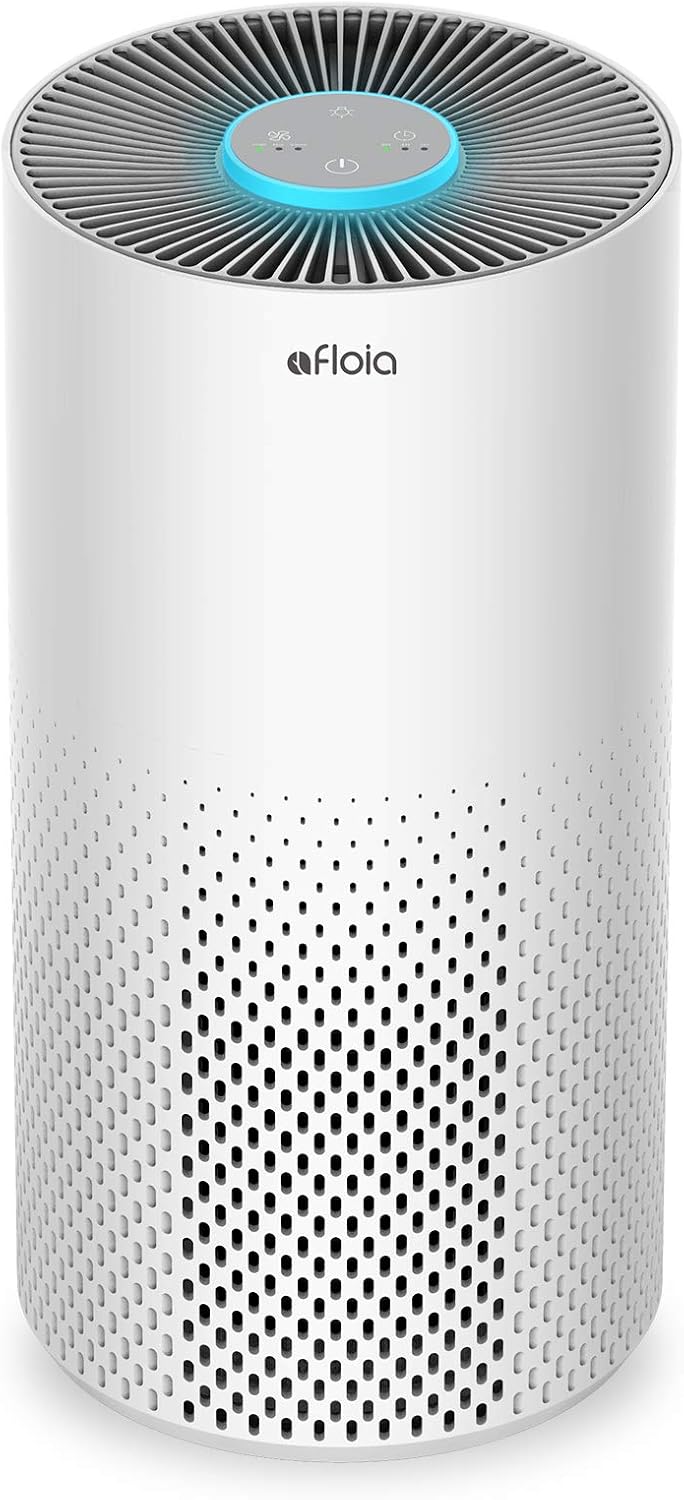
| Noise Level | 22 db |
|---|---|
| Particle Retention Size | 0.3 micron |
| Wattage | 23 watts |
| Filter Type | Activated Carbon |
| Floor Area | 60.84 square_feet |
The Afloia Kilo is a compact air purifier aimed at everyday home use, combining a washable pre-filter with multi-layer filtration to capture dust, pet hair, pollen, odors and wildfire smoke. It is typically placed in bedrooms, living rooms, or home offices and runs on adjustable fan speeds and timed cycles (2/4/8/16 hours) so you can tailor operation to occupancy and sleep schedules. Notable features include a washable pre-filter to trap larger debris, a 0.3 micron particle retention rating, a low-noise 22 dB sleep mode and a color-changing night light that auto-dims. The unit claims multiple air changes per hour for moderate-size rooms and operates at a modest 23 watts, so it is inexpensive to run. Practical benefits are easy maintenance from the removable pre-filter, quiet overnight operation, and simple touch/button controls. Limitations are the modest stated floor area coverage compared with larger purifiers and the need to replace specialized filters every few months for peak performance, which adds ongoing cost.
Best for: Buyers who prioritize quiet overnight performance and low-running power in a compact purifier for bedrooms or small living spaces and want easy-to-maintain filters.
Less Ideal for: Large open-plan homes or users who need very high clean-air delivery rates for whole-house coverage should consider higher-capacity models instead.
- Very quiet 22 dB sleep mode suitable for bedrooms
- Washable removable pre-filter reduces buildup and maintenance cost
- Multi-stage filtration rated to capture 0.3 micron particles
- Multiple timer settings and adjustable fan speeds for flexible operation
- Coverage claims vary and may be modest compared with larger, higher-CADR units
- Requires periodic replacement of specialized filters for optimal filtration
Verdict: Choose the Afloia Kilo if you want a low-power, very quiet bedroom purifier with washable pre-filtering and simple controls.
VOOPNU HEPA Air Purifier DH-JH12

| Filtration | H13 True HEPA triple-layer |
|---|---|
| Coverage claim | Up to 1,076 ft² |
| Noise level | 22 dB (low) |
| Speeds | 3 fan speeds |
The VOOPNU DH-JH12 is a small, user-friendly air purifier built around an H13 true HEPA triple-layer filter and 360 degree intake that the brand says removes 99.97% of airborne particles. It is intended for continuous use in bedrooms, living rooms, or home offices and is controlled through a simple panel with three fan speeds and a timer. The unit is notable for its low noise floor — as quiet as 22 dB on low — and includes a small essential oil tray if you want mild scenting while the purifier runs. Laboratory-tested coverage claims and CADR-style throughput in the listing suggest it moves air quickly for its footprint, and certifications such as ETL, CARB, and FCC support basic safety and compliance. Trade-offs are typical for a compact design: filter replacement every few months is recommended, and peak performance requires extended run time rather than short bursts. The small footprint makes placement flexible but also means this model is best for single rooms rather than whole-house cleaning.
Best for: Buyers who prioritize a low-noise, easy-to-use purifier for a single room and want certified HEPA performance on a modest budget.
Less Ideal for: People who need whole-house filtration, very large open-plan spaces, or those who prefer smart app or multi-room linked systems.
- H13 true HEPA filtration captures particles down to 0.3 microns with 99.97% efficiency
- Very quiet operation down to 22 dB, suitable for sleep and quiet rooms
- 360 degree air intake helps circulate and clean air from all sides
- Compact footprint fits on desks or in corners and is easy to move
- Built-in essential oil tray adds mild scenting option without extra accessories
- Requires regular filter replacements on a 3–6 month cycle depending on use
- Small unit is optimized for single rooms rather than multi-room or whole-house coverage
Verdict: A quiet, compact HEPA purifier that delivers certified particle filtration and easy operation for budget-minded buyers needing single-room air cleaning.
ECOSELF HAP609 Air Purifier

| Model | HAP609 |
|---|---|
| PM2.5 display | Yes |
| Noise level (Sleep) | 20 dB |
| Timer | 1–24 hours |
The ECOSELF HAP609 is a small, user-friendly HEPA air purifier intended for bedrooms and living spaces up to the manufacturer recommended coverage. It draws air from all directions using a 360° intake and runs a three-stage filtration system to remove common household particles such as dust, pollen, smoke, and pet dander. A built-in PM2.5 sensor and color ring give real-time feedback on air quality, and the auto mode adjusts fan speed automatically when pollutants rise. The unit includes a 1–24 hour timer and a dedicated Sleep Mode that turns off display lights and drops noise to about 20 dB, making it one of the quieter options for nighttime use. Practical benefits include hands-off air monitoring and quiet overnight operation, but buyers should expect limited room coverage compared with larger tower purifiers and will need periodic filter replacements to maintain performance. The design is compact and portable, so it is best placed on a bedside table or desk rather than for whole-house use.
Best for: Buyers who prioritize quiet, reliable overnight air cleaning and want automatic, low-effort air quality management in bedrooms or small living areas.
Less Ideal for: People seeking high-capacity purification for large rooms or open-plan homes should consider a larger, higher-CADR purifier instead.
- 360° air intake for more even room circulation
- Built-in PM2.5 sensor with color ring makes air quality easy to read at a glance
- Auto mode adjusts fan speed based on real-time pollution levels
- Sleep Mode mutes lights and lowers noise to about 20 dB for overnight use
- Smaller unit so not ideal for large open-plan spaces
- Requires replacement filters to sustain HEPA performance
Verdict: Choose the ECOSELF HAP609 if you need a compact, very quiet HEPA purifier that monitors air quality and runs automatically for reliable overnight use.
Levoit Core 300-P

| Power Source | Corded Electric |
|---|---|
| Filter Type | 3 in 1 Filtration |
| Floor Area | 1073 square_feet |
| Noise Level | 24 db |
| Particle Retention Size | 0.3 micron |
The Levoit Core 300-P is a small, portable HEPA air purifier meant for bedrooms and living spaces where low noise matters. It uses a three-stage Levoit original filter and a 56W motor to capture 99.97% of particles down to 0.1–0.3 microns, and the manufacturer cites AHAM-verified CADR numbers for smoke, dust, and pollen. Controls are touch-based with a Sleep Mode that reduces noise to about 24 dB and lets you turn display lights off for overnight use. Practical benefits include a compact footprint for tight spaces, simple manual speed control, and certifications such as AHAM and CARB that back its performance and safety claims. Important limitations are that this model lacks Auto Mode or smart connectivity, so you must change fan speeds manually, and best performance depends on using official replacement filters on the recommended schedule. The unit is intended for clean-air duty in single rooms rather than whole-home filtration and works best when run continuously or on a timer for sustained results.
Best for: Buyers who prioritize quiet overnight operation and want a compact, independently certified purifier for bedrooms or single rooms and who value strong user reviews and verified performance.
Less Ideal for: Households seeking whole-home coverage, integrated smart features, or automatic air-quality sensing should consider larger or smart-enabled models instead.
- True HEPA-grade three-stage filter with 99.97% efficiency for 0.1–0.3μm particles
- AHAM-verified CADR ratings for smoke, dust, and pollen supporting real-world cleaning claims
- Very quiet Sleep Mode (around 24 dB) and display-off option for undisturbed overnight use
- Compact, portable design that fits small rooms and is easy to move
- No Auto Mode or smart connectivity so fan speed must be adjusted manually
- Optimal performance relies on using Levoit replacement filters and regular replacements
Verdict: If you want a compact, AHAM-verified purifier that runs whisper-quiet at night, the Levoit Core 300-P is a dependable pick for single-room use.
Levoit Vital 200S-P Air Purifier

| Floor Area | 1875 square_feet |
|---|---|
| Noise Level | 27 db |
| Particle Retention Size | 0.1 micrometer |
| Wattage | 51 |
| Filter Type | 3-Stage Filter |
The Levoit Vital 200S-P is a Wi‑Fi–enabled air purifier made to clean large rooms quickly while staying unobtrusive. It uses a three-stage filtration system (pre-filter, activated carbon, and HEPA-grade media) and an AHAM-verified CADR to remove smoke, dust, pollen, pet hair, and odors across wide open spaces. You can control it by app or on-device buttons and monitor indoor air quality in real time, and the unit includes a sleep mode rated as low as 27 dB for use in bedrooms. Practical benefits include washable pre-filter media to catch larger debris and a choice of replacement specialty filters for pets, smoke, or toxins, which helps tailor performance for specific concerns. On the downside it is relatively large and has modest wattage, so it needs permanent placement and an outlet; replacement filters are required over time to sustain peak performance. For buyers focused on quiet, whole-room cleaning with smart controls, it balances strong CADR performance with low-noise operation.
Best for: Buyers who prioritize quiet, dependable whole-room air cleaning with smart control and independent CADR verification and who prefer a low-noise unit for bedrooms or living areas.
Less Ideal for: People needing a truly portable, battery-powered purifier for travel or those who want the smallest possible footprint for tight spaces.
- AHAM-verified CADR ratings for smoke, dust, and pollen indicating strong whole-room cleaning.
- Three-stage filtration with washable pre-filter and activated carbon for odors and particulates.
- Smart app control and onboard air quality monitor for remote monitoring and automation.
- Sleep mode with very low noise down to 27 dB suitable for bedrooms.
- Large footprint and weight require a fixed spot and may not suit very small rooms.
- Requires periodic replacement specialty filters to maintain specialized performance.
Verdict: Choose the Vital 200S-P if you want a quietly performing, AHAM-verified whole-room purifier with smart controls and configurable filters.
Choosing the Right Quiet Air Purifier: Key Factors to Consider
Sound Level and How It's Rated
Sound level matters because the whole point of a quiet air purifier is to run unobtrusively during sleep or work. Look for decibel ratings measured at specific distances and fan speeds, typically published for low, medium, and high settings. A unit rated in the mid-20s dB on its lowest setting will be noticeably quieter than one in the mid-30s.
Remember that perceived loudness depends on room acoustics and distance from the unit. A purifier tucked near a wall or in a corner may sound louder due to reflections. Also check whether manufacturers provide subjective descriptors like "sleep mode" and whether that mode deliberately lowers fan speed versus just dimming lights.
Filtration Type and Particle Removal
A quiet unit still needs to clean the air effectively. HEPA-class mechanical filters remove small particles like pollen, dust, and many airborne allergens and should be a baseline for most buyers. Some units include activated carbon to reduce odors and volatile organic compounds; this is helpful if odor control is a priority.
Check filtration ratings tied to particle size where available. A purifier that is very quiet but only uses basic prefilters may not meet health-related needs. Consider the combination of filter stages and any published CADR or particle-removal metrics to judge real-world effectiveness.
Room Size and Coverage
Match the purifier's coverage to the room where you expect to run it quietly. Coverage is usually listed as square footage for a target air change rate. A small, low-noise unit that is effective in a bedroom may be inadequate for an open-plan living room.
If you plan to run the purifier on low fan speeds to maintain quiet operation, pay attention to how that affects recommended room size. Running at sleep-level airflow reduces the effective clean-air delivery rate, so opt for a unit rated above the room size if you expect sustained low-speed use.
Control Options and Night Features
Controls affect how easy it is to set a purifier to quiet operation. Look for dedicated sleep or night modes that lower fan speed and dim or turn off display lights. A tactile dial can be simpler to use at night than a complex menu.
Programmable timers, auto modes tied to air-quality sensors, and remote or app control add convenience. However, app-driven units should still offer reliable local controls so you can set quiet modes without unlocking a phone.
Filter Replacement and Maintenance
Maintenance affects long-term noise and performance. Clogged filters force higher fan speeds, which increases noise. Check filter lifespans, whether filters are easy to access, and whether replacements are commonly available. Some units offer washable prefilters that extend time between replacements.
Also consider monitoring features such as filter-life indicators. These make it easier to keep the unit performing quietly and effectively without guesswork, which is especially important for users who run purifiers continuously at low speeds.
How Noise Ratings Translate to Real Use
Published decibel figures are helpful, but household perception of noise also depends on frequency, fan motor pitch, and room acoustics. A purifier with a lower low-speed dB may still sound intrusive if the tone is high-pitched or if the unit vibrates against nearby surfaces.
Place the purifier a few feet from the bed or workspace and avoid direct contact with furniture to minimize vibration transmission. If you want to compare models for yourself, test them in the room where they will be used, listening at typical sleeping or working positions.
- Lower Hz tones are generally less irritating than high-pitched whines at the same dB.
- Distance reduces perceived loudness quickly; even a foot or two can matter.
- Soft flooring and curtains help dampen reflected noise.
Balancing Low Fan Speed with Effective Air Changes
Running at low speed reduces noise but also lowers clean-air delivery. Look for models that deliver adequate air changes per hour at their lowest practical setting or choose a slightly larger-rated unit so quiet operation still produces meaningful filtration.
If continuous low-noise filtration is the goal, prioritize units with efficient fans and aerodynamic housings that move air quietly rather than simply running a powerful motor at a low percentage.
- Calculate expected air changes at sleep speed if the manufacturer provides CADR by fan setting.
- For chronic allergy sufferers, prioritize higher baseline CADR even if you intend to use lower speeds.
Placement Tips to Reduce Perceived Noise
Where you place the purifier affects both cleaning effectiveness and perceived noise. Centering in a room maximizes airflow distribution but may expose occupants to more direct sound. Placing the unit near the source of contaminants, such as a pet area, can improve cleanliness with lower fan speeds.
Avoid placing the purifier on hollow surfaces that amplify sound. Use a stable, solid floor surface and leave clearance around air intake and outflow to maintain efficiency without forcing the fan to work harder.
- Keep at least several inches of clearance around intake vents.
- Elevated placement on a solid, vibration-dampening stand can help in some layouts.
- Avoid tight corners that can reflect sound and disrupt airflow.
Energy Use When Running Quietly
Low fan speeds are almost always more energy efficient, but fan motor design and runtime matter more than occasional wattage differences. If you will run the purifier continuously, choose models with low idle power draw and reliable, energy-efficient motors.
Some units include eco or auto modes that reduce power when sensors detect good air quality. Those features can extend filter life and lower monthly energy use while maintaining quiet background operation.
- Compare standby and low-speed wattage, not just peak draw.
- Sensor-driven autosave modes reduce runtime at higher speeds.
Managing Odors and VOCs Quietly
Activated carbon or other adsorption stages help with odors and volatile organic compounds. Addressing these contaminants may require additional filter media, which can affect airflow and potentially increase noise if the fan must work harder.
If odor control is important, prioritize multi-stage filtration that balances carbon capacity with a fan sized to maintain low-speed airflow.
- Carbon inserts often need replacement more frequently than mechanical filters.
- Check for modular filter designs that allow swapping carbon media without replacing the whole filter pack.
How We Chose the Best Quiet Air Purifier
We prioritized measurable noise performance and verified filtration capability when selecting entries for this roundup. Key evaluation criteria included published sound levels at different fan speeds, real-world low-speed noise impressions, and CADR or filtration ratings tied to particle and smoke removal. We also looked at airflow coverage tied to room size to ensure a quiet model could still deliver sufficient air changes per hour. Ease of maintenance and replacement-filter availability were considered to judge ongoing upkeep costs and practicality. Energy use at typical quiet settings and intuitive controls for night mode or sleep operation were additional filters. We excluded units that only advertise low noise without supporting sound data or that sacrifice essential filtration to achieve low decibels. We did not include specialty commercial units that are overspecified for simple home use. The result is a set of models that meaningfully balance whisper-quiet operation with credible filtration and day-to-day usability.
Our full evaluation process is outlined in our review methodology.
FAQ
How quiet is quiet enough for a bedroom?
Most people find 25 to 30 dB at night to be comfortably quiet for sleeping. Perception varies, so prioritize models with dedicated sleep modes and low-frequency fan signatures rather than relying on a decibel number alone.
Will running an air purifier on low speed still help allergies?
Yes, but effectiveness depends on the unit's CADR at low speed and room size. For significant allergy relief, ensure the purifier can deliver multiple air changes per hour at the chosen quiet setting.
Do filter replacements affect noise?
Clogged or overdue filters restrict airflow, which can force the fan to run faster and louder. Regular maintenance and timely filter changes help preserve both quiet operation and cleaning performance.
Are ultrasonic or ionizing units quieter than fan-based purifiers?
Different technologies have varied noise profiles. Fan-based HEPA purifiers generate airflow noise, while some alternative technologies operate silently but may not match HEPA filtration for particle removal. Evaluate tradeoffs in filtration and health needs when considering non-fan options.
Can I reduce purifier noise with accessories or placement tricks?
Yes. Placing the unit on a stable surface, adding soft furnishings to absorb reflections, and avoiding placement against thin cabinets can reduce perceived noise. Avoid improvised enclosures, which can restrict airflow and worsen performance.
Final Verdict
Prioritize units that provide verified low decibel operation while still offering credible HEPA-class filtration and adequate coverage for your room. Expect tradeoffs: the quietest units may require choosing a slightly larger-rated purifier so that low-speed airflow still achieves sufficient air changes. Give weight to filter maintenance, night-mode controls, and the quality of the fan design when making a final choice. Focus on matching the purifier to the intended room and preferred noise threshold, and plan for routine filter upkeep to keep the unit both quiet and effective. That approach will yield the best balance between restful surroundings and cleaner indoor air.