
Note: This article contains affiliate links. If you click on these links and make a purchase, we may earn a small commission at no extra cost to you. This helps support our research and content. Read our full affiliate disclosure here.
A quiet electric coffee grinder can transform your morning routine by producing consistent grounds without waking the household. If you brew early or share counter space in a small apartment, noise and grind uniformity matter as much as capacity and ease of cleaning. This guide shortlists the top quiet electric coffee grinders across common home brewing needs and evaluates them on the practical factors that affect everyday use. Below you will find our top picks selected for low operational noise, reliable grind consistency, and simple maintenance, followed by buyer guidance to help you match features to your brewing style.
Top Picks at a Glance
| Best Overall The best all-around choice for most situations | TIMEMORE Whirly 01S Grinder |  |
| Best Quality Built to a higher standard if you want something more solid | Fellow Ode Gen 2 Grinder |  |
| Best Value The sweet spot between price and what you get | SHARDOR Electric Coffee Grinder CG0802 |  |
| Best Budget The cheapest option that still gets the job done reliably | Proctor Silex Sound Shield Grinder |  |
| Top Rated A top-rated pick with lots of positive feedback | KRUPS Silent Vortex Grinder |  |
| Most Popular A crowd favorite that many people choose with confidence | SHARDOR Coffee Grinder CG648B |  |
TIMEMORE Whirly 01S Grinder

| Capacity | 50 g |
|---|---|
| Wattage | 25 watts |
| Voltage | 3.7 volts |
| Power Source | rechargeable battery |
The TIMEMORE Whirly 01S is a compact, battery-powered burr grinder aimed at delivering consistent grinds from espresso to French press while staying quiet enough for home or office use. It uses a patented stainless steel octagonal burr and a 30-step adjustment system that lets you fine-tune grind size in small increments, and the swivel hopper holds up to 50 g of beans with a secure click-in design. The 1000 mAh battery supports multiple sessions per charge and recharges via USB-C, and built-in protections include auto shutoff, overheat protection, and a reverse rotation to clear clogs. TIMEMORE also isolates the motor from the coffee chamber to limit heat transfer and preserve flavor. Practical limits are the modest single-charge capacity relative to heavy daily use and the recommendation to limit continuous sessions to avoid triggering thermal protection. Cleaning is simple with the included brush, but avoid water exposure to the electronics. For a quiet, portable grinder that still covers the full grind range, the Whirly balances performance and convenience well.
Best for: Buyers who want a quiet, portable electric grinder that can handle the full range of brew methods and value precise, repeatable grind control for home or travel.
Less Ideal for: Those who need a heavy-duty daily grinder for back-to-back commercial volume or who prefer a mains-only unit with unlimited continuous runtime.
- Wide grind range with 30 precise settings for espresso through French press
- Patented stainless steel octagonal burr for consistent flavor and crema
- Low-noise slow-speed motor and motor-to-chamber heat isolation preserve flavor and reduce disruption
- Rechargeable 1000 mAh battery with USB-C charging gives true portability
- Smart protections including auto shutoff, overheat protection, and reverse rotation to prevent clogs
- Limited capacity per charge for high-volume users despite 50 g hopper
- Not intended to be rinsed; internal electronics require careful cleaning methods
Verdict: If you want a quiet, travel-ready electric burr grinder that still delivers precise, café-quality grind control across espresso to French press, the Whirly 01S is a strong choice.
Fellow Ode Gen 2 Grinder

| Capacity | 100 g |
|---|---|
| Wattage | 140 watts |
| Voltage | 120 volts |
| Burr size | 64 mm |
The Fellow Ode Gen 2 is a purpose-built grinder for brewed coffee that focuses on consistent, quiet single-dose grinding. It uses 64 mm stainless steel flat burrs and a two-stage grinding geometry to produce uniform particle size across 31 settings tailored for pour-over, drip, French press, and cold brew. The 100 g single-dose bin and magnetic catch cup make dosing and collection tidy, while anti-static tech plus a built-in knocker reduce retention and countertop mess. Noise is noticeably lower than many comparable grinders, making it a good fit for early mornings or shared living spaces. The grinder is motorized and stops automatically when a dose is finished, so it is easy to use in routine workflows. Limitations include the single-dose bin size and the fact that it is designed for brewed coffee rather than espresso, so it is not ideal for users who need fine espresso-level dialing or large batch grinding. Cleaning is straightforward thanks to accessible components, and the compact footprint helps it sit comfortably on a counter or under cabinets.
Best for: Buyers who prioritize consistent brewed-coffee flavor and quieter single-dose grinding workflows and who want a precision grinder for pour-over, drip, French press, or cold brew.
Less Ideal for: People who regularly grind large volumes at once or who need a grinder optimized for fine espresso extraction should look elsewhere.
- Professional-grade 64 mm flat burrs deliver consistent particle size for improved extraction
- Quiet operation compared with many grinders, suitable for early-morning use
- Anti-static system, built-in knocker, and optimized grind path reduce grind retention and mess
- 31 grind settings tailored for brewed methods and a magnetic catch cup for tidy dosing
- Automatic shutoff after grinding simplifies single-dose workflows
- Single-dose 100 g bin limits large-batch grinding
- Not intended for espresso-level grinding or heavy espresso use
Verdict: Choose the Ode Gen 2 when you want a quiet, single-dose grinder that delivers consistent brewed-coffee results with minimal mess.
SHARDOR Electric Coffee Grinder CG0802
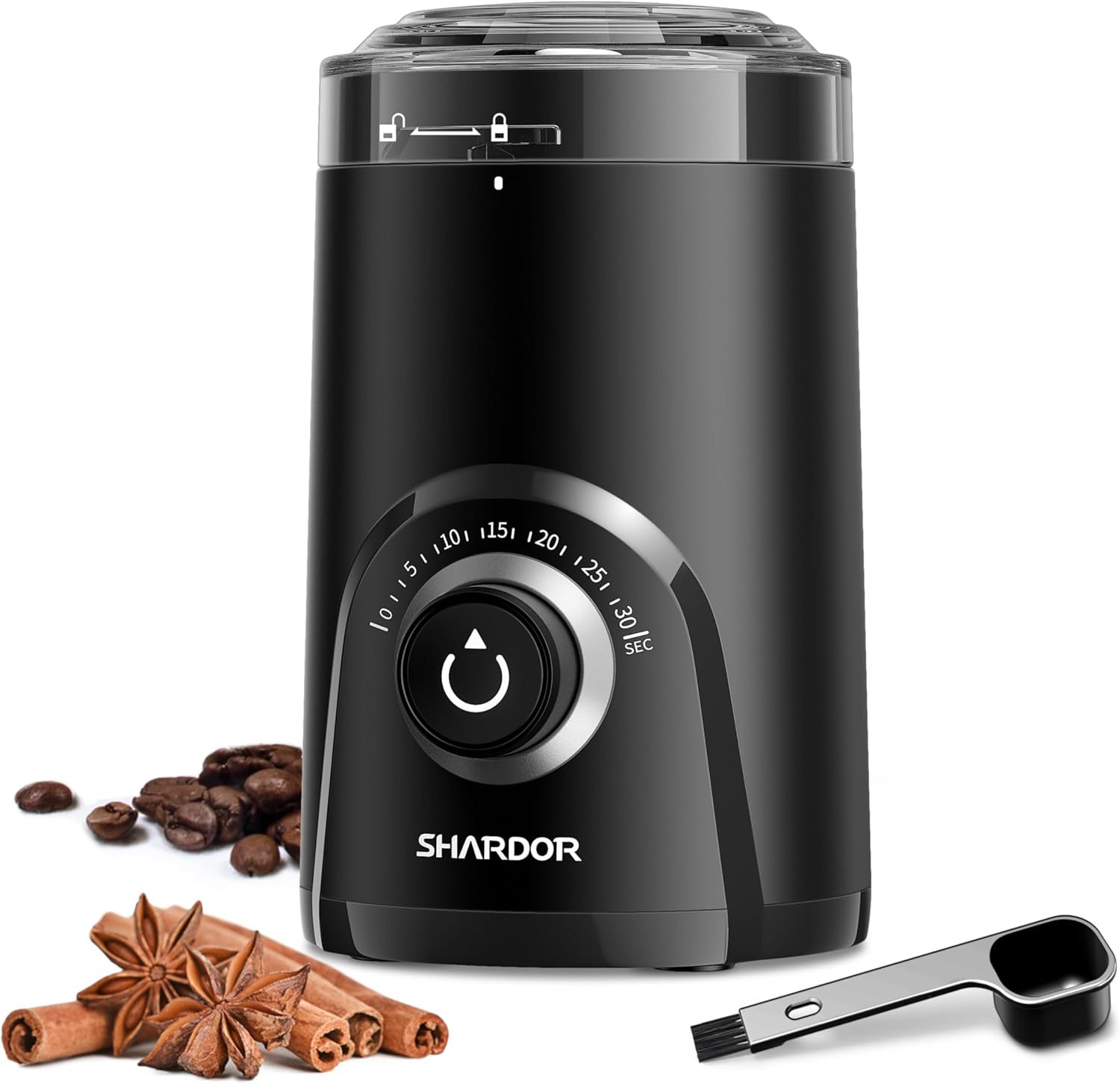
| Capacity | 70 g |
|---|---|
| Material Type | Stainless Steel |
| Power Source | Electric |
The SHARDOR CG0802 is a small, practical blade grinder designed for quick, repeatable grinding of coffee beans and dry kitchen ingredients. You set the clear timing knob by seconds, lock the lid, and the motor runs the stainless steel blades to produce whatever coarseness you need for espresso, drip, or French press; the visual timer helps avoid over-grinding and gives more consistent results than untimed push-button grinders. Its 70 g capacity handles a few cups at once or multiple spices in a single batch, and the package includes a two-in-one scoop with a cleaning brush for easy maintenance. SHARDOR advertises a noise level around 63 dB, so the unit is noticeably quieter than many blade grinders, which makes it convenient for early mornings or shared spaces. Limitations: as a blade grinder it cannot match the uniform particle size of a burr grinder, and wet grinding is not supported, so it is best suited to dry beans, spices, and grains. The compact stainless steel bowl and removable components simplify cleanup, making it a utilitarian choice for everyday use.
Best for: Buyers who prioritize a compact, low-noise grinder that gives predictable grind times for everyday coffee and spice use and want an easy-to-clean, no-fuss appliance.
Less Ideal for: Serious home baristas who need highly uniform grind particle distribution or users who require wet grinding for pastes and nut butters should look elsewhere.
- Clear visual timing knob for precise, repeatable grind times
- 70 g removable bowl holds multiple cups or batches of spices
- Quieter operation (~63 dB) compared with typical blade grinders
- Stainless steel blades and compact design are easy to clean and store
- Blade grinder design produces less uniform grind size than burr grinders
- Not suitable for wet grinding or oily beans
Verdict: A quiet, compact blade grinder with a visual timer that gives practical, repeatable grinds for everyday coffee and spice tasks.
Proctor Silex Sound Shield Grinder

| Capacity | 12 cups |
|---|---|
| Wattage | 125 watts |
| Voltage | 120 volts |
| Power Source | AC adapter |
The Proctor Silex Sound Shield Grinder is a straightforward blade grinder built for quiet, everyday use. It uses Sound Shield technology to reduce noise roughly half compared with similar blade models, so you can grind morning coffee without bothering others. The unit handles enough beans for a 12-cup pot and grinds beans or spices with stainless steel blades; the removable grinding bowl makes filling, pouring, and dishwasher cleanup simple. Operation is intuitive: press the outer lid to grind and release to stop, and the hidden cord storage keeps your counter neat. It runs on standard AC power and the compact footprint fits small kitchens. Limitations are typical of blade grinders: it cannot produce the consistent particle size of a burr grinder, so it is best for drip or French press rather than precision espresso, and texture can be uneven for some brewing methods. For a low-cost, low-noise grinder that is easy to use and clean, this is a practical pick.
Best for: Buyers looking for an inexpensive, compact grinder that minimizes noise and makes enough grounds for a full pot of drip coffee will appreciate this model.
Less Ideal for: People who need very consistent, adjustable grind sizes for espresso or pour-over extraction should choose a burr grinder instead.
- Sound Shield design claims about 50% quieter operation than comparable blade grinders
- Removable grinding bowl is dishwasher safe for easy cleanup
- Grinds enough beans to brew up to 12 cups, suitable for full-pot brewing
- Durable stainless steel blades provide reliable grinding for beans and spices
- Compact footprint with hidden cord storage keeps countertop tidy
- Blade grinder cannot match the grind consistency of burr grinders for espresso or precision brewing
- Basic on/off lid operation offers no grind time control or settings
Verdict: A budget-friendly, compact coffee grinder that keeps noise low and handles full-pot grinding with simple, dishwasher-safe cleanup.
KRUPS Silent Vortex Grinder

| Wattage | 200 watts |
|---|---|
| Voltage | 120 volts |
| Capacity | 12 cups |
The KRUPS Silent Vortex is a small, easy-to-use blade grinder designed to deliver quiet, consistent results for home use. Its patented Silent Vortex mechanism cuts noise to a fraction of typical grinders, making it useful for early mornings or shared living spaces, and the one-button operation simplifies grinding beans, spices, or dry herbs. The oval Vortex Spin design and adjustable grind time produce relatively uniform grounds suitable for drip, pour-over, and coarser methods like French press, while the 3 oz stainless steel cup yields up to a 12-cup pot in one run. Cleanup is straightforward because the removable bowl and lid are dishwasher-safe, and a storage lid helps keep grounds fresh. The unit is compact for small kitchens and stable during short runs, but as a blade-style grinder it cannot match a burr grinder for precise, ultra-fine espresso grinds and single-dose repeatability. Power and capacity are aimed at household use rather than commercial or high-volume grinding.
Best for: Buyers who prioritize quiet, reliable daily grinding for brewed coffee and occasional spice/herb use and want a fuss-free, low-maintenance appliance.
Less Ideal for: People who need precise, repeatable fine grinds for espresso or those who regularly grind large commercial volumes should consider a dedicated burr grinder or higher-capacity model.
- Very quiet operation compared with typical blade grinders
- Removable stainless-steel grinding bowl is dishwasher-safe for easy cleaning
- One-touch operation makes single-button grinding quick and simple
- 3 oz cup yields enough grounds for up to a 12-cup pot, useful for families or entertaining
- Blade grinder design limits grind consistency compared with burr grinders
- Not intended for very fine, repeatable espresso-level grinds
Verdict: Choose this grinder if you want a dependable, whisper-quiet countertop grinder that makes fresh grounds with minimal fuss and cleanup.
SHARDOR Coffee Grinder CG648B

| Capacity | 2.5 ounces |
|---|---|
| Wattage | 150 watts |
The SHARDOR CG648B is a small, press-to-start blade grinder designed for quick home grinding of coffee beans, spices, and seeds. You operate it by pressing down on the lid to run the 150-watt motor and releasing to stop, which gives simple on-demand control over grind time and coarseness. The removable stainless steel bowl and lid make filling, pouring, and cleaning straightforward and the unit is dishwasher-safe for the cup. SHARDOR advertises an average noise around 63 dB, so it runs noticeably quieter than many blade grinders and suits early-morning use without loudly disturbing others. Its 2.5-ounce capacity is intended for single- to small-batch brewing—roughly up to ten cups worth—so it is not geared for large batch grinding. As a blade grinder, it will not produce uniform particle sizes like burr grinders, so it is best for drip, French press, or spice work rather than precise espresso dialing. The unit is lightweight, multi-functional for herbs and spices, and offers solid everyday convenience for casual coffee drinkers who prioritize low noise and easy cleanup.
Best for: Buyers who value low-noise, easy-to-use equipment and want a compact grinder for single-batch coffee, occasional spice grinding, or small-batch home use backed by many user reviews.
Less Ideal for: People seeking precise, uniform grind control for espresso or those who regularly grind large quantities of beans should choose a burr grinder or a larger-capacity model instead.
- Quiet operation around the advertised 63 dB for less disruption in shared spaces
- Removable stainless steel bowl that is easy to fill, pour, and clean and is dishwasher-safe
- 150-watt motor handles coffee beans, spices, herbs, seeds, and coarse salt
- Simple press-to-start lid gives intuitive, on-demand control of grind time
- Compact footprint good for small kitchens and quick single-batch use
- Blade design yields less consistent grind size compared with burr grinders
- Small 2.5 oz capacity is limited for larger households or batch grinding
Verdict: A quiet, compact blade grinder well suited to small-batch coffee drinkers and home cooks who want easy cleaning and low-noise operation.
Choosing the Right Quiet Electric Coffee Grinder: Key Factors to Consider
Noise Output and Decibel Profile
How loud a grinder runs is a primary concern for buyers seeking a quiet electric coffee grinder. Look for units with dampened housings, low-RPM motors, or geared reduction systems that produce less mechanical noise. Decibel ratings reported by manufacturers can help, but real-world noise depends on kitchen acoustics and surface contact. Consider whether the grinder produces steady low hums or high-pitched whines, since high-frequency tones are more disruptive.
Noise matters beyond wake-up times. Less vibration often means steadier burr alignment and less retention of grounds, which improves dose repeatability. If you live in a shared space, prioritize grinders designed with sound reduction features even if it modestly increases footprint or weight.
Grind Consistency Across Settings
Consistent particle size is critical for reliable extraction whether you brew espresso, pour-over, or French press. A quiet electric coffee grinder should offer a range of grind settings while maintaining uniformity at each step. Conical and flat burr sets perform differently; the important part is stable tolerances and a clear adjustment mechanism so you can repeat a setting day to day.
Check for stepped versus stepless adjustment systems depending on how precisely you tune your grind. Stepped systems are easier to repeat, while stepless systems allow micro-adjustments. For home use, consistency at the most commonly used settings matters more than an extensive but noisy adjustment range.
Hopper Capacity and Bean Feeding
Hopper capacity affects how often you refill and how fresh the beans remain between grinds. A larger hopper is convenient for households that brew multiple cups, while a smaller hopper is fine if you prefer to measure and store beans separately. Also consider whether the hopper feeds beans consistently to the burrs; uneven feeding can increase noise and produce uneven grind.
Some quiet grinders include removable hoppers or airtight lids to preserve freshness and make cleaning easier. If you grind for single-dose brewing, evaluate how quickly you can empty, clean, and reassemble the hopper without introducing extra noise or fumbling.
Burr Type and Maintenance
Burr material and geometry influence both grind quality and longevity. Hardened steel burrs are common for balanced performance and cost, while ceramic burrs resist wear and retain sharpness longer but can be more brittle. Burr alignment and user-accessible designs make routine maintenance and cleaning simpler, which preserves performance over time.
Maintenance also affects noise. Built-up oils and fines can increase rattling or harsh sounds. Choose a model with easy-access burrs for periodic cleaning and a disassembly flow that does not require special tools, especially if you value a quiet, trouble-free routine.
Dosing Accuracy and Retention
Dosing accuracy determines how close the ground weight or volume is to what you expect. For espresso and precision pour-over, consistent dosing reduces variability across shots. Retention refers to how many grounds stay inside the grinder after a dose; high retention forces you to purge or waste grounds to change beans or settings.
A good quiet electric coffee grinder balances low retention with reliable dosing mechanisms. Look for timed dosers, discrete dose settings, or grind-by-weight compatibility if precise dosing is a priority. Lower internal retention also reduces the need for aggressive cleaning, which helps keep mechanical noise low.
Footprint, Build Quality, and Vibration Control
Home kitchens vary in counter space and surface stability. A larger, heavier base can reduce vibration-induced noise, while rubber feet or isolation mounts minimize transmission to cabinetry. Solid build quality also ensures moving parts remain aligned, which preserves both noise performance and grind consistency.
Consider where the grinder will sit and whether its dimensions and weight fit that space. If vibration is a concern, prioritize models with wider bases and intentional isolation features rather than simply relying on softer surfaces under the unit.
Why Low RPM and Motor Design Matter
Low-RPM motors tend to produce deeper, less intrusive noise profiles compared with high-speed motors. They also reduce heat transfer to the burrs, which helps preserve coffee aroma and prevents oils from becoming gummy during long grinding sessions.
When evaluating motor design, note whether the unit uses gear reduction or a direct-drive low-speed motor. Both can be quiet when engineered well, but gear reduction introduces additional moving parts that must be damped effectively to avoid rattles.
- Low RPM often equals lower acoustic pitch and less perceived loudness
- Motor cooling and heat management protect flavor and longevity
- Damped gear trains require good housing design to avoid rattle
Single-Dose Vs Hopper Grinding for Quiet Use
Single-dose grinding minimizes bean exposure and can reduce retention, but it may require more hands-on setup and can produce slightly different noise patterns because of bean flow differences. For quiet operation, single-dose setups let you grind only what you need and store beans elsewhere to preserve freshness.
Hopper grinders are convenient for multiple servings and typically have smoother, continuous bean feeding. If you choose a hopper model for quiet use, look for features like anti-static lids and well-shaped feed funnels to avoid irregular bean drops that can make intermittent clicking sounds.
- Single-dose: lower retention, more hands-on, potentially quieter overall sessions
- Hopper: convenience for multiple cups, requires consistent feed design to avoid clicks
Cleaning Routines That Keep Noise Down
Regular cleaning reduces mechanical noise caused by fines and oil buildup. Establish a simple weekly and monthly routine to remove the hopper, brush out the burr chamber, and wipe down surfaces. Less buildup means smoother operation and fewer surprise rattles.
Use recommended tools and avoid harsh solvents that can damage burr surfaces. If the grinder allows easy burr removal without tools, scheduled deep cleans become feasible and keep long-term noise and performance stable.
- Brush out fines after every few uses
- Deep clean burrs monthly or as recommended
- Avoid overfilling the hopper to reduce spillage noises
Placement and Countertop Tips to Reduce Perceived Noise
Where you place the grinder affects how loud it seems. A solid, heavy countertop will absorb vibration better than a hollow cabinet door or thin shelf. If possible, place the grinder on rubber pads or a small mat to decouple it from resonant surfaces.
Position the grinder away from walls that reflect sound or glass surfaces that amplify high frequencies. Simple changes in placement can reduce perceived loudness without changing equipment.
- Use isolation pads to cut vibration transfer
- Avoid hollow or lightweight surfaces
- Keep the machine away from reflective surfaces and corners
Matching Grind Range to Your Brewing Method
Choose a grinder whose range covers the brewing methods you use most often. For espresso, look for fine settings with low retention and fine-tuning capability. For French press and coarser methods, ensure the grinder can produce large, uniform particles without excessive fines.
A grinder tailored to your primary brew method reduces the need for frequent adjustments and the noise that can come from repeatedly changing settings and purging retained grounds.
- Espresso: fine settings with stable micro-adjustments
- Pour-over: medium-fine to medium range with repeatability
- French press: coarse range that minimizes fines
How We Chose the Best Quiet Electric Coffee Grinder
Our selection process focused on the features that materially affect home use of a quiet electric coffee grinder. We prioritized measurable grind consistency across settings, the machine's operational noise profile, build quality and burr type, and usability factors such as dosing, hopper capacity, and ease of cleaning. We also considered motor durability and heat management because excessive heat or motor strain can alter flavor and shorten service life. Excluded were grinders that rely solely on blade mechanisms, very low-capacity novelty units, or designs that sacrifice durability for low upfront cost. We filtered out products with limited grind range or known cleanup challenges. In short, the list favors grinders with proven burr systems, user-adjustable grind settings, thoughtful dosing and retention design, and documented low-noise performance in typical kitchen environments.
Our full evaluation process is outlined in our review methodology.
FAQ
How quiet is a quiet electric coffee grinder compared with a blade grinder?
Quiet electric grinders are typically much less intrusive than high-speed blade grinders because they use burrs and lower RPM motors. Blade grinders create noisy, high-pitched sounds and inconsistent particle sizes, while quiet electric grinders aim for a steadier, lower-frequency hum.
Will a quieter grinder compromise grind quality or speed?
Not necessarily. Many quiet grinders are engineered to balance low noise with effective burr geometry and motor torque. They may run a bit slower, which can slightly increase grind time, but that trade-off often improves consistency and reduces heat transfer.
How often should I clean a quiet electric coffee grinder to maintain low noise?
Light cleaning after every few uses and a deeper burr cleaning monthly is a practical schedule for home use. Regular maintenance prevents buildup that can introduce rattles or change the grinder's acoustic character.
Does hopper size affect noise level?
Hopper size influences how beans feed into the burrs and can affect intermittent noises caused by bean movement. Larger hoppers with smooth funnels usually provide steadier feeding and fewer clicks, but placement and feed design matter more than raw capacity.
Can I make my existing grinder quieter without replacing it?
Some noise reduction can be achieved by placing the grinder on isolation pads, tightening any loose panels or screws, and ensuring the hopper is seated correctly. However, inherent motor or burr noise may still limit how much quieter it can become.
Final Verdict
When choosing a quiet electric coffee grinder, prioritize grind consistency and operational noise in equal measure. Decide which brewing methods you use most and match the grinder's range and adjustment style to those needs. Also weigh practical attributes such as hopper size, retention, and ease of cleaning because these affect daily convenience and long-term noise behavior. The right quiet grinder reduces routine friction in your brewing process and helps you dial in consistent results. Focus on the tradeoffs between noise profile, burr quality, and dosing convenience to select a model that fits your countertop and brewing habits with confidence.