
Note: This article contains affiliate links. If you click on these links and make a purchase, we may earn a small commission at no extra cost to you. This helps support our research and content. Read our full affiliate disclosure here.
If you need cleaner air in a bedroom, nursery, or small office without a distracting hum, picking the right quiet small air purifier matters. Quiet operation affects sleep and concentration, while a compact footprint determines where the unit can sit in your space. This guide shortlists the top small air purifiers that prioritize low noise and effective filtration, with attention to CADR, filter type, and runtime. Below are our top picks for quiet small air purifiers, followed by detailed buying factors and practical tips to help you choose the best fit for your room and routine.
Top Picks at a Glance
| Best Overall The best all-around choice for most situations | Levoit Core 300-P Air Purifier |  |
| Best Quality Built to a higher standard if you want something more solid | Dyson HushJet Compact Purifier |  |
| Best Value The sweet spot between price and what you get | MOOKA M01 Air Purifier |  |
| Best Budget The cheapest option that still gets the job done reliably | MEGAWISE EPI810 Air Purifier |  |
| Top Rated A top-rated pick with lots of positive feedback | ECOSELF HAP609 Air Purifier |  |
| Most Popular A crowd favorite that many people choose with confidence | Levoit Core Mini-P |  |
| Best Seller A high-volume bestseller chosen again and again | VOOPNU HEPA Air Purifier DH-JH12 |  |
Levoit Core 300-P Air Purifier

| Power Source | Corded Electric |
|---|---|
| Floor Area | 1073 square_feet |
| Noise Level | 24 db |
| Particle Retention Size | 0.3 micron |
| Wattage | 56 watts |
The Levoit Core 300-P is a small, quiet air purifier built around a three-stage HEPA-grade filter that captures 99.97% of particles down to 0.1–0.3 microns and is targeted at common household pollutants like dust, pollen, smoke, and pet dander. It uses a 56W motor with a CADR suited to refresh a medium room quickly and has a near-silent Sleep Mode that drops noise to around 24 dB for overnight use. Controls are touch-based with a timer and a check-filter indicator, and the unit is portable enough to move between bedroom, office, and living spaces. Notable benefits include AHAM verification and multiple safety certifications, which support dependable real-world performance, and the use of genuine replacement filters for consistent results. Limitations are that the Core 300-P lacks smart connectivity and automatic sensor-driven Auto Mode found on some other models, so fan speed must be adjusted manually, and filter replacement is recommended every 6 to 8 months depending on use. The compact footprint also means it is optimized for single-room coverage rather than whole-house cleaning.
Best for: Buyers who want a reliable, quiet purifier for bedrooms or small to medium rooms and value proven HEPA performance and low-noise overnight operation.
Less Ideal for: People seeking a smart, sensor-driven purifier with automatic speed control or those who need to clean large open-plan areas or whole-house spaces.
- True HEPA-grade three-stage filtration capturing fine particles to 0.1–0.3 micron with 99.97% efficiency
- Very quiet Sleep Mode at about 24 dB suitable for bedrooms
- AHAM verified CADR and multiple safety certifications for reliable performance
- Compact and portable design that is easy to move between rooms
- Touch controls with timer and filter-change indicator for simple operation
- No smart connectivity or Auto Mode so fan speed must be managed manually
- Designed for single-room use and not intended to replace whole-home systems
Verdict: If you need a compact, whisper-quiet HEPA purifier for a bedroom or small room, the Core 300-P delivers proven filtration with low overnight noise.
Dyson HushJet Compact Purifier

| Filter Type | Electrostatic |
|---|---|
| Filter Class | Electrostatic, Activated Carbon |
| Floor Area | 203 |
| Particle Retention Size | 0.3 micron |
| Controller Type | Mobile app, Voice assistant |
The Dyson HushJet Compact is a small-format air purifier built to deliver strong whole-room circulation while keeping noise to a minimum. It uses a 360° electrostatic filter to capture 99.97% of particles down to 0.3 microns and a 360° activated carbon layer to reduce cooking and pet odors and certain gases. The unit is sealed to prevent re-release of trapped pollutants and is engineered to move air efficiently across a room up to about 203 sq ft, with performance monitored and adjusted in real time by its sensors and algorithm. Control is available via the MyDyson app or voice assistants, and the LCD provides live air-quality readouts and filter-life alerts. The design emphasizes quiet operation with a star-shaped nozzle and a sleep mode that can reach very low noise levels, making it suitable for bedrooms or workspaces. Important limitations are the premium positioning and reliance on proprietary filters and app connectivity, so buyers should expect higher consumable costs and need for Wi-Fi for remote features.
Best for: Buyers who prioritize quiet but high-performance purification in small to medium rooms and want real-time monitoring and remote control.
Less Ideal for: People seeking a budget purifier for very large open-plan spaces or those who want a completely offline device without app or smart features.
- High-efficiency 360° electrostatic filter captures 99.97% of particles down to 0.3 microns
- Activated carbon layer reduces odors and certain gases like NO2
- Engineered airflow and star-shaped nozzle deliver strong room circulation while minimizing noise
- Real-time monitoring with LCD and MyDyson app plus voice control for remote management
- Sealed construction prevents trapped pollutants from being reintroduced to the room
- Proprietary filters and long-life claims come with higher replacement costs
- Full remote features require app connectivity and compatible devices
Verdict: Choose the HushJet Compact when you want one of the quietest small purifiers that still delivers powerful, monitored whole-room performance.
MOOKA M01 Air Purifier

| Coverage | 430 ft² |
|---|---|
| Filter type | H13 HEPA |
| Noise level | 15 dB (sleep mode) |
| Power | USB‑C, wide voltage |
The MOOKA M01 is a small desktop air purifier aimed at bedrooms, dorms, offices, and other personal spaces where quiet continuous cleaning matters. It uses an H13 HEPA three‑stage filter to capture dust, pollen, smoke, pet dander and odor, and it offers four fan speeds plus a certified 15 dB sleep mode for near‑silent nighttime use. The unit is USB‑C powered with wide voltage support so you can run it from a wall adapter, laptop, or power bank, and it includes a timer, child lock, filter replacement indicator, and an aroma pad and night light for added comfort. Practical benefits are its portability, low noise for sleeping or studying, and straightforward maintenance with replaceable filters. Limits include its small footprint and filter lifespan of a few months, which makes it suitable for single rooms or close‑range use rather than whole‑home cleaning, and it relies on replacement filters to keep performance consistent. For buyers who prioritize quiet operation and compact size, the M01 delivers a solid personal‑space solution.
Best for: Buyers who want a low‑noise, portable purifier for a bedroom, desk, dorm or travel and who value simple plug‑in operation and quiet overnight performance.
Less Ideal for: People seeking high airflow or whole‑house/large‑room purification should choose a larger unit with higher CADR and longer filter life.
- H13 HEPA three‑stage filtration for particles like dust, pollen, smoke and pet dander
- Ultra‑quiet 15 dB sleep mode suitable for bedside or study use
- USB‑C power with wide voltage compatibility for use with adapters, laptops, or power banks
- Portable, compact design that fits desks, dorms, cars and small rooms
- Designed for personal or small-room coverage rather than whole‑room or open‑plan spaces
- Filter needs periodic replacement with a typical 3–6 month lifespan
Verdict: If you need a truly quiet, portable purifier for a bedroom or desk, the MOOKA M01 gives H13 HEPA filtration and a 15 dB sleep mode in a compact USB‑powered package.
MEGAWISE EPI810 Air Purifier

| Filter Type | HEPA |
|---|---|
| Floor Area | 250 |
| Noise Level | 32 db |
| Particle Retention Size | 0.3 micron |
| Wattage | 8 watts |
The MEGAWISE EPI810 is a small, energy-efficient air purifier intended for bedrooms, offices, and other compact spaces. It uses an H13 True HEPA 3-stage filter with an activated carbon layer to capture 99.97% of particles down to 0.3 microns while also reducing common household odors. The unit runs very quietly—advertised at as low as 24 dB in sleep mode and 32 dB on a listed setting—so it can operate overnight without disturbing sleep. Its touch/button controls and lightweight tabletop design make it easy to move and set on a nightstand or desk, and the built-in night light provides a gentle glow for nighttime use. Power draw is low at 8 watts, so continuous operation is practical for budget-focused buyers. Limitations are its coverage: the spec lists a floor area of 250 (likely square feet), so it is not intended for large open-plan rooms, and replacement filters will be a recurring cost. The purifier is ozone free and targets dust, pet dander, smoke, and odors effectively within its small-room scope.
Best for: Buyers who want an inexpensive, energy-efficient purifier for a bedroom, dorm, or small office that runs quietly overnight and handles dust, pet dander, and cooking smells.
Less Ideal for: Homes needing whole-room coverage or high clean-air delivery for large living areas should choose a larger-capacity purifier instead.
- H13 True HEPA plus activated carbon removes 99.97% of particles down to 0.3 microns and reduces odors
- Very low noise in sleep mode (as low as 24 dB) suitable for bedrooms
- Compact, lightweight tabletop design that fits on nightstands and desks
- Low power consumption at 8 watts enables continuous use without high energy cost
- Designed for small rooms only and not suitable as the sole purifier for large open spaces
- Replacement filter costs and frequency are an ongoing expense
Verdict: A budget-friendly, ultra-quiet tabletop purifier that delivers true HEPA filtration for small bedrooms and offices.
ECOSELF HAP609 Air Purifier

| Model | HAP609 |
|---|---|
| PM2.5 Display | Yes |
| Noise Level (Sleep) | 20 dB |
| Timer | 1–24 hours |
The ECOSELF HAP609 is a small-room HEPA air purifier that pulls air in from all sides and uses a PM2.5 sensor to adjust fan speed automatically. Typical use is bedside or desktop placement in bedrooms, offices, or near pet areas where quick response to smoke, pollen, or pet dander matters. Notable features include a 360° air intake for faster coverage, a visible PM2.5 readout with a color ring for instant feedback, an auto mode that ramps fan speed as pollution rises, and a dedicated sleep mode that mutes lights and drops noise to about 20 dB. Practical benefits are straightforward: it quietly maintains cleaner air without constant adjustments and the timer lets you schedule runs from 1 to 24 hours. Limits are its small physical footprint, which means it is intended for single rooms rather than whole-home purification, and replacement filters will be required over time to keep performance steady. The simple controls and low noise make it well suited to overnight use, while the PM2.5 display helps verify that the unit is responding to real indoor pollution events.
Best for: Buyers who prioritize quiet, reliable air cleaning for a bedroom or small living space and want a unit that runs automatically with minimal intervention.
Less Ideal for: Those seeking whole-home coverage or a high-output purifier for large open rooms should consider larger-capacity units instead.
- 360° air intake promotes faster room circulation than single-direction designs
- Built-in PM2.5 sensor with color ring gives real-time air quality feedback
- Auto mode adjusts fan speed automatically for hands-off operation
- Sleep mode mutes lights and lowers noise to about 20 dB for bedroom use
- 1–24 hour timer provides flexible scheduled run times
- Designed for small rooms only, not suitable for large open-plan areas
- Requires periodic filter replacement to maintain HEPA performance
Verdict: A near-silent, easy-to-use HEPA purifier that reliably cleans and monitors air in small bedrooms and offices.
Levoit Core Mini-P
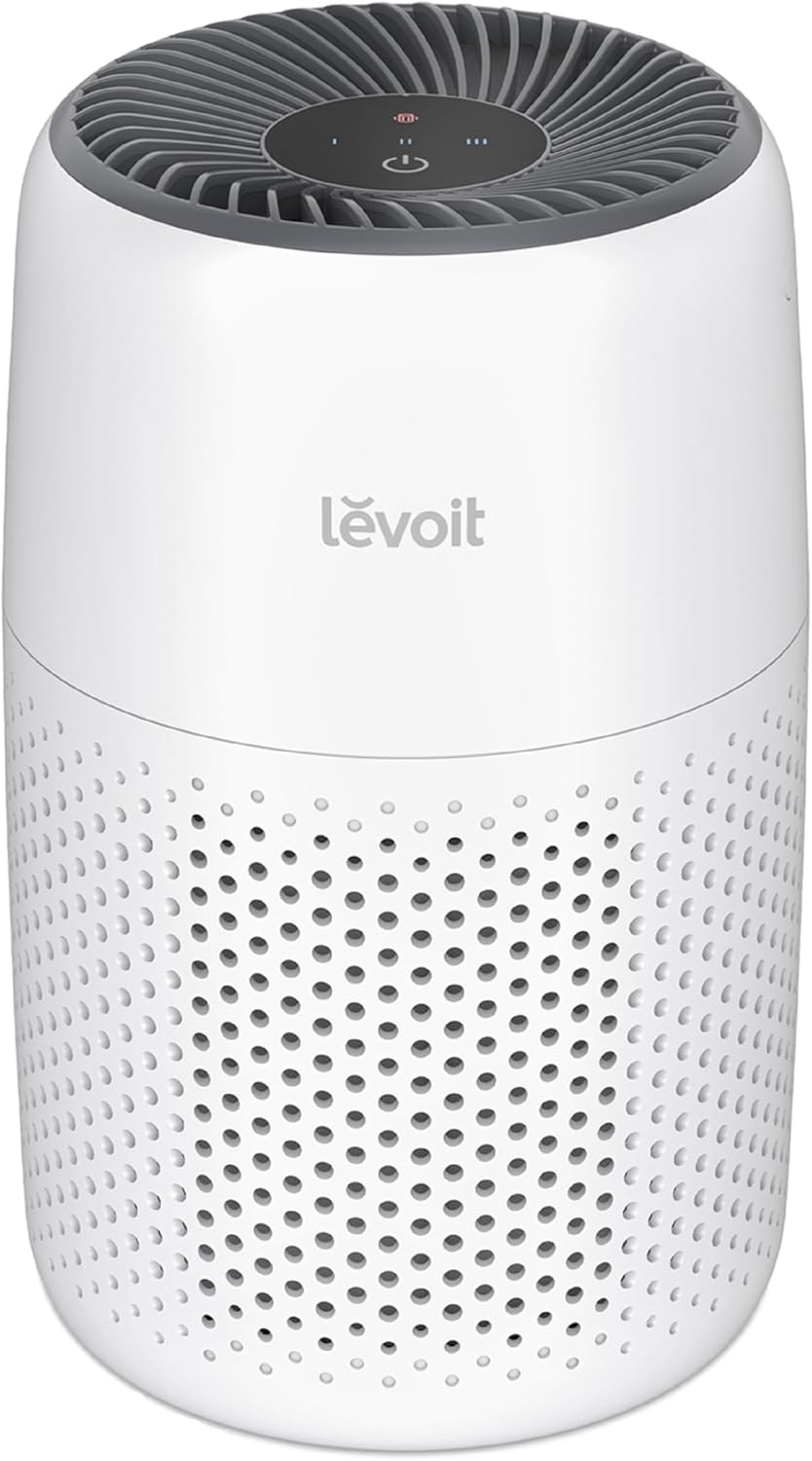
| Rated Power | 7W |
|---|---|
| Noise Level | 27-45 dB |
| Adapter Input | 100-240V, 50/60 Hz |
The Levoit Core Mini-P is a small tabletop air purifier built to clean the air in bedrooms, offices, dorms, or kitchens where space is limited. It uses a pre-filter and main HEPA-style filter to capture lint, pet dander, dust, and smoke-sized particles while an included fragrance sponge lets you add a light aromatherapy scent. The unit is tuned for quiet use with noise listed between about 27 and 45 dB, and it offers a sleep mode and auto-off display to minimize disruption at night. Its 7W power draw and internal adapter make it energy efficient and easy to place on a desk or nightstand. Practical limits are its small coverage area and modest airflow, so it is best for single rooms or close-range personal zones rather than whole apartments, and the aroma feature requires careful dosing to avoid damaging internal parts. For buyers focused on silent, compact purification near their workspace or bed, this model balances quiet operation and basic particle removal in a tiny footprint.
Best for: Buyers who prioritize a near-silent, space-saving purifier for a bedroom, desk, or small personal area and want a product with strong social proof and established testing standards.
Less Ideal for: People who need whole-room or multi-room purification or higher CADR performance for large open spaces should consider larger units instead.
- Very compact desktop form factor fits on nightstands and office desks.
- Low power consumption at 7W for continuous use.
- Quiet operation with a low noise floor and sleep mode for nighttime use.
- Includes pre-filter and main filter to capture pet dander, dust, and smoke particles.
- Aromatherapy sponge lets you add a light scent without separate accessories.
- Small unit is intended for single-room or close-range use and has limited coverage area.
- Aroma sponge can overflow if overfilled and may damage plastic parts if misused.
- Filter replacement and long-term costs are required for continued performance.
Verdict: If you want a proven, whisper-quiet desktop purifier for a small bedroom or office, the Levoit Core Mini-P delivers compact, low-power particle cleaning with simple aromatherapy.
VOOPNU HEPA Air Purifier DH-JH12

| Coverage | Up to 1,076 ft² (claimed) |
|---|---|
| Noise level | 22 dB (low) |
| Filtration | H13 triple-layer HEPA |
| Airflow | 360° intake |
This small VOOPNU purifier is built for bedrooms and dorms where low noise and effective filtration matter. It pulls air in through a 360 degree intake and passes it through an H13 triple-layer filter to capture particles down to 0.3 microns, and the brand reports it can clean about 250 ft² every 15 minutes. Controls are simple with a one-tap interface, three fan speeds, a timer and an essential oil tray if you want light fragrance. The unit claims a very quiet low setting around 22 dB, which makes it suitable for overnight use. Because it is compact it fits on a nightstand or desk, but that small size also means replacement filters are required regularly and the runtime recommendation is continuous use for best results. Certifications from DOE, ETL, FCC, CARB and CE indicate it meets common safety and performance standards, and VOOPNU offers dedicated replacement filters including a pet-care version for homes with animals.
Best for: Someone who prioritizes low-noise, easy-to-use air cleaning for a bedroom, dorm, or small living area and wants a certified, straightforward purifier without complex setup.
Less Ideal for: People seeking whole-house or large-room purification or those who want advanced smart features and app control should look at larger or feature-rich models instead.
- H13 triple-layer filtration captures 99.97% of particles as small as 0.3 microns
- 360° intake design for even room circulation
- Extremely quiet operation down to about 22 dB suitable for bedrooms
- Compact footprint fits on desks or nightstands and is easy to place
- Multiple certified safety and performance marks (DOE, ETL, FCC, CARB, CE, ROHS)
- Small unit may require continuous operation to achieve stated coverage in larger rooms
- Requires periodic filter replacements to maintain performance
Verdict: Choose this compact VOOPNU unit if you need a very quiet, certified HEPA purifier for a bedroom or small room that is simple to operate.
Choosing the Right Quiet Small Air Purifier: Key Factors to Consider
Noise Levels and Measurement
How loud the purifier runs is the primary concern when choosing a quiet small air purifier. Noise ratings are usually given in decibels and vary by fan speed. Look for published low-speed or sleep-mode dB figures and, when possible, independent measurements.
Lower dB numbers matter because perceived loudness rises quickly with small decibel increases. For bedroom use you want a unit that is unobtrusive at night; for office or nursery use, a stable low-noise background is important so alarms, speech, and white-noise remain audible.
Filter Type and Particle Capture
Filter construction determines what the purifier actually removes from the air. True HEPA or HEPA-equivalent filters capture fine particulates like dust, pollen, and smoke. Some small units include prefilters for larger particles and activated carbon layers to reduce odors and VOCs.
A purifier with multiple stages helps maintain airflow and efficiency over time because coarse particles are trapped before they reach the primary HEPA media. Confirm the minimum particle size the filter is rated for and whether the unit seals airflow through the filter rather than bypassing it.
Room Coverage and CADR
Small air purifiers vary in the size of room they can effectively clean. CADR or manufacturer-stated room coverage gives a practical sense of performance. For a small room, the purifier should be rated to cycle the room air several times per hour at a noise level you can tolerate.
Consider the actual floor area and ceiling height of the intended space. A unit rated for slightly larger than your room gives margin for open doors or higher particle loads, while an undersized unit will struggle despite low noise.
Control Features and Night Modes
Controls influence how quietly and conveniently you can operate the purifier. Look for dedicated night or sleep modes that lower fan speed and dim or turn off displays. Stepped fan controls or a precise variable fan help you find the best compromise between noise and air cleaning.
Auto modes with reliable sensors can keep noise down by raising speed only when needed, but some sensors are overly reactive. Physical buttons, remote control, or simple app controls provide flexibility without forcing high fan speeds.
Energy Consumption and Continuous Use
Because many quiet small purifiers run continuously in bedrooms or offices, energy consumption matters. Lower wattage at typical settings reduces operating cost and heat output. Check typical power draw at low and medium settings rather than peak numbers.
Long runtimes also require consistent filter performance. Units designed for continuous overnight use should combine low energy draw with reliable fan motors and minimal drifting of the quiet baseline over time.
Maintenance, Filter Life, and Replacement
A quiet purifier that becomes noisy during maintenance or when filters clog will not stay quiet for long. Consider how easily filters are accessed and whether replacement filters are standard sizes or proprietary shapes.
Filter life estimates vary by particle load and use pattern. Units with washable prefilters extend primary filter life and can reduce ongoing maintenance cost. Clear filter-change indicators help you maintain performance without guesswork.
Where to Place a Small Air Purifier for Best Results
Placement affects both noise perception and cleaning effectiveness. Position the unit on a stable surface at least a few inches from walls and large furniture so intake and outlet airflow is not blocked. Avoid enclosed cabinets or tight corners that trap noise and reduce airflow.
For bedrooms and nurseries, place the purifier near the breathing zone but not directly next to your head to minimize perceived sound. In offices, a central location or near the primary pollutant source such as a desk with heavy paper dust is ideal.
- Keep the purifier off the floor if pet hair is a concern; elevated placement reduces immediate clogging.
- Leave 6 to 12 inches clearance around the unit for unobstructed intake and output.
- Avoid placing the unit against soft fabrics that can muffle airflow and raise motor noise.
Understanding Sleep Mode and Low Fan Settings
Sleep modes reduce fan speed, dim displays, and sometimes disable sound cues to create a quieter nighttime environment. Not all sleep settings provide the same level of filtration, so check the expected air changes per hour when in sleep mode if possible.
Low fan settings are effective when particle concentrations are stable and you want background cleaning without distraction. If you need occasional higher purification, choose a unit with an easy way to temporarily boost airflow without changing other quiet-mode settings.
- Test the sleep mode in the room where you will use it to confirm perceived noise is acceptable.
- Consider units that allow scheduled operation so high-speed runs occur when you are away.
Ozone and Ionization: What Quiet Buyers Should Know
Some quiet purifiers use ionization or charge-based technologies to reduce particulate counts without high airflow. While these can be silent, buyers should be aware of potential ozone generation and generally prefer true filtration for particulate removal.
If the unit uses ionization as a supplemental feature, confirm it meets safety standards and that particulate filtration is provided by HEPA or equivalent media. For allergy or smoke concerns, mechanical filtration is the most reliable quiet cleaning approach.
- Look for explicit mentions of particulate filtration capacity rather than relying solely on ion counts.
- If odor reduction is a priority, ensure activated carbon stages are present in addition to particle filters.
Routine Care to Keep the Unit Quiet Over Time
Regular maintenance preserves both filtration performance and quiet operation. Replace or clean prefilters on the schedule recommended by the manufacturer, and replace primary filters before airflow restriction causes the fan to work harder and louder.
Keep the exterior and intake grilles free of dust accumulation and avoid using cleaning liquids that could damage motor bearings. Periodic inspection of fan mounts and vibration-damping feet will maintain low-noise operation as the unit ages.
- Follow filter replacement intervals based on your household particle load, which may be shorter in dusty or smoky environments.
- Wipe down grilles with a dry cloth and vacuum prefilter surfaces where accessible.
Matching Purifier Capacity to Typical Daily Use
Think about how and when you will run the purifier. For constant overnight use, prioritize low-energy, low-noise models. For intermittent use to tackle cooking odors or occasional smoke, a model with a quick, higher-speed boost is helpful.
Selecting capacity that slightly exceeds your room size gives flexibility to run quieter while still achieving effective air changes. Conversely, undersizing forces sustained high-speed operation, which defeats the goal of a quiet purifier.
- Estimate room volume, not just floor area, by including ceiling height when assessing coverage.
- If the purifier will move between rooms, consider how noise and coverage tradeoffs change with different spaces.
How We Chose the Best Quiet Small Air Purifier
We focused on small air purifiers intended for single rooms and prioritized attributes that matter specifically when quiet operation is a primary requirement. We evaluated units based on measured or advertised noise levels at low and medium fan speeds, the effectiveness of particle capture demonstrated by HEPA or equivalent filter ratings, and CADR or room coverage figures appropriate for small spaces. We also weighted build quality and control options that support low-noise use, such as dedicated sleep modes, dimmable displays, and precise fan steps. Runtime and energy efficiency were considered to ensure a unit can run continuously overnight without excessive power draw. Finally, we looked at ease of maintenance, including filter access and replacement frequency, because maintenance affects long-term performance. We excluded larger, whole-house systems and units whose documentation lacked clear noise or coverage data. Products that rely solely on ionization without true particulate filtration were not considered. The result is a curated list of compact purifiers that balance whisper-quiet operation with verifiable particle removal and practical daily use.
Our full evaluation process is outlined in our review methodology.
FAQ
How quiet should a small air purifier be for bedroom use?
For bedroom use, aim for low-speed noise levels that are typically under 30 to 40 dB depending on personal sensitivity. Sleep modes often bring noise down to background white-noise levels that do not disturb sleep.
Can a small quiet purifier remove smoke and odors?
A quiet small purifier with true HEPA filtration can reduce smoke particles, and an activated carbon stage is usually needed to reduce odors and volatile compounds. Filtration effectiveness depends on airflow and run time as well as filter media.
Will running a purifier on low speed meaningfully clean the air?
Low speed provides continuous background cleaning and can be effective if the unit is sized appropriately for the room and runs for extended periods. High pollution events require temporary higher speeds for rapid removal.
How often do filters need to be changed in a small purifier?
Filter life depends on pollutant load and runtime but commonly ranges from three to twelve months for primary filters. Prefilters often need more frequent cleaning, and following the manufacturer's guidance keeps noise and performance stable.
Do sleep modes disable all indicators and sounds?
Many sleep modes dim or turn off displays and mute alerts, but implementations vary. Check that the unit's sleep mode reduces both display brightness and audible indicators if you need a truly undisturbed environment.
Final Verdict
When quiet operation is the top priority, balance low measured noise with sufficient filtration and coverage for your room. Prioritize true HEPA or equivalent filtration, clear low-speed decibel ratings, and features like sleep mode and filter indicators that preserve quiet performance over time. Choose a unit sized to slightly exceed the target room, and maintain filters and grilles to prevent noise creep as the purifier ages. With those tradeoffs in mind, you can confidently select a quiet small air purifier that keeps indoor air cleaner without disrupting sleep or work.