
Note: This article contains affiliate links. If you click on these links and make a purchase, we may earn a small commission at no extra cost to you. This helps support our research and content. Read our full affiliate disclosure here.
If you spend a lot of time on the road, a dedicated refrigerator for cars can keep perishables safe and drinks cold without relying on ice. Choosing the right unit matters for fuel usage, available vehicle power, and how long food stays at safe temperatures. This guide shortlists the top portable refrigerators for cars and explains the practical tradeoffs you should consider. Below we profile seven highly suitable refrigerators for cars and evaluate them based on cooling performance, power demands, and real-world usability. Read on to find a compact, efficient model that fits your driving habits and storage needs.
Top Picks at a Glance
| Best Overall The best all-around choice for most situations | BODEGA 53-Quart Car Refrigerator |  |
| Best Quality Built to a higher standard if you want something more solid | Feelfunn 61QT Car Refrigerator |  |
| Best Value The sweet spot between price and what you get | Aeitto 20-Quart Car Refrigerator |  |
| Best Budget The cheapest option that still gets the job done reliably | Frigidaire Retro Mini Cooler |  |
| Top Rated A top-rated pick with lots of positive feedback | BougeRV CR22 23-Quart Portable Refrigerator |  |
| Most Popular A crowd favorite that many people choose with confidence | EUHOMY CFC-18 19QT Car Refrigerator |  |
| Best Seller A high-volume bestseller chosen again and again | EUHOMY CF-55 Portable Fridge |  |
BODEGA 53-Quart Car Refrigerator
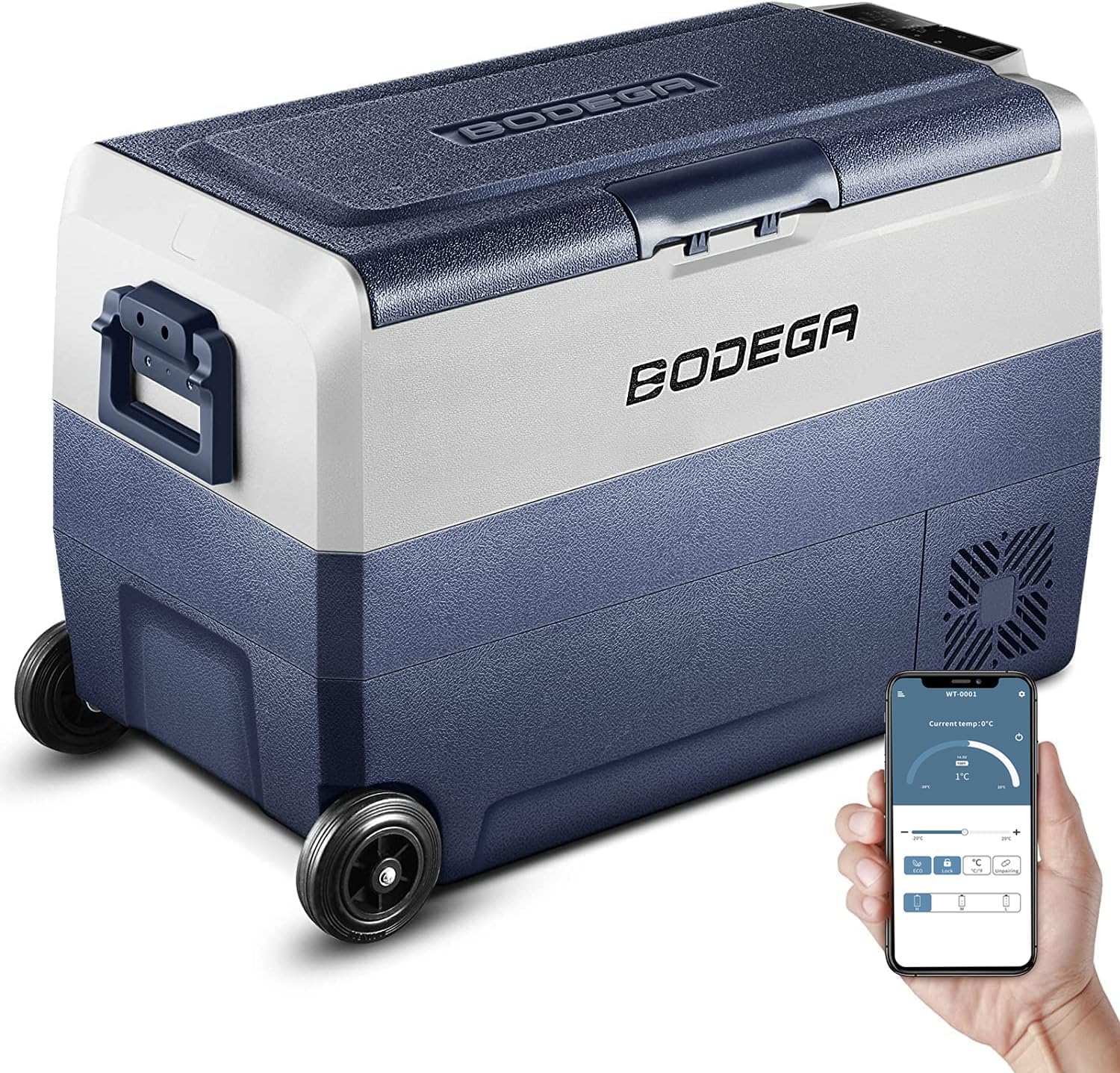
| Capacity | 50 liters |
|---|---|
| Temperature range | -4°F to 68°F |
| Cooling method | Compressor |
| Power input support | 12/24V DC and 100–240V AC |
| Defrost system type | Automatic |
This BODEGA 53‑quart single‑zone portable refrigerator is a compressor‑based car fridge that doubles as a home or RV freezer, offering a wide -4°F to 68°F temperature range and Bluetooth app control plus manual controls. It is typically used for road trips, camping, vanlife, or as an extra freezer at home and can hold roughly 57 cans or multiple bottles upright. Notable features include a powerful compressor with Max/Eco modes, battery protection levels to avoid vehicle drain, automatic defrost, an internal LED, detachable doors, retractable handle and wheels for portability, and both DC and AC power adapters. Practical benefits are rapid cooling in Max mode, stable operation on inclines thanks to anti‑shaking design, and flexible placement because it supports 12/24V and standard AC. Limitations include its single‑zone layout, so freezing and chilled storage cannot be controlled independently, and its size and weight make it less convenient for very compact vehicles or frequent one‑person carrying. Expect to pre‑cool for best frozen results and to plan space for a heavy, full unit.
Best for: Buyers who want a roomy, rugged vehicle refrigerator that can double as a home or RV freezer and prioritize reliable compressor cooling, portability features, and battery protection when traveling.
Less Ideal for: Those who need independent dual‑zone temperature control or require an ultra‑light, ultra‑compact cooler for tight cargo spaces should consider other options.
- Large 53‑quart capacity suitable for multi‑day trips or group outings
- Compressor cooling with wide -4°F to 68°F range for both fridge and freezer use
- Supports 12/24V DC and 100–240V AC so it works in vehicles and at home
- Bluetooth app control plus manual controls for convenient temperature adjustments
- Built‑in portability features like wheels, retractable handle, and USB charging port
- Single zone design cannot maintain separate fridge and freezer temperatures
- Relatively heavy and bulky for users who need a very compact or lightweight cooler
Verdict: A spacious, compressor‑cooled portable fridge built for multi‑day vehicle trips and RV use when you need dependable cooling plus practical portability features.
Feelfunn 61QT Car Refrigerator

| Capacity | 58 liters (61 QT) |
|---|---|
| Temperature range | -4°F to 68°F (-20°C to 20°C) |
| Cooling method | Compressor |
| Power source | 12/24V DC and 100–240V AC |
| Noise level | Approximately 45 dB |
The Feelfunn 61QT Car Refrigerator is a portable compressor fridge made for road trips, RVs, boats, and camping that gives you two independently controlled zones so you can refrigerate and freeze different items at once. It uses a compressor cooling system with a wide temperature range (-4°F to 68°F), a fast‑cooling mode that claims to reach near‑freezing in about 15 minutes, and selectable ECO/Max modes to balance power draw and performance. The unit includes practical touches such as a removable storage basket, bottom drain for cleaning, built‑in LED lighting, an easy touch control panel, and mounting points to secure it during travel. Power options include 12/24V DC and 100–240V AC with three‑level battery protection to avoid draining the vehicle. Expect a fairly heavyweight, full‑sized portable fridge that delivers true compression cooling and quiet operation around 45 dB, but it is large and intended as a freestanding or secured car appliance rather than a handheld cooler. For buyers who need strong cooling performance and dual‑zone flexibility on the road, this fridge is a capable choice.
Best for: Buyers who prioritize strong, reliable cooling performance on the road and need the flexibility to keep separate zones at different temperatures for mixed loads.
Less Ideal for: People who need an ultra‑light or compact cooler for backpacking, short picnics, or frequent one‑person carry; those users should choose a smaller, lighter option.
- Dual independent temperature zones for simultaneous refrigeration and freezing
- Compressor cooling with fast‑cooling mode (approximate 15 minute cool to 32°F)
- Runs on 12/24V DC and 100–240V AC with battery protection for vehicle use
- Built‑in features for travel: mounting holes, removable basket, bottom drain, and LED interior light
- Relatively quiet operation (~45 dB) suitable for use in cabins and vehicles
- Large and relatively heavy compared with small portable coolers, limiting carry convenience
- Annual energy consumption is substantial for long off‑grid use without shore power
- No app control on this model
Verdict: If you need strong compressor cooling and true dual‑zone control for extended vehicle trips, this 61QT Feelfunn fridge delivers the performance and travel‑friendly features to keep mixed loads cold and frozen.
Aeitto 20-Quart Car Refrigerator

| Capacity | 20 quarts |
|---|---|
| Cooling Method | Compressor |
| Power Source | 12/24V DC & 100-240V AC |
| Noise Level | <45 dB |
This Aeitto 20-quart car refrigerator is a compact compressor cooler designed for road trips, camping, and vehicle use where reliable cooling and low power draw matter. It runs from 12/24V DC or 100–240V AC and offers selectable Eco and Max modes plus a temperature range that reaches well below freezing, so you can chill drinks quickly or keep frozen goods for longer trips. The unit uses a detachable basket and a reversible lid for flexible loading, and the compressor design provides faster cooling than thermoelectric alternatives while keeping noise under about 45 dB. Practical features include a three-level battery protection system with user-set cutoff to avoid draining a vehicle battery and a manual-defrost regimen that is easy to manage. Downsides are the modest 20-quart capacity, which limits how much you can store for groups, and the heavier, built-in-style form factor compared with very small portable coolers. For buyers prioritizing efficient cooling and battery safety in a car or RV, this unit strikes a useful balance.
Best for: Buyers who want a compact, energy-conscious car or RV fridge that prioritizes fast compressor cooling and built-in battery protection for reliable food and drink storage on trips.
Less Ideal for: Those who need large-capacity refrigeration for long group outings or who prefer ultra-lightweight, grab-and-go soft coolers.
- Compressor cooling reaches low freezer temperatures quickly for reliable cold storage
- Runs on 12/24V DC or 100–240V AC for use in cars, RVs, and at home
- Eco mode keeps power consumption low (under 40W) for extended use
- Three-level battery protection with adjustable cutoff prevents vehicle battery drain
- Quiet operation under 45 dB and vibration-resistant construction for travel
- 20-quart capacity is limited for larger groups or extended trips
- Manual defrost requires occasional maintenance to remove ice buildup
Verdict: Aeitto's 20-quart car fridge is a compact, energy-efficient compressor unit that delivers fast cooling and user-adjustable battery protection for worry-free travel refrigeration.
Frigidaire Retro Mini Cooler

| Cooling Method | Thermoelectric |
|---|---|
| Capacity | 28.32 liters |
| Voltage | 110 volts |
| Power Options | Includes 12V car adapter and 110V cord |
This Frigidaire Retro Mini Cooler is a lightweight, portable thermoelectric fridge aimed at keeping drinks or small skincare items cool on the go. It holds roughly nine standard cans (6 L / 108 fl oz net capacity) and uses a quiet thermoelectric system rather than a compressor, so it is reasonably quiet but will not reach deep-freeze temperatures. The unit runs from a household 110V plug and includes a 12V car adapter, making it convenient for road trips, overnight car stays, or use in an office or dorm. It has one removable shelf, a locking latch and a carrying handle for transport, and a small viewing window for quick checks. Practical benefits are low weight and simple portability plus dual-power flexibility for vehicle use. Limitations to expect are modest cooling performance compared with compressor fridges, small internal volume, and manual defrost only, so it is best for chilled beverages and short-term storage rather than long-term refrigeration of perishables.
Best for: Buyers who need an inexpensive, ultra-portable cooler to keep drinks or skincare items cool during car trips, in dorms, or at a bedside and who prioritize light weight and dual-power convenience.
Less Ideal for: People who need reliable, low-temperature refrigeration or larger capacity for meal prep, long-term food storage, or frozen items should choose a compressor-based or larger unit instead.
- Dual power options with 110V wall plug and 12V car adapter for true on‑the‑road use
- Very lightweight and portable with a carrying handle and locking latch
- Quiet thermoelectric cooling suitable for bedrooms or cars
- Removable shelf provides simple organization for cans and small items
- Thermoelectric cooling is less cold than compressor models and not suitable for freezing
- Small 6 L internal capacity limits how many items you can store
- Manual defrost required and not ideal for long-term perishables
Verdict: A lightweight, budget-friendly portable cooler that is ideal for chilled drinks in cars and small spaces thanks to its dual-power setup and compact design.
BougeRV CR22 23-Quart Portable Refrigerator

| Capacity | 23 quarts |
|---|---|
| Temp range | -8℉ to 50℉ (-22℃ to 10℃) |
| Power source | 12/24V DC, 110V AC |
| Cooling method | Compressor |
| Noise level | 45 dB |
The BougeRV CR22 is a compressor-based 23‑quart portable refrigerator that works as a fridge or freezer for car trips, camping, and grocery runs. It runs from 12/24V DC or 110V AC and reaches about 32°F in roughly 15 minutes and below freezing in under an hour, so it can quickly chill beverages or freeze small items without ice. Practical features include a low-noise design (around 45 dB), a three-level battery protection to avoid draining vehicle batteries, and a shock-tolerant layout that can operate while tilted up to 30 degrees. Power use is modest—eco mode keeps consumption low and even max mode is rated at about 60W—making it suitable for longer trips when paired with a power source. The unit is manual-defrost with a top-opening chest form factor and lacks an inverter, so it is meant strictly for direct DC/AC corded use. Expect the usual chest-style limitations: you lose some upright storage convenience and will need to manage defrosting, but you gain reliable compressor cooling and fast performance in a compact package.
Best for: Buyers who prioritize dependable, fast compressor cooling in a compact, vehicle-ready unit and want straightforward, robust performance on road trips or camping.
Less Ideal for: People who need upright fridge-style organization, hands-free remote control, or a unit with an integrated battery/inverter for off-grid use without external power.
- Compressor cooling delivers fast and consistent temperatures without ice.
- Runs on 12/24V DC or 110V AC for vehicle and home use.
- Low noise operation (~45 dB) suitable for overnight use in vehicles.
- Built-in 3-level battery protection prevents deep discharge of the vehicle battery.
- Modest power draw with an ECO mode and max consumption around 60W.
- Top‑opening chest design reduces upright storage flexibility and requires bending to access contents.
- Manual defrost means occasional maintenance to remove ice buildup.
- No built-in inverter or app control for remote monitoring.
Verdict: Choose the BougeRV CR22 if you want a compact, vehicle-ready compressor fridge that cools quickly, protects your car battery, and runs efficiently on DC or AC power.
EUHOMY CFC-18 19QT Car Refrigerator

| Capacity | 18 liters / 19 QT |
|---|---|
| Voltage | 12 volts (DC) and 100–240V AC |
| Cooling method | Compressor (Rotary Scroll) |
| Temperature range | −4°F to 68°F (−20°C to 20°C) |
The EUHOMY CFC-18 is a portable compressor fridge that functions as both a cooler and a small freezer for road trips, camping, and vehicle use. It runs on DC or AC power and reaches low temperatures quickly thanks to its rotary scroll compressor, with ECO and MAX modes to balance cooling speed and energy use. The magnetic lid gasket and insulating chest design help keep contents cold without ice, and a touch control panel plus Bluetooth/app control let you monitor and adjust temperature remotely. Practical features include three-level battery protection to prevent vehicle drain, anti-shock design for use on bumpy roads, and a reversible lid and internal shelf for basic organization. Trade-offs are its small 19 QT capacity, which limits how much you can store, and the unit is best for short trips or small groups rather than family-scale provisioning. Noise is relatively low at around 42 dB, but expect some compressor cycling when set to fast-freeze modes.
Best for: Buyers who prioritize compact, vehicle-friendly refrigeration with battery protection and app control for road trips, overlanding, or occasional mobile use.
Less Ideal for: People who need large-capacity or full-time home refrigeration or who plan to store large volumes for extended periods.
- Runs on both 12V DC and 100–240V AC for versatile power options
- Compressor cooling with fast drop from ambient to fridge/freezer temperatures
- Three-level battery protection prevents vehicle battery drain
- Bluetooth and app control plus touch panel for remote monitoring and adjustments
- Magnetic-sealed lid and insulated chest improve temperature retention
- Small 19 QT capacity limits bulk storage
- Not suitable for long-term heavy-duty refrigeration needs
Verdict: Choose the EUHOMY CFC-18 if you want a compact, compressor‑cooled car refrigerator with battery protection and app control for reliable on-the-road chilling.
EUHOMY CF-55 Portable Fridge

| Capacity | 55 liters |
|---|---|
| Temp range | -4°F to 68°F (-20°C to 20°C) |
| Power source | AC/DC (12/24V) |
| Cooling method | Compressor |
| Additional features | App Control, ECO/MAX modes, 3-level battery protection |
The EUHOMY CF-55 is a 12V/AC portable compressor fridge aimed at keeping food and drinks cold on road trips, in trucks, and around the house. It offers dual storage zones and a removable internal basket so you can separate frozen items from fresh goods and organize supplies for travel. The compressor supports a wide temperature range (about -4°F to 68°F) with ECO and MAX modes, and the variable frequency compressor promises relatively fast cooling and modest energy draw. App and Bluetooth control plus an LCD panel let you monitor and adjust temperature remotely, and three-level battery protection helps avoid draining a vehicle battery. Practical touches include an internal LED, reversible door, and included AC and DC power cords. Expect a sizable footprint for a 55‑liter unit and a weight that makes it less convenient for frequent one-person moves, and while the compressor design is quieter than many portable freezers there is still some operating noise. For buyers who want a near-full-size, reliable car fridge with smart controls, this model covers the main bases without exotic extras.
Best for: A cautious buyer who wants a reliable, near‑full‑size car refrigerator for regular road trips, RVing, or truck use and values battery protection and remote control.
Less Ideal for: Someone needing a very lightweight or backpackable cooler for occasional day trips or one-person carry; not the best choice if absolute silence or minimal weight is the top priority.
- Large 55‑liter capacity with dual-zone layout for separating frozen and fresh items
- Compressor cooling with wide temperature range for true freezing and cooling
- AC and 12/24V DC power options for home, car, RV, and truck use
- App/Bluetooth control and LCD panel for remote temperature monitoring and adjustments
- Three-level battery protection to reduce risk of vehicle battery drain
- Relatively heavy and bulky compared with small portable coolers, limiting frequent solo lifting
- Not fully silent—compressor produces noticeable operating noise during active cooling
Verdict: Buy this if you want a dependable, large-capacity 12V compressor fridge with smart controls and built-in battery protection for regular car or RV use.
Choosing the Right Refrigerator for Cars: Key Factors to Consider
Cooling Performance and Temperature Range
How cold a refrigerator for cars can get and how consistently it holds set temperatures is the single most important factor. Vehicles endure temperature swings and hot ambient conditions, so a unit that can reach well below typical ambient temperatures and hold steady will protect perishables and reduce spoilage.
Look for adjustable thermostats and documented delta-T figures that show how many degrees below ambient the unit can maintain. Consider whether the unit offers both fridge and freezer modes if you need long-term frozen storage while on the road. Rapid cooldown from ambient to target temperature matters when loading warm groceries during a trip.
Power Requirements and Efficiency
A refrigerator for cars must operate within your vehicle's electrical limits. Power draw affects whether you can run the unit off the vehicle battery for hours, use it while the engine is off, or pair it with a secondary battery or solar setup.
Evaluate the rated wattage at typical operating temperatures, the presence of low-voltage protection and auto-shutdown, and whether the unit supports both 12V and 24V systems. Efficient compressors and good insulation reduce runtime and battery drain. Also check for options like DC input, AC compatibility, and smart power modes that save energy when full cooling is not required.
Size, Capacity, and Interior Layout
Vehicle space is limited, so internal usable volume and how that space is arranged matter more than gross exterior dimensions. Consider height and width relative to the vehicle's trunk or under-seat spaces, plus how shelves, baskets, and removable dividers fit common items.
A refrigerator that maximizes usable volume with adjustable shelves or split freezer compartments tends to be more practical. Think about the types of items you carry—tall bottles, meal prep containers, or frozen packs—and choose an interior layout that minimizes wasted space and keeps frequently used items accessible.
Mounting, Portability, and Installation
Decide whether you need a permanently mounted fridge or a portable unit you can move between vehicles. Mounting options and tie-down points matter for safety and to prevent tipping during driving. Portable units should be light enough to lift but sturdy enough to stay put.
Check how the unit connects to the vehicle power system and whether it includes cigarette-plug leads, hardwire kits, or quick-disconnects. Consider access for cleaning, lid swing clearance, and whether the unit can be secured with straps or brackets for off-road use.
Durability, Vibration Tolerance, and Noise
A refrigerator for cars faces constant vibration and occasional bumps. Compressor quality, shock-mounted components, and resilient housing materials reduce failure risk on rough roads. Units designed for mobile use often list vibration resistance or roadworthy features.
Noise level is another practical concern. Excessive compressor noise can be annoying in small cabins or when camping. Look for units with low operational noise and robust build quality that resists dents, moisture, and dust ingress.
Maintenance and Serviceability
Minimal maintenance requirements and accessible service support improve long-term ownership. Consider how the unit handles defrosting, whether condensation drips are managed, and how easy it is to clean the interior and seals.
Also review what spare parts or service options are typically available and whether the design allows you to replace filters, fuses, or cables easily. A fridge that is easy to maintain saves time and prevents spoilage over extended trips.
Understanding Power Options in Vehicles
Modern vehicle refrigerators commonly support multiple input types, but the typical choices for mobile use are 12V DC and 24V DC. Some units also accept AC power when you are near shore power or parked at an RV hookup. Knowing your vehicle electrical system and typical trip length helps you choose the right input configuration.
Low-voltage protection prevents a fridge from depleting your starting battery. If you plan to run the unit with the engine off, consider adding a dedicated auxiliary battery, a battery isolator, or a solar charging solution to extend operating time.
- 12V DC is standard for cars and most light trucks.
- 24V may be required for larger trucks and commercial vehicles.
- AC input is useful for overnight use at campsites or homes.
Choosing Size and Placement in Your Vehicle
Measure the available installation area before selecting a unit. Think about lid clearance when it opens and ensure the fridge will not block cargo access or interfere with seat movement. Placement affects both convenience and airflow for the compressor.
Consider tradeoffs between footprint and usable interior organization. A taller unit may fit better in narrow spots and accept upright bottles, while a wide, low model might slide under seats or into cup-holder style recesses.
- Check height with the lid open to avoid clearance issues.
- Confirm the door swing direction suits your vehicle layout.
- Allow space for ventilation around the compressor area.
Temperature Control and Food Safety on the Road
Maintaining safe temperatures is crucial for perishable items. Aim for a steady temperature at or below 40 degrees Fahrenheit for refrigerated items and 0 degrees Fahrenheit for frozen items when storing long-term. Portable refrigerators vary in how quickly they recover temperature after opening, so frequent-access items may need different packing strategies.
Use thermometers or the unit's digital readout to verify actual internal temperatures, especially in hot climates. Consider grouping items with ice packs for extra thermal stability and avoid overloading the fridge, which can reduce airflow and cooling effectiveness.
- Monitor temperatures during long trips to prevent spoilage.
- Pack coldest items deepest in the compartment for best results.
- Avoid placing hot items directly into the fridge to reduce recovery time.
Installation Safety and Securing the Unit
Secure installation prevents accidents. Use purpose-built mounting brackets, tie-down straps, or vehicle anchor points to keep the refrigerator from shifting under braking or during off-road travel. Check that power cabling is routed to avoid chafing and does not interfere with vehicle controls.
If hardwiring, follow vehicle electrical guidelines and consider professional installation to ensure proper fuse sizing and isolator placement. For portable use, ensure cigarette-lighter leads are rated for continuous draw and have built-in protection.
- Always secure the fridge to a fixed point when driving.
- Use correct fuse ratings to protect wiring and vehicle electronics.
- Inspect cables regularly for wear, especially after off-road trips.
Practical Packing Tips for Mobile Refrigeration
Organize items by frequency of use so the fridge can be opened briefly. Use removable baskets or labeled containers to separate fresh food, frozen items, and beverages. Pre-chill or pre-freeze goods when possible to reduce the fridge workload.
Consider the balance between refrigeration and insulating methods. For short trips, using coolers with ice packs may be sufficient, but a refrigerator for cars is better for longer journeys and situations where consistent temperature is required.
- Group like items together to minimize door-open time.
- Use flat, stackable containers to maximize usable space.
- Keep an emergency kit of spare fuses and power leads handy.
How We Chose the Best Refrigerator for Cars
We selected refrigerators for cars by focusing on the features that most affect real-world use in vehicles. Key evaluation criteria included cooling capability and temperature control, power and electrical options, size and storage layout, durability and vibration tolerance, and ease of installation and daily use. Cooling capability was assessed by advertised delta-T performance and the presence of adjustable thermostats or dual-mode cooling. Power and electrical options looked at 12V and 24V compatibility, low-voltage protection, draw at typical operating temperatures, and whether the unit supports AC, DC, and solar inputs. Size and storage layout were evaluated for usable cubic volume, shelf and basket configurations, and the ability to hold common items like gallon jugs and meal containers. Durability considerations prioritized compressor quality, insulation type, and design features that reduce noise and handle road vibration. Usability factors included control accessibility, lid orientation, portability features, and maintenance needs like defrosting. We excluded units intended only for household use or those lacking vehicle power options. Models with unclear specifications or minimal customer support were not considered. The final list balances cooling performance with realistic vehicle power limits and cabin-space constraints.
Our full evaluation process is outlined in our review methodology.
FAQ
Can a refrigerator for cars run off my car battery without the engine on?
It depends on the unit's power draw and your battery capacity. Most mobile refrigerators state current draw and include low-voltage protection to prevent complete battery drain. For extended use with the engine off, plan for a secondary battery, battery isolator, or solar charging.
How cold will a car refrigerator get in hot weather?
Performance varies by model, but units rated for mobile use should list their delta-T capability or lowest achievable temperature. High ambient temperatures reduce cooling efficiency, so choose a unit with strong cooling capacity if you frequently operate in hot climates.
Do portable vehicle refrigerators require special mounting?
Portable units can be used without permanent mounting, but securing them with straps or brackets is recommended for safety. If you plan to use the fridge in a fixed location in the vehicle, consider a proper mounting kit to prevent movement during travel.
Is a compressor fridge better than a thermoelectric one for vehicle use?
Compressor refrigerators generally provide stronger cooling and better temperature control, especially in hot conditions, while thermoelectric units are quieter and simpler but perform worse in high ambient temperatures. Choose based on your cooling needs and power availability.
How should I maintain a refrigerator used in a vehicle?
Keep seals clean and inspect for debris, defrost according to the manufacturer's guidance, and ensure ventilation around the compressor is not blocked. Regularly check power cables and fuses and clean the interior to prevent odors and bacterial growth.
Final Verdict
When choosing a refrigerator for cars, prioritize cooling capability and power efficiency first, then confirm that size and installation options fit your vehicle and travel style. Durable construction and low vibration tolerance become more important if you frequently drive off-road or on rough surfaces. Balance the tradeoffs between maximum cooling, battery draw, and interior usability. With the right combination of temperature control, suitable power options, and secure installation, you can keep perishable food safe and enjoy reliably cold drinks on every journey.