
Note: This article contains affiliate links. If you click on these links and make a purchase, we may earn a small commission at no extra cost to you. This helps support our research and content. Read our full affiliate disclosure here.
If you rely on steady ice for drinks, meal prep, or entertaining, choosing a refrigerator with an ice maker in the freezer matters. The right layout and ice system affect how much usable storage you have, how often you need to clean or service the dispenser, and whether the unit keeps food at safe temperatures while producing enough ice for your household. This guide shortlists six of the best refrigerators with ice makers located in the freezer compartment. We evaluated options across practical criteria such as ice output, freezer layout, reliability of the ice mechanism, and ease of upkeep. Read on to find the configurations and features that match your kitchen and daily routine, then move to the product summaries for specific choices that fit those priorities.
Top Picks at a Glance
| Best Overall The best all-around choice for most situations | Samsung 26 cu ft French Door Refrigerator |  |
| Best Quality Built to a higher standard if you want something more solid | Kenmore Bottom-Freezer 22.3 cu ft |  |
| Best Budget The cheapest option that still gets the job done reliably | LRAIN French Door Refrigerator 20 Cu Ft |  |
| Top Rated A top-rated pick with lots of positive feedback | Antarctic Star 17.5 Cu Ft French Door Refrigerator |  |
| Most Popular A crowd favorite that many people choose with confidence | BLACK+DECKER 16 Cu. Ft. French Door Refrigerator |  |
| Best Seller A high-volume bestseller chosen again and again | Kenmore 36" Side-by-Side Refrigerator |  |
Samsung 26 cu ft French Door Refrigerator

| Capacity | 26 cubic feet |
|---|---|
| Freezer Capacity | 7.5 cubic feet |
| Configuration | French Door |
| Cooling Method | Compressor |
| Installation Type | Freestanding |
This Samsung 26 cu ft counter-depth French door refrigerator is built for households that need roomy, organized fresh and frozen storage plus flexible ice options. It uses a three-door layout with a deep freezer drawer and four types of ice: cubed and Ice Bites from a dual auto ice maker in the freezer drawer and curved or crushed ice from the external dispenser. Metal Cooling helps keep temperatures steady across the fresh-food compartment while wide, slide-in shelves and multiple door bins make it easy to arrange bulky items and see contents at a glance. SmartThings connectivity provides remote monitoring and energy tips. Practical trade-offs include its counter-depth form that limits overall internal volume compared with standard-depth mega fridges and its sizable annual energy consumption figure, which buyers should weigh if electricity use is a priority. Installation is freestanding and the unit meets Energy Star specifications, making it a solid everyday refrigerator with a standout ice feature set.
Best for: Buyers who want a stylish, counter-depth French door refrigerator that balances spacious, organized storage with versatile ice options and smart connectivity for everyday family use.
Less Ideal for: Shoppers who need the absolute maximum interior capacity or who prioritize the lowest possible energy usage should consider other form factors or smaller models.
- Four distinct ice options including dual auto ice maker and external dispenser for curved or crushed ice
- Counter-depth French door design that fits flush with cabinetry while offering organized storage
- Metal Cooling for more consistent internal temperatures
- SmartThings connectivity for remote monitoring and energy tips
- Counter-depth layout reduces maximum internal volume compared with standard-depth models
- Annual energy consumption is relatively high compared with smaller refrigerators
Verdict: Choose this Samsung if you want a counter-depth French door refrigerator that pairs roomy, organized storage with four convenient ice types and modern temperature control.
Kenmore Bottom-Freezer 22.3 cu ft

| Capacity | 22.3 cubic feet |
|---|---|
| Freezer Capacity | 6.86 cubic feet |
| Defrost System Type | Automatic |
| Voltage | 115 volts |
| Ice Maker Dispensed Type | Cubed |
This Kenmore bottom-freezer refrigerator packs a lot into a compact 31-inch footprint, offering 22.3 cubic feet of usable storage and a 6.86 cu. ft. freezer with a two-tier layout and an installed ice maker that produces cubed ice. It uses an inverter compressor for steadier temperatures, quieter operation, and better energy efficiency, and ENERGY STAR certification plus an Eco Mode help reduce running costs. Inside you get full-width adjustable tempered glass shelves, five door bins including a gallon bin, two humidity-controlled crispers, and bright LED lighting that makes it easy to organize party trays and tall items. The stainless steel doors are fingerprint resistant, and the refrigerator is freestanding with reversible door orientation for flexible placement. Trade-offs are typical for a standard-depth, 31-inch wide unit: if you need ultra-deep shelving or the largest freezer capacity available this model is midrange, and the ice maker's 3.5 lb/day output is adequate for everyday use but not heavy entertaining. For buyers prioritizing reliable cooling performance, efficient operation, and a built-in ice maker in a narrower footprint, this is a strong practical choice.
Best for: Buyers who want dependable cooling performance and energy efficiency with the convenience of a factory-installed ice maker in a narrower, kitchen-friendly footprint.
Less Ideal for: Households that need very large or deep freezer capacity or who regularly require high daily ice production should consider larger-capacity models instead.
- Built-in ice maker producing up to 3.5 lb of cubed ice per day
- Inverter compressor for steadier temperatures and quieter, more efficient operation
- ENERGY STAR certified with Eco Mode to lower energy use
- Adjustable full-width tempered glass shelves and multiple door bins for flexible organization
- Fingerprint-resistant stainless steel finish with long-lasting LED lighting
- Freezer space is mid-sized and may be limiting for heavy freezer users
- Ice maker output is suitable for daily use but not high-volume entertaining
Verdict: Choose this Kenmore if you want efficient, quiet cooling and a built-in ice maker in a slim 31-inch bottom-freezer refrigerator.
LRAIN French Door Refrigerator 20 Cu Ft

| Capacity | 20 cubic feet |
|---|---|
| Freezer Capacity | 6.5 cubic feet |
| Refrigerator Net Capacity | 13.5 cubic feet |
| Cooling Method | Compressor |
| Voltage | 115 volts |
This LRAIN French door refrigerator pairs a 13.5 cu ft fresh food section with a 6.5 cu ft freezer and includes an automatic ice maker plus external water and crushed-ice dispenser for convenient access. It uses a compressor cooling system with multi-airflow to help keep food fresher and has microcomputer controls with an LED display so you can set fridge and freezer temperatures independently. The freezer offers automatic defrost and removable door seals for easier cleaning, while the reversible doors and seven interior shelves give flexible storage for groceries and large containers. Practical limits include a relatively small total capacity for a full-size look and a stated annual energy consumption that may be higher than competing efficient models. Installation is listed as built-in, so plan for a permanent space and professional hookup if needed. For someone wanting a feature-rich refrigerator with an integrated ice maker and dispenser on a budget, this delivers core functionality without fancy smart features.
Best for: Buyers seeking a budget-friendly French door refrigerator that includes a built-in ice maker and external water dispensing for everyday family use and convenience.
Less Ideal for: People who need the most energy-efficient model or very large storage capacity for bulk food storage should consider other options.
- Built-in automatic ice maker with cube and crushed ice plus external water dispenser for quick access
- Separate microcomputer controls and LED display for individual fridge and freezer temperature settings
- Automatic defrost in the freezer and removable door seals for easier cleaning and maintenance
- Multi-airflow compressor cooling and seven shelves provide even cooling and flexible storage layout
- Listed annual energy consumption is relatively high compared with more efficient modern units
- Capacity is modest for buyers expecting very large storage in a full-size French door layout
Verdict: A budget-minded French door refrigerator that gives you an integrated ice maker and dispenser with practical storage and straightforward temperature controls.
Antarctic Star 17.5 Cu Ft French Door Refrigerator

| Capacity | 17.5 cubic feet |
|---|---|
| Freezer Capacity | 5.1 cubic feet |
| Defrost System Type | Automatic |
| Voltage | 115 volts |
| Form Factor | French Door |
This Antarctic Star French-door refrigerator is a mid-size kitchen fridge that pairs a 12.4 cu ft fresh-food compartment with a 5.1 cu ft bottom freezer and a built-in automatic ice maker. It uses an inverter compressor and multi-air flow to accelerate cooling and keep temperatures consistent across shelves and drawers, while the LED touch display and door-open alarm make basic adjustments and monitoring straightforward. The bottom freezer keeps the ice maker out of sight and the 90 degree door swing helps installation in tighter spaces. Practical touches include a reversible door, four interior shelves, and a stainless-steel VCM finish that resists fingerprints. Expect solid everyday performance and reliable temperature control for household storage, though the unit is a mid-range appliance so features like advanced smart connectivity or premium finish materials are not present. Installation requires freestanding placement and you should confirm the footprint fits your kitchen given the listed dimensions and weight.
Best for: Buyers who prioritize dependable cooling and consistent temperature control in a mid-size, freestanding refrigerator and want an integrated ice maker for everyday use.
Less Ideal for: Buyers seeking advanced smart features, the lowest possible energy draw, or luxury finishes should consider higher-end models instead.
- Built-in automatic ice maker integrated into bottom freezer for convenient ice production
- Inverter compressor with multi-air flow for faster, more even cooling
- LED touch display and door-open alarm for easy control and safety
- 90° door opening and reversible door for flexible installation in tight spaces
- Stainless steel VCM finish that resists fingerprints
- No smart home connectivity or advanced remote monitoring features
- Annual energy consumption is relatively high compared with some energy-efficient models
Verdict: Choose this fridge if you want a reliable mid-size French-door unit with an integrated ice maker and strong, even cooling performance.
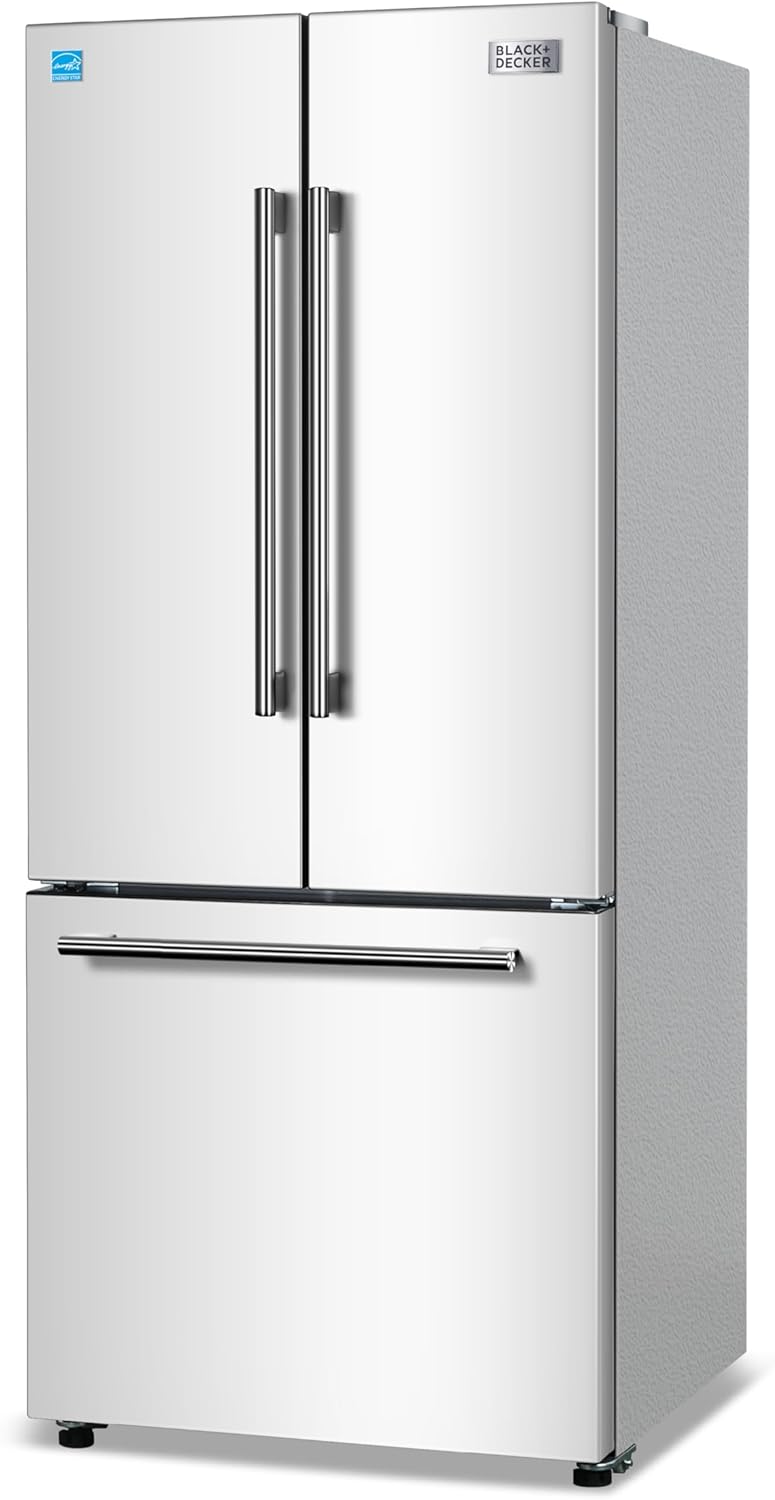
BLACK+DECKER 16 Cu. Ft. French Door Refrigerator
| Capacity | 16 cubic feet |
|---|---|
| Wattage | 470 watts |
| Door Orientation | Reversible |
| Voltage | 120 volts |
| Number Of Shelves | 3 |
This BLACK+DECKER French door refrigerator pairs a full-width 11.15 cu. ft. fridge with a 5.06 cu. ft. bottom freezer drawer and an included ice maker that produces up to about 3.5 lb of ice per day when connected to a water line. It uses a digital temperature thermostat to set refrigerator and freezer targets in Fahrenheit or Celsius and features interior LED lighting, adjustable leveling legs, and three adjustable shelves for organizing food. The refrigerator is ENERGY STAR certified and uses R600a refrigerant, which helps keep operating costs and environmental impact lower than older models. Practical limitations include its modest total capacity compared with larger full-size fridges and the requirement of a water hookup for the ice maker to function; installers will also want to measure delivery paths since doors and drawers may need removal to pass tight spaces. For buyers seeking a reasonably efficient, space-conscious French door layout with a factory-quality ice maker, this model offers a solid balance of features and everyday usability.
Best for: Buyers who prioritize energy efficiency and a modern French door layout with a factory-quality ice maker but who also want reassurance from clear features and common-sense performance.
Less Ideal for: Large households or users needing maximum refrigerated storage or those who cannot provide a water hookup for the ice maker should look at larger or alternative models.
- Built-in ice maker with automatic shutoff when the tray is full
- ENERGY STAR certified for lower energy use
- Digital temperature control with Fahrenheit or Celsius readouts
- French door layout plus bottom freezer drawers for easy access and organization
- Standard footprint fits through typical 30" to 36" doorways with removable doors/drawers
- 16 cu. ft. total capacity is smaller than many full-size refrigerators
- Ice maker requires a household water line connection to operate
Verdict: A compact, ENERGY STAR certified French door refrigerator with a built-in ice maker that suits efficiency-minded buyers who want a modern layout and reliable everyday performance.
Kenmore 36" Side-by-Side Refrigerator

| Capacity | 20 cubic feet |
|---|---|
| Freezer Capacity | 6.5 cubic feet |
| Configuration | Side-by-Side |
| Ice Maker Dispensed Type | Cubed |
| Water Dispenser Dispensed Type | Cold |
This Kenmore 36" side-by-side refrigerator is a counter-depth, space-saving fridge that packs 20 cubic feet of usable capacity and a factory-installed water filter with external dispenser and ice maker. It is designed for everyday family use, with adjustable edge-to-edge glass shelves, a dedicated chill boost to quickly cool groceries, and a multi-flow air system intended to keep temperatures even across shelves. The inverter compressor and ENERGY STAR certification point to quieter, more efficient operation, and the fingerprint-resistant stainless finish reduces visible smudges. Practical benefits include on-demand cubed or crushed ice from the freezer door, flexible shelving for large platters, and bright LED lighting for visibility. Important limitations are the moderate overall capacity compared with larger freestanding models and the counter-depth layout, which reduces internal space while delivering a built-in look; buyers who need maximum storage or deeper shelves may prefer a standard-depth option. Installation is freestanding only, and the unit uses R-600A refrigerant.
Best for: A cautious buyer who prioritizes reliable, energy-efficient daily performance and an external ice/water dispenser in a counter-depth, kitchen-friendly design.
Less Ideal for: Households that need maximum storage capacity or deeper shelves for large-format items should consider larger standard-depth or higher-capacity models instead.
- Counter-depth design offers a built-in look while saving floor space
- Factory-installed water filter with external dispenser and cubed/crushed ice maker
- ENERGY STAR certified with an inverter compressor for quieter, more efficient cooling
- Adjustable edge-to-edge tempered glass shelves for flexible storage and spill containment
- Multi-flow air system and an Accela Chill feature for faster cooling of groceries
- Counter-depth footprint reduces overall usable interior volume compared with standard-depth models
- Annual energy consumption listed is relatively high at 560 kWh/year for this capacity
Verdict: Choose this Kenmore if you want a counter-depth, ENERGY STAR side-by-side with a reliable factory-installed ice and water dispenser for everyday family use.
Choosing the Right Refrigerator with Ice Maker in Freezer: Key Factors to Consider
Ice Output and Production Speed
How much ice the built-in freezer ice maker produces per day and how quickly it recovers between cycles directly determines whether the unit meets your household needs. A system that produces only a handful of trays worth will struggle during gatherings, while higher output mechanisms keep up with sustained demand.
Look for clear specifications or manufacturer output ratings and consider your typical daily use. Remember that actual output varies with water pressure, freezer temperature, and how often the ice is harvested, so plan for some margin above your usual consumption.
Freezer Layout and Usable Storage
Ice makers occupy internal space and can obstruct shelf layouts or drawer access. The most practical designs integrate the ice mechanism without significantly reducing usable shelf area or blocking access to commonly used items.
Examine how the ice maker sits relative to shelves and drawers. Models with removable or adjustable shelving let you reclaim space when needed. Consider whether the configuration fits your typical frozen food habits, such as large platters, frozen pizzas, or many small containers.
Maintenance and Access
An ice maker will require periodic cleaning, occasional resets, and sometimes part replacement. Ease of access to the ice assembly, simple instructions for cleaning, and availability of user-serviceable components reduce the burden of upkeep.
Prefer units with straightforward access panels, tool-free removable bins, and clear water line paths. Regular maintenance helps prevent ice clumping, odor transfer, and mechanical failure, so factor the expected effort into your decision rather than treating maintenance as an afterthought.
Water Supply and Filtration Compatibility
Built-in ice makers depend on a reliable water feed and, often, inline filtration. Water pressure, quality, and filtration compatibility affect ice clarity, taste, and the longevity of the ice mechanism.
Check whether the refrigerator requires a specific filter size or line connection and whether existing household plumbing meets the pressure requirements. If you have hard water or mineral-heavy supply, a compatible filter or softened supply can reduce scale buildup and maintenance needs.
Temperature Control and Frost Management
Consistent freezer temperature preserves both ice production reliability and frozen food quality. Poor temperature control can lead to slow ice formation, partial melts, and refreezing that creates clumped or cloudy ice.
Consider models with precise temperature controls, good door seals, and frost-management features. Units that minimize temperature swings and block warm air infiltration when the door opens will produce clearer, more consistent ice and require less manual defrosting or clearing.
Noise, Vibration, and Placement Considerations
Ice makers and their pumps can add noise and vibration that may matter in open kitchens or nearby living spaces. The intensity and frequency of sound vary by design and mounting.
Plan where the refrigerator will sit relative to seating areas and bedrooms. Look for user feedback or specifications on operational noise and consider features like insulated mounts or quieter compressors if noise sensitivity is important.
Types of Freezer Ice Makers and How They Differ
Freezer ice makers come in a few common forms that affect installation, space, and maintenance. Some are compact, reusable-mold assemblies integrated into a lower shelf area. Others are modular units that sit behind an access panel and deliver larger daily output. The internal layout and size of the mechanism influence how much freezer space is sacrificed and how easy the unit is to service.
Understanding these variations helps match a refrigerator to your needs. For instance, compact systems are easier to fit into smaller freezers but may not support heavy entertaining. Modular in-freezer units typically give higher output with more consistent production but can be bulkier.
- Compact tray-style: small footprint, limited output, easy to replace.
- Integrated modular: higher daily production, accessible behind a panel, larger footprint.
- Removable bin systems: balance output and access, often easier to clean.
Installation, Water Line Routing, and Space Planning
Proper installation matters for performance and future maintenance. Ice makers in freezers require a routed water line and often a filter location. Plan the refrigerator placement to allow access to the water shutoff and filter changes without moving the unit repeatedly.
Think through the space behind and beside the refrigerator. Some models need clearance for water and drain lines, and others require easy front access for periodic maintenance. If your kitchen has tight setbacks, prioritize units with simpler plumbing needs or front-access filters.
- Verify water line length and routing before purchase.
- Allow service clearance for filter and ice mechanism access.
- Consider floor drains or trays in basements or utility areas.
Tips to Improve Ice Quality and Longevity
Ice clarity and longevity are influenced by water quality, temperature stability, and regular cleaning. Using a compatible water filter reduces mineral deposits and improves taste. Keeping the freezer at the manufacturer-recommended temperature and minimizing long door openings helps ice form evenly.
Regularly clearing the ice bin and running periodic cleaning cycles prevents odor transfer and clumping. If you notice slow production or cloudy ice, check water pressure, clean the supply line, and inspect the ice maker for scale or debris.
- Use an approved inline filter to reduce minerals and tastes.
- Keep the freezer door closed as much as possible during ice cycles.
- Run simple cleaning routines every few months to prevent buildup.
When an Internal Ice Maker Is Better Than External Dispensers
Ice makers inside the freezer can maximize door storage on models where the door would otherwise house a dispenser. They also reduce front-facing leaks and often have simpler mechanical paths, which can mean fewer service points. For households that value internal capacity and fewer external parts, an in-freezer ice maker can be the better choice.
Additionally, units with internal ice makers are less likely to be subject to door seal wear associated with external dispensers and may be quieter overall since components are enclosed. If you want a cleaner exterior look and slightly more interior control, the in-freezer option deserves consideration.
- Preserves exterior door aesthetics and reduces external service points.
- Can increase usable door storage compared with dispenser-equipped doors.
- Usually simpler plumbing paths and fewer external seals.
Planning for Seasonal and Event-Based Ice Demand
Households have variable ice needs. For everyday use, small to moderate production is often sufficient. For parties or seasonal entertaining, you may need significantly more ice for short periods. Plan for this by choosing a refrigerator whose ice output has headroom or by keeping a portable backup solution on hand.
If you often host large gatherings, evaluate whether the freezer layout allows for temporary ice storage and whether the ice maker can sustain continuous cycles without overheating or affecting freezer temperatures. Some buyers prefer models where the ice bin is easily removable so they can transfer ice to secondary containers quickly.
- Estimate peak daily ice needs before choosing a model.
- Look for removable bins to speed transfer during events.
- Consider supplemental options if you regularly host large groups.
How We Chose the Best Refrigerator with Ice Maker in Freezer
We focused on features buyers actually use when choosing a refrigerator with an ice maker in the freezer. Our selection filtered for consistent ice production, freezer storage efficiency, straightforward maintenance, and temperature stability that protects both frozen and chilled foods. We considered the variability of household demand by prioritizing documented ice output and the presence of adjustable freezer shelving or removable bins that preserve usable space when the ice maker is installed. Durability and serviceability were important. We favored designs with accessible ice mechanisms and clear instructions for cleaning or resetting the ice maker. Energy efficiency and overall system reliability were also weighed, since continuous ice production can amplify long-term energy and repair costs. Noise and vibration were considered where they affect daily living spaces. We excluded units that require extensive retrofit installation or external accessories to function as specified. We did not include refrigerators with ice makers located in door dispensers or external modules; the scope is strictly ice makers housed inside the freezer compartment. Our editorial filters emphasized real-world usability and straightforward ownership rather than speculative performance claims.
Our full evaluation process is outlined in our review methodology.
FAQ
How much ice should a typical household expect from a freezer ice maker?
Output varies, but many in-freezer ice makers produce enough for daily family use. Expect lower output than dedicated commercial units. If you regularly host gatherings, choose a system with higher listed daily output or plan a backup.
Will an ice maker in the freezer reduce usable storage space?
Yes, ice makers occupy internal space and can limit shelving configurations. Models with adjustable or removable shelves help reclaim space when needed. Consider the tradeoff between ice production and the types of frozen items you store.
How often do freezer ice makers need maintenance?
Typical maintenance includes cleaning the ice bin and running occasional cleaning cycles every few months, with more frequent attention in areas with hard water. Replacing filters on the recommended schedule helps reduce scale and extend component life.
Can I install an ice maker in a refrigerator that doesn't have one?
Some refrigerators support aftermarket kits, but installation requires compatible plumbing and sometimes cabinet modifications. This guide focuses only on units with factory-installed ice makers in the freezer, which avoid retrofit complexity.
Does water quality affect ice clarity and flavor?
Yes. Water with minerals or additives can make ice cloudy or alter taste. Using compatible filters and ensuring correct water pressure improves clarity and flavor and reduces scale buildup inside the mechanism.
Will the ice maker cause more noise than a refrigerator without one?
Ice makers add intermittent mechanical and water-run noise during production cycles. The level depends on the design and mounting. If noise sensitivity is important, prioritize models noted for quiet operation and stable mounting.
Final Verdict
Choosing the right refrigerator with an ice maker in the freezer is about balancing ice production with usable freezer space and manageable upkeep. Prioritize ice output that meets your habitual and peak needs, plus a freezer layout that preserves access and storage flexibility. Don't overlook water supply compatibility and maintenance requirements, as these affect long-term reliability and ice quality. Focus on the criteria that matter most to your household—steady production, easy maintenance, or extra storage—and select a model that offers reasonable tradeoffs. With the right priorities, you can get dependable ice without sacrificing the freezer space you need most.