
Note: This article contains affiliate links. If you click on these links and make a purchase, we may earn a small commission at no extra cost to you. This helps support our research and content. Read our full affiliate disclosure here.
Picking the right refrigerator with ice matters because reliable ice production affects daily convenience, entertaining, and meal prep. A fridge that stalls on ice or wastes space can make life harder in a busy household. This guide presents our shortlisted top picks for refrigerators with built-in ice systems, chosen for steady ice output, sensible storage layouts, and practical maintenance needs. We evaluate ice-making reliability, freezer and fresh-food organization, and long-term upkeep to help you find a model that fits how you live. Read on to compare the most relevant features and decide which setup suits your kitchen best.
Top Picks at a Glance
| Best Overall The best all-around choice for most situations | BLACK+DECKER 16 Cu. Ft. French Door Refrigerator |  |
| Best Quality Built to a higher standard if you want something more solid | Sharp SJF2955KS French-Three-Door Refrigerator |  |
| Best Value The sweet spot between price and what you get | Commercial Cool 20 Cu. Ft. Top Mount Refrigerator |  |
| Top Rated A top-rated pick with lots of positive feedback | Antarctic Star 17.5 Cu Ft French Door Refrigerator |  |
| Most Popular A crowd favorite that many people choose with confidence | BLACK+DECKER 16 Cu. Ft. French Door Refrigerator |  |
BLACK+DECKER 16 Cu. Ft. French Door Refrigerator

| Capacity | 16 cubic feet |
|---|---|
| Wattage | 470 watts |
| Door Orientation | Reversible |
| Voltage | 120 volts |
| Number Of Shelves | 3 |
This BLACK+DECKER French door refrigerator is a full-size, freestanding unit that pairs a 11.15 cu ft refrigerator compartment with a 5.06 cu ft bottom freezer drawer and an included ice maker. It uses a digital temperature thermostat for easy control of both compartments and offers adjustable shelving, interior LED lighting, and frost-free operation for low-maintenance cooling. The ice maker produces up to about 3.5 lb of ice per day and stops automatically when the tray is full, though it requires a household water line hookup. ENERGY STAR certification and a 470-watt compressor help keep operating costs down compared with non-certified units. Practical touches include reversible doors, adjustable leveling legs, and a standard-depth footprint designed to fit through typical doorways with removable doors or drawer if needed. The main compromises are its moderate 16 cu ft capacity—suitable for smaller kitchens or households—and the need to connect the ice maker to plumbing to get continuous ice production.
Best for: Buyers who want a modern-looking, energy-efficient French door refrigerator with a built-in ice maker and accessible bottom freezer for everyday household use.
Less Ideal for: Those needing very large capacity or a refrigerator that provides ice without a water line should consider larger or countertop ice solutions instead.
- Built-in ice maker with automatic shutoff and up to 3.5 lb/day production when plumbed
- Digital temperature controls for both fridge and freezer compartments
- ENERGY STAR certified for improved efficiency
- Bottom freezer drawer with two compartments for accessible frozen storage
- Standard-depth footprint and removable doors/drawer to assist delivery through doorways
- Requires a cold water hookup for the ice maker to operate continuously
- 16 cu ft total capacity may be small for large families or heavy entertainers
Verdict: A compact, ENERGY STAR French door refrigerator that delivers convenient built-in ice and straightforward digital controls for buyers who want an efficient everyday fridge with a bottom freezer.
Sharp SJF2955KS French-Three-Door Refrigerator

| Capacity | 28.9 cubic feet |
|---|---|
| Freezer Capacity | 10.4 cubic feet |
| Fresh Food Capacity | 18.5 cubic feet |
| Installation Type | Built-In |
| Cooling Method | Compressor |
The Sharp SJF2955KS is a large-capacity French-three-door refrigerator designed for households that prioritize steady cooling and frequent ice use. Its dual ice makers deliver up to 6.9 pounds of ice per day while the door dispenser offers cubed and crushed ice plus water without opening the door, which keeps the main compartment more stable. The Advanced Cooling Plus System, Chill-Boost and Freezer-Boost modes let you quickly lower temperatures for newly stocked groceries or when you need faster freezing. Inside, five bright white LED lights and adjustable slide-in shelves and gallon door bins make organizing large items straightforward, and the EZ Slide Drawer in the freezer improves access to frozen goods. It is Energy Star certified and runs quietly under 43 dB, which helps in open-plan kitchens. Trade-offs include the built-in installation requirement and the substantial footprint typical of a nearly 29 cu.ft. unit, which may not suit smaller kitchens.
Best for: Buyers who prioritize reliable ice production and fast, consistent cooling for large households or frequent entertaining and value organized, high-capacity storage.
Less Ideal for: Small kitchens, tight installation spaces, or buyers seeking a compact counter-depth unit should consider smaller or different form factors instead.
- Large 28.9 cu.ft. capacity with separate freezer drawer for bulk storage
- Dual ice makers and door dispenser providing cubed and crushed ice plus water
- Rapid temperature control with Chill-Boost and Freezer-Boost modes
- Quiet operation under 43 dB and Energy Star certification
- Adjustable shelving, slide-in shelf and EZ Slide Drawer for easier organization
- Built-in installation needed and large physical footprint may not fit all kitchens
- Annual energy consumption listed is relatively high at 740 kWh per year
Verdict: Choose this Sharp if you need generous capacity plus dependable dual ice production and fast temperature control for entertaining and heavy use.
Commercial Cool 20 Cu. Ft. Top Mount Refrigerator

| Capacity | 20 cubic feet |
|---|---|
| Freezer Capacity | 4.9 cubic feet |
| Fresh Food Capacity | 15.1 cubic feet |
| Annual Energy Consumption | 467 kilowatt hours per year |
| Refrigerant | R-600A |
This Commercial Cool 20 cu ft top-mount refrigerator is a straightforward full-size fridge intended for standard kitchens and apartments. It pairs a 15.2 cu ft fresh-food compartment with a 4.9 cu ft top freezer that includes a built-in ice maker capable of roughly 3.5 lbs of ice per day when plumbed to a water line. The unit uses glass shelves, reversible doors, adjustable leveling legs, and independent push-button temperature settings for fridge and freezer, which makes organizing and dialing in temperatures simple. Frost-free compressor cooling removes the need for manual defrosting and the ENERGY STAR rating helps limit annual energy use. Practical touches like recessed handles, interior lighting, and removable shelves ease cleaning and loading. Expect typical full-size installation needs: a freestanding footprint and a cold-water hookup for the ice maker, and the fridge's 467 kWh/year figure is moderate but not class-leading. Build and finish are utilitarian rather than premium, and you should verify doorway and delivery-path clearances before purchase.
Best for: Buyers who prioritize practical, feature-forward full-size refrigerators that include a factory-quality ice maker and straightforward controls for everyday home use.
Less Ideal for: Those seeking a premium stainless finish or the absolute lowest possible energy consumption should consider higher-end or specialty models instead.
- Included ice maker with auto-shutoff sensor when connected to a household water line
- ENERGY STAR certified compressor for improved energy efficiency
- Frost-free design removes need for manual defrosting
- Reversible doors and adjustable leveling legs simplify installation and placement
- Removable glass shelves and interior light make cleaning and organization easier
- Ice maker requires a water supply connection; not usable as a standalone tray unit
- Finish and overall fit-and-finish are functional rather than high-end
- Annual energy use (467 kWh/year) is moderate compared with the most efficient models
Verdict: Choose this fridge if you want a no-nonsense full-size refrigerator that delivers a factory-quality ice maker and practical, energy-conscious performance for everyday use.
Antarctic Star 17.5 Cu Ft French Door Refrigerator

| Capacity | 17.5 cubic feet |
|---|---|
| Freezer Capacity | 5.1 cubic feet |
| Cooling Method | Compressor |
| Defrost System Type | Automatic |
| Installation Type | Freestanding |
This Antarctic Star French door refrigerator is a mid-size, freestanding unit that pairs a 12.4 cu ft fresh-food compartment with a 5.1 cu ft bottom freezer and an integrated automatic ice maker. It uses an inverter compressor and multi-air flow to deliver faster cooling and more even temperatures across shelves and drawers, while the LED touch display and door-open alarm make basic controls and monitoring straightforward. The bottom freezer keeps ice production out of sight and the reversible doors plus 90 degree opening help with placement in tighter kitchens. The stainless steel VCM finish resists fingerprints and the automatic defrost system reduces maintenance compared with manual-defrost models. Expect solid day-to-day performance for household use, though the 17.5 cu ft capacity suits smaller families or as a primary fridge in modest kitchens rather than large households needing extensive storage. Installation is simple since it is freestanding, but its annual energy consumption is listed and should be considered if you prioritize the lowest running costs.
Best for: Buyers who prioritize reliable, steady cooling and convenient built-in ice in a mid-size freestanding refrigerator for everyday household use.
Less Ideal for: Those needing very large refrigerated storage or shoppers seeking the absolute lowest annual energy usage should consider larger or more efficient alternatives.
- Inverter compressor for faster cooling and more consistent temperature control
- Built-in automatic ice maker integrated into the bottom freezer
- Multi-air flow system that helps maintain even temperatures across shelves
- LED touch display and door-open alarm for simple monitoring and control
- 17.5 cu ft capacity may be small for larger families or heavy entertaining
- Annual energy consumption is relatively high compared with some energy-efficient models
Verdict: A dependable mid-size French door fridge with a built-in ice maker and inverter compressor for consistent, everyday cooling.
BLACK+DECKER 16 Cu. Ft. French Door Refrigerator
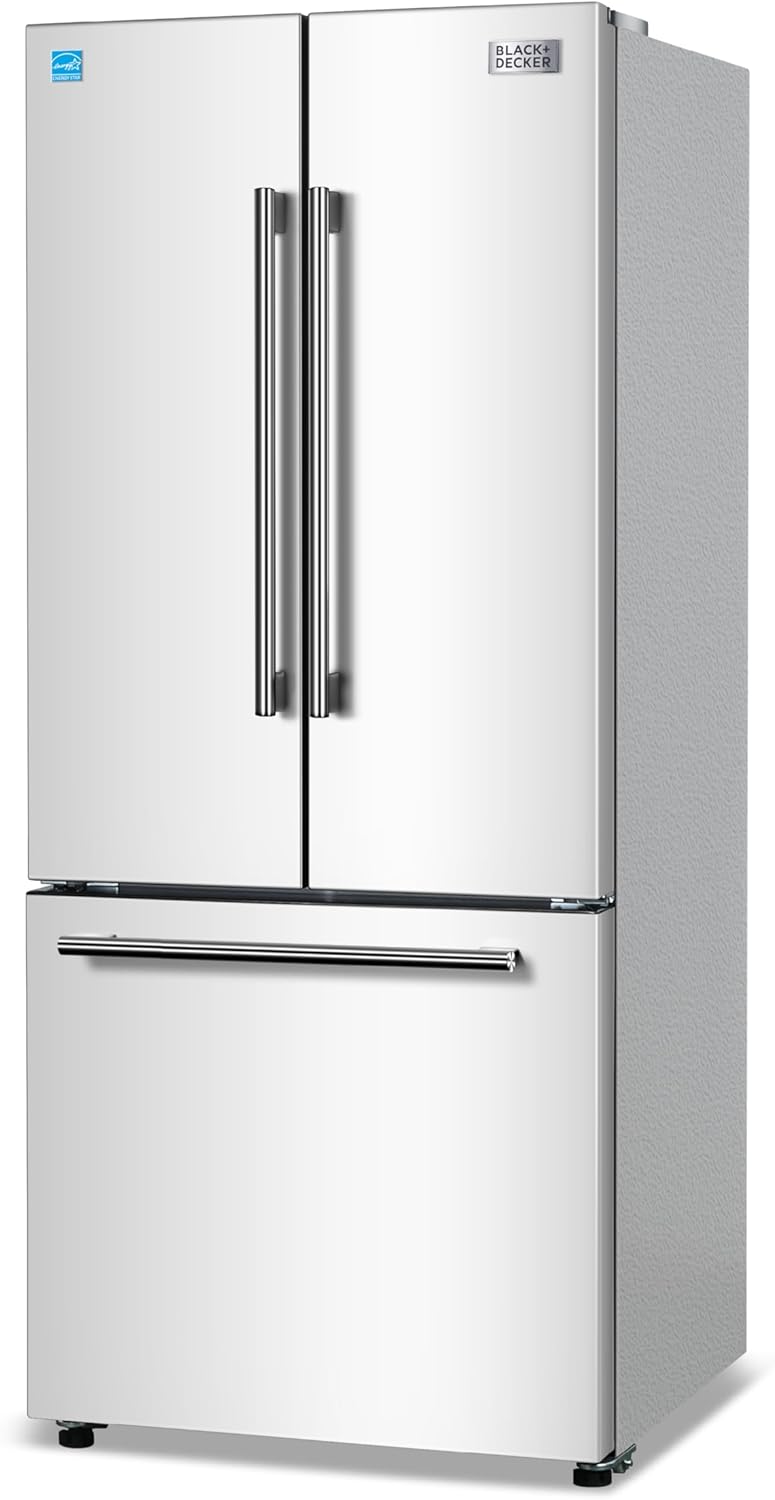
| Capacity | 16 cubic feet |
|---|---|
| Wattage | 470 watts |
| Door Orientation | Reversible |
| Voltage | 120 volts |
| Number Of Shelves | 3 |
This BLACK+DECKER French door refrigerator delivers full-size storage in a relatively compact footprint with a bottom-mount freezer drawer and an included ice maker. It is typically used as a primary kitchen fridge for households that want ample fresh‑food space and an accessible freezer layout; the fridge compartment holds roughly two thirds of total capacity while the lower freezer provides two pull-out drawers for organized frozen storage. Notable features include a digital temperature thermostat with Fahrenheit or Celsius readouts, an auto‑stop ice maker that produces up to about 3.5 lb of ice per day (requires a cold water hookup), interior LED lighting, and reversible doors for flexible placement. Practical benefits are ENERGY STAR efficiency, straightforward temperature control, and a standard-depth footprint that helps with delivery and installation through typical doorways. Limitations to consider are the modest overall capacity compared with larger full-depth models and the need for a water line to use the ice maker; heavier households or those who need very large freezer volume may find it undersized.
Best for: Buyers who prioritize an ENERGY STAR certified, space-efficient French door layout with an integrated ice maker and easy temperature control for everyday household use.
Less Ideal for: Those who need very large refrigeration or freezer capacity, or buyers who cannot or do not want to run a water line for an ice maker should consider alternative models.
- Built-in ice maker with auto shutoff for convenient daily ice production
- Digital temperature control with Fahrenheit/Celsius readouts for precise settings
- ENERGY STAR certified for lower energy use compared with non-certified units
- Bottom freezer drawer with two compartments for organized frozen storage
- Standard-depth footprint and reversible doors simplify placement and delivery
- Ice maker requires a household cold water connection to operate
- 16 cu ft capacity is modest for large families or heavy grocery users
Verdict: A compact ENERGY STAR French door refrigerator with a built-in ice maker and digital controls that fits standard delivery paths and everyday kitchen needs.
Choosing the Right Refrigerator with Ice: Key Factors to Consider
Ice Production Rate
How many ice cubes or pounds of ice a refrigerator can make in a 24-hour period directly affects usability, especially for families or frequent entertainers. Faster production reduces the chance of running out during gatherings, while slower or intermittent production can force you to rely on tray backups. Consider both the steady-state daily output and the initial time to produce the first batch after setup.
Also factor in peak needs. Some systems have high short-term output but cool down after continuous use, while others provide a steadier, lower volume. Match expected household ice demand to the rated production to avoid shortages.
Ice Storage Capacity And Layout
Built-in ice makers and dispensers occupy freezer volume, which can reduce usable space for food. Look at how the ice bin is positioned and whether it can be removed or relocated to optimize storage. A compact ice maker that hangs from the freezer ceiling preserves more drawer or shelf space than a large bin placed at the bottom.
Think about the types of items you store in the freezer. Flat shelves and drawers may be more useful for prepared meals, while large ice bins can block tall items. Balance ice capacity against the freezer layout you need for your typical groceries.
Dispenser Type And Convenience
An external dispenser provides quick access to ice without opening the door, which can save energy and is convenient when refilling drinks. Check whether the dispenser offers cubed and crushed ice, and how easy it is to switch modes. Internal dispensers are protected from the elements and can be quieter, but they require opening the door to access ice.
Consider whether the dispenser mechanism is simple to operate and whether the chute location interferes with door storage. Ease of use affects daily satisfaction more than raw feature counts.
Water Filtration And Ice Taste
Because ice is made from your water supply, filtration quality impacts taste and odor. A refrigerator with an effective, accessible filter will produce clearer, better-tasting ice and reduce mineral buildup inside the ice maker. Check filter change intervals and how easy it is to replace the cartridge.
Poor filtration can lead to off-flavors and visible particulates in ice, which is especially noticeable in clear cubes. For households on well water or with known municipal taste issues, prioritize stronger filtration and straightforward maintenance.
Maintenance And Reliability
Ice systems need periodic cleaning, occasional part replacement, and may develop scale or blockage over time. Choose designs where the ice bin, water lines, and accessible components are easy to remove and clean. Consider whether the ice maker has diagnostic features or simple access panels for service.
Reliability also ties to the quality of seals and water connections; leaks or frequent jams lead to service calls. Factor in how much time you are willing to spend on upkeep when selecting a model.
Types of Built-In Ice Systems
Integrated refrigerators typically use either modular ice makers or factory-installed, sealed units. Modular systems sit in the freezer cavity and feed a removable bin, while sealed units are designed as part of the freezer architecture and often pair with a dispenser. Each design has tradeoffs in space usage, ease of service, and initial ice output.
Modular units can be simpler to service and replace, but they may take up more visible freezer room. Sealed factory units are often more compact and quieter, yet can be harder to repair without professional help. Decide which tradeoffs suit your priorities before narrowing options.
- Modular ice makers: easier to replace, may occupy more usable space
- Sealed factory units: compact and integrated, potentially more complex to service
- Dispensers: offer convenience but affect door design and maintenance access
How Ice Systems Affect Refrigerator Layout
An ice maker changes how manufacturers allocate interior space. Look at the freezer compartment diagram or photos to see whether the ice bin blocks drawers, shelf clearance, or tall-item storage. Some models compensate with adjustable shelving or split drawers to reclaim utility.
When freezer storage is at a premium, consider designs that tuck the ice mechanism into less-used cavities or offer removable bins that free up space temporarily. For people who freeze bulk items, a large permanent ice bin may be a poor fit despite high ice capacity.
- Check clearance for tall frozen items if the ice bin sits on a shelf
- Removable bins let you convert ice space when needed
- Drawer-style freezers may lose more usable volume to built-in ice makers
Tips For Maintaining Ice Quality
Regularly replacing the water filter and flushing the water lines will help keep ice tasting fresh and reduce mineral deposits. Follow the manufacturer's recommended schedule, and perform a manual clean of the ice bin and chute every few months or when you notice off-odors.
If you see cloudy ice or unusual tastes, clear and sanitize the bin and check the filter. For systems that allow it, run a sanitizing cycle or use a mild bleach solution per the care instructions to remove buildup safely.
- Replace filter at recommended intervals or sooner with poor water quality
- Empty and clean the ice bin before extended periods of nonuse
- Sanitize water lines and dispensing chutes if odors appear
Matching Ice Features To Household Use
Consider how often you use ice, whether you prefer cubes or crushed, and whether convenience features like an external dispenser matter. A family that uses a lot of ice daily will value higher production and larger storage bins. Occasional users may prefer a design that preserves freezer space and requires less maintenance.
Think about noise sensitivity too. Some ice makers run cycles that produce rhythmic clicks or hums. If the refrigerator sits near living spaces where quiet is important, prioritize quieter designs or internal ice makers that dampen sound.
- Daily heavy use: prioritize production rate and bin capacity
- Light or occasional use: choose minimal footprint and simple maintenance
- Near living areas: consider noise levels of the ice-making cycle
Energy Use And Long-Term Cost Considerations
Ice makers add energy draw from the compressor and water pump. Look at energy efficiency ratings and consider the operational impact of continuous ice production. An energized system that keeps a large bin full will use more power than one that makes ice only on demand.
Balancing production needs with efficiency can reduce running cost over time. Simple steps like using the dispenser instead of opening the door to access ice also help keep the refrigerator at optimal temperature and reduce energy spend.
- Check energy ratings and estimated annual energy use
- Use dispenser access to avoid frequent door openings
- Consider models with adjustable ice-making schedules or economy modes
How We Chose the Best Refrigerator with Ice
We prioritized measurable features that matter for everyday use of refrigerators with integrated ice systems. Key evaluation criteria included ice production and consistency, since some systems produce more cubes or crush faster than others; freezer and fridge storage flexibility, looking at shelf layouts, drawers, and how the ice system affects usable space; water filtration and sanitary design, because water quality and ease of cleaning affect flavor and maintenance; and energy efficiency and reliability, to estimate operating cost and long-term performance. We also considered serviceability and access to replaceable parts to reduce downtime. Models were excluded if they lacked a dedicated ice-making option or forced severe compromises in usable storage. We filtered out units that rely solely on removable trays without an integrated dispenser when steady automatic ice output was required. The final list emphasizes practical tradeoffs buyers face when balancing ice capacity, storage layout, and maintenance burden.
Our full evaluation process is outlined in our review methodology.
FAQ
How often should I change the water filter for the ice maker?
Most manufacturers recommend replacing the filter every 6 months under normal use. If your water has high mineral content or you use a lot of ice, you may need to change it more often to maintain taste and reduce buildup.
Why is my ice cloudy or tasting off?
Cloudy ice usually indicates trapped air or mineral content in the water, while off tastes often come from an old filter, stagnant water in the lines, or a dirty ice bin. Cleaning the bin and changing the filter generally resolves these issues.
Can I turn off the ice maker when I do not need ice?
Yes. Many refrigerators have a switch or menu option to disable the ice maker. Turning it off preserves freezer space and reduces energy use when you do not need automatic ice production.
Will an ice maker significantly reduce freezer storage?
It depends on the design. Some ice makers have a compact footprint and minimal impact, while others occupy a large bin or drawer that reduces usable volume. Review interior layouts to see how the ice mechanism affects storage.
How noisy are built-in ice makers?
Noise varies by design. You may hear occasional clicks during harvest cycles and a low hum from water valves and pumps. Internal or sealed units tend to be quieter than some older modular designs.
Final Verdict
When choosing a refrigerator with ice, prioritize the features that match how you use ice and frozen storage. If you need constant, large-volume ice for entertaining, focus on production rate and bin capacity. If freezer space and low maintenance matter more, look for compact ice systems with easy-access filters and removable bins. Balance ice convenience against layout and energy tradeoffs. Consider maintenance tasks like filter changes and periodic cleaning as part of ownership. With the right priorities, you can select a refrigerator that delivers the ice performance you need without compromising everyday storage or reliability.