
Note: This article contains affiliate links. If you click on these links and make a purchase, we may earn a small commission at no extra cost to you. This helps support our research and content. Read our full affiliate disclosure here.
Cooking rice at altitude changes how water boils and how steam develops, so a standard recipe can leave grains undercooked, mushy, or uneven. If you live or frequently cook at higher elevations you need a rice cooker designed to handle longer boil-off, temperature differences, and altered steam dynamics. This guide gathers the top rice cookers for high altitude that we shortlisted for dependable results and straightforward operation. We evaluated models for how they adapt water absorption, maintain consistent heat, and preserve texture across common rice types. Below are our top picks and the criteria we used to assess them, followed by practical buying guidance to help you choose the right cooker for your kitchen and elevation. Read on for key features and maintenance tips before the product list.
Top Picks at a Glance
| Best Overall The best all-around choice for most situations | Zojirushi NS-TSC18 Rice Cooker |  |
| Best Quality Built to a higher standard if you want something more solid | Zojirushi Neuro Fuzzy NS-ZCC10 |  |
| Best Value The sweet spot between price and what you get | BLACK+DECKER 16-Cup Rice Cooker RC516 |  |
| Best Budget The cheapest option that still gets the job done reliably | AROMA ARC-363NG 6-Cup Rice Cooker |  |
| Top Rated A top-rated pick with lots of positive feedback | Cosori 5.0-Quart Rice Cooker |  |
| Best Seller A high-volume bestseller chosen again and again | Aroma Professional 5-Quart Rice Cooker |  |
Zojirushi NS-TSC18 Rice Cooker

| Capacity | 1.8 liters |
|---|---|
| Wattage | 820 watts |
| Power Source | Corded Electric |
| Voltage | 120 volts |
The NS-TSC18 is a full‑size Zojirushi micom rice cooker that uses fuzzy logic to manage cooking cycles for white, brown, mixed, porridge, sweet and quick rice, plus steam and cake settings. You select a menu and the cooker adjusts heat and timing to deliver consistent results, while automatic keep warm, extended keep warm and a reheat cycle maintain texture after cooking. Practical extras include a removable inner lid for easier cleaning, an included steaming basket to cook vegetables while rice finishes, a retractable power cord for storage, and an easy-to-read LCD with delay timer and interchangeable beep/melody alerts. The stainless steel exterior cleans easily, and the nonstick inner pan simplifies serving. Limitations are typical for micom cookers: it is large and heavier than compact models, and performance at very high altitudes may still require small water or time adjustments despite the fuzzy logic controls. For everyday household use it produces reliably fluffy rice and useful multifunction cooking beyond plain rice.
Best for: Buyers who want a reliable, full-featured cooker that delivers consistent rice and multi-function cooking for a household and value built-in convenience features and easy cleanup.
Less Ideal for: People seeking a compact, lightweight travel cooker or an ultra-simple single-purpose appliance should consider smaller models instead.
- Fuzzy logic microcomputer adjusts cooking for consistent rice results across menu types
- Multiple menu presets including steam and cake expand cooking uses beyond rice
- Automatic keep warm, extended keep warm and reheat keep rice ready for hours
- Removable inner lid and nonstick inner pan simplify cleaning
- Included steaming basket and retractable cord add everyday convenience
- Large footprint and heavier weight make it less suited to small kitchens or travel
- May require small manual water or timing tweaks at very high altitudes despite fuzzy logic
Verdict: Choose this Zojirushi if you want a durable, full‑size fuzzy logic rice cooker that reliably handles a wide range of rice types and steaming tasks for everyday household cooking.
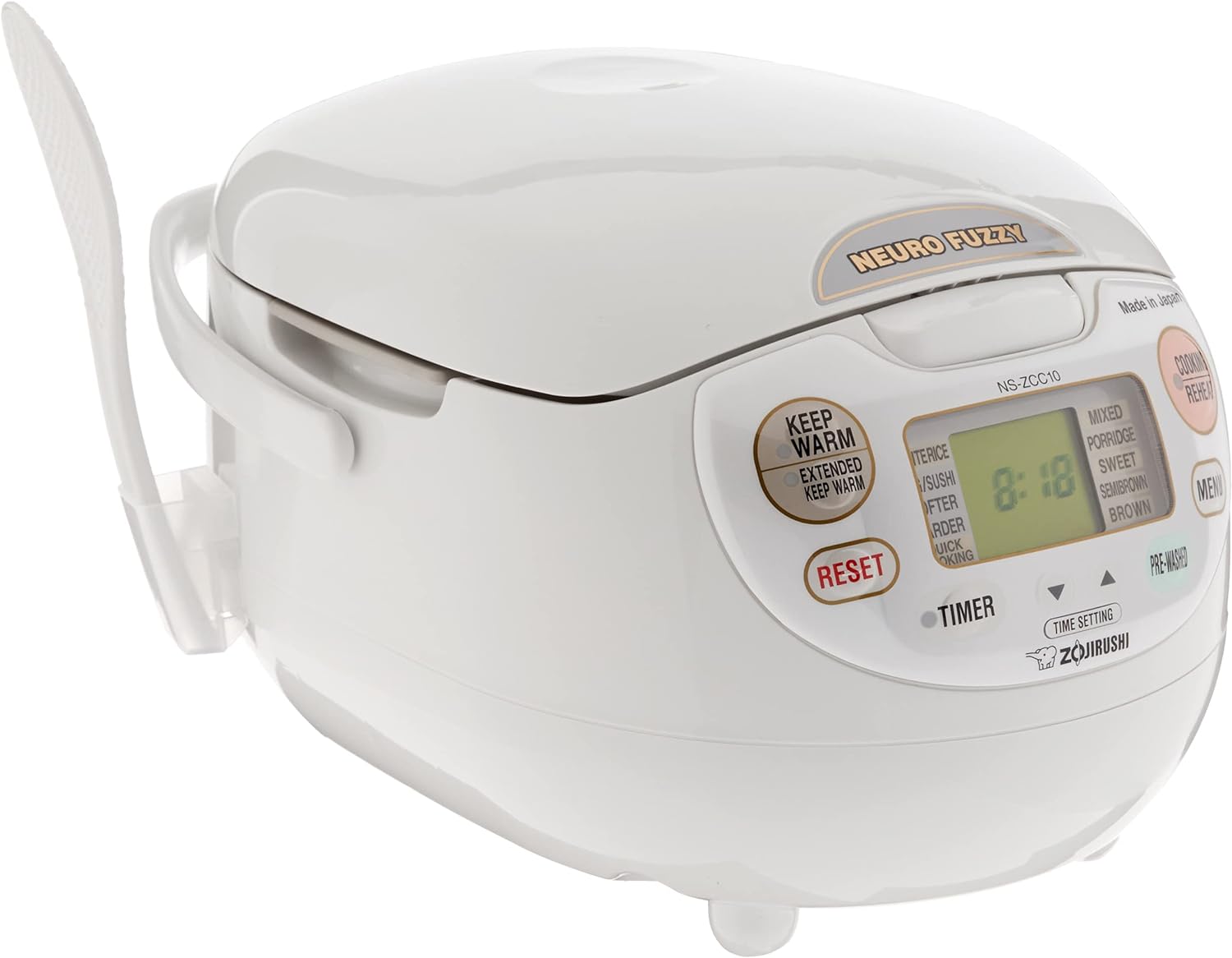
Zojirushi Neuro Fuzzy NS-ZCC10
| Capacity | 5.5 cups |
|---|---|
| Wattage | 680 watts |
| Power Source | Corded Electric |
| Voltage | 110 volts |
The Zojirushi NS-ZCC10 is a compact Neuro Fuzzy rice cooker that automatically adjusts cooking time and temperature to produce consistent rice across a variety of settings. It is typically used for daily rice cooking and can handle white, sushi, mixed, porridge, sweet, brown, rinse-free and quick cycles; an LCD timer, delay start and programmable keep-warm and reheat cycles make scheduling simple. The spherical nonstick inner pan and 680-watt heating system promote even heat distribution, which helps reduce hot spots and yields uniform texture. Practical touches include a detachable washable inner lid, retractable power cord, included measuring cups and spatula, and melody/beep end alerts. At high altitudes the Neuro Fuzzy logic and delay timer give more control than basic cookers, but users should expect slightly longer cook times and may need to experiment with water ratios for best results. The unit is well suited for cooks who want hands-off, reliable performance in a small footprint, though it lacks pressure or induction heating found on higher-end models that can further improve high-altitude results.
Best for: Buyers focused on consistent, hands-off rice cooking who want precise automatic adjustments and flexible timing in a compact cooker.
Less Ideal for: Those who need the fastest high-altitude performance or prefer pressure/induction models for firmer control and larger batch cooking should consider other options.
- Neuro Fuzzy logic adjusts temperature and timing for consistent rice textures
- Multiple menu settings for white, brown, porridge and quick cooking
- Spherical nonstick inner pan promotes even heating
- Programmable timer, delay start and automatic keep-warm for flexible scheduling
- No pressure or induction heating, which can be advantageous at high altitudes
- Smaller 5.5-cup uncooked capacity may be limiting for larger households
Verdict: Choose the Zojirushi NS-ZCC10 if you want a compact, Neuro Fuzzy cooker that delivers consistently good rice with programmable timers and hands-off operation at high altitude.
BLACK+DECKER 16-Cup Rice Cooker RC516

| Capacity | 16 cups (cooked) |
|---|---|
| Wattage | 500 watts |
| Power Source | Corded Electric |
| Other Features | Automatic Keep Warm, One-Touch Operation, Removable Bowl |
| Included Components | Measuring Cup, Rice Paddle, Steamer Basket |
The BLACK+DECKER RC516 is a straightforward, family-size rice cooker that handles large batches without fuss. You add measured rice and water, press the one-touch control, and the cooker brings rice to temperature then automatically switches to keep-warm when the moisture is absorbed. The removable nonstick bowl and tempered glass lid make cleanup and serving easy, and the included steaming basket expands use to vegetables, fish, and one-pot meals like oatmeal or soups. Indicator lights show cooking versus warming so you know status at a glance. With a 500-watt heater it cooks reliably, though like most simple cookers it uses a fixed cooking cycle rather than adjustable pressure or altitude settings, so high-altitude users may need to adjust water ratios or run an extra short reheat cycle for fully tender grains. The unit is compact for its capacity and the accessories are dishwasher-safe, but there are no advanced program options for custom grain types or timing. For households that want an uncomplicated, large-capacity cooker that cleans up easily, this is a solid choice; serious high-altitude cooks should be prepared to tweak water and timing manually.
Best for: Buyers who prioritize a simple, high-capacity cooker that reliably produces fluffy rice with minimal fuss and easy cleanup for family meals and batch cooking.
Less Ideal for: If you need programmable controls, pressure or induction cooking, or built-in altitude compensation for precise results at high elevations, look for a more advanced model with adjustable settings.
- Large 16-cup cooked capacity suitable for families and gatherings
- One-touch operation with automatic keep-warm for set-and-forget cooking
- Removable nonstick bowl and tempered glass lid are dishwasher-safe for easy cleanup
- Includes steaming basket, measuring cup, and serving spoon for versatile cooking
- No altitude-specific or multi-stage cooking programs so water/timing must be adjusted at high elevations
- Limited to basic on/off and keep-warm controls without customizable settings
Verdict: A no-frills, large-capacity cooker that delivers reliable, easy-to-clean results for families who are willing to manually adjust water and timing for high-altitude cooking.
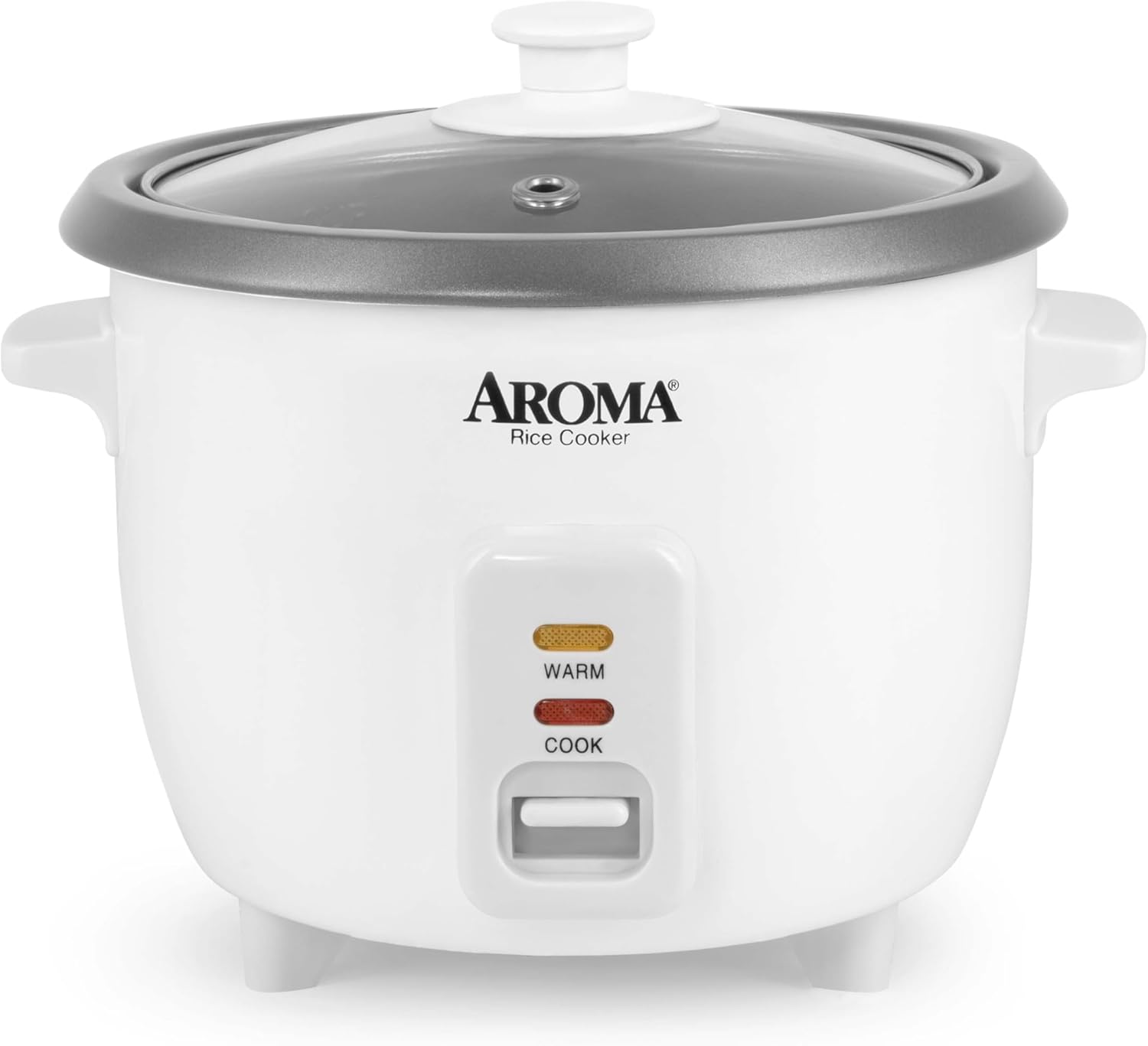
AROMA ARC-363NG 6-Cup Rice Cooker
| Capacity | 6 cups |
|---|---|
| Wattage | 500 watts |
| Power Source | Corded Electric |
| Voltage | 120 volts |
| Lid Material | Tempered Glass |
The Aroma ARC-363NG is a small, straightforward rice cooker designed to make 2 to 6 cups of cooked rice with minimal fuss. You add rice and water to the removable inner pot, press the single control, and the unit cooks then switches to Keep Warm automatically, which is useful for meal prep or serving later. The tempered glass lid lets you watch progress without lifting the lid, and included accessories (measuring cup and spatula) make portioning and serving easy. Its 500-watt corded design and ceramic-coated inner pot simplify cleanup and help prevent sticking. As a compact cooker it works well for side dishes, oatmeal, soups, and small family meals, but it lacks advanced controls or altitude-specific settings, so at high elevations you may need to adjust water ratios and cooking times yourself. The cooker is hand-wash recommended for some parts and relies on a basic one-touch mechanism rather than programmable cycles, so if you want more precision or multi-step recipes you will need a more feature-rich multicooker.
Best for: Buyers who want a reliable, no-frills cooker for everyday rice and simple one-pot meals and who prioritize low cost and easy operation over advanced features.
Less Ideal for: Users who need programmable cycles, precise temperature control, or built-in high-altitude adjustments should consider a more advanced multicooker.
- Simple one-touch operation that is easy for beginners
- Automatic Keep Warm keeps rice ready to serve without monitoring
- Tempered glass lid lets you monitor cooking without losing heat
- Compact footprint suitable for small kitchens and counters
- Includes measuring cup and serving spatula for convenience
- No altitude or programmable settings so manual adjustments are needed at high elevations
- Basic feature set without advanced cooking modes or timers
Verdict: A compact, affordable one-touch cooker that reliably makes small batches of rice for budget-focused buyers who can handle manual altitude adjustments.
Cosori 5.0-Quart Rice Cooker

| Capacity | 10 cups |
|---|---|
| Wattage | 1000 watts |
| Power Source | Corded Electric |
| Other Special Features | Advanced Fuzzy Logic, Airtight Lid, Automatic Keep Warm |
The Cosori 5.0-Quart Rice Cooker is a versatile countertop cooker that uses fuzzy logic to adjust multi-step cooking for consistent results across white, brown, and specialty grains. You pick a program from its 18 functions, set the delay timer if you want rice ready later, and the unit handles the 7-step fuzzy logic process to deliver evenly cooked, fluffy rice while keeping it warm for up to 24 hours. The cooker includes a removable nonstick ceramic inner pot, a stainless steel steamer basket, measuring cup, and paddle, and most removable parts are dishwasher-safe for easy cleanup. At 1000 watts the Quick Rice mode shortens cook time without sacrificing texture, which helps when altitude affects boiling points and timing. Practical limits are typical for countertop rice cookers: you still need to test water ratios for your altitude and some users may prefer a larger commercial unit for very large batches. The build and included accessories make it a reliable everyday cooker for households adapting recipes to higher elevations.
Best for: Buyers who prioritize a dependable, hands-off cooker that consistently delivers good rice with programmable options and easy cleanup, especially households adapting cooking at higher elevations.
Less Ideal for: Restaurants or large groups that need continuous high-volume cooking or users who want a single model that auto-compensates perfectly for every altitude without manual adjustments.
- Fuzzy logic adjusts cooking stages for more consistent, evenly cooked rice
- 18 preset functions cover white, brown, grains, oats, steaming, slow cook, and sauté
- Nonstick ceramic inner pot and removable lid are dishwasher-safe for easy cleaning
- 24-hour keep-warm plus delay timer lets you schedule cooking and keep rice ready
- 10-cup capacity may be small for large commercial batches
- Requires manual water-ratio adjustments for high-altitude cooking
Verdict: Choose this Cosori rice cooker if you want a reliable, fuzzy-logic cooker with flexible programs and easy cleanup that helps you get consistent results at altitude when you fine-tune water ratios.
Aroma Professional 5-Quart Rice Cooker

| Capacity | 20 cups |
|---|---|
| Power Source | Corded Electric |
| Wattage | 1550 watts |
| Voltage | 120 volts |
This Aroma Professional 5-Quart rice cooker is a full-featured multicooker aimed at families and cooks who want a reliable, set-and-forget appliance. It cooks rice and other grains with smart sensors and a quick-rice option, and doubles as a slow cooker, steamer, soup maker, and even a cake cooker via 10 preset modes. The removable steam tray lets you steam vegetables or seafood while rice cooks below, and the Sauté-then-Simmer mode lets you brown ingredients before slow simmering without transferring pots. Programmable digital controls, a 15-hour delay timer, and automatic keep-warm mean you can plan meals ahead and return to ready food. Practical drawbacks are that the inner pot is aluminum with a ceramic coating that needs hand washing, and the unit is large, so it needs a dedicated counter or cabinet space. Wattage is relatively high, so it uses more power during longer slow-cook cycles. For everyday family meals and hands-off cooking, it simplifies multi-step recipes and large batches well.
Best for: Buyers who want a dependable, easy-to-use multicooker for family-sized batches and predictable results with minimal babysitting.
Less Ideal for: Small-space users who need a compact appliance or cooks who prefer dishwasher-safe, low-maintenance inner pots.
- Multiple presets cover rice, multigrain, steam, soup, cake, and slow cook for one-pot versatility
- Sauté-then-Simmer mode lets you brown and then simmer in the same pot to cut prep and pans
- 15-hour delay timer and automatic keep-warm allow flexible meal timing
- Includes steam tray and useful accessories like measuring cup and spatula
- Inner pot requires hand washing and care for the ceramic coating
- Large footprint may be awkward in small kitchens
Verdict: Choose this Aroma multicooker if you want a reliable, programmable 5-quart appliance that handles large batches and multiple cooking tasks with minimal hands-on time.
Choosing the Right Rice Cooker for High Altitude: Key Factors to Consider
Altitude Compensation or Pressure Control
At higher elevations, the boiling point of water drops and the cooker must account for slower starch gelatinization. Models that offer altitude compensation settings or programmable pressure control let you raise the effective cooking temperature or extend the cooking phase to ensure even doneness. Without these features you may need to manually guess longer cook times or add extra water, which leads to inconsistent results.
Look for explicit altitude modes, pressure-assisted cooking, or adjustable cook cycles that let you add minutes to the main cook. These controls reduce trial-and-error and provide repeatable outcomes when you change elevation or cook different rice varieties.
Precise Temperature Control
Maintaining a steady, appropriate cooking temperature is critical because lower atmospheric pressure alters how quickly water evaporates and how starches set. A cooker with accurate temperature sensors and multi-stage heating profiles makes it easier to get the center of the grain fully cooked without overcooking the exterior.
Devices that use multi-step algorithms can slow the final simmer or extend an intermediate phase to compensate for slower heat transfer at altitude. This reduces the chance of undercooked cores or a gluey exterior caused by overly aggressive heat late in the cycle.
Water-to-Rice Calibration
Water requirements change with elevation because more water is lost to steam and evaporation during the cooking cycle. A unit that provides clear water-level markings for common rice types, or that allows you to manually set water amounts in grams or cups, makes adaptation straightforward.
Some cookers include adjustable water ratio guides or a reheat/soak feature that lets you restore moisture after the initial cook. Being able to control liquid precisely is one of the simplest and most effective ways to fine-tune results at altitude.
Steam Sealing and Lid Design
A tight lid and effective steam-sealing mechanism reduce boil-off and preserve trapped heat, both of which matter more at altitude. Well-designed lids keep pressure and steam around the rice, minimizing the extra water you would otherwise need to add.
Removable steam caps and accessible sealing gaskets also matter for maintenance. A poorly sealed lid that leaks steam will force you to compensate with additional water or longer cooking times, increasing the chance of inconsistent texture.
Control Simplicity and Presets
When compensating for altitude you will often rely on control adjustments rather than guessing. Cookers with intuitive presets for different rice types and manual time adjustments let you make deliberate changes to cook length and moisture. Clear labeling and tactile controls reduce mistakes when adjusting for elevation.
Look for models that let you save custom programs or nudge cook times in small increments. A simple reheat or keep-warm function that does not over-dry rice is also useful for finishing at high altitudes.
How Altitude Affects Rice Cooking
As elevation increases, atmospheric pressure decreases and water boils at a lower temperature. That changes how starch inside rice grains gelatinizes and how quickly moisture is driven off. The result can be undercooked interiors, a disconnected texture between outer and inner grains, or rice that dries out before starches fully set.
Understanding these physical changes helps you use a rice cooker more effectively. Rather than simply extending time blindly or dumping in extra water, a measured approach that adjusts temperature, steam retention, and water calibration leads to consistent results.
- Lower boiling point reduces maximum cooking temperature
- Increased evaporation requires more initial water or better sealing
- Starch gelatinization timing shifts, often requiring longer heat exposure
Practical Setup Tips for High-Altitude Cooking
Start by adjusting the water ratio by a small, consistent increment — typically an extra 5 to 15 percent depending on your elevation and rice type. Use the cooker's markings or measure by weight for the most consistent results. Avoid large jump increases; small incremental changes are easier to dial in.
Use presets as baselines rather than rules. If a cooker has an adjustable keep-warm or extended simmer stage, try adding a few minutes to the main cook phase and monitor the texture. For sticky or short-grain rice, slightly less extra water is usually needed than for long-grain varieties.
- Measure rice and water by weight when possible for repeatability
- Increase water in small steps and track changes
- Extend cooking time incrementally rather than large jumps
Cleaning and Maintenance to Preserve Sealing
Seals, steam caps, and inner lids trap moisture and pressure. Regular cleaning keeps these parts functioning and prevents steam leaks that would worsen boil-off at altitude. Remove and wash any silicone gaskets and steam caps after several uses and inspect them for wear.
Keep the inner pot base clean and free of residue so it maintains even heat contact. Residue can create hot spots that alter how quickly water evaporates, forcing compensations that reduce consistency.
- Wash and inspect sealing gaskets regularly
- Clean inner pot surfaces to prevent hotspots
- Replace worn sealing components to maintain steam retention
Choosing Capacity and Rice Type Considerations
Choose a pot size that matches the typical batch you cook. Overfilling increases boil-over risk and more surface area accelerates evaporation. Underfilling a large pot can also change heat dynamics and lead to drier rice.
Different rice types respond differently to altitude. Short-grain and sushi rice typically need less extra water than brown rice, which requires longer cooking and more liquid to fully soften. Make adjustments with the grain type in mind to avoid soggy or underdone results.
- Match capacity to typical batch size to control evaporation
- Adjust water more cautiously for short-grain vs long-grain rice
- Expect brown and other whole-grain rice to need longer, wetter cooks
When to Use Manual Modes or Custom Programs
If you regularly cook at elevation, a cooker that supports custom programs or manual timing will save time. These modes let you program longer soak or simmer stages and store the settings for repeat use. Manual control is particularly helpful when experimenting with new rice varieties or unfamiliar water sources.
Use manual modes to test one variable at a time, such as adding 5 percent more water or increasing cook time by two minutes. Document the outcome so you can replicate the exact setting for that elevation and rice type in the future.
- Use custom programs to save altitude-specific adjustments
- Change one variable at a time when testing
- Record successful settings for future reference
How We Chose the Best Rice Cooker for High Altitude
We focused on factors that directly affect cooking at elevation, prioritizing features that compensate for lower boiling points and increased steam loss. Key evaluation criteria included altitude compensation or programmable pressure settings, precise temperature control, consistent heat distribution, water-to-rice calibration options, and user controls or presets tailored to different rice types. We tested each candidate conceptually against real-world high-altitude behaviors: longer boil-off, slower starch gelatinization, and a higher tendency for undercooked centers or uneven texture. We excluded basic models that offer only a single on/off cook function with no adjustable cook time or water calibration because they lack the controls needed to adapt to altitude. Appliances without clear water-level guidance or that prevent manual calibration were also removed from consideration. Other dimensions we weighted included build quality and steam-sealing performance, ease of cleaning for components that trap starch, and intuitive controls that let you extend cook time or adjust moisture without guessing. The result is a list of rice cookers that balance altitude-aware functionality with everyday usability and durability.
Our full evaluation process is outlined in our review methodology.
FAQ
How much extra water do I need at high altitude?
It depends on your elevation and rice type, but a typical adjustment is an extra 5 to 15 percent water. Start with a small increase, test the result, and adjust in small increments until you reach the desired texture.
Can I just increase cook time instead of adding water?
Increasing cook time helps starches gelatinize, but without added water you risk drying the rice. A combined adjustment of slightly more water plus modestly longer cook time usually yields the best balance.
Do I need a pressure rice cooker for altitude?
A pressure-capable cooker can raise the effective cooking temperature and reduce the need for large water adjustments, but it is not strictly required. Good temperature control, sealing, and water calibration can also produce reliable results at elevation.
Will soaking rice beforehand help at high altitude?
Soaking can reduce necessary cook time and encourage even hydration, which is beneficial at altitude. For brown or older rice, a short soak helps ensure the center cooks through without overdoing the exterior.
How do I know if my cooker is losing steam?
Visible steam leaks around the lid or a noticeably lower water level after cooking indicate steam loss. Inspect gaskets and steam caps for residue or damage and clean or replace parts as needed to restore sealing.
Final Verdict
Choosing the right rice cooker for high altitude means prioritizing features that control temperature, manage steam loss, and let you fine-tune water ratios. Expect tradeoffs between simplicity and control: basic units are easy to use but may force more trial-and-error, while programmable or pressure-capable cookers reduce guesswork but require a bit more setup. Focus on altitude compensation, reliable sealing, and clear water calibration when deciding. With the right combination of controls and consistent measurement, you can achieve repeatable, restaurant-quality rice at elevation without endless experimentation.