
Note: This article contains affiliate links. If you click on these links and make a purchase, we may earn a small commission at no extra cost to you. This helps support our research and content. Read our full affiliate disclosure here.
If you have tile floors, the right robot mop can cut weekly maintenance time while protecting grout and tile surfaces. Tile presents unique challenges: grout traps dirt, high-traffic areas need extra scrubbing, and some cleaning methods can dull or damage finishes. This guide highlights the top shortlisted robot mops for tile floors, chosen for their wet-cleaning effectiveness, navigation over uneven grout lines, and built-in protections for sealed and unsealed tiles. Below you will find our top picks and a breakdown of the evaluation criteria that matter for tile owners, so you can match a model to your home's specific needs.
Top Picks at a Glance
| Best Overall The best all-around choice for most situations | iRobot Roomba 415X |  |
| Best Quality Built to a higher standard if you want something more solid | roborock Saros 10R |  |
| Best Value The sweet spot between price and what you get | Tikom G8000 Max Robot Vacuum |  |
| Best Budget The cheapest option that still gets the job done reliably | ILIFE V5s Plus Robot Vacuum |  |
| Top Rated A top-rated pick with lots of positive feedback | eufy C28 Robot Vacuum |  |
| Most Popular A crowd favorite that many people choose with confidence | iRobot Roomba 105 Combo |  |
| Best Seller A high-volume bestseller chosen again and again | roborock Q10 S5+ |  |
iRobot Roomba 415X

| Surface Recommendation | Carpet & Hard Floor |
|---|---|
| Battery Life | 6 hours |
| Controller Type | App Control, Button Control, Voice Control |
| Other Special Features | AutoWash Dock, Self-Emptying, Obstacle Avoidance, Intelligent Mop Lifting |
| Filter Type | Cartridge |
The Roomba 415X is a high-end vacuum-and-mop combo built to run frequent, hands-off cleaning cycles across large homes. It maps with LiDAR and obstacle recognition so it navigates around cords and toys while using multiple cleaning modes—vacuum-only, mop-only, both together, or vacuum then mop—for flexible routines. Strong suction and SmartScrub mop pressure help tackle dried spills and stuck-on messes, while tangle-free rubber brushes keep pet hair moving into the bin. The AutoWash Dock automatically empties debris for up to 90 days and washes and heat-dries mop pads at 113°F after each run, reducing daily maintenance. The robot also detects carpets and lifts the mop pads before crossing rugs to avoid wetting carpets. On the downside, the unit and dock add bulk compared with simple robot vacuums and you will need compatible replacement pads and cartridge filters over time. For owners who want sustained, whole-house cleaning without daily intervention, this model delivers a powerful, automated solution.
Best for: Buyers who prioritize sustained, high-performance cleaning across a large home and want a mostly automated system that handles both vacuuming and mopping with minimal daily upkeep.
Less Ideal for: People who need a compact, low-cost robot for occasional light pickup or those who prefer a unit without a multi-function dock and ongoing consumable replacements.
- LiDAR mapping and obstacle recognition enable reliable navigation in cluttered rooms
- AutoWash Dock auto-empties debris for up to 90 days and washes and heat-dries mop pads
- Multiple cleaning modes (vacuum, mop, combined, vacuum-then-mop) for flexible use
- Tangle-free rubber brushes and strong suction designed for pet hair and deep pickup
- Larger dock and robot footprint compared with basic robotic vacuums
- Requires replacement mop pads and cartridge filters over time
Verdict: If you want a powerful, low-intervention robot that vacuums and mops whole-house areas reliably, the Roomba 415X delivers automated, sustained cleaning with advanced mapping and self-maintenance.
roborock Saros 10R

| Suction | 22,000 Pa |
|---|---|
| Battery Life | 180 minutes |
| Filter Type | Washable |
| Noise Level | 65 db |
| Power Source | Battery Powered |
The roborock Saros 10R is a performance-focused robot vacuum and mop built to handle everyday dirt and pet hair on hard floors and low-pile carpets. It pairs powerful 22,000 Pa HyperForce suction with a Zero-Tangling DuoDivide brush and FlexiArm side brush to pick up hair without frequent brush cleaning, while the ultra-slim 3.14-inch body slips under low furniture to reach hidden dust. The multifunctional dock 4.0 automates maintenance with hot-water mop washing, hot-air drying, 60-day dust collection and auto refill features that greatly reduce hands-on upkeep. Navigation relies on the StarSight 2.0 system with 3D sensing and obstacle avoidance, which improves edge and cord handling and supports auto re-wash for high-traffic spots. For hardwood floors the mop functions and automatic mop lift when carpets are detected help avoid over-wetting. Trade-offs are the relatively loud 65 dB reported noise level during operation and a large, heavier docked system footprint, which may be more than needed for small homes.
Best for: Buyers who prioritize strong cleaning performance and low-maintenance operation on hard floors and have pets or long hair that require frequent deep pickup.
Less Ideal for: People living in very small apartments or who need a whisper-quiet machine for nighttime cleaning should consider smaller or quieter alternatives.
- Very strong 22,000 Pa suction for deep pickup on hardwood and low-pile carpets
- Zero-tangling main brush and omnidirectional wheels reduce hair maintenance
- Ultra-slim 3.14-inch profile reaches under low furniture and into tight spots
- Multifunctional dock automates mop washing, drying, and up to 60 days of dust collection
- 3D obstacle detection and advanced mapping improve edge cleaning and cord avoidance
- Noise level around 65 dB may be noticeable during cleaning
- Large multifunctional dock increases system footprint and setup complexity
Verdict: Choose the Saros 10R if you want top-tier suction and a hands-free docked system that keeps hardwood floors and pet hair under control with minimal daily effort.
Tikom G8000 Max Robot Vacuum

| Suction | 5000Pa |
|---|---|
| Battery Life | 150 minutes |
| Dustbin Capacity | 450 ml |
| Water Tank | 300 ml |
| Noise Level | 45 db |
The Tikom G8000 Max is a low-profile robot vacuum that combines strong suction with mopping to keep hard floors and low-pile carpets tidy with minimal user effort. In use it maps and navigates with anti-collision and anti-fall sensors, and supports app, remote, voice, and onboard button control so you can schedule cleanings and start runs from a phone or the included remote. Notable features include a 5000Pa suction motor for lifting pet hair and debris, a combined 450 ml dustbin plus 300 ml water tank for simultaneous vacuuming and mopping, and a runtime up to 150 minutes with automatic recharge. Its 3-inch height lets it access under furniture and the Zig-zag cleaning mode improves coverage on open floor areas. Limitations to keep in mind are that higher-pile carpets may not get deep cleaning compared with upright vacuums and mopping is best for maintenance rather than heavy wet cleaning; occasional emptying of the dustbin and refilling the water tank are still required. For routine hardwood maintenance the G8000 Max offers a practical balance of suction, run time, and smart controls.
Best for: Buyers who want a practical, time-saving floor care solution for hardwood and low-pile carpets and prioritize long runtime, reliable navigation, and flexible control options.
Less Ideal for: Households that need deep carpet extraction, heavy wet mopping, or commercial-grade cleaning should consider a dedicated upright or standalone mop system instead.
- Strong 5000Pa suction effective on hard floors and short-pile carpets
- Simultaneous vacuuming and mopping with combined dustbin and water tank saves time
- Long run time up to 150 minutes with auto-recharge for larger homes
- Slim 3-inch profile reaches under low furniture
- Multiple control options including app, remote, voice, and onboard button
- Mopping function is for light maintenance and not heavy wet cleaning
- May be less effective on high-pile carpets compared with full-size vacuums
Verdict: A slim, long-running robot that combines powerful suction and light mopping to keep hardwood floors clean with minimal hands-on work.
ILIFE V5s Plus Robot Vacuum

| Battery Life | 110 minutes |
|---|---|
| Capacity | 300 ml |
| Controller Type | App Control, Voice Control, Remote Control |
| Compatible Devices | Amazon Echo, Google Home |
The ILIFE V5s Plus is a slim 2-in-1 robot that vacuums and mops while offering app, remote and voice control for scheduled cleaning. It runs up to 110 minutes per charge and automatically returns to its charging dock when the battery is low, making it suitable for daily maintenance across small to medium rooms. The unit provides five cleaning modes including auto, spot, edge and max for adjustable suction and targeted passes, and its 300 ml tanks handle both dust and water for light mopping tasks. Practical benefits include a low profile that reaches under furniture, compatibility with Alexa and Google Assistant, and sensor suites that reduce falls and collisions. Limitations are a modest suction level compared with higher-end models, a relatively small water/dust capacity that requires frequent emptying for larger homes, and simpler navigation that may miss complex path optimization on cluttered carpets. For its price point the V5s Plus delivers consistent, hands-off upkeep rather than deep clean performance on thick carpeted surfaces.
Best for: Buyers looking for an affordable, no-frills robot that keeps hard floors and low-pile carpet tidy with minimal setup and smart-home control.
Less Ideal for: Homes that need powerful deep-cleaning on thick or high-pile carpets or large houses where longer runtimes and larger dust/water capacity are required.
- 2-in-1 vacuum and mop combination for quick maintenance of floors and light spills
- 110-minute runtime with automatic self-charging for largely unsupervised cleaning cycles
- Multiple cleaning modes and scheduling via app, remote or voice for flexible operation
- Slim profile and sensors help the robot reach under furniture and avoid drops or collisions
- Smaller 300 ml tanks and dustbin need more frequent emptying during larger jobs
- Navigation is basic compared with lidar or advanced mapping systems, so pathing can be inefficient on cluttered layouts
Verdict: A budget-friendly robot that combines vacuuming and light mopping with smart controls to keep small-to-medium homes tidy without breaking the bank.
eufy C28 Robot Vacuum

| Suction | 15,000 Pa |
|---|---|
| Battery Life | 140 minutes |
| Capacity | 3 liters |
| Filter Type | Washable |
The eufy C28 is a full-featured robot vacuum and mop designed to reduce hands-on maintenance. It uses LiDAR navigation to map rooms and avoid obstacles without cameras while its HydroJet roller mop spins and self-cleans into a separate dirty-water tank, and the included Omni station automatically empties dust into a 3 L container, refills and washes the mop, and dries it with hot air. In daily use it handles hard floors and short-pile carpet, boosts suction on carpets, and its zero-tangle DuoSpiral brush is built to manage pet hair without frequent brush cleaning. The unit reports long runtimes for multi-room jobs and can lift the mop on rugs to protect carpets. Practical limitations include the robot's overall size and weight for homes with very low clearances and the dependence on the docking station for the hands-free features to work as advertised. For buyers who prioritize low-maintenance cleaning and reliable navigation, the C28 delivers measurable time savings but it is best suited to households that can accommodate the Omni station footprint.
Best for: A cautious buyer who wants dependable mapping, strong suction, and near hands-off vacuuming and mopping with minimal daily maintenance.
Less Ideal for: Homes with very limited floor space for the docking station or users who need a compact robot that performs primarily without a large base station.
- 15,000 Pa suction with automatic carpet boost for stronger pickup on rugs
- All-in-one Omni station auto-empties dust, washes and hot-dries the mop, and collects wastewater for up to 75 days
- LiDAR navigation avoids obstacles using laser mapping without cameras to protect privacy
- Zero-tangle DuoSpiral roller reduces hair wrap and simplifies pet-hair maintenance
- Large station and robot size may be difficult to place in tight or low-clearance homes
- Hands-free features require the Omni station, so benefits are reduced if you only use the robot standalone
Verdict: Buy this if you want a privacy-safe LiDAR robot that combines strong suction with a station that largely automates emptying, mop washing, and drying for low-maintenance floor care.
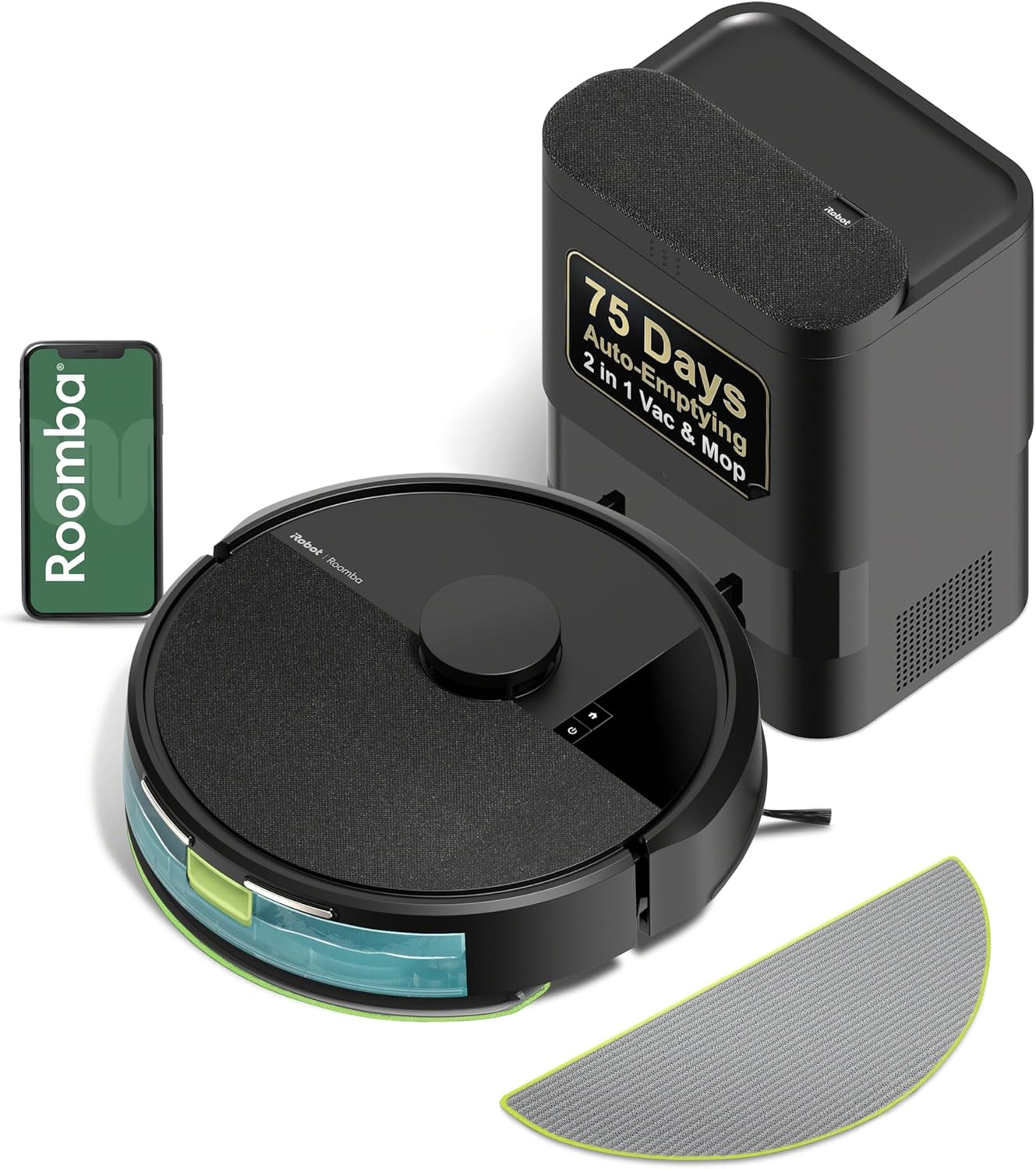
iRobot Roomba 105 Combo
| Surface Recommendation | Carpet & Hard Floor |
|---|---|
| Battery Life | 100 minutes |
| Controller Type | App Control, Button Control, Voice Control |
| Filter Type | Cartridge |
The Roomba 105 Combo is a vacuum-and-mop robot built for regular home cleaning on carpets and hard floors, with ClearView LiDAR mapping, 3 cleaning modes, and a self-emptying AutoEmpty dock. In typical use you pick mop only, vacuum only, or vacuum-and-mop, schedule runs in the iRobot Home app or start with voice commands, and the robot maps rooms to avoid obstacles and stairs. Notable features include a 4-stage cleaning system with power-lifting suction and an edge-sweeping brush for better corner cleaning, a washable microfiber mop pad and a micro-pump that meters cleaning solution for controlled mopping, plus a dock that holds up to 75 days of debris in a disposable bag. Practical benefits for LVP floors are targeted wet cleaning with carpet detection so rugs stay dry, and LiDAR navigation for consistent coverage. Limitations to expect are routine maintenance like filter and brush cleaning, a 100-minute battery life that may need recharges for larger homes, and dependency on the companion app for advanced settings and map customization.
Best for: Buyers who want a mostly hands-off vacuum-and-mop robot that reliably cleans LVP and other hard floors and values documented performance and peer reviews when choosing a dependable, low-maintenance option.
Less Ideal for: People who need the longest possible run time for very large homes, want a mop dock that washes and dries pads, or who prefer fully bagless base stations.
- Self-emptying AutoEmpty dock holds up to 75 days of debris for low-touch maintenance.
- ClearView LiDAR mapping gives reliable room coverage and obstacle avoidance.
- Combined vacuum-and-mop modes with a micro-pump and washable microfiber pad let you control how much liquid is applied to hard floors.
- 70x power-lifting suction and an edge-sweeping brush improve pickup, including pet hair and edge debris.
- App and voice control with scheduling and keep-out zones simplify routine cleaning.
- Battery runtime is 100 minutes which may require mid-run recharges in larger homes.
- AutoEmpty uses disposable bags, adding ongoing consumable cost.
- Does not include heated pad washing or advanced self-washing dock features found on higher-end models.
Verdict: Choose the Roomba 105 Combo if you want a trustworthy LiDAR-mapped vacuum-and-mop with a hands-free AutoEmpty dock that keeps LVP clean with minimal daily effort.
roborock Q10 S5+

| Maximum Suction | 10,000 Pa |
|---|---|
| Capacity | 2.7 liters |
| Battery Life | 150 minutes |
| Filter Type | Washable |
| Noise Level | 65 db |
The roborock Q10 S5+ is a robot vacuum and mop combo built for low-touch, regular maintenance of mixed flooring. It navigates with 360° LiDAR mapping and ReactiveTech obstacle avoidance, so it plans efficient routes and avoids common household objects while supporting multi-level maps and no-go zones via the app. The unit pairs a 10,000 Pa suction system and smart carpet detection to boost suction on rugs and a dual anti-tangle brush setup to reduce hair clogs, which is helpful for pet homes. Its VibraRise 2.0 sonic mopping lifts and scrubs floors and can auto-lift the mop when carpet is detected. The included auto-empty dock holds a 2.7 L dust bag for extended hands-free operation, advertised up to about 70 days between bag changes. Battery runtime and app controls allow scheduled and voice-operated cleaning. Expect roughly moderate noise and a relatively large robot footprint that may limit access under very low furniture, and advanced features depend on using the app and 2.4 GHz Wi-Fi.
Best for: Buyers who prioritize low-maintenance, reliable cleaning backed by broad user adoption and want a robot that cleans floors and mops with strong suction and advanced navigation.
Less Ideal for: If you need an ultra-compact robot for very low-clearance furniture or want a model that runs without any networked app features, this is not the best fit.
- Strong 10,000 Pa suction for deep pickup on carpets and floors
- LiDAR mapping with multi-level maps and no-go zones for predictable navigation
- VibraRise sonic mopping that auto-lifts on carpet to protect rugs
- Large 2.7 L auto-empty dock reduces how often you need to empty the bin
- Dual anti-tangle brush design reduces hair snags and maintenance
- Relies on 2.4 GHz Wi‑Fi and the app for full feature set
- Noise level is moderate and may be noticeable during runs
Verdict: Choose the Q10 S5+ when you want a mostly hands-free robot that combines strong suction, LiDAR mapping, and auto-emptying for dependable weekly cleaning under $1,000.
Choosing the Right Robot Mop for Tile Floors: Key Factors to Consider
Wet-Cleaning Effectiveness
How well a robot mop loosens and removes soil from both glazed tile surfaces and porous grout affects how often you will need manual touch-ups. Effective wet cleaning combines appropriate pressure, motion that agitates dirt, and a cleaning solution that dissolves common household grime.
For tile floors, look for models that offer selectable cleaning modes or oscillating pads that mimic a scrubbing motion rather than just dragging a damp cloth. Machines that can sustain a steady wet-clean cycle across a room will reduce streaks and prevent redepositing soil into grout lines.
Water Flow Control
Precise control over water or solution output matters because tile and grout respond differently to moisture. Over-wetting can saturate grout, potentially weakening some types of grout or promoting staining over time. Under-wetting leaves residues and fails to dissolve grease.
Prefer robot mops with adjustable water flow, multiple cleaning intensities, or smart sensors that modulate wetting based on floor type. This capability helps protect sealed and unsealed grout and ensures efficient drying between cleaning cycles.
Grout Line Navigation and Traction
Grout creates micro-topography that challenges wheels, brushes, and pads. A robot mop that navigates grout lines well will avoid getting stuck, will maintain consistent contact with the floor for even cleaning, and will not scrape or widen grout joints.
Check for navigation systems that detect height changes and for low-profile drive wheels that maintain traction without digging into grout. Good suspension or flexible cleaning heads help the mop follow uneven tiles and keep the cleaning surface level against the floor.
Pad and Brush Material
The material and design of pads or brushes determine how gently or aggressively the robot treats tile and grout. Microfiber pads offer gentle absorption and surface polishing, while textured or oscillating pads provide more mechanical agitation for stubborn dirt.
Consider replaceable pad availability and cleaning ease. Reusable microfiber pads are cost-effective but require laundering. Disposable pads simplify upkeep but generate waste. The ability to add a scrubbing accessory or switch between mop types increases long-term versatility.
Battery Runtime and Coverage
Battery life dictates how much area the robot can cover in one session, which matters for open-plan homes or multiple tiled rooms. Short runtimes require more frequent recharge interruptions and may leave areas only partially cleaned.
Look for runtime that comfortably exceeds the time needed to clean a typical room in your home, or for models with automatic recharge-and-resume features. Also consider idle standby consumption if you plan to schedule frequent short cleanings.
Maintenance and Hygiene
Routine maintenance affects ownership convenience and long-term performance. Tasks include washing or replacing pads, emptying or cleaning water tanks, and descaling components if you use hard water. Clogged nozzles or soiled pads reduce cleaning effectiveness and can spread odors.
Choose models with easy-access tanks and washable components. Systems that include automated pad rinsing or replaceable hygiene modules reduce manual effort and lower the risk of cross-contamination between rooms.
How Robot Mops Handle Different Tile Finishes
Tiles come in finishes from high gloss to matte and in materials ranging from ceramic to porcelain. High-gloss tiles show streaks and water spots more readily, so a robot mop that leaves minimal residue and can perform a final dry pass is useful. Matte or textured tiles hide minor streaking but trap soil more easily in surface pores.
Porcelain and ceramic typically tolerate more aggressive wet cleaning than softer or natural stone tiles. If you have sealed natural stone or specialty tile, verify that your chosen cleaning solution and the robot's wetting pattern are compatible with the finish to avoid buildup or etching.
- High-gloss tile benefits from low-residue cleaning modes and microfiber finishing passes
- Textured tiles may require oscillating or abrasive pad options for deep cleaning
- Natural stone needs gentle wetting and pH-appropriate cleaners
Preparing Tile Floors for Robot Cleaning
Clear loose debris and large crumbs before running a robot mop. Many robot mops can handle fine dust, but larger particles and gravel can cause scratching or clog pad fibers. Sweep or use a vacuum first, especially in homes with pets.
Seal grout and repair wide or missing grout joints prior to routine robotic wet cleaning. Well-sealed grout resists staining and prevents moisture from penetrating beneath the tile, which reduces long-term maintenance and potential damage.
- Sweep or vacuum high-debris areas before mopping
- Repair and seal grout annually or as needed
- Use manufacturer-recommended cleaning fluids for the floor type
Scheduling and Zoning for Efficient Tile Care
Use mapping and no-go zones where possible to keep the robot away from carpeted areas or delicate rugs. Scheduling shorter, more frequent cleanings prevents heavy accumulation in grout lines and lowers the need for intensive deep cleans.
Zoning also helps when you want higher-intensity cleaning in entryways or kitchens and lighter passes in low-traffic rooms. If your robot supports spot boosts or custom routines, set those for stubborn areas rather than increasing wetting across the whole home.
- Set frequent light passes for maintenance, deeper passes for weekly or biweekly care
- Use virtual walls or app-based zones to protect non-tile surfaces
- Run high-traffic zones after peak use times to reduce re-soiling
Cleaning Solutions and Tile Safety
Choose cleaning solutions that match your tile material. Neutral-pH cleaners are usually safe for most glazed ceramic and porcelain tiles and reduce the risk of damaging grout sealants. Avoid bleach or strong acids on colored grout or unsealed natural stone.
Some robot mops recommend plain water or specially formulated cartridges. If you mix a solution yourself, test it in an inconspicuous area first and use minimal concentrations to avoid residue build-up that attracts dirt.
- Prefer neutral-pH or manufacturer-recommended cleaners
- Avoid harsh acids or undiluted bleach on grout or stone
- Rinse or run a dry pass after mopping to reduce residue
Routine Care To Extend Lifespan
Maintain pads by rinsing or laundering after each use and inspecting for wear. Replace pads when they lose absorbency or show abrasive degradation. Clean tanks and nozzles regularly to prevent clogs and bacterial growth.
Check wheels and sensors for trapped grit that can impair navigation. Periodic software updates and recalibration keep mapping accurate and reduce accidental repeats or missed areas.
- Wash reusable pads promptly and store dry
- Empty and rinse water tanks after sessions
- Inspect wheels and sensors monthly for debris
How We Chose the Best Robot Mop for Tile Floors
We shortlisted robot mops for tile floors by applying practical, tile-focused filters that matter in day-to-day use. Key evaluation criteria included wet-cleaning effectiveness on porous grout and glazed tile, the ability to regulate water flow to avoid over-wetting, and navigation and traction over grout lines and uneven tiles. We also considered brush and pad design for scrubbing versus gentle wiping, onboard filtration or mop cloth hygiene systems, and battery life sufficient for typical room sizes. We excluded models that rely solely on sweeping or light dampening without selectable water control, as these are unsuitable for deep-cleaning grout. We also filtered out units lacking navigation features that prevent repeated rubbing over the same spot or getting stuck on threshold transitions. Our focus was on devices that strike a balance between scrubbing power and floor safety, with practical maintenance demands that tile owners can manage over time.
Our full evaluation process is outlined in our review methodology.
FAQ
Can I use a robot mop on sealed and unsealed grout?
You can use a robot mop on sealed grout with standard cleaning modes and neutral cleaners. For unsealed grout, reduce water flow and choose gentle cleaning cycles to avoid saturating grout, and consider sealing grout before routine robotic wet cleaning.
Will a robot mop damage tile or grout?
Most robot mops designed for tile are safe when used with appropriate settings and cleaners. Damage is more likely from over-wetting, abrasive homemade solutions, or abrasive pads, so follow manufacturer guidance and test in a small area first.
How often should I run a robot mop on tile floors?
Frequency depends on household traffic and soil levels. Many homes benefit from light maintenance passes two to four times per week and a deeper clean weekly or biweekly for grout attention.
Do robot mops work on textured or matte tile?
They can, but textured tile often requires more mechanical agitation to remove trapped dirt. Look for models with oscillating pads or stronger scrubbing modes to improve cleaning on matte and textured surfaces.
What maintenance does a robot mop need for tile use?
Regularly wash or replace pads, clean the water tank and nozzles, and remove trapped debris from wheels and sensors. Periodic deep cleaning of pads and descaling nozzles if you use hard water will maintain performance.
Final Verdict
Prioritize a robot mop that balances effective wet cleaning with careful water management and gentle contact for tile and grout. Focus on models with adjustable water flow, suitable pad or brush options, and navigation features that handle grout lines and thresholds smoothly. Consider maintenance routines, pad replacement availability, and runtime to match the size of your tiled areas. Selecting a device with these strengths will minimize manual scrubbing, protect tile finishes and grout, and give you a reliable, low-effort method for keeping tile floors clean over time.